

 Calculate Revenue
 Research Markets
 Find For Sale Properties
 Compare My Listing
 STR Revenue Calculator
 Custom Comp Sets
 Submarket Insights
 Custom Search Filters
 Rate Recommendations
 Performance Benchmarking
 Competitor Comparison
 Owner Contact Details
 Property-level performance data
 Tourism Insights
 Real Estate Investment Analytics
 About Us
 Sales
Sales Support
 Press
PressBest Airbnb Investment Guide: Strategies & Opportunities
Published: October 1, 2025
Last updated: September 25, 2026

Bram Gallagher
Key Takeaways
- The key to success in Airbnb investing is strategically selecting your property.
- Utilize data tools to analyze market trends, occupancy rates, and rental income potential and make informed decisions based on data to maximize your profitability.
- Before investing in Airbnb, understand the potential risks, including regulatory uncertainties, market saturation, and property damage/liability issues.
Investing in Airbnb properties mirrors the strategy of a Monopoly game: Acquiring the right properties on the right streets is key to maximizing your earnings. If you've saved up for an investment property, it's time to advance and reap the rewards of Airbnb investing.
However, Airbnb real estate investing isn't as straightforward as choosing a square on a board. It involves selecting the right property in the right location, often across diverse global markets.
While demand for Airbnbs continues to soar, entering the short-term rental (STR) market can feel overwhelming. With numerous potentially lucrative markets to consider, pinpointing the top Airbnb investment locations can be challenging. Yet, with the right Airbnb investing strategy and market data, success is within reach.
How Does Airbnb Investing Work?
In this section we’ll cover a high-level overview of the steps involved in airbnb investing. Conducting market research is the first step towards making money from vacation rental properties. This involves identifying areas down to a neighborhood level that have high tourist and business traffic, then seeking out properties suitable for STRs in those locations. For Airbnb investing beginners, focusing on data-driven decisions is crucial for success.
Once you identify an investment location, ensure that STRs are permitted in that locality and comply with any relevant regulations. Different cities have varying degrees of Airbnb-friendliness, with some welcoming short-term rentals and others imposing strict limitations or even bans. Once you've confirmed compliance, you're ready to start looking for a property! Chances are you'll have to obtain a home loan.
Once the property is yours, you’ll want to:
- Set up and furnish the property to meet the high standards expected by Airbnb guests.
- Arrange necessary services such as cleaning, maintenance, and guest support.
- Create an attractive listing on Airbnb that includes a catchy title, quality photography, and amenity highlights.
- Decide whether to host guests personally or hire a property management company to handle day-to-day operations.
The primary source of return on investment (ROI) stems from short-term rental income, which covers the mortgage, interest, and operating costs, with the potential for profit. Investors may also benefit from the property's appreciation in value over time. Many successful Airbnb investors report returns of 15-30% higher than traditional long-term rentals in top-performing markets.
Getting started with Airbnb investing
If you’re an Airbnb beginner creating your first Airbnb investment plan, don’t be afraid to start small. Investor Adam Nelson’s story is a great example of how you can work your way up.
At 22, Adam bought a condo and house-hacked it. In other words, he rented out the other rooms to cover his mortgage cost. Starting small in this way helped him lay the groundwork for a profitable portfolio.
“I needed to start with a primary residence and house-hacking, and then I needed to work up to … multi-family,” Adam said. “You just have to learn where you're at and see what you can pre-qualify for, and then you'll find your niche and what you actually enjoy doing.”

Airbnb vs. Long-Term Rental Investing
Think of a conventional rental property like a long-term relationship: tenants sign a lease, pay rent every month, and you enjoy a steady, predictable income stream. It's like the comfort food of real estate investing: reliable and stable.
Now, Airbnb investments? They're more like a whirlwind romance: fun, exciting, but also a bit more work. With STRs, you've got to stay on your toes, handling day-to-day tasks like cleaning and guest communication. The upside is that short-term rentals can bring in some serious cash, often with higher profit margins than their long-term counterparts.
Ultimately, the biggest differences between Airbnb investing and long-term rental property investing are your profits and risks, upfront costs, and level of involvement. Read our article on Airbnb vs renting out to get a more nuanced picture of these two strategies.
Comparing profits and risks
Airbnb investments generally have higher earning potential but a higher level of risk compared to a conventional rental property. To mitigate these risks, many experienced investors purchase specialized short-term rental insurance policies that cover both property damage and liability protection against guest injuries.
The higher earning potential comes from the fact that the average daily rate (ADR) is higher for short-term rentals than it is for long-term rentals. The ADR is lingo for how much hosts typically charge guests per day. For example, a property that would rent for $2,000 monthly as a long-term rental might generate $4,000-$6,000 monthly as an Airbnb, depending on the market and occupancy.
Part of the high risk relates to the fact that your Airbnb property might only be booked half of the time. The exact percentage is referred to as your occupancy rate. You’ll need to account for your occupancy rate and its fluctuations when pricing your Airbnb.

Understanding upfront costs
One of the biggest surprises for first-time Airbnb investors is how different the cost structure looks compared to long-term rentals. To make sense of it and to avoid underestimating your budget, it’s helpful to separate what you’ll spend upfront to launch your STR from what you’ll need to keep it running month after month.
Loan & start-up costs
Compared to conventional long-term rentals, short-term rentals often come with stricter lending requirements and higher initial expenses:
- Loan requirements: Lenders typically require a higher credit score and a larger down payment (often 20–25%) for STRs than for primary residences. Interest rates may also be higher since lenders view Airbnbs as riskier than a long-term rental.
- Closing and legal fees: Standard real estate costs such as closing fees, appraisal, and inspections apply here.
- Furnishing and setup: Unlike long-term rentals, STRs must be fully furnished, decorated, and equipped with essentials (think kitchenware, linens, Wi-Fi). Expect to budget several thousand dollars for this setup, depending on property size .
- Photography and marketing: Professional photography and an optimized Airbnb listing are must-haves to stand out.
Operational costs
Once your property is live, ongoing expenses differ significantly from long-term rentals:
- Utilities and services: STR owners cover expenses like internet, water, power, and streaming services. These are costs that long-term tenants usually pay themselves.
- Consumables and cleaning: Toiletries, coffee pods, and restocking essentials are part of the guest experience. Cleaning costs, though usually passed through as a guest fee, still need to be managed and scheduled .
- Insurance: Specialized STR insurance is recommended to cover unique risks like guest damage and liability.
- HOA fees and taxes: If applicable, these are recurring costs that also apply to long-term rentals, but they can be higher in vacation-friendly communities.
Short-term rentals demand more upfront capital and higher ongoing expenses, but with the right market and pricing strategy, those costs are offset by significantly higher earning potential compared to traditional rentals. Alternatives like rental arbitrage and seller financing help first-time investors break into the market without massive upfront capital.
Regulations and compliance
Short-term rentals face a different regulatory landscape than long-term rentals, and the rules can vary dramatically by city or state. Here are the most common types of regulations to be aware of:
- Licensing and permits: Many cities require STR owners to register their property or obtain a special license before listing. Skipping this step can lead to fines or even removal from platforms.
- Primary residence requirements: Some jurisdictions only allow you to rent out your primary home, or they limit how many days per year you can rent a secondary property.
- Caps on rental nights: Certain markets impose maximum booking limits (e.g., 90 days per year) to prevent STRs from displacing long-term housing.
- Zoning restrictions: Local zoning laws may dictate where STRs are allowed, sometimes excluding residential neighborhoods entirely.
- Taxes and fees: Expect to collect and remit occupancy or lodging taxes. In many cases, platforms like Airbnb handle this automatically, but the responsibility ultimately falls on the host.
- Insurance and liability standards: Some cities require proof of additional liability coverage to protect guests and neighbors.
For a deeper dive, see AirDNA’s guides on how STR regulations can impact your business, understanding STR rules, and compliance best practices.
Pros and Cons of Airbnb Investing
Investing in Airbnb properties poses several advantages and disadvantages. The pros and cons lists below can help you determine whether Airbnb investing is a good fit for you and your goals.
Benefits of Airbnb investing
- Passive income (eventually). While setting up an STR isn’t passive in the beginning—you’ll be furnishing, creating listings, and setting up guest processes—over time, your property can become a reliable source of passive income. Hiring a property manager or co-host can take most of the day-to-day work off your plate. Keep in mind: how you structure your involvement isn’t just about time—it can also affect your tax status. STR income may be considered “active” or “passive” depending on your level of participation, which impacts deductions and liabilities.
- Flexibility for you and your circle. Unlike a long-term lease, an STR allows you to block out dates for your own vacations or even for friends and family to use the property. This flexibility is especially valuable if you own in a desirable destination. On top of that, U.S. tax law exempts rental income if you rent out your property for 14 days or fewer per year, meaning you can earn short-term revenue tax-free in some cases.
- Potentially higher profits: Airbnbs often outperform long-term rentals in terms of gross revenue, especially in high-demand markets. With the right data to guide your property choice and pricing strategy, it’s possible to see returns significantly above conventional rentals.
- Assured payment: Guests pay upfront through platforms like Airbnb, which reduces the risk of late or missed rent compared to long-term tenants.
- Guests contribute to cleaning and damage (but coverage isn’t unlimited): Every booking includes a cleaning fee that hosts can pass on to guests, and Airbnb’s AirCover provides some reimbursement for damages. However, it’s not foolproof. Platform-provided insurance often has exclusions or requires documentation that can be time-consuming to process. Many investors choose to layer on dedicated STR insurance for more comprehensive protection.
- Lower marketing overhead than long-term rentals: You don’t need to hire a real estate agent or property manager to secure tenants. The booking platforms handle visibility and guest acquisition. However, those services come with fees, which function as the STR equivalent of a leasing agent’s commission. Savvy investors may also build direct booking channels over time to reduce platform dependency and boost margins.

Challenges of Airbnb investing
- Less income security: Unlike long-term rentals, which usually guarantee steady monthly rent, STRs can experience long stretches of low or no bookings. Seasonality, competition, and local events can all affect occupancy, so cash flow is less predictable. Investors must be prepared to ride out slow periods.
- Active management requirements: Hosting isn’t “set it and forget it.” Even with systems in place, you’ll likely spend time handling guest communication, check-ins, cleanings, and maintenance. Without a property manager or co-host, your Airbnb can quickly feel like a part-time (or even full-time) job.
- Higher upfront and operating costs: STRs need to be fully furnished, decorated, and photographed to attract guests. Once up and running, monthly costs like utilities, streaming services, consumables, and ongoing maintenance can be significantly higher than those for a long-term rental.
- Platform dependency. Relying on Airbnb or Vrbo for bookings exposes investors to risks beyond their control, such as sudden policy changes, account suspensions, or fee increases. Building a direct booking channel can help mitigate this risk, but it requires additional marketing effort.
How to Start Airbnb Investing
You’ve weighed the pros and cons and decided Airbnb investment is for you. Congratulations! A lucrative career may lie ahead. Now, follow these five steps to start investing in Airbnb real estate.
1. Find top locations for Airbnb investing
Identifying a great market to invest in an Airbnb requires:
- Analyzing occupancy rates and nightly rate (ADR) data by neighborhood. Short-term rental performance can vary on a neighborhood level.
- Researching local regulations and compliance requirements
- Understanding seasonality patterns and booking windows
- Evaluating property types that perform best in that specific market
- Calculating potential ROI based on purchase price and projected revenue
If you read that list of research requirements and immediately felt overwhelmed, don’t fret. The AirDNA platform is built specifically for those questions and organizes the needed data into a user-friendly interface. Here is a quick overview of some of the features can help you identifying the right investment location for your short-term rental:
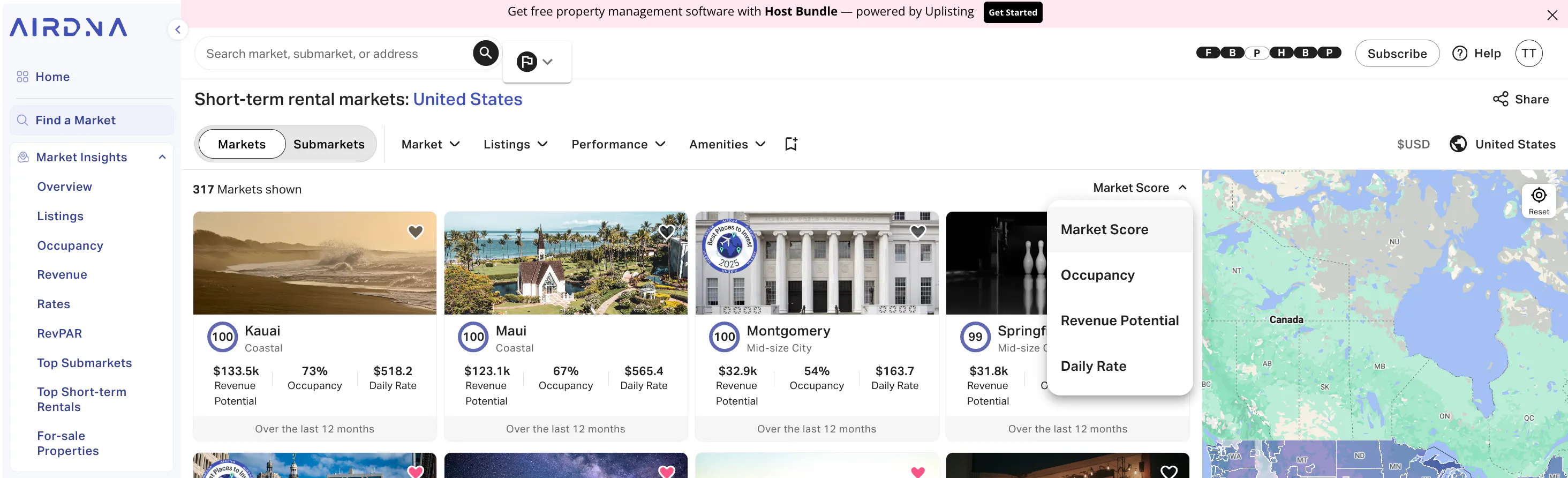
Every market and submarket in the U.S. (and abroad) is assigned a Market Score that captures its investability, rental demand, revenue growth, seasonality, and regulation in one simple 40-100 value that makes it easy to compare areas against one another. Filter markets and submarkets based on their Market Score so that the healthiest and most promising short-term rental markets appear at the top of the results, whether you’re searching nationally or within a specific area.
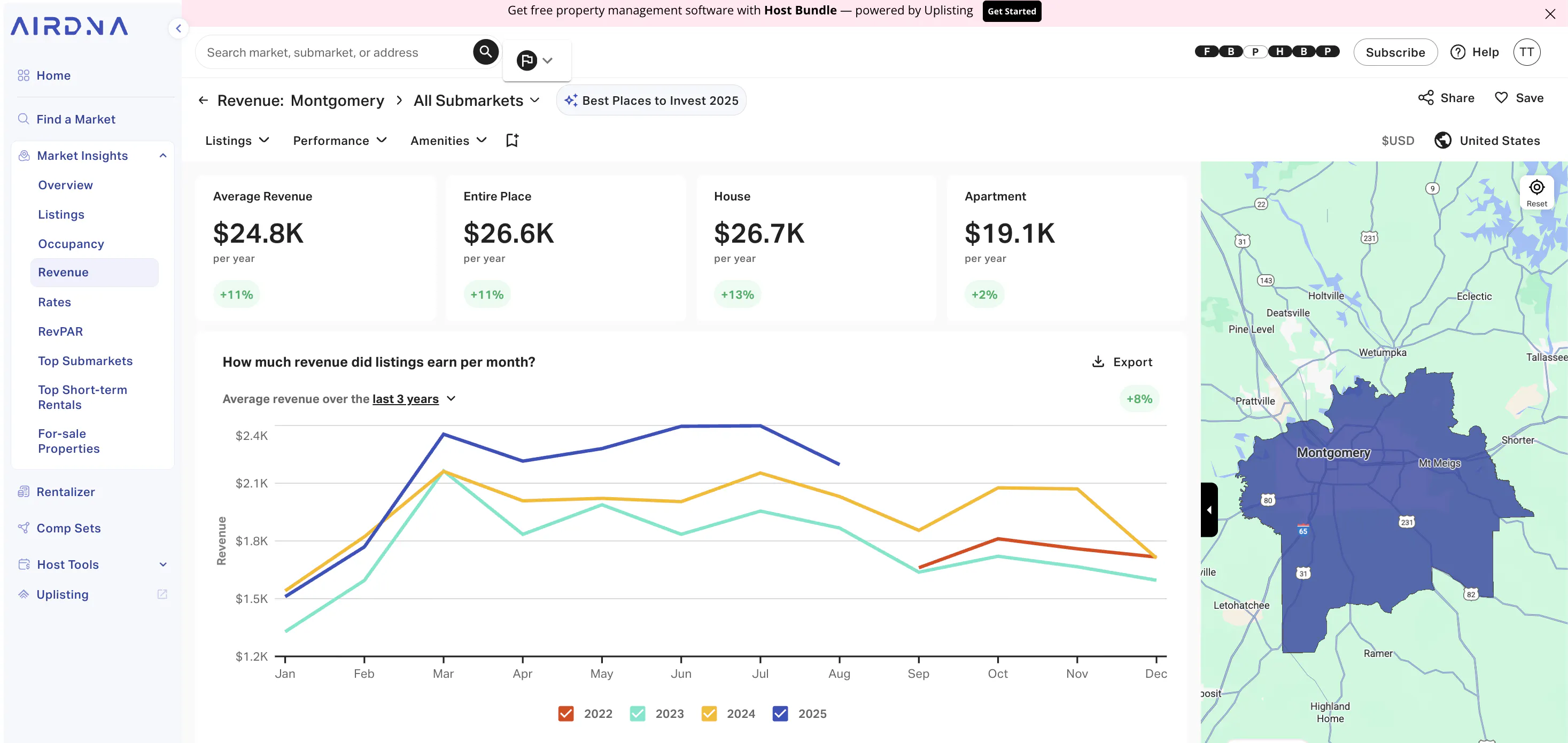
Individual market data includes occupancy, nightly rate, revenue, and available listing insights. Look at how these metrics vary over the course of the year to better understand seasonality, or track their historic performance as far back as 2018 to parse the market’s long-term trajectory.
Some markets are more STR-friendly than others, which is why you might ultimately invest in one market over another, even if all else is equal. Certain cities have friendlier STR regulations than others. Is Airbnb investing profitable? The answer often depends heavily on local regulations.
For example, the local government in Maui, Hawaii, strictly limits the number of actively listed STRs on the island. This may sound like a deterrent for investors, but it’s not that simple. Investors who can manage to secure a licensed STR in Maui find themselves in an enviable position: low supply, high demand, and limited competition.

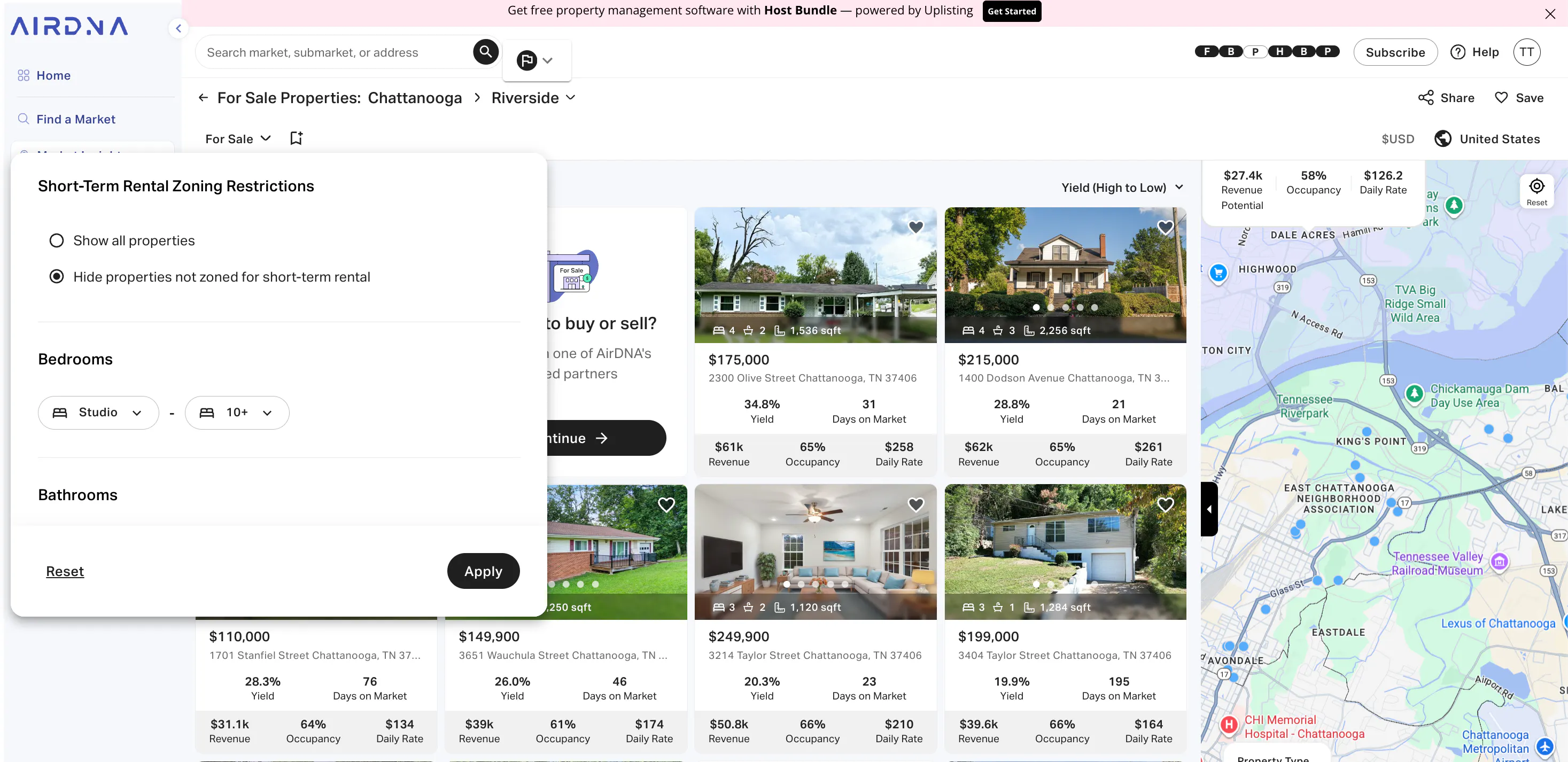
Do your research into each market to understand not only what their regulations are, but also if they have any special zoning laws, taxes, or occupancy limits that might cut into your profitability. AirDNA has a short-term rental zoning filter that you can apply to exclude for-sale listings that don’t allow Airbnbs, making it easier to weed out investment opportunities that aren’t actually viable.
Learning how to research STR markets isn’t just about laws. There are also certain metrics specific to STRs that can help you uncover whether an investment will be as profitable as you hope. Our short-term rental glossary is a great starting point for learning industry jargon and an STR-friendly real estate agent with deep knowledge and expertise in the STR market can also help inform your Airbnb investing strategy.
For a better understanding of the markets with the most growth, tap into AirDNA’s latest Best Places to Invest report. It reveals the top 25 Airbnb locations in the country, along with revenue potential for STR investments in each destination.
2. Parse the market data for Airbnb investments
Once you’ve picked a larger market, it’s time to dive deeper into its submarkets, zip codes, and adjacent markets. Even after you’ve chosen a city, it’s important to analyze the factors within that city that can make your investment soar: competition, zoning laws, ADR, and more.
Though you can find some of these figures manually, you can also use tools like the AirDNA app to quickly generate the data you need.
Understand market seasonality
Virtually all markets have high and low seasons—and that's especially true for destination markets like lakeside retreats, ski towns, and beach towns.
A key metric to watch is RevPAR (Revenue per Available Rental), which combines occupancy and daily rates into one number. RevPAR helps you see not just if your property is booked, but how profitably. For example:
- In peak season, both occupancy and average daily rates (ADR) tend to climb, driving RevPAR to its highest point.
- In shoulder or off-seasons, you may keep bookings flowing by lowering nightly rates, but that can drag RevPAR down even if occupancy remains steady.
- Year-over-year RevPAR trends show whether your market is becoming more or less lucrative over time, regardless of seasonal swings.
In the example of Hilton Head, South Carolina, RevPAR is low during the fall and summer months and the peaks during the busy summer tourist season:
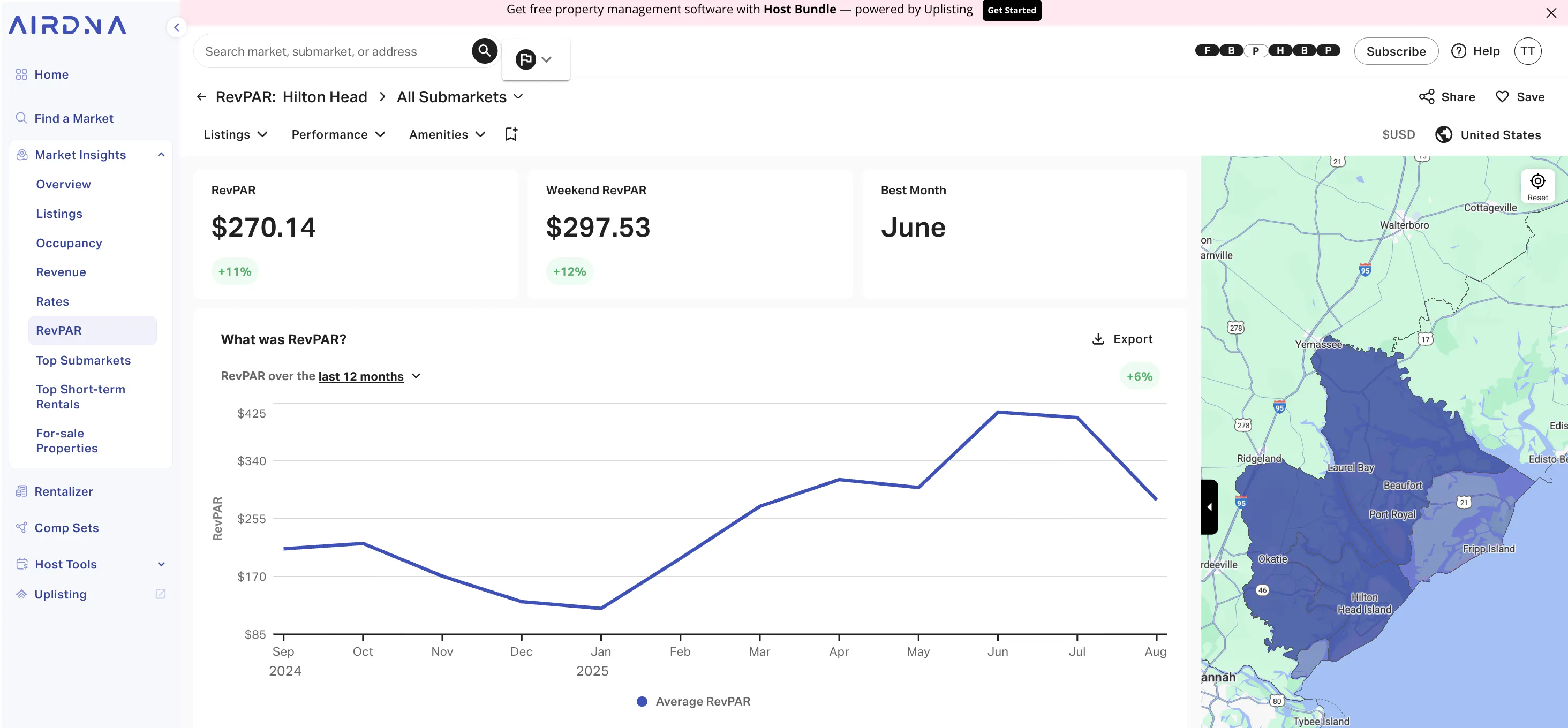
Understanding these patterns is critical for forecasting cash flow, setting smart nightly rates, and preparing reserves for slower months. Investors who anticipate seasonality and adjust their strategy—through dynamic pricing, targeted marketing, or diversifying into markets with different peak seasons—are better positioned to smooth out earnings across the year.
Evaluate supply and demand factors
Supply and demand are at the heart of STR performance. Too much supply—lots of competing listings—can drive down occupancy and nightly rates. On the other hand, strong demand with limited supply can push both higher. The challenge for investors is understanding not just today’s conditions, but how they’re likely to change in the future.
This is where data comes in. With AirDNA, you can:
- Forecast demand: See booking activity up to six months ahead to gauge whether demand is rising or cooling in your market.
- Measure supply growth: Track how many new listings have entered a market over time and compare them to historical norms. A rapid increase in supply may signal growing competition.
- Benchmark against history: Compare current and projected performance to historical averages, helping you separate seasonal shifts from structural changes in the market.
- Spot market imbalances: Layer demand forecasts with supply data to identify whether a market is undersupplied, which is an opportunity for higher ADR and occupancy, or oversaturated, which may signal increased competition and lower margins.
Understanding these dynamics helps you avoid overpaying in overheated markets and instead zero in on neighborhoods where demand outpaces supply.
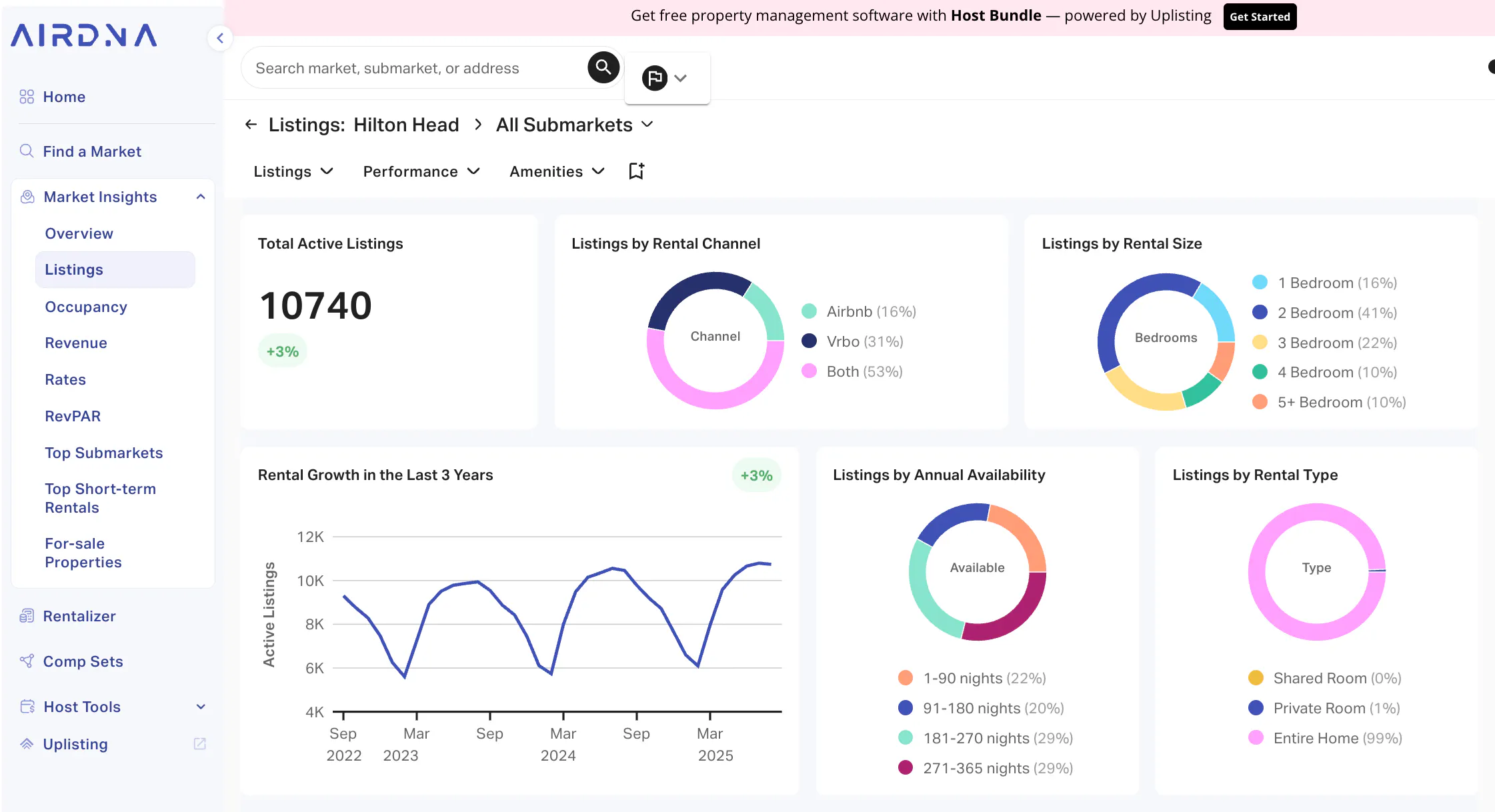
3. Compare Airbnb investing opportunities
Once you’ve identified promising markets and neighborhoods, the next step is to evaluate how a specific property might perform. This involves analyzing how performance differs by property within a market.
Use custom filters to understand performance variation based on bedroom count, real estate type, price tier, amenities, and more.
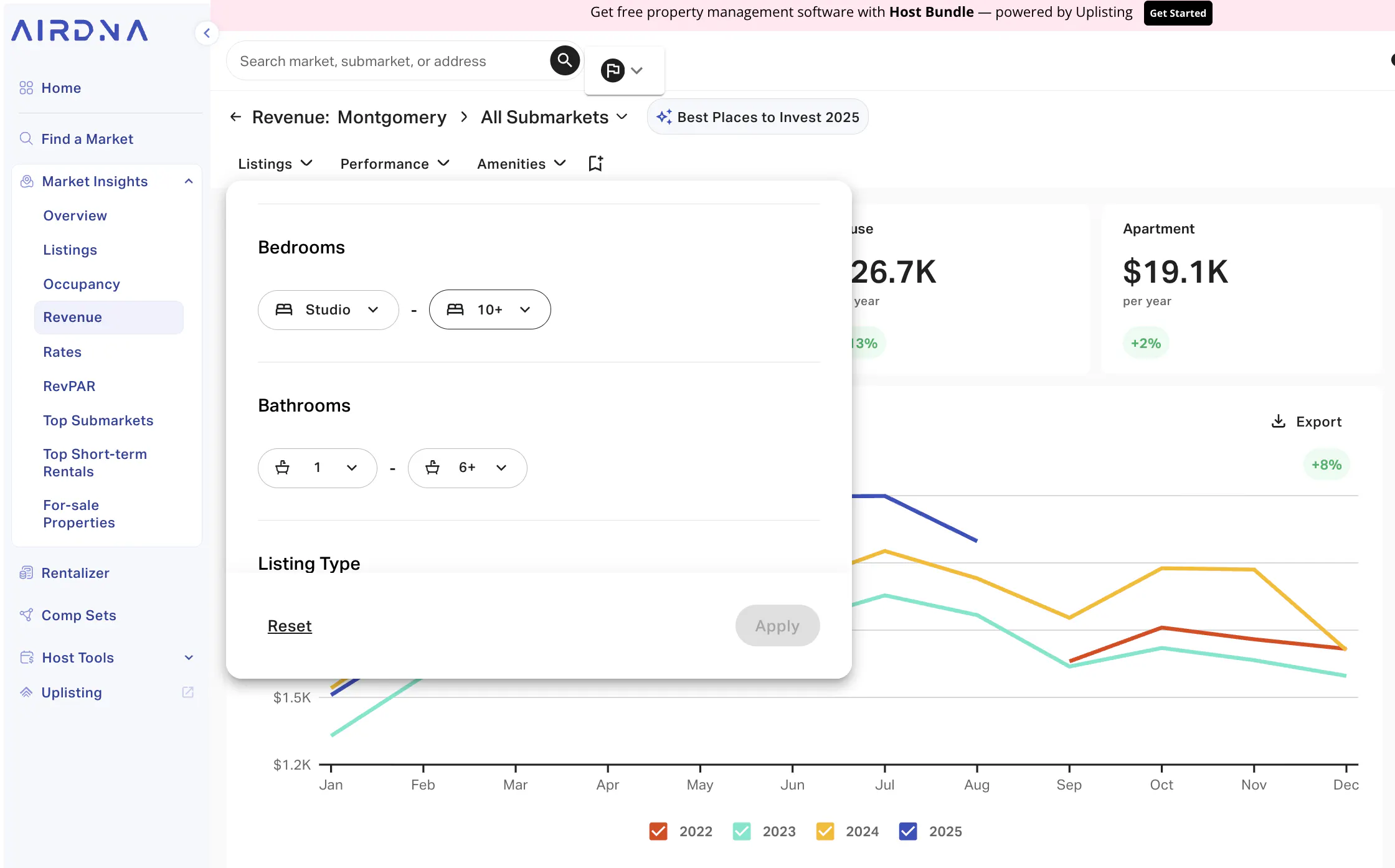
You can also accomplish this by looking at comparable short-term rentals, or “comp sets.”
A comp set is a group of existing Airbnb or Vrbo listings that share key characteristics with your potential investment, such as property size, number of bedrooms, amenities, and location. You can forecast how your property is likely to earn once it’s listed by analyzing their performance.
With AirDNA’s comp set tools, you can:
- Build custom comp sets: Hand-pick properties that mirror your investment target to see how they perform in terms of occupancy, ADR (average daily rate), and revenue.
- Spot revenue potential: Compare projected income across different property types—like one-bedroom condos vs. three-bedroom homes—to decide which aligns best with your goals.
- Evaluate market fit: Drill down to the zip code or neighborhood level to see whether your property type is over- or under-supplied.
- Fine-tune strategy: Use comp data to set realistic expectations for pricing, seasonality adjustments, and overall return on investment.
For example, let’s say you’re considering buying a two-bedroom apartment near downtown Denver. Instead of relying on citywide averages, you can build a comp set of nearby two-bedroom condos with similar amenities. Compare their aggregate occupancy, ADR, and annual revenue against the larger market to see whether your target property is in line with local demand, or if another property type in the same market might deliver stronger returns.
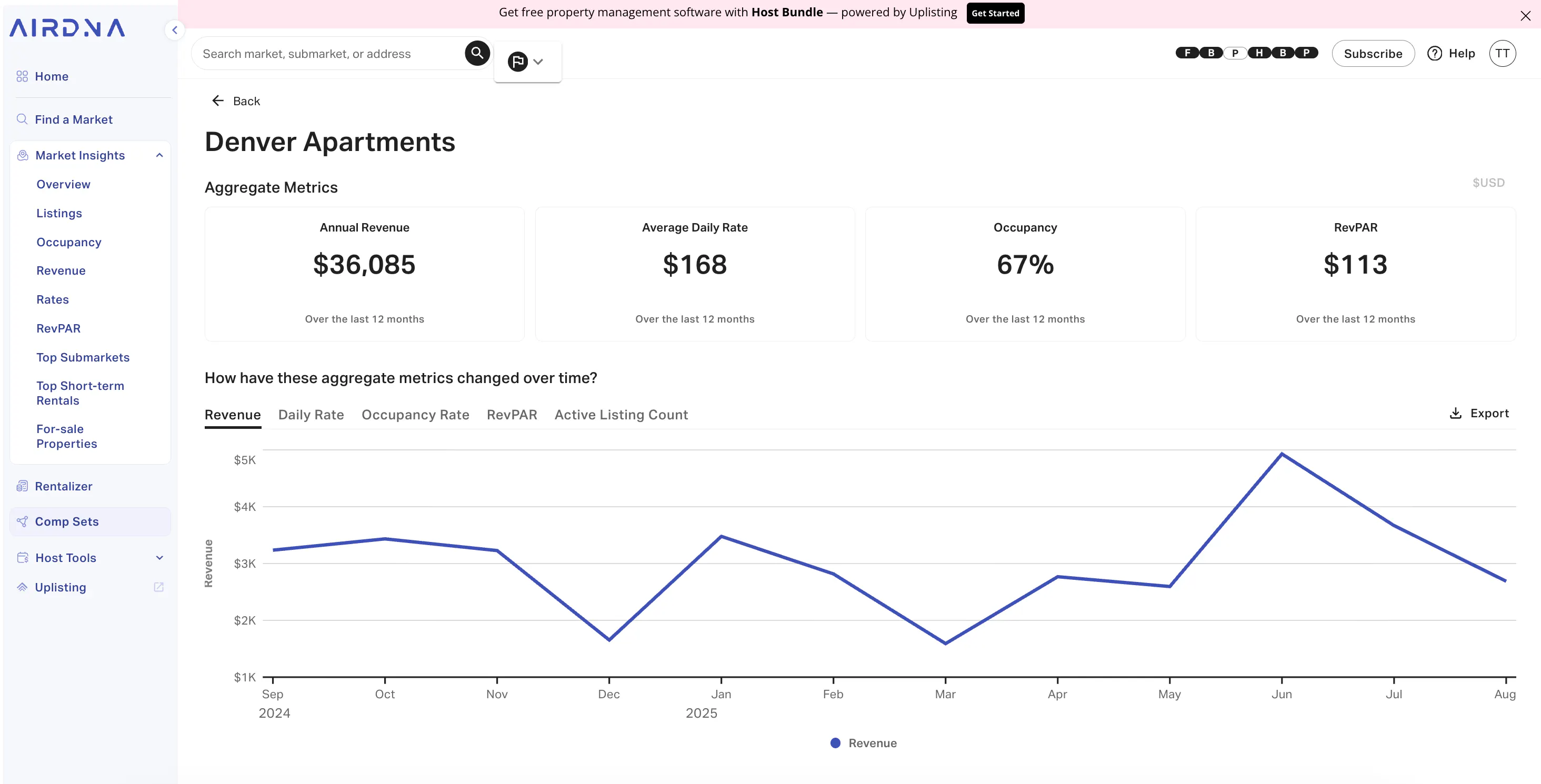
Comp sets take the guesswork out of Airbnb investing and give you confidence that your property can compete profitably by grounding your decision in real-world performance data,
4. Calculate potential Airbnb investing returns
Once you've chosen your target market and property size, you’re ready to research rentals for sale. Zillow is a great place to start looking for listings that fit your criteria. Start by browsing listings and filtering by budget and desired property attributes. Note down the addresses of interest.
AirDNA also compiles for-sale properties from sites like Zillow directly in the app and automatically generates annual revenue projections. Get individualized yield and cap rate projections for real investment opportunities.
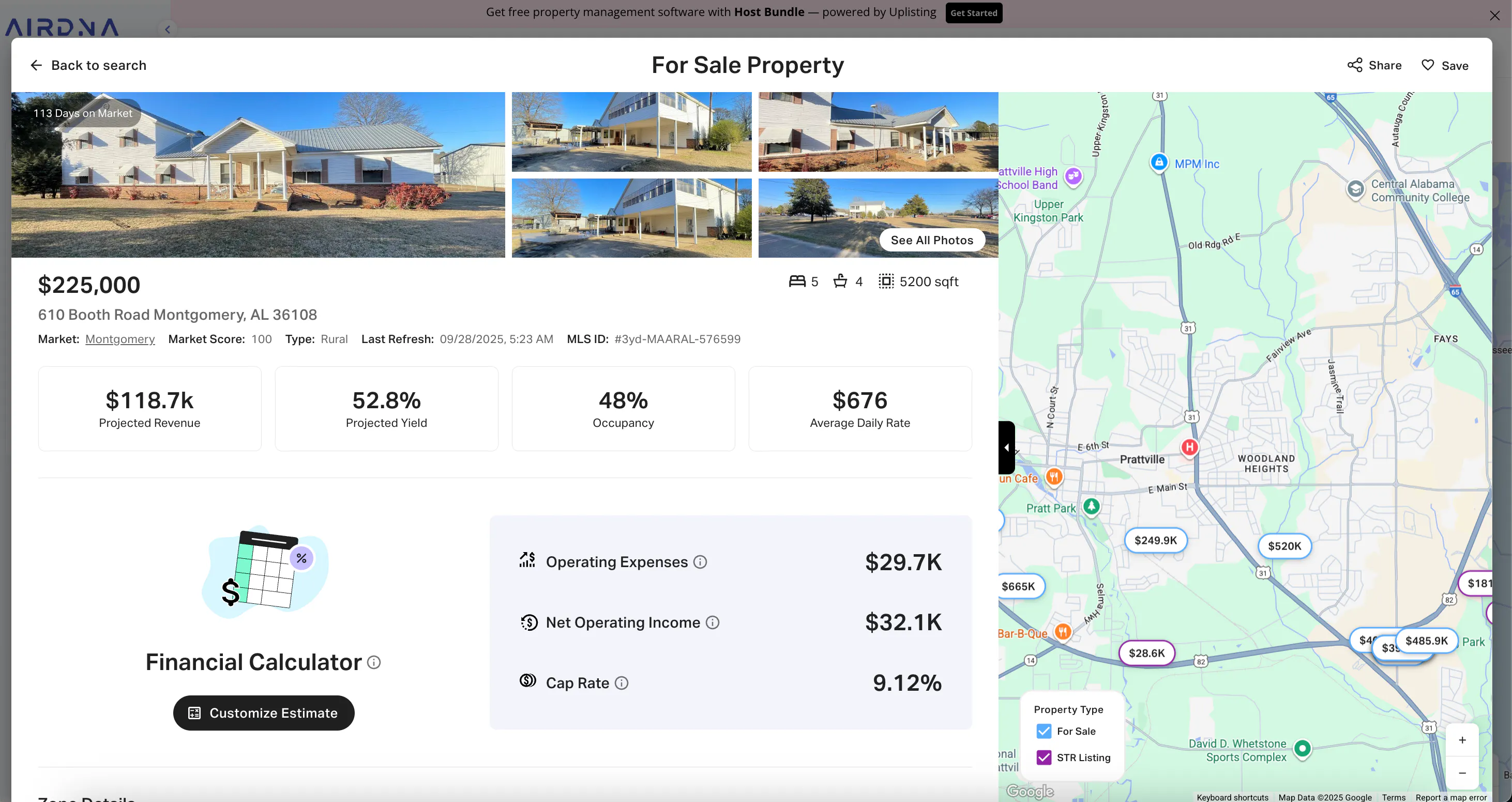
Improve the accuracy of the projection by customizing the estimate in the Financial Calculator. Here, you can add additional operating costs and market-specific tax requirements that eat into your bottom line.
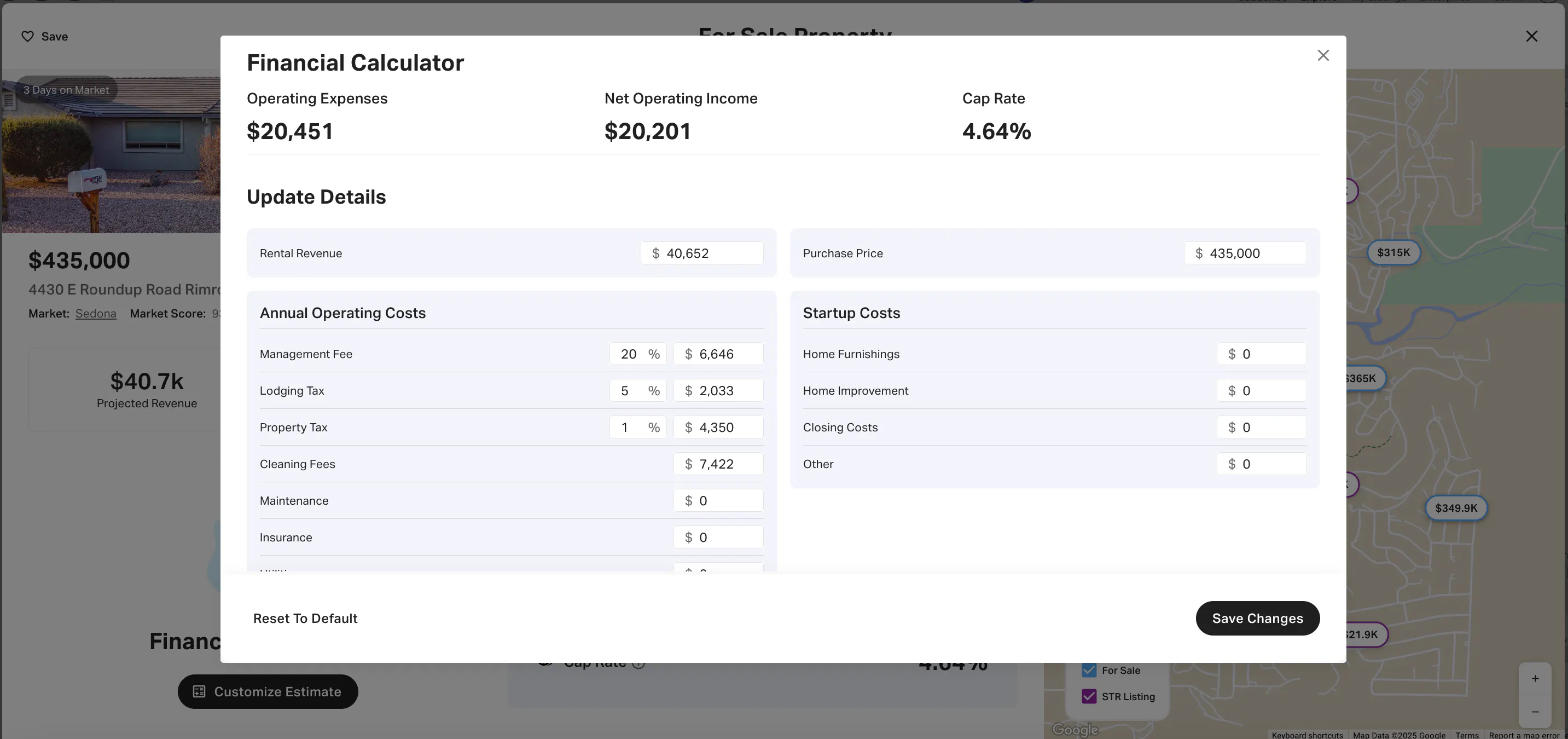
If you’re interested in turning an existing property into an Airbnb or curious how a property that isn’t currently for sale might perform, you can input the address into the Airbnb calculator and get the same performance projections that you see with for-sale properties.
5. Secure financing for your Airbnb investment
Once you’ve identified a promising property, the next step is figuring out how to pay for it. Financing an STR isn’t the same as buying a primary residence, and understanding your options is critical to closing the deal.
- Conventional investment loans: Often require higher down payments (15–25%) and stricter credit requirements than primary home loans.
- DSCR loans (Debt Service Coverage Ratio): Evaluate the property’s projected rental income rather than your personal W-2 income, making them increasingly popular among STR investors.
- Alternative strategies: Some investors start with house hacking, a HELOC, or even rental arbitrage to minimize upfront capital requirements.
For a deeper dive into loan types, risks, and strategies, read our guide to short-term rental financing and our piece on best loans for short-term rental investment properties.
6. Set strategic pricing for maximum returns
Although this step moves into the operational phase, it’s worth including here because pricing is the link between your investment projections and your actual earnings. Even the best property in the best market can underperform if it’s not priced correctly.
Smart pricing strategies ensure that your property’s performance matches—or exceeds—the revenue expectations you set during your market research. Consider the following strategies to optimize your Airbnb pricing:
- Dynamic pricing: Implement dynamic pricing strategies that automatically adjust your rates based on real-time market demand, competitor pricing, and other relevant factors. Airbnb rate recommendations are data-backed suggestions that you can apply to your listing.
- Seasonal adjustments: Tailor your pricing to reflect seasonal fluctuations in demand. During peak seasons and holidays, you can increase your rates to capitalize on higher demand. On the flip side, you can offer discounts or promotions during off-peak periods to attract guests.
- Weekday vs. weekend rates: Recognize that weekdays and weekends may attract different types of guests and have varying demand levels. Adjust your rates accordingly, with higher prices for weekends and lower rates for weekdays to encourage midweek bookings.
- Length of stay discounts: Encourage longer bookings by offering discounts for extended stays. Consider implementing tiered pricing structures where guests receive progressively higher discounts for longer durations.
- Competitive analysis: Stay informed about pricing trends in your market by conducting regular competitive analysis. Monitor the rates of similar properties in your area and adjust your prices to remain competitive while maximizing profitability.
- Value-added services: Improive the perceived value of your listing by offering additional services or amenities, such as complimentary breakfast, Wi-Fi, or parking. Adjust your pricing to reflect the added value provided to guests.
- Guest reviews and feedback: Monitor guest reviews and feedback to gauge the perceived value of your listing compared to competitors. Use this information to fine-tune your pricing strategy and address any areas for improvement.
Market-Informed Pricing Decisions
AirDNA’s vacation rental pricing tool uses data-driven recommendations to propose the best daily rates.
Maximize Airbnb Investing Success with Data
Here’s the truth: Finding the perfect property and then pricing it competitively can be challenging and tedious without the right tools. It doesn’t have to be. Whether you’re a first-time investor or simply looking to add to your portfolio, the AirDNA app makes Airbnb real estate investing easy.
With AirDNA, you’ll have the tools, data, and confidence you need to operate a successful STR business at your fingertips. Don’t just take our word for it—jump into AirDNA today and see how easy it is to hit the ground running and watch your Airbnb investment revenue grow.
Frequently Asked Questions
Is Airbnb investing a good option?
Investing in Airbnbs can be a great way to expand your income opportunities. Though there is risk involved in Airbnb real estate investments, there are also sizable returns. The best places to invest in short-term rentals deliver 10% or higher yields and revenue potential exceeding $30,000 per year. The airbnb investing process begins with thorough market research and understanding the regulatory landscape.
2. How profitable is Airbnb investing?
Whether or not your Airbnb is profitable depends on several factors. Though many investors do see a solid return on their Airbnb real estate, there is no silver bullet to making a profit as a host.
Location may be at the top of the list of all the factors that can impact your profitability Destination properties can see a greater return than those in metropolitan areas. Metropolitan areas, however, are often immune to the high and low seasons that affect destination properties. Choosing a market that can sustain your income goals is the first step in paving the way toward profitability.
3. How much do Airbnb investors make?
There is no one answer to “How profitable is owning an Airbnb?” Airbnb investors' earnings vary based on several factors, including property location, size, seasonality, and occupancy rates.
On average, Airbnb hosts can expect to earn anywhere from a few hundred to several thousand dollars per month in rental income. According to Airbnb, U.S. hosts earned an average of $14,000 in 2023. However, keep in mind that individual earnings may fluctuate significantly based on market conditions and how effectively each host prices and markets their STR. Read out article on how much you can earn on Airbnb to learn more.
4. What are the risks of Airbnb investing?
One significant risk of investing in Airbnb is regulatory uncertainty, as many cities and municipalities have imposed restrictions or outright bans on short-term rentals. Violating these regulations can result in fines, legal issues, and even the forced closure of your Airbnb property. Additionally, market saturation in popular tourist destinations can lead to increased competition and lower occupancy rates, affecting your rental income potential. Successful Airbnb investing requires staying informed about regulatory changes, having contingency plans in place, and analyzing Airbnb performance on a submarket level to identify pockets of opportunity within larger tourist destinations.
Another risk to be mindful of is the potential forproperty damage and liability issues. Hosting short-term guests increases the likelihood of accidents, damages, and disputes, which could result in costly repairs, insurance claims, and legal liabilities. Relying on Airbnb as your sole source of income can be risky, especially duringeconomic downturns or periods of low demand that cause rental income to fluctuate unpredictably.
Make smarter Airbnb investing decisions
AirDNA’s powerful yet easy-to-use tools make hosting and investing a breeze. This means having every insight you need, all in one place, always up-to-date.
5. Do I have to live close to my Airbnb investment?
No, you don’t need to live near your Airbnb investment. However, living near your Airbnb offers benefits like easier management and quicker responses to guest needs.
Being nearby allows for hands-on property oversight and quicker resolution of issues, which ultimately improves the guest experience. Of course, with professional property management services and technology, remote management is feasible. Outsourcing tasks, utilizing apps, and leveraging smart home devices like smart locks empower you to manage your property from afar. Ultimately, whether to live near your Airbnb property depends on personal preferences and resources.
6. Is Airbnb stock worth investing?
Some investors find more control and higher earning potential in directly owning and managing short-term rentals, while others prefer the liquidity of investing in Airbnb as a publicly traded company. The Airbnb stock revenue growth rate looks promising, but it also faces competition from emerging platforms in the hospitality sector. Diversification of your investment portfolio often offers stability. Always evaluate market trends and consult professionals before making a final decision.
7. What is the 80/20 rule for Airbnb?
The 80/20 rule suggests that 80% of your returns often come from the most profitable 20% of your activities. In Airbnb terms, that may mean pinpointing the most in-demand features and focusing on optimizing them, such as a private hot tub or stunning view. An elevated emphasis on these high-value aspects can boost your occupancy and nightly rate.
ARTICLE SUMMARY
Unlock the secrets to successful Airbnb investing with strategic property selection, savvy data analysis, and risk mitigation to boost your profits in the competitive short-term rental market.
Bram Gallagher
AirDNA Director of Economics and Forecasting
Bram Gallagher is an Economist at AirDNA, specializing in uncovering insights that drive smarter short-term rental decisions. He put his Ph.D. in Economics from the University of Georgia to work researching and forecasting hotel data with CBRE prior to joining AirDNA, as well as teaching economics at a number of universities. In his spare time, Bram enjoys making wooden furniture with hand tools.
