

 Calculate Revenue
 Research Markets
 Find For Sale Properties
 Compare My Listing
 STR Revenue Calculator
 Custom Comp Sets
 Submarket Insights
 Custom Search Filters
 Rate Recommendations
 Performance Benchmarking
 Competitor Comparison
 Owner Contact Details
 Property-level performance data
 Tourism Insights
 Real Estate Investment Analytics
 About Us
 Sales
Sales Support
 Press
PressEurope Ski Season 2024: How Will Your Winter Vacation Rentals Perform?
Published: January 12, 2024
Last updated: February 20, 2025

Linda Rollins
Key Takeaways
- The 2022-23 ski season in Europe saw a decrease in same-month bookings due to poor snow. Popular destinations like the Alps underperformed, but areas like Scandinavia and the Dolomites experienced booking surges.
- Forecasts for the 2023-24 winter indicate warmer-than-normal temperatures in Western and Central Europe, but colder fronts in Northern and Northeastern Europe. These variable weather patterns will affect snowfall and ski conditions.
- Top ski resorts for Airbnb bookings are seeing significant year-over-year increases. Scandinavian destinations and the Dolomites are leading in pre-booked nights, while traditional Alpine resorts show less demand.
As temperatures fall, skiers, snowboarders, and short-term rental (STR) hosts across Europe have snow on the brain. Many winter enthusiasts are chomping at the bit for more powder and better skiing conditions after an underwhelming 2022-23 season.
The good news? Temps are cold, snow is falling, and many expect that Europe is in for a wonderfully snow-filled season. That doesn’t mean the pressure is off for European STR hosts, though. Snow seems to be on the way to many resort areas, but forecasts show some parts of the continent could still be warmer than normal.
This mixed forecast has left many STR hosts understandably anxious, wondering how much snow will fall and if (and how) that will impact their properties’ performance. Here’s what hosts need to know to prepare for Europe ski season 2024, according to our vacation rental data.
Using Snowpack To Predict Ski Season Performance
In any other season, no one factor universally sways STR performance. Come ski season in Europe, though, average daily rates (ADR) and revenue rise and fall along with a single measure: snowpack.
Here at AirDNA, we analyze the impact of snowfall on STR performance using same-month bookings, which are the percentage of bookings made in the same month a guest stays. Skiers and boarders often wait until after a snowfall to book so they can hit the slopes when the powder is at its freshest.
When the snow starts to pile up, same-month bookings usually follow.
Snowfall and Same-Month Bookings in 2022-23
The 2022-23 ski season, for example, was a weak snow year for Europe. Grass peeked through the usually snow-covered slopes in destinations like the Alps, leading resorts to limit operations or even close until later in the season.
This triggered a significant slowdown in same-month bookings across 12 popular European ski areas in January and February of last year. Yet, stronger early and late-season snowfall drove up the percentage of same-month bookings for the entire season, with the same-month bookings rising 19% year-over-year (YOY) for December through April.
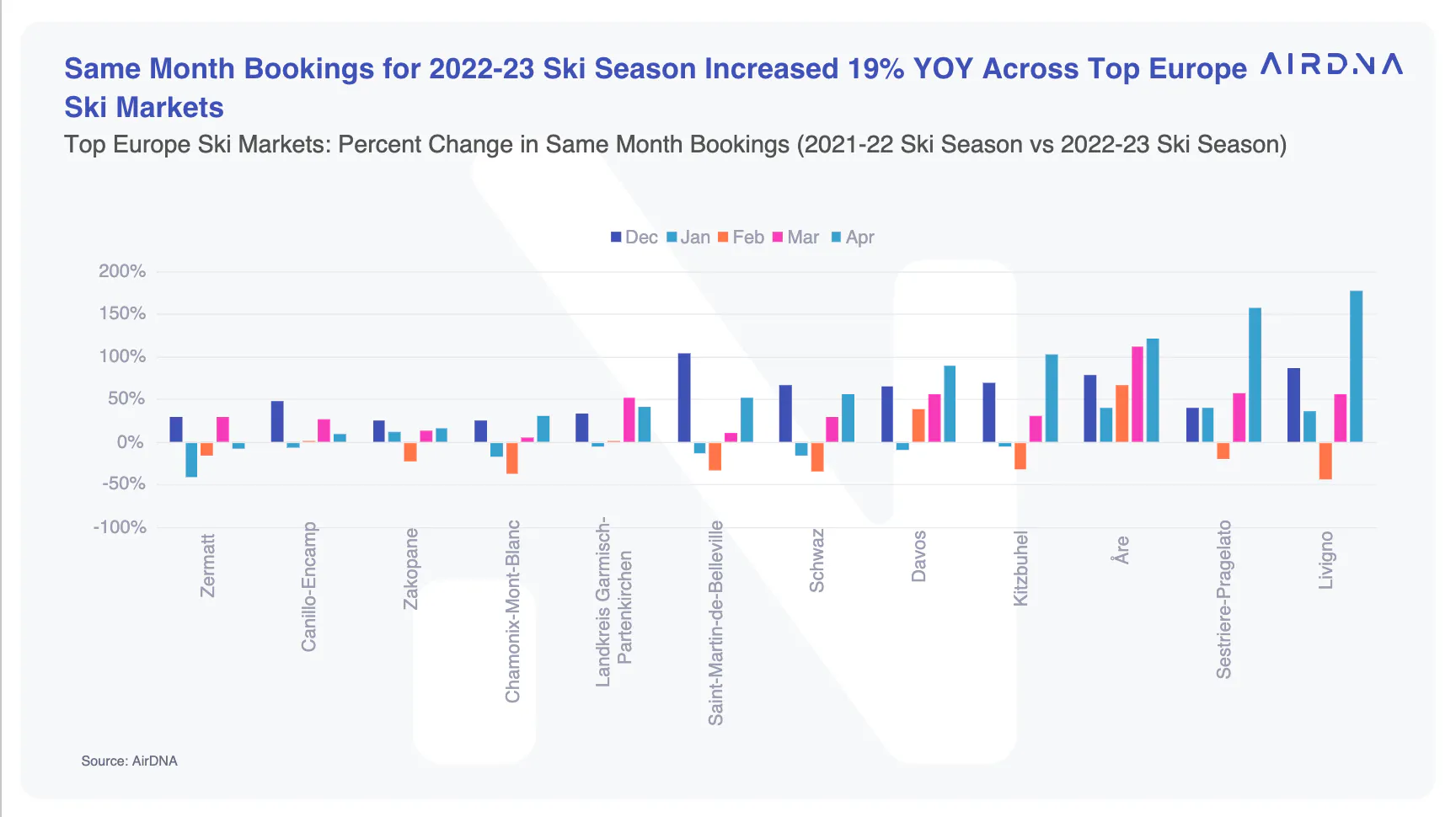
Performance by Month
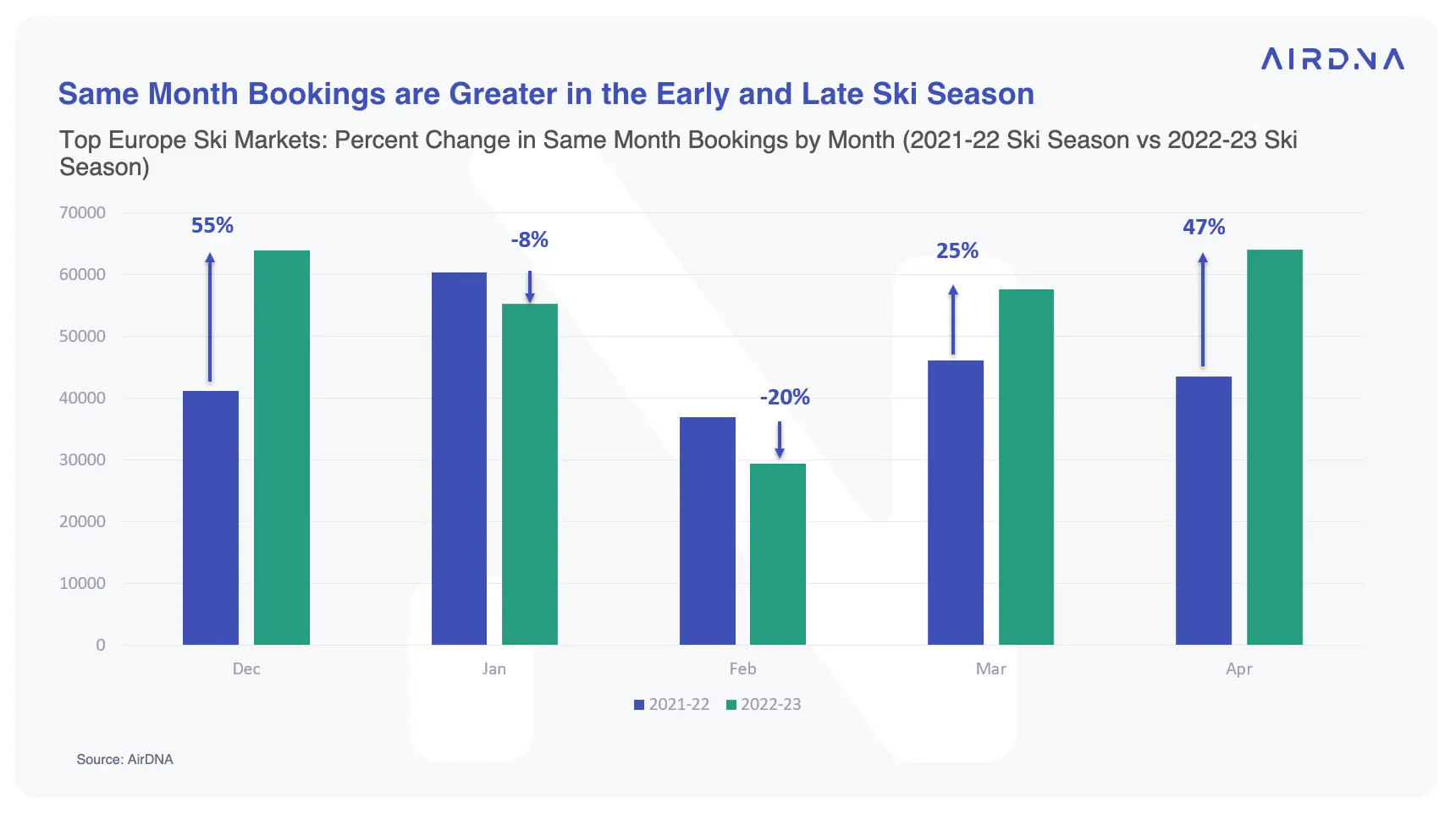
Winter sports enthusiasts who book in advance tend to plan stays for February, making the month relatively immune to the ebb and flow of same-month bookings. We expect to see fewer same-month bookings in February because so many stays are already on the books.
For every other winter month, all bets are off. Travelers book based on snowfall, so the number of same-month bookings often fluctuates. Among our top 12 European ski areas, for example, December 2022 and April 2023 racked up the biggest increases in same-month bookings, with 55% and 47% YOY increases, respectively.
Performance by Ski Area
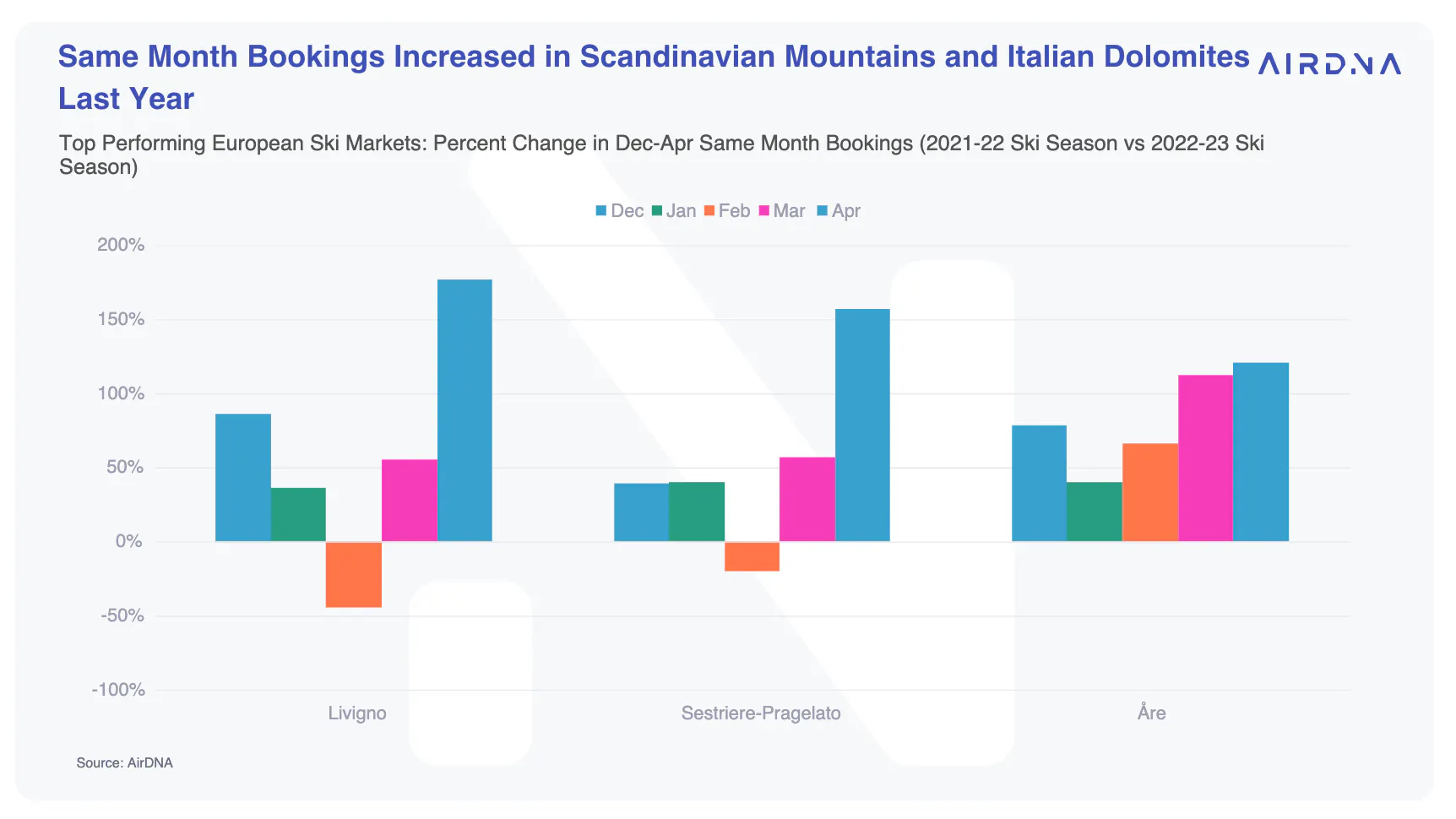
While ski resorts in the western and eastern Alps struggled last season, solid snowfall boosted same-month bookings in Scandinavia and the Dolomites, otherwise known as the Italian Alps.
The three ski areas with the biggest YOY jump in same-month bookings were:
- Livigno: Located in Italy near the Swiss border, Livigno won big after low snow in the Alps drove demand for the Dolomites. Same-month bookings increased 86% YOY in December and 36% YOY in January, before closing out the season with an astounding 176% YOY increase in same-month bookings in April.
- Sestriere-Pragelato: Located in Italy near the French border, Sestriere-Pragelato had a similar season to its Dolomites counterpart, Livigno. Same-month bookings for STRs in this area increased 39% and 40% YOY in December and January, respectively, before soaring to a 157% YOY surge in April.
- Åre: Powder chasers found the fresh powder they were missing in the Swiss Alps and the Pyrenees in this Scandinavian resort destination. Same-month bookings surged anywhere from 40% to 120% last year between December and April.
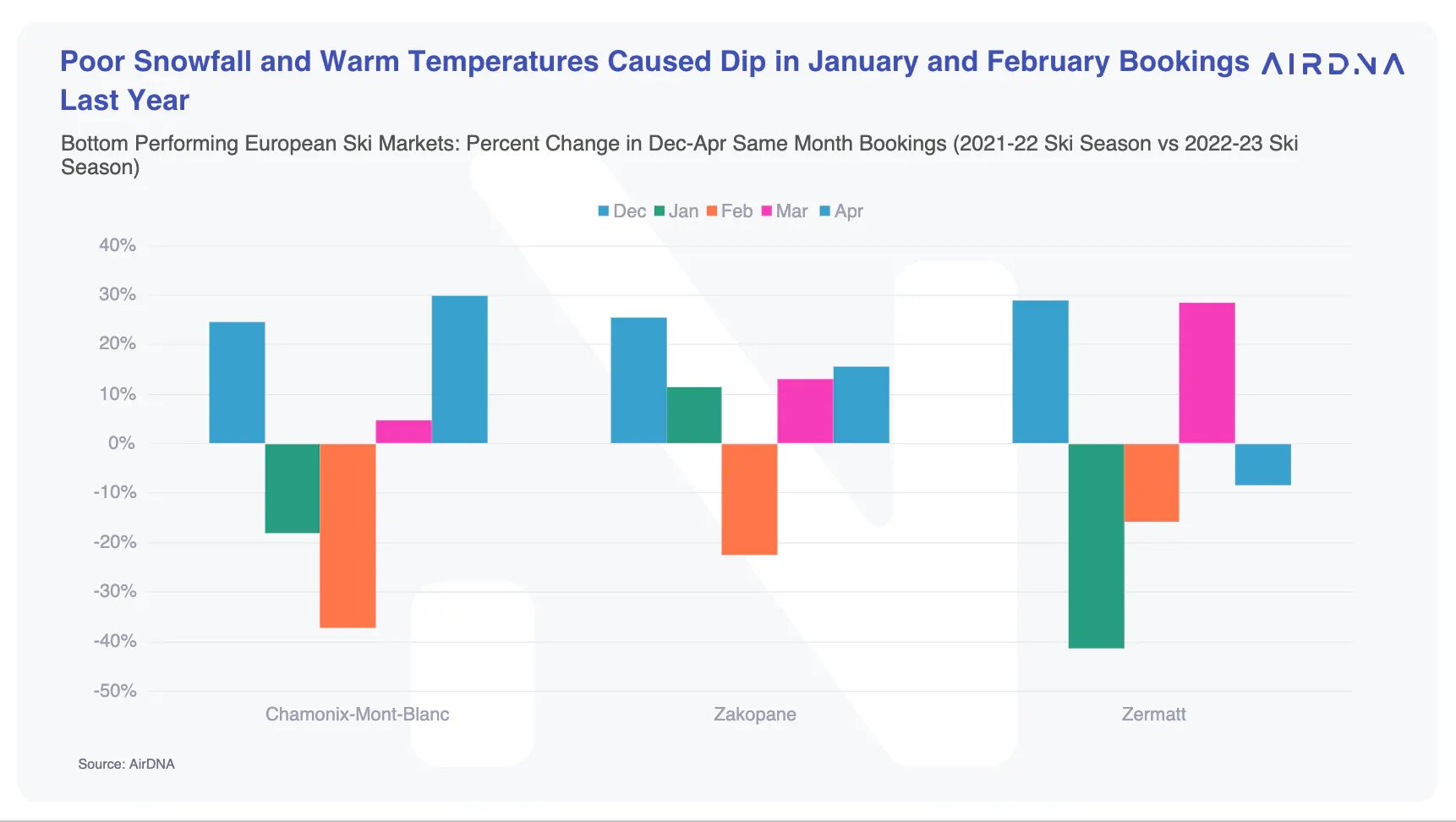
As the top three ski destinations drew unprecedented crowds, demand for other popular areas receded. Early snowfall helped boost same-month bookings in December, but the early arrival of spring-like temperatures slowed same-month bookings for January and February to a trickle.
The ski areas most impacted by the melting snowpack were:
- Zermatt: Same-month bookings for Zermatt, located in the Swiss Alps, were down 42% YOY in January and 16% in February YOY.
- Chamonix: Over in the French Alps, Chamonix saw 18% and 37% YOY decreases in same-month bookings for January and February, respectively.
- Zakopane: In Poland’s Tatras Mountains, Zakopane’s same-month bookings were up by 11% in January but down 23% in February.
In all ski areas, temperatures dropped and the snowfall resumed, triggering a welcome uptick in same-month bookings for March and April.
Winter 2023-24 Forecast
Given how impactful snow can be, STR hosts should keep the winter forecast close. According to forecasts from the Copernicus Climate Change Service, the ski season will bring warmer-than-normal temperatures, with colder fronts in the north and northeast. Like the U.S., Europe will experience an El Niño, but that pattern may peak in January before yielding more typical winter conditions.
Expected Temperatures in Ski Areas
- Northern and Northeastern Europe, including Scandinavia: Colder than normal
- Western and Central Europe: Warmer than normal
Expected Snowfall in Ski Areas
- Northern and Northeastern Europe, including Scandinavia: Average
- Western and Central Europe: Wetter than normal
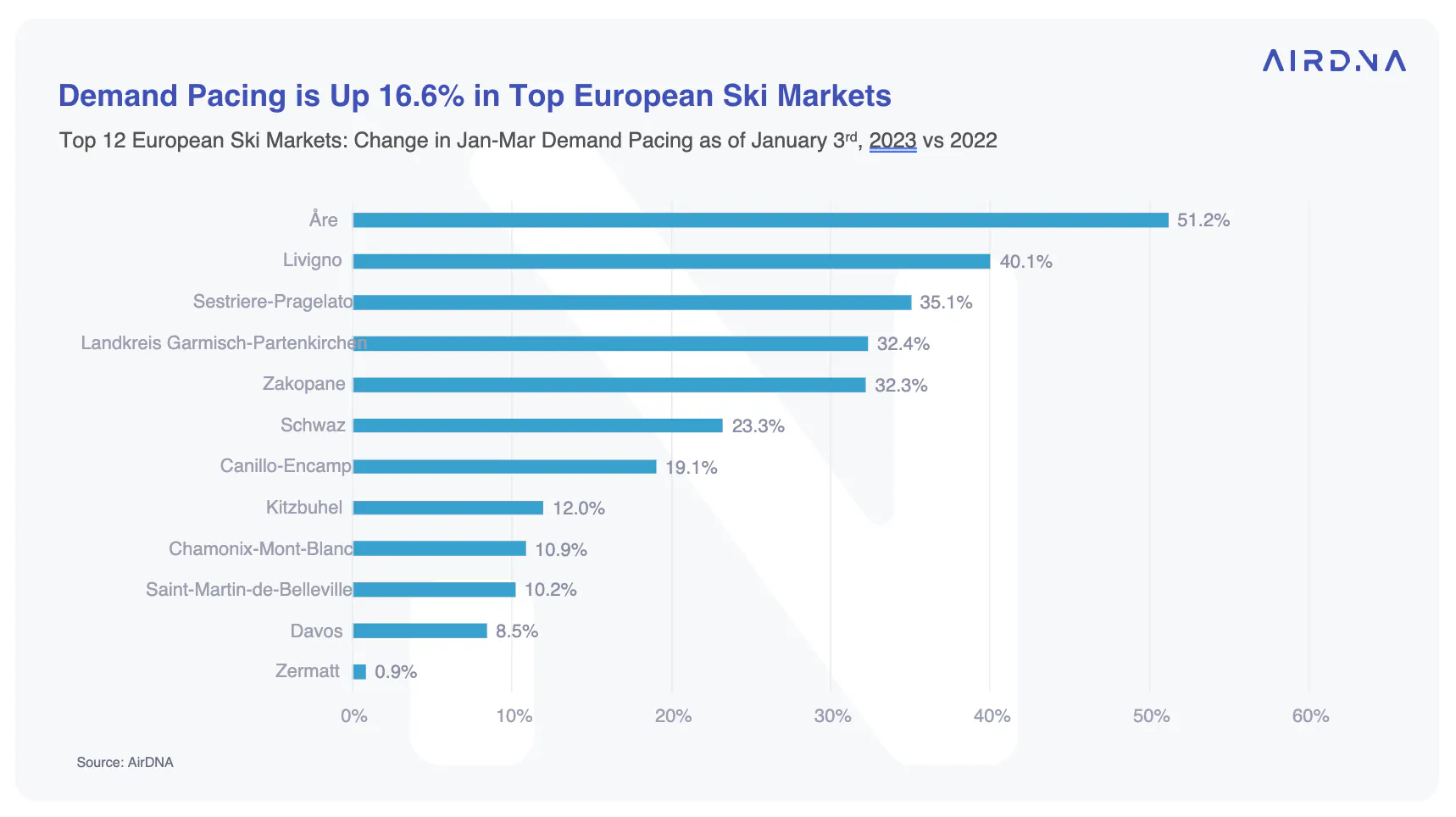
Top Ski Resorts for Airbnb This Winter
As climates across Europe grow warmer, skiers seem to once again be looking toward the Scandinavian mountains and the Dolomites.
- Åre: There are currently 51.2% more nights on the books for January through March than there were last year.
- Livigno: Ski season bookings have already increased by 40.1% YOY.
- Sestriere-Pragelato: This destination remains popular, with 35.1% more nights on the books YOY.
- Landkreis Garmisch-Partenkirchen: Travelers have booked 32.4% more trips to this Bavarian resort than this time last season.
Ski Resorts With Less Demand (So Far)
Several ski resorts are underperforming at this point in the winter, though late-season snowfall could still drive up demand.
- Davos: This area is slightly more in demand than last season, with an 8.5% increase in bookings YOY so far.
- Zermatt: Just 0.9% more stays are on the books than the same time last year.
How to Make the Most of European Ski Season
While it’s true that you can’t control the weather, there are many other factors you can control to manage your STR performance. Any number of travelers could still come to your area regardless of snowpack. As a host, the best thing you can do is use the data for your area to capture as many bookings as possible.
Consider the following:
- Using Dynamic Pricing: Snowfall can be dynamic, so your pricing should be, too. Our data shows that a dynamic pricing tool is key to striking the right balance between offering a competitive average daily rate (ADR) and hitting your earnings goals.
- Updating Amenities: Your competitors may be winning out on amenities. Check out their listings to see what they offer—and what you can reasonably add to your own property. While adding a fireplace may be out of the budget, ski season-specific amenities like boot warmers and dryers can set your property apart from the rest.
- Optimize Your Listing: Make sure your listing shines. Airbnb photography and listing descriptions specific to the ski season can help guests see how your property will bring their dream ski trip to life.
Navigate the European Ski Season With Confidence
There are many different STR factors we can accurately measure. Unfortunately, the weather isn’t one of them. Forecasts only go so far, and long-range forecasts can quickly and unexpectedly change along with the climate. It doesn’t mean European STR hosts are powerless, but it does mean they need to be prepared.
While you can’t control the weather, you can control how you manage your STR to capitalize on whatever the season brings. As the snow falls, keep tabs on vacation rental data for your market to see whether demand changes and how to adapt accordingly.
ARTICLE SUMMARY
Excitement mounts for Europe's 2024 ski season, promising better snow conditions than last year and driving high expectations among skiers, snowboarders, and short-term rental hosts. Amid mixed weather forecasts, hosts are advised to stay adaptable by leveraging dynamic pricing and optimized amenities to capitalize on the season's potential.
Linda Rollins
Senior Research Analyst
Linda Rollins is a Senior Research Analyst at AirDNA and a self-managing short-term rental host, which means she understands the market as both an analyst and an operator. She writes research and blogs for AirDNA and for Adapt, its revenue management tool, making her work a go-to resource for investors trying to find and size up the right opportunities, and for operators looking to understand changing market dynamics and find concrete ways to improve occupancy, rates, and guest experience. Her data is regularly cited in major news outlets, and she has a knack for bringing both the numbers and the story behind them. In her free time, Linda enjoys spending time with her family, traveling, and looking for good eats.
