

 Calculate Revenue
 Research Markets
 Find For Sale Properties
 Compare My Listing
 STR Revenue Calculator
 Custom Comp Sets
 Submarket Insights
 Custom Search Filters
 Rate Recommendations
 Performance Benchmarking
 Competitor Comparison
 Owner Contact Details
 Property-level performance data
 Tourism Insights
 Real Estate Investment Analytics
 About Us
 Sales
Sales Support
 Press
PressDoes Airbnb Rental Arbitrage Still Work in 2026? Your Complete Guide
Published: March 9, 2026
Last updated: September 1, 2026

Linda Rollins
Key Takeaways
- Rental arbitrage only works when short-term rental income clearly exceeds your monthly rent.
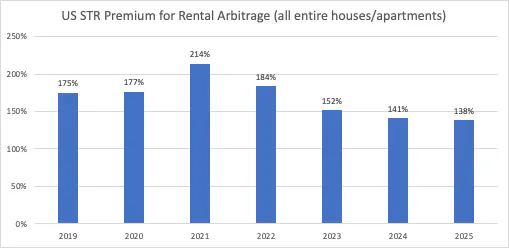
- In 2025, the national STR premium averaged 138%, meaning revenue is still higher than rent in many markets. However, the cushion isn’t as wide as it used to be.
- Rental arbitrage is a great way to break into the short-term rental industry without buying property, but it’s a risky strategy for scaling a larger real estate portfolio.
You don’t need to own real estate to earn on Airbnb, but the days of easy Airbnb rental arbitrage are largely behind us.
Rental arbitrage—leasing a property long-term and listing it for short-term stays—has helped plenty of hosts break into the short-term rental world (STR) without buying a home. In 2026, however, the explosive margins of the early days have leveled off.
STR premiums remain strong in many markets, averaging 138% nationally, but they’re gradually compressing as rent growth catches up to short-term revenue. While arbitrage isn’t off the table, it isn’t plug and play anymore.
In this guide, we’ll break down what Airbnb rental arbitrage really looks like in 2026, highlight where margins still exist (and where they’re fading), and walk through what it takes to make the numbers work today.
What Is Airbnb Rental Arbitrage?
Airbnb rental arbitrage—sometimes called “Airbnb rent to rent”—is the practice of leasing a property long-term and re-listing it as a short-term rental on sites like Airbnb or Vrbo.
It’s a way to earn short-term rental income without owning the property. You lease the unit, furnish it, list it and if the numbers work, bring in more each month than you pay in rent. You’re a middleman (or middlewoman) in the real estate game.
While it may sound one-sided, landlords can benefit too. A reliable long-term lease, consistent rent payments, and a professionally maintained property can make the arrangement appealing, especially when expectations are clearly outlined upfront.
Airbnb rental arbitrage has gained popularity in recent years, fueled by the rise of the sharing economy and the allure of passive income. It’s one of the easiest ways to get started in the short-term rental space because there’s no mortgage and no down payment. Airbnb rental arbitrage is a lower-cost path into a business with real earning potential.
That being said, it’s not a guaranteed shortcut. You’ll need a solid plan, a strong market, and a close eye on the numbers. We’ll get into all of that later on.
Airbnb Rental Arbitrage Example
Let’s say you sign a long-term lease on a house for $2,500 a month. You list that same property as a short-term rental for $200 a night. With steady bookings, you could cover your rent in under two weeks—and everything after that is profit (minus your expenses).
That’s the basic play: rent low, earn high. The bigger the gap between what you pay and what you earn, the more upside you’ve got.
Is Airbnb Rental Arbitrage Still Profitable in 2026?
At a national level, Airbnb rental arbitrage is still profitable, but the math is not as forgiving as it once was.
In 2025, the average U.S. STR premium across single- and multifamily properties was 138%, down slightly from 141% the year before. In practical terms, short-term rental revenue is still more than double long-term rent in many markets. That’s meaningful. However, compared to the 2021 peak of 214%, the margin has gone down significantly.
Why? Rent growth is starting to catch up to short-term rental revenue.
In 2025, single-family homes saw a 2.1% increase in monthly short-term rental revenue, supported by small gains in Average Daily Rates (ADR) and occupancy. Multifamily properties grew more slowly at 1.3%.
At the same time, rents moved faster, especially for single-family homes. Single-family rents rose 3.8% year over year, which outpaced STR revenue growth and pushed premiums down from 140% in 2024 to 136% in 2025.
Multifamily properties saw more moderate rent growth at 2.2%, partly due to elevated apartment vacancy rates, which reached 7.2% in late 2025: the highest level since 2017. That helped keep multifamily STR premiums slightly more stable, slipping from 143% to 141%.
So what does that mean?
Arbitrage still works in 2026. Premiums above 100% leave room to cover expenses and generate profit. However, because the cushion is thinner than it was a few years ago, you really need to have your operations and budgets down pat in order to be profitable.
Ultimately Airbnb rental arbitrage can still work, but only in the right market, with the right numbers, and a clear plan to evolve. It’s a way to get in, not a way to grow.
The Best Cities for Airbnb Arbitrage in 2026
Where does rental arbitrage still work in 2026? The table below highlights the 10 U.S. markets where the STR premium (the rent-to-revenue gap that drives arbitrage) remains the most attractive.
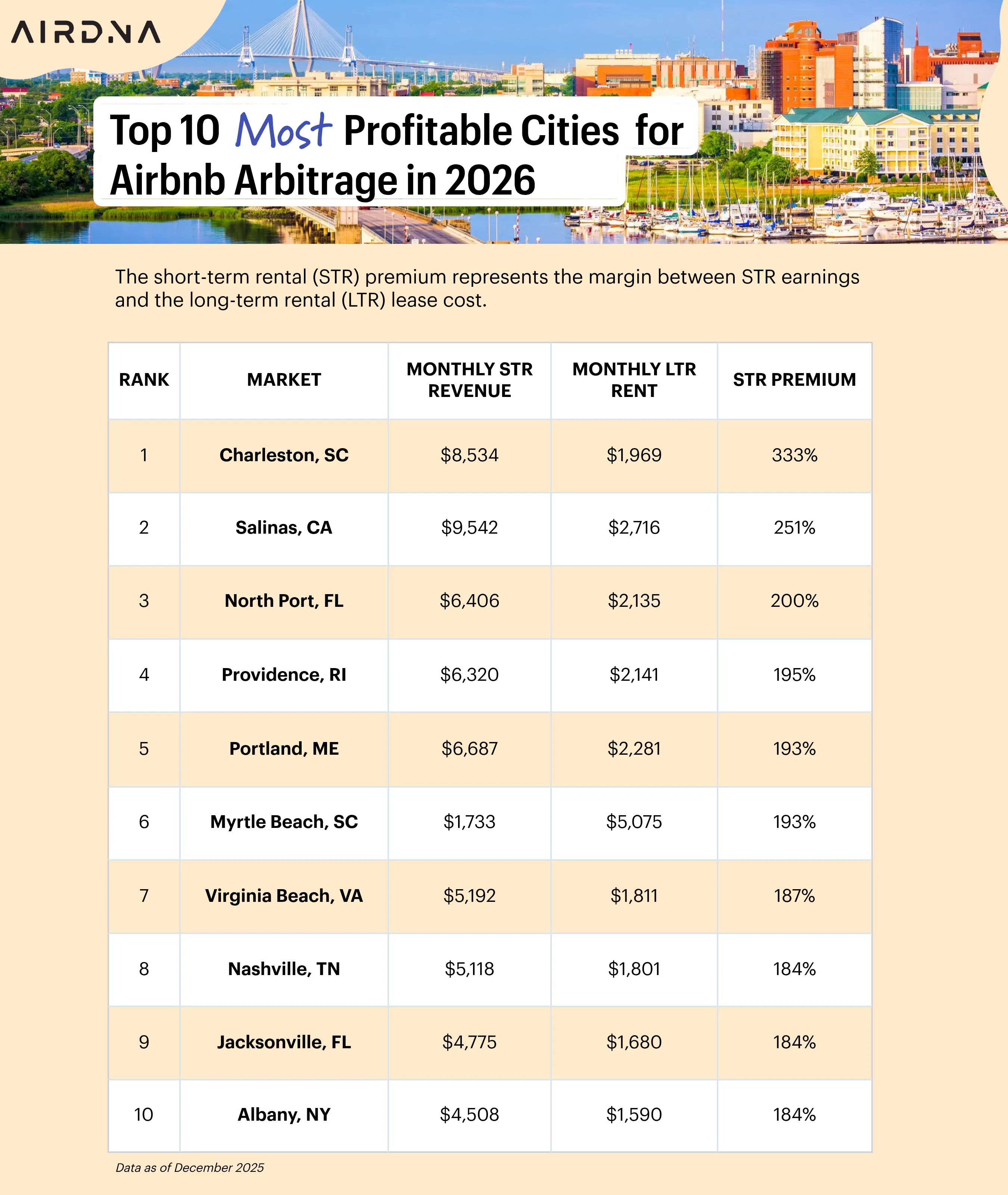
While the national STR premium averages 138%, several of these markets are pushing past 200%, with Charleston topping 300%. Even the bottom of the top 10 sits comfortably above the national average. That tells you one thing: strong arbitrage margins haven’t disappeared. They’ve just become more location-specific.
If you’re looking to dig in a little further, you can use the full dashboard to compare STR premiums, view emerging markets, and see how many listings are already active, so you can find the best fit for your next Airbnb arbitrage deal.
The Worst Cities for Airbnb Arbitrage in 2026
On the flip side, plenty of markets have slipped into low-margin territory, with STR premiums so tight that monthly short-term rental income barely beats the cost of rent, if it does at all.
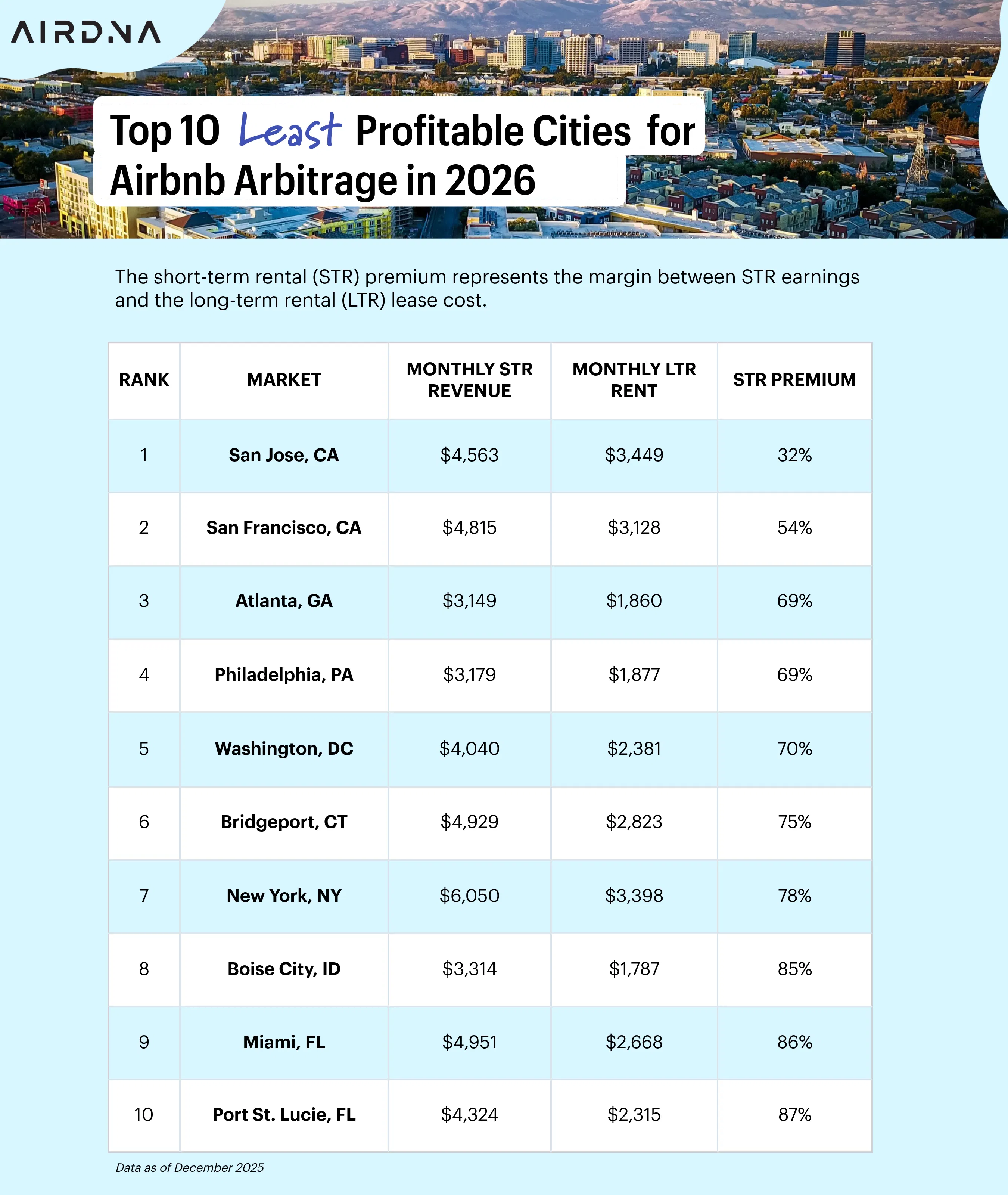
When that margin shrinks, arbitrage gets risky. Once you factor in startup costs, turnover, management, and platform fees, there’s little to no profit left on the table. These are tough places to make arbitrage work, especially for newer operators.
That doesn’t automatically rule arbitrage out. However, it does change the approach.
In lower-premium markets, operators often need a clear edge: an exceptional location, a differentiated property, strong branding, or operational efficiencies that competitors don’t have. Without that advantage, the math can feel strained from day one.
Bottom line: if you’re considering an Airbnb arbitrage strategy in these markets, tread carefully. The numbers don’t offer much cushion and even small shifts in revenue or regulation could put you in the red.
How to Spot a Good Market for Airbnb Arbitrage
Not every property is a strong candidate for Airbnb rental arbitrage. The right deal depends on timing, location, and how well rent and short-term rental income align in that specific market.
While national trends can point you in the right direction, profitability ultimately comes down to local dynamics. A property that performs well in one neighborhood may struggle just a few miles away.
If you want lease costs and short-term rental revenue to work in your favor, here’s what to look for:
- STR premiums above 100%. When short-term rental income is at least double the rent, you have room to cover expenses and still generate profit. Anything much lower leaves little cushion.
- Revenue growth that outpaces rent. It’s not just about today’s earnings. Ideally, STR income should grow faster than lease costs. In 2026, rents remain elevated in many markets, and when they rise faster than revenue, margins tighten over time.
- Room to negotiate on lease terms. Flexible landlords, competitive rental conditions, and reasonable lease rates can materially improve your margin. Even small differences in monthly rent add up quickly.
To evaluate opportunities more closely, explore our 2026 dashboard covering 72 of the largest U.S. markets and their submarkets. Filter by location and property type to see where rent and revenue are most likely to align.
How to Get Started With Airbnb Rental Arbitrage
In 2026, Airbnb rental arbitrage is a launch strategy. Like any smart launch, it only works if you go in with a plan. Here’s how to do it right from the beginning.
Do your research
With Airbnb rental Arbitrage, you’re committing to a fixed monthly rent, whether the property books or not. If you guess wrong on what you’re going to make on Airbnb, you’ll be locked into a deal that drains cash fast.
That’s why it’s critical you do your research first.
Start with a quick and dirty check: plug the address of a property you’re eyeing up into AirDNA’s Airbnb Calculator. In seconds, you’ll see an estimate of what that specific home could earn on Airbnb based on comparable listings nearby. If the projected revenue doesn’t clearly outpace the rent and expenses, that’s a signal to pause before going any further.
If the numbers look good, it’s worth looking under the hood and trying some short-term rental analysis (not to worry, AirDNA makes it easy).
If you’re new to AirDNA, start with the Market Score. It’s a simple 1–100 rating that gives you a quick snapshot of how strong the short-term rental market is in a specific area. Think of it as a quick health check. Higher scores generally mean stronger demand and revenue potential.
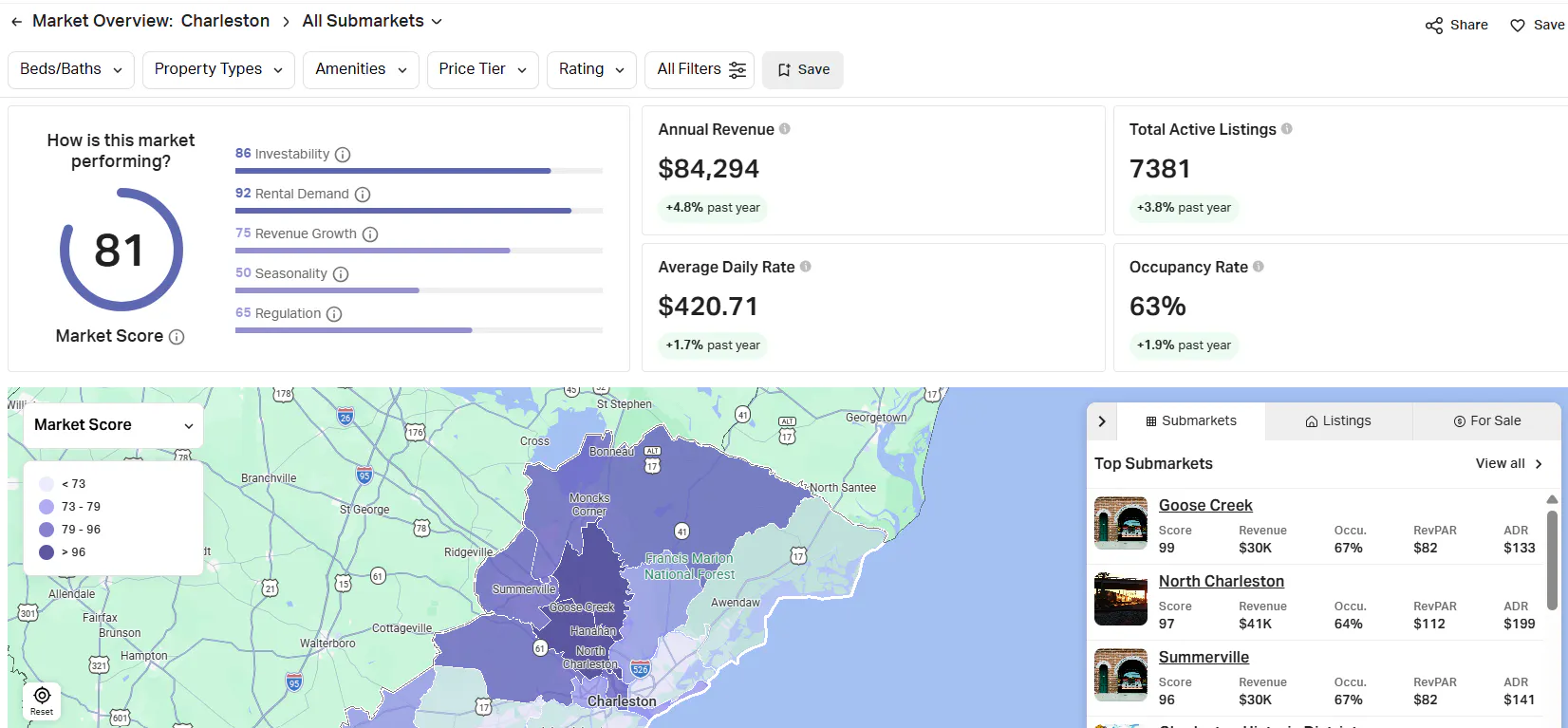
Next, look at a few core performance metrics like occupancy rate, Average Daily Rate (ADR), and Revenue Per Available Rental (RevPAR). Together, these show you whether properties like the one you’re considering are consistently booked, earning competitive nightly rates, and generating reliable monthly revenue. You’re looking for enough earning power to comfortably cover rent. Otherwise, you’ll be dead in the water with Airbnb rental arbitrage.
Run the numbers before you sign a lease
Once you’ve found a promising property, take a hard look at the financials. You'll need more than just the first and last month’s rent—furnishings, kitchen basics, Wi-Fi, utilities, maybe even a fresh coat of paint. Getting a place STR-ready takes real investment. Map out your startup costs and ongoing expenses so you know what it’ll take to break even and what kind of margin you’re really working with. Arbitrage only works when the numbers hold up from day one.
Get the green light in writing
Before you list anything, make sure you’re allowed. Have an honest conversation with the landlord, explain your plans, and get their full permission to operate as a short-term rental. Put it all in writing because vague nods won’t protect you later. Don’t forget to check local short-term rental regulations because every city’s different, and ignoring regulations can shut you down fast. Better to know the limits up front than deal with surprises down the line.
Make the space guest-ready
With rental arbitrage, you’re usually starting with an empty unit. Turning that blank space into something people want to book on Airbnb is part of the up-front investment.
You don’t necessarily need fancy furniture or designer decor. You just need a space that’s clean, comfortable, and can hold up to frequent guests. Think durable beds, blackout curtains, fast Wi-Fi, and the basics people expect. The goal is to make your space Airbnb-ready—practical and appealing in photos, with strong attention to detail.
Write a great Airbnb listing
Your listing does the heavy lifting online. Take the time to showcase yourself in the host description. Use clear, high-quality photos and a catchy title that highlights what makes your space appealing, whether that’s location, layout, or amenities. Clearly state your minimum stays and house rules in the listing, so there are no surprises for either party.
Set up operational systems
Managing a short-term rental requires more than handing over the keys. You’ll need a system for cleanings, guest communication, maintenance, and reviews. Whether you handle it yourself or use a property management software like Uplisting, consistency is key.
Set the right rates and protect your margins
You don’t need to set nightly rates in the dark. Use recommended rates and local market data to set a nightly price that’s competitive with similar listings in your area. Revisit your pricing regularly, especially around peak seasons or local events. The right rate can make or break your margins.
How to Find the Best Airbnb Arbitrage Properties
If you’re new to rental arbitrage, finding a property isn’t about chasing the perfect deal. It's about filtering quickly and narrowing in on units where the numbers clearly make sense. In this model, discipline matters more than excitement. The goal is to eliminate risky options early and focus on properties where rent, demand, and projected revenue line up.
Here’s a simple way to approach the search:
Search traditional long-term rental listings.
Many arbitrage opportunities begin with standard rental listings on sites like Zillow or Apartments.com. You’re not limited to properties labeled “Airbnb-friendly.” Reach out directly and ask. Individual owners, smaller landlords, or units that have been sitting vacant may be open to a structured short-term rental arrangement, especially if you present yourself professionally.
Look at properties listed for sale.
This is a less obvious strategy, but it can work. If a home has been sitting on the market, the seller may be open to leasing instead of continuing to wait for a buyer, especially in slower sales environments.
AirDNA makes this easier by showing properties for sale alongside their projected short-term rental revenue. That means you can quickly spot homes with strong earning potential before ever reaching out. If the projected revenue looks compelling, you can contact the listing agent and explore whether the owner would consider a long-term lease with short-term rental permission.
It won’t work in every case, but when a motivated seller meets strong projected STR income, it can open doors most operators never knock on.
Look for units similar to ones already performing well.
Focus on properties that match high-performing listings nearby—same bedroom count, similar layout, comparable location. If those are consistently booked at solid nightly rates, that’s a strong signal.
Choose simple, guest-friendly properties.
Standard layouts, good lighting, parking access, and convenient locations make furnishing and turnover easier. The more complicated the setup, the harder it is to protect your margin.
Do your due diligence on regulations
Before moving forward with a property, confirm STRs are legal in the city and permitted in the building or neighborhood. City rules, HOA policies, and lease terms all matter. If short-term rentals aren’t clearly allowed, move on. Here are some tips on how to research short-term rental regulations in your area.
Run the numbers with an Airbnb Calculator
Once a property looks promising, plug the address into AirDNA’s Airbnb Calculator. Compare projected revenue to rent and expenses. Arbitrage works when the spread clearly supports the lease, when you’re hoping for best-case bookings.
Calculate potential earnings
Understand the Airbnb arbitrage potential of any address in the world.
Learn More About AirDNA’s Methodology
Our Airbnb rental arbitrage opportunity analysis includes data on 72 of the largest U.S. markets and their submarkets. Long-term rental data was obtained from Zillow research, while short-term rental performance data came from AirDNA. Market data for both datasets was collected by Metropolitan Statistical Area (MSA) as defined by the U.S. Office of Management and Budget (OMB).
To be included in the analysis, a market needed to have more than 50 total active STR listings in the last year, and submarkets had to have at least 20 active STR listings. Short-term rental revenue numbers are the sum of the nightly rate and the cleaning fee. They exclude service fees and taxes, with the assumption that any additional costs would be added to the rental rate to cover those expenses.
It's important to note that if you’re interested in STR arbitrage, you must account for start-up costs (appliances, furniture, decor, and licensing and legal fees) and ongoing costs like utilities, maintenance, toiletries, and insurance. Given the variable nature of these expenses, they were not included in our analysis.
Frequently Asked Questions About Airbnb Rental Arbitrage
How risky is Airbnb rental arbitrage?
Airbnb rental arbitrage can be risky because your biggest expense (rent) is fixed. You owe that payment every month, even if bookings slow down. If you overestimate revenue or choose the wrong market, profits can disappear quickly.
That said, the upside can still be meaningful. Nationally, the average STR premium is around 138%, and in some top markets it climbs above 300%. In those areas, short-term rental income can be several times higher than monthly rent. When the gap is that strong and demand is steady, the potential rewards can outweigh the risk. The key is choosing the right market and property carefully and making sure the margin is there before you sign a lease.
Is Airbnb rental arbitrage legal?
Yes, rental arbitrage can be legal, but only if it’s allowed both by local short-term rental regulations and by your lease. Laws vary widely by city, and even if STRs are permitted at the city level, individual buildings or HOAs may have their own restrictions. Most importantly, your landlord must explicitly approve short-term rental use in writing. Running an arbitrage property without clear permission can put your lease at risk.
The safest approach is simple: confirm the rules, get everything in writing, and make sure the agreement clearly outlines what’s allowed before you ever list the property.
Is rental arbitrage worth it?
Rental arbitrage can still be worth it in 2026, but it all comes down to the gap between what you earn and what you pay.
Nationally, the average STR premium is around 138%, which means short-term rental income is still higher than long-term rent in many markets. In simple terms, there’s still a cushion in plenty of places. But that cushion isn’t as wide everywhere, and it doesn’t guarantee a profit on every property.
What matters is this: after you pay rent, utilities, furnishings, and other expenses, is there still enough left over to make the effort worthwhile? When that gap is clear and consistent, arbitrage can be a smart way to get started in short-term rentals without buying property. When the numbers feel tight from the beginning, they usually get tighter over time.
Is rental arbitrage passive income?
No, Airbnb rental arbitrage isn’t passive income. Even though you don’t own the property, you’re still running a short-term rental business. That means managing guest communication, coordinating cleanings, handling turnovers, restocking supplies, and staying on top of maintenance. Some of this can be automated or outsourced over time, but it’s rarely hands-off. especially in the beginning.
It can become more streamlined as you build systems and gain experience. However, at its core, arbitrage requires active management.
How do I convince my landlord to arbitrage Airbnb?
Start by explaining to your landlord how short-term rental arbitrage works and highlight the benefits: consistent rent, a well-maintained property, and less wear and tear. Offer a formal agreement and insurance coverage to make it feel like a professional setup. not a risk. You can go as far as to offer a share in the profits or references from other landlords who have benefitted from similar arrangements.
How much does it cost to start a rental arbitrage?
Starting Airbnb rental arbitrage typically costs between $3,000 and $10,000, depending on the market and property. You'll typically need to cover a security deposit, first month’s rent, and upfront costs to furnish and set up the unit as a short-term rental. Think beds, kitchen essentials, Wi-Fi, and cleaning supplies. The more guest-ready the space, the faster you can start booking and earning.
Can you make a living off of arbitrage?
You can make money with rental arbitrage, but making a full-time living is tough to sustain. Building a portfolio of leased units comes with risks. .especially when rent is high or rules change. Arbitrage works best as a stepping stone toward more stable strategies where more control is in your hands.
How do I find rental arbitrage properties?
Start by looking in three places: traditional long-term rental listings, Airbnb-friendly apartment buildings, and even properties listed for sale where the owner may be open to leasing instead. Most arbitrage deals don’t come labeled as “STR-ready.” Tthey come from standard rentals where the landlord is willing to have a conversation.
Once you’ve identified a potential property, confirm short-term rentals are allowed in that city and building. Then use AirDNA to compare similar listings nearby and estimate what that specific address could realistically earn. The goal is straightforward: find a unit where projected short-term income clearly exceeds the monthly rent before you sign the lease.
Discover hidden gems for your next investment
Get granular insights into which neighborhoods are hottest for vacation rentals.
ARTICLE SUMMARY
Airbnb rental arbitrage has changed. With margins tightening and rent catching up to short-term rental revenue, finding the right opportunity takes more effort than it used to. In this guide, we break down what the 2026 data shows, where arbitrage still makes sense, and how to evaluate a deal before signing a lease
Linda Rollins
Senior Research Analyst
Linda Rollins is a Senior Research Analyst at AirDNA and a self-managing short-term rental host, which means she understands the market as both an analyst and an operator. She writes research and blogs for AirDNA and for Adapt, its revenue management tool, making her work a go-to resource for investors trying to find and size up the right opportunities, and for operators looking to understand changing market dynamics and find concrete ways to improve occupancy, rates, and guest experience. Her data is regularly cited in major news outlets, and she has a knack for bringing both the numbers and the story behind them. In her free time, Linda enjoys spending time with her family, traveling, and looking for good eats.
