


Airbnb vs Renting: Which Is More Profitable?
Published: March 9, 2026
Last updated: September 1, 2026

Linda Rollins
Key Takeaways:
- Short-term rentals like Airbnb have historically generated higher returns. Over the past seven years, average net ROI for short-term rentals has stayed above ~8%, compared with just under ~4% for long-term rentals, even after accounting for higher operating costs.
- Airbnb income can be higher but more variable. Hosts can adjust nightly rates based on travel demand, events, and seasonality, while long-term rentals typically provide stable monthly income through fixed leases.
- Market conditions play a major role. Tourism demand, local regulations, and home prices can all influence whether Airbnb or renting long-term performs better in a specific market.
Venture into property investment and sooner or later you’ll face this question: Should I Airbnb my property or rent it out the old-fashioned way?
On one hand, short-term rentals promise higher nightly rates and the potential to earn more during busy travel seasons. On the other, traditional rentals offer stable monthly income and far less day-to-day management.
So which strategy actually makes more money?
The answer isn’t always obvious. Returns can vary widely depending on your market, property type, local regulations, and demand.
In this guide, we’ll break down the Airbnb vs renting decision using real market data. You’ll see how the two strategies compare on return on investment (ROI), why short-term rentals often generate higher returns, and how to evaluate which option makes the most sense for your specific property.
Airbnb vs Renting Income: Which Has the Highest ROI?
Historically, short-term rentals like Airbnb have generated higher returns than traditional long-term rentals, even though they typically come with higher operating costs.
To compare the two strategies fairly, we looked at net return on investment (net ROI), which measures how profitable a property is after expenses are taken into account. That’s important because Airbnb and long-term rentals have very different cost structures, so looking at revenue alone doesn’t tell the full story.
To estimate net ROI, we compared typical rental income with common operating costs for each strategy. For long-term rentals, we assume operating expenses equal about 35% of revenue, along with roughly 5% vacancy throughout the year. Short-term rentals tend to have higher costs, about 50% of revenue, to account for things like furnishing the property, cleaning between guests, and guest turnover.
Even after accounting for those higher costs, short-term rentals have historically averaged net ROI above 8%, while long-term rentals have typically stayed just below 4%.
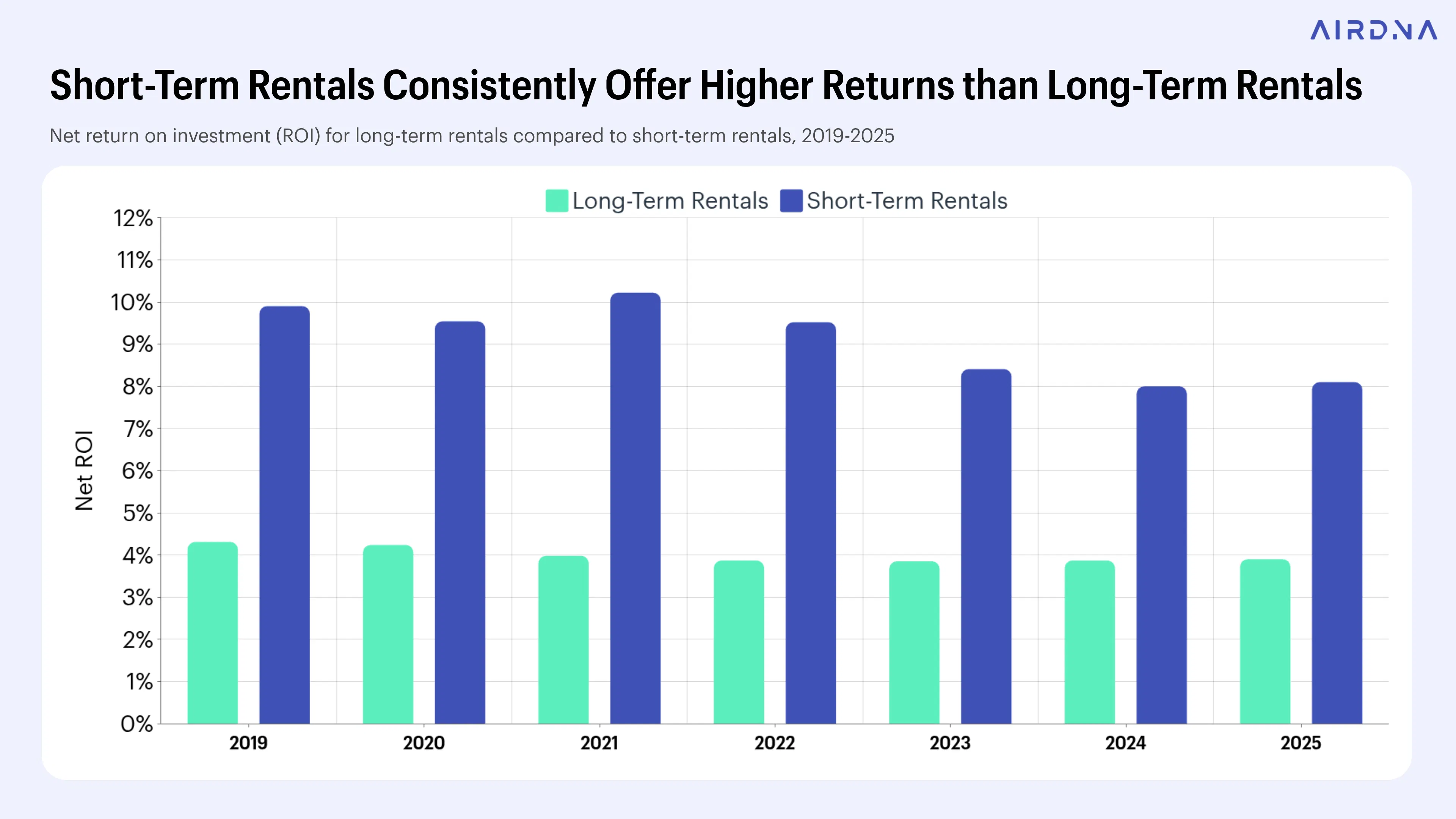
Put simply, even after accounting for high operating costs, short-term rentals still tend to generate twice the return of traditional long-term rentals.
One reason is how the two models earn money. Airbnb hosts can adjust nightly prices based on travel demand, local events, and seasonal tourism, which can push rental income higher during busy periods. A long-term rental, on the other hand, usually has a fixed monthly lease, meaning income is steady, but it doesn’t increase quickly when demand spikes.
Returns for Airbnb vs. rental income can shift over time as housing prices and travel demand change. For example, when home prices surged in 2020 and 2021, long-term rental returns dropped because property values rose faster than rents, while short-term rentals recovered quickly as travel demand returned. In periods when travel demand softens or more short-term rentals enter the market, long-term rentals can sometimes look more competitive because their income is more stable.
Of course, the higher potential returns that come Airbnb have trade-offs. Short-term rentals often require more hands-on management, higher operating costs, and may face stricter regulations, while traditional rental properties typically offer more stable and predictable rental income.
That’s why when you’re evaluating renting vs. Airbnb, you need to think about more than just money. It’s important to consider what works best for your property and your market.
How to Compare Between Airbnb vs. Renting for Your Market
When deciding between Airbnb vs renting, one of the most helpful things you can do is compare how each strategy performs in your local market.
Short-term and long-term rentals can behave very differently depending on factors like travel demand, housing demand, home prices, and local regulations. Looking at market-level data helps you see how the two strategies stack up exactly where your property is located.
To make comparing Airbnb vs. renting easier, AirDNA has two interactive dashboards that compare short-term rental ROI and long-term rental ROI using real market data. These tools let you explore performance across markets and identify areas where Airbnb or long-term renting may be a better fit.
Look at overall market dynamics of Airbnb vs. long-term rental
Begin with our first dashboard, which compares Airbnb vs renting returns across hundreds of markets.
Start by finding your market in the table and selecting the property type that best matches your property, such as a house or condo. From there, you can compare key metrics like short-term rental revenue, long-term rental income, home prices, and net ROI, which shows how much profit a property typically generates after expenses.
This gives you a quick snapshot of how Airbnb vs renting performs across your market and which strategy tends to produce stronger returns.
See how performance varies by neighborhood
Once you’ve found your market, the second Airbnb vs renting dashboard lets you take a closer look at how different submarkets and neighborhoods within that city perform.
This can be especially useful because rental performance can vary widely even within the same market. One neighborhood might attract strong short-term rental demand from tourists, while another area may be better suited for a traditional long-term rental due to steady local housing demand.
Find your market again in this dashboard to compare how Airbnb vs renting performs across different neighborhoods, along with the same key metrics like revenue and net ROI.
From there, you might start to notice patterns, such as certain neighborhoods where short-term rentals generate higher returns, or areas where long-term rentals provide more consistent income. That kind of insight can help you narrow in on which rental strategy makes the most sense for your property’s specific location.
How to Compare Airbnb vs. Renting For Your Property
Once you’ve looked at how Airbnb and long-term rentals perform in your market, the next step is figuring out what those numbers might look like for your specific property.
AirDNA’s tools make it possible to estimate short-term rental revenue and compare it with typical long-term rental income in your area.
Start by searching your location in Market Explorer and looking at the Market Overview for your area. From there, filter the data by factors like bedroom count, property type, and other attributes so the results more closely match your property.
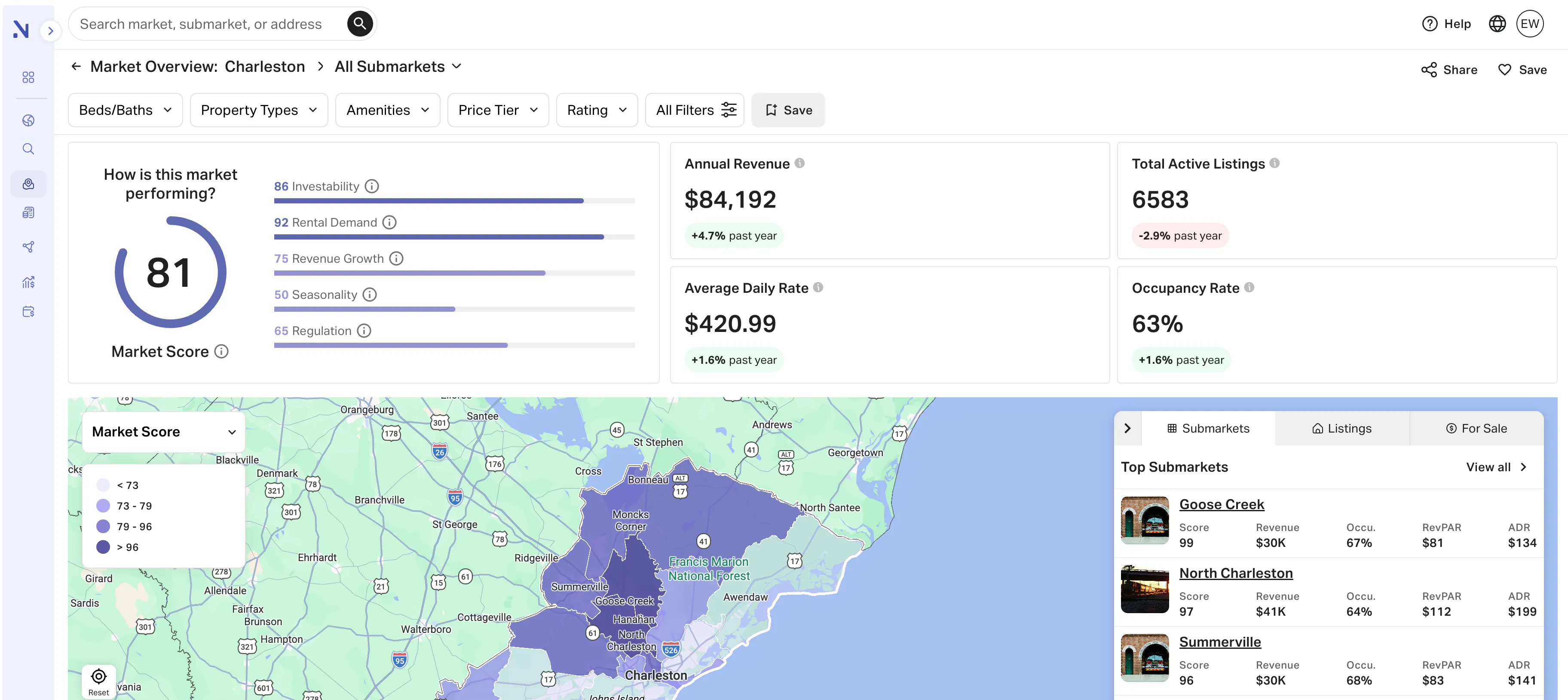
The Market Overview shows the average annual revenue for short-term rentals in that market. To estimate a monthly average, simply divide the annual revenue by 12.
Next, compare that number with long-term rental rates for similar properties in your area. Tools like Zillow’s rent index can provide a benchmark for typical monthly rents.
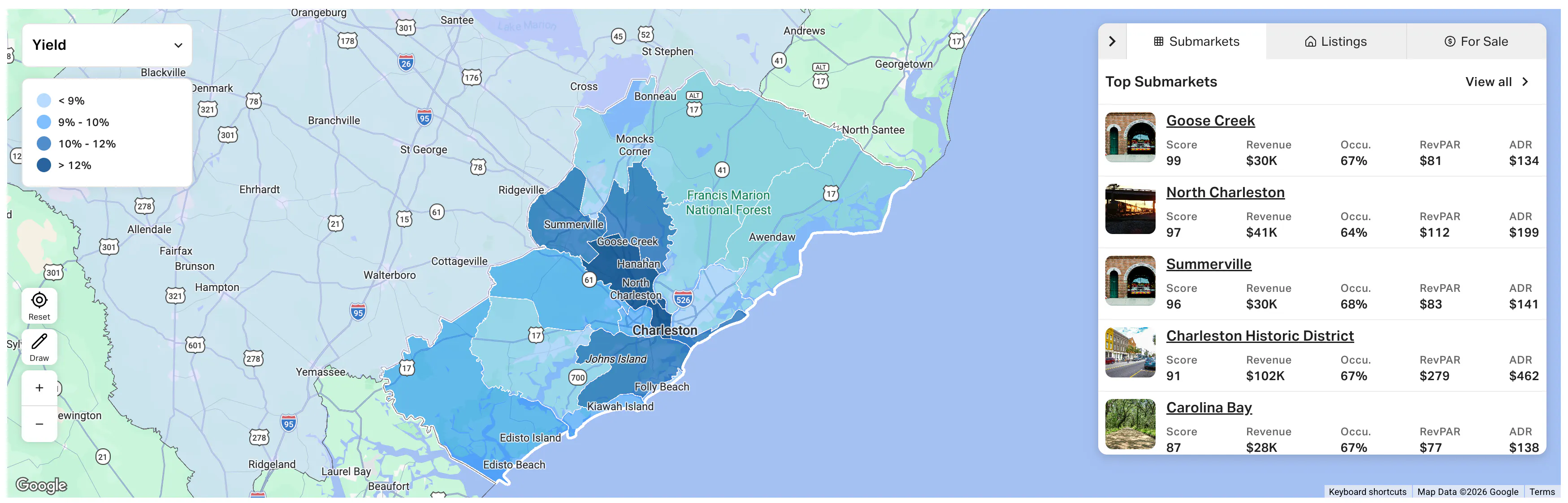
You can also use the heat map feature to see how short-term rental performance compares between submarkets in a given area. Filtering by yield in Charleston shows that the Charleston Historic District and North Charleston perform best, with yields exceeding 12%. Taking the time to understand performance differences within a larger metropolitan area can help you pinpoint areas where the short-term rental premium is highest.
You can also use AirDNA’s Airbnb Calculator, which analyzes similar properties near your exact address to estimate potential revenue and operating costs. This is a step up from market averages because it provides a fully customized, granular estimate of short-term rental income potential for a specific property.
Analytics like these give investors a glimpse into potential earnings. Remember, though, that this is part of a larger picture. For more detailed guidance, read our article on what to charge for rent for your STR.
Why Returns Differ Between Airbnb vs. Traditional Renting
While both Airbnb and traditional renting can generate income, they operate very differently. Those differences are what often drive the gap in returns.
Understanding how these two models function and the forces that influence them helps explain why Airbnb vs renting can lead to very different ROI depending on the market.
Revenue model: nightly rates vs fixed rent
One of the biggest differences comes down to how revenue is generated.
With Airbnb, hosts charge nightly rates that can change based on travel demand, local events, and seasonal tourism. When demand is high during holidays, festivals, or peak travel seasons, hosts can increase prices and earn significantly more per night.
Traditional renting works differently. Long-term rentals typically operate under a fixed monthly lease, meaning rental income stays relatively stable throughout the lease period. While that predictability can be appealing, it also means landlords usually can’t raise prices quickly when demand increases.
Cost structure: higher operating costs for short-term rentals
Higher potential revenue for Airbnb often comes with higher operating costs.
Short-term rentals typically require expenses such as:
- Furnishing and stocking the property
- Cleaning between guest stays
- Guest communication and booking management
- Higher utility usage and restocking supplies
Long-term rentals generally have lower ongoing costs because tenants stay for longer periods. Expenses are usually limited to maintenance, repairs, and occasional turnover between tenants.
Demand dynamics: travel demand vs housing demand
Another major difference between Airbnb vs renting is what drives demand.
Short-term rentals depend largely on travel demand. Markets with strong tourism, business travel, or major events often see higher occupancy rates and the ability to charge higher nightly rates.
Long-term rentals are driven more by local housing demand. Factors such as job growth, population growth, and housing shortages can increase demand for long-term rental housing and support steady rental income.
Regulations
Local regulations can also play a major role in determining which strategy performs better.
Some cities have strict rules on short-term rentals, including permit requirements, caps on the number of rental days, or restrictions on non-owner-occupied properties. In these markets, operating an Airbnb may be more difficult or less profitable.
Long-term rentals are generally more widely permitted and operate under established landlord-tenant laws, making them a more straightforward option in highly regulated markets.
Home prices
Finally, home prices relative to rental income can influence which strategy generates stronger returns.
In markets where property values are very high, long-term rental income may not rise quickly enough to keep pace with purchase prices. In these situations, short-term rentals sometimes offer better ROI because nightly pricing can generate higher overall revenue.
However, in markets where housing demand is strong and home prices are more aligned with rents, traditional renting may provide solid and stable returns.
Whether you’re evaluating a potential investment or comparing rental strategies, these factors can help you determine which approach is likely to be more profitable in your market. For a deeper look at analyzing short-term rental markets, read our Airbnb Investment Guide.
Airbnb vs. Renting: A Side-by-Side Comparison
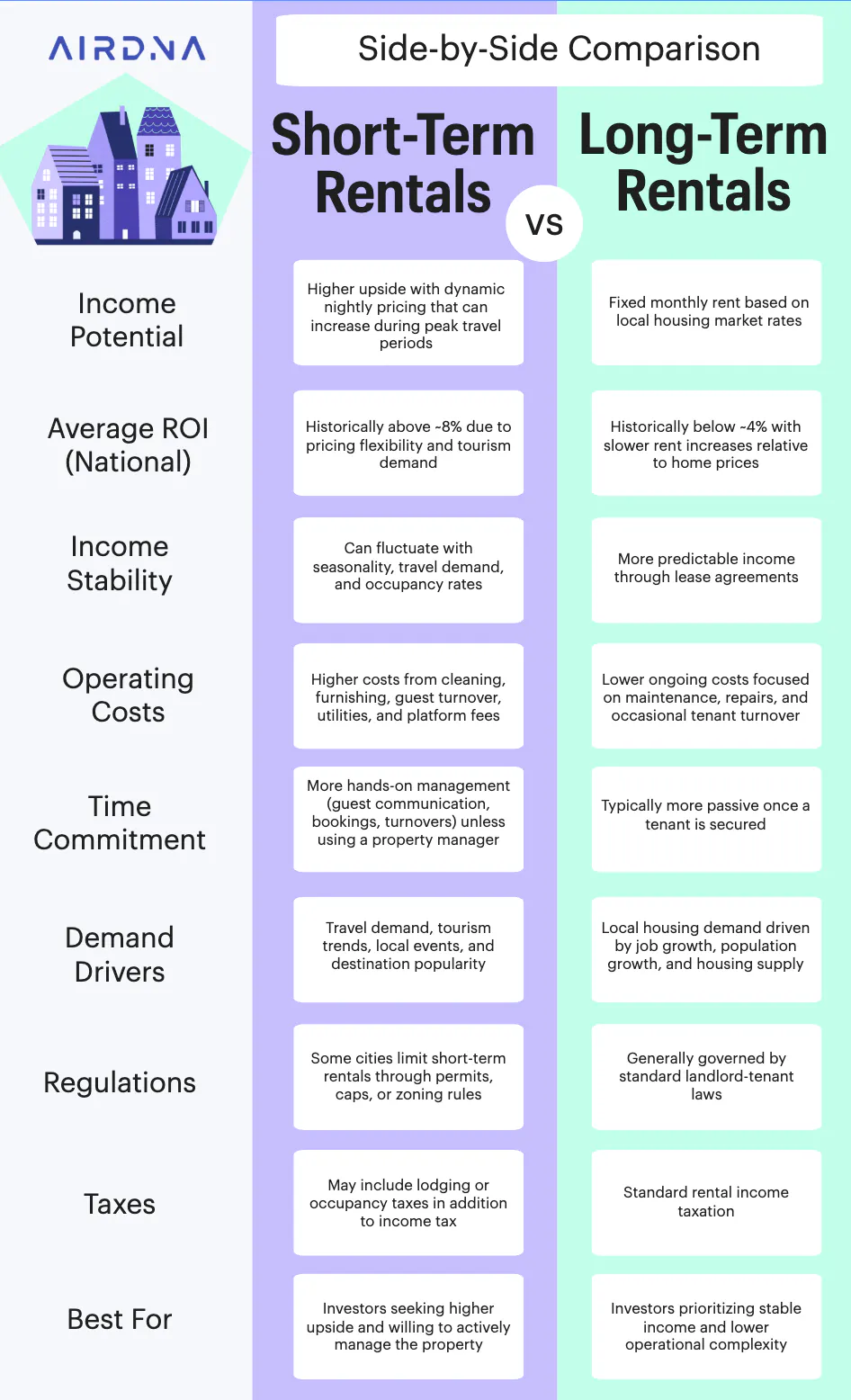
When deciding between Airbnb or renting out your property long-term, it helps to look at how the two strategies compare across the most important factors for investors and property owners.
The table below highlights the key differences between a rental property vs Airbnb strategy.
Other Key Considerations of Vacation Rentals Vs Traditional Rentals
Comparing Airbnb vs renting isn’t just about potential income. The two strategies also come with different day-to-day realities: from how much time they require to how easy they are to operate in your area.
Before deciding whether to list your property on Airbnb or rent it out long-term, it’s worth understanding a few of the practical differences that can affect how each strategy works in the real world.
Regulations
Short-term rental regulations set the groundwork for what's possible with property rentals. Cities like New York have implemented stringent zoning laws that curtail the ability to offer STRs unless specific conditions are met, such as the host's presence during the stay. These regulations can influence the decision to pursue Airbnb as an option, with the need for permits or strict guidelines potentially complicating the rental process.
Taxation
The tax considerations for Airbnb rentals can diverge from traditional rentals. Airbnb property earnings might come with hotel or tourist taxes and income taxes, creating a unique tax scenario for vacation home operators. Conversely, long-term rental properties typically fall under more familiar tax rules. Landlords can deduct expenses like mortgage interest, property tax, and maintenance costs directly related to the upkeep of the rental property.
Property Insurance
Insurance for vacation rentals must cover the higher risks associated with transient occupancy, such as property damage or liability issues. These risks aren't usually covered in standard homeowners' policies. This specialized insurance tends to be more costly, reflecting the increased risk. Landlords of long-term rentals, however, generally invest in landlord insurance policies that provide liability and property damage coverage suitable for longer-term tenancies. Long-term rental insurance offers a different cost and coverage structure that aligns with the lower turnover rates.
Property Management
The day-to-day management of an Airbnb rental property can be much more hands-on than a traditional rental. The high turnover of guests demands regular cleaning, maintenance, and active communication for check-ins and support. This operational demand can be both a time and financial burden on the property owner. In a traditional rental property, the property can often be managed more passively once a reliable tenant is secured. However, it is possible to operate your vacation rental remotely or hire a property manager to make your Airbnb investment more passive.
Frequently Asked Questions About Airbnb vs Renting
Is Airbnb more profitable than renting?
In many markets, Airbnb can be more profitable than renting long-term, largely because short-term rentals allow hosts to adjust nightly prices based on demand.
AirDNA data shows average net ROI for short-term rentals has generally remained above 8%, while long-term rentals have typically stayed below 4%. That gap comes from the ability to charge higher nightly rates during busy travel periods.
Of course, results vary by market. Tourism demand, local regulations, and home prices can all influence whether Airbnb or renting out a property long-term generates better returns.
What type of rental property is most profitable?
In many markets, short-term rentals can be the most profitable type of rental property, especially in areas with strong tourism or business travel.
However, the most profitable property usually depends on location and demand. Smaller homes or apartments in high-demand areas often perform well as Airbnb properties, while properties in residential neighborhoods may generate steadier income as long-term rentals.
Looking at local market data is often the best way to determine which type of rental property will generate the strongest returns in your area.
How do I decide between Airbnb vs renting out my property?
Deciding between Airbnb vs renting out your property long-term usually comes down to a mix of income potential, your local market, and how involved you want to be as a property owner.
Short-term rentals often benefit from travel demand, tourism, and local events, which can create higher earning potential but also more ups and downs in income. Long-term rentals are typically driven by local housing demand, which tends to produce more stable monthly rent.
It’s also worth considering practical factors like local short-term rental regulations, operating costs, and how much time you want to spend managing the property day to day. The right choice often depends on which approach fits your market and your goals.
What is the downside of Airbnb compared to renting?
While Airbnb can generate higher revenue potential, it also comes with more active management and variable income.
Hosts typically need to manage bookings, communicate with guests, coordinate cleaning between stays, and maintain their listing. Income can also fluctuate depending on seasonality and occupancy.
In addition, some cities have short-term rental regulations that limit how often a property can be rented.
Should I rent out my house or turn it into an Airbnb?
Whether you should rent out your house or list it on Airbnb depends largely on your location.
Homes in areas with strong tourism, business travel, or frequent events often perform well as short-term rentals. In other areas, long-term renting may be simpler to operate.
Looking at market data for both short-term rental revenue and long-term rental rates can help you determine which option is more likely to perform better.
Can you switch from renting to Airbnb?
Yes, many property owners switch from long-term renting to Airbnb if they believe short-term rentals will generate higher income.
Before making the change, it’s important to check local short-term rental regulations, HOA rules, and zoning laws. You may also need to furnish the property, update insurance coverage, and prepare for more hands-on management.
How do operating costs compare between Airbnb and renting?
Operating costs for Airbnb are typically higher than for long-term rentals, mainly because of guest turnover.
Short-term rentals often include expenses like furnishing the property, cleaning between stays, restocking supplies, and platform service fees. Long-term rentals generally have lower ongoing costs, focused mostly on maintenance and occasional tenant turnover.
Because of these differences, it’s important to compare both revenue potential and operating costs when evaluating Airbnb vs renting.
ARTICLE SUMMARY
Trying to decide between Airbnb vs renting out your property long-term? This guide breaks down how the two strategies compare—from ROI and operating costs to demand, regulations, and market conditions—so you can better understand which option might perform best for your property.
Linda Rollins
Senior Research Analyst
Linda Rollins is a Senior Research Analyst at AirDNA and a self-managing short-term rental host, which means she understands the market as both an analyst and an operator. She writes research and blogs for AirDNA and for Adapt, its revenue management tool, making her work a go-to resource for investors trying to find and size up the right opportunities, and for operators looking to understand changing market dynamics and find concrete ways to improve occupancy, rates, and guest experience. Her data is regularly cited in major news outlets, and she has a knack for bringing both the numbers and the story behind them. In her free time, Linda enjoys spending time with her family, traveling, and looking for good eats.


