Airbnb vs Vrbo for Owners: Which Is Best for You?
Published: August 19, 2025

Jamie Zhang
Key Takeaways
- Airbnb now has about 1.5M active U.S. listings compared to Vrbo’s 714K, and both platforms have grown substantially since 2019.
- Vrbo’s emphasis on whole-home rentals tends to attract families and groups booking for longer, higher-value trips.
- Hosts are listing on both platforms more than ever before, but you need the right tools and processes to keep calendars, pricing, and guest communication in sync.
For short-term rental hosts, picking where to list your property is a lot like choosing the best fishing spot . . . you want to be where the guests you’re trying to attract are actually looking. In the U.S., the two biggest spots are Airbnb and Vrbo.
Choose the wrong one and you might miss out on your ideal guests, leave money on the table, or spend time on bookings that don’t fit your style. Choose the right one and you can fill your calendar, attract travelers who value what you offer, and run a smoother, more profitable rental business.
While both Airbnb and Vrbo can bring in steady bookings, they tend to attract different types of guests, favor different kinds of properties, and follow different rules. Which one works best for you comes down to what you’re renting, where it’s located, and the kind of guest you want to host.
In this guide, we’ll put Airbnb and Vrbo head-to-head, walk through the key differences that matter for your hosting strategy, and help you decide whether to stick with one platform or list on both.
Airbnb vs. Vrbo for Owners: A Side-by-Side Comparison
Airbnb and Vrbo are the two biggest names in the game of short-term rentals. They both connect you with millions of travelers, but they do it in different ways and those differences can impact how often your property gets booked, the type of guests you attract, and even your bottom line.
Airbnb burst onto the scene in 2008, starting with spare rooms and budget-friendly stays before expanding into entire homes and unique properties. It’s now the largest short-term rental platform in the U.S., offering a diverse mix of urban apartments, small houses, and unique listings, including yurts and treehouses. Its strength lies in its global reach, easy-to-use interface, and the diversity of its guest base, from solo travelers and couples to small groups looking for affordable stays.
Vrbo has been around much longer, launching in 1995 with a focus on traditional vacation homes in leisure destinations. While smaller than Airbnb in total number of listings, Vrbo’s inventory is made up almost entirely of whole-home rentals in markets like beaches, ski towns, and resort areas. It’s the go-to for families and larger groups who want space, privacy, and amenities for longer, higher-value stays.
The best way to compare Airbnb and Vrbo is to see them head-to-head. We put together this side-by-side breakdown to show you the differences that actually matter and then we'll explore what each one means for your hosting strategy.

Main Differences Between Airbnb and Vrbo
Choosing between Airbnb and Vrbo isn’t just about picking a name you’ve heard of. You need to understand how each platform works and how that lines up with your property and goals as a host. The way these platforms operate can influence how often you get booked, who books with you, and what you earn. That’s why it’s worth looking a little closer at how they compare.
Platform size
When you compare Airbnb and Vrbo, one of the biggest differences is sheer size. As of June 2025, Airbnb has about 1.5 million active U.S. listings, nearly twice as many as Vrbo’s 714,000 listings. Both platforms have expanded quickly since 2019, with Airbnb growing 90% and Vrbo 84%. That’s a clear sign that short-term rentals are still in high demand and that Airbnb is far from “dead," despite what the occasional news cycle says.
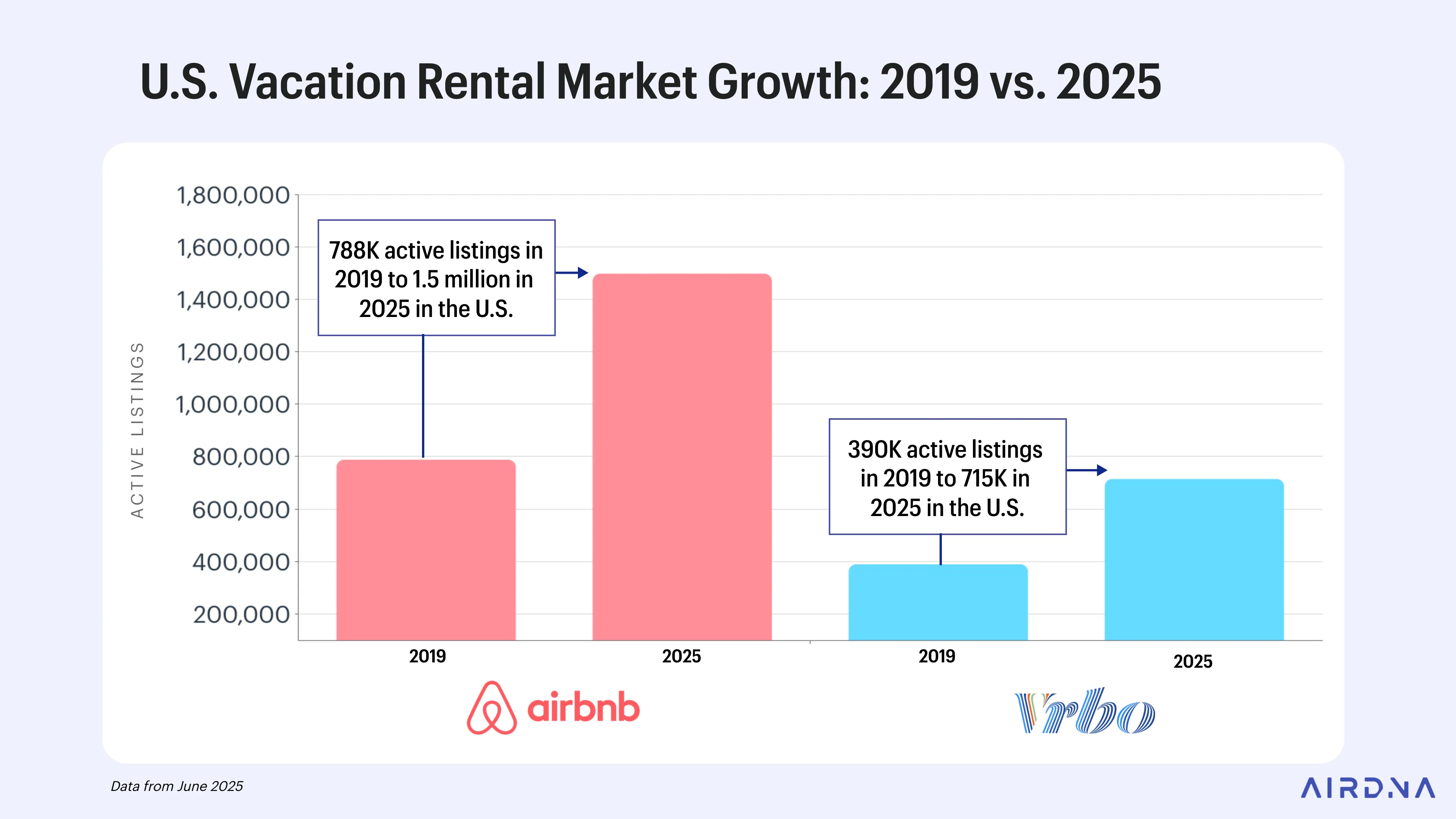
The number of listings on Airbnb vs.Vrbo matters because it affects both your exposure and your competition. On Airbnb, the larger marketplace can put your property in front of more potential guests, which is ideal if you’re aiming for high booking volume or targeting busy urban markets.
The trade-off is more competition, which means your pricing, photos, and listing details have to work harder to stand out. Vrbo’s smaller pool of listings can be an advantage if you have a high-ADR property in a vacation destination—especially in markets where travelers often book longer, higher-value stays.
In the end, whether you lean toward Airbnb’s reach or Vrbo’s room to stand out depends on your property type, location, and hosting strategy.
Host fee structure
Airbnb and Vrbo both charge service fees to cover the cost of running their platforms, but the way they structure those fees can make a difference to your bottom line.
Airbnb typically uses a split-fee model, where the host pays about 3% of the booking subtotal and the guest pays the rest. Some hosts, such as hotels, serviced apartments, or those using property management software are required to use a host-only fee. The host fee is usually 14–16% of the booking subtotal.
Vrbo’s fee structure includes two main options. The pay-per-booking model combines a 5% commission fee with a 3% payment processing fee (around 8% total). Alternatively, frequent or high-revenue hosts can choose a $699 annual subscription, which covers all bookings for the year.
For hosts, the right fee structure often depends on booking volume and nightly rates. Airbnb’s lower host fee works well for those with occasional or lower-cost bookings, while Vrbo’s annual subscription can be cost-effective for properties that command higher ADRs or see steady demand.
Property type
When you compare Airbnb and Vrbo, one of the biggest distinctions is what you can actually list. In 2025, over 10% of Airbnb’s U.S. inventory is made up of private or shared rooms, while Vrbo doesn’t offer that option at all. That single fact says a lot: if you’re renting out part of your home or a smaller unit, Vrbo simply isn’t an option.
Airbnb’s flexibility extends to smaller properties overall. Studios and one-bedroom units make up about 32% of Airbnb listings, compared to just 2% on Vrbo. Vrbo’s catalog, on the other hand, is dominated by larger vacation homes: 28% of its listings have three bedrooms and 15% have four bedrooms, versus 21% and 11% on Airbnb.
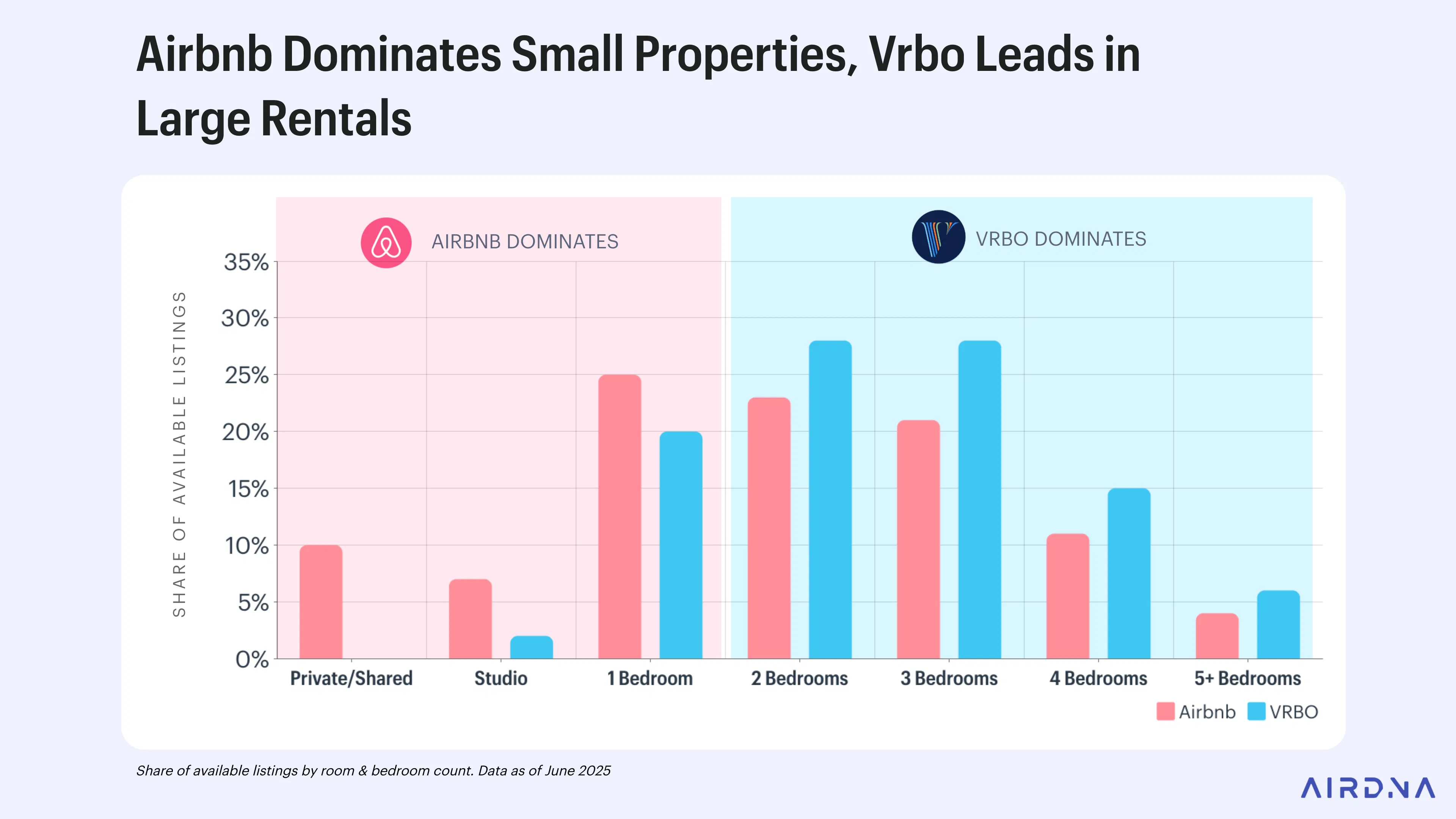
The mix of property types for Airbnb vs. Vrbo has shifted in some interesting ways over the past year. From 2024 to 2025, Airbnb’s proportions have stayed fairly consistent, but Vrbo’s share of 5+ bedroom properties dropped from 11% to just 6%. If you own a very large home, that’s a big deal: fewer comparable listings mean less direct competition in search results, which can make your property more visible to the high-value groups Vrbo tends to attract. On Airbnb, the 5+ bedroom share has held steady, so you’d likely face more competition for those guests than you would on Vrbo.
In short, Airbnb’s broad range of property sizes makes it well-suited for everything from small urban apartments to quirky, one-of-a-kind spaces. Vrbo’s whole-home focus, especially in leisure destinations, positions it to draw families and groups booking longer, higher-value stays . . . an advantage that’s even stronger now for owners of the largest homes.

Nightly rates
If you compare Airbnb and Vrbo prices, you’ll see a clear difference in the types of stays each platform attracts. Vrbo is still the go-to for higher-value bookings: think large vacation homes where nightly rates often start in the mid-hundreds, while Airbnb offers more range, from budget-friendly rooms to luxury getaways.
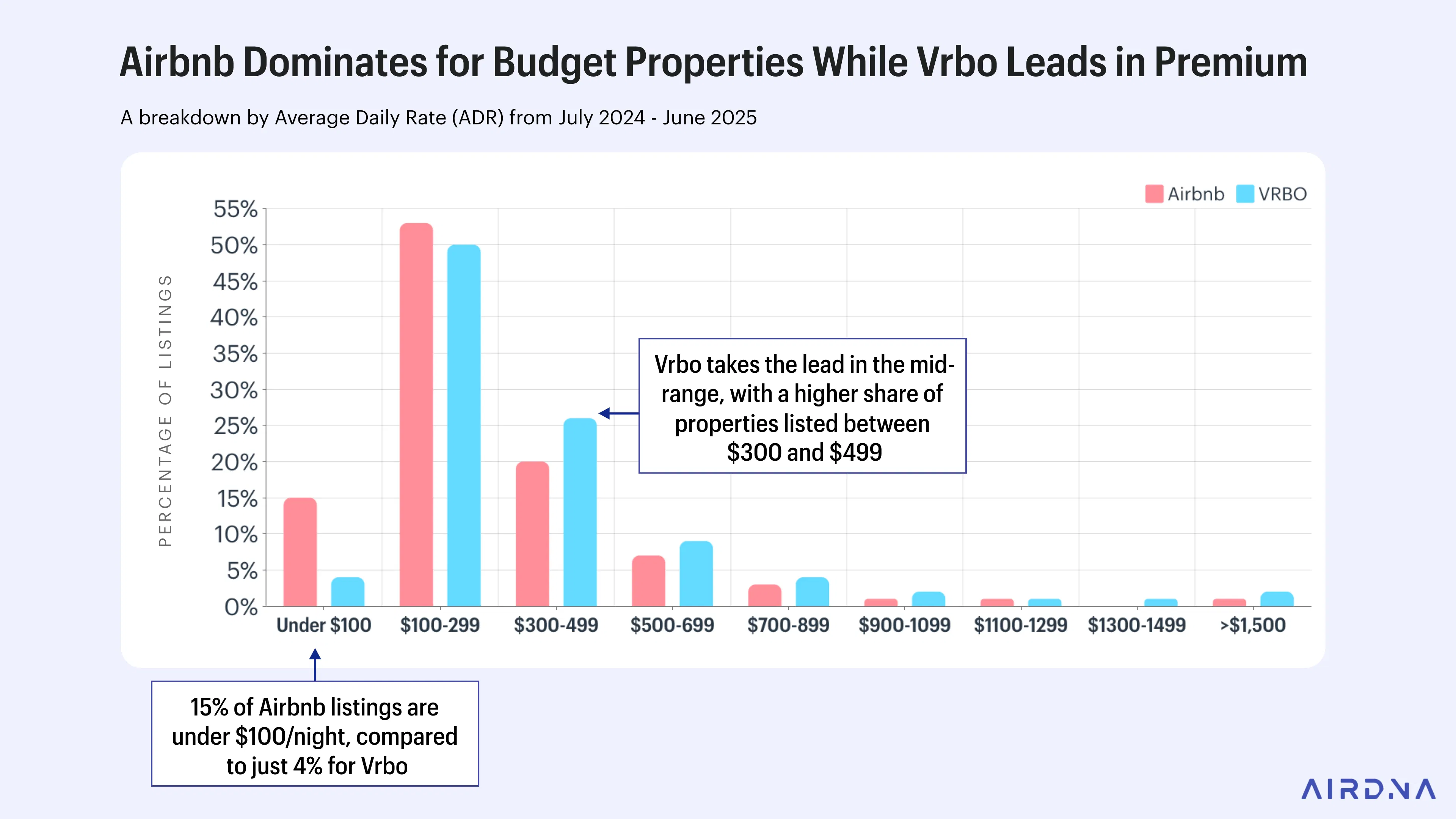
As of June 2025, 15% of Airbnb listings have an average daily rate (ADR) under $100, compared to just 4% on Vrbo. On the flip side, Vrbo has a much larger share of higher-priced listings: 26% of its properties have an ADR between $300 and $499, versus 20% for Airbnb. Vrbo leads in almost every price tier above $300. Over the past year, Airbnb has added more mid-to-high-end properties without losing its budget-friendly options, while Vrbo’s pricing mix has stayed steady, keeping its focus on the premium market.
Here’s the bottom line: if your property competes on price, Airbnb’s audience is more likely to be searching in that range. If you’re offering a large, high-ADR home, Vrbo’s guest base may be more aligned with your nightly rate.
Location type
Where your property is located can make a big difference in whether Airbnb or Vrbo will work better for you. In 2025, the two platforms still have very different footprints. Vrbo is heavily focused on classic vacation spots. About 37% of its U.S. listings are in Coastal resort markets and 22% are in Mountain/Lake destinations. That means nearly 6 in 10 Vrbo properties are in places where people go specifically for getaways.
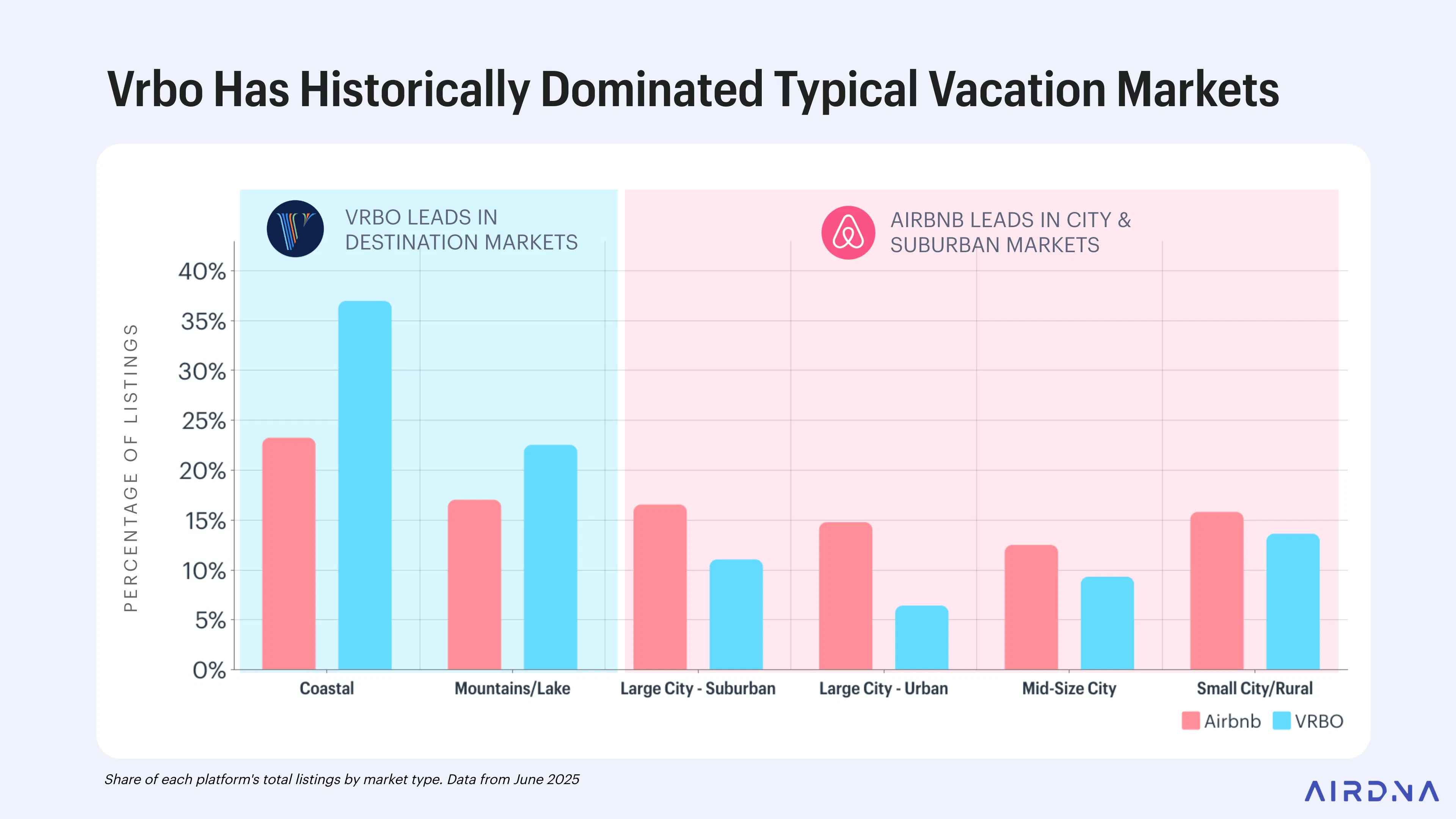
Airbnb has plenty of vacation rentals in those areas, too (23% coastal, 17% mountain/lake), but it also has a much bigger share of Large City Urban listings. Around 16.6% of its inventory is in Large City Suburban markets and 14.8% in major urban cores, compared to Vrbo’s 11.1% and 6.4%. If your property is in a city or metro-adjacent area, Airbnb can put you in front of more travelers searching in those markets.
Looking at the past year, Vrbo’s share of Coastal listings ticked up a bit, but the biggest growth actually came from less traditional STR markets—Large City Urban areas and Small City/Rural locations. Vacation spots are still its bread and butter, but it’s starting to make more inroads into places where Airbnb has usually been stronger. Airbnb’s mix hasn’t changed much, but because it grew in every category, its lead in urban and suburban listings is now even bigger.
P.S. If you want to learn more about how we break out markets by geographical type and location, check out our methodology page.
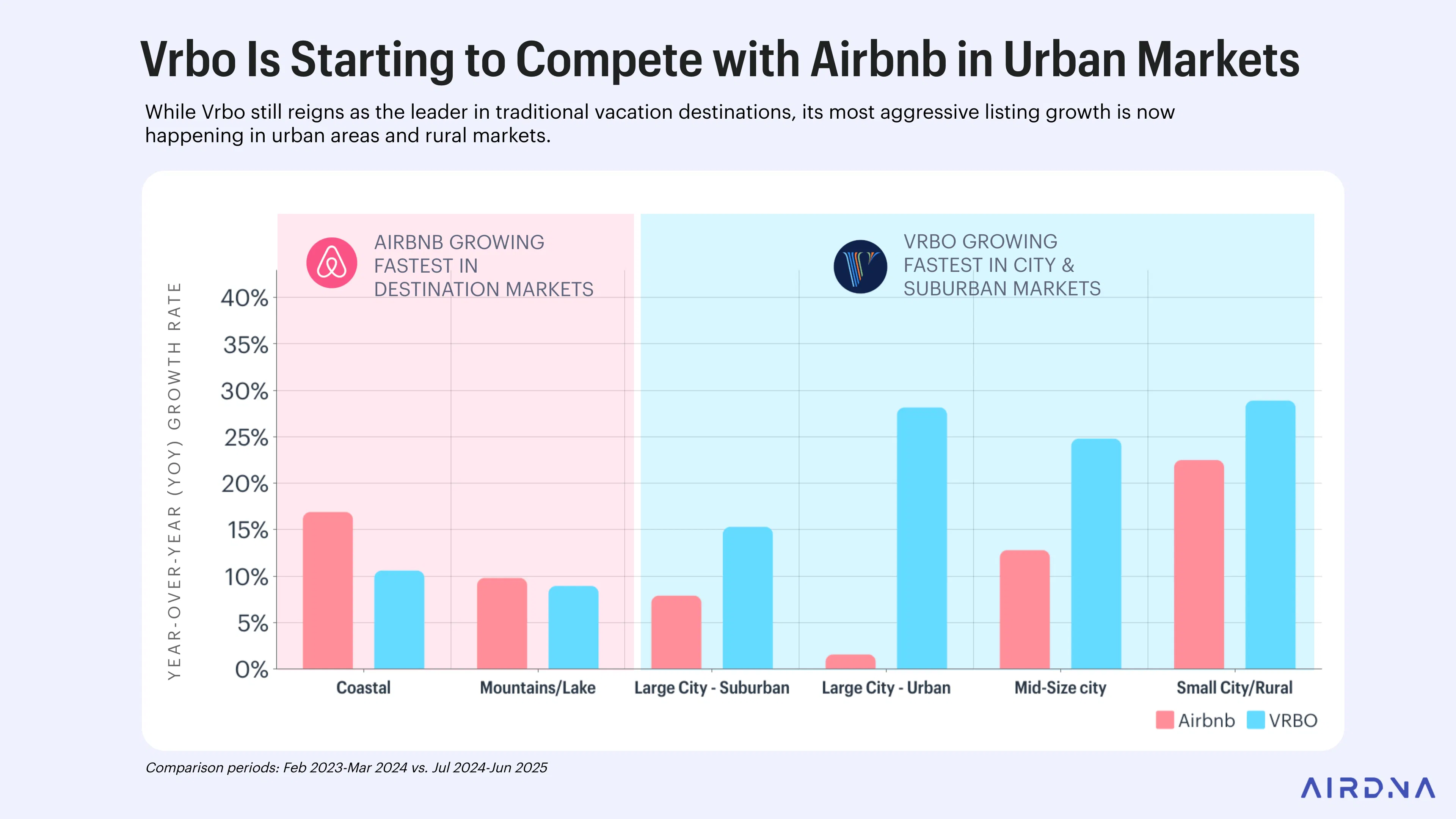
For hosts, the best fit often comes down to your market. A beach house or mountain cabin will likely get more interest on Vrbo, where vacation destinations dominate search results. If you’ve got a condo downtown or a home just outside a major city, Airbnb’s stronger urban and suburban presence means more of the right guests are likely to see your listing.
Target audience
While Airbnb and Vrbo both attract millions of travelers, the typical guest on each platform can look quite different. Airbnb’s audience is broad and diverse: solo travelers, couples, small groups, and budget-conscious guests who might be booking anything from a private room to a treehouse. It’s especially popular with younger travelers and those who want to “live like a local” in the heart of a destination.
Vrbo’s audience is more niche. It’s the go-to for families and larger groups booking entire homes for vacations, often in beach towns, ski resorts, or lakeside communities. These guests usually stay longer, spend more per night, and prioritize space, privacy, and home-style amenities over novelty or the lowest price.
Knowing which group your property appeals to can help you decide where to focus or whether listing on both platforms will help you reach a wider range of travelers.
Cancellation policy
Airbnb gives hosts more choice when it comes to cancellation policies. You can opt for fully flexible (full refund up to 24 hours before check-in) or set stricter rules. Airbnb’s “super strict” policies require much more notice, though, that this option will no longer be available for new listings after October 1, 2025. The range of cancellation policies available on Airbnb can be handy if you want to attract last-minute bookings or adjust your approach based on the season.
Vrbo’s cancellation policies tend to be less flexible. The most lenient option allows a full refund up to 14 days before check-in, and stricter settings require even more notice or offer no refund at all. That can help reduce last-minute cancellations, but it may also discourage guests who want more wiggle room.
For hosts, it comes down to strategy: if you’re aiming for high occupancy and can handle the occasional cancellation, Airbnb’s approach may work better. If you’d rather secure bookings well in advance, Vrbo’s tighter cancellation windows might be a better fit.

Booking length
The typical length of stay can be another clue to which platform might be a better fit. Airbnb tends to attract shorter stays with higher turnover: weekend getaways, a few nights in the city, or quick trips where guests are looking for flexibility and variety. That can mean more bookings overall, but also more guest changeovers and cleaning days.
Vrbo guests usually stay longer. Families booking a beach house for a week or friends sharing a ski cabin for several days are common, and it’s not unusual for stays to stretch beyond a week in peak vacation markets. Longer bookings can reduce turnover costs and keep your calendar filled, but they also mean fewer total reservations over the year.
If your property is set up for quick turnovers and you want to keep occupancy high, Airbnb’s shorter stays might work in your favor. If you’d rather host fewer guests but secure larger payouts per booking, Vrbo’s longer-stay pattern could be a better match.
Other Differences Between Airbnb and Vrbo
We’ve covered the major differences between Airbnb and Vrbo—the ones most likely to shape your hosting strategy. But there are also smaller distinctions between the platforms that, while less critical, can still influence how you manage your short-term rental day to day.
Damage protection and liability coverage
Airbnb’s AirCover for Hosts includes up to $3 million in Host Damage Protection plus $1 million in Host Liability Insurance, automatically applied to every booking.
Vrbo offers $1 million in liability coverage, but that doesn’t cover damage to your own property. For that, you can either require a damage deposit or purchase an optional Accidental Damage Protection plan.
Booking lead time
Vrbo lets you open your calendar up to 24 months in advance, which is handy for securing long-range vacation planners. Airbnb lets you set your own booking window, with no fixed maximum.
Instant booking and guest screening
Both platforms allow instant booking, but Vrbo also gives you the option to review and approve each request manually.
Review systems
Airbnb uses a blind review system, where reviews only appear after both parties submit. Vrbo allows you or the guest to post anytime within a year of the stay, but neither can see the other’s review until both are posted.
These aren’t the kinds of factors that usually decide which platform to use, but they can make hosting easier or more comfortable depending on your style. If you care about things like how far out you can take bookings or how guest communication works, these are worth keeping in mind.
Can You List on Both Airbnb and Vrbo?
You don’t actually have to choose between Airbnb and Vrbo. You can list on both! This is called cross-listing and it’s becoming much more common.
In 2019, only 13% of short-term rentals in the U.S. were on both platforms. By 2025, that number has jumped to 30%. Fewer hosts now stick to just one site: Airbnb-only listings dropped from 60% to 51%, and Vrbo-only listings fell from 28% to 19%.
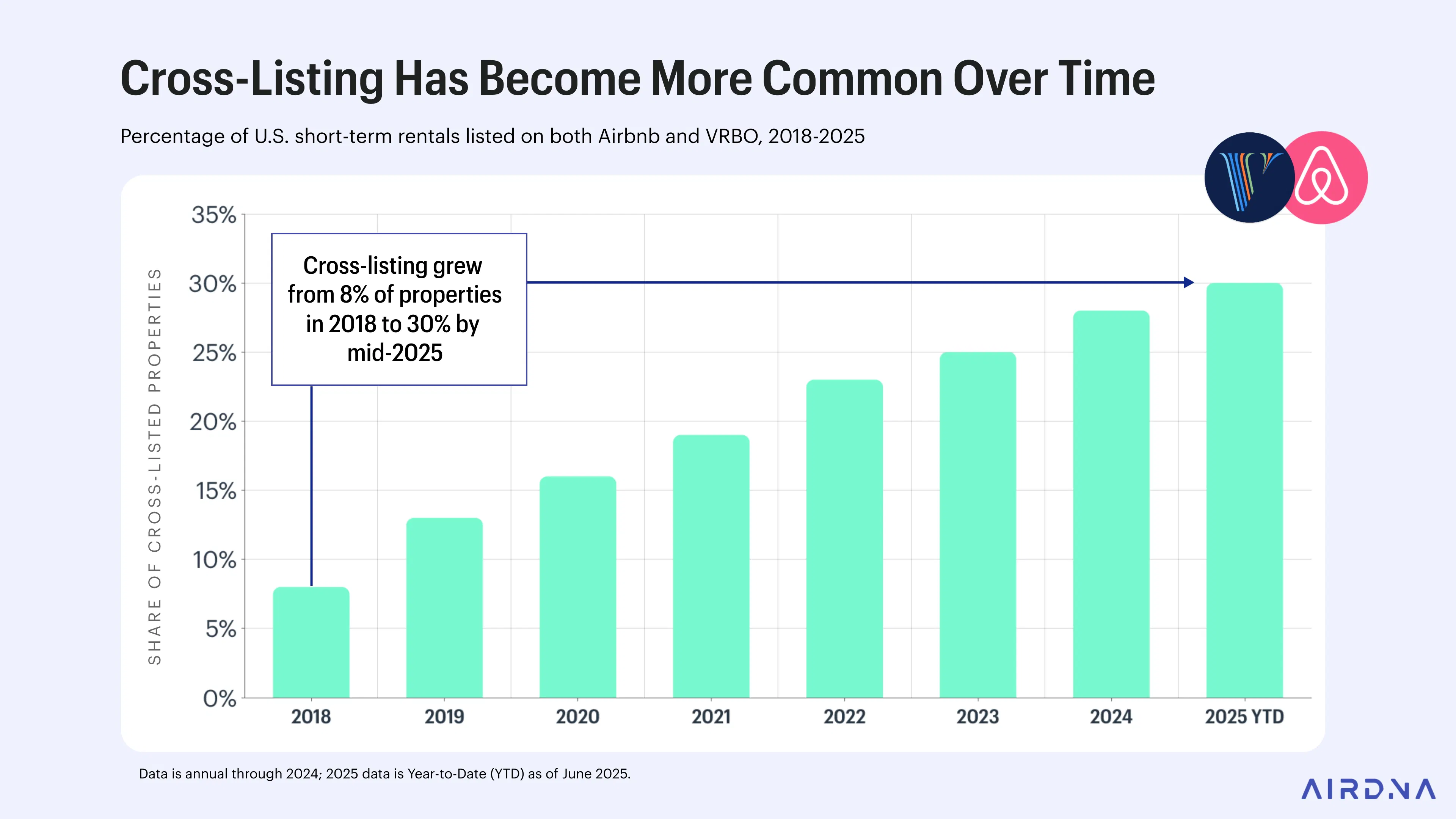
Why do more hosts list on both? Because it usually means more bookings. In 2025, cross-listed properties had an average occupancy rate of 58%, compared to 54% for Airbnb-only and 52% for Vrbo-only. This pattern is true for small apartments, big vacation homes, and everything in between. All of the data points to cross-listing as the best strategy for maximizing your revenue. In fact, we've dedicated a whole article to why you should cross-list.
The trade-off is that you’ll need to manage two listings—keeping calendars updated, replying to guests on both platforms, and making sure your prices match. The good news is that tools like calendar sync or a channel manager can make this much easier. We explore this process in more detail in our article on how to cross-list.
Is Vrbo or Airbnb Better for Owners?
If you came here hoping for a simple, one-size-fits-all answer… sorry to disappoint. The truth is, the “better” platform depends entirely on your property, your market, and how you want to run your rental business.
What we can do is help you think through the decision like an experienced host would. Ask yourself these questions to figure out where your property is most likely to shine.
- How do guests experience my property? Is it a quick city stopover, a cozy weekend retreat, or a week-long family vacation spot?
- When do travelers typically book in my area? Do you see lots of last-minute bookings, or are guests locking in trips months ahead?
- How much space am I offering and how will guests use it? Is it a shared space or small apartment, or is it built for larger groups and gatherings?
- What kind of trip is my property perfect for? A budget-friendly city break, or a higher-value, planned-in-advance getaway?
- How hands-on do I want to be? Am I ready for frequent turnovers and active pricing adjustments, or do I prefer longer, more predictable stays?
- Am I willing to manage two listings? Could cross-listing help me reach both Airbnb’s wider audience and Vrbo’s premium guests?
Once you’ve answered these, the choice often becomes a little clearer. Airbnb’s flexibility and massive reach make it great for a wide variety of spaces, especially in urban or mixed markets. Vrbo’s focused audience and longer booking windows are a better fit for destination markets and larger properties.
At the end of the day, asking which platform is better isn’t the right question. The better question would be, should I list on both? Cross-listing can give you the best of both worlds, provided you have the tools and processes to manage it smoothly.
Frequently Asked Questions
What’s the difference between Vrbo and Airbnb?
Airbnb offers a wider variety of property types, from budget-friendly shared rooms to unique stays and entire homes, while Vrbo focuses almost exclusively on whole-home rentals in vacation destinations. Airbnb tends to attract a broader audience, including solo travelers and short-term urban guests, while Vrbo is more popular with families and groups looking for longer, higher-value stays.
Is Airbnb or Vrbo better for owners?
It depends on your property and hosting goals. Airbnb’s larger marketplace and variety of listings give it a broader reach, which can mean more bookings if you’re in a competitive or urban market. Vrbo’s smaller pool of listings and focus on whole homes can help larger or high-value vacation properties stand out—especially in beach, mountain, or lake destinations.
What is more profitable, Airbnb or Vrbo?
It depends on your property. Airbnb’s wide range of listings includes about 15% under $100/night, which can drive higher booking volume. Vrbo has fewer budget listings (around 4% under $100) and more in the $300–$499 range, which often means higher nightly revenue, especially for large vacation homes. Your profitability comes down to whether more bookings at lower rates (Airbnb) or fewer bookings at higher rates (Vrbo) fit your strategy.
What do Airbnb and Vrbo charge?
Both Airbnb and Vrbo charge service fees, though their pricing structures differ. Vrbo has host-only fees, while Airbnb has a split-fee option that distributes the cost between host and guest. When comparing Airbnb and Vrbo prices for hosts, it's important to note that while all Airbnb service fees are taken as a percentage of the booking subtotal, Vrbo has an annual fee as well as a pay-per-booking option.
How do I list on Airbnb and Vrbo?
Yes, you can list your property on both Airbnb and Vrbo. You’ll need to set up a separate host account on each, then add your property details, photos, pricing, and policies. The key is to keep your calendars in sync so you don’t get double bookings, which you can do with the free sync tools each platform provides or with a channel manager. If you want a full walkthrough, we’ve got a step-by-step guide on how to list on multiple short-term rental websites.
ARTICLE SUMMARY
Airbnb vs. Vrbo: Wondering which is better for your short-term rental? We take a look at the differences between Airbnb and Vrbo that actually matter, so you can pick the right fit for your rental strategy.
Jamie Zhang
AirDNA Data Analyst
Jamie Zhang is a Data Analyst at AirDNA, leveraging her background in data science and analytics to uncover key trends in the short-term rental industry. Before joining AirDNA, she worked as a data analyst at Shanghai Disney, where she specialized in revenue forecasting and financial planning . She holds a Master’s degree in International Economics and International Relations from Johns Hopkins. Jamie enjoys cycling to explore different corners of the city.