

 Calculate Revenue
 Research Markets
 Find For Sale Properties
 Compare My Listing
 STR Revenue Calculator
 Custom Comp Sets
 Submarket Insights
 Custom Search Filters
 Rate Recommendations
 Performance Benchmarking
 Competitor Comparison
 Owner Contact Details
 Property-level performance data
 Tourism Insights
 Real Estate Investment Analytics
 About Us
 Sales
Sales Support
 Press
PressEuropean Market Review: Shoulder Season Travel Explodes as Supply Increases, Keeping Occupancy Stable | AirDNA
Published: November 28, 2023
Last updated: May 5, 2026

Scott Sage
Traveling during shoulder season —the months between peak and off-season— is a trend that we’ve seen grow exponentially since the pandemic. Yet, few months have seen as significant an uptick in demand and occupancy compared to 2019 as October 2023.
At a Glance: October STR Performance in Europe
- Available listings were up 16.9% year-over-year (YOY) and 7.7% above 2019
- Demand was up 13.8% YOY, 17.9%vs. 2019
- Average daily rates (ADRs) were up 11.3% YOY and 36.9% vs. 2019
- Revenue was up 26.6% YOY and 61.3% from 2019
- Occupancy was down 0.7% YOY and up 9.8% vs. 2019
- Revenue per available rental (RevPAR) grew 10.5% YOY and was up 50.3% from 2019
Looking at occupancy over the last two years compared to 2019, October 2023 was easily one of the strongest-performing months. Occupancy in 2022 increased by 10.5% compared to 2019 and this year, October occupancy continued to defy expectations, exceeding 2019 levels by 9.8%.
An unexpected demand surge fueled October’s huge leap in occupancy. Demand last month increased by 13.8% YOY and 17.9%% compared to 2019. Thanks to the greater number of nights stayed, total revenue reached $5.3 billion in October. Hosts also benefited from generous RevPARs—up 10.5% YOY and an unprecedented 50.3% higher than 2019.

The State of the European Economy
In its most recent macroeconomic projections report, the European Central Bank (ECB) reported a 0.1% decline in real gross domestic product (GDP) in the third quarter of this year compared to the prior quarter. The report affirmed a deteriorating outlook for the European economy and listed inflation, interest rate hikes, slowdown of manufacturing and exports, and weak consumer demand as the main culprits for Europe’s stagnating economy.
While a few positive notes were mixed into the report’s projections, the prevailing narrative was that Europe will likely continue on its path of subdued GDP growth for the next year. The ECB predicts that real GDP growth will slow down from 3.4% in 2022 to 0.7% in 2023 before recovering to 1.0% in 2024.
The biggest factors that will aid GDP recovery next year will be Europe’s enduring labor market and declining inflation, which will boost disposable incomes. As of current estimates, October inflation stands at 2.9%, down from 4.3% in September and a fraction of last October’s inflation rate of 10.6%. The ECB predicts inflation will continue its downward trajectory and fall from an average of 5.6% in 2023 to 3.2% in 2024. Unemployment as of September stood at a historic low of 6.5%. The ECB predicts that employment will grow by 1.2% in 2023 and continue its growth in 2024 at a slower rate of 0.2%.
While it remains to be seen if Europe will avoid recession and return to positive GDP growth in 2024, current projections of declining inflation and a robust labor market are reasons to hope for increased consumer spending next year.

October Occupancy Highlights Thriving Off-Season Travel Growth
Across the top 20 European countries, October occupancy reflected the boom in off-season travel since 2019.
Eleven of the top 20 European countries saw occupancy growth in October compared to 2019 due to the growing popularity of off-season travel. Five countries, in particular, stood out, with occupancy levels that exceeded 2019 by more than 15%: Spain (+15.2%), Portugal (+19.9%), Greece (+22.8%), Italy (+24.9%), and Croatia (+20%).
Slow recovery to pre-pandemic levels of supply and accelerating demand for off-season travel led to stellar occupancy performance in Spain, Portugal, and Italy. As of October, available listings compared to 2019 were up 2.4% in Portugal, 2.5% in Spain, and down 6.3% in Italy. On the other hand, October demand increased 26.6% in Portugal, 12.2% in Spain, and 19% in Italy compared to 2019.
Demand grew 33.1% in Greece, which far exceeded the 10.8% increase in available listings and resulted in strong occupancy growth. Notably, there were several other countries where demand grew nearly 40% compared to 2019: Norway (+39.7%), Poland (+39.6%), and France (+40.6% — perhaps in part thanks to the Rugby World Cup hosted by various French cities during October)

Airbnb’s New Ratings Page Incentivizes Operators to Improve Guest Satisfaction
For its latest winter release, Airbnb launched a newly designed rating page to improve how guests view ratings and reviews for listings they’re interested in. Guests can now sort reviews by recency or rating, view the distribution of ratings, see relevant information about the reviewer, such as their length of stay or if they traveled with pets, and search reviews by keyword.
Airbnb aims to improve the transparency of listings when a guest books a stay. Unlike hotels, Airbnbs can differ greatly in how they look and what they offer. By allowing guests to access more details on their potential stays, Airbnb hopes to secure more guests who may otherwise favor the consistency of hotels.
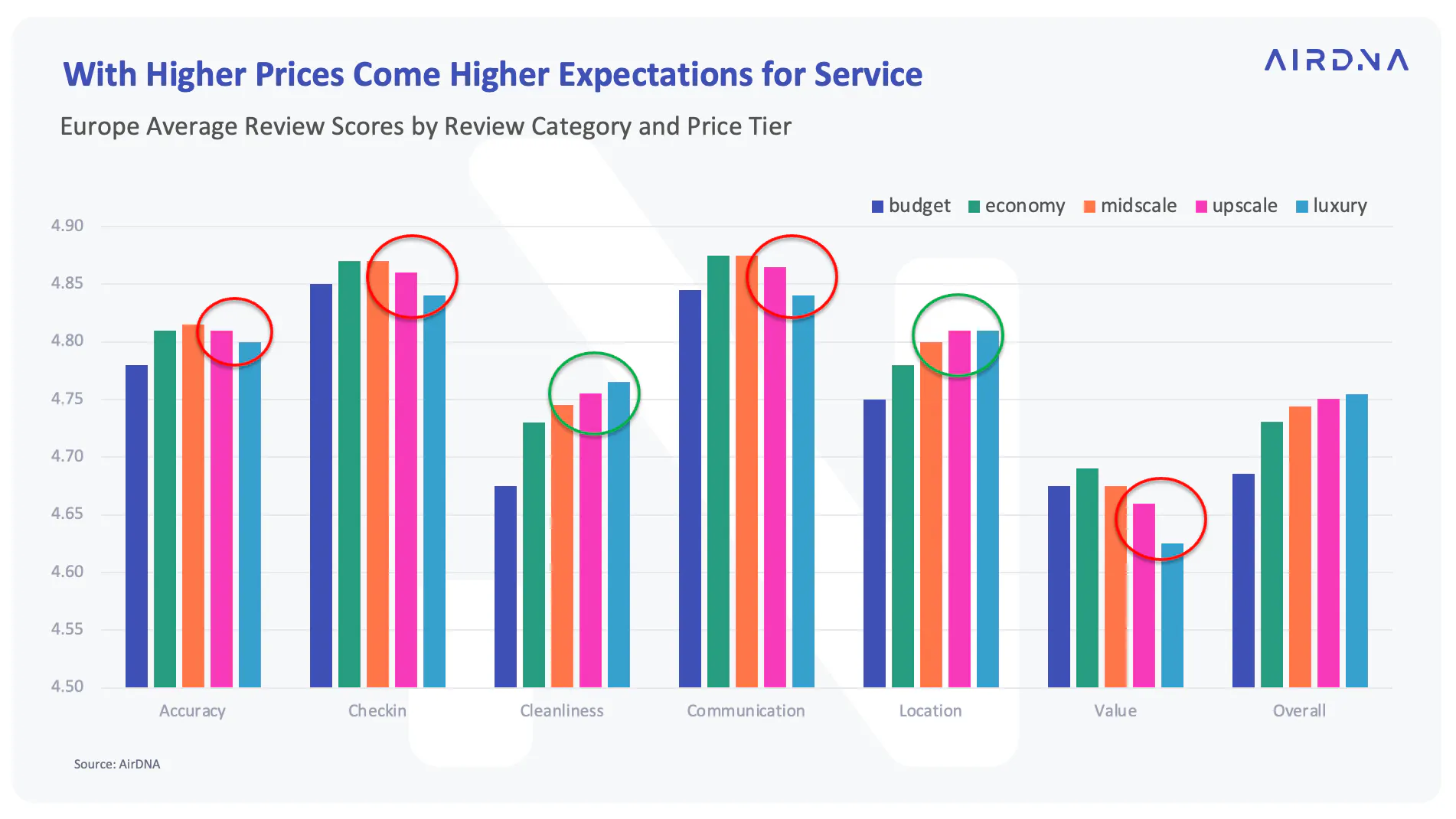
Average Airbnb ratings in Europe vary greatly depending on price tier and the number of properties the host operates. Higher-priced properties tend to receive higher average review scores but can falter in specific review categories. Currently, in Europe, the average review score for both upscale and luxury-priced properties is 4.75. Midscale properties have a slightly lower average review score of 4.74, and economy and budget properties have review scores of 4.73 and 4.68, respectively.
When analyzing review scores by category, higher price tier properties often excel in the location and cleanliness categories compared to other price tiers. Still, their accuracy, check-in, and communication scores are not as high as lower price tiers. This could come down to the clientele. Luxury guests who may be used to the service they receive from a luxury hotel concierge could find that the service they receive at even high-end Airbnbs is not what they’re used to. The inability of high-end listings to meet the expectations of luxury guests is resulting in significantly lower value scores than those of lower price tier properties.
The number of properties a host operates also greatly affects average review scores. Larger operators see consistently lower review scores. While single-unit and two-to-five-unit operators have average review scores of 4.79 and 4.77, respectively, the average review scores for operators with 21-99 units and 100+ units are 4.62 and 4.49, respectively. Smaller operators often manage their own properties and can be more attentive to quality control and guest needs. Larger operators tend to be property managers who oversee multiple listings for rental property owners and are unable to provide the same caliber of guest communication and property upkeep as smaller operators. As a result, smaller operators have better review scores across all review categories, particularly in the communication category.

Europe Demand Pacing Showing Strength Into the New Year
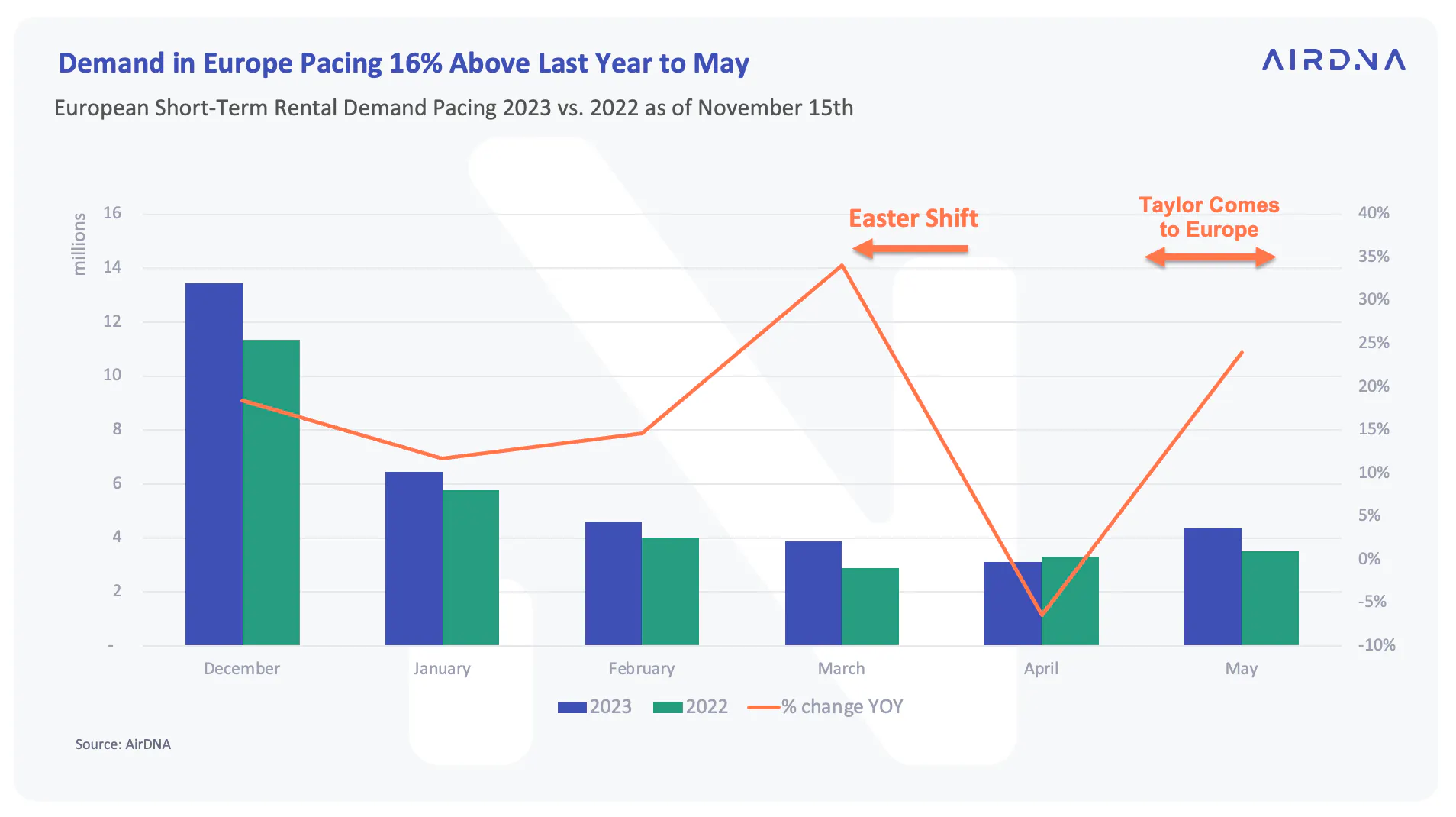
Travelers are already booking upcoming stays, signaling that European rentals will remain in high demand into next year. The current demand on the books for December through April is 15% higher than it was at the same time last year. For the holiday month of December, demand on the books is currently up 18% YOY. January and February, which are typically the slowest demand months of the year, are seeing 12% and 15% YOY growth in demand on the books.
Easter next year is on March 31st, and the holiday’s shift from April to March caused a significant jump in demand pacing for March (+34% YOY) and a subsequent 6% YOY decline in demand pacing for April. Taylor Swift’s Eras Tour through Europe begins in May, and Swifties who have already booked their stays are driving a 24% YOY uptick in May demand pacing.
Looking at popular European winter destinations, Spanish cities are leading the top 50 European cities. Those escaping colder climates are seeking the milder Mediterranean weather of Málaga, and current demand on the books for December through February is up 61% YOY in the popular Costa del Sol city. Those desiring a city rich in historical, architectural, and religious heritage are flocking to Seville, where demand on the books is currently up 54% YOY.
Eastern Europe continues to attract travelers on the hunt for cheaper stays. ADRs for booked nights from December through February in the top 50 European cities are currently averaging €160. However, in Bucharest, Warsaw, and Budapest, average ADRs for the next three months are below €100. These three Eastern European capitals are seeing generous YOY growth in demand pacing, with demand on the books up 45% in Bucharest and Warsaw and 35% in Budapest.

As part of our ongoing commitment to accuracy, we continuously implement data methodology improvements, leading to updates to some of the information in this report as of December 12, 2023. For further questions, please contact us.
NEW! Find For-Sale Properties for Your STR Investment with AirDNA

For-sale properties, new amenities insights, “days available” data … it’s been a busy month for AirDNA! In case you missed it, the all-new AirDNA just launched in September. But we didn’t stop there. We’ve been adding new features ever since. These are some of the top changes you’ll notice in October that will help you make smarter, faster investment decisions.
ARTICLE SUMMARY
Travel in Europe during the "shoulder season," especially in October 2023, has become really popular - beating records from before the pandemic. More people are booking trips, and places to stay are filling up fast as countries like Spain, Portugal, Greece, Italy, and Croatia are seeing a lot of visitors during this usually quieter time. It's an exciting look into how travel in Europe is growing in new ways after the pandemic.
Scott Sage
Senior Vice President, Marketing & Customer Experience
Scott is an Airbnb Superhost and industry pro, having founded Home Base BnBs—a short term rental management company that scaled to 200+ units. Scott combines his experience and passion for hosting to empower AirDNA customers' success. When he's not thinking about STRs, he is hiking, playing basketball, or playing pickleball.
