


Europe Market Review: High Demand Performance Powers Record Occupancy
Published: July 20, 2022
Last updated: November 13, 2026

Scott Sage
At a Glance: June STR Performance Summary
- Demand up 52.9% YOY, +3.2% vs. 2019
- ADRs up 4.8% from 2021 (+22.0% vs. 2019)
- Available listings down -4.7% vs. 2019, though up +16.6% from 2021
- Occupancy: 58.2%, ninth consecutive month of new highs
- Revenue up 60.2% from last June
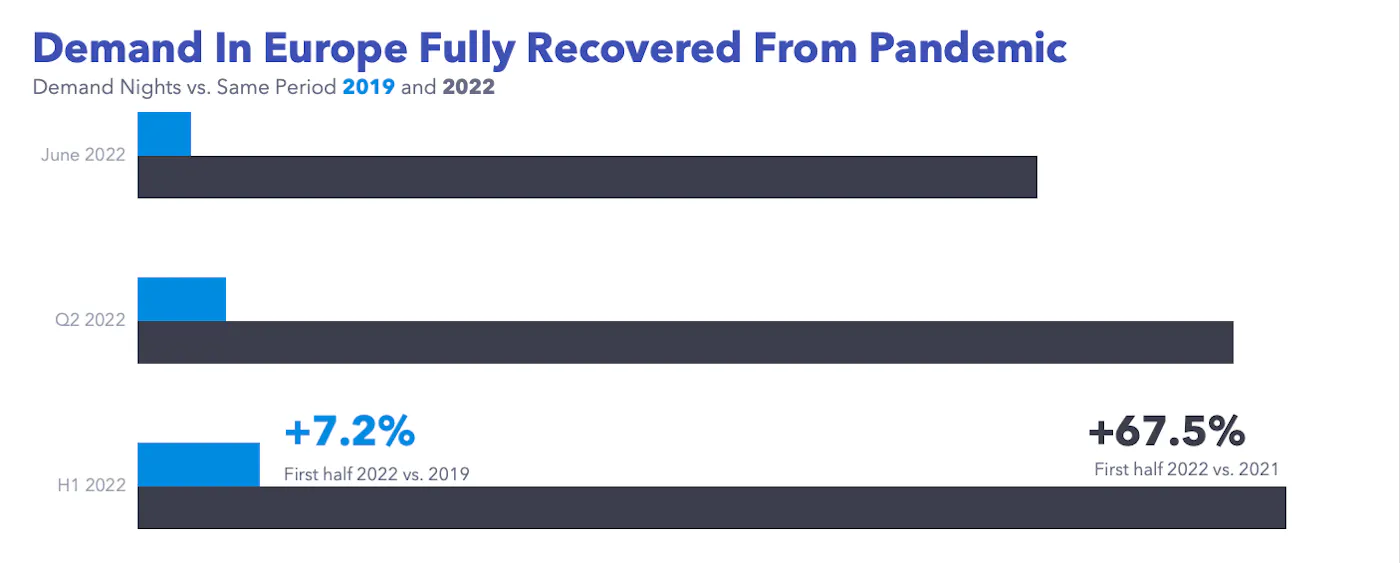
Demand for stays in short-term rentals continued positive momentum in the month of June, with 3.2% more nights booked in the month than in June 2019 (+52.9% vs. 2021).
Persistent growth in demand over 2019 has been witnessed for each month of 2022 thus far. Europe saw demand in Q2 reach 5.2% above 2019 (+64.4% vs. 2021), allowing the first half of 2022 to close at 7.2% above 2019 (+67.5% vs. 2021).
After a period of decline off 2021 highs between March 2022 and May 2022, average daily rates (ADR) in June stood just 4.8% higher than the previous year (+22.0% vs. 2019). A combination of inflationary pressures and the euro reaching parity with the U.S. dollar may conceivably result in a further increase in average daily rates within Europe as the industry fights to retain the value of stays against increasing costs.
Outperformance in demand, as well as an increase in rates, has accordingly allowed revenue to remain positive relative to 2019 for each month since October 2021. In June 2022, revenue ascended 25.9% higher than in June 2019. Europe closed the second quarter of 2022 with 29.6% more short-term rental revenue than in Q2 2019 (+66.2% vs. 2021). In the first half of 2022, the continent garnered 32.2% more revenue than in the same period in 2019 (+69.9% vs. 2021).
Monthly supply of available listings in the European continent has yet to fully recover to 2019 levels. Total supply of available listings in June was 4.7% below June 2019. However, when compared to 2021, this past June represented the strongest month of supply growth over last year, with 16.6% more listings.
Change in Supply Gaining Momentum Over 2021, Up 16.6% in June

Occupancy in the month of June rose 3.0% over 2019 figures (+12.6% vs. 2021), reaching a new record for the month. Attenuated supply caught within a deluge of pent-up demand has allowed occupancy to reach record highs for nine consecutive months.
Disparate Recovery Leads to Occupancy Imbalance in Top-20 Countries
The top-20 European countries experienced a range of demand recovery from 2021 lows this June. The greatest year-over-year increases were exhibited in Croatia (+131.8%), Norway (+117.0%), and Hungary (+96.7%), while the lowest growth rates were conceded by Finland (+27.4%), the United Kingdom (+29.0%), and the Netherlands (+34.0%), as the domestic travellers who bumped up their numbers in 2021 move back towards foreign holidays.
When comparing to 2019, the top-20 countries were divided in half for demand performance in June 2022. Greece, Germany, and France achieved the greatest changes in demand in the period, respectively garnering 27.2%, 26.1%, and 17.5% more nights stayed than in June 2019. As in May, the weakest demand relative to 2019 continued to be in the Czech Republic (-39.4%), Hungary (-30.3%), and Ireland (-26.8%).
Occupancy changes in the period between the top-20 countries illustrate that a balance between supply and demand has not yet been reached throughout Europe. Relative to 2019, 11 countries saw lower occupancy rates in June 2022. Occupancy in Italy was the strongest in the comparison period with 12.9% growth, while supply (-16.2%) has yet to recover at the rate of demand (+6.8%). A similar trend occurred in Portugal, where occupancy rates were 12.2% above June 2019, as supply remained down by 16.2%, though the country saw a nominal increase of 0.5% in demand in the period. Greece was the country to see the third highest increase in occupancy (+8.4%), where demand increased by 27.2% over 2019, and listings embraced a modest 5.1% gain.
The Occupancy Equation
Italy: supply -16.2% + demand +6.8% = occupancy up 12.9%
Portugal: supply -16.2% + demand +0.5% = occupancy up 12.2%
Greece: supply +5.1% + demand +27.2% = occupancy up 8.4%
Growth of available listings in June was most prominent in Austria (+15.2%), though the supply increase outpaced the growth in demand within the country (+8.6%), which resulted in overall occupancy rates being 3.8% lower vs. June 2019. Germany was the second strongest country in terms of available listing growth in the period, with 14.8% more listings in June. However, demand in Germany (+26.1%) more than offset the increase in supply, which allowed the country to see occupancy rates reach 5.7% higher than in June 2019.
Average daily rates continue to push higher from last June in 13 countries. The nations with the greatest increase in year-over-year ADR were Poland (+17.9%), Denmark (+14.4%), and the Czech Republic (+8.9%). However, prices in countries such as Finland, Austria, and Sweden seem to have hit a ceiling, as they are seeing the greatest declines from last year with -17.6%, -13.1%, and -7.8%, respectively.

Parity Between U.S. Dollar and Euro Could Entice International Travel
The euro has fallen nearly 12% to the U.S. dollar since the start of 2022 as investors seek to safeguard wealth during times of economic uncertainty. As of July 14th, the euro was equal in value to the dollar, which is the first occurrence of such an event in nearly 20 years. Some countries and industries within Europe may become more unsettled than others by the effects of the exchange rate. However, the short-term rental industry in Europe could conceivably benefit from the currency par, as it makes travel to Europe more attractive to international travellers, especially Americans who have been unable to do so for the past two years of the pandemic. Urban areas, in particular, could become more enticing to international travellers who have long been deterred from visiting large cities, as they are more accessible by air.
Astonishingly, international travellers in Italy during Q2 2022 made up 85.5% of the total Airbnb reservations in the country. While reservations from international guests in Italy were still down 68% from Q2 2019, an increase in travel affordability could aid in reviving international visitation. In the most recent quarter, European Airbnb travellers (excluding Italians) made up 51.3% of the total reservations to the nation, whereas this segment represented 44.3% in Q2 2019.
Similarly, Airbnb users from the U.S. increased their market share of total Italian Airbnb reservations in Q2 from 11.4% in 2019 to 16.6% in 2022. A stronger dollar and the easing of travel restrictions could perhaps lower the barriers to entry for American travellers, though the rising cost of airfare could create additional friction.
Prepared for international guests?

Competition is tougher than ever as new supply hits popular markets. Are you ready to win over international guests?
Check rates in your area with AirDNA's MarketMinderFrance: Bastille Day Demand Up Double-Digits vs. 2021
As of July 10th, demand for stays in France over Bastille Day weekend was pacing 39.7% higher vs. 2019 (35.4% vs. 2021). All of the regions in France were trending toward double-digit gains in demand over the holiday weekend vs. 2019, except Île-de-France, which was pacing -9.4% lower in the comparison period. The strongest gains in demand were being witnessed in Normandy (+78.1%), Hauts-de-France (+75.7%), and Centre-Val de Loire (+74.4%).
Relative to 2021, demand for stays in the north-eastern/central regions of France was exhibiting the strongest change in demand for the holiday. While demand as of July 10th for Île-de-France remained negative relative to 2019 over the Bastille Day weekend, the capital region was posting the greatest climb over last year for the holiday weekend, 123.1%.
Demand for the city of Paris was pacing 116.8% above 2021, while all neighbourhoods were commanding triple-digit gains over the period. Buttes-Chaumont (+178.5%), Observatoire (164.1%), and Batignolles-Monceau (149.3%) were trending toward the steepest demand inclines vs. last year for the French national holiday.
Unprecedented Demand in Birmingham, UK for Commonwealth Games
Demand for short-term rental stays during the Commonwealth Games in Birmingham is surging at an unprecedented rate. As of July 10th, there were over 21,000 short-term rental nights booked between July 28th and August 9th. This figure equates to 373.2% more nights on the books relative to the same period in 2019. In the first half of 2022, Birmingham averaged roughly 2,800 listings. Relative to the influx in demand, the market has only moderately increased total available supply leading up to the event by 17.7% in June 2022 over June 2019.
Of the 10 boroughs and cities in Birmingham, all are seeing triple-digit growth in demand pacing for comparable dates in 2019. The highest increase in demand as of July 10th was in Sandwell with 281.5%, followed by Wolverhampton (+198.8%) and Solihull (+189.6%).
Birmingham Bookings Up Triple-Digit Percentages for Commonwealth Games

Demand Pacing Outlook
As of July 10th, demand behaviour for the second half of 2022 was beginning to normalise with 2019. Relative to the same months in 2019, the months of July and September were pushing toward gains of 10.0% and 8.0%, respectively. And while the most popular travel month, August, was heading towards a 3.3% decline, Q3 overall demand was tracking toward 4.2% above 2019.
Demand pacing for Q3 was divided amongst the top-20 countries when compared to 2019, with 10 countries drawing gains and 10 bearing losses. Greece continues to see the greatest increase in demand over 2019, with 26.5% more demand for stays in Q3 over 2019. Germany followed closely with 26.4% more demand in the period, followed by Austria (+17.5%), France (+14.5%), and Belgium (+14.4%). On the other end of the spectrum, the Czech Republic, Hungary, and Ireland persist, bringing up the rear of the demand pacing, with each respectively remaining -33.0%, -27.7%, and -20.2% below Q3 2019.
Despite 12 of the top-20 countries pacing toward a decline in rates from last year, as of July 10th, European ADR was tracking 1.3% above 2021 for Q3. Finland is seeing the largest slashes in Q3 prices relative to last year at (-24.2%), followed by Belgium (-10.5%) and Ireland (-8.1%). Meanwhile, Denmark is trending towards double-digit rate hikes over Q3 last year, rising by 14.9%. Poland (9.5%) and Germany (8.1%) were also making notable strides in ADR over the period.
Broader economic implications pertaining to monetary policy, exchange rates, war, and inflation provide both opportunities and threats to the outlook of the short-term rental market. Booking pace normalising with 2019 figures indicates that there is no shortage of overall demand in the European short-term rental market. As rates trend off the highs of Q3 2021 in the majority of the top-20 countries and exchange rates provide increased affordability, there is an opportunity for the continent to recover international demand.
However, rising airfare and airport bottlenecks during peak periods could be viewed as a deterrent to some travellers. The decline of the euro may price a portion of Europeans out of travelling abroad this year. It is unlikely that this segment would avoid travel altogether, instead opting for more budget-friendly itineraries and closer-to-home destinations.
Additionally, increasing interest rates and inflation could impact the acceleration of new supply on two fronts – investors may shy away from entering the market while existing second homeowners could become more inclined to rent their homes for supplemental income during economic downturns.

Mid-Year Outlook Report
What's to come for the STR industry?

Vacancies for summer?
Use our Smart Rates to price perfectly and fill up your calendar.
Europe Review: May 2022
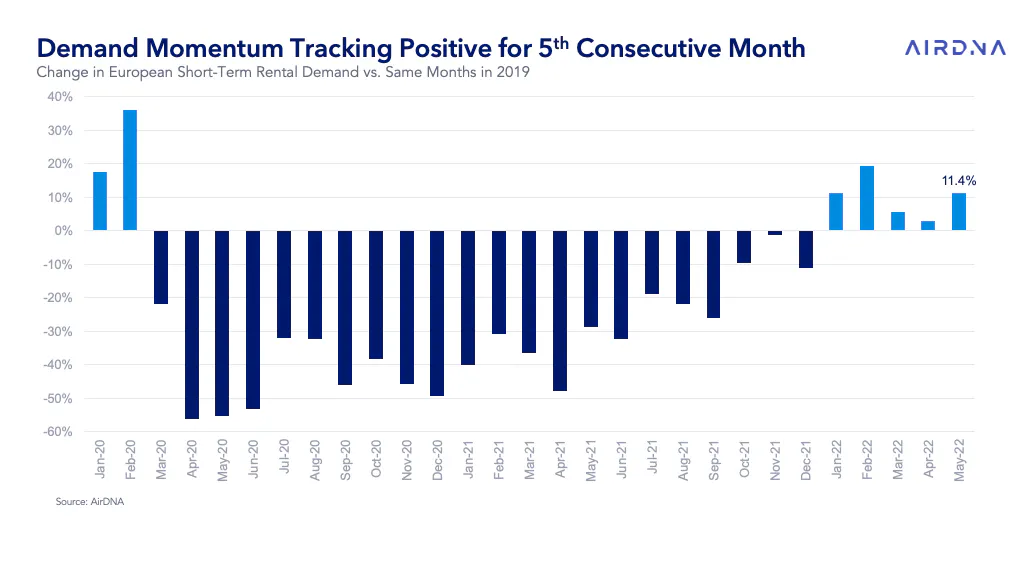
Demand for European short-term rentals in May was 11.4% higher than the same month in 2019.
ARTICLE SUMMARY
The travel recovery is fully on in Europe: in the first half of 2022, 7.2% more nights were stayed in a European holiday rental than in the same period in 2019. Occupancy in June hit record levels for the ninth month running.
Scott Sage
Senior Vice President, Marketing & Customer Experience
Scott is an Airbnb Superhost and industry pro, having founded Home Base BnBs—a short term rental management company that scaled to 200+ units. Scott combines his experience and passion for hosting to empower AirDNA customers' success. When he's not thinking about STRs, he is hiking, playing basketball, or playing pickleball.
Related



Get started with AirDNA today.
Powerful, easy-to-use tools that help hosts and investors succeed in the short-term rental market.
Try for free