

 Calculate Revenue
 Research Markets
 Find For Sale Properties
 Compare My Listing
 STR Revenue Calculator
 Custom Comp Sets
 Submarket Insights
 Custom Search Filters
 Rate Recommendations
 Performance Benchmarking
 Competitor Comparison
 Owner Contact Details
 Property-level performance data
 Tourism Insights
 Real Estate Investment Analytics
 About Us
 Sales
Sales Support
 Press
PressEuropean Market Review November 2022: Cautious Optimism for Winter Travel in Europe
Published: December 21, 2022
Last updated: May 5, 2026

Scott Sage
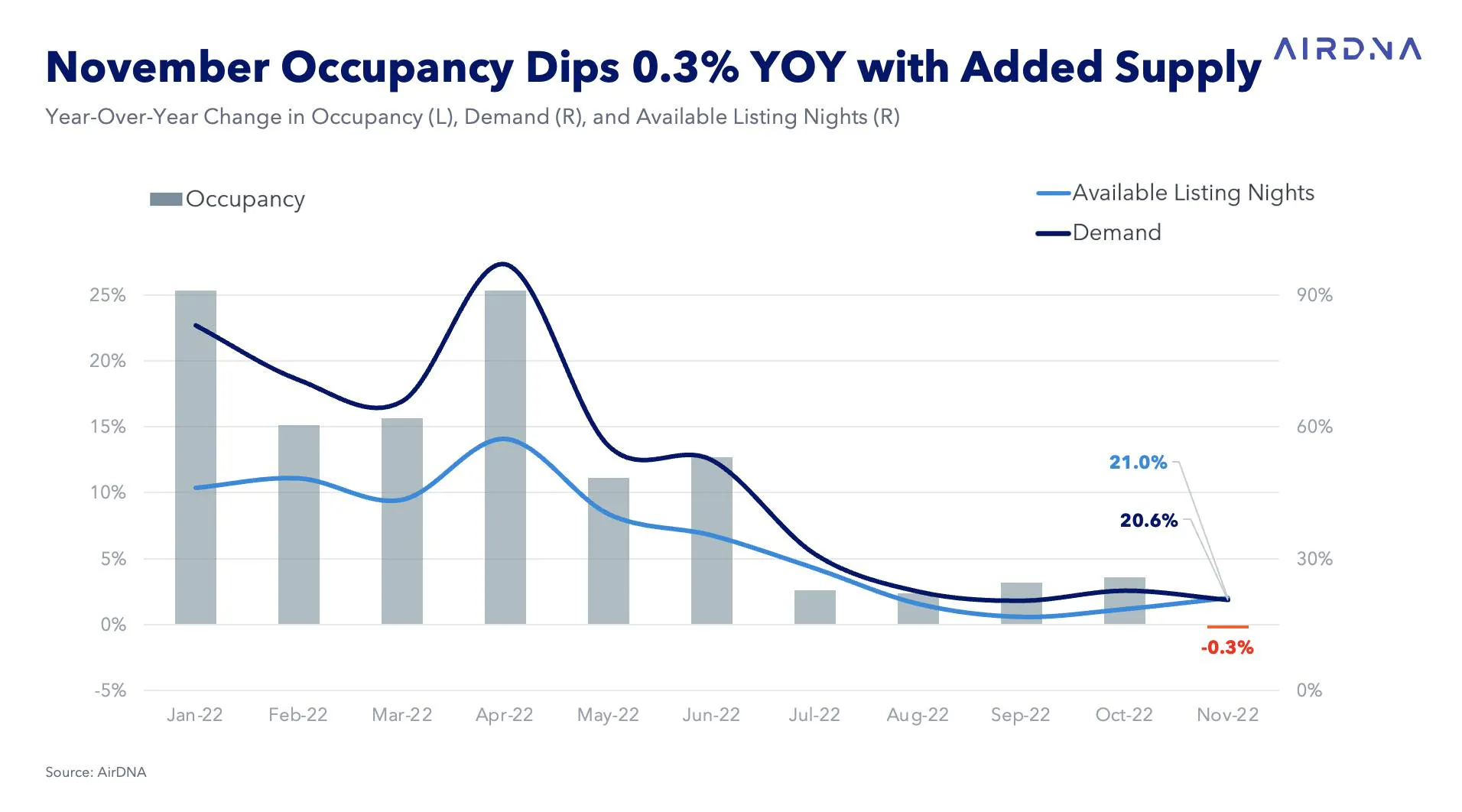
The European continent ended the month of November with 16.8% more nights stayed than in 2019 (20.6% vs. 2021).
Occupancy was also 17.2% higher than in 2019, though had fallen by 0.3% relative to 2021. This fall in occupancy, despite the climb in demand, was a result of a greater level of supply in the market relative to last year.
Available listings rose 13.5% in the period over last year, marking the 11th straight month of year-over-year (YoY) supply growth.
When compared with 2019, listing counts remained 3.7% lower, though this was the second closest the continent had been to pre-pandemic monthly supply levels since May 2022 (-3.3%).
Average daily rates (ADR) in the month continued to rise over last year. On average, guests paid 6.4% more for stays this November relative to 2021 (+33.5% vs. 2019). The growth in demand and ADR allowed the European continent to earn $3.16 billion in revenue in November, which represented a 28.3% increase over last year (55.9% vs. 2019).
Supply, Demand Growth Prevalent in Majority of Top-20 Countries
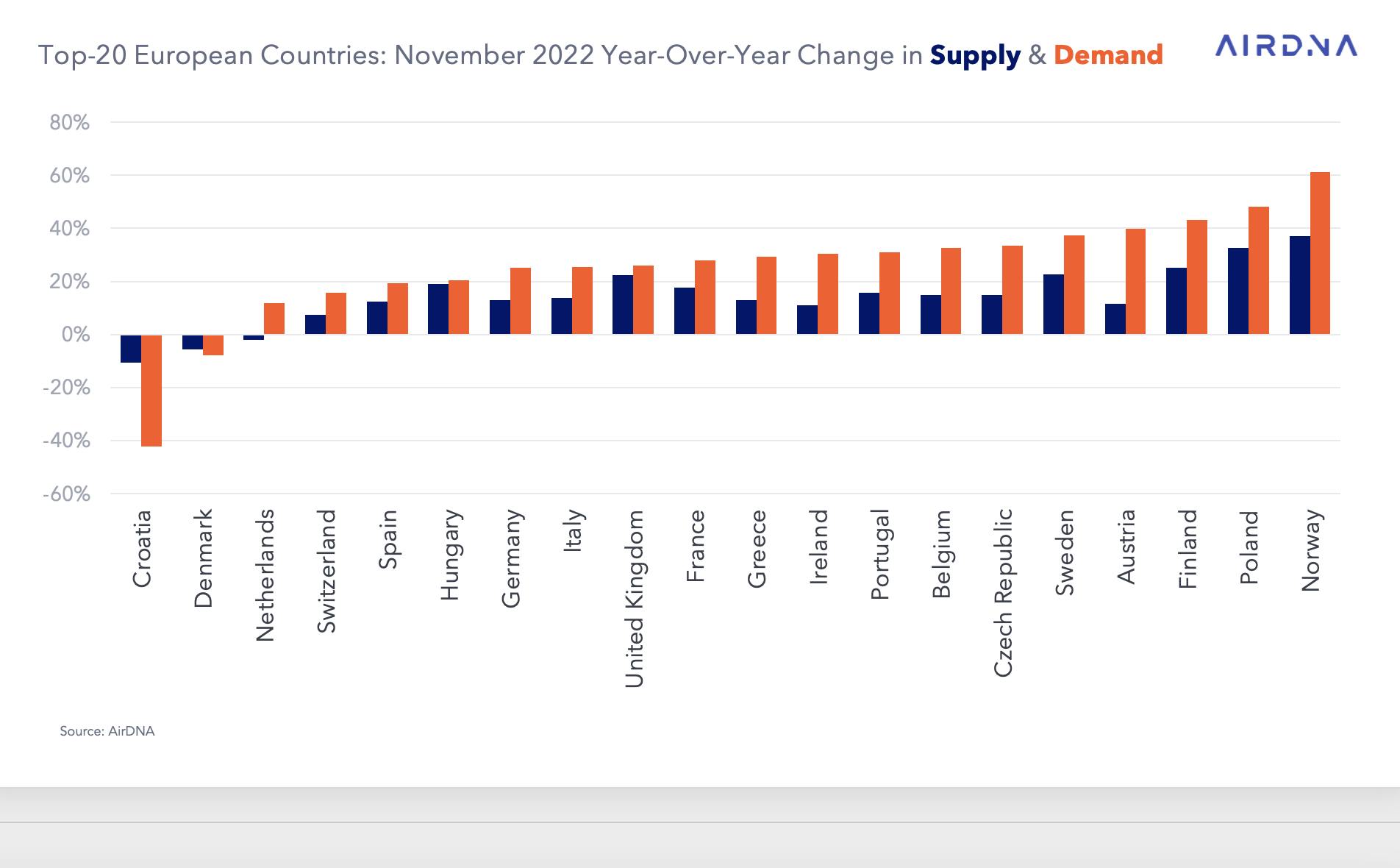
On a year-over-year basis, 18 of the top-20 European countries saw an increase in demand in November. Norway saw the largest increase, with 61.2% more demand than last year, followed by Poland (48.2%) and Finland (43.2%). On the supply side, 17 of the top-20 European countries saw listing growth in the period relative to last year. In addition to seeing the strongest year-over-year gains in demand in the month, Norway also saw the greatest growth in terms of available listings, with 37.0% more listings than last November. Poland (32.6%) and Finland (25.1%) also made significant listing gains in the period.
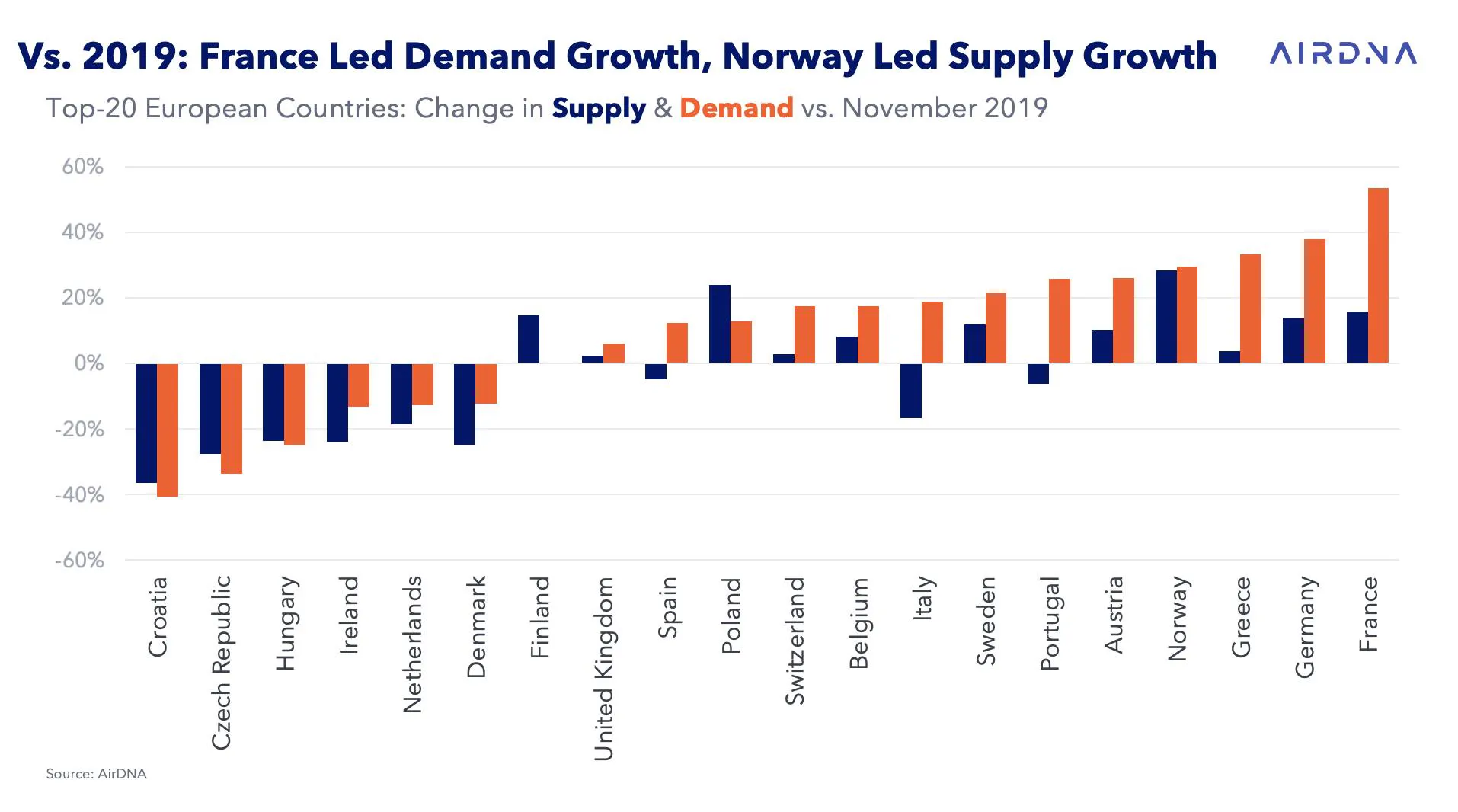
When compared with 2019, however, only 14 of the top-20 countries saw increases in the period. The greatest gains relative to 2019 were in France (53.3%), Germany (37.9%), and Greece (33.2%), while the falling behind were Croatia (-40.6%), the Czech Republic (-33.8%), and Hungary (-24.9%). November supply of available listings grew in 11 countries over the three-year period. Norway was also the leader in this comparison period, with 28.2% more listings, followed by Poland (23.8%) and France (15.7%).
In November, occupancy fell in seven of the top-20 European countries. Occupancy last year was at all-time highs in many markets, as supply was deflated in the aftermath of the pandemic. Now, listing growth has caught up, and is even growing faster than demand, causing these drops in occupancy.
Increasing year over year on the whole, average daily rates rose in 17 of the top-20 countries. Norway took the lead again, with 13.9% higher rates in the month relative to last November, followed closely by Croatia (13.8%) and Sweden (12.8%).
2022: The First 11 Months in Review
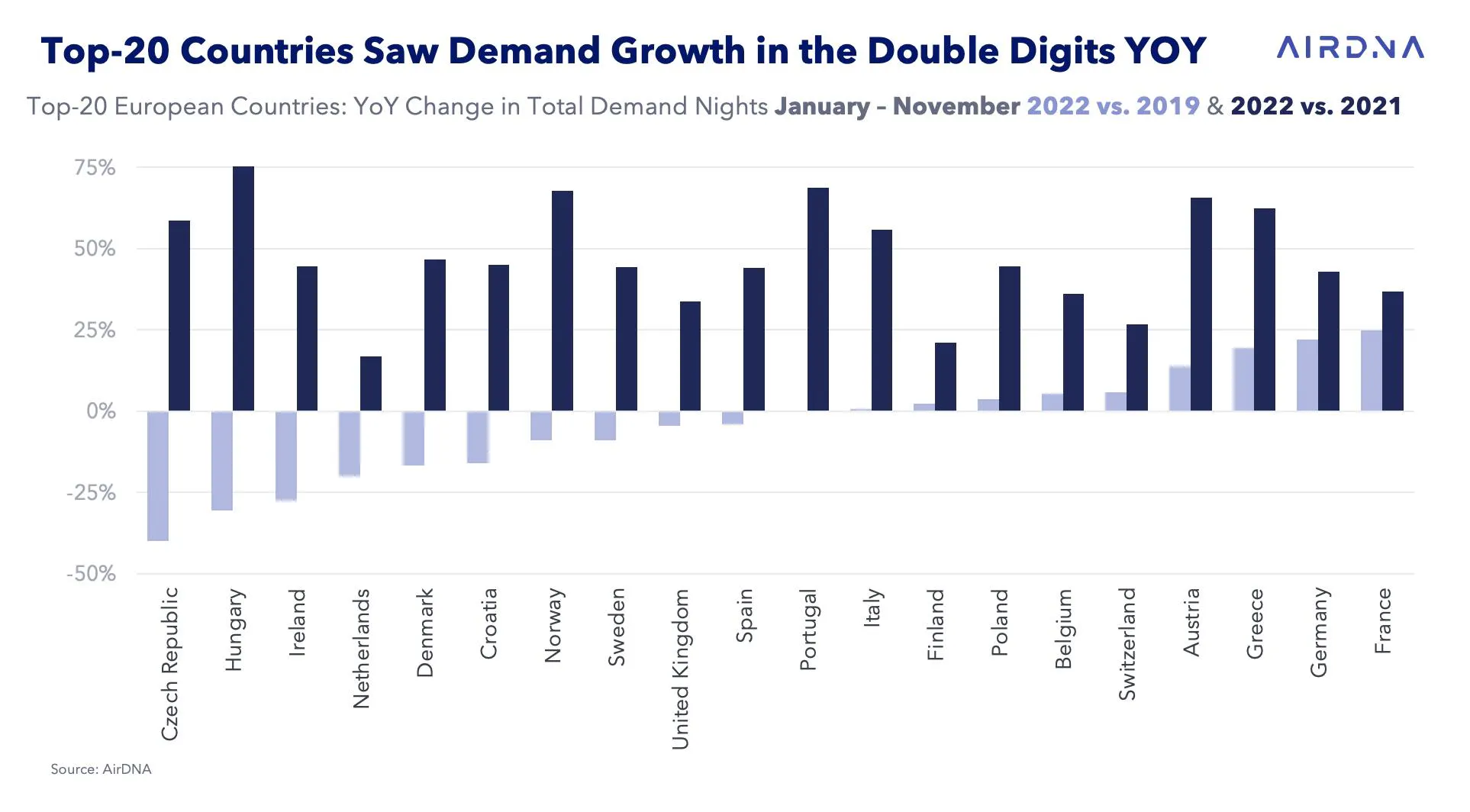
Between January and November 2022, the European continent amassed more than 330 million total demand nights, representing an increase of 40.1% over 2021 and 2.4% over 2019. It’s worthy here to note the European short-term rental market’s ability to recover from the pandemic and display resilience through economic difficulties.
Each of the top-20 countries was able to grow total demand nights by double digits between January and November relative to last year, while nine nations landed in positive demand territory relative to 2019 in the same comparison months. Despite remaining 30.5% below 2019 figures in the first 11 months of 2022, Hungary made the greatest recovery in the period over 2021, with 75.3% more demand nights thus far this year. France was able to gain the most demand relative to 2019 (24.8%) and made a remarkable stride over 2021, with 36.7% more nights booked between the first 11 months of 2021.
Demand Pacing Shows Signs of Slowing vs. 2019 in Q1 2023
As of December 11th, the European short-term rental market was pacing toward a 19.6% YoY increase in demand nights booked in the month of December (+0.1% vs. 2019). Looking toward Q1 2023, pacing is down relative to 2019 as travelers weigh broader economic conditions. The continent was pacing below 2019 demand figures by 11.5%, though 17.1% above 2021. The decline from 2019 demonstrates a level of hesitancy compared with pre-pandemic travel patterns. Nevertheless, sentiment has made strides toward recovery as reflected in the comparison to 2021.
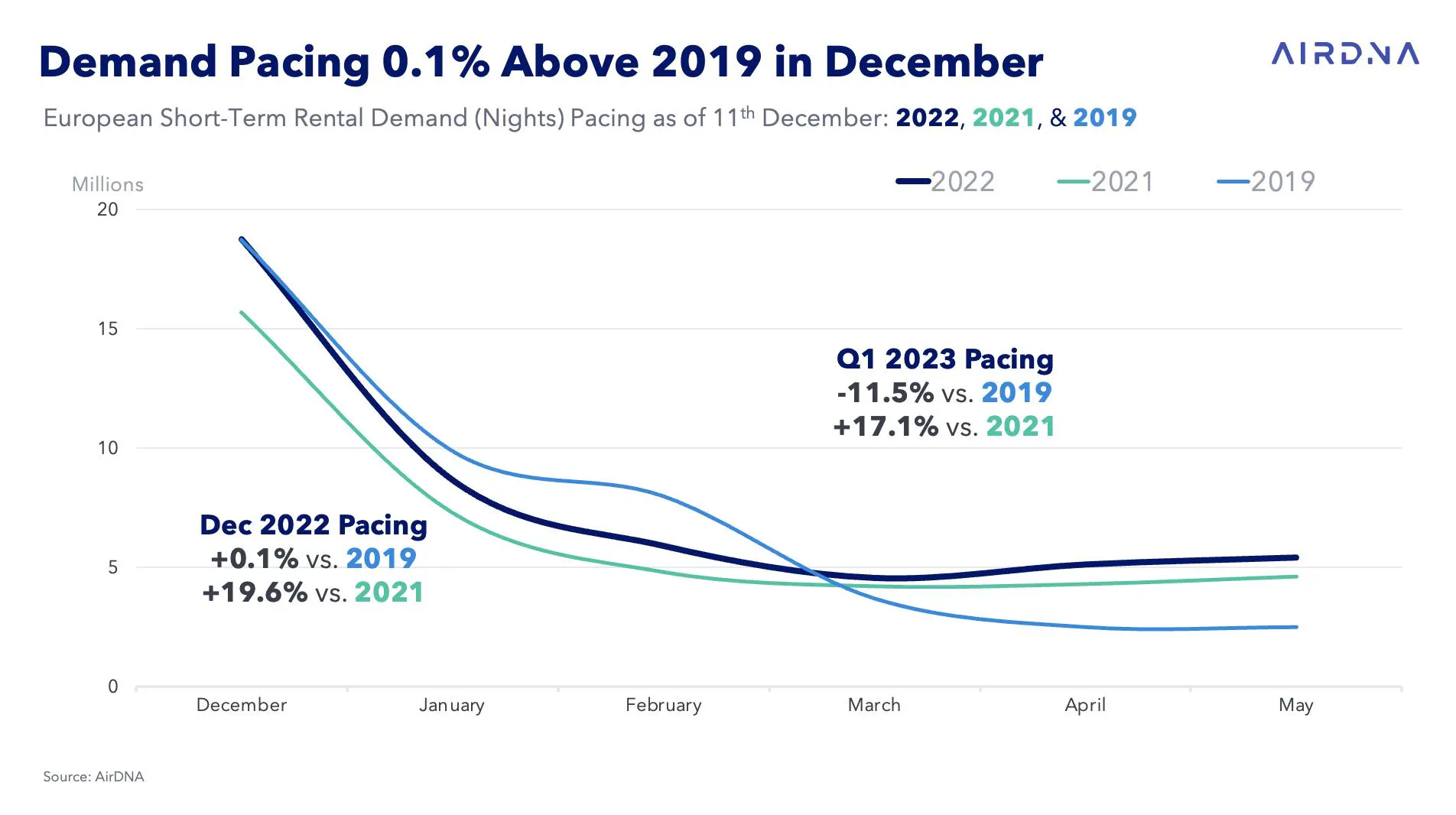
December demand was pacing higher in 18 of the top-20 countries relative to last year. Croatia (-48.5%) and Denmark (-15.7%) were the two nations that were experiencing a decline in December nights booked. Despite a year-over-year decline in demand pacing, average daily rates in Croatia and Denmark were trending toward the second- and third-highest growth rates over last year among the top-20 countries, up 18.4% and 11.7%, respectively. Average daily rates in December were leaning higher in 17 of the countries relative to 2021, with the greatest increase of 28.7% being present in the Czech Republic.
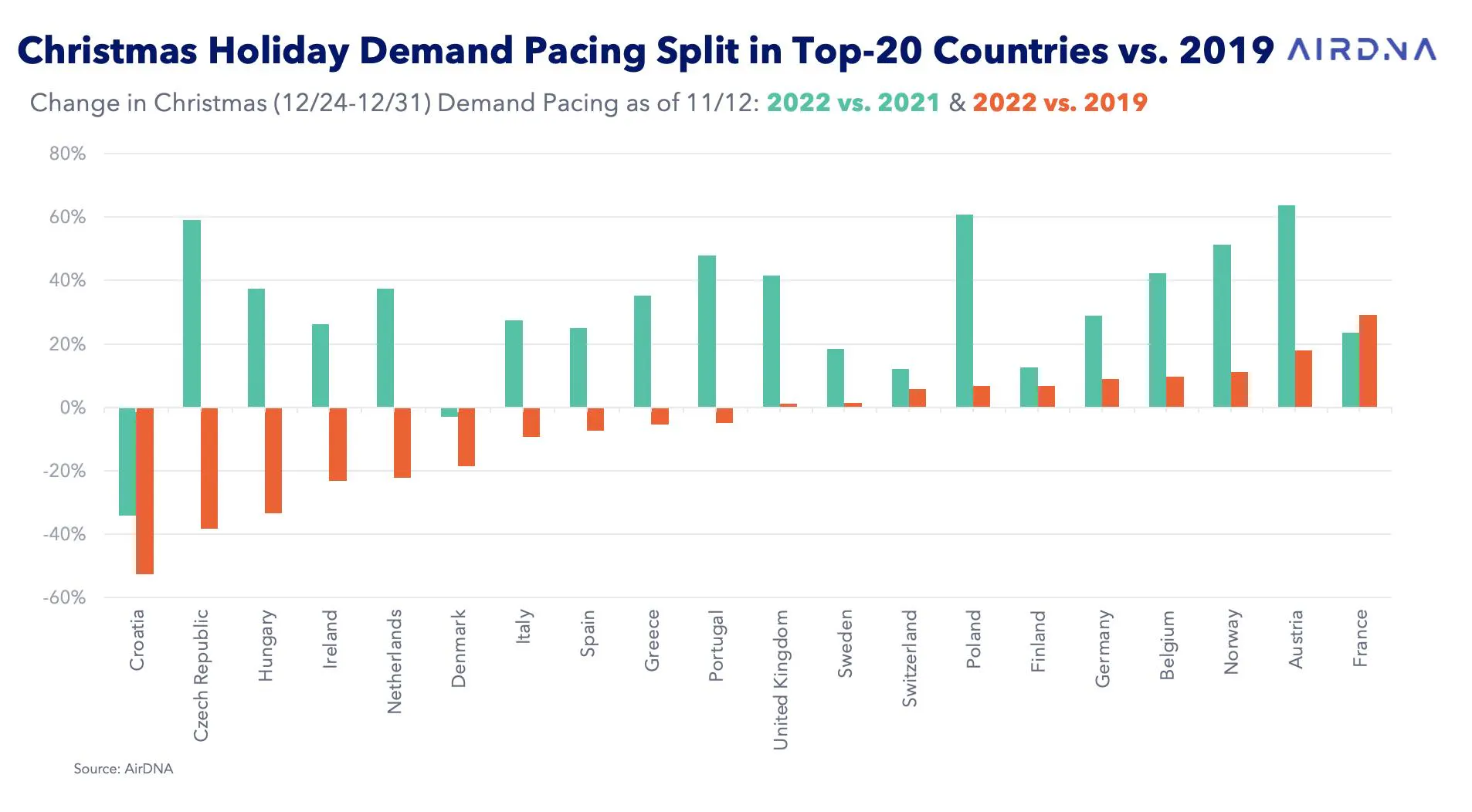
When drilling down to the last week of December (24th – 31st), we can see a similar trend to that of the full month’s performance, with 18 of the top-20 nations surpassing demand pacing relative to 2021. Nights booked in Austria (63.8%) were up the most for Christmas week, followed by Poland (60.9%) and the Czech Republic (59.1%). Croatia and Denmark were the two countries trending lower by 34% and 3%, respectively. In contrast, the final week compared with 2019 was split, with 10 of the top-20 countries in positive demand pacing territory—similar to the trend for the entire month. Relative to three years prior, demand pacing in France (29.2%), Austria (18.0%), and Norway (11.0%) was growing the most, while Croatia (-52.6%), the Czech Republic (-38.4%), and Hungary (-33.4%) were pacing towards the deepest declines.
Average daily rates for the holiday time frame were growing among 17 of the 20 nations over last year. Rate declines were trending in Greece, Finland, Austria, and Switzerland by -12.2%, -8.2%, -1.3%, and -0.9%, respectively. Though double-digit rate growth was present in Czechia (35.6%), Croatia (25.1%), and Denmark (11.7%).
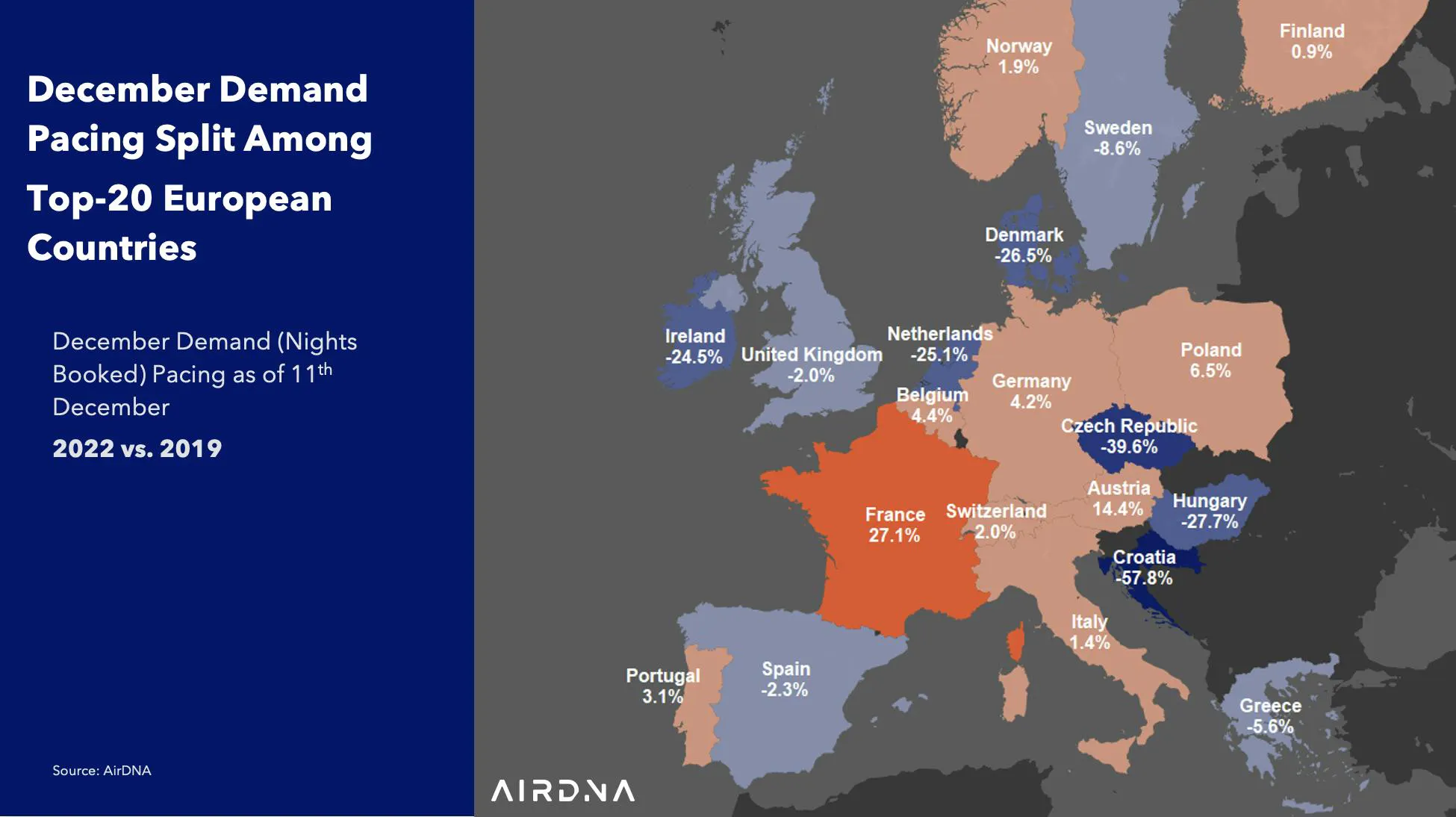
Compared with 2019, the top-20 countries were split in terms of December demand pacing as of December 11th. France was experiencing the strongest growth relative to 2019, with 27.1% more nights booked for December stays than at the same point in 2019, followed by Austria (14.4%) and Poland (6.5%). The greatest declines in demand pacing were coming out of Croatia (-57.8%), the Czech Republic (39.6%), and Hungary (-27.7%).
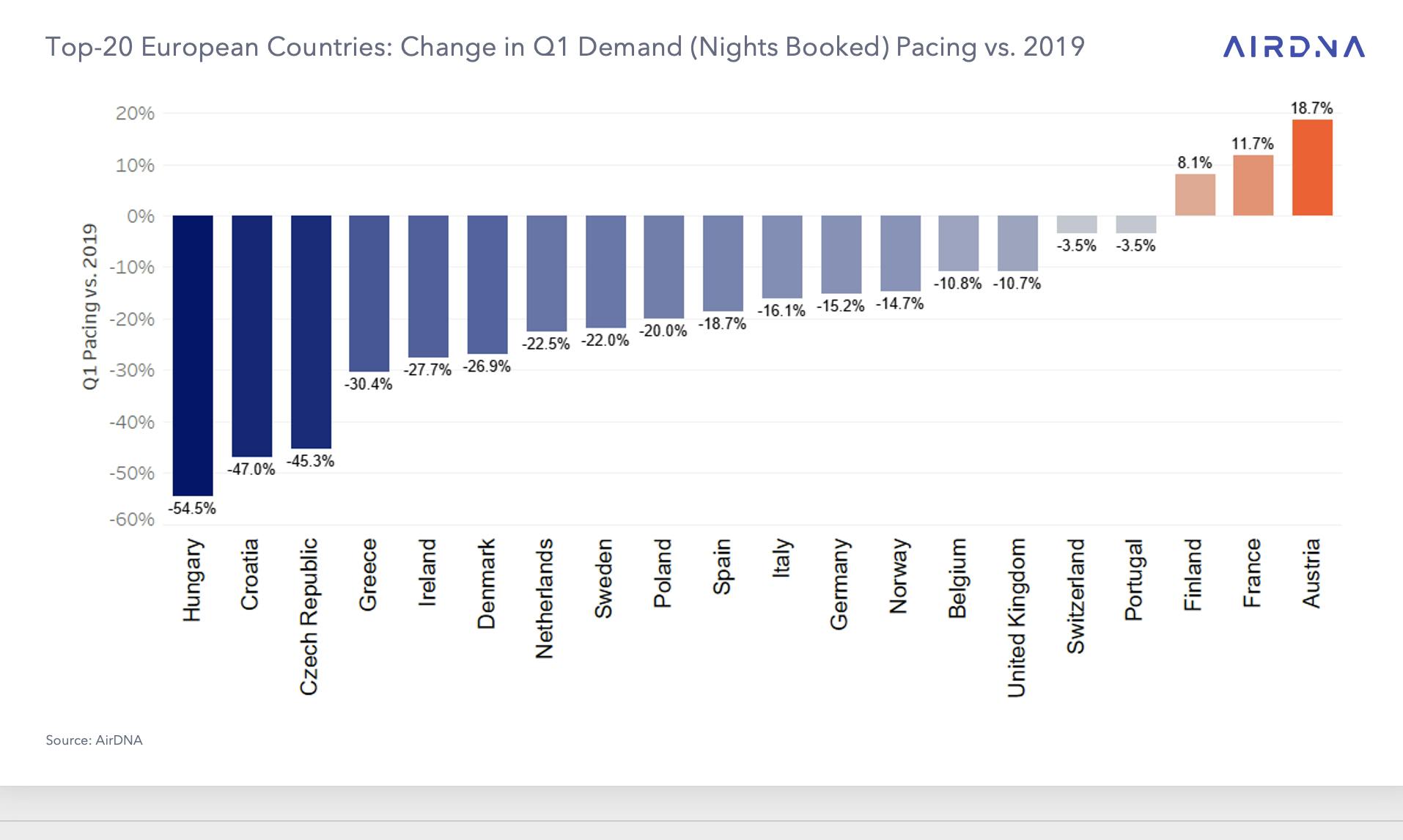
When looking into 2023, negative demand pacing trends were much more prevalent, with 17 of the top-20 European countries pacing lower in Q1 relative to 2019. Austria (18.7%), France (11.7%), and Finland (8.1%) were the three countries pacing toward gains in Q1 2023 over 2019, while Hungary (-54.5%), Croatia (-47.0%), and the Czech Republic (-45.3%) were swinging the lowest in the period.
While traveler demand for short-term rentals in Europe remains robust, the outlook is highly uncertain, as guests are reluctant to book far in advance for trips this winter. Higher energy costs, an ongoing war, and the prospects of a deep recession are clearly on the minds of potential guests as they plan travel for the year ahead.
U.S. 2023 Short-Term Rental Outlook
Find out what's in store for the U.S. short-term rental market in 2023 in our latest outlook report
Data before drama
Analyze better and make the right decisions for your STR business with AirDNA.
5 Data-Driven Tips on How to Prepare for 2023
Are you a property manager prepping for 2023? Our analytics have you covered.
ARTICLE SUMMARY
November was another month of growth for demand and supply in the European short-term rental market. Holiday lets on the continent are seeing an increase in demand for Christmas week in 18 of the top-20 countries, though this winter is not yet reaching the highs of 2019-2020.
Scott Sage
Senior Vice President, Marketing & Customer Experience
Scott is an Airbnb Superhost and industry pro, having founded Home Base BnBs—a short term rental management company that scaled to 200+ units. Scott combines his experience and passion for hosting to empower AirDNA customers' success. When he's not thinking about STRs, he is hiking, playing basketball, or playing pickleball.
