


Are Townhomes Good Rental Properties? Pros & Cons
Published: April 9, 2024
Last updated: September 25, 2026

Bram Gallagher
Key Takeaways:
- Townhomes offer an affordable entry point for first-time investors, though they may have a lower return on investment compared to single-family homes.
- Townhomes can provide higher rental income potential and lower maintenance costs, but HOA fees and regulations may impact profitability.
- Evaluating market location, demand, and property characteristics is essential to determine if a specific townhome is a good short-term rental investment.
As the real estate market evolves, investors constantly seek new opportunities to grow their portfolios and generate steady income. That search has attracted many investors to townhomes for their unique blend of affordability, convenience, and potential for rental income.
Townhomes currently represent only 3% of listings on Airbnb and Vrbo combined, but that figure is larger in some markets and could grow in 2024 as more investors consider taking the townhome plunge.
The question remains, though: Are townhomes a good investment? Though townhomes have their allure, they also have genuine drawbacks. Understanding both is essential to deciding whether investing in townhomes suits your investment strategy.
Are Townhomes a Good Investment?
The short (and likely unsatisfying) answer to this question is that it depends. In most markets, townhomes have a slightly lower yield than houses as a property type, but they tend to be about $100,000 cheaper.
That price difference means that townhomes are about 12% cheaper than single family homes, but their revenue potential is 21% lower—hence the smaller return on investment (ROI) overall.
The lower price point is an advantage that makes townhomes more attainable and affordable to first-time buyers entering the housing market. That being said, mortgage rates are around 7% right now, and stepping down from an 8.7% national average yield for homes to a 7.8% average yield for townhomes is significant.
There are some U.S. markets where the purchasing price for townhomes is less than that of single family homes and they earn more. These destinations represent the investing sweet spot for townhomes. While not a comprehensive list, a townhomes is a smarter investment than a single family home in the following locations:
- Savannah, Georgia
- Seattle, Washington
- Key West, Florida
- Philadelphia, Pennsylvania
- Denver, Colorado
- Pensacola, Florida
We explore annual revenue potential (i.e. earning potential) and average yield, as well as their strengths and shortcomings as investment metrics, in a later section on top-performing townhome markets.
What Is a Townhome?
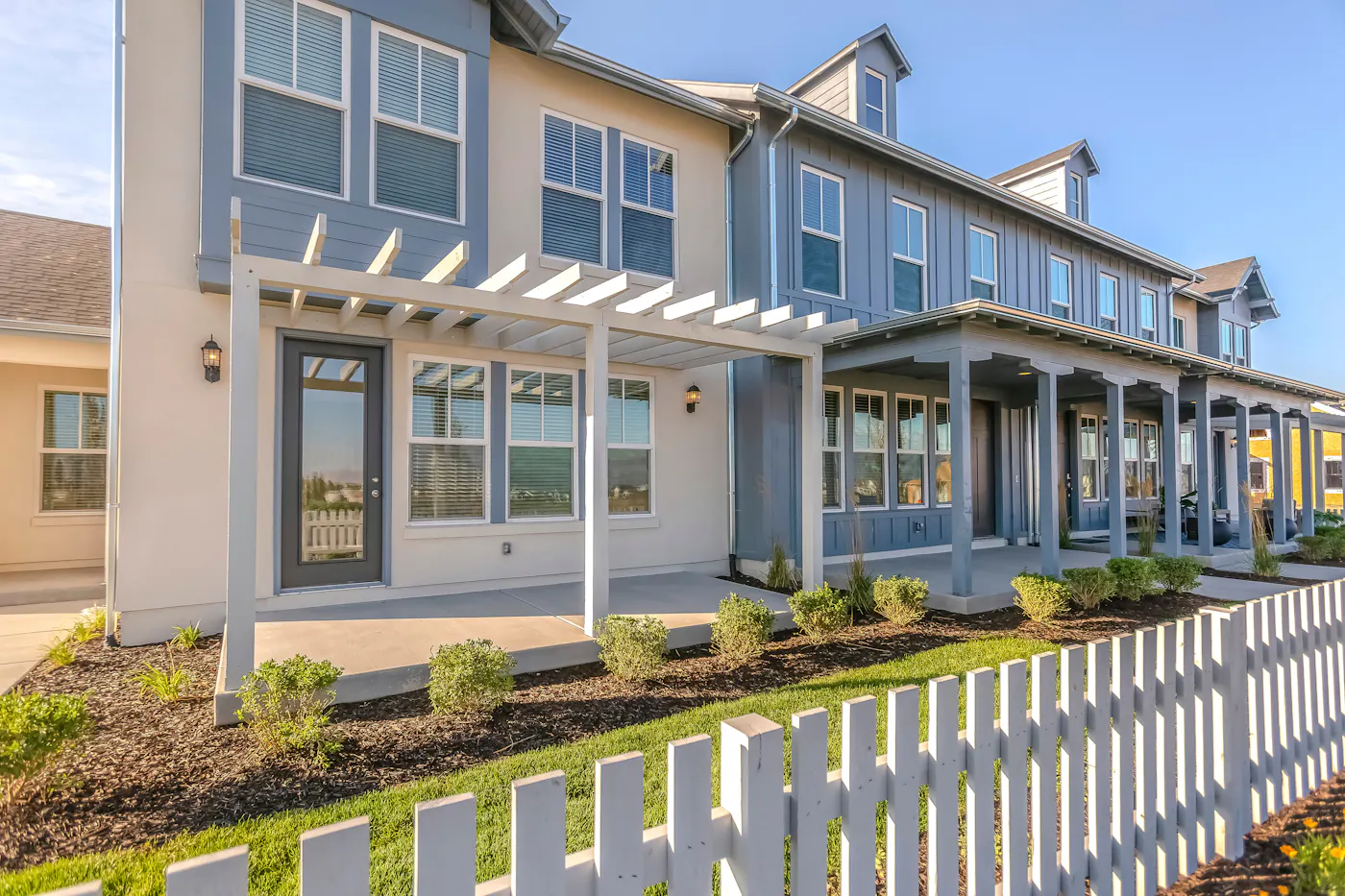
A townhome, also known as a townhouse, is a type of residential dwelling that shares at least one wall with adjacent units but has its own separate entrance.
Townhome STR guests may enjoy amenities such as private outdoor spaces, attached garages, and shared community facilities. This makes them an attractive option for travelers seeking a balance between privacy and community.

Key Features Distinguishing Townhomes From Condos and Apartments
Townhomes offer a unique blend of features that set them apart from both condominiums and apartments. These include:
- Private Entrances and Outdoor Spaces: Townhomes offer individual entrances and often include private outdoor areas, providing guests with a sense of privacy and autonomy.
- Traditional Layout: Unlike condominiums, townhomes typically have multiple floors and a layout that resembles a single-family home. This offers guests more space and a house-like feel.
- Horizontal Arrangement: Townhomes are usually arranged horizontally in rows, as opposed to the vertical stacking of condominium units in high-rise buildings, which can be more family-friendly.
- Ownership Structure: While apartments are often rented out by a landlord or property management company, townhomes are usually individually owned. This means that townhome owners have more control over their living space and they’re responsible for maintaining their property's exterior, including landscaping and upkeep.
- HOA Regulations: While townhomes may be subject to homeowners association (HOA) regulations and monthly HOA fees, owners often have more autonomy than condominiums. As an Airbnb host, this allows for greater flexibility in managing your STR.
Pros of Townhouse Investment
Despite townhomes’ prowess in multiple markets, that doesn’t necessarily mean they’re the right asset class for you in the real estate market. However, there are some real pros to consider as you ponder whether townhomes are a good investment property choice for you.
Land Ownership
Townhome investments offer the distinct advantage of owning the land beneath the unit. Unlike condominiums, where land ownership is typically communal, townhome owners have exclusive ownership of the land on which their unit is built. This ownership provides added security and potential for property appreciation over time.
Potential for Higher Rental Income
One of the key benefits of a townhome investment property is its potential to generate higher STR income compared to traditional apartments or condominiums. Townhomes often offer more space, privacy, and amenities, making them attractive to guests willing to pay premium rental rates. Additionally, townhomes may appeal to a broader range of guests, including families and professionals seeking a comfortable living environment.

Lower Maintenance Compared to Single-Family Homes
While single-family homes require owners to bear the full responsibility of maintenance and upkeep, townhome investments offer a more manageable maintenance burden. Townhome owners typically share exterior maintenance responsibilities through homeowners associations (HOAs). Monthly HOA fees cover tasks such as landscaping, repairs, and community upkeep. This shared responsibility can significantly reduce maintenance costs and streamline property management for investors.
Potential for Appreciation
Townhomes, like other real estate assets, can appreciate over time, driven by factors such as location and market trends. Investing in townhomes in desirable neighborhoods or areas experiencing gentrification may yield higher appreciation rates. Conducting thorough research and selecting properties with strong appreciation potential can maximize long-term investment returns.
Cons of Investing in a Townhouse for Airbnb
As lucrative as townhouses can be, don’t get carried away with the revenue potential. Townhouse investing also comes with unique challenges and considerations that prospective investors should carefully evaluate before making a decision.
HOAs
The involvement of an HOA can complicate any investment property, especially an STR investment. While they can provide benefits such as shared maintenance responsibilities and community amenities, they also come with monthly fees and regulations that property owners must adhere to. These fees can vary widely depending on the HOA's services and amenities, and failure to comply with HOA rules may result in fines or other penalties.
Regulations and Restrictions
Townhome investments may be subject to various regulations and restrictions beyond the HOA. Regulations from local government authorities can dictate aspects such as length of stay, pet restrictions, exterior modifications, and noise ordinances. Real estate investors should thoroughly review and understand these regulations to ensure compliance and avoid potential conflicts with regulatory agencies in their area.
Shared Amenities
While shared amenities such as fitness centers, swimming pools, and community spaces can make townhome investments more appealing, they also pose potential challenges. Investors may need to consider factors such as maintenance costs, usage restrictions due to strict HOA rules, and liability issues, all of which could impact your guests’ experience.
Additionally, disputes or disagreements among residents regarding how STR guests use amenities—and how the investor should manage them—may arise, requiring more hands-on management and resolution.
How to Determine Whether a Specific Townhouse Would Be a Good Short-Term Rental Investment
Investing in a townhouse as a short-term rental property requires careful analysis and evaluation to assess its potential for profitability and success in the rental market. Here are key factors to consider when determining whether a specific townhouse would make a good short-term rental investment in your real estate market:
Location and Demand
Evaluate the townhouse's location and assess the demand for short-term rentals in the area. Consider factors such as proximity to tourist attractions, business districts, and amenities like shopping centers and restaurants. Research the local rental market to understand rental rates, occupancy rates, and seasonal trends in the area.
Property Characteristics
Examine the townhouse's features and amenities to determine its appeal to potential guests. Look for desirable amenities such as updated appliances, modern furnishings, ample parking, outdoor spaces, and access to community amenities like pools or fitness centers. Consider the property's layout, size, and configuration to assess its suitability for short-term rental use.
Revenue Potential
Conduct a financial analysis to estimate the townhouse's rental potential and projected income. Calculate potential rental income based on comparable rental rates in the area and occupancy rates. Factor in expenses such as property taxes, HOA fees, utilities, maintenance costs, and property management fees to determine the property's potential cash flow and return on investment (ROI).
Regulatory and Legal Considerations
Research any regulatory requirements, zoning ordinances, and short-term rental regulations that may apply to the townhouse. Ensure compliance with local laws and regulations governing short-term rentals, including licensing requirements, occupancy limits, and safety standards. Consider consulting with a knowledgeable real estate agent, real estate attorney or property management expert familiar with local regulations.

Market Analysis and Investment Strategy
Scaling up your Airbnb portfolio? Evaluate the townhouse's investment potential within the broader context of your investment strategy and financial goals. Consider factors such as market trends, economic indicators, and long-term growth prospects for the area. Determine whether the townhouse aligns with your investment objectives, risk tolerance, and overall portfolio diversification strategy.
Top 10 Townhome Markets in the U.S.
Now that we’ve reviewed the different factors that inform whether a townhome is a good investment, let’s explore some markets where townhomes are performing well for Airbnb hosts. We’ve made two top 10 lists that rank townhomes based on annual revenue potential and average yield.
Annual revenue potential is the amount of money that a townhome property could make if it was listed 365 days per year. Keep in mind, though, that actual earnings likely fall short of the numbers shared below.
Why? Vacation rental properties are rarely available year-round. Usually, the owner blocks off some days for personal use or scheduled maintenance. Plus, the revenue potential figures communicated here are gross, not net, meaning that they don’t take into account all of the short-term rental expenses that chip away at your profit margin. We suggest applying a conservative net return on investment (ROI) calculation that assumes half of your total revenue will go to operating costs.
Average yield is the annual revenue potential divided by property prices. By taking into account the barrier to entry (i.e. the initial investment), aspiring townhome owners get a more realistic idea of earnings. Operating expenses are still excluded from the calculation, though.
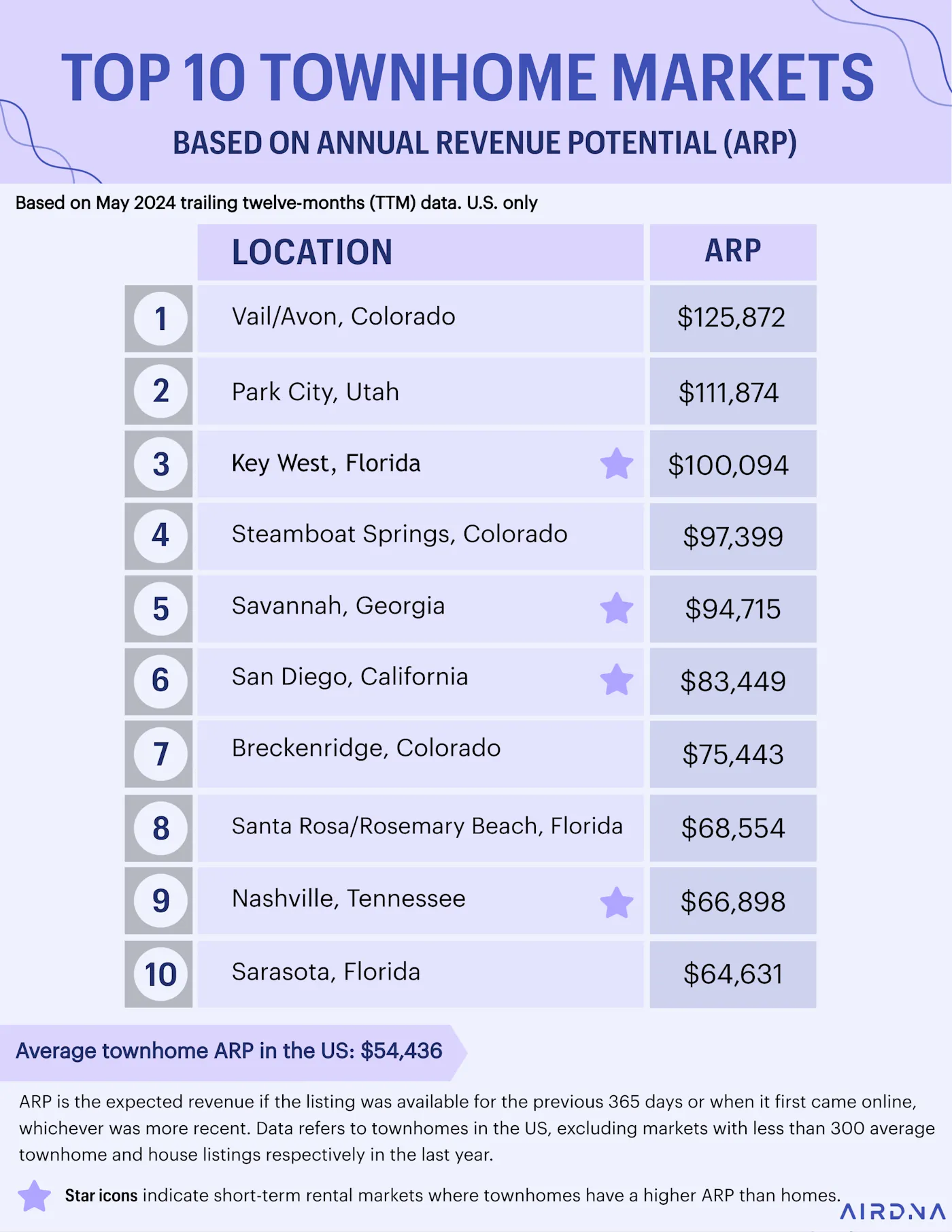
Savannah, Georgia and Key West, Florida, despite ranking #3 and #5 for townhome annual revenue potential (ARP), are arguably the best investment choices of the bunch if you stack them up directly against single family homes as a property type.
In Key West, the earning potential for townhomes only slightly edges out that of houses by $1,600. However, townhomes are over $175,000 cheaper, bringing the average yield for townhouses to 9.2% versus 7.7% for houses.
In Savannah, townhomes are approximately $11,000 cheaper than houses but can earn almost $15,000 more annually. Current yield for townhomes is therefore 2.5% higher than that of houses in this popular southern destination.
Despite having higher-than-average annual revenue potential, houses still outperform townhomes in several markets on this list. In popular Colorado ski destinations, Vail/Avon and Steamboat Springs, a townhome is actually pricier than a single family home as a property type. In Vail/Avon, townhomes are $194,000 more expensive than an average home! Townhomes are also more expensive than houses in San Diego and Sarasota, Florida.
In Nashville, Tennessee, townhomes earn approximately $13,000 more on average than houses ($77,772 vs $64,559) but the heftier price tag on townhomes makes the average yield better for a single family home.
Looking at townhome performance through the lens of average yield, the top 10 markets for townhomes in the U.S. look a little different:
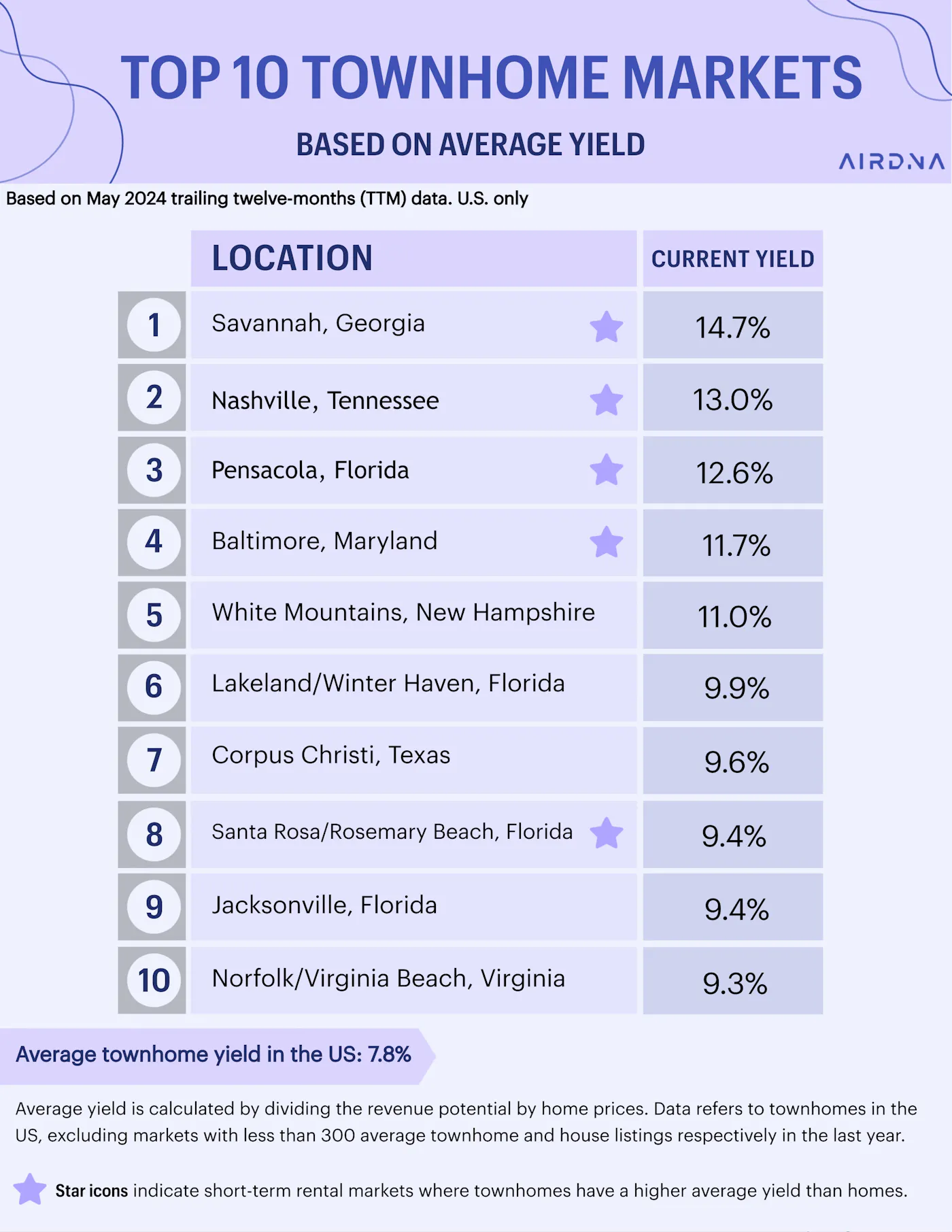
Savannah, Georgia and Nashville, Tennessee move up from their #5 and #9 ARP rankings, respectively, to claim first and second place for average yield.
Pensacola, Florida, and Baltimore, Maryland join Savannah and Nashville as markets where investing in townhomes is more financially savvy than purchasing homes through the lens of average yield.
In all 4 of these markets, townhomes are both cheaper to buy and have better average yields. In Baltimore, townhomes earn significantly less than houses ($35,704 vs $55,621) but they’re nearly 40% cheaper so they offer better returns.
Despite the high yields compared to the national average of 7.8%, townhomes in the White Mountains, New Hampshire and Lakeland/Winter Haven, Florida perform worse than houses as a property type. Townhomes are $50-60,000 more expensive than houses in these locations but have similar revenue potential.
While markets can make the top 10 for one metric, this serves as an important reminder to never look at one performance indicator in isolation.
Master Your Next Investment—Townhouse or Otherwise
Investing in townhomes as short-term rentals offers a unique opportunity to capitalize on the growing demand for temporary accommodations in popular destinations. At the same time, townhomes aren’t the only profitable STR asset class. Finding the right one for you is as much about your market as it is about your unique investment strategy.
Mastering your next short-term rental investment requires careful planning, research, and strategic decision-making. Explore proven, data-driven strategies in our Airbnb investment guide.
ARTICLE SUMMARY
Are townhomes a good investment for rental properties? Learn about their features, how they compare to apartments and condos as investment ventures, which markets they perform well in, and more.
Bram Gallagher
AirDNA Director of Economics and Forecasting
Bram Gallagher is an Economist at AirDNA, specializing in uncovering insights that drive smarter short-term rental decisions. He put his Ph.D. in Economics from the University of Georgia to work researching and forecasting hotel data with CBRE prior to joining AirDNA, as well as teaching economics at a number of universities. In his spare time, Bram enjoys making wooden furniture with hand tools.


Get started with AirDNA today.
Powerful, easy-to-use tools that help hosts and investors succeed in the short-term rental market.
Try for free