


How to Invest in Airbnb Out of State
Published: November 10, 2025
Last updated: September 25, 2026

Bram Gallagher

Key Takeaways
- Airbnb investments in different states can unlock higher profits and diversify your wealth portfolio by tapping into markets with strong tourism.
- Out-of-state ownership comes with hidden costs that'll torpedo your ROI if you're not careful: 20-30% property management fees, travel expenses for property visits, market-specific costs, and a 15-20% maintenance buffer above local rates.
- Assessing out-of-state properties demands a methodical approach that can all be done within the AirDNA app.
Airbnb offers fantastic opportunities for people looking to invest in real estate. With over 2 billion guests having made trips to 100,000 cities and towns around the world, investing in Airbnb rentals has quickly become a new asset class for savvy investors.
Investors eyeing Airbnb properties might naturally gravitate towards buying close to home. It's understandable: they know the market, have friends who are also landlords, and the property is just a short drive away. On the surface, it seems like the smart choice. However, we're here to make a case for why investing in a property far from your own backyard can, in many instances, be a smarter move.
When managed correctly, owning an Airbnb in another state can be a profitable and rewarding addition to an investment portfolio. Many successful hosts find that out-of-state properties can actually perform better than local ones when the right systems are in place. Still, it demands ongoing attention to detail and a proactive management style.
In this context, let's review what you need to know about owning a short-term rental property from afar and how to run an Airbnb out of state.
Benefits of Owning an Out-of-State Airbnb
Owning an Airbnb property in a different state presents a unique opportunity to diversify your investment portfolio and unlock the potential for more income than you might get from a local rental.
Higher returns in strategic locations
Certain regions boast thriving tourist markets with higher average daily rates (ADR) and occupancy levels, translating to greater rental income. An investor may capitalize on seasonal demand peaks in strategic locations that exceed their local market’s potential.
Let’s say you live in Gilford, New Hampshire. The Market Score for this area, which captures the health of a short-term rental market on a scale of 40-100, is just 42 and occupancy is 48% on average. Gunstock Mountain Resort draws some tourists, but it’s by no means a thriving investment market for Airbnb.
Just a 4-hour drive away, though, is the Maine Down East/Acadia Coastal market which includes towns like Bar Harbor and Blue Hill. Here, the Market Score is 93 and the occupancy average is much higher at 68%. Demand peaks in the summer time with an impressive 85% occupancy. This is a clear example of how exploring neighboring states can uncover investment opportunities that blow your local market out of the water. Where you live is not necessarily where people want to vacation!
Beyond seasonal demand, some out-of-state markets offer unique attractions. National parks (like Acadia in Maine), ski resorts, or cultural festivals may draw consistent visitor interest year-round, further bolstering investment returns.
Access less-regulated markets
Investors can explore less-regulated markets that may offer fewer restrictions on short-term rentals. This means finding areas where operating an Airbnb investment property comes with less bureaucratic red tape, potentially leading to a more streamlined and profitable venture. Additionally, venturing into markets with fewer restrictions can offer a “first-mover advantage.” When an investor enters an up-and-coming market early, they can establish their presence and optimize their operations without the competitive saturation in more regulated locales.
Create efficient remote management systems
When you own a property in another state, you might not be physically present to manage it. This distance can make it difficult to oversee the day-to-day operations of the property. You must implement efficient systems for property management, such as hiring a local property manager or using automated services.
In fact, this remote management style can inadvertently lead to a more professional and scalable business model, as owners are compelled to rely on dependable procedures and trusted personnel to handle their property's operations from the start.
Additionally, owners of distant properties usually need to cultivate a reliable network of local contractors for maintenance, along with professional cleaning services, to ensure the property is always guest-ready. This approach improves the guest experience and helps maintain high review scores.
How to Buy an Out of State Airbnb
Are you ready to explore an out-of-state investment? Here's your step-by-step playbook for finding, vetting, and buying a short-term rental property in another state.
1. Evaluate out-of-state market trends
First things first: dig into the data to understand what areas of the country offer the best investment potential. AirDNA makes this easy by compiling an annual Best Places to Invest report. You can also sort short-term rental markets within the AirDNA app by Market Score, which takes into account investability, rental demand, revenue growth, seasonality, and regulation to give you a well-rounded picture of a market’s health.
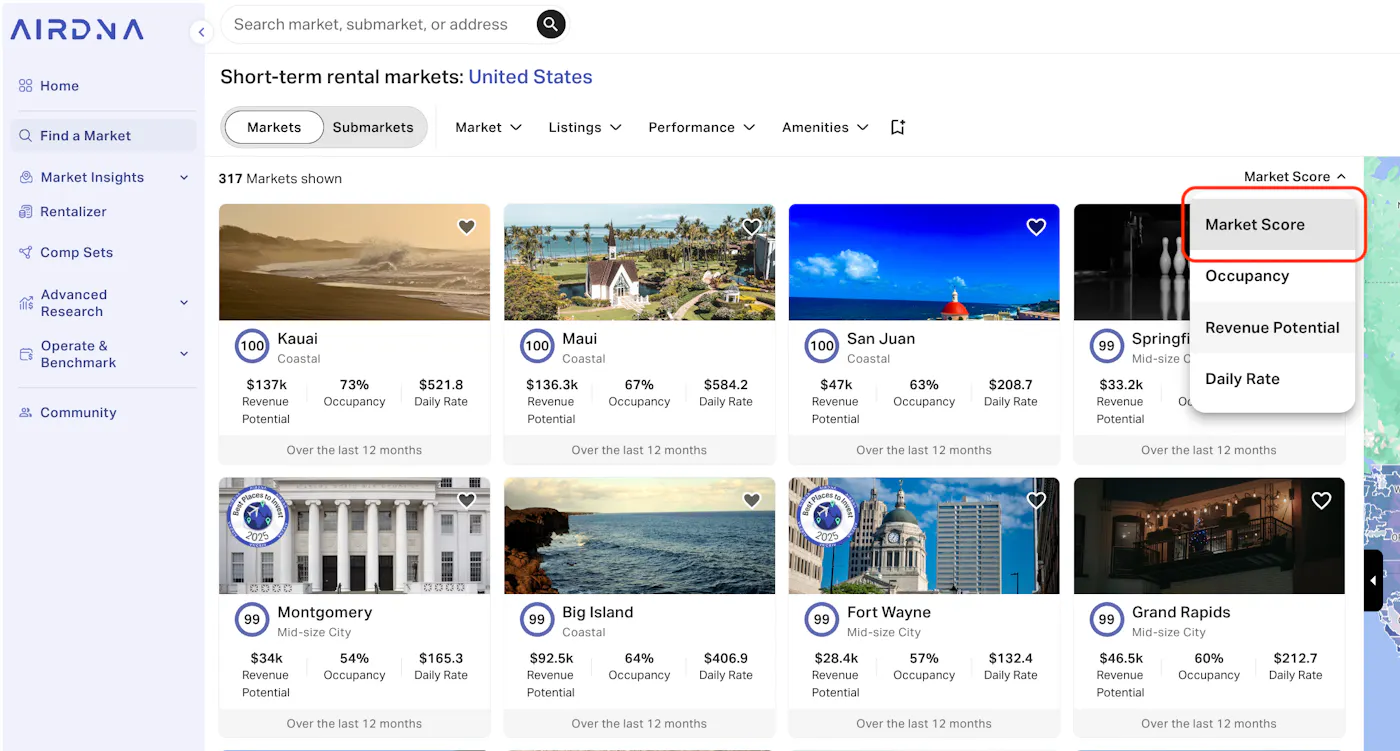
If you want to hone in specifically on investability, which compares the cost of homes in the area to the average short-term rental income of full-time rental properties, you can also apply a filter to only show markets within a certain score range.

Examine the health of the real estate market by looking at historical appreciation rates, current supply and demand, and potential growth indicators.
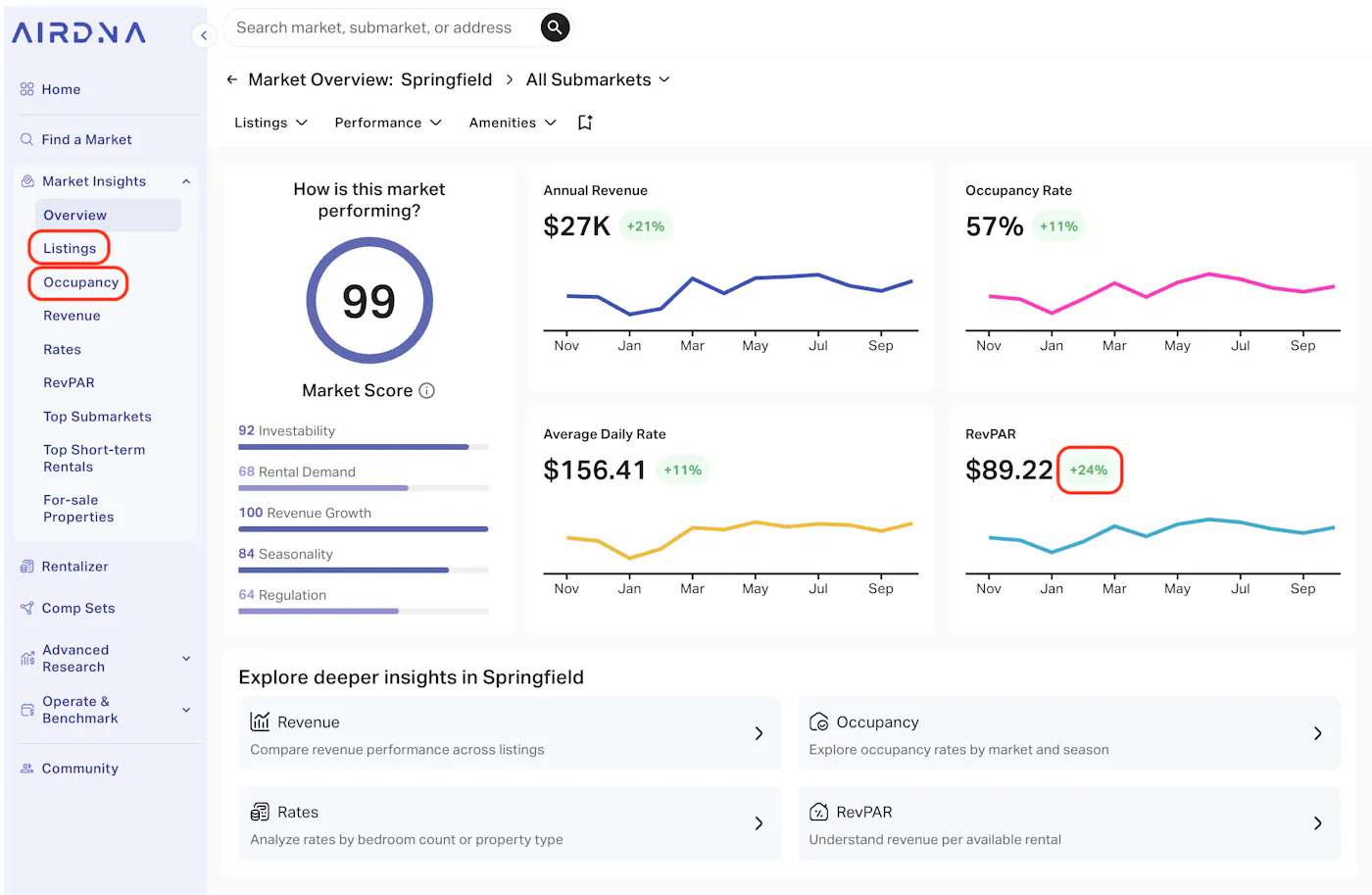
Supply information, including rental growth over the last three years, number of active listings, and listings by bedroom count, is all accessible on the Listing tab of AirDNA’s Market Insights for any given market. The Occupancy tab has a wealth of information about demand, including the percentage of each month short-term rentals are occupied, how long guests typically stay, and more.
You want to see positive year-over-year (YOY) change for key performance metrics like annual revenue and revenue per available rental (RevPAR) which takes into account both the average nightly rate (ADR) and occupancy. Growth rates can also capture the volatility of local markets. Areas with stable YOY growth may offer safer investment opportunities compared to those with rapid, unpredictable fluctuations.
2. Identify your ideal location
It can be a bit overwhelming to start nationally and try to narrow down your market from there. Ask yourself some hard questions that can help save you from analysis paralysis:
Where do you want to vacation?
If you're planning to use the property personally, pick somewhere you'd actually enjoy visiting. A ski condo in Colorado or a beach house in Florida becomes a dual-purpose asset: investment property and personal getaway.
AirDNA’s Market Type filter can come in handy here. Select the types that most interest you between Coastal, Mountains/Lakes, Suburban, Urban/Metro, Mid-Sized City, and Small City/Rural. From there, you can sort the resulting markets by Market Score or Revenue Potential to see which areas best align with your geographic preferences and your business goals.

What type of guest do you want to host?
Tourists? Business travelers? Families on vacation? Digital nomads? Knowing your guest avatar helps you pick the right location and amenities. Properties near business districts attract corporate travelers, while homes close to theme parks or beaches pull in families.
How hands-on do you want to be?
Some markets have robust property management infrastructure; others don't. If you're truly remote and want minimal involvement, prioritize locations with established STR management companies and reliable local service providers. Once you’ve narrowed it down to a few markets, AirDNA’s Professionally Managed filter comes in handy.
Let’s say you’re primarily interested in Small City/Rural markets that represent an escape into the countryside and a chance to unwind. You’re particularly interested in West Virginia, but as a Maryland resident you know that you live too far away to manage the place yourself and you’re worried that having a rural Airbnb limits your management options.
Seneca Rocks, a submarket in West Virginia, has 51 total active short-term rental listings. After applying a filter for professional management, however, you see that number falls to just 8. Only 15% of short-term rentals in Seneca Rocks are professionally managed, which might mean that your vacation rental manager options in that area are limited.

You repeat the same exercise with Canaan Valley, another West Virginia market with a larger Airbnb presence. There are 598 active short-term rentals there currently in the Cortland area, and 184 of those are professionally managed. Clearly, you’ll have more property management options in a larger market like Canaan Valley. This is just one example of how the Professionally Managed Filter can help you understand what role third-party management plays in a given short-term rental market.
3. Understand local STR regulations
Navigating short-term rental regulations is fundamental for any Airbnb host. Regulations surrounding permitting, taxes, and operational standards can differ widely between states and local jurisdictions. For example, Florida has generally more permissive STR regulations in many areas, while cities like New York or San Francisco have much stricter rules. Ignoring these rules might lead to severe fines or the closure of your property.
Just as short-term rental performance can vary on a submarket level within an area, so can regulations. For instance, if one home on the edge of a main thoroughfare is technically in a commercial district but the house four doors down is zoned residential, Airbnb could be viable for the former but not the latter property.
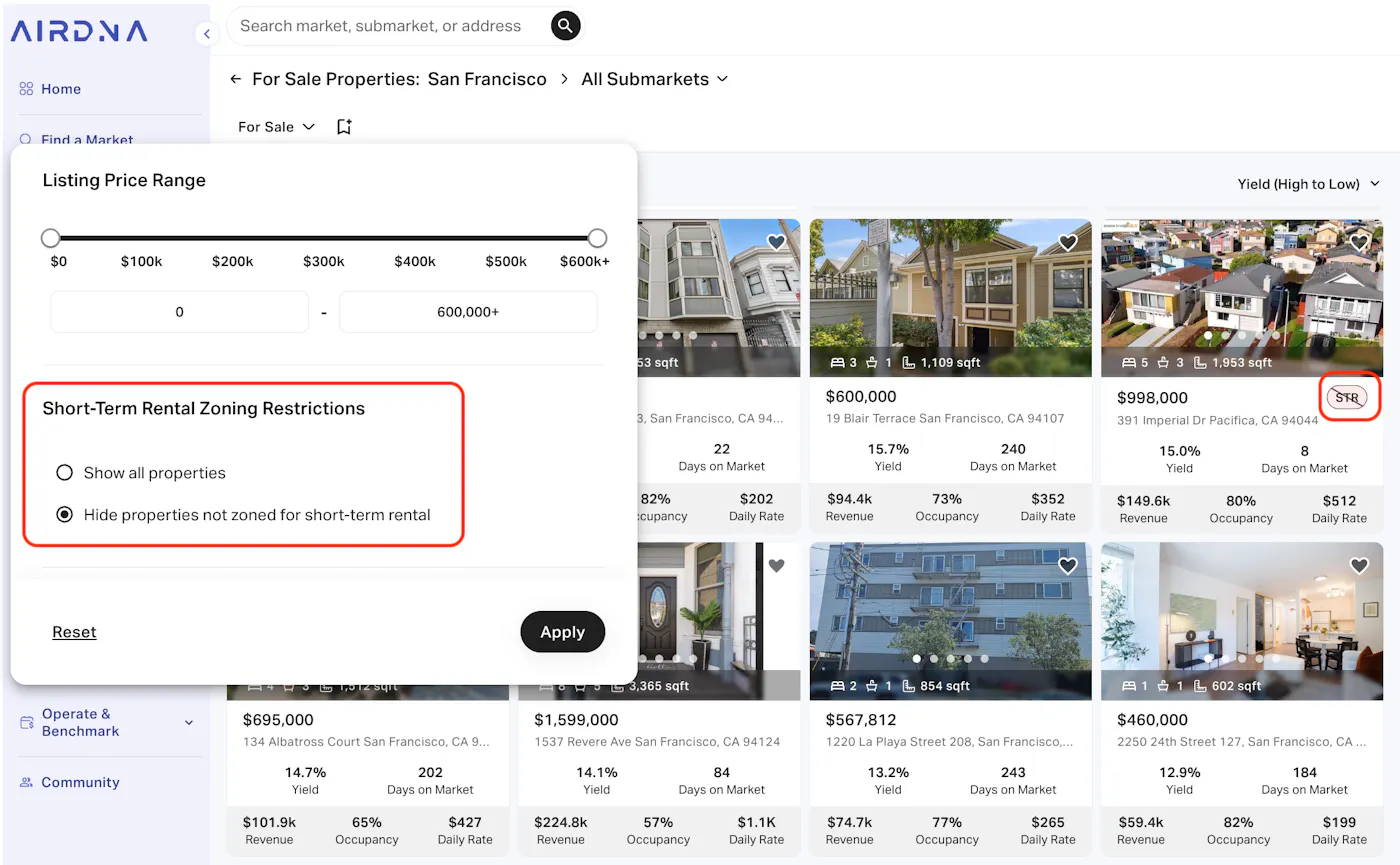
AirDNA’s Short-Term Rental Zoning Restrictions filter can help you quickly weed out investment opportunities that are not viable for an Airbnb in cases like this. You can choose to hide properties that are not zoned for short-term rentals. If you don’t apply the filter, we still provide a helpful STR prohibition icon on the properties where they’re not allowed.
Keep in mind that this filter only applies to zoning restrictions, and not other types of regulation. There are myriad other ways that policy can restrict short-term rental activity, such as minimum night stay requirements that force Airbnb hosts to transition their properties into mid- to long-term rentals or primary residence requirements that require hosts to live on-site. Do your due diligence to make sure you understand the full regulatory picture.
It's also wise to assess the local sentiment towards short-term rentals. Communities that embrace tourism are likely to support Airbnb endeavors. They offer a more favorable environment for your investment, both in terms of regulatory ease and public reception.
4. Estimate costs and revenue potential
Here's where many out-of-state investors screw up: they forget to account for the hidden costs that pile up when you're managing from a distance. You will need to calculate the obvious stuff such as maintenance, cleaning services, utilities, but remote ownership adds additional layers of expense.
First, factor in higher property management fees. While a local property might cost you 10-15% if you self-manage with occasional help, an out-of-state rental typically demands 20-30% for full-service management. Then there's travel costs. Budget for at least 2-4 trips per year to inspect the property, handle major issues, or meet with your team. Flights, hotels, and rental cars add up fast.
Don't forget market-specific costs either. Buying a beach property when you live in the suburbs? You're looking at flood insurance, hurricane shutters, and salt-air corrosion that eats through HVAC systems faster than you'd expect. Mountain cabin? Snow removal, septic maintenance, and propane delivery aren't line items you're used to seeing. Connecting with other hosts already operating in these types of markets through facebook groups or other online forums can give you insider insight on what to expect.
Remote management also means you can't just "swing by" to fix something or meet a contractor. You'll pay premium rates for last-minute service calls, emergency repairs, and rush cleaning jobs when your local cleaner cancels. Build in a 15-20% buffer above what you'd budget locally for maintenance and repairs.
Tools like AirDNA’s Airbnb Revenue Calculator can help you piece together what your net operating income might look like from an initial gross revenue projection. All you need is an address to get started. The calculator projects annual revenue, occupancy, and ADR based on how similar, active short-term rentals in the area are performing.
We’ll use a for-sale property in Hilton Head, South Carolina as an example. Projected revenue is just shy of 50k per year and the Confidence Score is high. The Confidence Score is an indicator of how precise the forecast is based on whether the revenue across the properties in the comparable set is consistent.
If you get a Medium or Low score initially, you can always customize your comps. That means hand-selecting the properties that are informing the projection to ensure that only the most similar short-term rentals are being included. In cases where there is only a small number of Airbnbs in the submarket or your property is unique with limited direct competitors, you might have to include properties from the larger surrounding area or a comparable area. Luckily, Hilton Head is a very popular area for short-term rentals and the comp set informing the revenue forecast is strong.

Next step is to update the Financial Calculator estimate, which takes into account both hosting costs and startup costs. Net Operating Income will automatically calculate based on the Annual Operating Costs that you fill in. AirDNA will automatically assume a 20% management fee, 5% lodging tax, and 1% property tax, but you should update these fields with figures specific to your market and your property. Cleaning fees are also pre-filled according to the share of gross revenue that they account for in your comp set.
For the Hilton Head property, we’ll estimate $3,000 per year in maintenance ($250 per month) and $4,000 per year in STR insurance (the national average according to Proper). Combined with taxes and management fees, the 50k gross quickly falls to 17k in net earnings.
The Startup Costs fields in the financial calculator, which include purchase price, home furnishings, and closing costs, inform the cap rate but are not included in the net operating income calculations since they are one-time costs.

The bottom line is that out-of-state investing means higher costs and more complexity. Run the numbers with brutal honesty, or you'll find yourself bleeding cash on a property that looked great on paper but tanks in reality.
5. Partner with investor-friendly realtors
Selecting a real estate agent knowledgeable in STR investments and the nuances of out-of-state property investments is vital. Reference the qualities of an investor-friendly real estate agent and empower yourself to pinpoint a high-return property with expert guidance. A realtor with a strong network in the target area can also provide access to off-market deals or early listings that may offer competitive advantages.
Key Implications of Out-of-State Ownership
Owning an Airbnb property in another state presents unique financial and legal challenges. Investors must be diligent about mortgage and tax implications and stay compliant with varying local regulations.
Mortgage and tax considerations
Ownership often involves a higher mortgage rate if it’s not your primary residence. Rental income is typically taxed as ordinary income unless you materially participate, but short-term rental hosts can take advantage of deductions related to mortgage interest and operating costs regardless of whether their Airbnb income gets classified as active or passive.
It's smart to review in detail how rental income is taxed to effectively manage the property's finances. Investors can receive customized strategies and uncover overlooked tax deductions by consulting with a real estate investment tax advisor.
Regulatory compliance across state lines
Local governments have distinct short-term rental regulations that can differ significantly from one jurisdiction to another. Investors must closely follow these laws to avoid substantial fines and legal issues.
This includes adhering to zoning laws, acquiring necessary permits, and understanding the nuances of short-term rental regulations. AirDNA’s For Sale property listings are a great place to start with zoning research. Within each listing, we provide some initial information to get you started, including Zone Details with zone code, zone name, and whether the zone permits STRs.

Engaging with a local property manager or a real estate attorney can offer invaluable insights into these local regulations so you stay compliant and get a local perspective on opportunities to maximize profit from the Airbnb investment.
Staying informed about potential regulatory changes is also crucial, as these laws can evolve. Strategies for keeping up-to-date include:
- Join local real estate investment groups
- Subscribe to updates from municipal government websites
How to Run an Out-of-State Airbnb
Learning how to run an Airbnb can have a steep learning curve, but it's worth the effort. You need to plan carefully and make use of the latest property management technology to be successful. The key to remote Airbnb management is to establish a strong foundation, which involves understanding the factors that contribute to your property's success. Here are some tips to help you get started.
Communicate effectively with distant guests
Clear and timely communication is key. Property owners should use instant messaging platforms and Airbnb’s own communication tools to respond promptly to guest inquiries and concerns. Adopt and automate pre-booking messages and post-stay thank you notes to send in the days surrounding a booking. Have pre-written replies on deck for common questions and make sure you or a local co-host or property manager is accessible for urgent issues to make the guest experience better.
Use tech to optimize remote management
Technology plays a crucial role in managing bookings and guest interactions efficiently. Explore Airbnb’s preferred partners for software platforms that can help hosts streamline guest communication and performance analytics.
AirDNA's performance benchmarking features let you stack your property against local competitors, so you know exactly where you stand on occupancy, revenue, and guest satisfaction. Pair that intel with the right tech stack: a solid property management system (PMS) to automate bookings and messaging, smart locks for seamless check-ins, and noise monitors to catch problems before neighbors do.
Build a reliable remote maintenance system
Keeping your property clean and in good condition is non-negotiable when managing an Airbnb out of state. Develop a comprehensive cleaning checklist tailored to your property, ensuring thoroughness in every turnover. Schedule regular inspections either by yourself or through a trusted contact to address maintenance issues proactively.
A digital management system can help track cleaning schedules, maintenance tasks, and inventory needs systematically. Many successful remote hosts use keyless entry systems to provide access to cleaning staff and maintenance providers without needing to be physically present.

Hire local property managers
A reputable local property management company is the operational backbone for an out-of-state Airbnb. They can handle day-to-day operations, from guest communications to emergency maintenance, ensuring your property adheres to Airbnb standards and local regulations. Their local presence means they can address issues swiftly, providing peace of mind to both the host and guests.
Here's how to actually find and vet the right team:
- Start with STR-specific experience: General property managers who handle long-term rentals won't cut it. You need someone who understands dynamic pricing, guest communication protocols, and same-day turnovers. Ask how many STR properties they currently manage and request references from some of their current clientele with properties similar to yours
- Dig into their fee structure: Are cleaning fees included or extra? What about maintenance markups? Some companies tack on hidden costs that erode your profits. Get everything in writing and compare at least three companies before signing.
- Test their communication style: Before you hire, gauge their responsiveness. Send a few emails, make a couple calls. If they're slow to respond during the courtship phase, imagine how they'll handle a 2 AM plumbing emergency.
- Clarify their scope of work: What exactly are they handling? Guest communication? Cleaning coordination? Maintenance? Restocking supplies? Pricing optimization? Some companies offer full-service management. Others are glorified cleaning coordinators. Make sure their services align with your needs and that nothing falls through the cracks.
The right property manager transforms your out-of-state Airbnb from a logistical nightmare into a passive income stream. Take the time to find someone who's competent, communicative, and committed to maximizing your ROI. When you're managing from afar, they're your eyes, ears, and boots on the ground.
Develop an effective guest screening process
When you're managing from hundreds or thousands of miles away, you can't afford to let problem guests slip through. Property damage is just one part of the fallout from a bad booking. It means scrambling to coordinate repairs with local contractors, fielding angry neighbor complaints you can't address in person, and potentially tanking your reviews while you're powerless to fix things quickly.
Adopt a process that includes verifying guest identity, reviewing previous Airbnb reviews, and setting clear expectations through your listing’s rules and communication. When you're remote, you can't swing by to enforce rules in person, so guests need to know exactly what's expected before they book. The clearer you are on the front end, the fewer surprises you'll deal with later on.
Manage finances from a distance
Strong financial management is essential for tracking the performance of your out-of-state Airbnb investment. Utilize cloud-based accounting software designed for real estate investments to monitor income, expenses, and profitability. Regular financial reviews will help you make informed decisions about pricing, promotions, and maintenance investments to maximize your returns. Many successful remote hosts set aside 1-2% of property value annually for maintenance reserves and create separate bank accounts for each property to simplify tax reporting and expense tracking when managing Airbnb properties out of state.
Automate check-in for remote properties
Automating the check-in and check-out process makes it more efficient and convenient for guests. Invest in smart locks or lockboxes to offer self-service check-in and check-out, allowing guests flexibility while reducing the need for in-person key exchanges. Provide detailed instructions and local tips in anAirbnb guidebook to make their stay seamless.

Frequently Asked Questions
Can I host an Airbnb from another country?
Yes, but managing an Airbnb from another country is a whole different beast than out-of-state ownership. The legal maze is exponentially more complicated and includes:
- Foreign property ownership restrictions
- International tax treaties
- Currency exchange implications
- Visa requirements
Bottom line: international Airbnb ownership can work, but only if you're willing to invest serious time and money into understanding foreign property laws, building a bulletproof local team, and navigating cross-border tax and financial complexities. Consult with attorneys and accountants who specialize in international real estate before you make an offer because the mistakes you make buying property abroad are exponentially more expensive and harder to fix than domestic screw-ups.
What are the most profitable states for Airbnb?
Short-term rental performance can vary so much within a state that questions of profitability are best answered on a market level. AirDNA's Best Places to Invest in Short-Term Rentals provides a detailed analysis of various markets, with Peoria, Illinois; Fairbanks, Alaska; Akron, Ohio, Columbus, Georgia; and Crescent City, California topping the list. We’ve also broken out top markets by state if you’re curious what markets are performing well in your state, a neighboring state, or a state where you personally enjoy vacationing.
Can you successfully run an out-of-state Airbnb?
Managing an STR remotely is not only possible, but quite efficient with the right setup. The key to how to run an Airbnb out of state is to integrate property management services that can handle day-to-day operations and guest interactions on your behalf. Invest in smart home technology, such as keyless entry systems, remote-controlled thermostats, and security cameras. The right tech enables smooth self-check-in and check-out processes while giving you visibility into your property from anywhere.
For a deeper dive into how to run an Airbnb out of state, read the Ultimate Guide to Managing an Airbnb Remotely.
How do I avoid the Airbnb 90-day rule?
Some cities cap unhosted short-term rentals to 90 days annually, such as San Francisco, which mandates hosts live on-site for the rest of the year. One way to circumvent strict limitations is to host guests as a primary resident, allowing you to offer shared stays without hitting the 90-day ceiling. Additionally, keeping an eye on local ordinances can help you identify extended permit options or exemptions.
What is the 80/20 rule for Airbnb?
The so-called 80/20 rule, often called the Pareto Principle, suggests that roughly 20% of a host’s efforts drive around 80% of the resulting revenue. This can manifest in focusing on profitable booking windows or high-demand periods while optimizing dynamic pricing. Zeroing in on essential guest amenities and proactive communication can produce the biggest impact on occupancy.
Why are states banning Airbnb?
Some localities restrict or ban Airbnb due to concerns about housing shortages, community complaints, or lost tax revenue. Cities like Burbank in California have completely prohibited short-term rentals, aiming to preserve local housing for residents. Traditional lodging providers also pressure municipalities to regulate home-sharing, fearing unfair competition. As policies evolve, staying informed on local legislation, engaging with community forums, and building neighborly goodwill can help hosts maintain compliance and legitimacy.
ARTICLE SUMMARY
Investing in Airbnb properties in another state offers opportunities for higher returns and market diversification, but it requires careful planning, understanding of local regulations, and strategic management from a distance.
Bram Gallagher
AirDNA Director of Economics and Forecasting
Bram Gallagher is an Economist at AirDNA, specializing in uncovering insights that drive smarter short-term rental decisions. He put his Ph.D. in Economics from the University of Georgia to work researching and forecasting hotel data with CBRE prior to joining AirDNA, as well as teaching economics at a number of universities. In his spare time, Bram enjoys making wooden furniture with hand tools.



Get started with AirDNA today.
Powerful, easy-to-use tools that help hosts and investors succeed in the short-term rental market.
Try for free