

 Calculate Revenue
 Research Markets
 Find For Sale Properties
 Compare My Listing
 STR Revenue Calculator
 Custom Comp Sets
 Submarket Insights
 Custom Search Filters
 Rate Recommendations
 Performance Benchmarking
 Competitor Comparison
 Owner Contact Details
 Property-level performance data
 Tourism Insights
 Real Estate Investment Analytics
 About Us
 Sales
Sales Support
 Press
PressHow to Make Money on a Vacation Rental Property in 2026
Published: June 2, 2025
Last updated: September 25, 2026

Bram Gallagher
Key Profit Strategies for Vacation Rental Properties:
- Maximizing the return on your vacation rental takes more than creating a good guest experience.
- Optimizing your listing and listing across platforms are just two ways to boost your returns, but there are others you should also implement.
- Data-driven decision-making is the most effective way to influence your property’s performance.
What does it take to unlock a vacation rental property's full earning potential? For many property owners, deciphering how to make money on a vacation rental property is more nuanced than creating a great guest experience. While prioritizing guest experience is always a good idea, there are many other strategic steps you can and should take to give your rental the boost it needs to maximize profitability.
In this comprehensive guide, we'll take a closer look at the best tips to maximize the return on your vacation rental investment. Whether you're a seasoned host or just getting started, here's how to earn more from your short-term rental (STR) business, increase your vacation rental income, and stay ahead of the competition.
Which Factors Affect Vacation Rental Profitability?
While there's no exact science for getting the most out of your vacation property, certain key factors influence profitability more than others. AirDNA data shows that the factors that most significantly affect your vacation rental profit margin are:
- Location
- Property amenities
- Seasonality
- Supply and demand
- Competition
- Pricing strategies
- Investment income vs. the cost of the property
- Daily pricing (ADR)
Detailed ROI calculation and profit margin examples
Many vacation rental owners aim for a 5–10% return on investment (ROI), although standouts in thriving markets surpass this range. ROI is typically calculated by subtracting all operating expenses—like utilities, maintenance, and property management fees—from gross rental income, then dividing by the total investment.
It’s also wise to consider additional metrics like capitalization rate or net operating income for a more complete snapshot of profitability. Dynamic pricing, paired with a laser focus on operating costs, can uncover hidden opportunities to raise your profit margin. Over the long term, you can boost your ROI by leveraging tax advantages and counting on property appreciation.
Some of the factors that play into revenue potential—location, for instance—come down to the property you buy. Others you can optimize as you go to give your vacation rental business the best shot at success. We’ll explain how to do just that in the next section.
Data-Driven Tips to Make More Money on Your Vacation Rental Property
Planning and effort are the heartbeat of any successful vacation rental property and are key to getting more out of your real estate investment . A profitable vacation property requires both an optimized rental listing for prospective guestsand consistent work to keep them happy during their stay.
We've compiled the 21 best tips to maximize the return on your vacation rental.

1. Optimize and update your listing
Your listing should evolve along with the vacation rental landscape. During COVID-19, for example, travelers wanted to see details about cleanliness. Now, many guests have turned their eye to eco-friendliness.
Regularly review and update your vacation rental listing so that it stands out to potential guests and speaks to their preferences. Some of the best ways to optimize your listing and increase vacation rental bookings are to:
- Post high-quality photos from a professional photographer and post a lot of them. AirDNA data shows that the number of photos in your listing is directly tied to your occupancy rate. Occupancy jumps from 50% for listings with 1-10 photos to 55% for listings with more than 40.
- Write thoughtful descriptions that accurately describe your rental property to entice prospective renters and get them excited about your property.
- List all relevant amenities to attract more guests and keep your competitive edge in the vacation rental market.
- Utilize pre-booking messages to create a positive impact on your guest experience.
- Update your Airbnb calendar daily. A property management software (PMS) like Uplisting can automatically sync your listing availability across multiple booking platforms, so you never run the risk of a double booking.
- Enable Instant Booking on Airbnb.
2. List Your Vacation Rental Property on Multiple Platforms
Plan to list your short-term rental on more than one site . Occupancy rates tend to increase when a rental is listed across multiple sites. For example, hosts in Gatlinburg, Tennessee, gain up to two more booked nights per month and over $600 more revenue when they list on Vrbo in addition to Airbnb.
Cross-listing is becoming the standard for short-term rental operators, with the percentage of total listings on more than one platform hitting 28% in the U.S. last year, up from just 5% in 2019.
You ultimately increase your vacation property's visibility and booking potential by listing it on multiple vacation rental sites, like Vrbo, Booking.com and other alternative sites like Plum Guide or Kid & Coe. You can attract more guests and maximize your rental income by making your rental easy to find.
3. Get insurance to protect your property
Not all renters value vacation homes the way they should, posing risks that are unique to short-term rentals . Comprehensive vacation rental insurance is critical to safeguarding your property against unexpected damages, liabilities, and other unforeseen events. Cleaning up after an accident shouldn't' eat into your returns.
AirDNA’s STR Insurance Guide offers insights into how insurance coverage can provide peace of mind and financial protection should something go wrong.
4. Use a dynamic pricing tool
Dynamic pricing lets you adjust rental rates in real time based on factors like demand, seasonality, local events, and competitor pricing. This strategy is essential for maximizing vacation rental earnings. AirDNA's rate recommendations can help you price your rental competitively up to 4 months out, attracting more bookings and maximizing your occupancy and rental income.
5. Optimize Your Minimum Stay
Minimum stay policies can help you fill up your rental calendar and maximize the return on your vacation rental. During off-peak periods, shorter minimum stays cater to more intermittent travelers, while longer minimum stays during high-demand times keep your rental earnings as much as possible.
Be aware that local regulations may dictate minimum stay requirements in certain markets—many cities have implemented 30-day minimum stay rules in an effort to combat housing shortages and preserve neighborhood character. In urban cities, approximately a quarter of properties utilize minimum stay policies of 28 days or more, often in response to these regulatory constraints.
One to two-night minimum stays tend to be the most common across market types, whether your vacation rental is in the suburbs or on the beach. That being said, coastal markets are more likely to require 3-night stays at a minimum (about 20% of listings).

6. Offer mid-term stays in the off-season
During the off-season, consider seeking long-term guests by offering mid-term stays and monthly rentals. This short-term rental strategy can help you stabilize vacation rental profits during slower periods and reduce the risk of vacancies, which is a common pitfall for many vacation rental owners.
7. Provide a seamless guest experience
At the end of the day, nothing is more important than delivering an experience that guests will love.
Best practices for property managers include making sure to provide:
- A clean, well-maintained rental
- Easy check-in procedures
- A thoughtful guidebook
- Clear communication and prompt assistance with any issues that arise during a stay
Welcome baskets, personalized messages, and even in-person greetings can provide a more memorable guest experience that leads to favorable reviews and repeat bookings.
How is your STR performing?
Your vacation rental may be amazing, but is it better than your competition? Connect your Airbnb listing to AirDNA to see its Booking Performance Score.
8. Communicate effectively with your guests
Respond to inquiries as soon as possible, give clear instructions for check-in and check-out, and be helpful throughout every guest's stay. This is essential to building trust with guests and improving their overall satisfaction, which in turn leads to positive reviews and repeat bookings.
Consistent communication is also critical for earning coveted Airbnb badges like Superhost status, which requires a response rate of at least 90% and can increase bookings by up to 22%. The "Guest Favorites" badge, awarded to the top 2% of listings based on ratings, reviews, and reliability, similarly prioritizes hosts who maintain excellent communication. These badges signal quality to potential guests and Airbnb will boost your listing's visibility and booking potential as a result.
Automating messages through a PMS like Uplisting is an easy way to ensure your messages to guests are timely and consistent for every reservation. Trigger a message to send at regular intervals before or after a guest books their stay, arrives at your Airbnb, and departs. Use message filters and dynamic fields to customize which guests get messages when, and to personalize the message each time.
9. Collect five-star reviews
Unlike other real estate investments, the success of a vacation rental hinges on delighting guests. Listings with an average rating of 4.9 stars or above enjoy an approximately 10% higher occupancy rate, a 8% higher average daily rate (ADR), and 18% higher revenue compared to listings with lower ratings. These statistics demonstrate how critical guest satisfaction is to achieving a healthy vacation rental profit margin.
The best way to encourage positive guest reviews on listing sites is by providing exceptional service and amenities. Guests who see their issues addressed promptly are more eager to share their five-star experience and help your property rank higher on vacation rental platforms.
Another pro tip for soliciting reviews is to leave a review for your guest first. Thanks to the double-blind review system adopted by most booking platforms, your review won't be accessible to the guest until they leave a review in return or the review window closes, whichever comes first. People are often motivated to leave a reciprocal review for the immediate gratification of seeing what you wrote about them.
10. Encourage repeat bookings
Consider providing incentives for guests to return, such as offering discounts or loyalty offers for their next stay. Specific strategies include creating a tiered loyalty program (5-15% off for returning guests), sending personalized anniversary offers ("One year since your stay!"), offering complimentary upgrades like early check-in or late check-out, and providing exclusive seasonal packages. You might also consider referral bonuses when guests recommend your property to friends and family. Collecting guest preferences during their first stay allows you to tailor welcome amenities for their return visit.
Providing a memorable experience and maintaining open communication through these targeted incentives can lead to repeat bookings, resulting in a steady income stream for your vacation properties while reducing your marketing costs.
11. Screen new guests carefully
A thorough guest screening process helps to ensure the safety and security of your investment property while directly impacting your bottom line. Proper screening prevents costly damages, unauthorized parties, and negative reviews that can hurt your property's ranking and future bookings. Don't be afraid to ask potential guests about the purpose of their visit as well as their past rental experiences.
Guest screening platforms can also verify a prospective guest's identity and assess how suitable they are for your vacation rental. Uplisting, for example, allows you to verify over 4,000 types of government IDs from over 100 countries.
By carefully screening new guests, you can mitigate potential risks, avoid expensive repairs and downtime between bookings, and maintain a positive rental experience for everyone. This proactive approach protects your revenue stream and helps maintain the premium rates that quality guests are willing to pay for well-maintained properties.
12. Automate behind-the-scenes tasks
Vacation property owners can save time and headaches by automating repetitive tasks such as guest communication, booking confirmations, and cleaning schedules . While property management software (PMS) represents an upfront cost, it typically pays for itself by preventing costly errors like double bookings, reducing the need for additional staff, and freeing up your time to focus on revenue-generating activities.
Property managers should leverage automation tools to streamline administrative duties, minimize human error, and ensure consistency across all guest interactions. These efficiencies directly impact your bottom line by reducing operational costs and creating a more reliable vacation rental business that earns better reviews and commands higher rates.
Uplisting is the best all-in-one vacation rental software (VRM), offering integrations, automations, and guest experience features that reduce your workload while increasing profitability. The return on this investment often becomes apparent within months as you scale your operation without proportionally increasing expenses. We explore VRM options in an article dedicated to the topic .

13. Offer add-on services and experiences
Every short-term rental business wants to increase revenue.
You can achieve that by offering add-on concierge services such as grocery delivery and airport transfers or Airbnb experiences like local tours or a class. This strategy aligns perfectly with Airbnb's new direction through their Airbnb Services initiative, which is designed to make short-term rentals more competitive with hotels.
With Airbnb now building out the infrastructure to support host-provided services, it's never been easier to increase your offerings as a vacation rental operator. These additional services not only cater to the diverse needs of your guests but also create opportunities to upsell and generate extra income while improving the overall guest experience.
14. Optimize your cleaning fees
Cleaning fees shouldn’t come as a sticker shock to guests. Set competitive cleaning fees that cover cleaning expenses and hosting fees without setting off renters.
When calculating cleaning fees, consider:
- Size : Average cleaning fees in the U.S. for a private/shared room on Airbnb are approximately $50 per stay, while fees for a house with five bedrooms is closer to $300.
- Location : The cost of labor tends to be higher in cities, and that's reflected in average cleaning fees. Hosts charge approximately $160 per stay in large urban cities and only $130 per stay in smaller or rural cities for a three-bedroom listing. Destination markets like coastal, mountain, and lake resort areas have the highest cleaning fees of all.
- Rising costs : Between 2020 and the end of 2023, Airbnb cleaning fees increased by about 27%.
Market research can provide you with a ballpark figure of cleaning charges in your area so you can adjust fees accordingly. Offering transparent and reasonable cleaning fees will improve guest satisfaction and contribute to positive reviews, ultimately maximizing rental income for your vacation rentals.
15. Charge an additional fee for pets
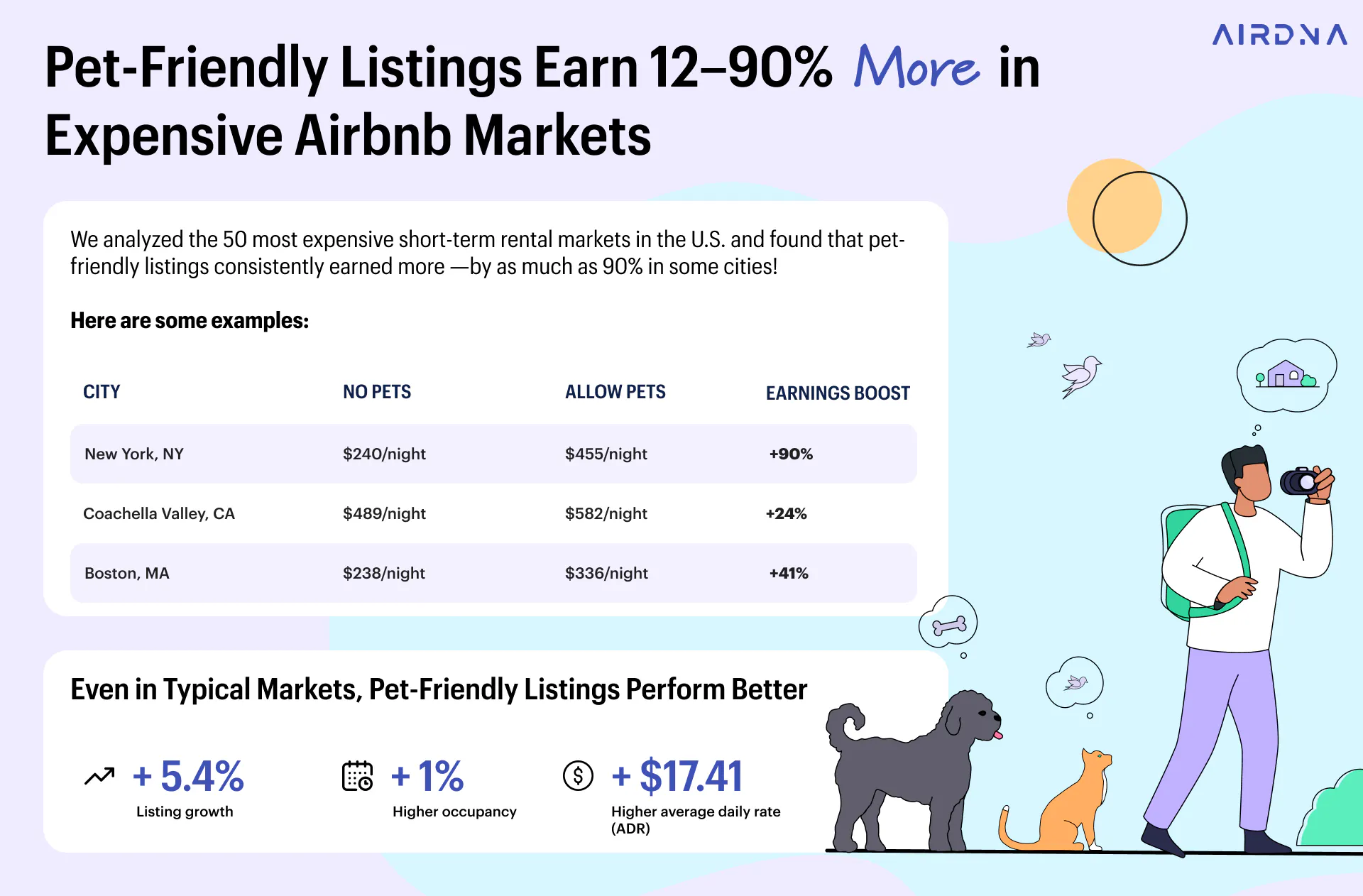
Homes that allow pets can earn higher nightly rates. Just how much being pet-friendly increases your revenue will depend on your price tier and your location, though. Luxury listings in New York City, for example, can earn nearly double per night than pet-free vacation rentals, an average difference of $215. This blows the national average of $17.41 ADR gains for pet-friendly listings out of the water!
The risk of inviting in travelers with pets is their leaving a mess. Pet fees can help cover any cleaning costs associated with pet damages, keeping your vacation rental well-maintained and profitable. It’s important to communicate this fee clearly in your listing to set expectations for pet-owning guests.
16. Create a direct booking website
Creating a dedicated website for your vacation rental lets you bypass booking platform fees while maintaining full control over your booking process. With solutions like Uplisting's direct booking engine, you can automatically generate a professional booking website as soon as you connect your listing to the PMS—eliminating upfront development costs.
This turnkey approach provides a user-friendly interface with secure payment options, allowing you to cut out the middleman and offer a seamless experience for direct bookings. By reducing or eliminating commission fees that can range from 3-15%, this strategy improves your real estate investment returns while building your independent brand presence.
17. Build an online presence
Vacation rentals can take on a life of their own, leading to direct bookings that boost profitability. Take advantage of social media platforms and create engaging content that establishes credibility and shows off your property.
Photo and video content on platforms like Instagram and TikTok can work wonders for attracting new guests. Encourage past guests to tag you in their content so that their followers can easily find your page.
Consider investing in search engine optimization (SEO) strategies to improve your rental's search engine visibility, which drives organic traffic to your listing.
18. Leverage email marketing
Email marketing lets you maintain connections with past guests and nurture potential leads, especially when paired with your direct booking website. When you control your own booking platform, you can strategically collect guest information during the checkout process, including email addresses with marketing opt-ins.
Consider sending:
- Personalized messages based on previous stay preferences
- Exclusive offers only available through direct bookings
- Updates about your vacation rental improvements
- Seasonal promotions with special returning guest rates
Emails like these keep your property top-of-mind and encourage repeat bookings while bypassing OTA fees. With email automation tools integrated with your direct booking engine, you can streamline your marketing efforts and maximize engagement without too much effort Create a powerful revenue-generating system that works while you sleep.
19. Market to your target audience
Your vacation home won't be the perfect fit for every traveler, which is why it's important to tailor marketing efforts to those who are a great fit. Learn your target audience's preferences, demographics, and booking behaviors by analyzing guest reviews, booking patterns, and direct feedback.
Pay close attention to which amenities guests mention most frequently in their five-star reviews, what type of travelers book your property (families, couples, business travelers), and which seasons attract your highest-paying guests. As part of email marketing efforts, you can also send post-stay surveys to gather more specific data about guest preferences and travel motivations.
Once you understand who your ideal guests are, make use of the messaging and visuals that resonate with them. For example, if your data shows families make up your most profitable segment, highlight kid-friendly features and nearby attractions suitable for children.
By targeting the right audience with data-driven precision, you can maximize vacation rental revenue through increased visibility and appeal, driving more bookings and revenue while reducing marketing costs on segments less likely to convert.

20. Claim tax deductions to maximize vacation rental income
Consult with a tax professional to claim all applicable deductions, which can include property maintenance, insurance, depreciation, and more. Maximizing tax deductions will reduce your taxable income, which in turn keeps more money in your pockets. Optimizing your tax situation is one of the most overlooked ways to make money on vacation rental property.
In addition to deductions, consider implementing a cost segregation study for your vacation rental property. This powerful strategy allows you to accelerate depreciation by identifying components of your property that qualify for shorter depreciation periods (5, 7, or 15 years) instead of the standard 27.5 years for residential real estate. Items like appliances, furniture, fixtures, and even certain structural elements can be reclassified, potentially creating significant upfront tax deductions.
Don't overlook the short-term rental tax loophole, either. If you "materially participate" in your rental business for at least 250 hours per year (about 5 hours weekly), you might qualify as a real estate professional for tax purposes. When you pair this status with cost segregation, you can use paper losses from faster depreciation to reduce taxes on your other income sources. This powerful combination can lower your overall tax bill while your property continues to grow in value over time.
21. Measure the success of your vacation rental business
AirDNA believes in the power of data to drive smart decisions and more profit, so we'd be remiss not to mention data analysis as a key strategy for making more money with your Airbnb.
Tracking key performance metrics will help you to gauge the effectiveness of your vacation rental business and to identify opportunities to improve it. Metrics to consider include:
- Occupancy rates
- Average Daily Rates (ADR)
- Monthly and annual revenue
- Guest satisfaction scores
- Return on investment (ROI)
Beyond your individual property performance, tracking your market and submarket trends is equally crucial. Understanding how seasonal demand shifts, new supply enters the market, and how competitors adjust their pricing strategies gives you a competitive edge.
With AirDNA's comprehensive dashboards, you can analyze both property-specific metrics and broader market dynamics in one place—comparing your performance against market averages to pinpoint exactly where you're outperforming or underperforming. This dual approach to measurement ensures you're not just optimizing your property in isolation but positioning it strategically within your competitive landscape for maximum returns.
Use data to increase your vacation rental profits
Plan your STR strategy based on real booking activity and trends—plus, see how things change year over year.
Frequently Asked Questions About Vacation Rental Profits
What is a good profit margin for a short-term rental?
A good profit margin for a short-term rental typically ranges between 20-50% of annual rental income.
However, this can vary based on factors such as:
- Location
- Size
- Rental rates
- Occupancy rates
- Operating expenses
It's essential to analyze your specific situation and aim for a margin that ensures profitability while remaining competitive in the market.

Are there hidden costs when making money on vacation rentals?
Yes, many new property owners are surprised by unforeseen costs associated with their vacation rental.
These may include:
- Maintenance and repairs
- Property management fees
- Premiums for vacation rental insurance
- Taxes
- Utilities
- Marketing expenses
- Unexpected vacancies
Vacation rental owners need to budget for these potential costs to ensure profitability and financial stability in the long run.
How do I know If my vacation rental is profitable?
Accurately tracking income and expenses is key to determine your vacation rental's profitability. Compare your rental income to your total costs, including mortgage payments, maintenance, utilities, and property management fees. Analyze your cash flow and calculate your return on investment (ROI) to assess profitability accurately. For a comprehensive approach, consider using the 50% rule (estimating that expenses will be about 50% of rental income) as a quick evaluation method.
What is a good rate of return on a vacation rental?
Rates of return vary depending on factors such as location, property type, and market conditions. However, vacation rental owners usually aim for a return on investment (ROI) of at least 8% to 10%. This ROI accounts for rental income, expenses, property appreciation, and potential tax benefits. You'll need to conduct a thorough market analysis and financial projection to determine if vacation rentals are profitable for your specific situation.
Monitoring key performance indicators and using data-driven insights from platforms like AirDNA can help investors gauge and optimize rental profitability and ROI.
What is the 50% rule in rental property?
The 50% rule is a quick estimate that half of your gross rental income will go toward operating expenses, such as taxes, insurance, and maintenance. This guideline can be handy for an initial feasibility check, but you’ll want to refine your numbers using real data to accurately account for factors like dynamic pricing and seasonal shifts. It’s generally used for traditional rentals, but short-term rentals often have higher turnover costs, so careful analysis is key.
What is the 7 day rule for vacation rental?
The 7 day rule typically refers to a tax-specific guideline indicating that if your property’s average stay is seven days or less, certain deductible losses may be restricted, effectively limiting them to zero. Always check local regulations and consult a tax professional for personalized guidance.
How is your short-term rental performing?
Your vacation rental may be amazing, but is it better than your competition? Connect your Airbnb listing to AirDNA to see its Booking Performance Score
ARTICLE SUMMARY
Learn how to make money on vacation rental properties through strategic optimization, data-driven pricing, and effective marketing techniques that boost your return on investment.
Bram Gallagher
AirDNA Director of Economics and Forecasting
Bram Gallagher is an Economist at AirDNA, specializing in uncovering insights that drive smarter short-term rental decisions. He put his Ph.D. in Economics from the University of Georgia to work researching and forecasting hotel data with CBRE prior to joining AirDNA, as well as teaching economics at a number of universities. In his spare time, Bram enjoys making wooden furniture with hand tools.
