

 Calculate Revenue
 Research Markets
 Find For Sale Properties
 Compare My Listing
 STR Revenue Calculator
 Custom Comp Sets
 Submarket Insights
 Custom Search Filters
 Rate Recommendations
 Performance Benchmarking
 Competitor Comparison
 Owner Contact Details
 Property-level performance data
 Tourism Insights
 Real Estate Investment Analytics
 About Us
 Sales
Sales Support
 Press
PressHow Much Does Airbnb Charge Hosts? Fees Breakdown
Published: October 29, 2024
Last updated: September 25, 2026

Bram Gallagher
Key Takeaways
- Airbnb charges hosts using either a split-fee model (hosts pay 3%, guests pay 6-12%) or a single service fee structure (hosts pay 14-16%).
- Cleaning fees, pet fees, and additional guest fees should balance covering costs with staying competitive.
- Use dynamic pricing tools, offer discounts for longer stays, and encourage direct bookings to reduce the impact of Airbnb’s fees on your bottom line.
Hosting on Airbnb is an incredible way to turn your property into a revenue-generating machine, but those service fees? They’re the cut that stings. Just as you’re tallying up a promising payout, Airbnb swoops in, claiming its slice of the pie. It’s the cost of accessing millions of travelers worldwide, sure—but that doesn’t mean you’re any less attached to every dollar you worked for.
So, just how much does Airbnb take? And is there a way to keep a bit more of that hard-earned cash in your pocket? In this guide, we’ll walk through Airbnb’s fee structures, break down what each charge means for you, and explore strategies to keep more of your profits intact.
What Are Airbnb Host Fees?
As an Airbnb host, you don’t get to pocket the full amount of every booking. Like most vacation rental platforms, Airbnb takes its cut in the form of host fees. These fees vary depending on the fee structure you're using: a host-only or split-fee model, which we define and cover below.
What Percentage Does Airbnb Take?
If you’re on the split-fee structure, Airbnb charges a 3% host service fee per booking. While that seems small, remember it’s taken from your nightly rate and other booking costs, such as cleaning fees.
Airbnb also adds a 6-12% service fee that’s paid by your guests. The guest service fee declines from 12% to 6% as the reservation amount increases.
If you’re on a single service fee model (previously known as the host-only fee model), Airbnb will take a total service fee of 14–16% of the booking subtotal.
How Much Does It Cost to List on Airbnb?
Listing your property on Airbnb is technically free. You won’t pay anything until a guest books a stay. Once that happens, Airbnb takes its cut through host service fees.
Property owners can set a pricing strategy that maximizes earnings without overcharging guests by understanding Airbnb’s fee structures.

Breakdown of Host Fees on Airbnb
Airbnb service fees
Airbnb offers a simplified pricing model for their fees. There are two types of Airbnb service fee structures: a host-only fee model and a split-fee model.
Single service fee
Under the single service fee structure, all associated fees are taken from the host's payout—the guest doesn’t pay a dime for Airbnb’s services unless the host chooses to increase their nightly rate to account for fees. Fees typically come out to 15.5%, with a couple of exceptions. For example, stays of 28+ nights may lower the service fee.
Traditional hospitality listings and serviced apartments are required to pay single service fees.
The single service fee structure is most common among international hosts using third-party vacation rental software. As of October 27, 2025, all hosts that use a property management software are charged fees under the single service fee structure. Previously, PMS-connected hosts operating in the U.S. and other select countries could choose between the two fee structures.
In countries like Spain, Italy, and Germany, where the single-service fee model has been required for software-connected hosts for awhile now, around 40% of hosts with 6-20 units and 80% of hosts with 21+ units use this fee structure.
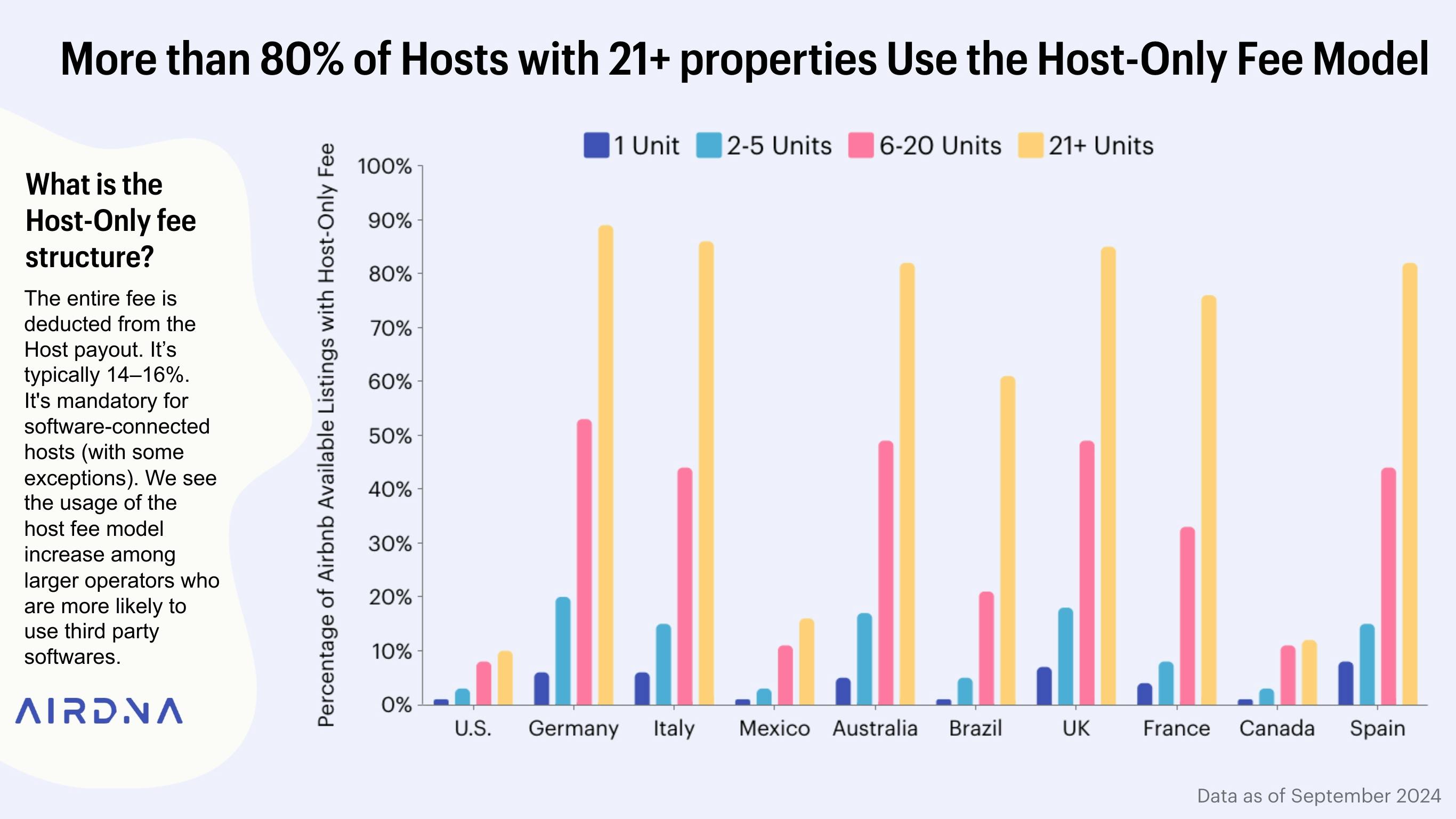
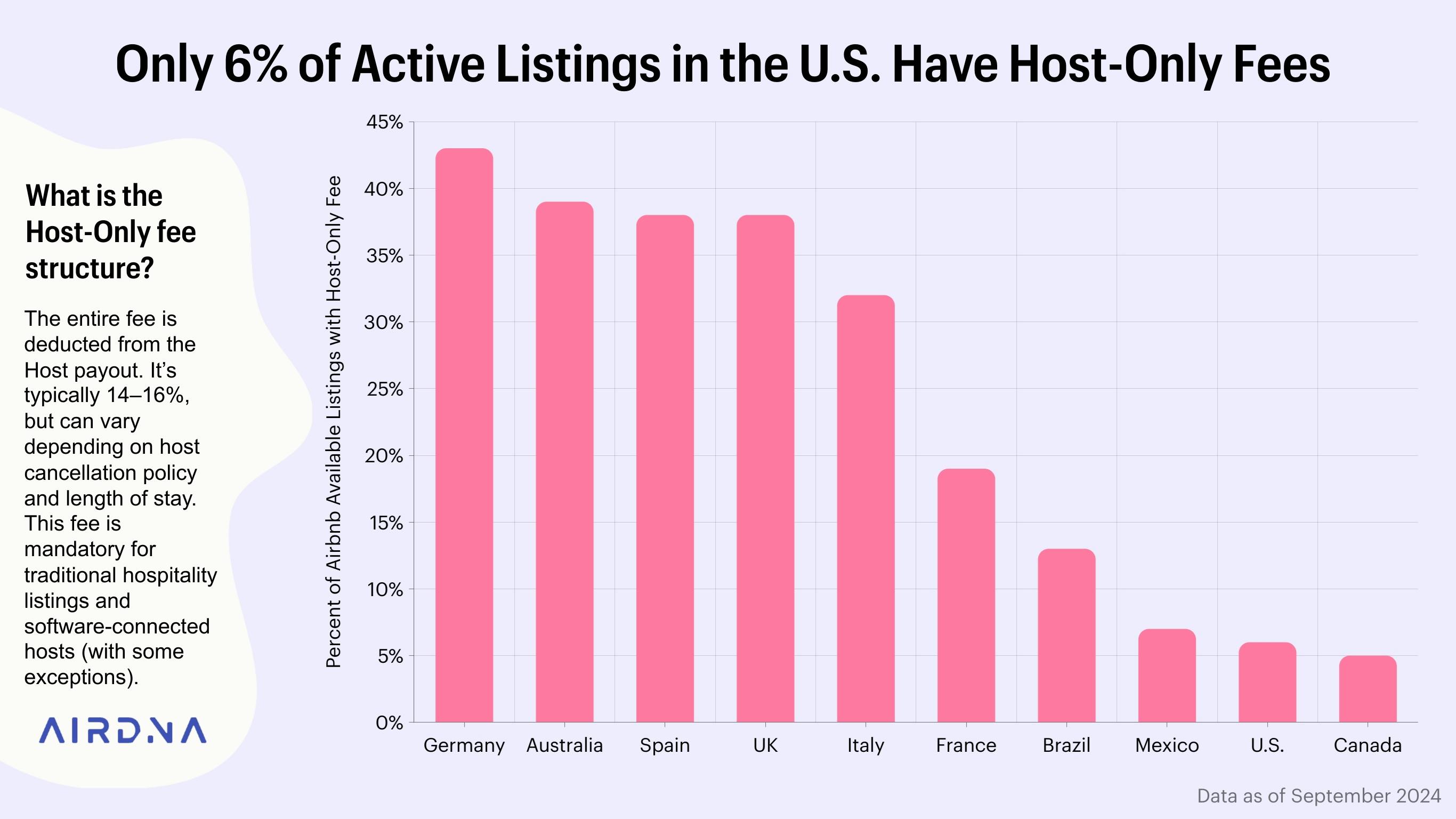
In contrast, there is not widespread adoption of the single service fee model among hosts in the United States, Canada, Mexico, Bahamas, Argentina, Taiwan, and Uruguay who connect to third-party software. Only 6% of listings in the U.S. use the single service fee model, but that's likely to change now that the single service fee model is the only option available to software-connected hosts. Read our op-ed on why switching to the single service fee structure represents a strategic opportunity for hosts.
Split-fee structure
The split-fee structure—where hosts and guests both pay Airbnb fees—is the most common.
Most hosts pay a 3% fee with split-fee pricing, but some pay more, including certain hosts with listings in Italy. Airbnb calculates the host’s fee based on the booking subtotal and automatically deducts it from their payout.
Meanwhile, the guest covers a 6-12% guest service fee.
This model helps spread the costs between hosts and guests, but you’ll need to be mindful of the total price the guest sees at checkout.
VAT and other taxes
Depending on their location, hosts on the Airbnb platform might also be subject to VAT or other applicable taxes. These taxes collected are typically automatically deducted from the host’s earnings and show up in their booking confirmation email.
Strategies for Managing and Reducing Airbnb Host Fees
Now that you know how much Airbnb charges hosts, what can you do to manage or reduce these fees?
Here are a few strategies to make sure you’re maximizing your profits:
Encourage longer stays to minimize fees per night
You can effectively reduce the impact of Airbnb service fees on your earnings by offering discounts for weekly or monthly stays. Longer bookings mean fewer turnover costs (cleaning, restocking supplies, etc.) and a lower overall service fee burden since fewer individual transactions are processed. This strategy also helps boost your occupancy rate and reduce vacancy gaps, keeping your income steady.
Optimize your nightly rate to offset Airbnb fees
Setting your nightly rate isn’t just about picking a number that “feels right”—it’s about crafting a strategy that makes the most of your property’s value in different market conditions. A smart pricing strategy will cover Airbnb host fees while keeping your listing compelling to guests.
Optimize your nightly rate by tapping into data-driven pricing tools. AirDNA provides deep insights into short-term rental data, including pricing trends, occupancy rates, and market comparisons. Analyzing local data helps you set rates that are competitive and responsive to market demand, allowing you to adapt quickly when conditions change.
It’s also worth using dynamic pricing, which means thinking of your nightly rate as flexible rather than fixed. Adjusting your nightly rate based on specific factors—such as last-minute availability or seasonality—can capture more interest from guests and help you make up for fees in high-demand windows. Combining dynamic pricing with a data-driven approach lets you stay one step ahead, maximizing your revenue potential every season.
Try Our Vacation Rental Pricing Tool
Use Dynamic Pricing to optimize your pricing strategy.
Encourage direct bookings
Encourage prospective guests to book directly with you to bypass Airbnb’s fees entirely. Share your direct booking website in marketing materials and consider offering a small discount or lower nightly rate when guests book through your website rather than Airbnb. Additionally, always encourage past guests to re-book with you directly in the future.
Uplisting, our recommended property management software (PMS), makes it easy to create a direct booking website in seconds.
Avoid cancellations
Avoid canceling booked stays whenever possible to make sure you’re not hit with Airbnb host cancellation fees.
Hosts who cancel confirmed reservations or are found to be responsible for a guest’s cancellation are subject to a minimum cancellation fee of $50.
Exact host cancellation fees depend on when the reservation is canceled. There are some exceptions to host cancellation fees if the circumstances of the cancellation are out of the host’s control.
Here’s a breakdown of fees:
- 50% of the reservation amount if the reservation is canceled less than 48 hours before or after check-in.
- 25% of the reservation amount if the reservation is canceled between 48 hours and 30 days before check-in.
- 10% of the reservation amount if the reservation is canceled more than 30 days before check-in.

Guide to Choosing the Right Airbnb Guest Fees
As a host, you need to determine how best to set your Airbnb guest service fees. Guests want to see a simplified pricing model, with limited additional fees that pop up as part of their booking subtotal during check-out. We’ve reviewed tons of fee configurations and compiled our thoughts on the most effective Airbnb guest fee strategy:
Cleaning fees
A cleaning fee covers cleaning costs and the expenses associated with turning over and preparing your property for the next guest.
Cleaning fees are clearly visible to prospective guests before they book, so you have to be reasonable with what you charge. You don’t want to put off potential guests by pricing yourself out of the market. Review similar listings in your area to establish the average cleaning fee, then set your fee accordingly.
One thing to consider: cleaning fees can be used as a tool to encourage longer stays. Think about it—a $100 Airbnb cleaning fee spread over a week is no big deal. When you add it to one night, it’s cost prohibitive.
Average cleaning fees vary based on bedroom count and market. Our comprehensive article on cleaning fees equips you with all of the information you need to set a competitive cleaning fee, including an interactive dashboard where you can search for the average fee in your specific market.
Security deposit
Reminder: Airbnb hosts cannot charge a security deposit unless their listing is connected to a third-party property management software that offers security deposits.
If you’re considering charging a security deposit through your short-term rental software, balance risk of theft or damage with the potential for a deposit to deter potential guests. If you’re concerned about valuables in your home, remember that you’re covered by the Airbnb Host Damage Protection through AirCover, which covers losses up to $3 million.
If you are hosting a high-end property, the decision to charge a security deposit may be an easy one. In this case, you may want to charge a security deposit to deter the wrong type of guest. Deposits can help you attract more careful (and higher paying) guests. If you decide to take a deposit, check competitor listings to establish the going rate in your area.
Suggested security deposit: $0

Pet fees
If you welcome pets at your Airbnb, adding a pet fee can help cover the extra cleaning and potential wear and tear that comes with hosting furry friends. Pet-friendly vacation rentals can require more upkeep, especially if your vacation rental has carpeting, upholstered furniture, or outdoor areas that pets can access.
Since pet fees are often a point of consideration for travelers, it’s important to balance this fee so it’s high enough to cover any extra cleaning but not so high that it deters guests with pets. If your property is in a location popular with pet owners—such as near hiking trails, beaches, or dog parks—a fair pet fee can make your property more appealing to this niche of travelers. Elevating the guest experience with an Airbnb guidebook or welcome basket that caters to travelers with pets can also help justify adding additional costs to the guest bill.
Another tip: Consider setting pet fee policies that protect both your space and your guest’s experience. For example, if you allow only certain types or sizes of pets, or if you want to limit the number of animals, mention this in your listing.
Suggested Pet Fee: $10–$50 per night or a flat rate for each stay
Additional guest fee
Charging an additional guest fee can help cover the extra costs associated with more occupants. However, guests can easily side step this fee by being elusive.
Instead of charging an extra guest fee, consider sticking to a maximum number of guests and charge the same fee no matter how many people stay at your place. You don’t want to find yourself patrolling the premises like a secret service agent to count heads. Trust your guests; they are looking to gain credibility on Airbnb as much as you are.
Suggested additional guest fee: $0
Create 5-star guest experiences
With Uplisting, you can send the right messages at the right time on all booking sites. Read and respond to guest messages in a single, unified inbox — whether you’re at the office or on the go.
Frequently Asked Questions
What is Airbnb’s service fee?
Airbnb charges service fees using two different models. Under the split-fee model, hosts pay around 3% and guests pay 6-12% of the booking subtotal. Under the host-only model, cover the entire fee at 14-16% of the total price. The booking subtotal includes the nightly rate and any additional fees charged by the host, but excludes the guest service fee and taxes. Traditional hospitality listings and software-connected hosts in certain countries are required to pay host-only fees.
How to add a deposit fee to Airbnb?
You'll need a property management software (PMS) that connects with Airbnb, such as Uplisting, to add a security deposit on Airbnb. You can set a custom deposit amount through your PMS that guests pay at booking. Airbnb considers these offline security deposits.
How to add cleaning fee on Airbnb?
Go to your Calendar and click on the listing that you’d like to change. Under Pricing, look for Additional charges. Select Fees, then Cleaning fee, and set your fee amount. Click save. This fee will automatically be included in each guest’s booking cost.
How to avoid Airbnb service fee?
You can avoid Airbnb’s service fees by encouraging direct bookings. This can be achieved by setting up a direct booking website through a PMS like Uplisting and sharing this link with potential guests. Direct bookings eliminate the fees, saving hosts a percentage of each booking.
ARTICLE SUMMARY
Airbnb charges hosts through service fees that vary based on different fee structures, impacting how much hosts earn per booking. With the right fee strategy, hosts can minimize costs and maximize their take-home revenue.
Bram Gallagher
AirDNA Director of Economics and Forecasting
Bram Gallagher is an Economist at AirDNA, specializing in uncovering insights that drive smarter short-term rental decisions. He put his Ph.D. in Economics from the University of Georgia to work researching and forecasting hotel data with CBRE prior to joining AirDNA, as well as teaching economics at a number of universities. In his spare time, Bram enjoys making wooden furniture with hand tools.
