


European Market Review September 2022: Demand Growth Slows After Record-Breaking Summer
Published: October 17, 2022
Last updated: November 13, 2026

Scott Sage
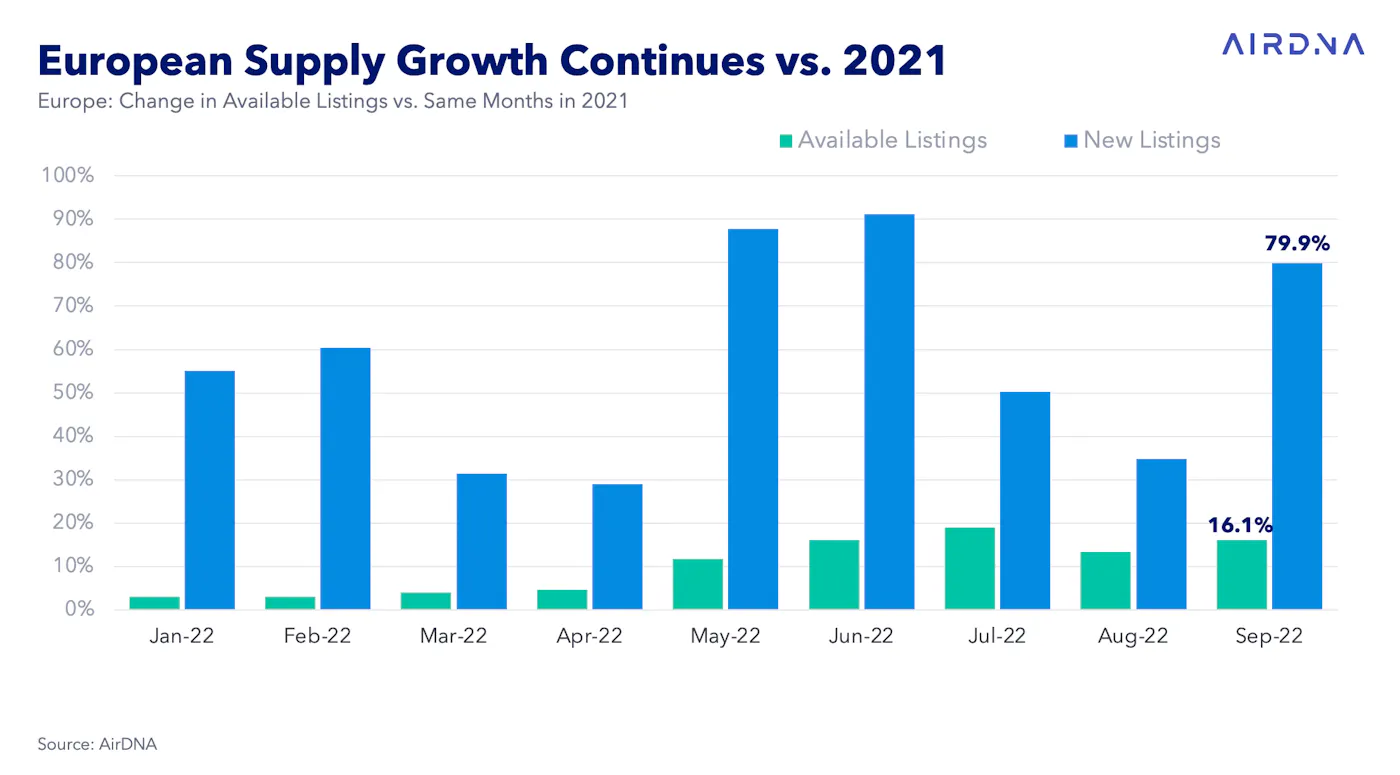
As the close of the summer peak season arrived in Europe, demand momentum took a somewhat anticipated pause in September. After posting new records during the preceding summer months, the trajectory of European short-term rental (STR) demand reversed course. The European continent ended September with 39.2 million nights stayed, which was 1.7% less than in 2019, though 33.9% vs. 2021. Nights booked for future travel also declined in the month by 4.3% vs. 2019, though still 25.8% above last year.
Listings available for rental in the month also declined by 9.4% relative to September 2019, to 2.99 million. Compared to 2021 however, available listings have continued to climb, ending September with 16.1% more listings than last year. Similarly, new listing growth was strong in September on a year-over-year basis, but lagged September 2019. There were 83,600 new units added in the month, which represents a 79.9% increase over last September, though -25.1% vs. 2019.

Occupancy levels remained strong in the month despite a decline in demand growth. In September, short-term rental occupancy reached 61.4% in Europe, which represented an increase over both 2019 (+2.7%) and 2021 (+6.5%).
The deceleration in demand growth seen in September had a slight impact on average daily rates during the month, which dipped 0.1% year-over-year (+25.3% vs. 2019). However, inflation remains strong compared to 2019, with rates sitting 25.4% higher compared to September 2019. In spite of a decline in rates over last year, higher occupancy levels in the month allowed revenue per available room (RevPAR) to continue to climb by 6.4% over the same period last year (+28.7% vs. 2019).
At a Glance: September 2022 Short-Term Rental Performance
- Available listings reached 2.99 million, up 16.1% year over year, -9.4% vs. 2019
- Total demand rose 33.9% YoY
- Occupancy rose to 61.4%, up 2.7% from 2019 and 6.5% YoY
- Average daily rates (ADRs) dipped 0.1% YoY, remaining up 25.3% vs. 2019
Top-20 Countries See Mixed Results on Supply, Demand in September
Whereas nine of the top-20 European countries saw positive demand figures in August relative to 2019, this number was reduced to just six in September.
France, Germany, and Austria led the continent in demand growth, pulling in 19.2%, 15.7%, and 15.1% more nights respectively vs. September 2019. Unsurprisingly, the countries with the lowest demand figures relative to 2019 were the Czech Republic (-36.9%), Hungary (-33.3%), and Ireland (-26.3%), each of which have lagged behind the rest of the top-20 since the start of the pandemic.

Listing growth was mixed among the top-20 countries in the month of September, with eight countries seeing more properties online than in 2019. The strongest growth in available listings was seen in Norway (11.2%), France (8.5%), and Poland (7.7%), whereas supply in the Czech Republic (-32.2%), Hungary (29.0%), and Ireland (27.4%) remained more than 25% below September 2019.

Stay ahead of the curve with local STR data
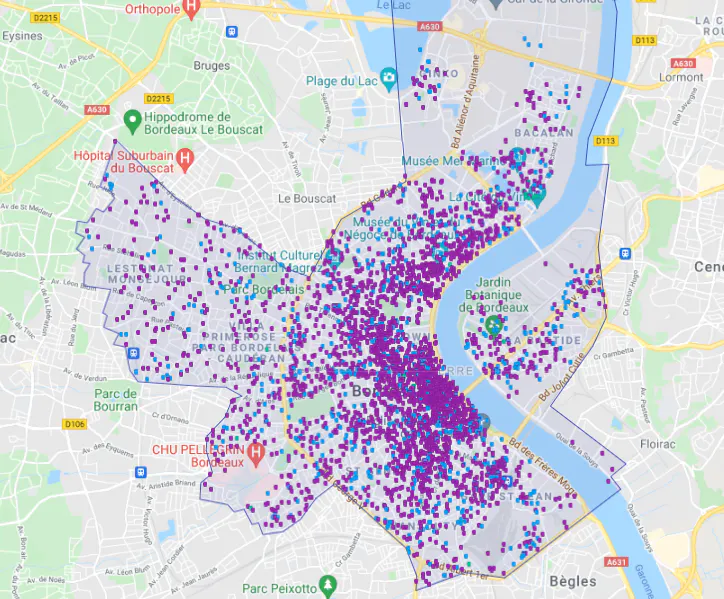
See daily, weekly, and monthly performance in your market on key metrics with AirDNA.
Click here to find your marketFrance Under the Spotlight
France has maintained consistent demand growth over 2019 levels, and it is the largest short-term rental market in Europe. So where are their guests coming from, and where are they staying?
Domestic travellers within France accounted for the bulk of STR demand in Q3 2022, at 62.8% of Airbnb reservations. Expectedly, this figure declined by 15% from the same period in 2021, when domestic travel was at its peak while international travel hurdles remained in place. In 2022, however, demand growth has been bolstered by an increase in international guest traffic.
Of the 37.8% of reservations in France made by international travellers in Q3 2022, the British led the crowds, making up 17% of international bookings in the country, followed by United States (15.4%), and German travellers (12.4%), the latter of which increased their share the greatest when compared to pre-pandemic levels (+2.2%).
Of the top-10 countries sending the most guests to France, visitation between Q3 2019 and Q3 2022 increased the most for Germany (+2.2%), the Netherlands (+1.6%), and the United States (+1.6%). Across the same period, the market share of international guest demand decreased for Spain (-0.9%), Australia (-0.8%), and Canada (-0.4%).

Coastal Destinations Driving France's Continued STR Leadership
Historically, the coastal areas of France have held a majority of listings in the country. As travellers’ preferences have changed with the pandemic, this trend has continued, with coastal areas even beginning to gain listing share.
In September 2019, coastal areas made up 38.1% of listings in the country. By September 2022, this share had increased to 40.0%, which translates to roughly 300,000 available listings.
These gains in market share for coastal regions came at the expense of the largest cities, with Paris and other urban areas giving up 3.3% and 2.4%, respectively. Mountain destinations (+1.5%) and rural areas (+0.7%) have both picked up some modest listing share in 2022, possibly a reflection of travellers’ pent-up desire to visit the great outdoors after spending over two years mostly indoors during the pandemic.

The reasoning behind this shift in listing market share between location types is related to a change in demand mix. Demand for mountain areas, coastal areas, rural, and midsize cities has shown consistent monthly growth over 2019 figures since September 2021. In September 2022, mountain areas saw the strongest demand growth over the same month in 2019 (41.7%), followed by rural (36.1%), coastal areas (30.0%) and midsize cities (29.7%). The STR market is very quick to adapt to demand changes, as hosts and property managers react to market conditions and add supply where it’s needed.
Greater Paris continues to see a shortage of demand for short-term rental stays, which is of course linked to heightened regulations by the French government to limit listings in the city. Demand in the Paris area this summer was 73.6% higher than last year, while supply remained low, pushing occupancy up 24.2%. However, both demand and supply are more than 20% below 2019 levels.

This mix shift has jostled occupancy levels throughout French location types. While demand was in the midst of recovery last summer (June-September), location types where demand growth outpaced supply growth experienced unprecedented occupancy levels. However, in the last year, occupancy has begun to normalise in areas where hosts have added units to capitalise on unmet demand.
The strongest summer supply growth over 2021 was seen in midsize cities (29.4%), followed by mountain areas (26.3%), rural areas (22.2%), and coastal areas (22.1%). The volume of listings added in midsize cities, coastal areas, and rural areas appears to have been adequate to quell the surge in occupancy seen last year.
However, occupancy levels remained high relative to last year in mountain areas, Paris, and urban agglomerations despite strong listing growth. The greatest year-over-year change in summer occupancy was in the Paris area (24.2%), which also saw the greatest change in demand (73.6%) in the comparison period. As demand began to return to the capital city this summer, occupancy became inflated despite a 19.9% increase in available listings over last summer. Also notable is that relative to the summer of 2019, demand and supply in Paris remained 25.9% and 20.8% lower, respectively.

Tumultuous Times Bring Demand Pacing Decline in 2023
As of the 10th October, demand for stays in Europe was on pace to increase 8% over 2019 levels for the months of October and November, and a strong +24.9% reading year over year.
Looking out across the following four months (December-March), however, demand is lagging versus 2019 (-15.7%) but showing a respectable 11.6% year-over-year increase. There is clearly some uncertainty about booking for this winter, with increasing fears of an economic downturn, war in Ukraine, energy shortages, and persistent inflation all weighing on travellers’ minds.

The declines versus the 2019 benchmark in demand pacing for December-March are even more pronounced when looking at individual countries. Across this forecast period, growth in future demand was seen in just three of the top-20 countries: Austria (+18.5%), France (+7.8%), and Finland (+10.9%). The remainder were pacing somewhat below or well below 2019 figures as of this time, though it’s likely that some travelers are holding off on bookings while weighing up broader economic conditions.

This is a tumultuous time in the economic cycle, although short-term rentals as well as the broader travel industry will recover.
There is still a lot of pent-up demand for travel, but at the margin, guests may decide on more budget-friendly destinations, and destinations closer to home. Hosts should be mindful of some popular trends in the post-pandemic era that can help to capitalise on the some of that pent-up demand, especially for digital nomads and “bleisure” travel (business + leisure at the same time). Hosts and property managers should raise the awareness of amenities and features at their properties that can cater to these demographics while waiting out the current opaque nature of geopolitical and economic concerns.

Regulations and Your STR business
Understand how legislation and restrictions can benefit and hinder your STR business and community

Supercharge Your Market Knowledge
AirDNA's new, updated rates and revenue pages make it easier to manage your property like a pro at the click of a button

Europe Review: August 2022
The summer of 2022 saw a full recovery from the pandemic in Europe, with 3.5% more nights stayed in a short-term rental in June, July, and August than in 2019.
ARTICLE SUMMARY
After surpassing pre-pandemic levels of demand every month since January 2022, the European short-term rental industry started to lose its momentum towards the end of the peak summer period: the continent ended September with 39.2 million nights stayed — 1.7% less than 2019, though still 33.9% more than 2021 — as guests began to weigh the implications of an economic downturn happening in the continent.
Scott Sage
Senior Vice President, Marketing & Customer Experience
Scott is an Airbnb Superhost and industry pro, having founded Home Base BnBs—a short term rental management company that scaled to 200+ units. Scott combines his experience and passion for hosting to empower AirDNA customers' success. When he's not thinking about STRs, he is hiking, playing basketball, or playing pickleball.

Get started with AirDNA today.
Powerful, easy-to-use tools that help hosts and investors succeed in the short-term rental market.
Try for free