What’s the Best Minimum Stay Policy for Your Short-Term Rental?
Published: May 21, 2026
Last updated: October 4, 2026

Linda Rollins
Key Takeaways
- Most STR hosts still use static minimum stay policies, despite clear revenue opportunities from more dynamic approaches.
- Larger homes, luxury listings, and professional operators are the most likely to vary minimum stays by season, weekends, and booking window.
- Top operators adjust minimum stays dynamically to capture more bookings, reduce turnover costs, and maximize peak-period revenue.
A 3-night minimum sounds sensible until it blocks a last-minute 2-night booking that would’ve filled your calendar. On the flip side, accepting too many short stays during peak season can leave you buried in turnover costs while longer bookings go elsewhere.
Minimum stay policy is one of the most overlooked tools in short-term rental revenue management, yet most operators barely touch it. Across the 50 largest U.S. markets, 60% of hosts use the same minimum stay every night of the year. In major urban markets, that rises to 64%.
The problem is that the “right” minimum stay changes constantly depending on the market, season, property size, and booking window. A beach house during peak summer shouldn’t operate the same way as a downtown apartment in February.
In this guide, we’ll break down how operators are actually using minimum stay policies across the largest U.S. markets to increase profits, where dynamic strategies are gaining traction, and which approaches are working best in coastal, mountain, and urban destinations.
Static Minimum Stays Still Dominate the Market
Before deciding what your minimum stay policy should be, it helps to look at what most operators are actually doing. The answer: not much.
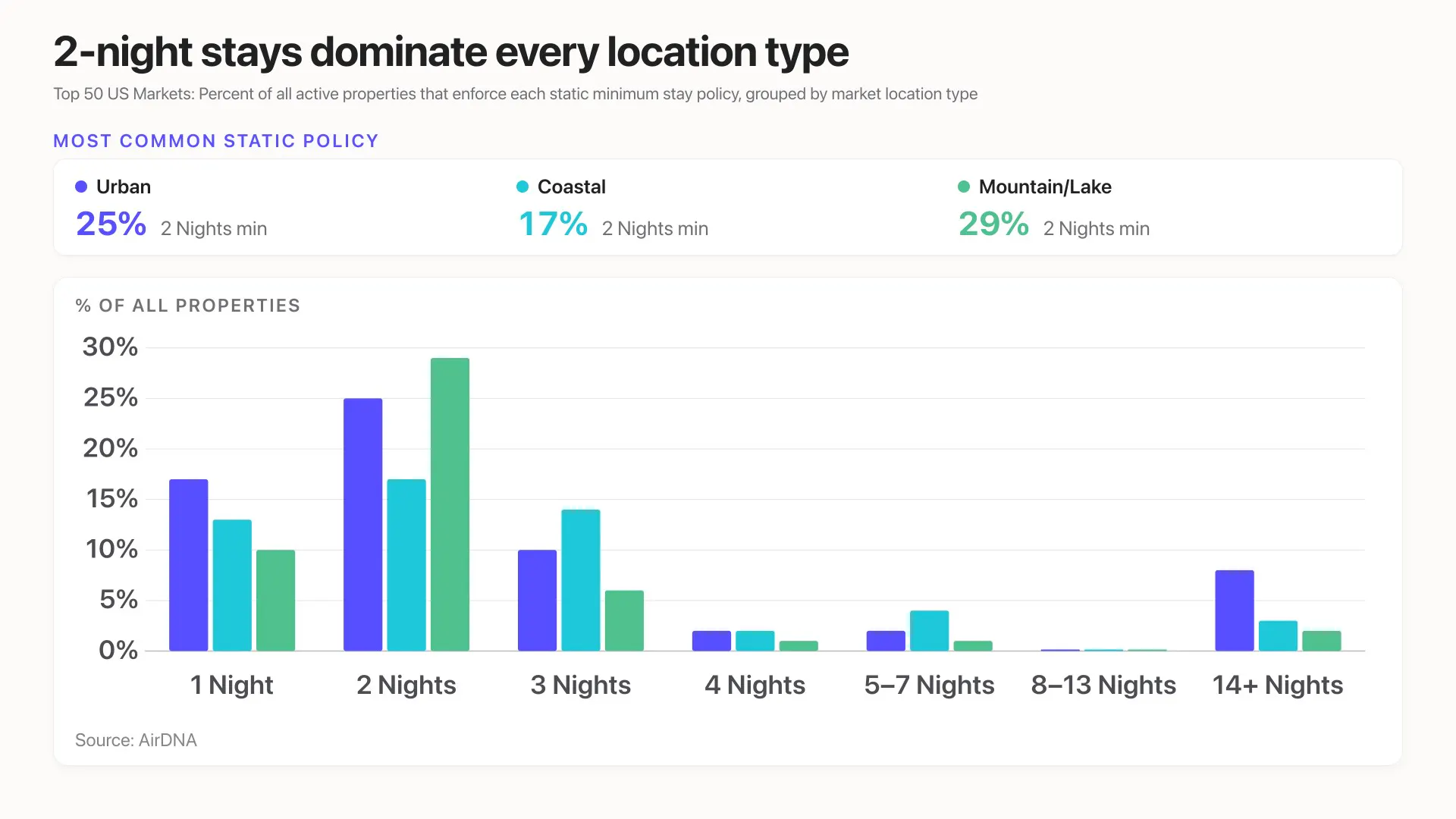
Across the 50 largest U.S. markets, 60% of operators use the same minimum stay every night of the year. In major urban markets, that figure climbs to 64%. Even in large coastal and mountain destinations, about half of listings stick to a single minimum stay year-round. Dynamic policies are still far from the norm.
What those static minimums look like depends heavily on the kind of trips guests are taking. Urban, mountain, and lake markets tend to skew shorter because travelers are booking quick getaways, business trips, and long weekends. Roughly 40% of listings across the largest urban, mountain, and lake markets run a static 1-night or 2-night minimum.
Coastal markets tend to operate differently. About 20% of listings in the largest U.S. beach markets use a static minimum stay between 3 and 7 nights. Beach travel is more likely to revolve around longer vacations planned months ahead, often tied to school schedules and larger group trips.
At the far end of the spectrum, some urban markets have a surprisingly large share of listings requiring 14-plus-night stays. In cities like New York, Los Angeles, and San Francisco, local STR regulations push many operators toward mid-term rentals, while demand from traveling nurses, corporate relocations, and extended business stays helps support those longer minimums.
View the most common static minimum stay policy for each of the 50 largest US markets:
Who’s Actually Using Variable Minimum Stay Policies?
Variable minimum stay policies are still the exception rather than the rule, but adoption isn’t evenly distributed. Our data shows clear patterns by property size, price tier, and operator scale.
Larger homes are more likely to go dynamic
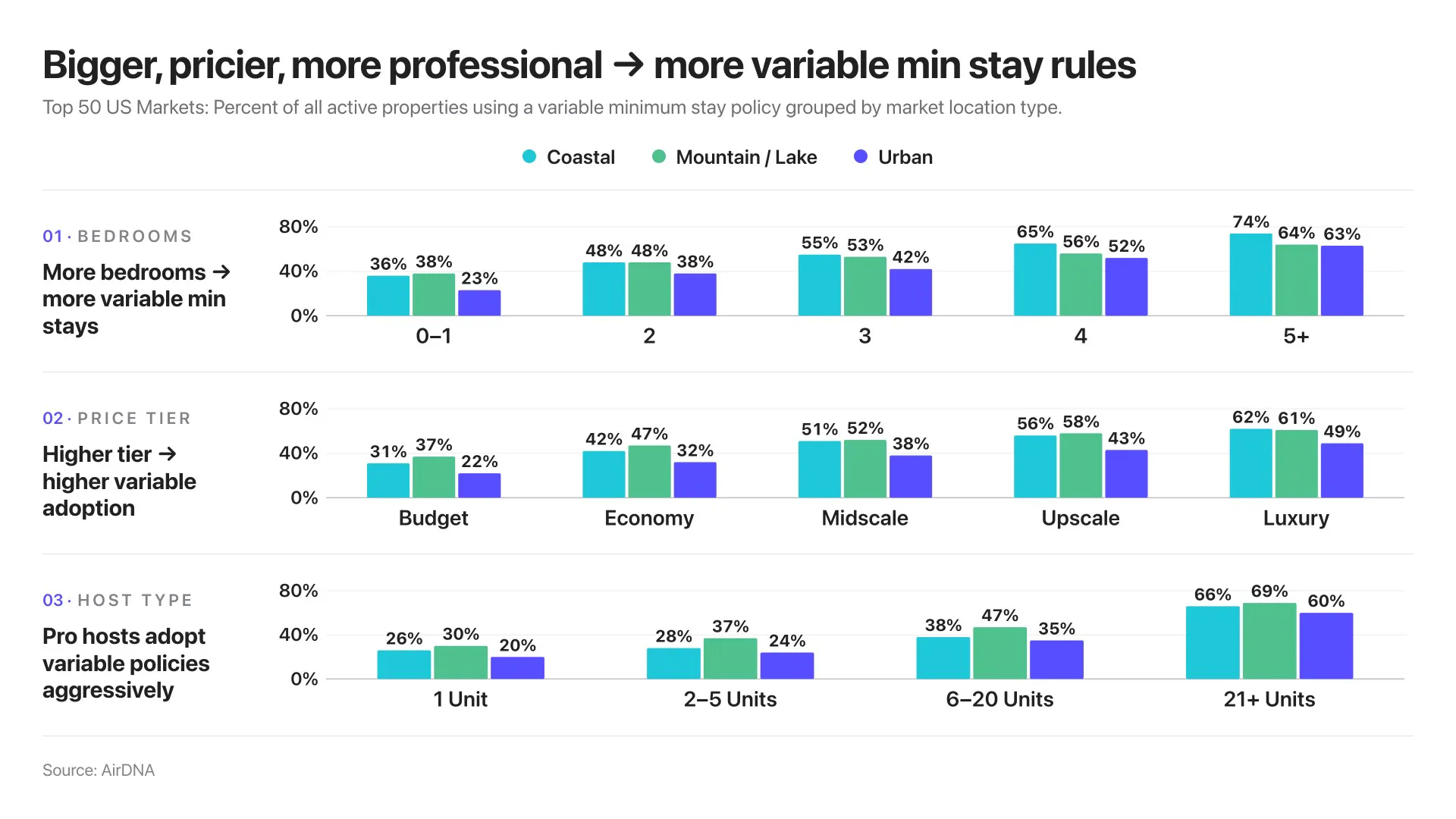
The larger the property, the more likely operators are to vary their minimum stay.
Across the largest coastal, mountain, and urban markets in the U.S., more than 50% of 4-bedroom properties and more than 60% of 5-plus-bedroom properties use variable minimum stay policies. Studios and 1-bedrooms sit well below that level, with fewer than 40% varying their policy across all location types.
The reason is simple: Larger properties have more demand variability and more revenue at stake.
Holiday periods, summer peaks, and event weekends tend to attract longer group bookings, while shoulder seasons often require shorter stays to keep occupancy moving. A static rule that works during peak season can quickly become too restrictive during slower stretches. The cost of getting it wrong is also much higher on a 5-bedroom property than on a studio, whether that’s turnover-heavy short stays or empty calendar gaps caused by minimums that are set too high.
Luxury listings vary more than budget properties
Price tier matters too. In mountain and coastal markets, more than 50% of Midscale through Luxury properties vary their minimum stay. Budget and Economy listings are much more likely to stick with a single rule year-round. Cities show an even sharper divide: Fewer than 35% of listings overall vary their minimum stay, but roughly half of Luxury properties do.
Budget listings tend to see less dramatic swings in both demand and pricing, making a single rule easier to sustain.
Luxury operators, meanwhile, face much larger differences between peak and shoulder season demand. The right minimum stay for a holiday week looks very different from the right minimum stay for a slow Tuesday in February. Luxury properties are also more likely to be managed by professional operators using revenue management tools that already include dynamic minimum stay settings.
Larger operators adopt dynamic policies more often
The clearest trend appears at the portfolio level. Across every location type, operators managing 21-plus properties show the highest adoption of variable minimum stay policies, with more than 60% using them. Meanwhile, fewer than one-third of hosts managing five or fewer units vary their minimum stay policy.
Large operators typically have three advantages. First, many already use revenue management tools that include dynamic minimum stay logic by default. Second, they have the operational bandwidth and data visibility to monitor performance and adjust rules over time. Third, the gains compound quickly across a portfolio. A strategy that adds three or four booked nights per month on one property becomes much more meaningful across 20-plus listings.
Smaller operators aren’t locked out of these tools or strategies. Revenue management software is accessible at nearly every portfolio size, and in many cases the gap is awareness rather than capability.
The Minimum Stay Strategies Working in Every Market Type
What do variable minimum stay policies actually look like in practice? The answer depends heavily on the type of market and its seasonality. For the underlying data on how stay length varies by market, season, and check-in day, see our analysis of Airbnb length of stay across the 50 largest U.S. markets.
Here are the patterns we see across coastal, urban, and mountain destinations, along with the logic behind each one.
Beach markets: Lean into peak season
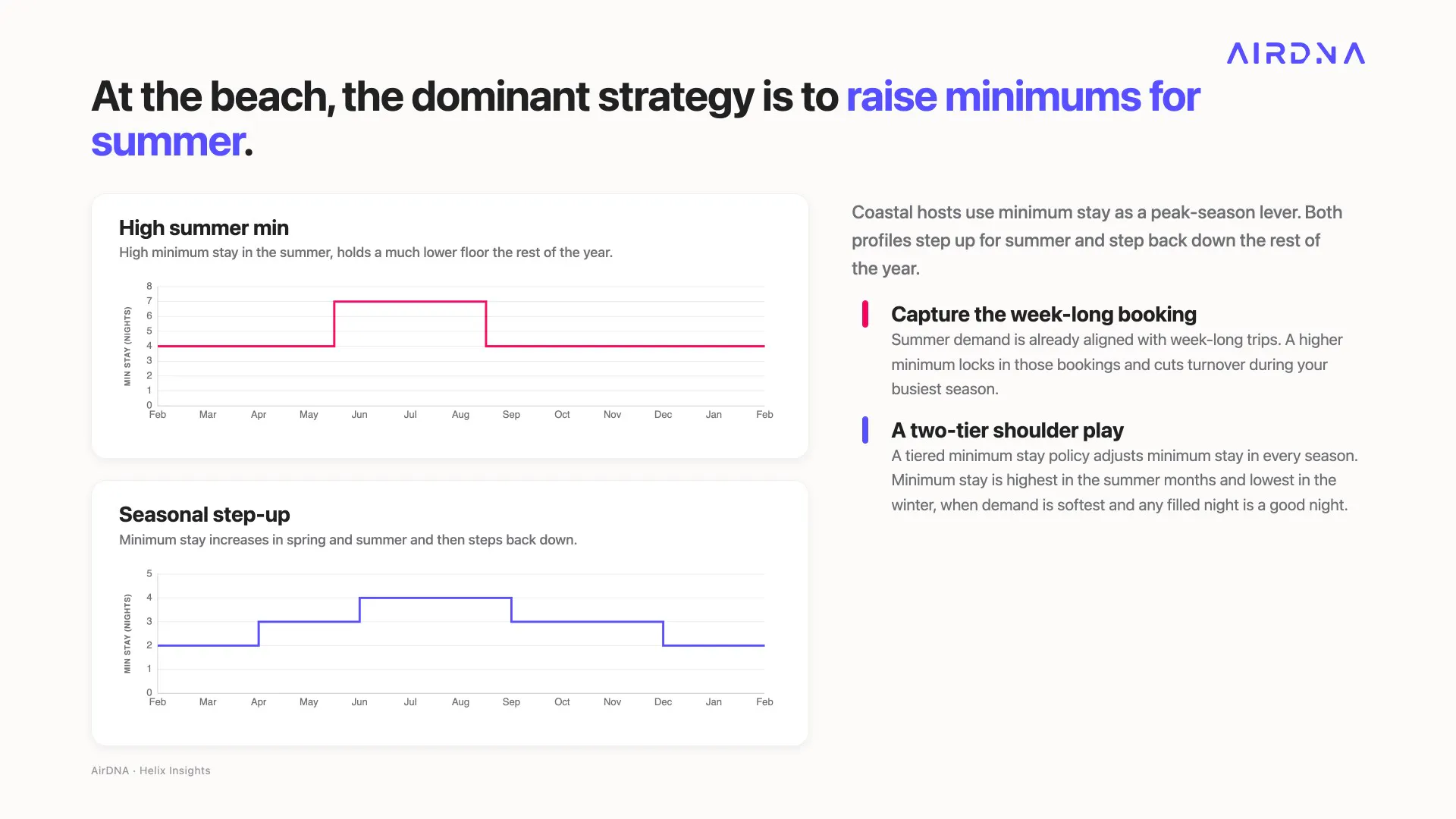
At the beach, the dominant strategy is to raise minimum stays significantly during peak summer months. A common setup is a 5- to 7-night minimum in June, July, and August, with much lower minimums outside of that window.
The reasoning is straightforward. Summer is when beach demand peaks, and guests are already planning week-long trips. Higher minimums during that stretch help operators capture longer bookings that match natural travel patterns while keeping turnover costs down during the busiest season.
Some coastal operators layer in a second tier, slightly increasing minimums during spring and fall before dropping to the lowest minimums of the year in late fall and winter, when demand softens and flexibility becomes more important.
Cities: Weekday-weekend variation is the default
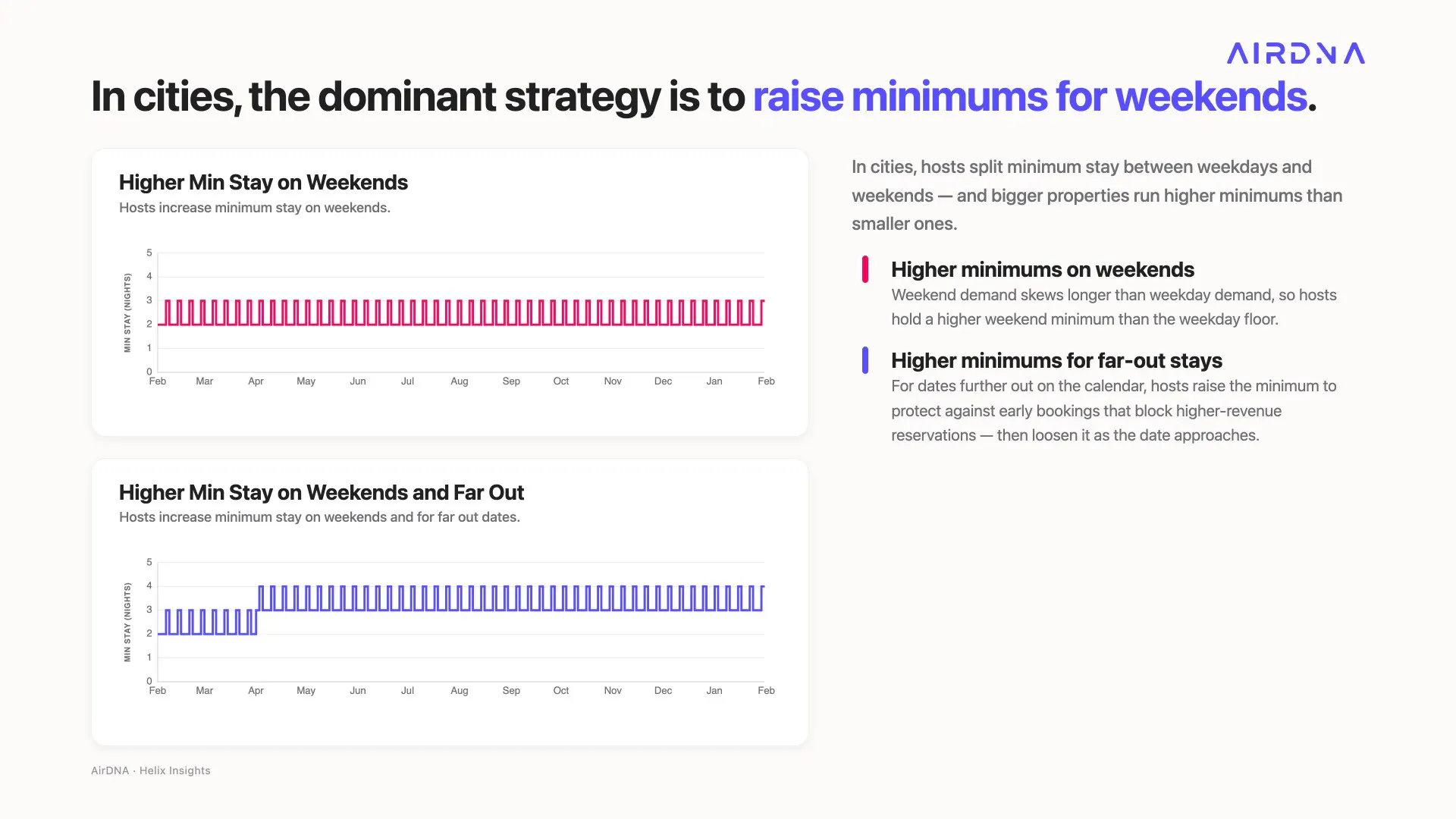
In urban markets, the most common dynamic strategy is splitting minimum stays between weekdays and weekends. Weekday demand often comes from business travelers and short leisure trips looking for 1- or 2-night stays, while weekends skew longer. The minimum stay policy follows the demand pattern.
Smaller properties typically run a lighter version of this split. A 1-bedroom or 2-bedroom property might require a 1-night minimum Sunday through Thursday and a 2-night minimum on Friday and Saturday. Larger urban properties tend to push those minimums higher. A 4-bedroom or 5-bedroom might require 2 nights Sunday through Wednesday and 3 nights Thursday through Saturday, helping offset the higher operational cost of turnovers on larger homes.
The most sophisticated operators add a third layer: booking window. Near-term dates may require shorter minimums, while dates several months out hold higher minimum stays to leave room for longer, higher-value reservations. If those longer bookings don’t materialize as check-in approaches, operators can relax the rules later and reopen dates to shorter stays.
Mountain markets: Peak-period lifts + weekday/weekend patterns
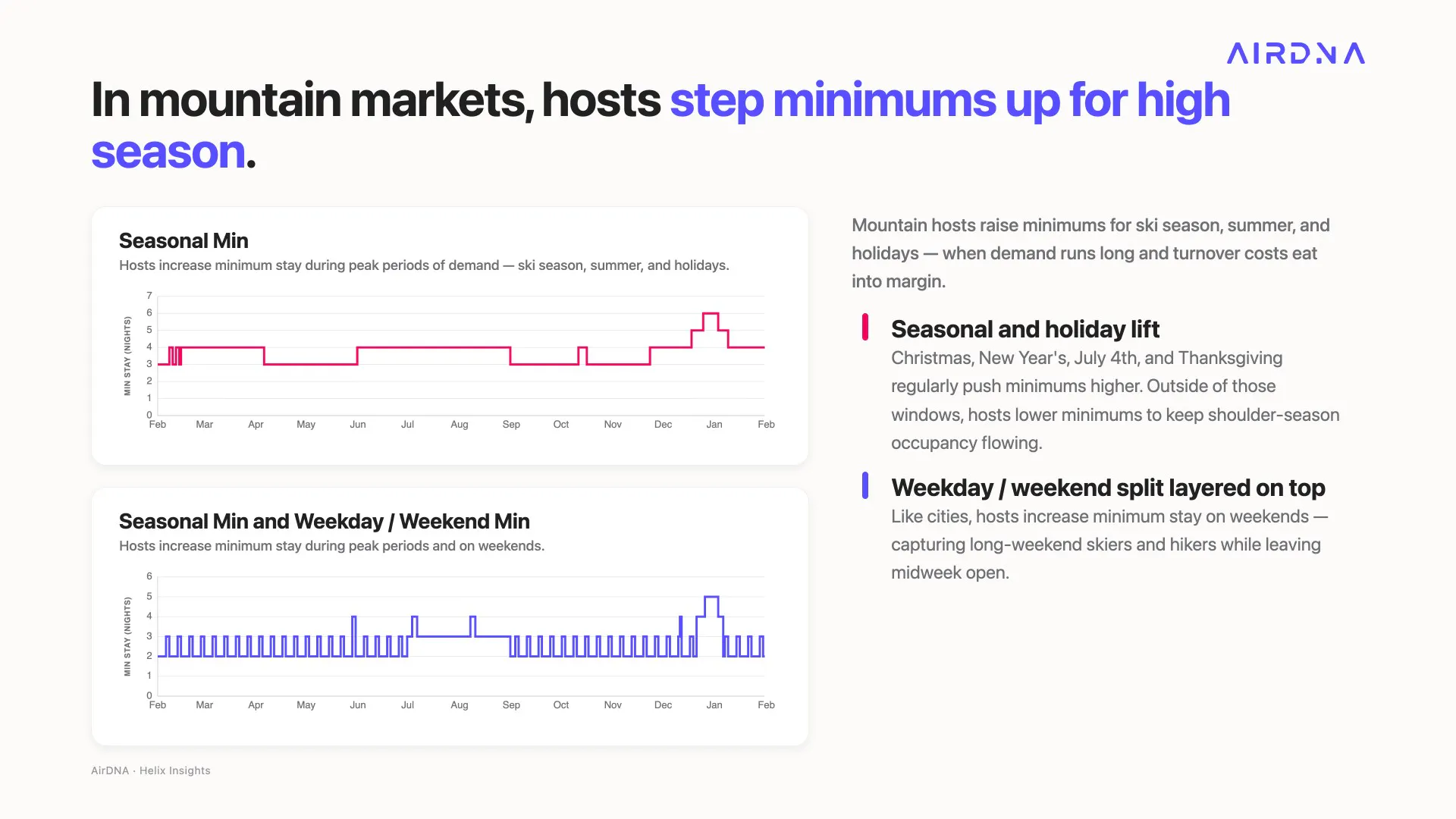
Mountain operators typically raise minimum stays during ski season, summer, and major holiday periods, when guests are already planning multi-night trips and turnover-heavy 1-night stays become more expensive operationally.
The biggest increases usually happen around Christmas, New Year’s, Presidents’ Day, July 4th, and Thanksgiving, when minimum stays often rise to 4 to 7 nights depending on property size. Outside of peak periods, operators generally relax minimums back to 2 or 3 nights to help maintain shoulder-season occupancy.
Mountain markets also commonly layer in weekday and weekend variation. A property might require a 2-night minimum Sunday through Wednesday and a 3-night minimum Thursday through Saturday. The weekend bump helps capture long-weekend skier and hiker demand while still allowing flexibility for shorter midweek stays.
The Tactics Separating Top Operators from Everyone Else
The strategies above are the foundation. The operators pulling ahead are using calendar settings to adjust minimum stays based on how bookings are actually coming in, not sticking to a hard and fast rule.
- Lower minimums to fill gap nights: Gap nights are short openings between bookings that become unbookable under a standard minimum stay rule. Top hosts automatically relax minimums for these dates to recover otherwise lost inventory. Industry data suggests this tactic alone can add 3 to 4 booked nights per month on average.
- Relax minimums closer to check-in: Many operators hold higher minimums far in advance, then lower them as check-in approaches. The logic is simple: Months out, there’s still time for a longer, more profitable booking to come through. Closer to arrival, flexibility becomes more valuable than holding out for the perfect stay length.
- Raise minimums during major events: Holiday weeks, festivals, sporting events, and peak travel periods are often the best times to push minimum stays higher. Strong demand during local events allows operators to require longer stays while reducing turnover pressure during the busiest periods of the year.
- Adjust minimums by day of arrival: Some operators require longer stays for Friday or Saturday arrivals while keeping weekday minimums lower. This helps capture long-weekend demand without unnecessarily restricting slower midweek dates.
- Use shorter minimums during shoulder season: During slower periods, flexibility often matters more than maximizing stay length. Reducing minimums in shoulder season can help keep occupancy steady and attract shorter, spontaneous trips that might otherwise book elsewhere.
Let Adapt Do It for You
Every trend in this guide points the same way: the right calendar setting changes constantly. It changes with the season, the check-in date, how far out a date sits, and the size of your property, and it shifts during holidays and when an event is in town.
Adapt gives you the controls to build and automate your calendar rules so you don’t have to adjust every date manually. You can set minimum stay policies, check-in and check-out restrictions, and gap night rules for each day of the week, create seasonal and event overrides for specific months and holidays, override an individual date on its own, and set minimum stays by lead time.
But you may not want to build the rules yourself, or even know where to start. Adapt is an AI-native pricing tool, which means AI sits at the core of how pricing and calendar decisions get made rather than being layered onto a rules-based system. It starts from a pricing strategy you choose: Smart Yield to optimize RevPAR, Volume Builder to price at market and work discounts hard to keep occupancy high, Steady Earner to fill early at a slightly lower rate for predictable income, or Premium Hold if you’d rather have an empty night than a cheap one. From there it sets your calendar rules to maximize toward that goal, adjusting them through the year based on lead time, season, holidays, events, and how your calendar and market are filling up.
Adapt calibrates all of it to your listing’s history, your local market, and attributes like property type and bedroom count. A one-bedroom urban condo and a five-bedroom beach house on the same strategy get different day-of-week rules, seasonal swings, and minimum stay rules.
When Adapt sees gap nights or orphan nights your minimum stay is blocking, it adjusts both your minimum and your rates so the date has a higher chance of getting booked. And when an event comes to town that lets you command a higher minimum stay and rate, Adapt makes that adjustment too.
Build the rules yourself in Adapt, or pick a strategy and let Adapt build them. Either way, your calendar rules stop working against you.
ARTICLE SUMMARY
Most short-term rental operators still use static minimum stay policies, but dynamic strategies are becoming a major advantage. Using AirDNA data, this guide explores how top operators adjust minimum stays by market, season, booking window, and demand pattern to improve occupancy and revenue.
Linda Rollins
Senior Research Analyst
Linda Rollins is a Senior Research Analyst at AirDNA and a self-managing short-term rental host, which means she understands the market as both an analyst and an operator. She writes research and blogs for AirDNA and for Adapt, its revenue management tool, making her work a go-to resource for investors trying to find and size up the right opportunities, and for operators looking to understand changing market dynamics and find concrete ways to improve occupancy, rates, and guest experience. Her data is regularly cited in major news outlets, and she has a knack for bringing both the numbers and the story behind them. In her free time, Linda enjoys spending time with her family, traveling, and looking for good eats.