

 Calculate Revenue
 Research Markets
 Find For Sale Properties
 Compare My Listing
 STR Revenue Calculator
 Custom Comp Sets
 Submarket Insights
 Custom Search Filters
 Rate Recommendations
 Performance Benchmarking
 Competitor Comparison
 Owner Contact Details
 Property-level performance data
 Tourism Insights
 Real Estate Investment Analytics
 About Us
 Sales
Sales Support
 Press
PressWhat Is Airbnb Yield? How to Spot a Good Investment at a Glance
Published: December 8, 2025
Last updated: May 6, 2026

Camilo Schmid Rivas
Key Takeaways
- Airbnb yield is a fast way to estimate how much income a short-term rental might generate each year compared to its purchase price.
- The average Airbnb yield in the U.S. is around 9%, based on AirDNA data. Yields above 10% are more common in lower-cost markets, while high-demand urban or coastal areas tend to sit between 5% and 7%.
- As property prices rise, yields tend to drop. That’s why lower- to mid-priced homes often offer better returns in terms of income per invested dollar.
When you're sizing up a potential short-term rental, one of the first things you're trying to figure out is: Is this a good return on investment (ROI)?
Before you start building out a full financial model or running dozens of what-if scenarios, there's a quick way to get a read on whether a property is worth pursuing: yield.
Yield is a fast, back-of-the-napkin calculation that compares how much income a property could earn each year against what it costs to buy. Looking at yield doesn’t replace full Airbnb ROI analysis, but it’s the shortcut many investors use to narrow down options before going deeper.
In this guide, we’ll break down what Airbnb yield is, how to calculate it, and what kind of yield might signal a great investment. If you're in the early stages of property hunting, this is one number you'll want to keep in your toolkit.
What Is Airbnb Yield?
Yield is one of the easiest ways to size up how much bang you’ll get for your buck with a short-term rental. It compares the income a property might earn each year with what it costs to buy. Put another way, yield shows you the percentage of your property value that short-term rental earnings cover annually.
Just divide estimated annual revenue by the purchase price, multiply by 100 to get a percentage, and you’ve got your yield.

Why Airbnb yield matters for real estate investors
If you’re wondering whether a short-term rental is really worth the price tag, Airbnb yield is one of the best places to start. It gives you a quick snapshot of how much income a property might bring in each year, compared to what it costs to buy. Think of it as a shortcut for spotting income potential before you get buried in spreadsheets.
That’s why yield is so useful early in your investment process. Whether you're browsing listings, comparing cities, or just trying to figure out if a property could be a good deal, yield helps you focus on the investment opportunities that make the most sense.
It’s especially handy when you:
- Want to compare properties across different cities or price points
- Need a fast way to estimate how long it might take to earn back your investment
- Don’t have all the expense details yet to calculate full Airbnb ROI
- Are thinking about balancing cash flow with long-term appreciation
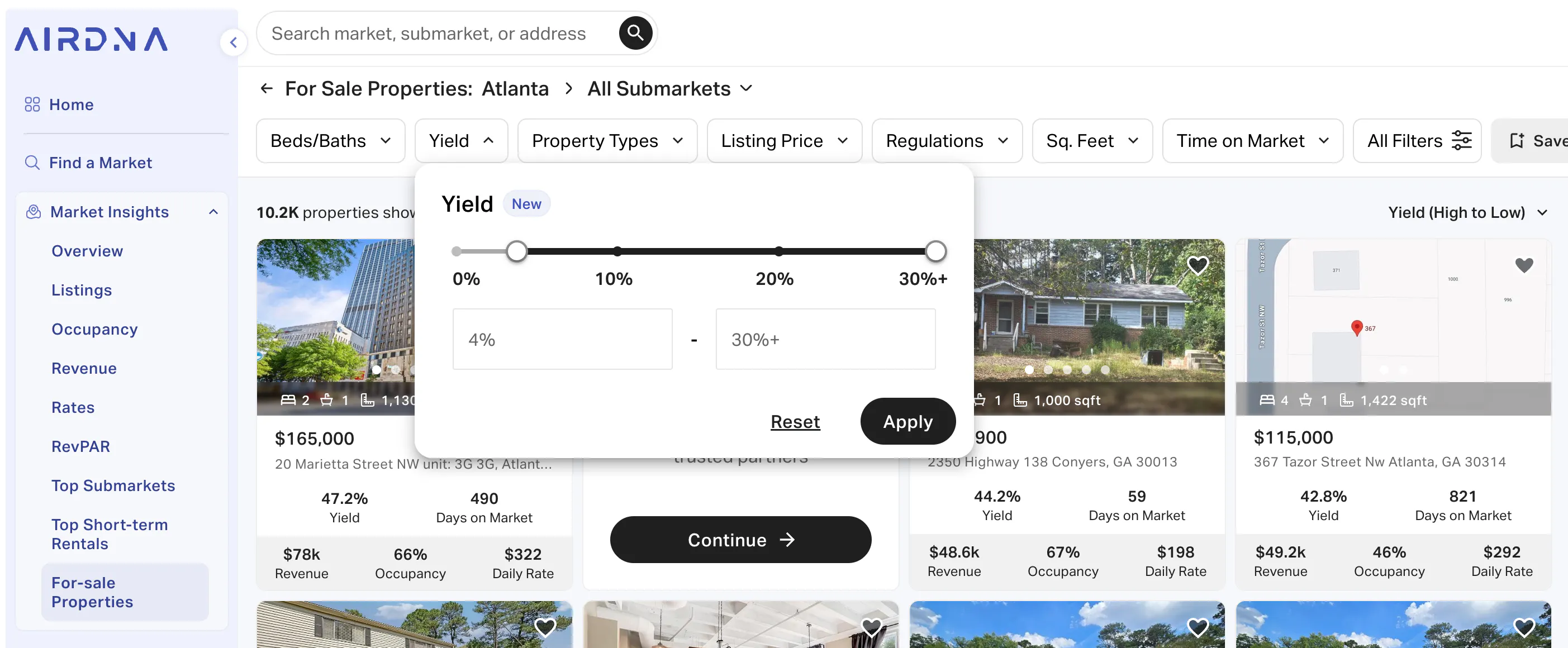
If you're using AirDNA, you're already ahead of the game. Yield is automatically calculated for each listing in our For-Sale Properties tool. That means you can scroll through available homes and instantly see which ones might offer stronger returns (no calculator required). We’ll walk you through that a little later on in this article.
Airbnb yield vs. return on investment (ROI)
You might be wondering, “Aren’t these the same thing?”
Close, but not quite. Airbnb yield and Airbnb ROI are both ways to measure investment potential, but they serve different purposes depending on where you are in your decision-making process.
Yield is a quick gauge of investment potential. It compares the property’s price to its potential annual income, giving you a simple way to compare listings and spot high-earning opportunities without splitting hairs and diving into every last detail.
ROI, or return on investment, goes much deeper. Whether you’re projecting it before you buy or calculating it after the fact, ROI looks at total profitability. It looks at the total return you could expect from a property, factoring in:
- Startup costs
- Operating expenses
- Property financing
- Property appreciation
- Equity growth
- Tax advantages
Yield won’t answer every question, but it can point you toward the right ones. It’s a great first step before diving into a full ROI calculation.
Start With Yield, Go Deeper Later
Use AirDNA to assess market performance and compare Airbnb yield across for-sale listings before diving into full ROI.
How to Calculate Airbnb Yield (With Examples)
Airbnb yield is a simple formula that gives you a quick read on how much income a short-term rental could generate compared to what it costs to buy. Here’s the basic formula:
(Estimated Annual Revenue ÷ Purchase Price) × 100 = Yield (%)
Let’s break that down with a few examples.
Example 1: Mid-size city
- Listing price: $450,000
- Estimated annual revenue: $49,500
($49,500 ÷ $450,000) × 100 = 11% yield
That’s a solid yield, especially if you're looking for strong monthly income relative to purchase price.
Example 2: Coastal destination
- Listing price: $1,200,000
- Estimated annual revenue: $66,000
($66,000 ÷ $1,200,000) × 100 = 5.5% yield
This yield is lower, but not unexpected for a premium vacation market. The trade-off may be lower short-term returns in exchange for long-term appreciation and reliable demand.
What Is A Good Yield for an Airbnb Investment Property?
Across the U.S., the average Airbnb yield is 9%. However, what’s considered a healthy yield varies depending on location, property type, and your personal investment strategy.
Understanding how different yield levels affect your strategy is key to making the right decisions. High, moderate, and low yields each present unique opportunities and challenges, depending on your goals as an investor.

High yield (12% and above)
These properties often appear in smaller cities, rural areas, or emerging vacation markets where home prices are relatively low, but rental demand is strong. They're attractive for income-focused investors looking to maximize cash flow.
Pros for high yield properties
- Strong monthly income relative to purchase price
- Faster payback period
- Attractive for investors focused on short-term cash flow
Cons for high yield properties
- Often found in more volatile or seasonal markets
- May face higher operational risk or regulation shifts
- Property appreciation may be limited
High-yield opportunities work best for investors prioritizing cash flow and faster returns, but these investments require close attention to local market conditions.
Moderate yield (8–12%)
This range is often considered the “sweet spot” for many STR investors. Moderate-yield properties are typically found in mid-size cities or vacation markets with steady demand and pricing.
Pros for moderate yield properties
- Balanced income and appreciation potential
- Consistent occupancy and reliable performance
- Suitable for most investment strategies
Cons for moderate yield properties
- Slower Airbnb ROI compared to high-yield properties
- May require more patience to see significant equity growth
- Performance is steady, but less dramatic
Moderate-yield properties are ideal for investors seeking dependable income and long-term value. They make a solid middle ground for both new and experienced hosts.
Low yield (5–7%)
Low-yield investments tend to show up in premium markets where property prices are high. Think Cape Cod or San Diego. While the income may not wow you up front, long-term appreciation and portfolio stability are key advantages.
Pros for low-yield properties
- Located in high-demand, often prestigious markets
- Strong potential for long-term equity growth
- Consistent occupancy and nightly rates
Cons for low-yield properties
- Lower short-term cash flow
- Slower return on investment
- High barrier to entry due to steep property costs
These properties are best suited for investors playing the long game who are willing to trade immediate returns for long-term appreciation and market stability.
Filter by yield in the AirDNA app
AirDNA’s for-sale properties feature generates revenue projections for real-time investment opportunities by looking at how active short-term rentals in the same area as the available property are performing.
If you know the yield range that you’re looking for in a short-term rental investment, you can filter properties by their projected yield to quickly hone in on the for-sale homes that match your criteria.
We explore how to use AirDNA to calculate yield in more detail a little later in this article.
Don’t Just Guess at Profitability—Compare
Use AirDNA filters to explore listings and markets by revenue potential, property size, and more.
Airbnb Yield Analysis of the U.S.
At AirDNA, we regularly track Airbnb yield using real-time revenue estimates from our Rentalizer tool. However, being the data nerds that we are, we decided to take a closer look at yield patterns across the United States to help investors make sense of this handy metric and make better decisions.
Instead of averaging the yield for each property individually, we totaled up the estimated revenue and listing prices for all for-sale properties across entire markets and used these aggregate figures for yield calculations. That gave us a better sense of how efficiently different areas turn property value into income and revealed some pretty useful yield patterns for short-term rental investors.
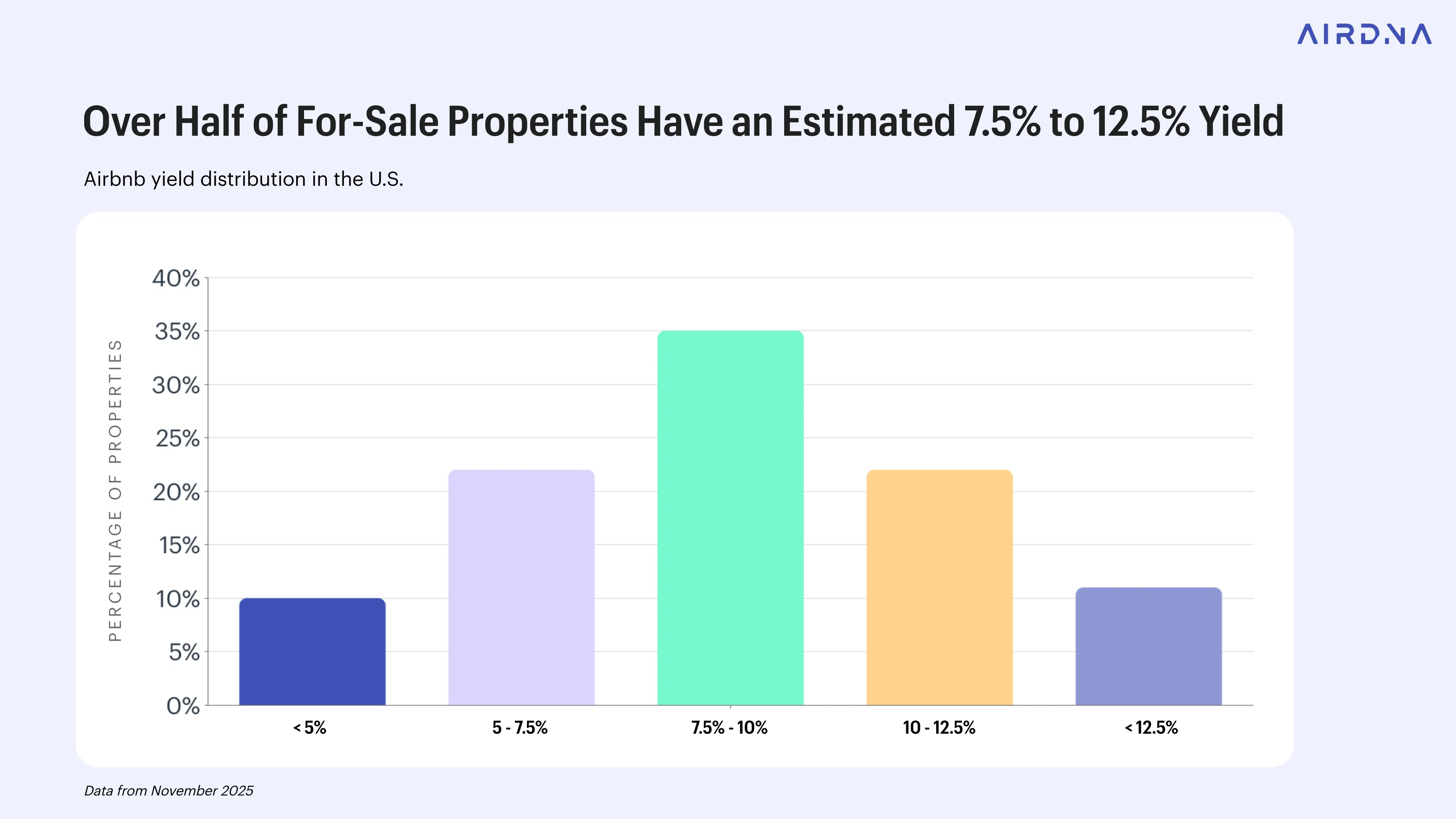
Nationally, over one third (35%) of current for-sale properties have an estimated yield between 7.5-10%. Yields of 5-7.5% and 10-12.5% account for approximately 25% of inventory respectively, while for-sale properties with yields on the low end (<5%) and on the high end (more than 12.5%) capture about 10% each.
Homes with higher prices usually have lower yields
Here’s something that might surprise you: just because a property costs more doesn’t mean it earns more, at least not in proportion to the price. In fact, our analysis showed a clear pattern: as property prices increase, yield tends to drop.
This is what’s known as yield compression. Income rises with price, but not at the same rate. So while a $1.5 million home might have a higher nightly rate, it won’t necessarily bring in enough extra revenue to keep pace with that price tag.
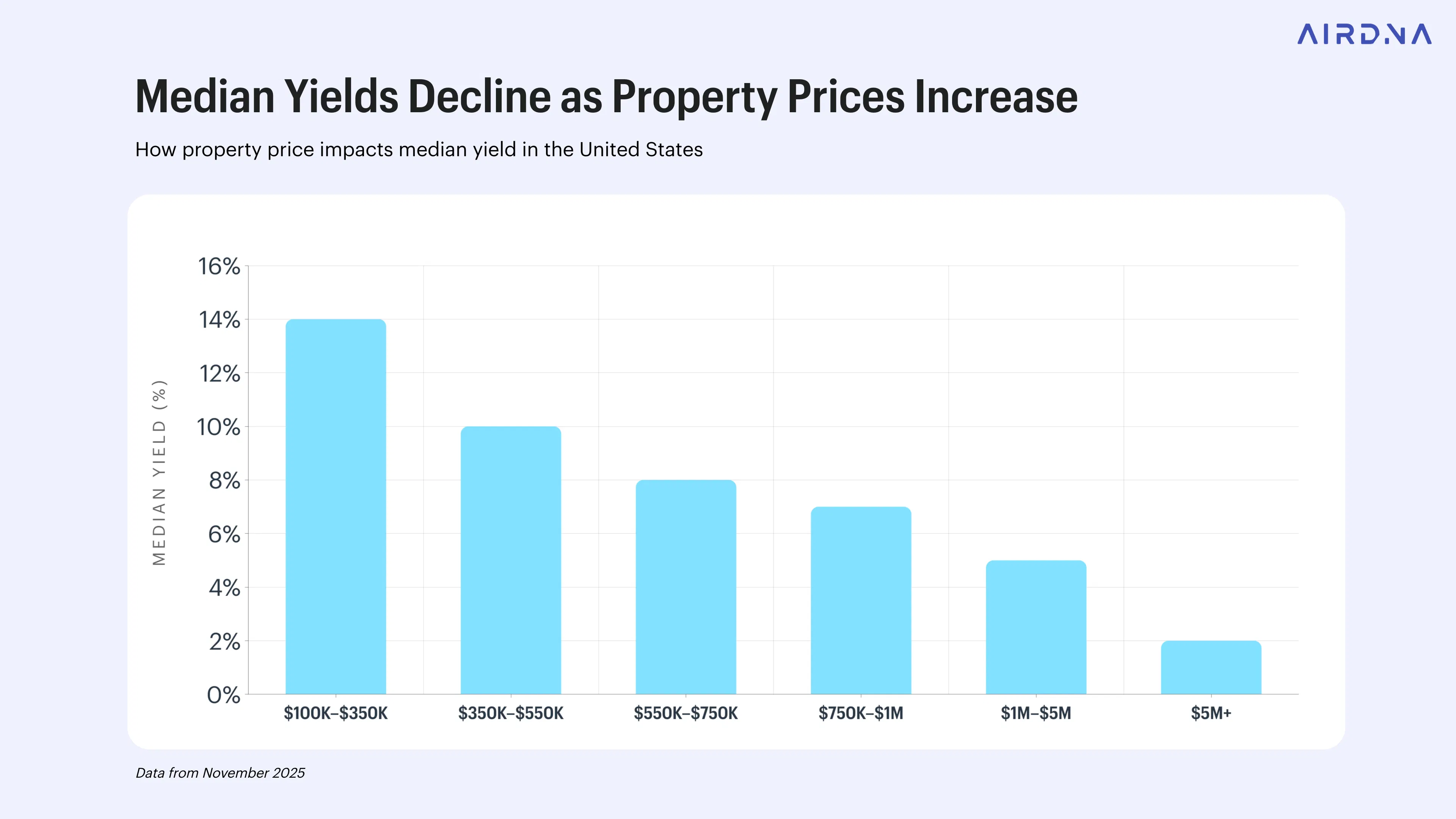
Meanwhile, smaller, more affordable properties tend to deliver stronger yields. Those in the $100K–$550K range often bring in more income per invested dollar than their higher-priced counterparts.
That doesn’t mean luxury properties are a bad investment—far from it. They often come with other benefits, like long-term appreciation or steady demand in premium markets. But if your focus is on maximizing income now, these numbers suggest that lower- to mid-priced homes may offer a better return in the short term.

Stable vacation markets often come with lower yields
When we looked at different types of markets, we noticed that you can often predict Airbnb yields based on a market’s levels of reliability and risk. Large City Urban markets and Coastal areas usually have lower yields, but it’s not because they don’t perform well. They’re actually more stable, with beach towns earning consistently high summer income and cities supporting year-round demand through business, cultural attractions, dining, and events. Investors are really paying for the peace of mind that comes with steady bookings, strong resale value, and fewer surprises in these market types.
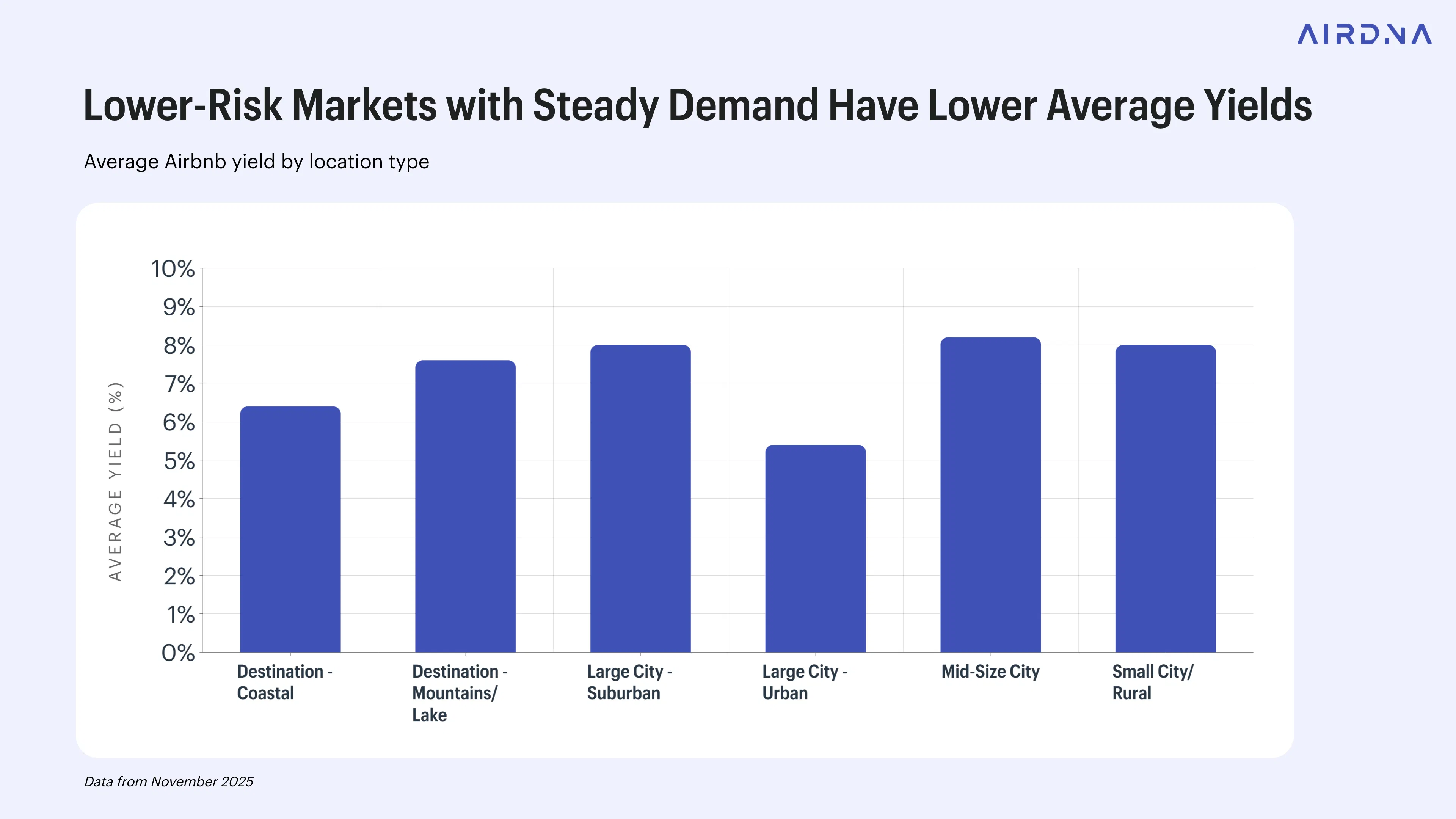
Meanwhile, Small City/Rural areas, Mid-Size cities, and Mountain/Lake destinations tend to offer higher yields. That stronger return is there to balance out the trade-offs, like seasonality or a smaller guest pool. It’s the same risk–reward pattern you’ll find in any investment landscape: the more uncertainty a market carries, the more it needs to deliver to make the numbers work.
How to Calculate Airbnb Yield with AirDNA
There are two ways to explore yield in AirDNA, depending on where you are in your investment journey:
- Already have a property in mind? Use Rentalizer to forecast yield using data from similar nearby rentals.
- Just starting your search? Use AirDNA’s For-Sale Properties feature to browse active listings with built-in yield projections.
Finding yield for a specific property
If you’re looking for a property that could potentially be turned into a short-term rental, your first step is to look around. That might mean browsing a real estate site like Zillow (or your country’s equivalent). Alternatively, you can browse for-sale properties directly within AirDNA, but that’s a demo for another time.
Step 1: Enter the address into Rentalizer
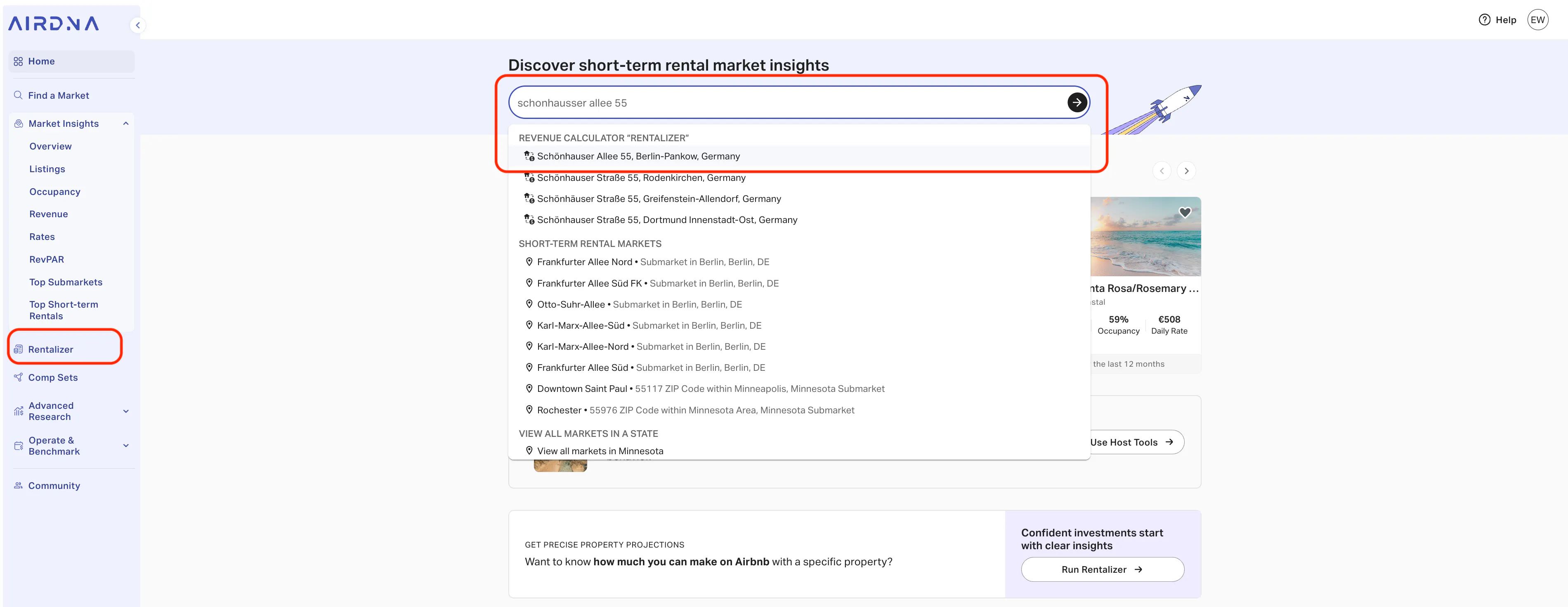
Let’s say you’ve found a 3-bedroom, 2-bath property in the Prenzlauer Berg neighborhood of Berlin. It accommodates 6 guests and is listed at €1,000,000. Once you log into AirDNA, enter the property’s address in the search bar. Rentalizer will automatically generate a revenue estimate based on how similar short-term rentals in the area are performing.
Step 2: Adjust the property inputs
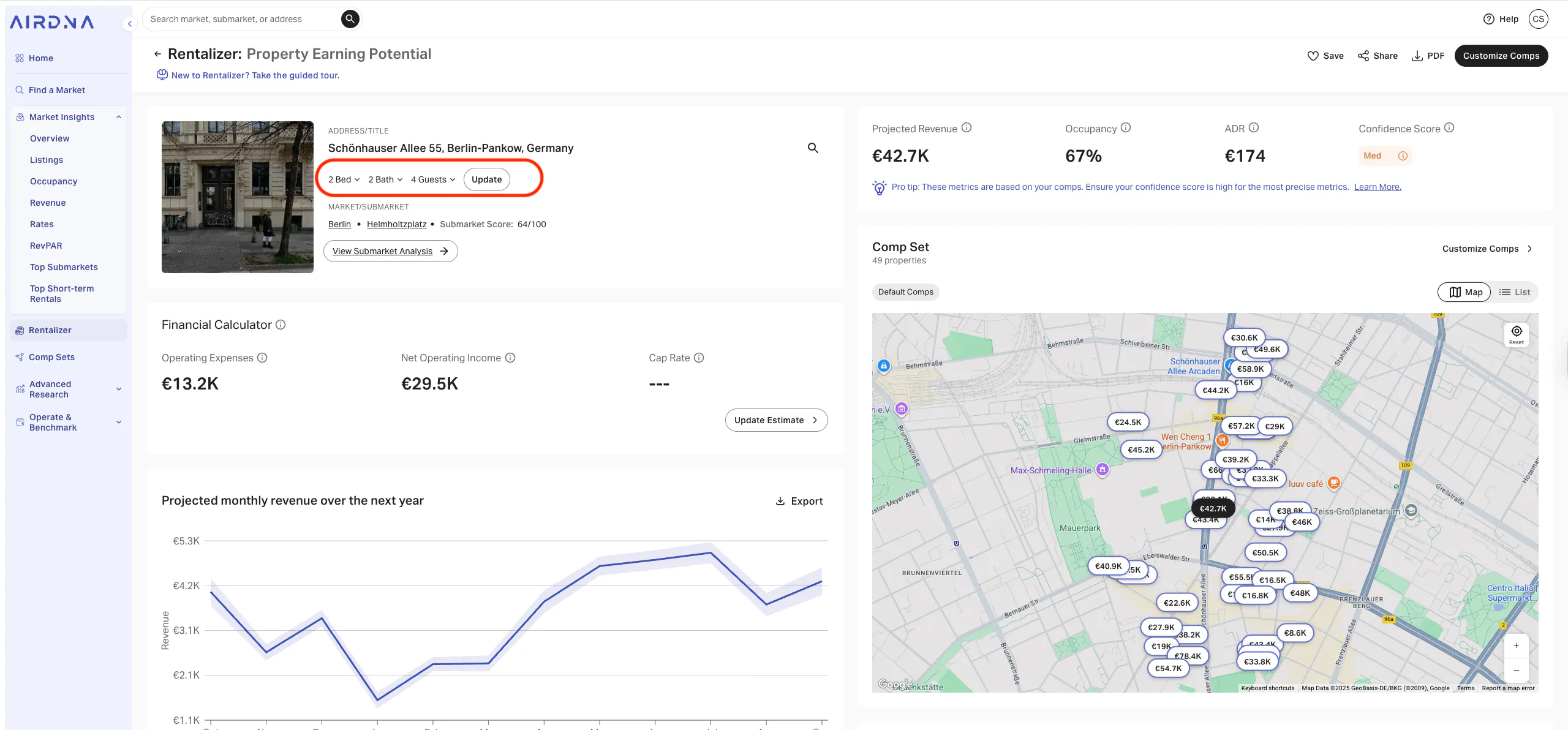
At the top left, use the drop down fields to match the property’s correct bedroom count and guest capacity. This ensures the comps are aligned.
Step 3: Review the Confidence Score
Each estimate includes a Confidence Score (low, medium, high), depending on how consistent performance is within your comp set. A Medium score (as we get here) means revenue among similar properties varies, so refinement is a good next step.
Step 4: Customize your comps
Open the Customize Comps view in the upper right hand corner of your Rentalizer report to see nearby properties on the map. Use filters (like bedrooms, bathrooms, and guest capacity) to focus on listings that better match your target property.
- Pink dots represent available comps
- Adding them to your selected comparison set turns them into purple
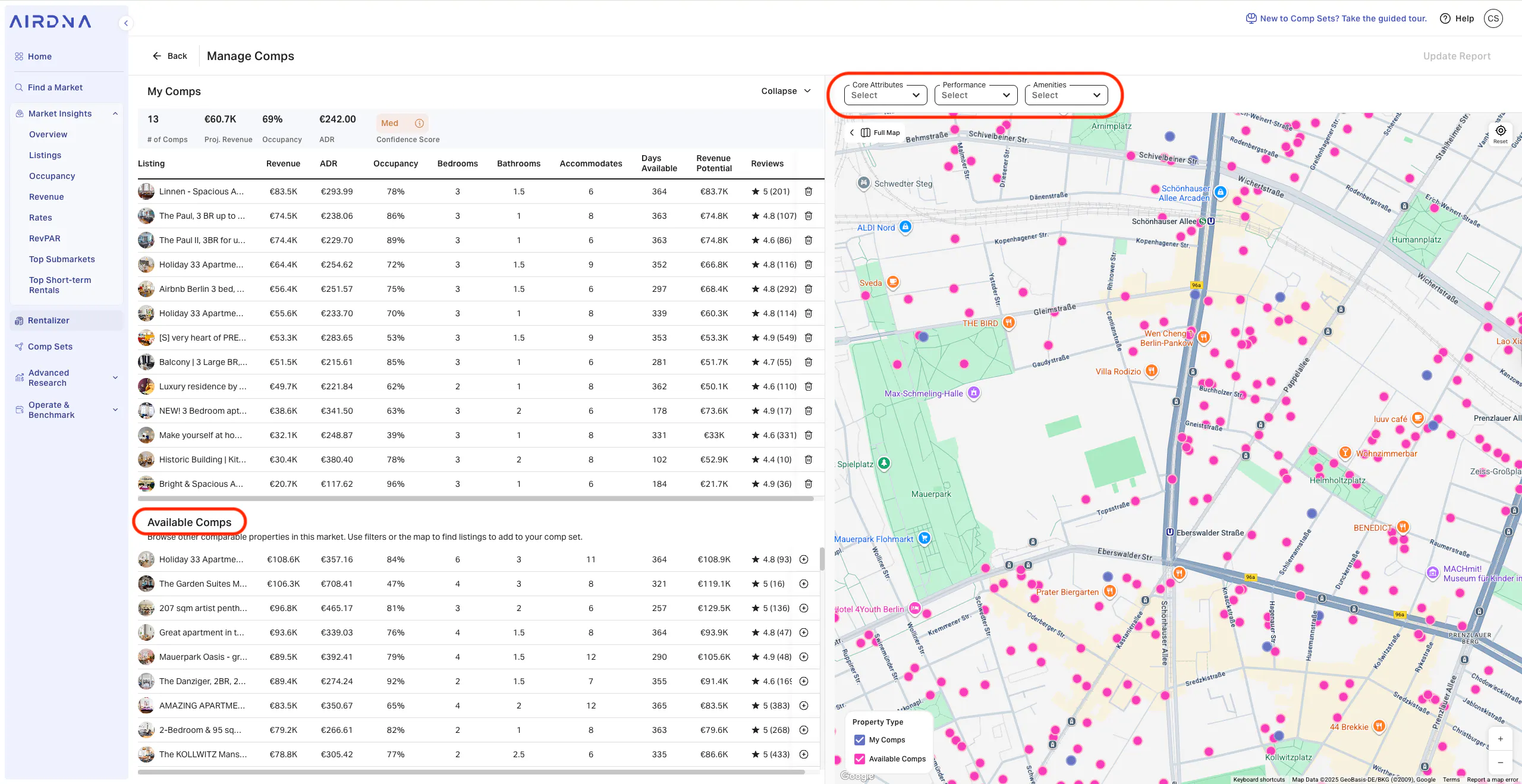
As your comp set becomes more refined, your Confidence Score updates in real time. In our example, adjusting the comps bumps the Confidence Score from Medium to High.
Get reliable data for smarter investment decisions
AirDNA allows you to handpick the active short-term rentals that align with your investment criteria and shows you exactly how a similar property performs in the real world.
Step 5: Calculate yield
Once you’ve put together a more reliable selection of comps and your Confidence Score is High, you’re in good shape to calculate your Airbnb yield.
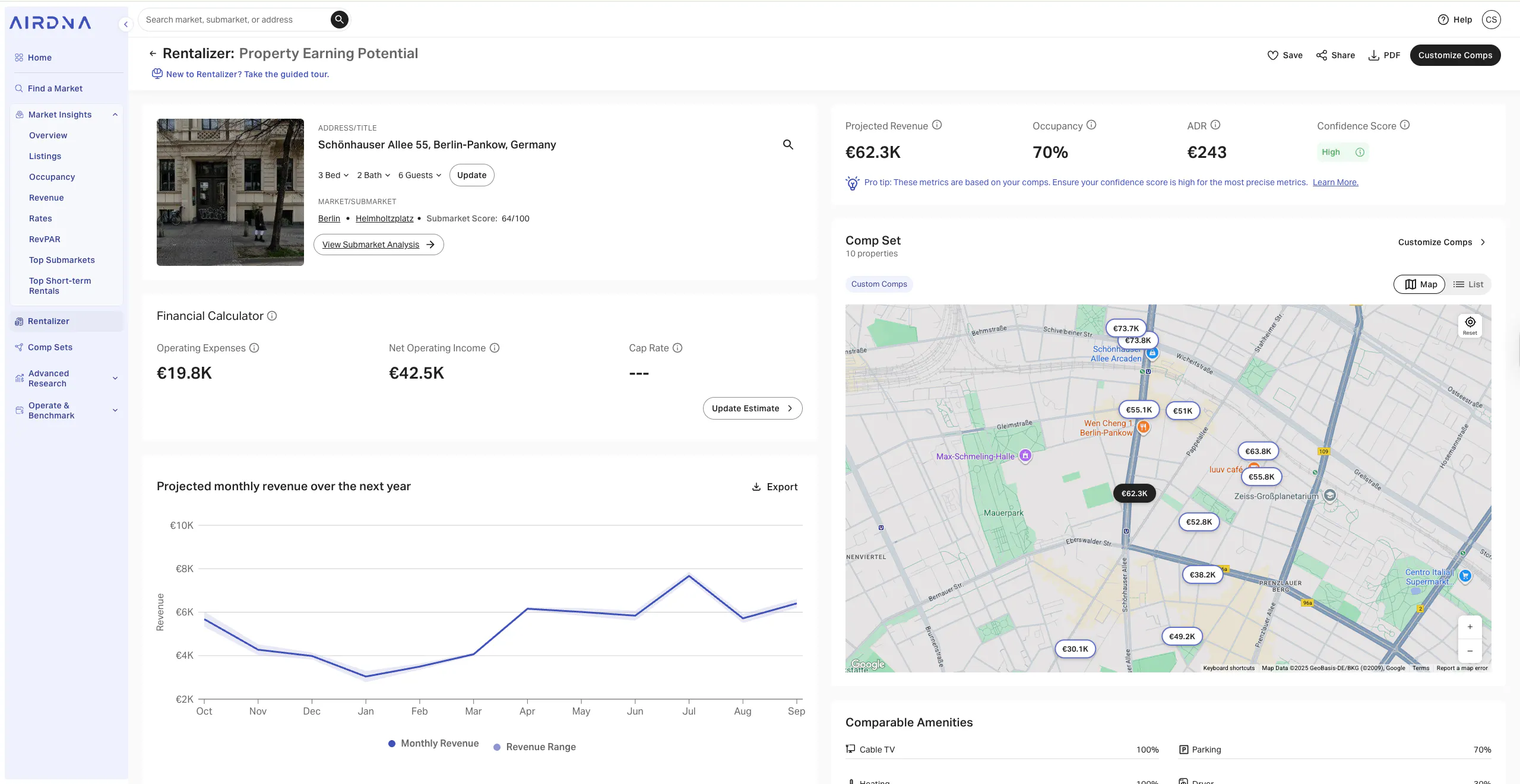
Take the projected revenue number, divide it by the list price, and multiply by 100.
Here’s how we would calculate yield for our Berlin example:
- Protected Revenue: €62,000
- List Price: €1,000,000
- Yield = (62,000 ÷ 1,000,000) × 100 = 6.2%
Finding yield for for-sale properties
If you don’t have a specific property in mind yet, AirDNA’s For-Sale Properties tool is a great place to explore high-potential listings, all with projected yield already calculated. (This feature is currently only available for U.S. markets.)
Let’s walk through an example using Atlanta, Georgia. Ideally, you’d start by analyzing submarkets to find the best-performing neighborhoods. For now, though, we’ll stick with the broader Atlanta market to get a sense of what’s available and what kind of returns you might expect.
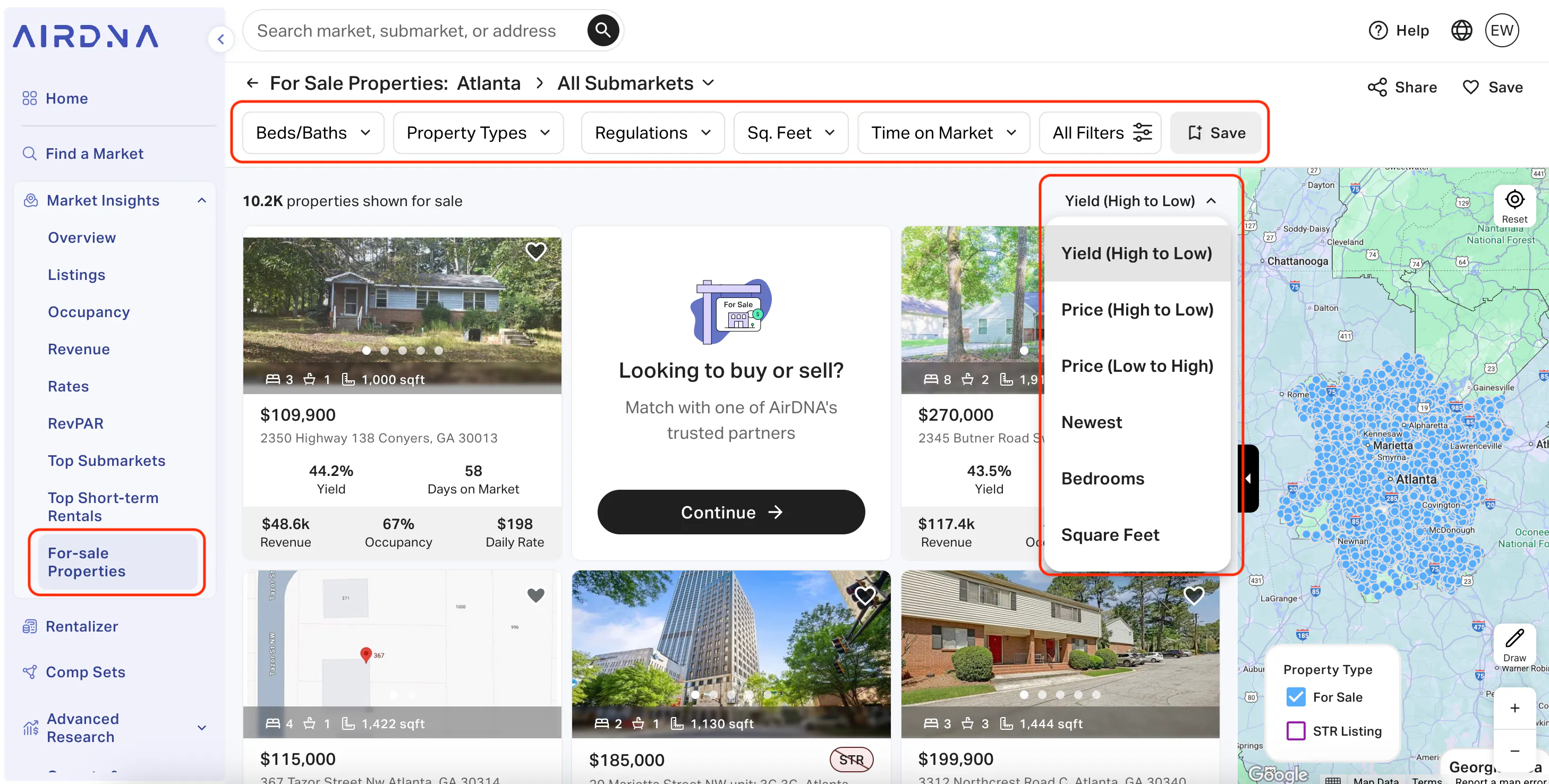
Step 1: Navigate to the For-Sale Properties tab
In the left-hand navigation menu, click Market Insights, then select For-Sale Properties.
Step 2: Browse the listings
You’ll see active listings automatically sorted by yield, from highest to lowest.
Each property card shows:
- Estimated STR revenue
- Projected yield as a percentage
- A zoning status icon (a red STR icon with a slash through it means short-term rentals are not permitted)
Step 3: Apply filters
Narrow results using the For-Sale dropdown to focus on properties that fit your investment goals. You can filter by:
- Property type (house, condos & apartments, townhomes, multi-family)
- Price range
- STR zoning legality
- Property size (bedrooms, bathrooms)
- Square feet
- Time on market
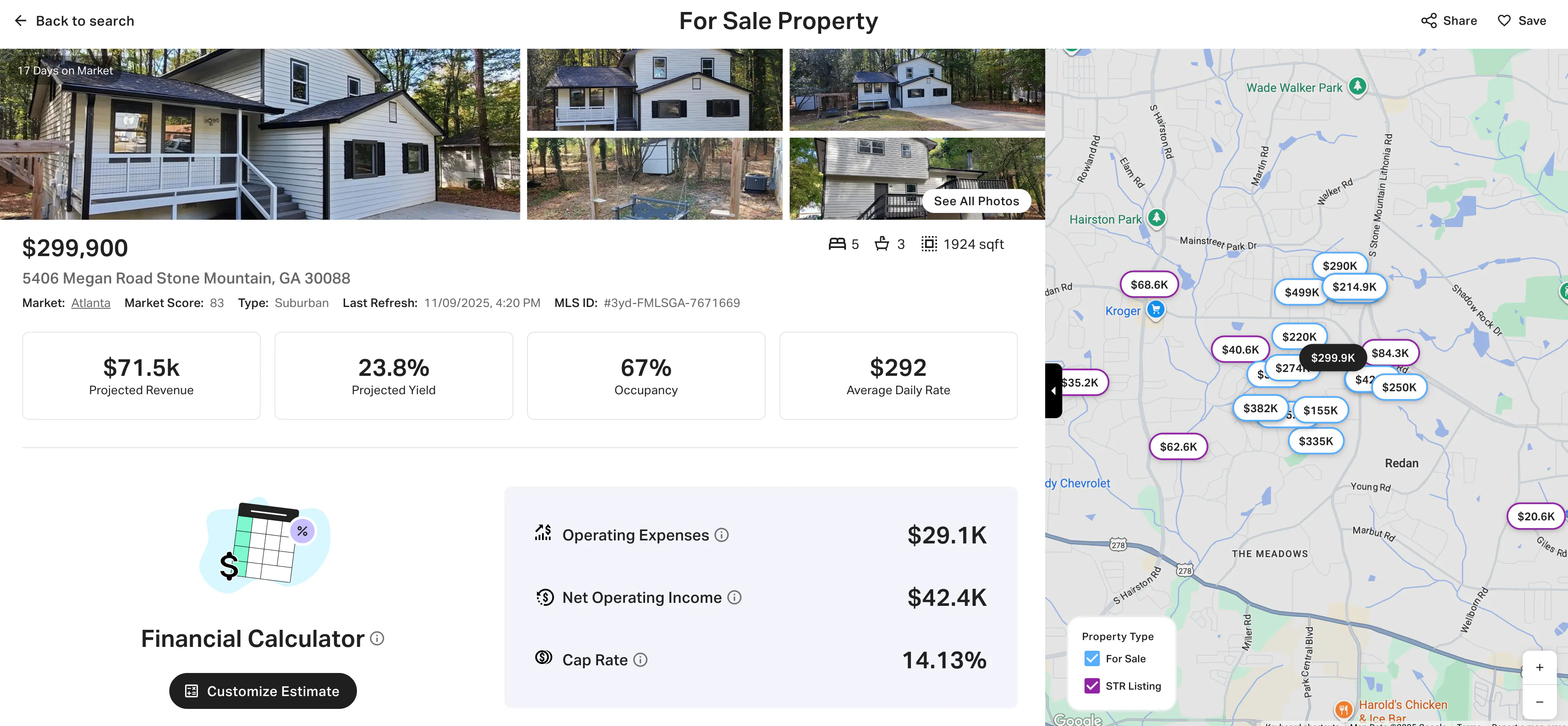
Step 4: Explore the Financial Calculator
Once you click into a specific listing, you’ll see more details like average daily rate (ADR), occupancy, and cap rate. Cap rate is another investment metric similar to yield, except it takes into account your expenses. You can also explore other nearby for-sale properties (in blue) and active short-term rentals (in purple) using the map view on the right.
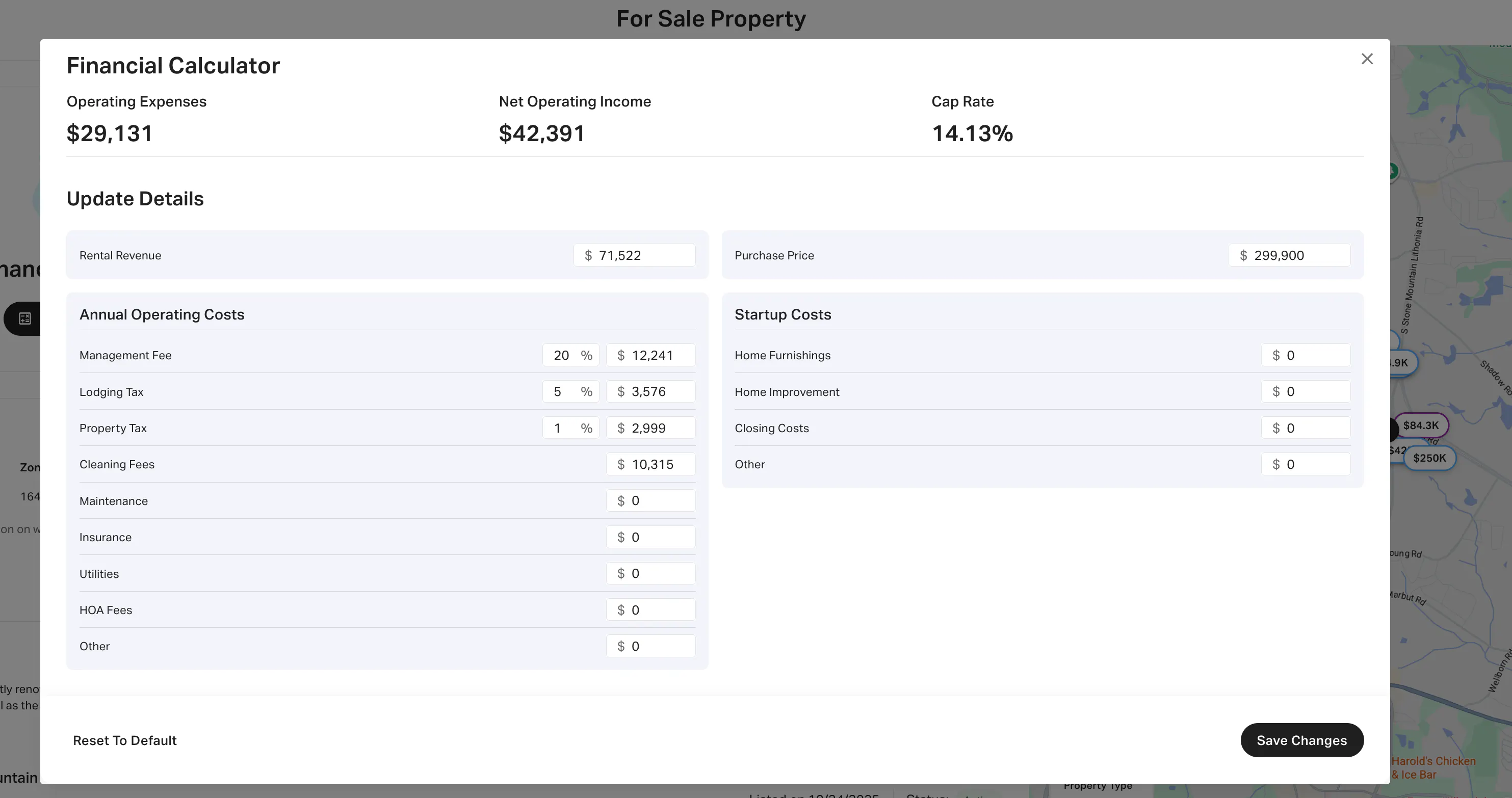
You can also customize the operating expenses in the Financial Calculator. We recommend you:
- Add startup costs (furniture, renovations, permits)
- Enter monthly operating expenses (cleaning, management, supplies)
Note that AirDNA will automatically assume a 20% management fee, 5% Lodging Tax, and 1% Property Tax, but you should update these fields according to your management plan and local taxation rules. Cleaning fees are also prefilled according to the share of gross income that cleaning fees account for among your comp set.
As you update these fields, your net operating income and cap rate will automatically recalculate, giving you a clearer view of overall Airbnb ROI.
Remember: Yield only takes into account gross STR income and the purchase price and not other costs, so it won’t change no matter the level of operating expenses you submit through the Financial Calculator. It doesn’t provide the nuanced picture you’ll need once you start zeroing in on a property. Yield is best for a quick comparison between investment properties in the earlier stages of your research.
Discover hidden gems for your next investment
Get granular insights into which neighborhoods are hottest for vacation rentals.
4 Ways Yield Helps You Make Smarter Investment Decisions
Yield shows how quickly you can expect returns
Yield gives you a clear idea of how fast your investment will pay off. A higher yield means you’re generating more income relative to your home price, which translates to a quicker return on investment (ROI). This is especially important for real estate investors looking for strong cash flow or planning to grow their portfolio rapidly.
Example: A property with a 10% yield will generate 10% of its purchase price in revenue annually, meaning you could cover your property cost in 10 years or less, depending on operational factors.
Yield helps you compare different markets and properties
One of the greatest strengths of yield is its ability to act as a comparison tool. By calculating the yield on different properties or across various markets, you can make apples-to-apples comparisons and identify where your investment dollars will work hardest.
Example: A property in a high-tourism market like Miami might have a 7% yield, while a property in a less popular but affordable market could have a 12% yield. Yield helps you decide whether the higher revenue in Miami justifies the cost, or if the lower-cost property offers better returns despite the greater risk.
Yield takes the guesswork out of evaluating risk
Every investment in the real estate market carries risk, but yield helps you assess how much risk you’re taking on. A high yield might seem appealing, but it could also signal volatility or a saturated market. On the flip side, a low yield may indicate a stable, high-value market with strong appreciation potential.
Example: A low-yield property in a premium area like Aspen, Colorado may not generate immediate returns. However, the long-term value of holding property in such a market could reduce overall risk, especially if the area's appreciation outpaces other regions.
Yield provides flexibility for different investment strategies
Whether you’re focused on generating cash flow or building equity for future gains, yield can guide your strategy. High-yield properties can be great for short-term income, while low-yield properties in high-demand areas might be better for long-term appreciation.
Example: If you're in it for quick cash flow, high-yield properties in smaller, less saturated markets may fit your strategy. On the other hand, if you’re looking for long-term gains, a lower-yield property in a blue-chip market could offer higher returns over time through property value appreciation.

Best Cities for STR Investments Based on Yield
AirDNA’s annual Best Places to Invest (BPTI) report is your go-to resource for exploring insights on Airbnb investment opportunities. Our rankings of promising short-term rental markets take into account a number of factors, including yield, but are ultimately based on a unique BPTI score that evaluates demand, revenue, and investability in aggregate. Below are the top 10 best places to invest, but we encourage you to read the full report for a longer list of destinations and more detail.
1. Peoria, Illinois
2. Fairbanks, Alaska
3. Akron, Ohio
4. Columbus, Georgia
5. Crescent City, California
6. Shreveport, Louisiana
7. Page, Arizona
8. Rockford, Illinois
9. Dayton, Ohio
10. Frankfort, Kentucky
Other STR Real Estate Metrics to Consider
Yield is a great place to start, but it’s not the whole picture. To really understand a property's potential, here are a few more key short-term rental metrics to watch:
- Cap rate: Like yield, but based on net income instead of gross revenue. It gives a clearer picture of returns after operating costs. You’ll find cap rate estimates (and editable expense fields) in AirDNA’s Financial Calculator.
- Cash-on-cash return: You’ll use this metric if you’re financing a property. This measures your annual net income compared to the actual cash you put in, like your down payment and closing costs.
- Occupancy rate: Your occupancy rate is how often your property is booked. It’s a good indicator of demand and helps with forecasting income and setting prices.
- ADR (Average Daily Rate): The average amount earned per booked night, including things like cleaning fees. High ADRs can boost income, but only if they’re paired with healthy occupancy.
Together, these metrics give you a fuller picture of short-term rental performance, beyond just the headline yield.

FAQs
What is a “good” yield for Airbnb rentals?
A yield between 8% and 12% is generally considered strong. In lower-cost markets, yields can reach 14–15%, while pricier areas like city centers or coastal spots often hover around 5–7%. What’s “good” really depends on your investment goals and whether you're prioritizing cash flow now or long-term value later.
How do I calculate Airbnb yield?
Airbnb yield is calculated by dividing estimated annual revenue by the purchase price, then multiplying by 100 to get a percentage.
For example:
If a property earns $49,500 a year and costs $450,000: Yield = (49,500 ÷ 450,000) × 100 = 11%
Use AirDNA’s Rentalizer to estimate income based on nearby Airbnb and Vrbo listings and then calculate yield from there. You can also explore our For-Sale Properties feature (U.S. only) to browse active listings with yield already calculated for you.
Why does a property with high income sometimes have low yield?
Yield compares income to price, and some high income properties require a large upfront investment. A luxury Airbnb rental might earn $100K per year, but if it costs $2M to buy, that’s just a 5% yield. A smaller, lower-cost property might only bring in $35K, but if it cost $300K, that’s an 11.7% yield.
High income is great, but yield helps put that income in context, so you don’t overlook investment properties with stronger cash flow.
What if my Airbnb has negative cash flow even with a good yield?
It’s possible! Yield doesn’t account for costs like mortgage payments, utilities, or insurance. If those income and expenses don’t balance, you could still see negative cash flow even if the yield looks great. That’s why yield is best used early in your research. Due diligence requires digging deeper into total Airbnb ROI and keeping a close eye on expenses, too.
Can I use yield to estimate my Airbnb passive income?
Yes, yield can help you estimate potential passive income, but with a big caveat. Yield is based on gross annual revenue, not net profits.
If you want to get closer to your true cash earnings, subtract income and expenses like cleaning fees, property management, taxes, maintenance, and mortgage payments. Yield is a great starting point for spotting potential, but you’ll need to go deeper to get a full picture of monthly cash flow and Airbnb ROI.
What’s the difference between Airbnb yield and ROI?
Airbnb yield is a fast, upfront way to estimate how much income a short-term rental property might generate each year compared to its purchase price. ROI (return on investment) goes further. It includes operating expenses, property management, mortgage costs, tax savings, equity growth, and even rental appreciation.
In short:
- Use yield to quickly compare Airbnb investment opportunities.
- Use ROI to understand how profitable the property could be after you factor in real costs and cash flow.
What is a good ROI for an Airbnb investment?
A good ROI (return on investment) for an Airbnb rental usually falls between 8% and 12%, but the “right” number depends on your strategy, location, and financing. ROI is a broader metric than yield. It looks at your net returns after accounting for income, expenses, taxes, mortgage payments, appreciation, and more.
Yield, on the other hand, is just one piece of the ROI puzzle. It gives you a quick read on a property’s gross income potential before you dig into the full financial picture. Many investors use yield to screen property listings and then calculate projected ROI for a smaller set of properties once they're ready to get serious.
Research Airbnb Markets
Gain insights into the revenue and occupancy trends in your market.
ARTICLE SUMMARY
Trying to figure out if a short-term rental is actually a good investment? Yield is a quick, no-nonsense way to size up income potential before you get lost in spreadsheets. We’ll show you how to use it to find the right property faster.
Camilo Schmid Rivas
Senior Research Analyst
Camilo Schmid Rivas is a Senior Research Analyst at AirDNA who brings a uniquely well-rounded perspective to short-term rental analytics. With a background that spans investment, real estate, and business analysis—including roles at Stayery and Sollers Consulting—Camilo has worn many analyst hats, each sharpening his ability to turn complex data into clear, actionable insights. A graduate of École hôtelière de Lausanne, he now channels his multidisciplinary expertise into uncovering trends that drive smarter STR decisions. In his free time, he enjoys playing tennis or scuba diving in or around Barcelona.
