How to Choose Your First Short-Term Rental Investment
Published: March 28, 2025
Last updated: January 2, 2026

Jamie Lane
Key Takeaways
- Your first short-term rental investment should match your budget, goals, and how involved you want to be.
- With the right data, you can see what’s actually working in a market—so you’re not just hoping a property will perform; you’ll know why it should.
- With AirDNA, you can forecast earnings, compare properties, and spot trends—all before you buy—so you’re not going in blind.
You’ve run some numbers, scrolled Zillow into the night, and maybe even daydreamed about that perfect cabin or beachside bungalow. But before you make a move, you probably have some questions: What actually makes a great first short-term rental investment and how do you know when you’ve found it?
Short-term rentals are one of the most accessible ways to get into real estate. They’re flexible, beginner-friendly, and full of potential—but they’re not foolproof. It’s easy to fall for the wrong property: A trendy location, a vacation-style listing, or a fixer-upper that looks fun until the expenses stack up.
Your first investment sets the tone. Get it right, and you build momentum. Get it wrong, and it can eat up your time and budget before you’ve even gotten started.
This guide will show you exactly how to choose your first STR investment the right way—with your goals in mind, not just your gut—so you can feel good about where your money’s going.
1. Define Your Investment Goals and Budget
The most successful investors don’t start with a property. They start with a plan.
Before making your first short-term rental investment, get clear on why you're doing it. Are you looking to build passive income? Cover the cost of a second home? Create a stepping stone into a larger real estate portfolio? Your goals will shape every decision that follows—from where you invest to how much you spend and how you manage the property.
That clarity helps set realistic expectations. A part-time mountain cabin won’t generate the same income as a full-time rental in a high-demand market—and that’s okay, as long as it aligns with what you want from this investment.
Once you know your “why,” the next step is figuring out what you can actually afford—and how you’ll finance it. Budgeting for your first Airbnb investment goes well beyond the listing price. Between startup expenses, operating costs, and ongoing hosting expenses, the financial picture can get complicated quickly. You’ll definitely want to explore how to finance a vacation rental if you haven’t already.
Your budget will directly shape the kind of property—and market—that makes sense for you. And if you're trying to match your spend to the right location, take a look at thebest places to invest by budget to help narrow your search.

2. Research the Market Like It’s Part of the Investment
It’s tempting to zero in on the most popular vacation spots, like beach towns, ski resorts, or buzzy city centers. But the best short-term rental markets aren’t always the most obvious. In fact, first-time investors often find more reliable returns in places that don’t make the travel headlines.
You don’t need to be a data pro to spot them. With the right tools, you can find a market that fits your budget, matches your goals, and gives you a real shot at solid performance—even if you’ve never done this before.
Zoom into submarkets, not just cities
Looking at a popular city is a solid starting point—but to really understand potential, you need to zoom in. Every market is made up of submarkets—smaller areas like neighborhoods or zip codes that can perform very differently from the city as a whole.
AirDNA has grouped all U.S. short-term rental listings into 317 markets—and each market includes its own submarkets. Here’s what it looks like to explore submarkets in AirDNA. This example is from Birmingham, Alabama, where the city is broken down into smaller areas—like Avondale, Hoover, and Downtown Birmingham.
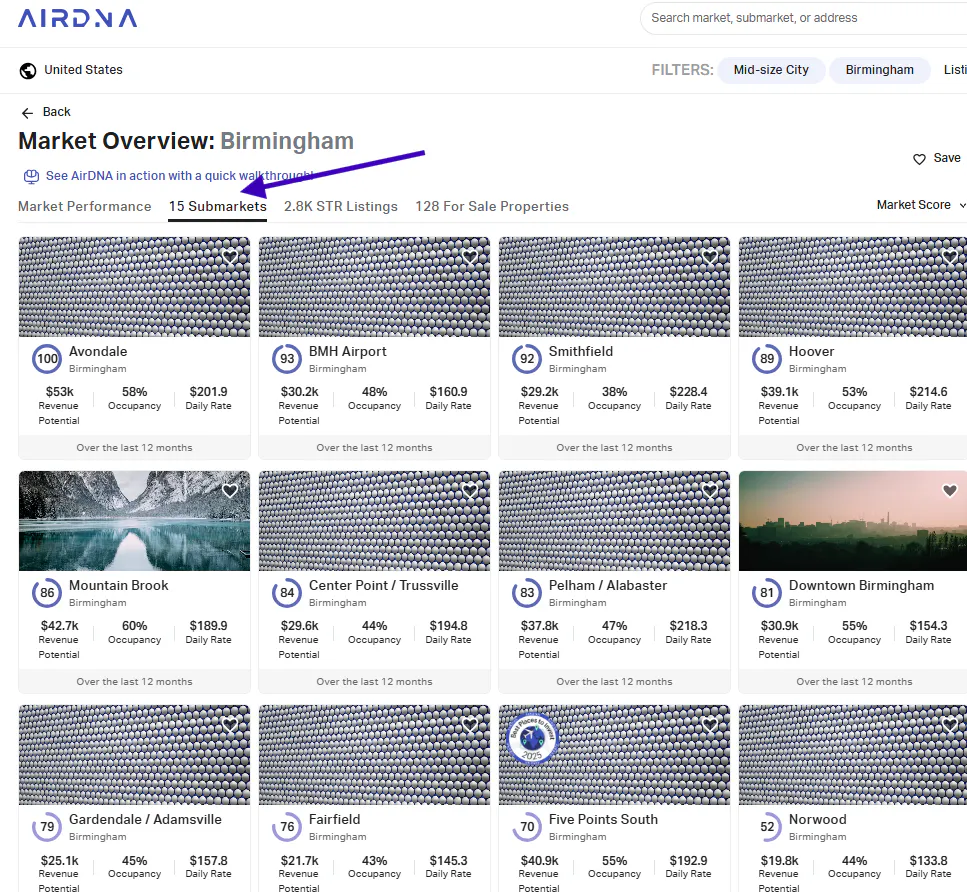
At a glance, you can view and compare each submarket’s key performance metrics: how much revenue properties typically earn, how often they’re booked, and the Average Daily Rate (ADR).
This makes it easy to spot which neighborhoods have stronger performance—and helps you focus on areas that match your goals, even if the city overall doesn’t look like a top pick. Want to go deeper? We can show you how to complete a full submarket analysis.
Focus on demand first
For any beginner real estate investor, it’s tempting to chase high nightly rates—but they only matter if your place is getting booked. That’s why occupancy is often the smarter place to start. It shows how often listings are booked each month and reveals seasonal trends or year-round stability.
Once you understand occupancy, layer in other demand metrics:
- Average Daily Rate (ADR) tells you what guests are paying on average per night.
- RevPAR (Revenue per Available Rental) combines occupancy and ADR to show overall revenue performance.
If you’re new to investing, stable occupancy and strong RevPAR often signal a healthier market than high rates alone.
Get a feel for what’s already in the market
Once you’ve narrowed down a location, it’s time to understand what kinds of properties are already performing there. You don’t need to dig into every listing. Even a quick scan of the local landscape can tell you a lot about what’s working (and what’s oversaturated).
In AirDNA’s Active Listings tab, you can filter by things like bedroom count, property type, and amenities to see how different property setups are priced, how often they’re booked, and what kind of revenue they’re generating.
As you explore, look for patterns:
- What types of listings dominate the market?
- Where are there clear gaps?
- What do the top earners have in common?
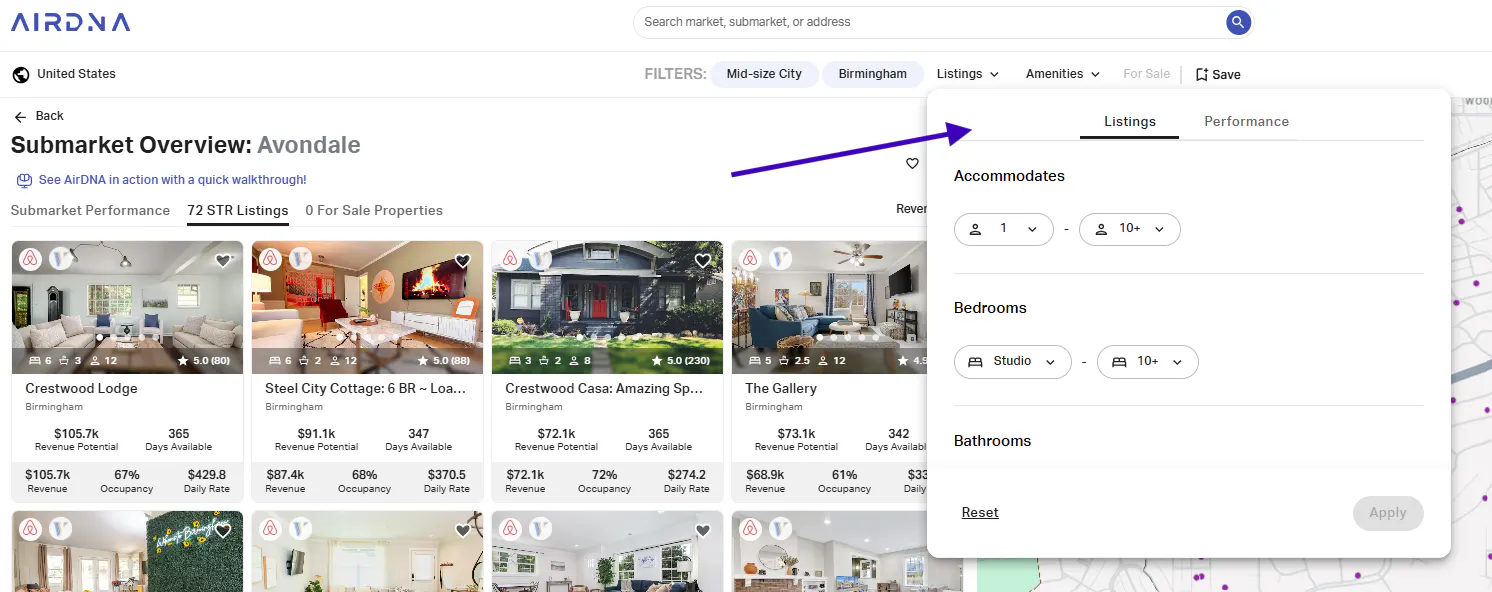
This kind of quick competitive analysis helps you understand where your property could stand out—not just blend in with the crowd.
Consider how close you need to be
Proximity matters—especially if you’re planning to self-manage. A great market that’s two flights away might not be the right call for your first short-term rental. Think about how often you’ll need to be onsite, whether for maintenance, turnovers, or emergencies. If you’re investing in Airbnb out-of-state, make sure there’s a reliable local property manager or co-host who can support you.
Look for long-term potential
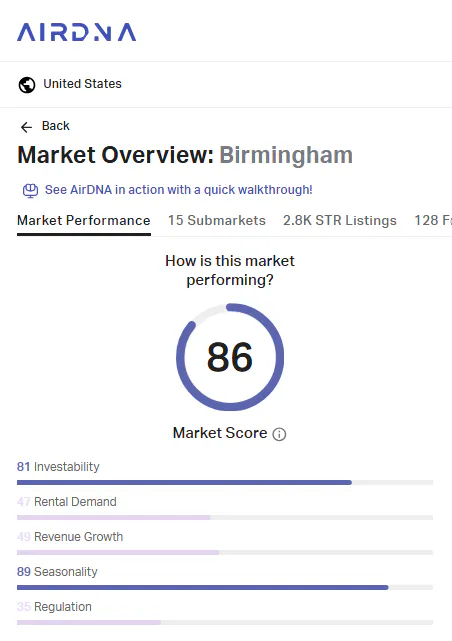
Some markets look great in the short-term—but won’t hold up over time. That’s why it’s worth going beyond demand and revenue to evaluate sustainability. AirDNA’s Market Score pulls together key indicators to help you assess long-term potential at a glance. Metrics like the Investability score, revenue growth, and regulation give you a clearer sense of whether a market is steady, growing, or potentially risky.
That doesn’t mean you have to go with the safest bet. You might be totally comfortable choosing a market that’s a little less predictable if it aligns with your goals—like using the property part-time or getting into a dream location at a lower price point. What matters is knowing what you’re walking into, and making the tradeoff intentionally.
3. Pick the Right Property Type for Your Strategy
Once you’ve chosen a market, your next big decision is what kind of property to buy. And that’s not a small choice—it can shape everything from your guest experience to your revenue potential.
Single-family home or condo? One bedroom or three? In town or tucked away? Or maybe you’re looking for something a little more unique.
When you're making your first real estate investment, the right property type depends on a few key things: Your budget, how hands-on you want to be, and what travelers in your market are actually booking. What seems like a premium feature—like being right next to the beach or in the heart of downtown—doesn’t always mean better performance.
Take beachfront properties, for example. You might assume that the closer to the water, the higher the revenue—but that’s not always the case. In some markets, properties just a few blocks inland perform nearly as well (or better) when you factor in cost, occupancy, and nightly rate. Higher purchase prices in “prime” locations don’t automatically translate to higher returns. That’s why a data-first approach matters so much.
With AirDNA, you can explore local listings and filter by property type, bedroom count, and features to see how different setups perform—how much they earn, how often they’re booked, and what guests are paying. You might find that a two-bedroom cottage with parking outperforms a more expensive condo closer to the action.
Layout and features also play a big role. Things like outdoor space, full kitchens, and flexible sleeping arrangements can impact bookings just as much as proximity to attractions. And depending on your target guest—families, solo travelers, business guests—those details matter.
Still deciding what fits your goals? Check out our guide to identifying the best type of property for Airbnb for tips on choosing the right vacation rental investment based on real performance data—not just assumptions.

4. Run the Numbers Before You Commit
Now comes the part where you turn possibilities into projections. The best short-term rental ROI analysis helps you understand what a property could realistically earn—and how those earnings stack up against your costs.
This isn’t just about gross revenue. You’ll need to look at:
- Startup and furnishing costs
- Ongoing expenses like utilities, cleaning, and maintenance
- Local taxes and licensing fees
- Mortgage payments (if financing)
AirDNA’s Revenue Calculator makes this easy. Just plug in a property address, and you’ll get a forecast based on actual local performance data. You can adjust for bedroom count, amenities, and property type to see how those changes impact your cash flow analysis.
Our Pro users also have access to a customizable financial calculator for deeper scenario planning.
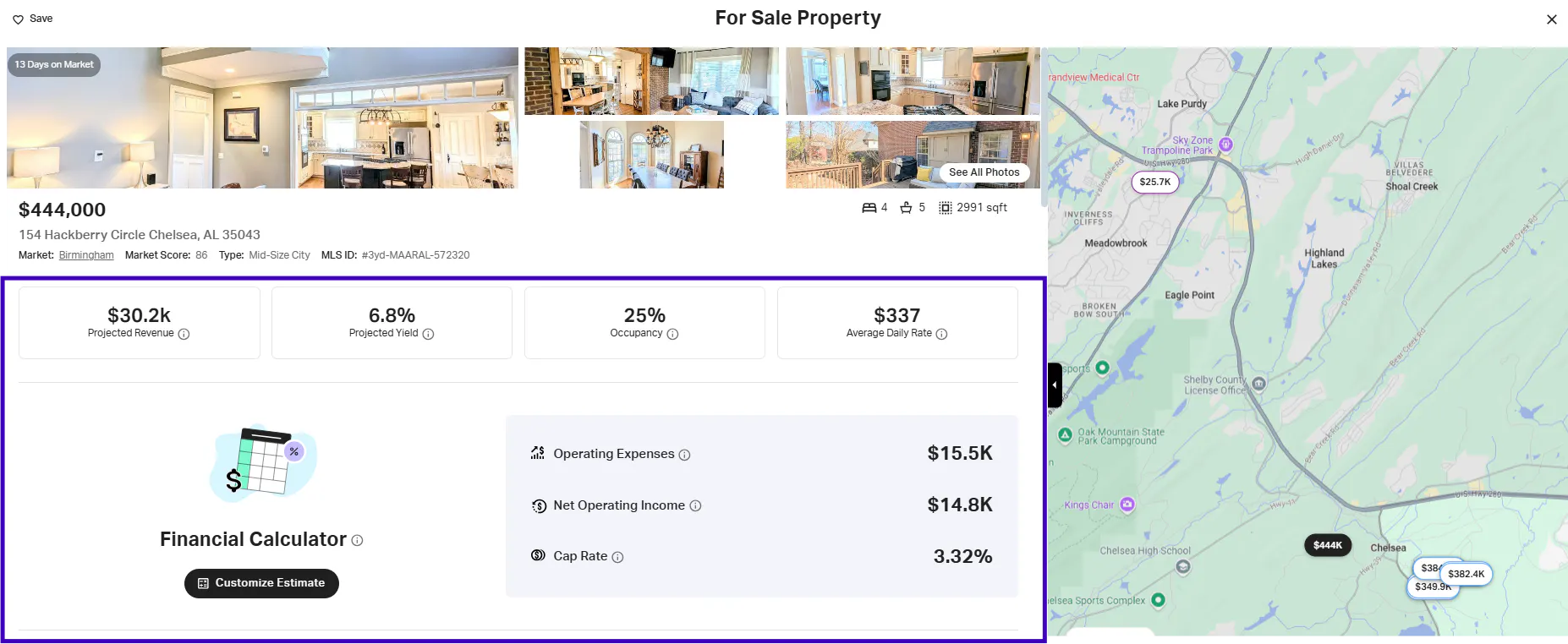
Compare a few properties side by side. Which one offers better income relative to cost? Which has higher occupancy but lower overhead? This is the step where you begin to separate “looks good on Zillow” from “makes sense as an investment.”
Having a clear handle on your financing, expenses, and income potential helps you make a confident, informed choice—not just go with your gut. And when it’s your first real estate investment, that kind of clarity really matters.
5. Confirm That Short-Term Rentals Are Actually Allowed
You’ve probably heard that some cities have rules around Airbnb—but what many first-time investors don’t realize is just how local and specific those rules can be. In some cases, the difference between a profitable rental and a costly mistake comes down to what side of a street—or floor of a building—you’re on.
Short-term rental regulations can vary by city, neighborhood, zoning district, or even individual condo buildings. Some places require permits or limit how many STRs are allowed. Others have waitlists, strict owner-occupancy rules, or only allow rentals in certain zones. And some HOAs can ban short-term rentals entirely, regardless of what local law says.
Before you buy, make sure you understand:
- Zoning laws — Are STRs permitted in this area?
- Licensing and permits — Will you need one? Are there limits or restrictions?
- HOA or condo rules — Do community guidelines allow short-term rentals?
- Local enforcement trends — Are rules getting stricter? Are new regulations being proposed?
Make regulations part of your research process from the very beginning (here are 10 ways to look up regulations yourself), not something you scramble to fix later.

Tips for Short-Term Rental Investing as You Get Started
So, you’ve bought your first short-term rental or you’re about to. We’re sure you’ll be hooked. Now that you’re all-in on Airbnb investing, the natural next question is: how do I keep getting better at this?
Here are a few practical strategies to help you grow from here—with fewer surprises and more confidence.
- Invest with the right data — Tools like AirDNA show you what’s earning, when demand peaks, and how to price smart—insight that can mean the difference between breaking even and beating your goals.
- Build a team that knows short-term rentals — Beyond your agent, you’ll want a lender who understands investment financing, a tax advisor who can walk you through STR deductions, and property managers who know what it takes to keep your Airbnb business running smoothly.
- Use software that helps you stay organized from the start — Real estate investing tools can help you compare deals, estimate returns, and keep track of your numbers—all in one place. If you’re not sure where to begin, we’ve rounded up some of thebest real estate investment software to help you find tools that match your budget and your setup. Once you’re up and running, platforms like Uplisting and other vacation rental management (VRM) software make it easier to manage bookings, automate messages, and coordinate cleanings without burning out.
- Learn from people who’ve done it before — The STR world is full of hosts who’ve already made the mistakes, figured out the systems, and are happy to share both. Local groups, online forums, even casual chats—they’re all worth tapping into.
- Keep leveling up — The short-term rental industry isn’t very good at standing still. Be sure to stay sharp on short-term rental trends, regulations, and the tourism industry. You may even want to expand into new markets you’ve spotted in our Best Places to Invest report.
Good luck out there buying your first Airbnb investment property—we won’t be surprised if it isn’t your last.
FAQs
How do you pick your first short-term rental investment property?
Start by getting clear on your goals. Are you aiming for cash flow, personal use, or long-term appreciation? Once you know what success looks like for you, focus on finding a market and property type that align with that goal—and use real data (like occupancy, revenue, and seasonality) to guide your decision, not just your instincts.
Are short-term rentals a good choice for buying your first real estate investment?
Absolutely. We believe short-term rentals are one of the best first real estate investments you can make. They offer lower barriers to entry, faster income potential, and more control than long-term rentals. Yes, they come with more moving parts—but that’s also what makes them such a powerful learning opportunity. You get to test pricing, respond to real-time demand, and build your skills as you grow your income. It’s a hands-on way to start—and that’s exactly what makes it so effective.

What tools or platforms can help me evaluate a potential STR?
Look for tools that give you access to real performance data. AirDNA, for example, lets you analyze revenue potential, occupancy, booking trends, and competition by market and submarket. That kind of visibility is key when figuring out how to buy your first real estate investment property with confidence.
What are some tips for short-term rental investing on a budget?
You don’t need a massive down payment or a luxury property to get started. Some of the best-performing STRs are in affordable, lesser-known markets with steady demand and less competition. Focus on areas where the numbers make sense—strong occupancy, manageable startup costs, and room for revenue growth.
Look for properties that are already guest-ready or need minimal upfront work. Make every dollar count by investing in amenities that improve the guest experience (like better bedding or smart check-in tools) rather than expensive renovations.
To help you narrow things down, our Best Places to Invest report includes data on top-performing STR markets broken down by budget range—so you can find opportunities that match what you’re working with.
Do I need to self-manage my first short-term rental?
Not necessarily. Many investors self-manage at first to keep costs low and learn the ropes, but others hire a local property manager from day one. The right call depends on your proximity to the property, your time, and how hands-on you want to be.
ARTICLE SUMMARY
Your first short-term rental property can set the tone for your entire investing journey. Here’s how to choose your first Airbnb property with real potential—backed by data, not guesswork.
Jamie Lane
AirDNA Chief Economist
He is responsible for data analysis, thought leadership, and leveraging advanced analytical techniques to provide new insights into short-term rental market trends. Native to Atlanta and an Airbnb host himself, Jamie enjoys cycling, mountain biking, backpacking, running, and playing in a dart league in his free time.