

 Calculate Revenue
 Research Markets
 Find For Sale Properties
 Compare My Listing
 STR Revenue Calculator
 Custom Comp Sets
 Submarket Insights
 Custom Search Filters
 Rate Recommendations
 Performance Benchmarking
 Competitor Comparison
 Owner Contact Details
 Property-level performance data
 Tourism Insights
 Real Estate Investment Analytics
 About Us
 Sales
Sales Support
 Press
PressAirbnb Startup Costs: What It Takes to Launch Your First Rental
Published: January 9, 2025
Last updated: September 25, 2026

Bram Gallagher
Key Takeaways
- Airbnb startup costs typically range from $5,000 to $50,000, influenced by factors like property acquisition, furnishings, and location.
- Rental arbitrage offers a lower-cost option for starting an Airbnb, with upfront expenses ranging from $5,000 to $15,000.
- Many startup costs may be tax-deductible, making record-keeping essential to maximizing savings.
Starting an Airbnb can feel like spotting a sparkling lake on a summer day—it looks inviting, refreshing, and full of potential. As you wade in, though, you might find hidden rocks beneath the surface. Those glossy success stories and eye-catching nightly rates? They’re the surface shimmer. The real work—and the real costs—are what lie just out of view, waiting for savvy hosts to uncover them.
Overlooking start-up costs is like jumping into that lake without checking the depth—you risk stumbling into financial setbacks that could easily have been avoided. In this guide, we’ll explore the true costs of starting an Airbnb, from must-have investments like furniture and cleaning supplies to the extras that impress guests and earn rave reviews. With a little foresight, you’ll be swimming in five-star feedback—not unexpected expenses.
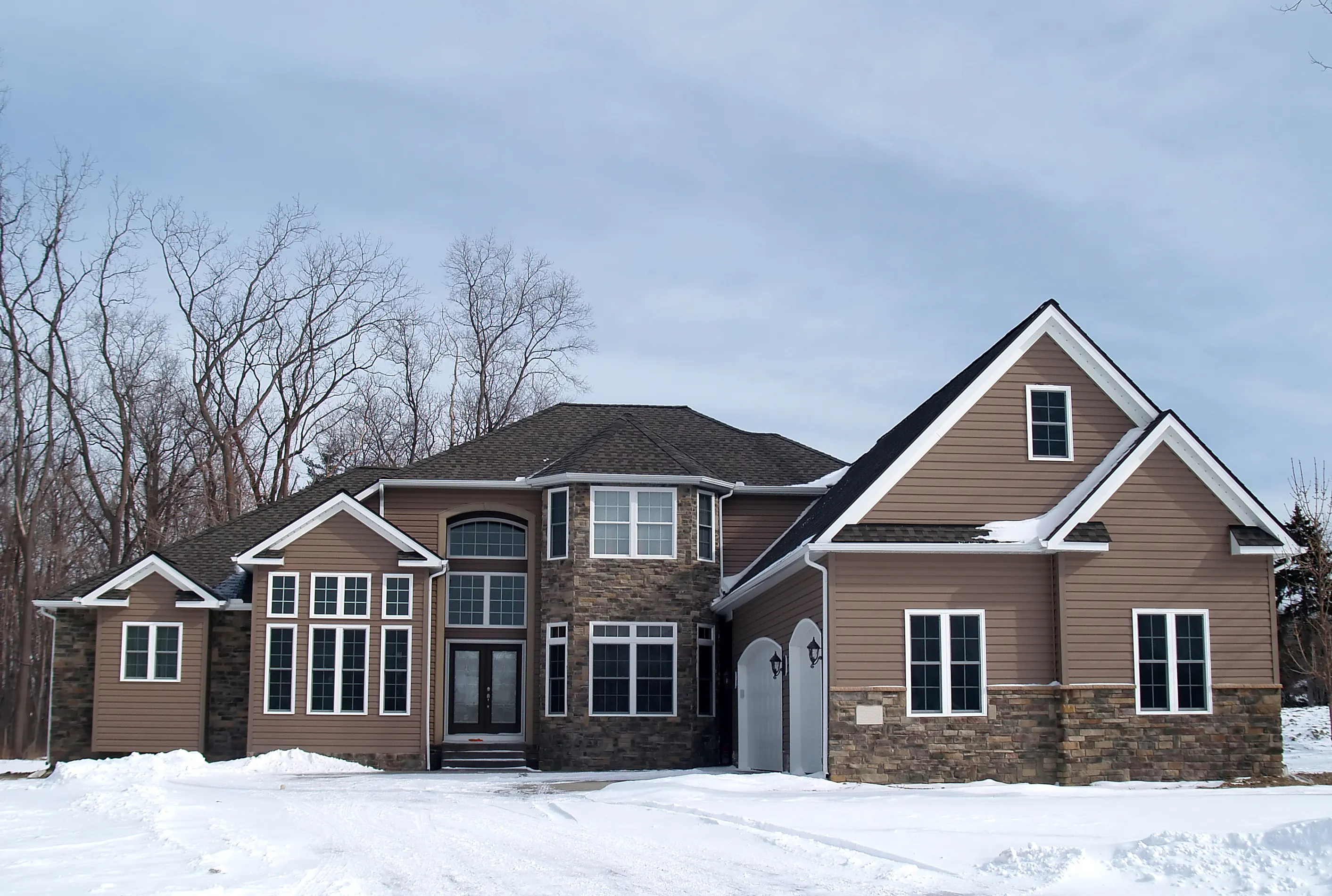
Why Airbnb Startup Costs Matter
Starting an Airbnb isn't as simple as listing your property and watching the bookings roll in. Whether you're planning to rent out a spare room or invest in multiple rental properties, you'll face upfront costs that can range from a few thousand to hundreds of thousands of dollars. Here's the thing: understanding these costs before you start can help you avoid expensive surprises down the road.
Your startup costs will largely depend on your approach. Are you planning to list a room in your current home? Convert an existing property into a short-term rental? Perhaps you're interested in rental arbitrage, where you rent a property specifically to list it on Airbnb. Each path has its own set of host costs and your choice will impact both your upfront investment and your potential returns.
The market you choose also plays a crucial role in your startup costs. A property in a prime urban location might require a larger initial investment but could generate higher occupancy rates and Average Daily Rates (ADR). Meanwhile, vacation rentals in a seasonal area might require investing in extra amenities to stand out during peak periods. Using market data from AirDNA, you can research these factors in advance to ensure your startup budget aligns with your revenue goals.
Let's break down exactly what you'll need to budget for, whether you're starting with one property or planning to build a short-term rental portfolio.
How Much Does it Cost to Start an Airbnb?
The table below outlines ballpark estimates for the major cost categories you’ll encounter when starting an Airbnb. These ranges account for different scenarios. Keep in mind that a realistic budget will depend on a lot of different factors, including:
- Property type
- Property condition
- Property location and short-term rental market
- Local regulations
- Guest demographic (e.g. budget versus luxury travelers or individuals versus groups)
- Your hosting goals
It's important to remember that these figures are broad guidelines, not guarantees. Think of the table as a foundation to help you map out your budget—not a precise prediction of what you’ll spend. You can tailor your financial planning to align with your market and hosting strategy by combining these estimates with tools like the Airbnb Revenue Calculator.
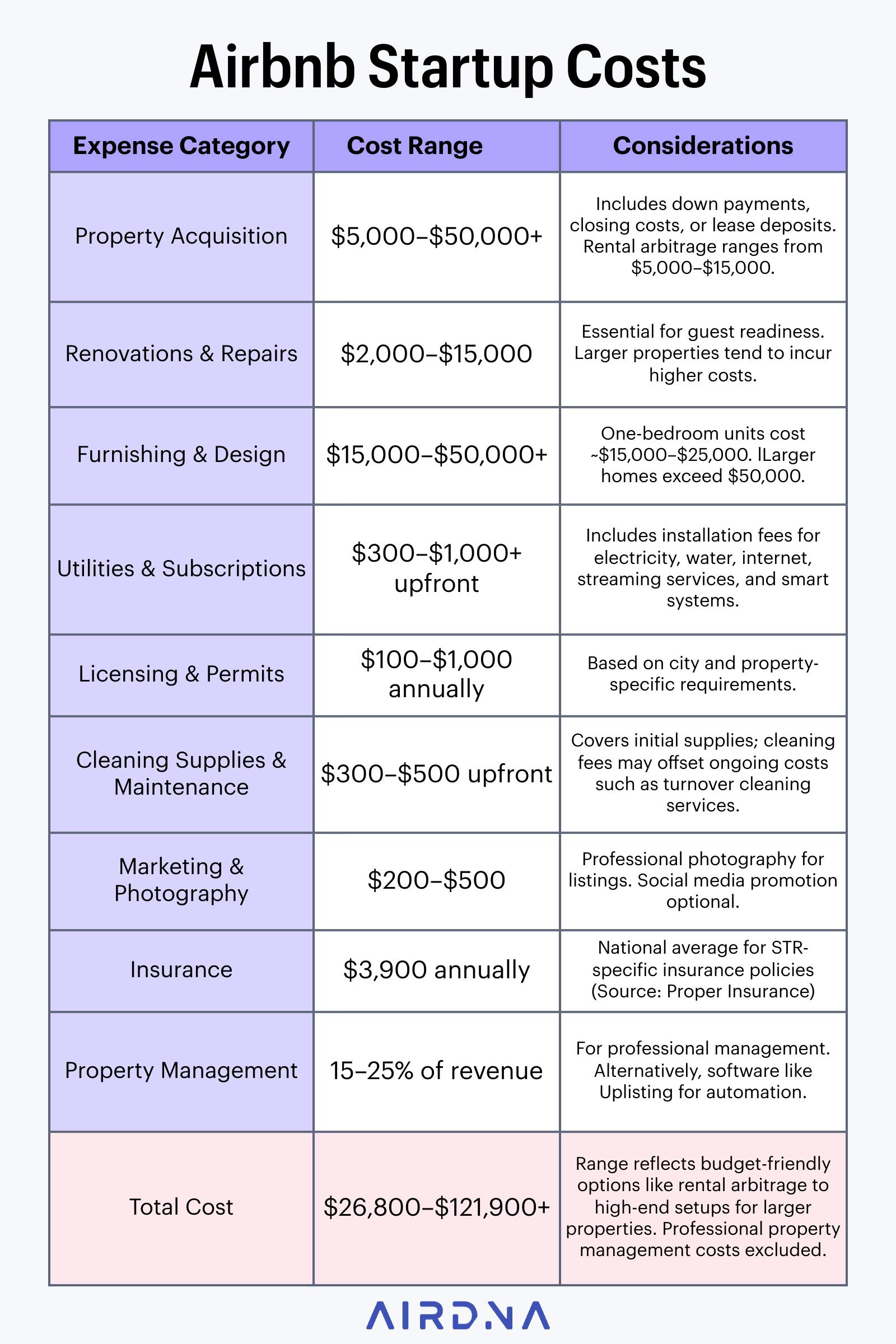
Breakdown of Airbnb Startup Costs
Starting an Airbnb comes with a variety of upfront costs that vary widely based on your strategy and market. Here's a detailed breakdown of what you'll need to budget for before welcoming your first guest.
Property acquisition
The biggest startup cost you'll face is getting your property. Buying a rental property usually requires a down payment (typically 20-25% for investment properties) plus closing costs. Alternatively, rental arbitrage—where you rent a property to list on Airbnb—requires first and last month's rent plus security deposits. That usually totals $5,000-$10,000. Your monthly mortgage or rent will depend on your location and property size.
Renovations and repairs
Before welcoming your first guest, your property needs to be in top condition. Budget $2,000-$15,000 for essential upgrades and maintenance like fresh paint, plumbing fixes, updated lighting, and ensuring all appliances work perfectly. If you’re not handy yourself, consider hiring an Airbnb handyman to handle these tasks efficiently and professionally. Remember: these costs typically increase with property size.
Furnishing and interior design
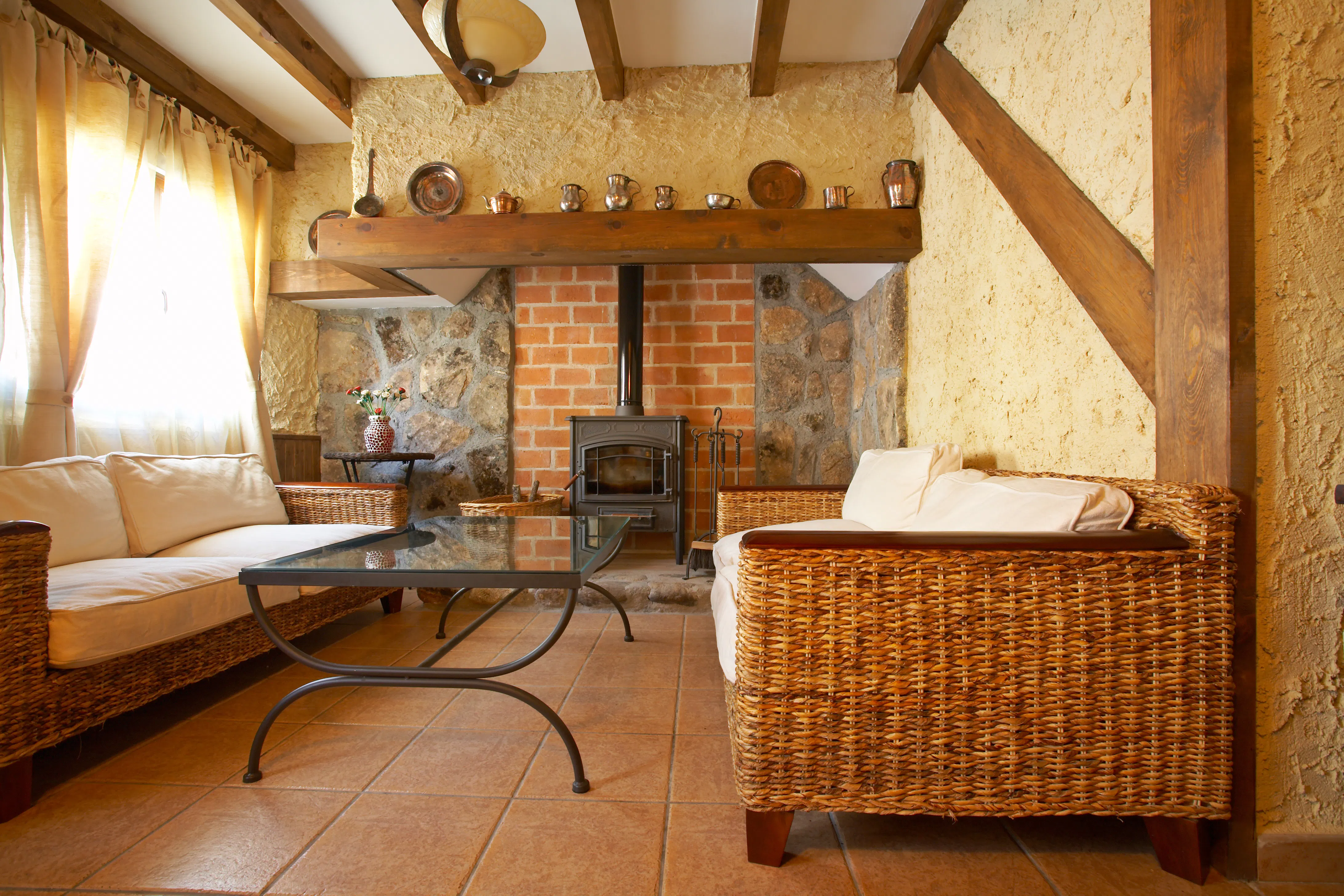
Quality furnishings make a huge difference in your listing's appeal. A one-bedroom apartment typically requires $15,000-$25,000 for basics like beds, sofas, dining sets, and kitchen essentials. Larger homes can cost $30,000-$50,000+ to furnish completely. You could, however, also explore short-term furniture rental for your Airbnb to reduce startup costs. Short-term furniture rental for your Airbnb is one way to reduce startup costs.
Furnishing your rental involves more than the big ticket items like couches. Each room has its own set of needed supplies, from bedding for bedrooms to toiletries for bathrooms. Consider decor best practices and adopt a theme or popular interior design trend.
Utilities and subscriptions
Setting up utilities sometimes comes with an upfront fee. After setup, you’ll need to plan ahead for monthly costs: electricity, water, high-speed internet, and streaming services. Smart thermostats and keyless entry systems might add initial costs but can reduce long-term expenses.
Licensing and permits
Most cities require short-term rental permits, business licenses, and health/safety inspections. These typically range from $100-1,000 annually, depending on your location. Some cities also require zoning permits or HOA approval. See our guides on short-term rental regulation, how to find short-term rental ordinances in your area, and short-term rental compliance.
Cleaning and maintenance
Initial cleaning supplies and equipment will cost $300-500. Stock up on essentials like towels, bed linens (at least 2-3 sets per bed), and basics like disinfectant spray that guests may need. Professional cleaning services between guests typically cost $25-50 per hour. Keep in mind that you’ll be able to recoup at least some of your cleaning costs through cleaning fees that you charge guests.
Marketing and photography
Professional Airbnb photography is pretty much a non-negotiable if you want to attract guests. Expect to pay $200-500 for a professional photoshoot. Additional marketing costs might include social media promotion or listing site fees.
Insurance
Beyond standard homeowner's insurance, you'll need short-term rental insurance coverage. The average short-term rental insurance policy is $3900 annually, according to Proper Insurance. STR-specific policies are critical because they protect both your property and business (something typical residential insurance can’t do).
Professional property management
For hosts who want a hands-off approach from the start, professional property management can handle everything from guest communication and cleanings to pricing optimization and maintenance. While these services typically cost 15-25% of your rental income, they save time and ensure a polished guest experience, which can lead to better reviews and higher occupancy rates. This option is ideal for remote hosts, hosts who want to scale quickly, or those who are balancing hosting with other responsibilities. We’ve got a guide to help you decide if it’s time to hire a property manager.
If you’re hesitant to invest in professional property management, a property management software can be a good compromise. Uplisting, for instance, can automate time-consuming tasks like security deposit collection, cleaner scheduling, and guest messaging.
All-in-one Vacation Rental Software and Channel Management System
Manage short-term rentals & bookings, message guests, take payment, and so much more. All in one easy-to-use platform (that never double-books).
Host tools
Starting your Airbnb journey is easier with the right tools to guide you. In addition to a property management system like Uplisting, AirDNA can help you understand your market and set the right price.
Our bread and butter is offering insights into local demand, occupancy rates, and what similar properties are charging. We even provide rate recommendations based on these insights to make sure you’re not leaving money on the table.
You might also consider other real estate investment software to evaluate properties and keep track of your budget. While these tools involve an upfront cost, they simplify your workload and help ensure your Airbnb gets off to a strong start.
Creating an Airbnb Startup Cost Spreadsheet
Budgeting is the backbone of financial planning for your Airbnb. A detailed startup cost for Airbnb spreadsheet helps track every dollar spent and offers a clear picture of your profitability. You can avoid unpleasant surprises and identify areas where you can cut back by mapping out costs upfront.
For example, if you’re wondering how to start Airbnb with 5k, a spreadsheet allows you to prioritize high-impact investments. Plus, it provides a roadmap to forecast profits and evaluate how quickly you can expect a return on your investment. If your finances are tight, there are a number of ways to start an Airbnb business with no money.
Essential categories to include
Your Airbnb startup cost spreadsheet should cover these core expense categories:
- Property acquisition: Down payments, mortgage payments, rental deposits, or lease fees
- Setup & safety: Initial renovations, repairs, and upgrades needed for guest readiness
- Guest experience: Furnishings, decor, kitchenware, and linens
- Monthly operations: Utilities, internet, cleaning services, and property maintenance
- Business essentials: Insurance, permits, licenses, and property management software
- Marketing: Professional photography and guest extras like concierge services or welcome baskets
Pro tip: Add columns to distinguish between one-time startup costs and recurring monthly expenses. This organization helps you understand both your initial investment needs and ongoing operational costs.
Use accurate numbers
Starting an Airbnb doesn't have to be a guessing game. AirDNA’s Financial Calculator in for-sale listings helps you understand exactly what you're getting into.
Take this $435,000 property—the calculator automatically pulls in key metrics based on market data. The projected annual short-term rental revenue, assuming that the property will be available year-round, is $40,700. Operating expenses are estimated at $20,500 and the projected cap rate is 4.64%. These real numbers help you understand exactly what you're getting into before making any investments.
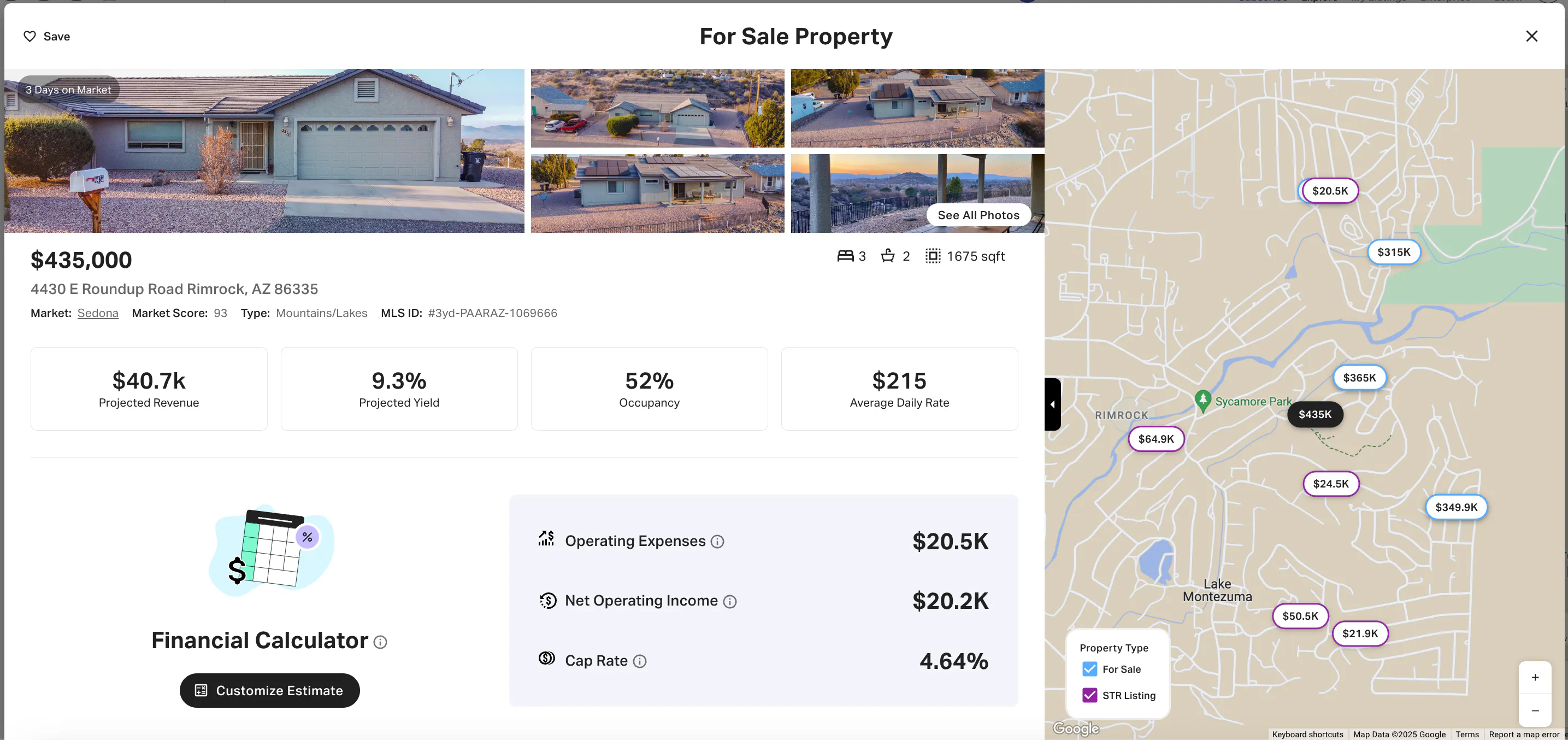
We’ve also got a section where you can input the property’s startup costs to factor into the total equation. Every property and host will have different startup needs, but our calculator helps you plan for the major categories. For a property like this, you'll want to research and estimate:
- Home furnishings (bedrooms, living spaces, kitchen essentials)
- Any improvements needed to get the space guest-ready
- Closing costs (typically 2-5% of purchase price)
- Initial operating capital
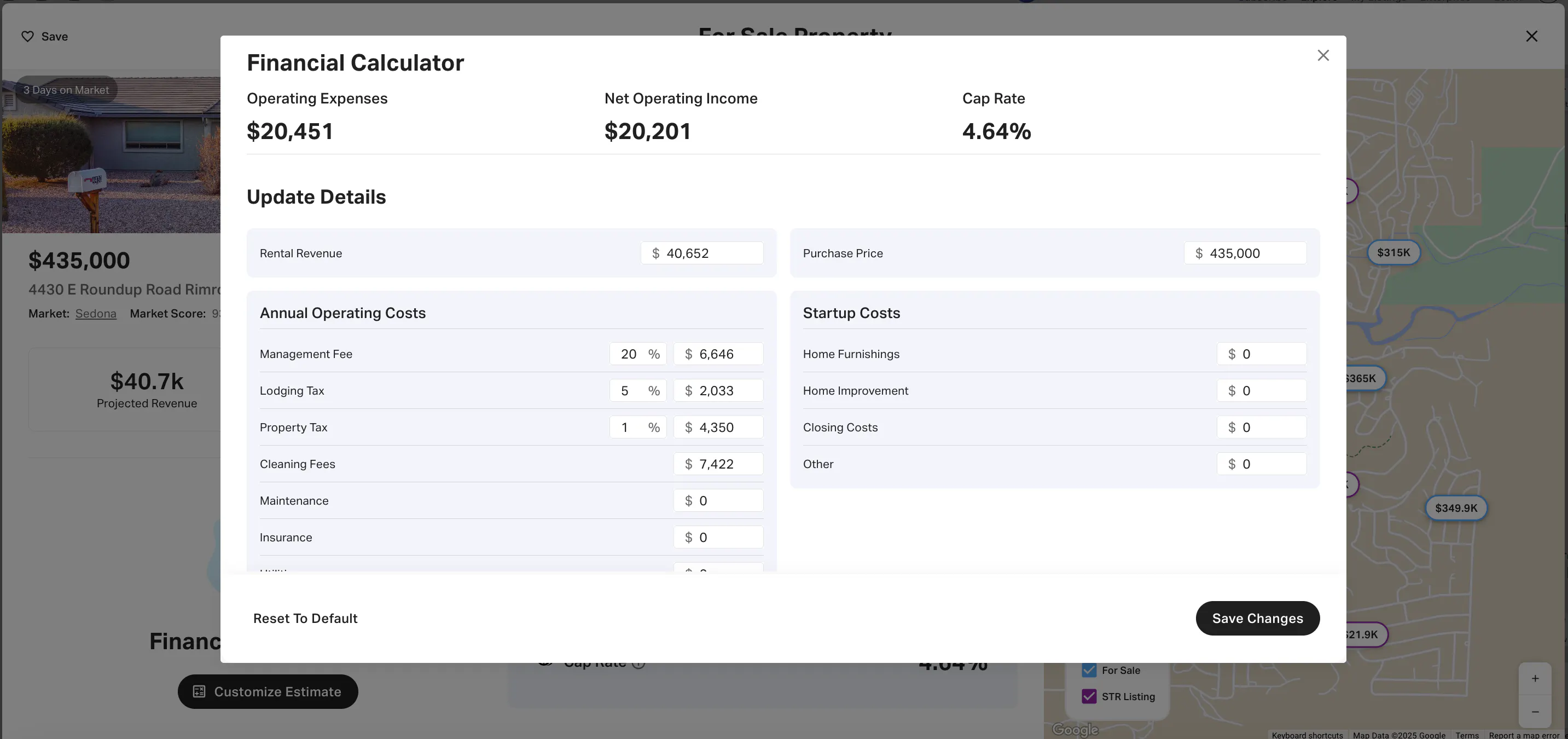
Once you input these startup costs, the calculator updates your total investment needs and shows how they impact your potential returns. In this example, you'll see how your specific startup costs affect the $41,972 net operating income, giving you a complete picture of both your initial investment and long-term opportunity.
Tax Deductible Airbnb Startup Costs
Understanding how to file your taxes for Airbnb can be intimidating, but doing your homework can translate into significant tax savings. Between the short-term rental tax loophole, cost-segregation analyses, and depreciation, there are a number of strategies that can put money back in your pockets come tax time.
Let’s not get ahead of ourselves, though. In the realm of startup costs specifically, repairs, furnishings, and supplies may qualify as deductible business expenses. This means you can subtract these costs from your taxable income, lowering the amount of taxes you owe.
Expenses must be considered “ordinary and necessary” for operating your short-term rental to qualify as Airbnb startup costs that are tax deductible. For instance, purchasing furniture for your property or advertising your listing qualifies, while extravagant upgrades beyond business needs might not.
The benefits? Deducting these costs can make your startup phase much more affordable, helping you reinvest savings back into your rental.
Common deductible expenses
Your first year of hosting offers unique tax advantages, particularly for major startup investments. Here are some significant short-term rental tax deductions to consider:
- Large property improvements: Major renovations or upgrades to prepare your property for hosting may qualify, but be aware that some costs (like structural improvements) typically need to be depreciated over several years rather than deducted immediately.
- Complete room setups: Full furnishing packages and appliance purchases
- One-time business costs: Incorporation fees, legal consultations, and business licenses
- Professional services: Initial deep cleaning, property inspections, and setup assistance
- Training and education: Host courses, property management training, and short-term rental market research tools
Pro tip: While many Airbnb expenses are deductible year after year, these substantial startup costs can make a significant impact on your first year's tax return. Be sure to track these larger investments carefully.
Keep track of your Airbnb startup costs
Meticulous record-keeping is essential when starting your Airbnb, especially for tax deductions. The IRS or your local tax authority will expect clear evidence to back up your claims. Keep all receipts and invoices, from furniture to cleaning supplies. Use a dedicated bank account to separate business and personal expenses, and categorize your costs (property, furnishings, licenses) in a spreadsheet or accounting software.
A little effort now can translate into big savings later!
Enjoy the confidence & focus you need to scale your vacation rental business
With a reliable VRM solution you can trust, Uplisting can help you grow your business without wasting time on double bookings, unhappy guests, upset clients and worrying what could go wrong next.
Strategies to Minimize Startup Costs
While vacation rental success often takes significant investment, there are ways to begin your hosting journey with a smaller budget. Whether you're considering renting out a spare room, exploring rental arbitrage, or looking to purchase a property, here's how to make your startup funds go further.
Start with the essentials
Focus your initial budget on what guests truly need. Whether you're starting with an existing property or exploring rental arbitrage, prioritize the basics: quality beds, linens, towels, and safety features. Premium amenities and decor upgrades can come later as your revenue grows. Even with a modest $5,000 budget, you can create a welcoming space by investing strategically in these core elements.
Build smart systems
Before thinking about expansion, focus on creating efficient processes with your first property. Start with basic cleaning routines, simple check-in procedures, and essential guest communication. You might handle tasks like photography and listing management yourself initially, while selectively investing in professional services where they matter most—like deep cleaning between guests.
Scale strategically
Your second (or tenth) property benefits from everything you've learned. As you expand, you'll leverage:
- Existing business licenses and host tools that cover multiple properties
- Established relationships with vendors and service providers
- Better bulk purchasing power for furnishings and supplies
- Data on what amenities drive bookings in your market
- Streamlined setup processes based on experience
Airbnb Rental Arbitrage Business Startup Costs
Looking for a lower-cost way to start an Airbnb business? Rental arbitrage—renting a property long-term to list on Airbnb—typically requires $5,000-$15,000 to get started, compared to the much larger down payment needed to purchase a property.
Here's what Airbnb arbitrage startup costs include and what you should budget for:
- Lease costs such as security deposit plus the first and last month's rent
- Essential furnishings like beds, linens, a couch, and dining room set.
- Safety items like locks, smoke detectors, and a fire extinguisher
- Business setup like insurance, permits, and landlord agreements
- Initial cleaning and household
Remember: Before investing any money, always check local regulations and get explicit landlord approval. While arbitrage offers a lower-cost entry for Airbnb hosts, success depends on finding the right property with favorable lease terms in a market with strong short-term rental demand.
Research Airbnb Markets
Gain insights into the revenue and occupancy trends in your market.
Assessing If Starting an Airbnb Is Right for You
Starting an Airbnb can be an exciting and profitable venture, but it’s not a decision to take lightly. Before diving in, assess your financial readiness, market potential, and the time commitment required. Here’s how to evaluate if hosting is the right move for you.
Are you financially ready?
The first step is to reflect on your budget. Can you comfortably cover the Airbnb startup costs outlined earlier, including property acquisition, furnishings, and ongoing expenses?
It’s also critical to have a financial buffer for unexpected costs. Emergency repairs, unexpected guest cancellations, fluctuating occupancy rates, changing regulations, and more can impact your earnings. A healthy cushion can help you weather these challenges without stress.
Do you understand your goals and your market?
Your market and goals play a significant role in determining your Airbnb’s success.
- Market potential: Is there demand in your chosen location? Use tools like AirDNA to evaluate occupancy rates, seasonal trends, and average nightly rates. A property in a high-demand area will naturally have better profitability prospects.
- Define your goals: Are you aiming for supplemental income, building a long-term investment, or creating a full-time business? Your goals will shape your approach to startup costs, marketing, and property management.
Aligning your plans with market realities and your personal objectives is key to making an informed decision.
Do you have the time and energy?
Hosting is more than a “set it and forget it” operation (although with Uplisting, you can get pretty close!). You’ll need to handle bookings, cleanings, guest communication, and property maintenance. If you already have a demanding schedule, consider the following:
- Time commitment: Can you dedicate the necessary hours to manage the property yourself?
- Property management services: Professionals can take over tasks like guest communication and cleaning for a fee (often 10–30% of your earnings), allowing you to focus on other priorities.
Weighing the time and costs associated with hands-on hosting versus outsourcing is crucial for sustainable growth.
Does hosting fit your lifestyle?
Hosting isn’t just a financial decision; it’s a lifestyle choice. Are you comfortable welcoming guests into a property you own or operate? Do you enjoy problem-solving and providing excellent customer service?
If you’re excited about creating a great experience for your guests—offering unique touches or ensuring your space feels like a home away from home—you’re likely to thrive as a host. However, if the idea of late-night calls or constant upkeep feels overwhelming, hosting may not be the right fit for you at this time.
Starting an Airbnb is a big decision that impacts your finances, time, and daily life. Reflect on these factors and align them with your goals so you can move forward confidently, knowing hosting is a step in the right direction.
You’re in great company
Some of the largest short-term rental operators (with 250+ properties) rely on Uplisting's software to scale their businesses.
FAQ
How much does it cost to start an Airbnb?
Starting an Airbnb typically costs between $10,000 and $50,000, depending on factors like property size, location, and condition. Costs include:
- Property expenses: Security deposits, down payments, or rental costs.
- Furnishings: Expect to spend $5,000–$15,000 on furniture and décor.
- Licensing and compliance: Local permits may cost anywhere from $50 to $500+.
- Marketing and setup: Professional photography and listing ads range from $200 to $500.
Starting with a smaller budget (like $5,000) is possible if you use existing resources—like an existing residence or arbitrage—and focus on essentials first.
What to know before starting an Airbnb?
Before jumping into hosting, consider these important factors:
- Know your market: Use tools like AirDNA to research occupancy rates and pricing trends in your area.
- Understand local regulations: Ensure your city permits short-term rentals and understand how to comply with any licensing requirements.
- Plan your finances: Budget for upfront and ongoing costs, including cleaning, maintenance, and unexpected repairs. Make sure you have a financial cushion for any emergency or unexpected expenses.
- Commit to the guest experience: Hosting requires time, effort, and excellent communication to succeed.
Preparation is key to avoiding common pitfalls and maximizing your property’s profitability.
What are the startup costs for Airbnb arbitrage?
Airbnb arbitrage—renting a property to sublet on Airbnb—has unique startup costs. These often include:
- Initial lease payments: Security deposit plus first and last month’s rent.
- Furnishings and decor: Typically $5,000–$15,000 to fully outfit the space, depending on the size of the space and whether you’re shooting for a budget or luxury guest experience.
- Utilities: Setup costs for electricity, water, and internet services.
- Compliance: Any required permits or licensing fees in your area.
Arbitrage can be less expensive than purchasing a property outright, but it requires landlord approval and a solid understanding of local rental laws to ensure your venture is both ethical and profitable.
Both traditional hosting and arbitrage can lead to rewarding returns if you plan strategically and know what to expect.
Are Airbnb startup costs tax deductible?
Yes, many of your Airbnb startup costs are tax deductible, including furnishings, cleaning supplies, and initial marketing expenses. However, larger investments like property renovations may need to be depreciated over time rather than deducted in full during your first year. Accurate record-keeping and consulting a tax professional are key to making the most of these deductions while staying compliant.
ARTICLE SUMMARY
Thinking about starting an Airbnb? Before you jump in, get the full picture on Airbnb startup costs. From property setup to furnishings, licensing, and tax deductions, this guide breaks it all down to help you plan smarter and maximize your investment.
Bram Gallagher
AirDNA Director of Economics and Forecasting
Bram Gallagher is an Economist at AirDNA, specializing in uncovering insights that drive smarter short-term rental decisions. He put his Ph.D. in Economics from the University of Georgia to work researching and forecasting hotel data with CBRE prior to joining AirDNA, as well as teaching economics at a number of universities. In his spare time, Bram enjoys making wooden furniture with hand tools.
