

 Calculate Revenue
 Research Markets
 Find For Sale Properties
 Compare My Listing
 STR Revenue Calculator
 Custom Comp Sets
 Submarket Insights
 Custom Search Filters
 Rate Recommendations
 Performance Benchmarking
 Competitor Comparison
 Owner Contact Details
 Property-level performance data
 Tourism Insights
 Real Estate Investment Analytics
 About Us
 Sales
Sales Support
 Press
PressBuying Rental Property: 5 Steps for Short-Term Profit 💵
Published: June 3, 2025
Last updated: September 25, 2026

Bram Gallagher
Key Takeaways:
- Take a strategic approach by understanding market dynamics and your investment goals before analyzing the potential of a single property.
- Analyze markets and submarkets to uncover hidden opportunities and ensure your rental property will thrive in its specific location.
- Refine your financials to account for all costs and create a realistic plan that aligns with your investment strategy before making the purchase.
You want to buy a rental property as a short-term rental investment and you've found a property that seems perfect. The location is great, the price fits your budget, and you can already picture happy guests leaving glowing reviews. But before you get carried away, there's a lot to consider—more than just the numbers. Is this property the right fit for your investment goals? Will it perform well in the market? What should you be thinking about before buying rental property? Will it meet key investment rules like the 1% rule or generate sufficient cash flow?
Many real estate investors, whether they’re buying their first property or their fifth, face these same questions.
Before buying rental property, it's essential to take a step back and approach it with an investor mindset. In this guide, we'll cover the key things you need to do first, from understanding the market to evaluating specific properties. You'll learn how to think critically about your rental property investment, identify the right opportunities, and set yourself up for success before opening your pocketbook.
Smart investments happen here.
AirDNA makes hosting and investing a breeze. Every insight you need, all in one place, always up-to-date.
1. Clarify Your Investment Goals for Buying Rental Property
It’s easy to get excited when you spot a property with great potential—a cozy cabin or a sleek city apartment that you can already imagine turning into a profitable short-term rental. Before diving into individual listings and crunching numbers, though, it’s crucial to step back and think about your overall investment strategy.

Are you aiming for steady passive income and cash flow, or is your goal long-term property appreciation? Your rental property investment strategy will influence which metrics are most important as you evaluate properties—including whether you're considering turning your own primary residence into a short-term rental. Understanding investment rules like the 50% rule (where operating expenses typically consume about half of your rental income) can help you set realistic expectations.
Before focusing on specific properties, think about what makes an area attractive to short-term renters. Is it near tourist hotspots, business districts, or unique local attractions?
Seasonality is also key—some properties perform well year-round, while others may peak in summer or winter and struggle in off-seasons. Can you attract different types of guests to fill gaps and keep occupancy steady throughout the year? When you're evaluating locations for buying rental property, consider both high and low seasons in your ROI calculations. For more information on short-term rental investment strategies, check out our Guide to Airbnb Investing.
Once you've clarified your goals and understand the bigger short-term rental market dynamics, you'll be in a much stronger position to evaluate individual properties (which we'll get to later in this article, so not to worry!).
While it's tempting to dive straight into the details of a specific listing, thinking through market factors first will set you up for long-term success when purchasing a rental property.
2. Evaluate Rental Property Market Types
Successful real estate investors know that a property's potential isn't determined in isolation. While individual metrics are essential, understanding the broader short-term real estate market context can make or break your rental property investment. Before buying rental property, you need to evaluate how market conditions will impact your potential returns.
AirDNA divides the country into markets, which then fall under six market types based on geographic characteristics—such as proximity to the coast, mountains, or urban centers. Each market type presents unique opportunities and challenges for rental property owners. Before buying a rental property, you’ll want to understand how each market aligns with your investment goals.

Coastal markets
Coastal markets are often some of the most desirable locations for short-term rentals, drawing in beachgoers, retirees, and vacationers year-round. However, these areas tend to be highly seasonal and come with their own set of challenges. Investors in coastal areas need to weigh the high potential revenue with the associated risks and costs.
- High ADR potential : Coastal areas, especially during summer, can command high average daily rates (ADR).
- Seasonal fluctuations : These markets tend to peak in warmer months, with potential revenue dips in off-seasons.
- Higher acquisition and maintenance costs : Desirable locations drive up prices, and properties may need extra weather-proofing like hurricane windows and flood insurance.
- Off-season opportunities : Target different demographics like retirees or remote workers to maintain occupancy during the slower months.
Mountain/lake markets
Mountain and lake markets are perfect for nature-loving travelers, offering activities like skiing, hiking, and water sports. Like coastal markets, these areas are highly seasonal, often peaking during the winter for ski resorts or summer for lake destinations. Investors in these markets need to account for both peak season earnings and the off-season potential.
- Peak seasonality : Strong winter demand for ski resorts and summer demand for lakes.
- Amenity investments : Guests expect features like hot tubs, fire pits, or boat docks, which can raise the property’s appeal but also its maintenance costs.
- Year-round potential : With effective marketing (e.g. for fall foliage or spring hiking), you can attract visitors in all seasons.
- Unique expenses : Be prepared for costs like snow removal or dock upkeep.
Urban/metro markets
Urban markets are bustling year-round with business travelers, tourists, and event-goers. These markets offer consistent demand but often come with higher acquisition costs and increased competition. Success in urban areas may depend on standing out from the crowd with strategic pricing, amenities, and niche targeting.
- Year-round occupancy : Business travelers, tourists, and event-goers fuel consistent demand.
- High competition : Popular neighborhoods can be oversaturated with short-term rentals, so setting competitive nightly rates and offering standout amenities is crucial.
- Higher acquisition costs : Properties in prime urban areas tend to come with higher price tags.
- Regulatory risks : Cities often have stricter regulations on short-term rentals, so make sure to review local laws before investing.

Suburban markets
Suburban markets, while often overlooked, provide excellent opportunities for investors seeking stable, long-term occupancy and lower competition. With families, groups, and business travelers looking for more space and quiet, suburban properties can deliver solid, year-round performance.
- Stable, long-term occupancy: Suburban properties often attract families or business travelers looking for spacious accommodations at an affordable price point.
- Lower acquisition costs: Compared to urban centers, suburban homes can be more affordable, offering a higher return on investment (ROI).
- Larger properties: More space can appeal to groups, but the suburbs can require guests to have cars to access local attractions, which limits some demographics.
- Less competition: Many investors overlook suburban areas, which can offer untapped potential in the short-term rental market.
Mid-sized city markets
Mid-sized cities are markets that rank between 50-150 in population density in the U.S. They're' are balanced markets with a mix of business and leisure travelers. They typically offer more affordable entry points than major metros while still providing solid demand, and the 7.9% year-over-year supply growth reflects the potential that investors see in this market type. Mid-sized cities are often more stable than rural or coastal areas, without the extreme seasonality.
- Balanced opportunities : These markets often have a mix of leisure and business travelers, providing steady demand without the extreme peaks of larger cities or rural areas.
- Affordable acquisition costs : While generally more expensive than rural markets, mid-sized cities often present lower entry costs than major metros.
- Emerging neighborhoods : Watch for up-and-coming areas that offer growth opportunities and potential price appreciation.
Small city/rural markets
Small cities and rural areas offer unique opportunities for investors looking for niche markets. We define small cities and rural areas as markets that fall outside of the country’s top 150 most populous cities (and aren’t classified as destination/resort markets). The explosive listing growth in these markets reflects their appeal to short-term rental operators, with the supply of vacation rental listings in small cities and rural areas growing 13.76% year-over-year.
While demand can be seasonal, the lower property prices and higher ROI potential make these areas attractive. Investors can capitalize on niche trends like eco-tourism or farm stays to drive demand.
- Lower entry prices, higher ROI potential: These markets often have lower property acquisition costs, making them appealing for new investors.
- Niche market potential: From eco-tourism to farm stays, rural areas offer unique opportunities to tap into niche traveler preferences.
- Seasonality: Demand may be more volatile, with higher seasonality based on local events or attractions.
- Higher amenity costs: Properties in rural areas might require more investment in amenities like barns or outdoor recreation facilities to stand out.
Calculate potential earnings
Understand the investment potential of any address in the world.
3. Complete a Rental Property Market Analysis
Submarkets—specific neighborhoods or smaller geographic areas within a larger market—can have a significant impact on a property's performance. Think of a market as a pie, and submarkets as the slices—each with its own unique flavor profile that can dramatically influence your return on investment.

Submarket analysis allows you to uncover hidden gems or avoid potential pitfalls that might not be apparent when looking at overall market data. For instance, while a city’s average occupancy rate might seem mediocre, certain neighborhoods may be consistently outperforming others. This can translate into thousands of dollars in additional revenue each year.
Submarkets also have distinct guest demographics, pricing dynamics, and seasonal trends, all of which can greatly affect your property’s success. By considering submarket data, you can tailor your investment to the specific characteristics of a neighborhood. This can give you a significant edge over competitors who only focus on broader market trends.
Digging into granular submarket data is also key to doing your due diligence around regulations. Regulations that prohibit short-term rentals or specify operating standards are often enacted on a local ordinance level, meaning there may be neighborhoods side by side with very different regulatory frameworks.
Navigating new rental property regulations in 2025
California offers a great case study in the breadth of regulations that can affect short-term rental operations. In 2025, new laws have introduced stricter rent control measures, extended eviction timelines, and tighter security deposit regulations, significantly impacting how investors approach short-term rentals.
Landlords must often photograph their units at move-in and move-out and respond quickly to safety concerns, including lock changes for domestic violence victims.
Sustainability mandates, such as energy efficiency upgrades or solar installations, help meet environmental goals and can qualify investors for potential tax incentives.
Additionally, zoning reforms have made it easier to develop accessory dwelling units (ADUs), which can serve as extra income streams. Corporate ownership of single-family homes is more restricted, creating new opportunities for individual investors seeking higher returns. Regulations can get a bad rap, but they have the potential to benefit vacation rental owners.
Staying informed and compliant with these evolving regulations can protect your investment and keep you thriving in an increasingly competitive market.
Research Airbnb Markets
Gain insights into the revenue and occupancy trends in your market.
4. Evaluate Specific Rental Properties
At this point, you might have a few specific properties in mind. This is where the rubber meets the road - it's time to look at the numbers for each potential investment. When evaluating rental properties, you'll want to analyze both the revenue potential and all associated costs to determine if they meet investment criteria like the 1% rule. The 1% rule dictates that monthly rent should be at least 1% of the purchase price.
One of our most popular tools for vacation rental property investors is our revenue calculator, Rentalizer™. Simply type in an address, and you’ll see a snapshot of what the property could earn as a short-term rental.
For example, if you’re looking at a property in Salt Lake City, Rentalizer™ provides projections based on the performance of comparable properties within a 10-mile (15-kilometer) radius. We provide a Confidence Score that captures how precise the revenue estimate is, with the ability to customize the properties used as the basis for the projection to increase its precision.
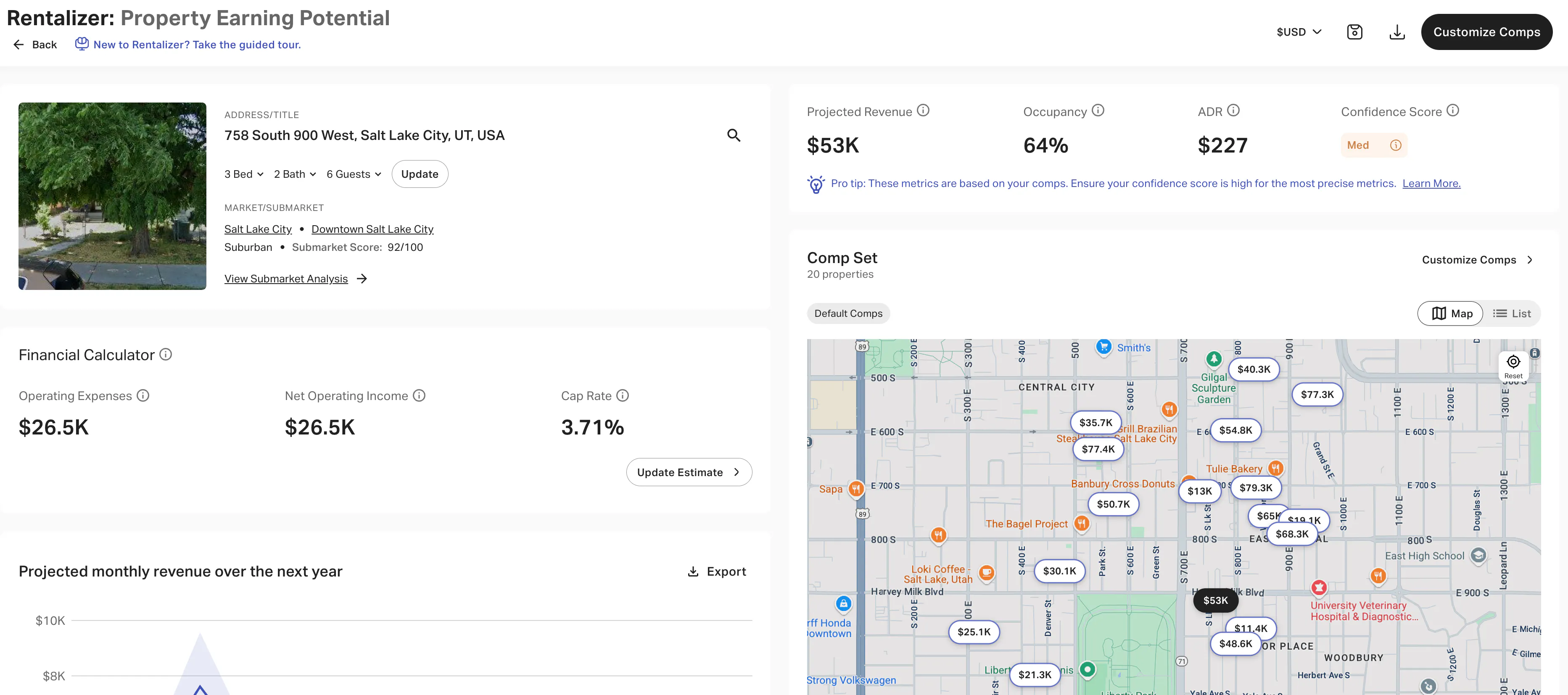
That's just the starting point, though. To make a well-informed decision before buying a rental property, you need to dive deeper into the data. Running a thorough ROI calculation that includes all expenses and projected income will help you determine if a property meets your investment criteria. Luckily, we offer a customizable financial calculator with each Rentalizer™ estimate with fields for both startup costs and annual operating expenses.
Evaluate key metrics
Let’s break down key metrics and what they mean for your investment:
- Projected Annual Revenue: This shows expected earnings over the next year, assuming full availability. Compare it to your goals and see how it stacks up against long-term rentals in the area.
- Occupancy Rate: This indicates how often the property is likely to be booked. Watch for seasonal fluctuations, as they can affect your overall income.
- Average Daily Rate (ADR ): This is the average nightly rate you can charge. Compare it to market expectations. Are there opportunities to raise rates through strategic upgrades or marketing?
These metrics in your Rentalizer report are specific to the property. If you consider these numbers on a market or submarket level, however, they represent averages across all listings in the area. Your property might perform better—or worse. The goal is to figure out where your property falls on the performance curve.
Identify and refine comparable properties
When considering buying a rental property, you need to compare apples to apples. Just as you wouldn't compare the price and quality of a Red Delicious apple to a Valencia orange, you shouldn't compare a beachfront condo to a suburban house, even if they're in the same city. They're fundamentally different properties that will attract different guests and command different rates.
Rentalizer™ automatically selects comparable properties based on location, bedrooms, bathrooms, and guest capacity. However, you’ll want to review these to make sure they really are comparable to the property you’ve selected. Review these comps in detail, and make sure they match your property’s size, amenities, and proximity to local attractions.
If they don't, it's time to customize your comps. See the comp set properties informing your revenue projections alongside all other available short-term listings in a map view. Add or takeaway properties from your comp set, and use core attribute, performance, and amenity filters to easily sift through the vacation rental listings in your area based on their similarity to the inputted address.
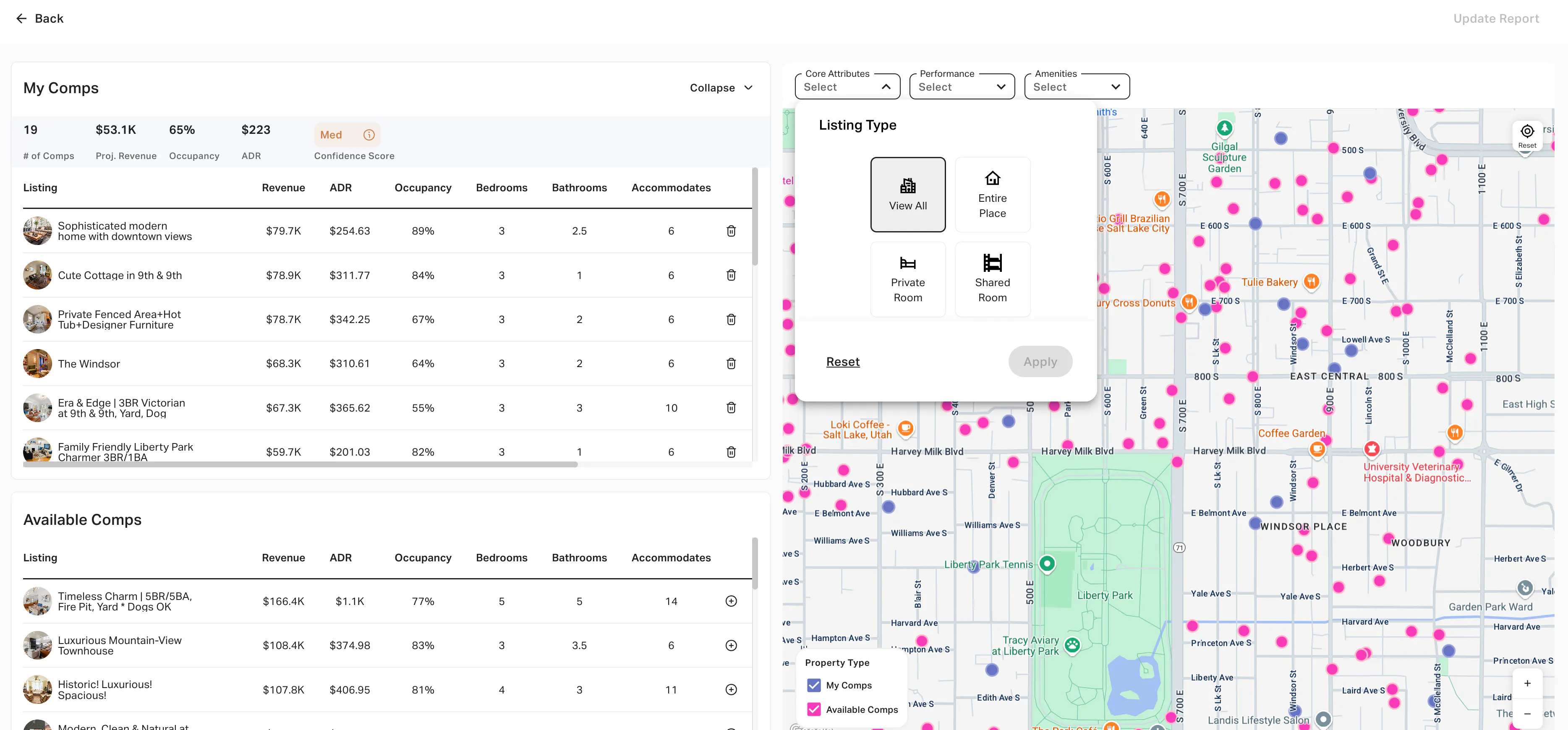
As you add and take away from the Rentalizer™ comp set, you'll see the projected revenue, occupancy, ADR, and Confidence Score shift accordingly. Customizing your comp set allows you to take a low confidence score and turn it into a high one by hand-selecting the most relevant properties.
Fine-tune broader market insights with filters
The Explore feature of the AirDNA app is another helpful tool for rental market analysis. If you don't have a specific property in mind, then filtering market data can be a more useful tool than Rentalizer™.
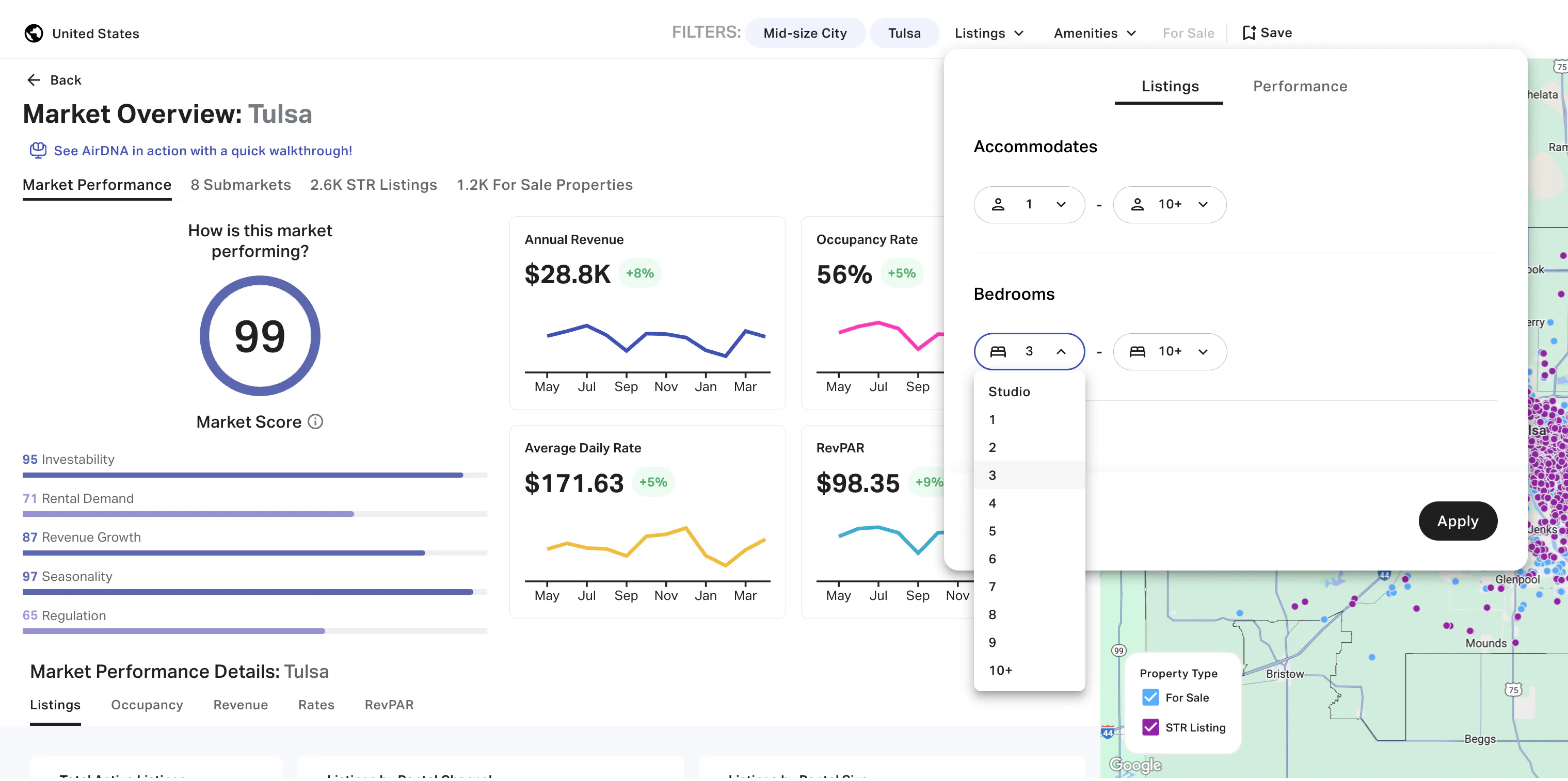
The Market Overview page of any location will show you the average of each performance metric, but you can filter the performance results in a number of ways to better match the type of property you're looking for. Here are some of our filtering options:
- Property type and size : Match the number of bedrooms and bathrooms.
- Guest capacity : Adjust based on how many guests your property can accommodate.
- Price tiers : AirDNA categorizes properties as Luxury, Upscale, Mid-range, or Budget based on ADR. Choose the tier that aligns with your property.
- Amenities : Filter for key features like pools, parking, or other enhancements you're considering.
By narrowing performance information with filters, you’ll get a much clearer picture of your property’s potential. For example, you might go from 14,000 total short-term rental properties in a given market down to 133 truly comparable listings, giving you more accurate insights for your investment decision.
Remember, it’s about quality over quantity. A smaller, well-matched set of comparables will provide better insights than a large, broad sample.
Analyze the results
As you apply filters, track how key metrics may shift:
- A higher ADR after filtering for a pool? That feature may be worth investing in.
- A drop in occupancy for larger properties? Smaller units might perform better in your area.
- A significant change in revenue based on price tier? This can help you optimize your property's positioning.
The best way to do a rental market analysis is to pair property-specific insights through Rentalizer™ with a broader view of the market. This will help you understand how larger factors—such as seasonality, competition, and local trends—can influence your investment strategy. Balancing both individual property metrics and market-level data will give you the full perspective you need to make a confident investment decision.

5. Prepare Your Finances for Your Rental Property
Now that you’ve analyzed market dynamics and assessed potential properties, it’s time to make your financial and business plan—this is the final, crucial step before committing to a purchase. While projected revenue, occupancy rates, and average daily rates (ADR) give you a sense of the property’s income potential, it’s essential to factor in all costs to ensure the investment meets your financial goals.
Refine your financials with a full understanding of both income potential and operating expenses and get a clear picture of whether the property aligns with your investment strategy.
Apply the 50% rule as a quick check (operating expenses typically amount to about 50% of rental income) to ensure your property will generate positive cash flow. Remember that a property that doesn't meet key investment criteria like the 1% rule or generate enough cash flow might not be a worthwhile investment, even if the location seems perfect.

At this point, you're probably feeling ready to take the plunge and buy that rental property. With a solid financial plan, a deep understanding of the short-term rental market, and all the right data in hand, you're set up for success. You've done the research, made informed decisions based on proven investment rules, and now it's time to move forward and turn your rental property investment dreams into reality. Good luck—you've got this!
Try Our Vacation Rental Pricing Tool
Use AirDNA's recommended rates to optimize your pricing strategy.
FAQs
Is it a good idea to buy a rental property?
Owning a rental property can offer steady cash flow, property appreciation, and valuable tax deductions. Factors like local demand, seasonality, and short-term rental regulations play pivotal roles in overall profitability. Although it brings the potential for strong returns, you may also face property upkeep tasks and shifting guest expectations. If you’re unsure, consider consulting with real estate experts or property management services to gauge the market’s stability. Keep in mind that changes in local laws can influence how profitable and hassle-free your investment will be.
What is the 50% rule in rental property?
The 50% rule suggests that about half of your rental income goes toward operating expenses—like repairs, property taxes, insurance, and utilities. It’s a quick way to estimate your potential cash flow before factoring in more precise costs. While it’s useful as a back-of-the-envelope calculation, actual costs can vary depending on the property’s condition and location. Staying close to this rule helps ensure you remain profitable, even when unplanned repairs or tenant turnovers arise.
How many rental properties do I need to make $5000 a month?
There’s no one-size-fits-all answer, but many investors use the 1% and 50% rules as benchmarks. In general, if each property passes these tests, owning about five such rentals can net around $5000 a month in cash flow. Naturally, this depends on your location, purchase price, and expense structure. Some investors can reach that target with fewer properties if they command higher rates or have lower operating costs. Either way, careful market analysis and diligent property management are key to hitting consistent monthly income goals.
What is the 2% rule for investment property?
The 2% rule is a more stringent guideline than the 1% rule, stating that the monthly rent should be at least 2% of the property’s purchase price. For example, if you buy a home for $200,000, you’d aim to collect at least $4,000 in monthly rent. Investors who adhere to the 2% rule typically look for exceptionally high cash flow returns, often in more affordable markets. However, meeting a 2% threshold can be challenging in competitive areas where property values are high. This rule is best applied as a screening tool, rather than a sole determinant of a deal’s overall viability.
ARTICLE SUMMARY
Ready to dive into the short-term rental market but unsure where to begin? Smart investors know success goes beyond just picking a prime location. Learn the essential steps for evaluating market types, conducting thorough property analyses, and creating a bulletproof financial strategy that will transform your rental property investment from a hopeful venture into a profitable reality.
Bram Gallagher
AirDNA Director of Economics and Forecasting
Bram Gallagher is an Economist at AirDNA, specializing in uncovering insights that drive smarter short-term rental decisions. He put his Ph.D. in Economics from the University of Georgia to work researching and forecasting hotel data with CBRE prior to joining AirDNA, as well as teaching economics at a number of universities. In his spare time, Bram enjoys making wooden furniture with hand tools.
