What Is a Good ROI on a Short-Term Rental Property?
Published: April 21, 2025
Last updated: September 25, 2026

Bram Gallagher
Key Takeaways
- A 10% yield is a good ROI for your short-term rental, but you should also look at other metrics—like cap rate, NOI, and cash-on-cash return—to get the full picture of performance.
- Occupancy, pricing trends, seasonality, regulations—even the neighborhood you’re in—all affect how much you really take home. A great deal on paper isn’t always a great deal in practice.
- A “good” ROI depends on your investing style—whether that’s steady and low-maintenance or higher-risk with bigger upside.
Everyone’s got an opinion on what makes a short-term rental a success. Some go after big returns. Others play it safe. But no matter your strategy, you need a clear target—a number to aim for—before you can decide if a deal’s worth it.
That’s what this guide is here for.
We’ll define what a good vacation rental ROI looks like, show you how to measure it, and help you figure out what kind of return makes sense for you. Once you know what you’re aiming for, it’s a lot easier to make the numbers work.
What Is a Good ROI for Short-Term Rentals?
Everyone says “it depends,” but let’s be honest. You want a number you can hang your hat on. Here it is: 10% yield is a good ROI for a short-term rental.
So what’s yield? It’s a metric investors use to estimate how much income a property earns each year compared to what it costs to buy, expressed as a percentage. A 10% yield means you're making back 10% of the property’s value in income every year, a solid, middle-of-the-road return that offers healthy cash flow without taking on too much risk.
In AirDNA’s 2025 Best Places to Invest report, the top 25 markets show yields ranging from 9.3% to 15.3%. But yield wasn’t the only thing that landed them on the list.
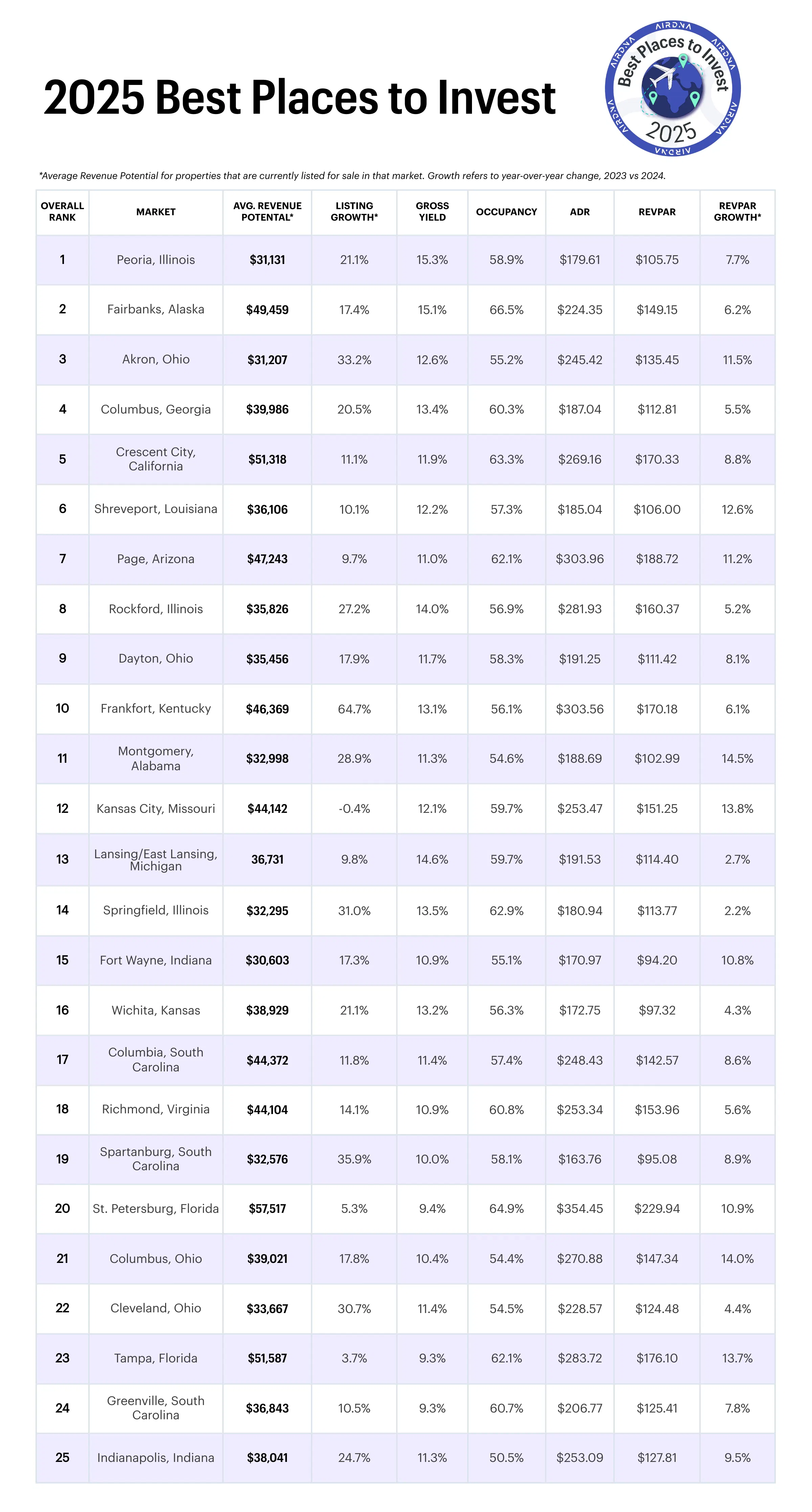
Each market earned a BPTI score based on demand patterns, affordability, seasonality, local regulations, and the number of properties actively for sale. Why? Because ROI isn’t just about how much you could earn. It also comes down to how steady that income is, how easy it is to buy in, and how simple it is to actually run a rental in the area you’re looking at.
So yes, a 10% yield is a great benchmark. However, a “good” ROI also depends on what you value most: High cash flow, long-term consistency, low effort, or high upside. Once you know what you're aiming for, you can decide what “good” really means for you.
Factors That Impact Your Short-Term Rental ROI Perspective
Now that you have a benchmark, now it’s time to add some nuance (where the “it depends” part comes in).
What makes a good ROI depends on what kind of investor you are. It’s not just about how much income a property brings in — it’s about how reliable that income is, how much risk you’re willing to take on, and how hands-on you want to be.
In other words: The number matters, but the context matters more. Here are other factors that will affect what you determine to be a ‘good’ ROI.
Risk tolerance
The best ROI isn’t always the biggest one. It’s the one that matches your investment style and comfort level.
High-yield markets can be appealing at first glance. If you're targeting cash flow, a market with a 14–15% yield might seem like a slam dunk. But ask yourself:
- Does the area rely heavily on seasonal travel or weekend demand?
- Are local STR regulations stable or are they under review?
- Will you need to self-manage to hit that number?
Now compare that to a lower-yield market, say 9–10%, where demand is steady year-round and the local government supports responsible short-term renting. You may not hit the same cash flow highs, but your income could be more consistent — and less likely to be disrupted by changing laws or seasonal dips.


For example, Peoria, Illinois has a 15.3% yield (the highest in the country). However, Peoria’s lower average revenue ($31,131) and fast-growing competition (listings up 21%) suggest a market where returns might be strong now but less predictable over time. That might work well for someone chasing high cash flow and willing to navigate some ups and downs. But for investors who prefer a steadier income or lower risk, that same deal might feel too uncertain.


Now compare that to St. Petersburg, Florida. Its gross yield is 9.4% — lower than Peoria’s, but still above the national average.
St. Petersburg has a higher average revenue potential ($57,517), strong RevPAR growth (10.9%), and slower listing growth (just 5.3%). That suggests a more stable, high-demand market with less competition and stronger long-term momentum.
For an investor who values consistency, fewer surprises, and a more passive approach, this type of market may feel like a better fit, even if the yield isn’t as eye-catching.
In the end, a high ROI on paper only works if you’re willing and able to manage the risks that come with it.
Local market performance
Where your property is located has a big impact on what kind of ROI you can expect. Some markets look great at first glance, but if most bookings only happen during a short peak season, you might end up with long stretches of vacancy. That means you’d need a higher return during busy months just to break even. On the other hand, in markets with steady demand all year—thanks to things like hospitals, colleges, or business travel—a lower yield can still add up to solid, reliable income.
And even within the same city, different neighborhoods, called submarkets, can perform very differently. A place near downtown attractions might book more often and charge higher rates than a similar home in the suburbs. That’s why it’s important to look at data on a neighborhood level—not just the city as a whole—when setting ROI expectations.
Demand and pricing trends
Occupancy and nightly rates help explain how a property earns its income. A place that books up often but at a lower rate might bring in the same revenue as a property that charges more but books less. Both can lead to a good ROI—it just depends on how those numbers work together in your market.
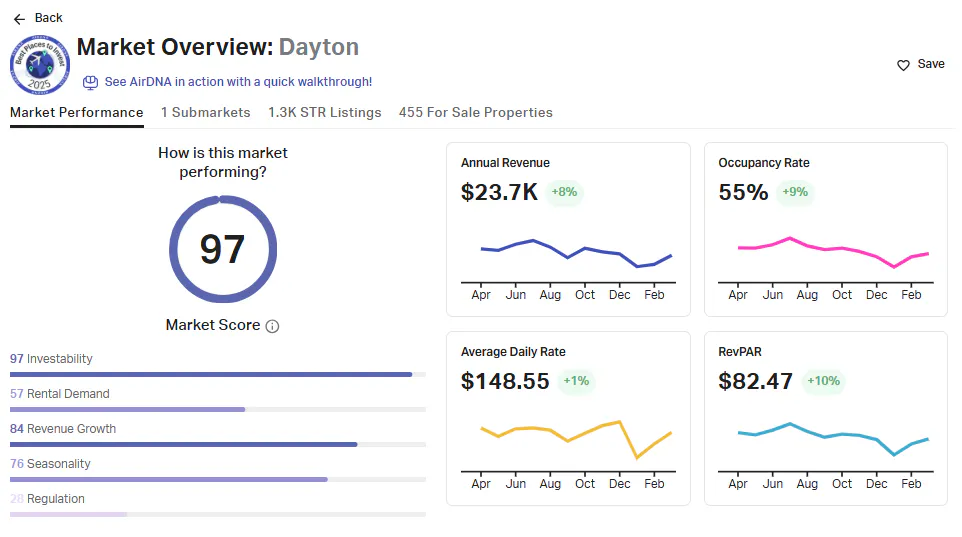
That’s where RevPAR (Revenue per Available Rental) comes in. It shows how much a property earns on average each day it’s available to book, blending occupancy and nightly rate into one helpful number. If RevPAR is going up over time, it usually means the market is getting stronger. Even if the yield isn’t the highest, steady RevPAR growth could be a sign of long-term potential.
Regulatory environment
Even the best property won’t perform if the city limits how often you can rent it.
Short-term rental regulations can seriously shape your ROI. Some cities cap the number of nights you can rent per year—so even if your place could earn great revenue, you're limited by law. Others require specific permits, restrict STRs to primary residences, or only allow them in certain neighborhoods.
Before you invest, dig into the local regulations. Can you rent year-round? Is permitting capped or competitive? Do you need to live on-site? A market with clear, stable rules gives you room to grow—and protects your returns. A ‘good’ ROI only matters if you’re allowed to earn it consistently.
Property-level decisions
What you buy—and how you run it—can make or break your returns.
Two homes in the same market might look identical on paper, but perform very differently. Maybe one’s walkable to restaurants, has great outdoor space, or is pet-friendly—while the other is tucked away in a less desirable spot. Details like these shape your guest appeal, booking rate, and ultimately, your ROI.
How you manage the property matters too. Doing it yourself can save money and boost profits—but it also means late-night messages and learning the ropes. Hiring a manager cuts into your revenue but gives you back your time. There’s no one-size-fits-all answer—it depends on how hands-on you want to be, and what you value more: Time or margin.

How to Calculate ROI
Experienced investors look at multiple ROI metrics before making a decision (not just yield, though that’s a big one). Each one gives you a different lens on your potential return — from how efficiently the property earns income, to how much profit you’re making on the cash you’ve invested.
The right metric depends on what you're trying to evaluate:
- Are you comparing properties in different markets?
- Do you want to see how operating costs affect your returns?
- Are you using financing and want to know how hard your upfront cash is working?
Here are the four ROI metrics every short-term rental investor should know and when to use each one.
1. Net Operating Income (NOI)
Net Operating Income (NOI) measures how much money your property earns after covering all ongoing operating expenses — like cleaning, maintenance, property taxes, insurance, and utilities. It doesn’t include mortgage payments or financing costs, which makes it useful for comparing the true earning potential of different properties, regardless of how they're financed.
Formula:
NOI = Annual Rental Income – Operating Expenses (excluding mortgage)
NOI is the foundation for understanding a property’s profitability. It's used to calculate cap rate and gives you a clear view of how well the property performs as a business. A strong NOI means the property is generating solid returns before financing comes into play — a key part of any ROI analysis.
Example:
If a short-term rental earns $50,000 in bookings and incurs $20,000 in operating expenses each year, the NOI is $30,000. This figure helps you assess whether the property is financially sound before layering in loan payments.
2. Cap Rate
Cap rate (short for capitalization rate) is a percentage that shows how efficiently a property converts its price into income. It’s based on the property’s NOI and doesn’t factor in your financing. Investors often use cap rate to compare similar properties in different markets or evaluate how well a property performs on its own.
Formula:
Cap Rate = (NOI ÷ Property Purchase Price) × 100
Cap rate gives you a market-neutral way to assess return. It tells you how profitable the asset is without considering how it was financed — useful when comparing investment properties side by side. A higher cap rate usually signals stronger income potential relative to cost.
Example:
A property that costs $400,000 and generates $30,000 in NOI would have a cap rate of 7.5%. That means for every dollar spent on the property, you’re earning 7.5 cents in profit annually, before debt.

3. Yield
Yield is a quick, high-level measure of income potential. It compares a property’s annual rental income to its purchase price, but doesn’t include operating expenses or financing. While it’s not a complete picture, it’s often used to screen properties or compare markets early in the research process.
Formula:
Gross Yield = (Annual Rental Income ÷ Property Purchase Price) × 100
Yield gives you a fast way to estimate return at a glance. It doesn’t tell you if the property is profitable, but it helps you identify promising opportunities worth digging into further. Think of it as a first filter, not a final answer.
Example:
A $250,000 property expected to generate $30,000 in annual income would have a gross yield of 12%. That number suggests strong earning potential, but you’d want to explore expenses and financing next to understand the full ROI picture.
4. Cash-on-Cash Return
Cash-on-cash return measures the return you’re earning on the actual cash you’ve invested in a property. It takes into account income after operating costs and debt service, showing how efficiently your upfront capital is performing. This is the most relevant ROI metric if you’re financing the property.
Formula:
Cash-on-Cash Return = (Annual Cash Flow After Debt ÷ Total Cash Invested) × 100
CoC return gives you a real-world view of what you're getting back on your own money. It’s especially useful for investors using leverage, since it reflects the return on your down payment, closing costs, and any upfront improvements, not just the total property value.
Example:
You buy a $300,000 home and put 20% down ($60,000). After all expenses and mortgage payments, the property nets $12,000 annually. Your cash-on-cash return is 20%, meaning you’re earning 20% on your original investment, a good ROI made possible by financing.
Which metric should I use to find out my ROI?
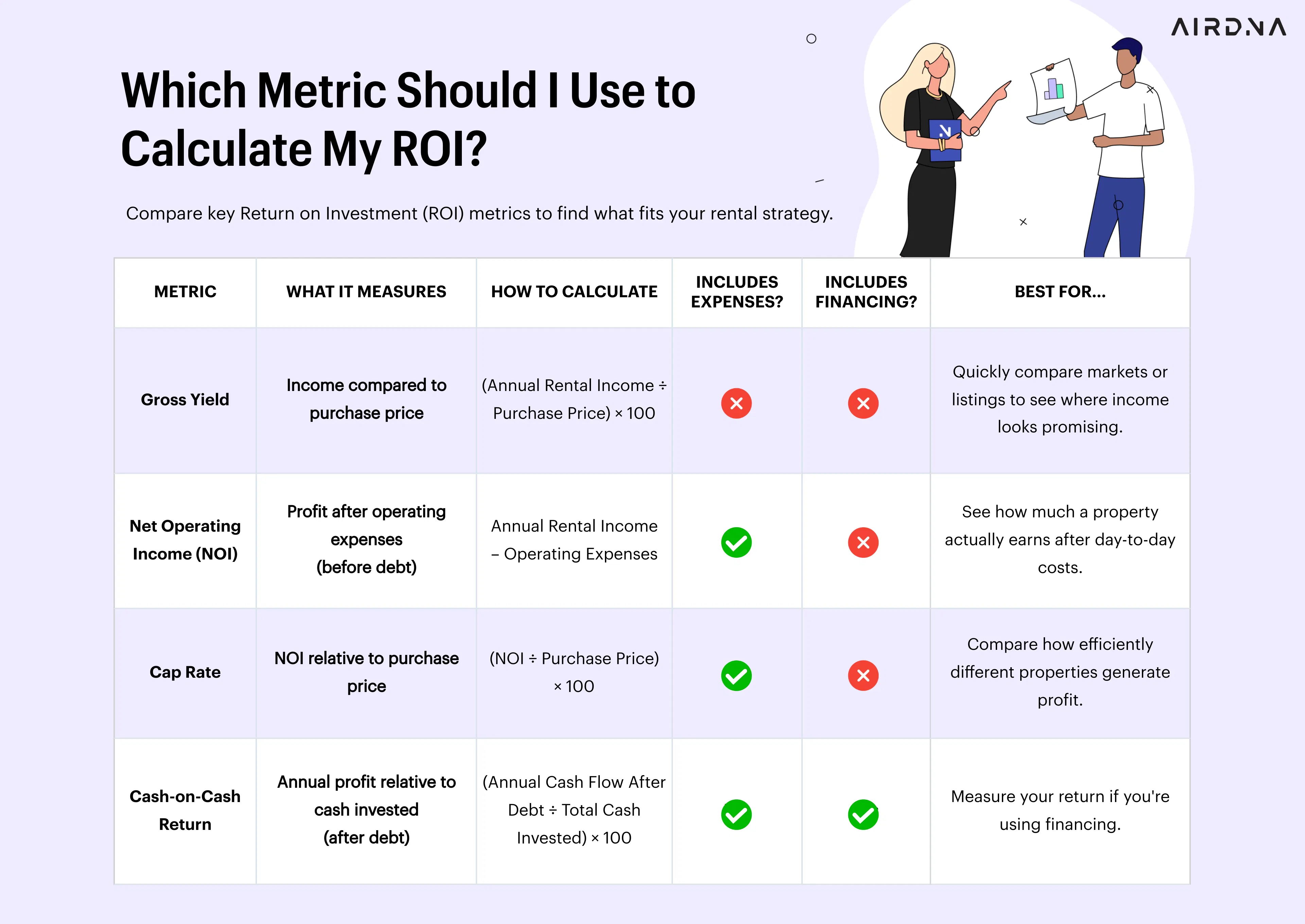
There’s no single number that tells you everything about a property’s return and that’s actually a good thing. Each ROI metric gives you a different piece of the puzzle. Some help you quickly compare deals across markets, while others help you understand how profitable a property really is once you factor in costs or financing.
Whether you’re still browsing listings or breaking down a potential deal, this chart shows how each metric works, what it tells you, and how to calculate it, so you can use the right one at the right time.
How to Improve Vacation Rental ROI
ROI isn’t a one-and-done number. It’s something you can actively improve. Even if you bought in a great market and started with strong numbers, how you manage your short-term rental day to day can have just as much impact on your return.
Whether you’re launching your first listing or fine-tuning one you already own, here are a few simple, practical ways to improve your short-term rental ROI with data-driven STR investing.
Increase revenue
Use pricing tools
Pricing your listing the same every night leaves money on the table. Tools like AirDNA’s Pricing Tool help you set competitive prices based on demand, seasonality, and local events — so you’re not undercharging on busy weekends or holidays.
Improve your listing quality
High-quality photos, clear titles and descriptions, and well-highlighted amenities help attract more guests and justify higher rates. Even something simple like updating your photo captions or adding a list of features can improve conversions.
Encourage longer stays
Offering weekly or monthly discounts can help reduce calendar gaps and cleaning costs. Longer stays mean fewer turnovers and more predictable income, which is especially useful during slower seasons.
Reduce operating costs
Automate routine tasks
Platforms like Uplisting let you automate guest messaging, calendar syncing, and even cleaner scheduling. This reduces time spent on admin and helps prevent booking errors or communication gaps.
Shop around for services
Compare insurance, utilities, and recurring service contracts annually. Switching providers or negotiating better rates can lead to consistent savings that add up over time.
Schedule preventative maintenance
Instead of waiting for something to break, plan regular maintenance routines for HVAC systems, appliances, and plumbing. Preventing big-ticket repairs helps protect your ROI and avoid mid-stay disruptions.
Improve occupancy
Adjust your minimum stay requirements
Lowering minimum night requirements mid-week or during slow periods can help fill calendar gaps. Even one-night bookings can add up and improve your listing’s visibility on platforms.
Use calendar optimization tools
Many PMS platforms and pricing tools offer insights into how adjusting your calendar (like opening orphan nights) could drive more bookings. These small changes can lead to more consistent occupancy.
Keep an eye on your comp set
Monitoring nearby listings — their rates, availability, and performance — helps you stay competitive. AirDNA’s MarketMinder tools let you track comps over time so you can adjust based on real data.
Focus on guest experience
Five-star reviews lead to higher rankings and more bookings. Thoughtful amenities, fast communication, and smooth check-ins make a big difference and often justify higher nightly rates.

FAQs
What ROI should I expect on a short-term rental property?
A good ROI on a short-term rental starts at 10% gross yield. That means you’re earning back 10% of the property’s value every year. In top-performing markets or a great operations strategy, a yield of 12–15% or higher is absolutely achievable. What’s “good” depends on your strategy: steady income or aggressive cash flow? Pick your lane.
What is a good cap rate for short-term rentals?
A cap rate between 6% and 8% is considered strong for short-term rentals, though it can vary by market. Higher cap rates may signal better vacation rental income potential, but could also come with more risk or variability. Use cap rate to evaluate how efficiently a property earns income, regardless of how it’s financed.
What is a good cash-on-cash return for short-term rentals?
A cash-on-cash return of 8–12% is generally considered solid, while 15% or higher is often viewed as excellent — especially if you’re using financing. This metric looks at how much profit you're making on your actual invested cash, so it gives a clear view of how hard your money is working.
How can I increase my ROI on a vacation rental property?
You can improve your ROI by earning more and spending less. Even small changes can make a big difference. Use a pricing tool to adjust your rates based on demand, write a listing that attracts bookings, and encourage longer stays to reduce turnover. On the operations side, automate guest messaging and check-ins, keep a close eye on expenses, and stay ahead of maintenance to avoid costly surprises. The more efficiently you run your rental, the more you keep in your pocket.
Should I hire a property manager or self-manage to maximize ROI?
Hire a property manager to maximize ROI if you value time, want higher occupancy, and prefer outsourcing tasks. Self-manage if you have the skills, time, and desire to cut costs. Beginners can self-manage to learn, then delegate as the workload grows. Your time’s value often offsets a slightly lower ROI.
ARTICLE SUMMARY
Not all returns are created equal. Learn what a good short-term rental ROI really looks like, how to measure it, and what factors shape the return that’s right for you.
Bram Gallagher
AirDNA Director of Economics and Forecasting
Bram Gallagher is an Economist at AirDNA, specializing in uncovering insights that drive smarter short-term rental decisions. He put his Ph.D. in Economics from the University of Georgia to work researching and forecasting hotel data with CBRE prior to joining AirDNA, as well as teaching economics at a number of universities. In his spare time, Bram enjoys making wooden furniture with hand tools.