


The Q2 2026 Earnings Brief: What Airbnb, Vrbo, and Booking.com Signal for Your Business
Published: August 13, 2026
Last updated: October 22, 2026

Jamie Lane

Key Takeaways:
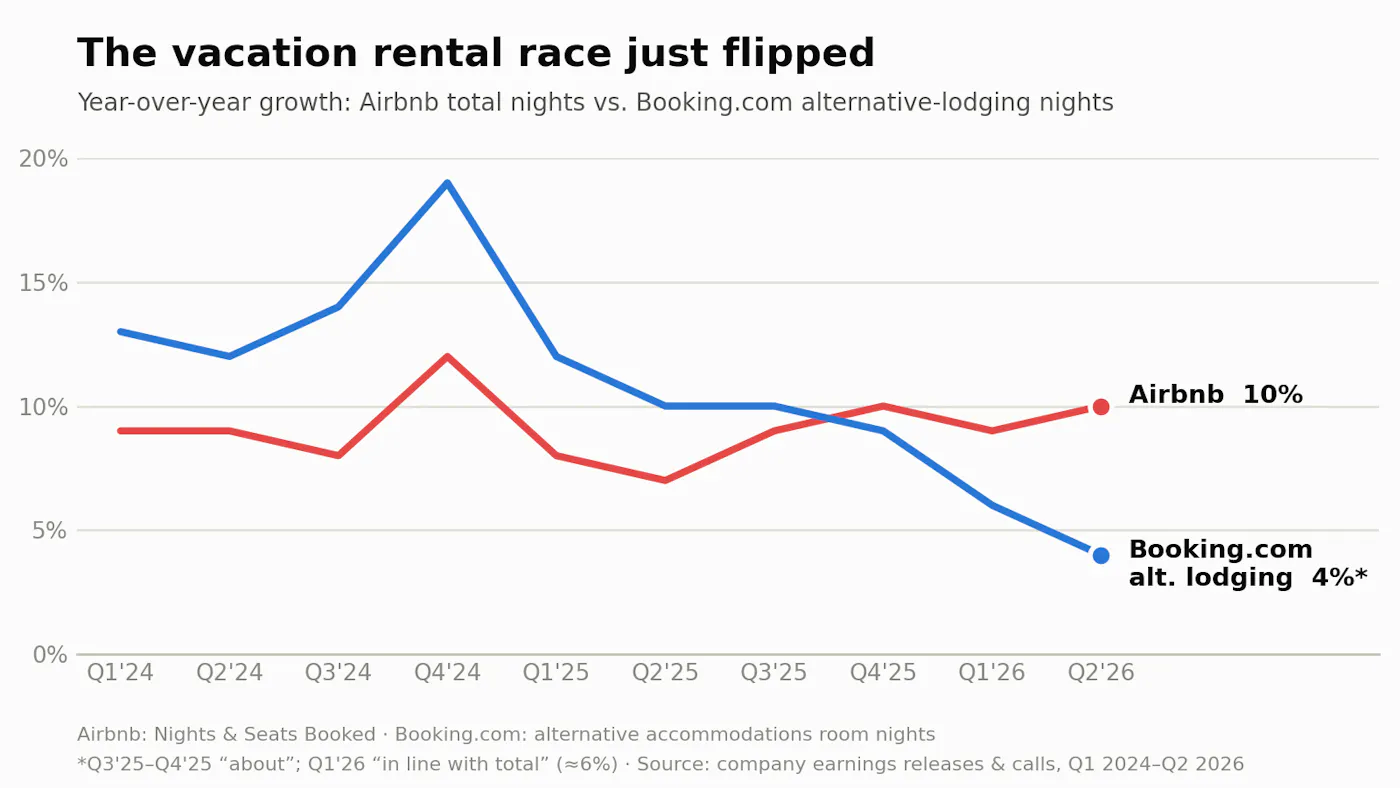
- Airbnb grew booked nights at nearly double the rate of Booking.com, with revenue up 17% to $3.6 billion.
- First-time bookers on Airbnb grew 11%, the fastest pace in four years, suggesting the pool of short-term rental travelers is expanding rather than just shifting.
- Airbnb is replacing its split 3% host / 15% guest fee with a single 15.5% host-only fee, with deadlines of September 15 and October 13, 2026.
- Hosts who leave nightly rates unchanged through that switch will see net payouts drop by around 13%.
- Supplier-funded promotions reached over 40% of Vrbo bookings in Q2, up from 33% in Q1, and Vrbo Sponsored Listings launched on August 6.
- Booking.com's alternative accommodations grew just 4%, and its CEO said the platform wants more U.S. home supply.
Three major platforms that dictate how travelers find your listing just reported Q2 earnings: Booking Holdings (August 4), Expedia Group (August 5), and Airbnb (August 6). While these calls were hosted for investors, the subject was the host.
Here is what mattered, and what to do about it.
1. Demand Is Reaccelerating, and Airbnb Is Winning the Volume Race
Airbnb grew booked nights at nearly double the rate of Booking.com, accelerating its momentum from Q1. Key metrics reflect this strength: revenue rose 17% to $3.6 billion, and gross booking value (GBV) climbed 16% to $27.2 billion. Crucially, first-time bookers grew 11%, the fastest pace in four years, driven by Gen Z. This suggests Airbnb isn't just shifting market share; it's expanding the total pool of short-term rental (STR) travelers.
Geographical trends were consistent across all platforms. U.S. demand remains the global leader, whereas Europe appears to be softening on macroeconomic headwinds and reduced outbound air capacity. Booking.com also noted a two-percentage-point growth headwind resulting from regional conflict in the Middle East.
The takeaway: If your bookings are flat in a U.S. market, it isn't a platform issue. The demand is there, but competition for it has intensified.
2. Mandatory Fee Overhauls: Your September Deadline
This is the most urgent update for hosts. CFO Ellie Mertz confirmed that Airbnb's entire supply base will transition to a single-fee structure by year-end. While described as "payout-neutral," the implementation requires host action.
Airbnb is consolidating the legacy split fee (3% host / 15% guest) into a single 15.5% host-only fee. Guests will no longer see a service fee at checkout, making the total price easier to read. While the 15.5% reflects the global average of both old fees, the impact on individual payouts depends on your pricing strategy.
The math matters here. If you do not adjust your nightly rates upward, your net payout will drop by around 13%. Keeping a $100 rate under the new system results in an $84.50 payout rather than the previous $97.
Deadlines are close: September 15, 2026, for hosts outside the European Economic Area (EEA), and October 13, 2026, for those in the EEA or Switzerland. Airbnb has provided a bulk-adjustment tool to assist. The new fee applies only to new reservations made after the switch.
Airbnb has been open about the intent. Mertz noted that the single fee applies "downward pressure on pricing," while CEO Brian Chesky said it corrects "mispricing" by property managers. A cleaner checkout price is meant to lower the barrier for guests. Whether it also lowers your payout depends on whether you reprice first.
3. AI and the "Pricing Lever"
Chesky identified pricing as "the single biggest lever" for host success. A new AI-driven pricing model is rolling out, using hotel benchmarks, local events, and real-time booking lead times to suggest rates.
We agree with the diagnosis. It is why we built AirDNA Adapt. Pricing is the highest-leverage decision most hosts make, it is the one most hosts revisit least often, and lead time plus events are exactly the signals that separate a full calendar from a profitable one.
4. The Hotel Flywheel: How Inventory Expansion Aids Hosts
Airbnb is expanding hotel inventory quickly, but not to compete with you. Instead, it is using hotels to capture "top-of-funnel" demand that eventually converts to home bookings. The logic is as follows:
- Airbnb adds hotel inventory, initially in cities where homes are scarce or regulated, now everywhere. Chesky: "We are absolutely going to be stepping on the gas given the reception, and we are focused not just on supply-constrained markets, but all markets."
- A traveler who would never have opened Airbnb for a one-night city trip now does, because the right product is finally there. Airbnb acquires that user on a hotel booking.
- That user comes back for the trip where a home wins: the family reunion, the group ski week, the two-week stay where a kitchen and four bedrooms beat four hotel rooms. Airbnb says 35% of first-time hotel guests later book a home.
- More travelers at the top of the funnel means more demand pointed at your listing on the trips where homes are the better product.
5. Vrbo: Growth Is Increasingly "Supplier-Funded"
Expedia reported a significant shift: supplier-funded promotions accounted for over 40% of Vrbo bookings in Q2, up from 33% in Q1. This indicates that Vrbo's growth is increasingly reliant on host-funded discounts rather than platform-led marketing.
"Supplier-funded" means the discount comes out of your rate, not Expedia's marketing budget. That is a jump of seven percentage points in one quarter in the share of Vrbo bookings that carry a host-funded discount.
Note also that Expedia did not break out Vrbo's performance this quarter, having specifically called it out as a standout in Q1. Group room nights grew 6% and the consumer segment that contains Vrbo grew bookings 8%, so Vrbo's own night growth was likely in the low single digits.
What it means for you: check which Vrbo promotions you are enrolled in and what they cost. Growth you paid for is not the same as demand you earned. If your Vrbo bookings held up this year, work out how much of that was a discount you funded.
6. Paid Search Arrives on Vrbo
On the August 5 call, Expedia described extending its advertising platform to Vrbo as still early. It went live to hosts the following afternoon.
Vrbo Sponsored Listings launched on August 6, 2026. This is a "pay-on-booking" model, where hosts pay an additional commission only when an ad leads to a completed reservation. How it works:
- You pay only when a guest books. Not per click, not per impression. No booking, no spend.
- Your ad appears only when your listing matches the traveler's search criteria.
- Campaigns launch in minutes and can be adjusted anytime, positioned as a way to fill calendar gaps.
Pay-on-booking is better for hosts than pay-per-click, which can burn a budget on browsers who never convert. But be clear about what this is: a commission charged on top of the commission you already pay. The launch materials do not state the rate, and that single number decides whether this is worth doing. Get it before you launch anything.
What it means for you: this is the second host-funded growth lever Vrbo has added in two quarters, sitting alongside supplier-funded promotions going from roughly a third to over 40% of bookings. Organic visibility is now partly purchasable, which also means it is partly purchasable away from you. If you run a portfolio, test it on a subset of listings with a real measurement plan and track incremental bookings against a held-back control, not total bookings. If you have one listing, understand that the top of the page is now inventory Vrbo sells.
7. The Booking.com Supply Gap
Booking.com's alternative accommodations grew just 4%. CEO Glenn Fogel explicitly stated a desire for more U.S. home supply. This creates an opportunity for U.S. hosts to expand their distribution. However, be mindful that the platform's "Genius" loyalty tiers, which require host-funded discounts, drive the majority of its volume.
That is the largest lodging platform in the world saying out loud that it is short of U.S. home supply. If you are not distributing there, you have more leverage than you did a year ago.
One thing to know before you list: Booking's Genius tiers 2 and 3 are just over 30% of active customers but drive a high-50s percentage of room nights. On Booking.com, the discounted loyalty tiers are where the volume is, so model the Genius discount as a cost of entry rather than an optional extra.
8. AI Search: Optimization Over Panic
The three companies disagree, which is the useful part.
- Booking.com: traffic referred from AI assistants is "significantly below 1%" of room nights and has barely moved.
- Expedia: answer engine optimization (AEO) is one of its fastest-growing channels.
- Airbnb: started testing AI-powered search this month on a small slice of traffic, as an optional toggle, with classic search still the default.
AI isn't a primary booking driver yet, but natural-language search is coming. Optimize your listings now by using specific, use-case language (for example, "sleeps 10 with two chef's kitchens") rather than keyword stuffing. This appeals to both algorithms and human decision-making.
Two Smaller Things Worth Knowing
- Reserve Now, Pay Later is now over 20% of Airbnb bookings, and Mertz acknowledged it comes with "a very elevated level of cancellations." Expect more cancellations mechanically, further out from arrival. Do not read it as a demand signal, and do not stop marketing a date just because it looks booked.
- The 2026 FIFA World Cup showed up in rates, not volume. Expedia said the tournament's impact was "relatively modest" and appeared more in average daily rates (ADR) than room nights. That matches what we see in host-market supply: a lot of inventory arrived for the event, and much of it will not stay.
The Bottom Line
Overall demand remains resilient, but the cost of capturing that demand is shifting. Successful hosts in the second half of 2026 will be those who reprice deliberately as fee structures change, audit their promotional costs on Vrbo, and use platform tools without letting them dictate their margins.
Airbnb is growing nights twice as fast as Booking.com, adding new travelers rather than recycling old ones, and is about to change the fee mechanics for every host on the platform while shipping a pricing tool built around hotel rates, events, and lead time. Vrbo is holding its growth together with discounts that hosts fund, and is about to start selling placement. Booking.com is behind in the U.S. homes category and has said so publicly.
The hosts who do well over the next two quarters will be the ones who reprice deliberately when their Airbnb fee structure flips, audit what their Vrbo promotions actually cost them, and treat platform pricing advice as an input rather than an answer.
Frequently Asked Questions
When does Airbnb's new single-fee structure take effect?
Hosts outside the European Economic Area switch on September 15, 2026. Hosts in the EEA or Switzerland switch on October 13, 2026. Airbnb's full supply base is scheduled to be on the single fee by year-end, and the new fee applies only to reservations made after the switch.
What is Airbnb's new host fee?
A single 15.5% host-only fee replaces the legacy split of 3% from the host and 15% from the guest. Guests will no longer see a separate service fee at checkout.
Do hosts need to raise nightly rates when the fee changes?
Hosts who want to hold their current net payout do. Leaving rates unchanged reduces net payout by around 13%: a $100 nightly rate pays out $84.50 under the new structure, compared with $97 before. Airbnb has provided a bulk-adjustment tool for the change.
What are supplier-funded promotions on Vrbo?
Discounts funded out of the host's rate rather than Expedia's marketing budget. They accounted for over 40% of Vrbo bookings in Q2 2026, up from 33% in Q1.
How do Vrbo Sponsored Listings charge hosts?
On a pay-on-booking basis. Hosts pay an additional commission only when an ad produces a completed reservation, on top of the commission they already pay. Expedia did not publish the rate at the August 6, 2026 launch.
Is AI search driving bookings yet?
Not materially. Booking.com reported that AI-assistant referral traffic is "significantly below 1%" of room nights. Expedia describes answer engine optimization as one of its fastest-growing channels, and Airbnb is testing AI-powered search on a small share of traffic as an optional toggle.
ARTICLE SUMMARY
Booking Holdings, Expedia Group, and Airbnb reported second-quarter 2026 results in the first week of August. Demand is reaccelerating and Airbnb is growing booked nights at nearly double Booking.com's rate, but the cost of capturing that demand is shifting onto hosts. Airbnb is moving every listing to a single 15.5% host-only fee with deadlines in September and October, Vrbo is funding more of its growth through host-paid promotions and a new sponsored-listings product, and Booking.com's volume still runs through discounted loyalty tiers. Here is what each platform reported and what hosts should do about it.
Jamie Lane
AirDNA Chief Economist
He is responsible for data analysis, thought leadership, and leveraging advanced analytical techniques to provide new insights into short-term rental market trends. Native to Atlanta and an Airbnb host himself, Jamie enjoys cycling, mountain biking, backpacking, running, and playing in a dart league in his free time.
Related



Get started with AirDNA today.
Powerful, easy-to-use tools that help hosts and investors succeed in the short-term rental market.
Try for free