Airbnb Host Costs: 4 Expenses Every Host Should Know
Published: December 18, 2024
Last updated: September 25, 2026

Bram Gallagher
Key Takeaways
- Service fees, property management, cleaning and insurance typically consume 25-40% of your revenue.
- Higher-earning properties often face proportionally higher costs.
- While upfront costs might seem daunting, proper planning and the right investments in your business can help protect your profits.
That Instagram-worthy mountain cabin earning $500 a night might look like a gold mine, but successful hosts know it's more complicated than that. Behind every profitable Airbnb is a thorough understanding of the short-term rental expenses that impact your bottom line.
Understanding these costs upfront puts you ahead of the competition and helps you build a sustainable hosting business.
In this guide, we'll break down the four biggest expenses you'll face as an Airbnb host, with real numbers and industry insights. We'll show you what these costs actually look like using real properties we found for sale on AirDNA.
You’ll walk away with the tools you need to estimate hosting costs for a potential investment, or to manage costs and protect the profits of an existing short-term rental (STR).
1. Airbnb Service Fees
Most Airbnb hosts pay a simple 3% service fee on their bookings (but there are some exceptions, according to Airbnb).
This fee is calculated from your booking subtotal—which includes your nightly rate, cleaning fees, and any extra guest charges you add. Airbnb automatically deducts the fee from your payout.
There's more to the story, though—Airbnb actually offers two ways to handle fees:
The most common approach is the split-fee structure. Here, you pay 3% of the booking subtotal, while guest service fees are up to 14.2%. Since it's calculated from the same subtotal, your fees rise and fall with your rates and any extra charges you include.
Alternatively, you can choose the host-only structure. With this option, you'll pay a higher fee of 14-16% of the booking subtotal, but your guests pay nothing. This approach is popular with professional managers since listings can appear more attractive to guests who see lower total prices.
Most hosts stick with the standard 3% split-fee option, but the choice is yours. Whichever structure you choose, build these fees into your pricing strategy from the start. Factor them into your minimum viable rates and consider them when setting cleaning fees or other additional charges.

Estimating Your Host Service Fees
You can estimate your Airbnb host fees—or Vrbo fees or Booking.com costs if you’re listed on those platforms, too—using your estimated booked nights and average length of stay.
Start by estimating the occupancy rate that you expect for your property.
- If you’re already hosting, analyze your historical occupancy rate using Airbnb data or tools like AirDNA’s Performance Dashboard.
- For a new property, use AirDNA’s Revenue Calculator to project occupancy rates and nightly rates based on market demand in your location.
You can then estimate your booked nights by multiplying the occupancy rate by the number of available nights per year. If you’re considering a highly seasonal beach house, for instance, your number of available nights might by the 90-days high summer season window.
Example: 0.60 (60% occupancy rate) x 90 = 54 nights
Estimate your booking subtotal by multiplying your nightly rate by the total booked nights. This will give you estimated earnings for the year.
Booking subtotal = $200 nightly rate x 54 booked nights = $10,800.
Don’t forget that cleaning and any additional fees you charge your guests contribute to your earnings, too. Typically, cleaning fees get charged per stay rather than per night, so your earnings from guest fees can vary based on your average length of stay. You’ll need to divide your total booked nights by your average length of stay to estimate the number of reservations.
For example, with 54 booked nights and an average reservation of 6 days, that’s 9 stays. If your cleaning fee is $100 per stay, the total cleaning fee would be $900 (9 stays x $100 cleaning fee).
Once you combine your booking subtotal with your cleaning fees, you’re ready to calculate your service fee.
Using the earlier example, the total subtotal would be $11,700 ($10,800 booking subtotal + $900 in cleaning fees). Multiplied by your fee structure, that’s :
- Split-Fee (3%): $11,700 × 0.03 = $351.
- Host-Only Fee (14-16%): $11,700 × 0.14 = $1,638.
2. Property Management Fees
Running a successful Airbnb takes time—lots of it. Let's do the math: managing guest communication, coordinating cleanings, handling maintenance issues, optimizing pricing, and keeping your calendar up to date can easily consume 10-15 hours per week per property. That's why many hosts turn to property managers or management software to handle these tasks.
Full-service property management
Professional property managers typically charge between 20-30% of your booking revenue, though fees can range from 15-40% depending on your market.
Several factors come into play that can significantly influence pricing.
- Location (urban markets often command lower fees than vacation destinations)
- Property type (luxury properties typically require more hands-on management)
- Service level (from basic booking management to full-service concierge)
- Booking volume (higher occupancy means more turnover work)
Let's break that down: if your property generates $3,000 in monthly revenue, you might pay $600-$900 in management fees at the average rate.
At first glance, this Airbnb management fee might seem high. Consider the trade-off, though—if you value your time at $50 per hour, those 10-15 weekly hours of self-management would cost you $2,000-$3,000 monthly.
Of course, there’s a whole lot more to consider before hiring a property manager and taking on that cost. That’s why we’ve put together 7 signs it’s time to consider hiring a property manager.
We’re also here to help you find one. Check out AirDNA’s interactive dashboard to find the best Airbnb management companies in your market, complete with performance data and reviews.
Property management software
Not ready for full-service management? A property management system (PMS) can transform how you run your Airbnb while keeping you in control. A PMS like Uplisting helps automate the most time-consuming aspects of hosting:
- Guest communication: Automated messaging for bookings, check-ins, and reviews
- Channel management: Sync your calendar and rates across multiple booking platforms
- Operations: Schedule cleanings, track maintenance, and manage team tasks
- Financial tools: Track revenue, expenses, and generate owner statements
- Dynamic pricing: Optimize your nightly rates based on market demand and how much your competitors are charging.

3. Airbnb Cleaning Costs
Cleaning fees can make up a significant portion of your Airbnb host costs, but they're also crucial for maintaining high ratings and securing repeat bookings. Understanding Airbnb cleaning company costs helps you price your cleaning fees appropriately and maintain your Airbnb profitability.
Your Airbnb cleaning service costs will vary based on several factors:
- Property size and layout (studios may average $75-100, while large homes can exceed $300)
- Location and local labor rates
- Level of service required (basic cleaning vs. full turnover)
- Furnishing complexity (more amenities mean more cleaning time)
- Seasonal conditions (mud, sand, or snow can increase cleaning needs)
House cleaning estimate calculators like Jobbers can help you budget accurately for your specific situation. You can also get custom quotes from trusted cleaners, which can help you understand the local market rates for vacation rental turnover cleaning. Local facebook groups that serve short-term rental hosts in your area are great forums for soliciting recommendations. Turno has also broken out average cleaning costs by state, as a starting point for estimating the average Airbnb cleaning cost.
While it might be tempting to cut corners on house cleaning services to reduce your Airbnb host cost breakdown, remember that cleanliness directly impacts your reviews and booking success. Consider building these costs into your nightly rates or charging them separately based on your market's norms.

4. Short-Term Rental Insurance
Insurance is a crucial investment in your business's longevity. Let's break down the cost of Airbnb insurance and what you're really paying for.
How insurance rates are determined
Short-term rental insurance rates start with your property's zip code—each area has a base rate determined by actuarial claims data. From there, your premium is calculated based on four main components:
- Building coverage (the structure itself)
- Contents coverage (your furnishings and amenities)
- Income coverage (your rental revenue)
- Liability protection
Your final Airbnb insurance cost then adjusts based on risk factors specific to your property:
- Proximity to emergency services
- Construction type (reinforced concrete vs. wood frame)
- Age of the home
- Fire suppression systems
- High-risk amenities (pools, hot tubs, bunk beds)
Here's where it gets interesting: amenities and property features affect both your revenue potential and risk profile. For instance, a hot tub might boost your RevPAR by 33% while only modestly increasing your Airbnb host insurance cost. Pet-friendly policies can boost occupancy but will likely require additional host liability insurance due to potential incidents. Even your property's location plays a dual role—prime tourist areas often command higher rates but might have higher insurance premiums due to increased risk factors.
The key is approaching these decisions strategically. Every revenue-enhancing choice comes with an insurance consideration, but that shouldn't automatically deter you. Instead, weigh the complete picture: Will the extra revenue from that hot tub or pet policy outweigh the increased insurance costs? Is a property's location worth higher premiums given its earning potential? These calculated decisions help maximize your profit while protecting your investment.
Your insurance options
According to Nick Massey at Proper Insurance, one of the leading STR insurance providers, there's a crucial difference in how standard home insurance and STR-specific policies work. Traditional homeowners insurance primarily underwrites you as an individual, while STR-specific insurance underwrites the property itself—a distinction that becomes particularly important when filing claims.
Let's look at the numbers: The average residential insurance policy costs about $2,800 annually, while STR-specific insurance averages $3,900. That higher premium might give you pause, but Massey's data shows why it matters: STR properties typically face claims every 5 years, compared to every 9-10 years for residential properties.
Here's a real-world example: Consider a typical water damage claim of $50,000. With standard residential or landlord coverage, you might get reimbursed only for fair market rental value—around $2,600 monthly for a standard three-bedroom home.
If your property earns $5,000-6,000 monthly through short-term rentals, though, that's a significant gap. STR-specific insurance covers both property damage and your actual lost revenue. A $50,000 damage claim plus $15-20,000 in lost income could result in a $70,000 payout. While the annual premium is higher, you're likely to recoup that investment through just one claim, making it a smart business decision for serious hosts.
This is where having reliable data on your property's earning potential becomes crucial—insurance companies use tools like AirDNA's revenue data to verify your actual income and calculate appropriate coverage levels.
Ready to dig even deeper into the world of STR insurance? Our complete guide to short-term rental insurance walks you through everything you need to know about protecting your hosting business.

Sample Airbnb Host Costs Calculations
Let's break down the expected costs for three real properties, using data from our For-Sale database to give you a realistic picture. We've partnered with Proper Insurance for detailed insurance quotes.
These calculations can help you:
- Compare operating costs across different property types
- Understand how expenses scale with revenue
- Set realistic profit expectations
- Make informed decisions about property features and amenities
Entry-level condo
1606 Vicksburg Place, Atlanta GA 30350
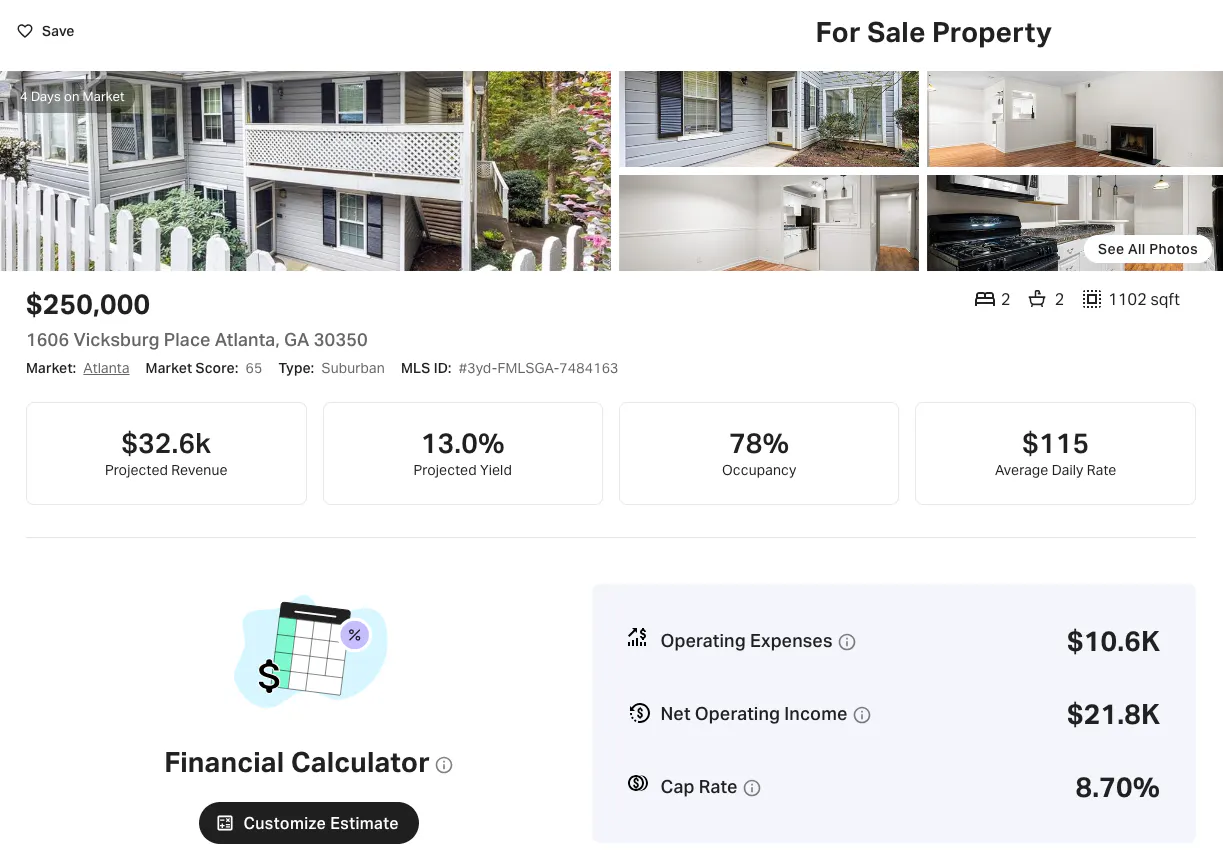
- Projected Annual Revenue (AirDNA): $32,600
- Host fees (3% Airbnb split-fee model): $978
- Insurance (Proper Insurance quote): $1,508
- Property Management (estimated at 20% of revenue): $6,520
- Cleaning Fees (based on market averages for 2-bed condo): $2,800
- Total Major Expenses: $11,806
- Net Before Additional Costs: $20,794
Mid-range single-family home
7180 Pharr Mill Rd, Harrisburg NC 28075
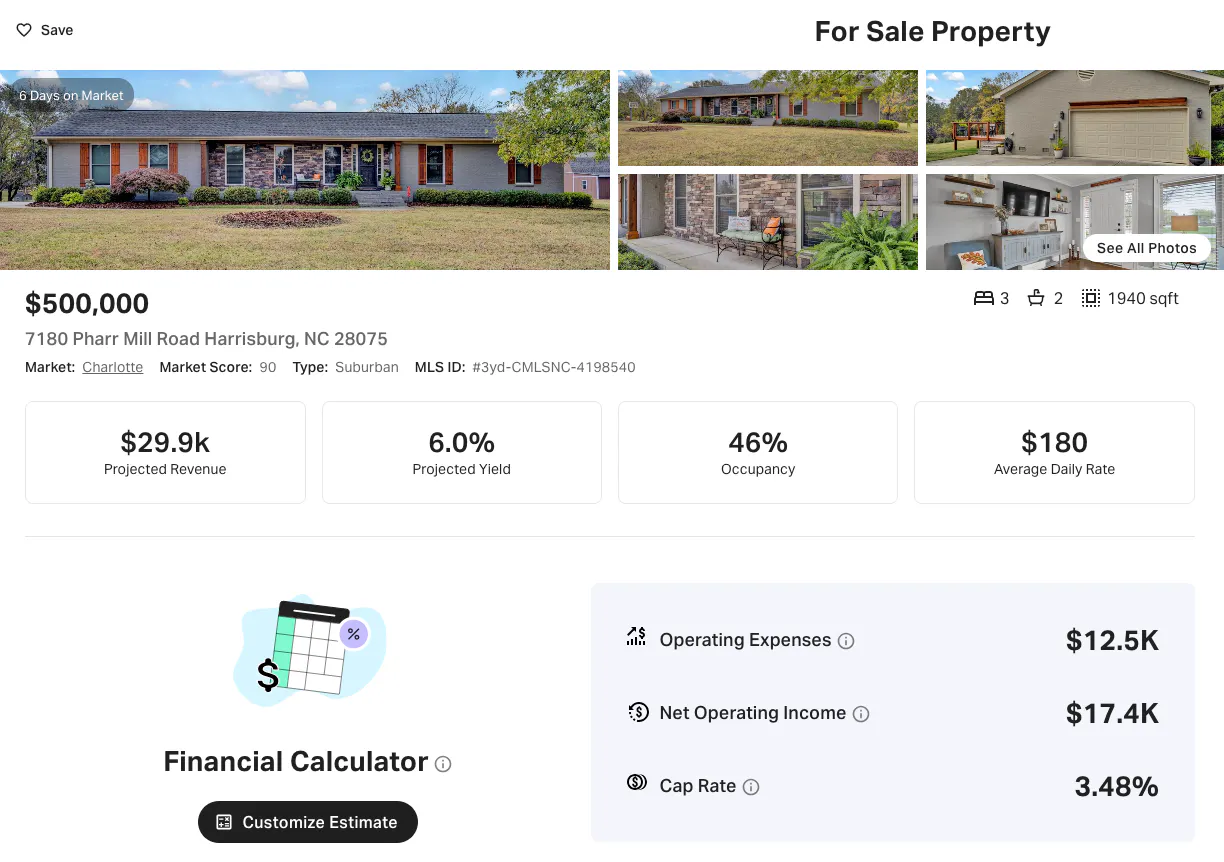
- Projected Annual Revenue (AirDNA): $29,900
- Host fees (3% Airbnb split-fee model): $897
- Insurance (Proper Insurance quote): $2,858
- Property Management (estimated at 20% of revenue): $6,000
- Cleaning Fees (based on market averages for 3-bed home): $3,600
- Total Major Expenses: $13,355
- Net Before Additional Costs: $16,545
Luxury mountain property
78 East Villa Lane, Stowe VT 05672
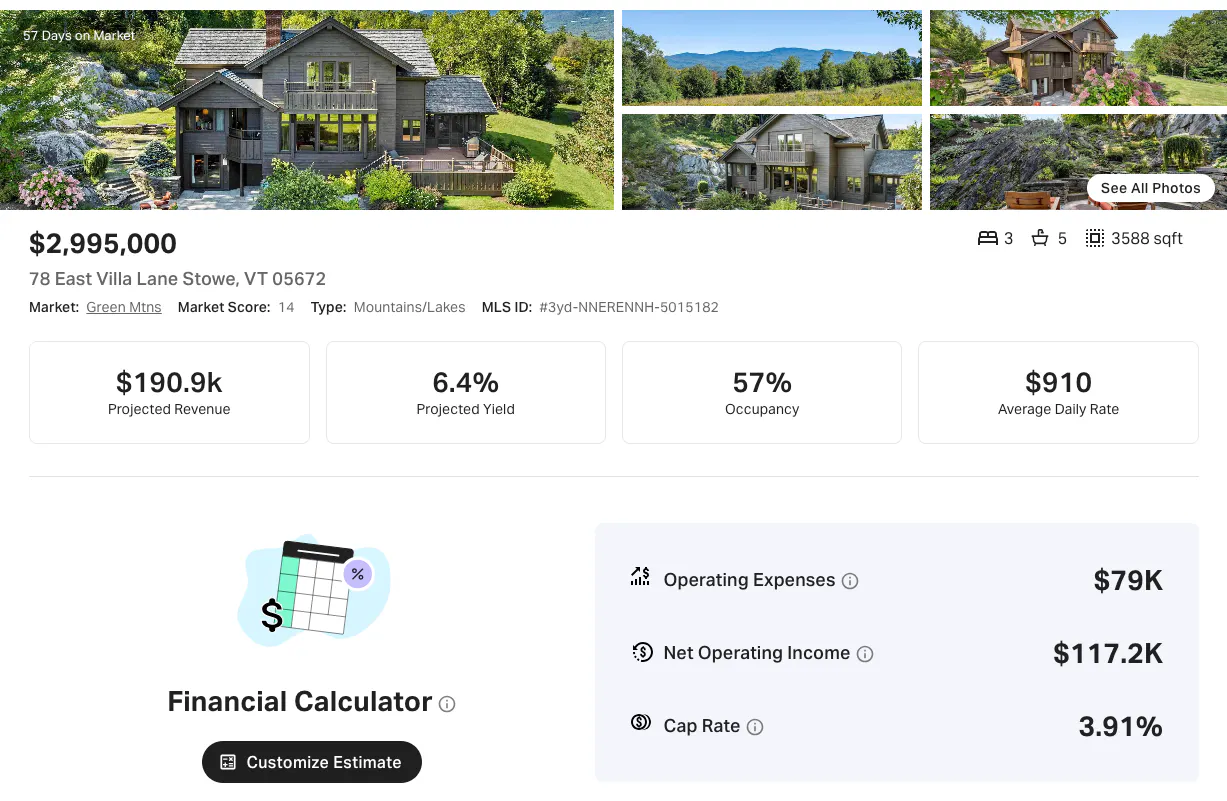
- Projected Annual Revenue (AirDNA): $190,900
- Host fees (3% Airbnb split-fee model): $5,700
- Insurance (Proper Insurance quote): $15,721
- Property Management (estimated at 25% of revenue to reflect the luxury market): $47,750
- Cleaning Fees (based on luxury property standards): $8,400
- Total Major Expenses: $77,571
- Net Before Additional Costs: $113,329
What These Numbers Tell Us
Looking at these examples, some key insights emerge:
- Insurance costs scale with property value and amenities—notice how the luxury property's higher revenue potential comes with proportionally higher insurance costs.
- Property management fees typically increase for luxury properties due to higher service expectations.
- Cleaning costs vary significantly based on property size and type, impacting your operational decisions.
- The ratio of expenses to revenue can help you determine if a property fits your investment goals.
Remember, these calculations only cover major expenses. You'll need to factor in additional costs like utilities, maintenance, supplies, mortgage payments, and property taxes.
Ready to explore potential investments? You can find For-Sale Properties in AirDNA to discover short-term rental opportunities, with revenue forecasts and detailed cost insights already built in.
Frequently Asked Questions
What are the costs associated with hosting Airbnb?
The main costs include Airbnb's service fees (3% for most hosts), property insurance ($2,800-$3,900+ annually), cleaning services ($75-300+ per turnover), and property management (20-30% of revenue if you use a full-service manager). You'll also need to budget for utilities, supplies, maintenance, and any mortgage payments.
How much does Airbnb cost to host?
Starting an Airbnb business requires minimal upfront platform costs—just the 3% host service fee on bookings. However, your total operating costs will depend on your property type, location, and management approach. AirDNA’s sample calculations above show how these costs can vary from around $10,000 annually for a condo to over $70,000 for a luxury property.
Does it cost money to host an Airbnb Experience?
Yes, Airbnb charges a 20% service fee for experiences. This is higher than property hosting fees because experiences typically have lower price points. You'll also need to cover any materials, supplies, or equipment needed for your experience.
How much does a co-host for Airbnb cost?
Co-hosts typically charge 10-20% of booking revenue, less than full-service property managers because they handle fewer responsibilities. The exact rate depends on their duties—some co-hosts just handle guest communication, while others manage cleaning and maintenance too.
How much do Airbnb cleaners make an hour?
Cleaning rates vary significantly by location and property type. Urban areas might see rates of $25-40 per hour, while luxury properties or remote locations could command $50+ per hour. However, most cleaners charge by the job rather than hourly, with turnover cleaning services ranging from $75 for a studio to $300+ for larger homes.
How much does Airbnb host insurance cost?
The cost of Airbnb host insurance can vary, but on average, short-term rental (STR) insurance costs about $3,900 annually, according to Proper Insurance. Airbnb provides a Host Guarantee that offers up to $1 million in protection for damages caused by guests, but this is not a substitute for traditional homeowners or rental insurance. Many hosts opt for specialized STR insurance to ensure comprehensive coverage, so it’s important to compare various policies and options to find the best protection tailored to your specific needs and property location.
ARTICLE SUMMARY
This guide breaks down the four major expenses that shape your bottom line: service fees, property management, insurance, and cleaning costs. Using real properties from our For-Sale database, we examine how these expenses impact different types of investments.
Bram Gallagher
AirDNA Director of Economics and Forecasting
Bram Gallagher is an Economist at AirDNA, specializing in uncovering insights that drive smarter short-term rental decisions. He put his Ph.D. in Economics from the University of Georgia to work researching and forecasting hotel data with CBRE prior to joining AirDNA, as well as teaching economics at a number of universities. In his spare time, Bram enjoys making wooden furniture with hand tools.