The Day Your Guest Checks In Tells You How Long They’ll Stay: Here’s How to Set Your Minimum Stay Around It
Published: September 15, 2026
Last updated: October 22, 2026

Linda Rollins
The day of the week a guest checks in often determines how long they’ll stay. Understanding that pattern in your market means you can align your minimum stay and calendar rules to how guests are actually booking.
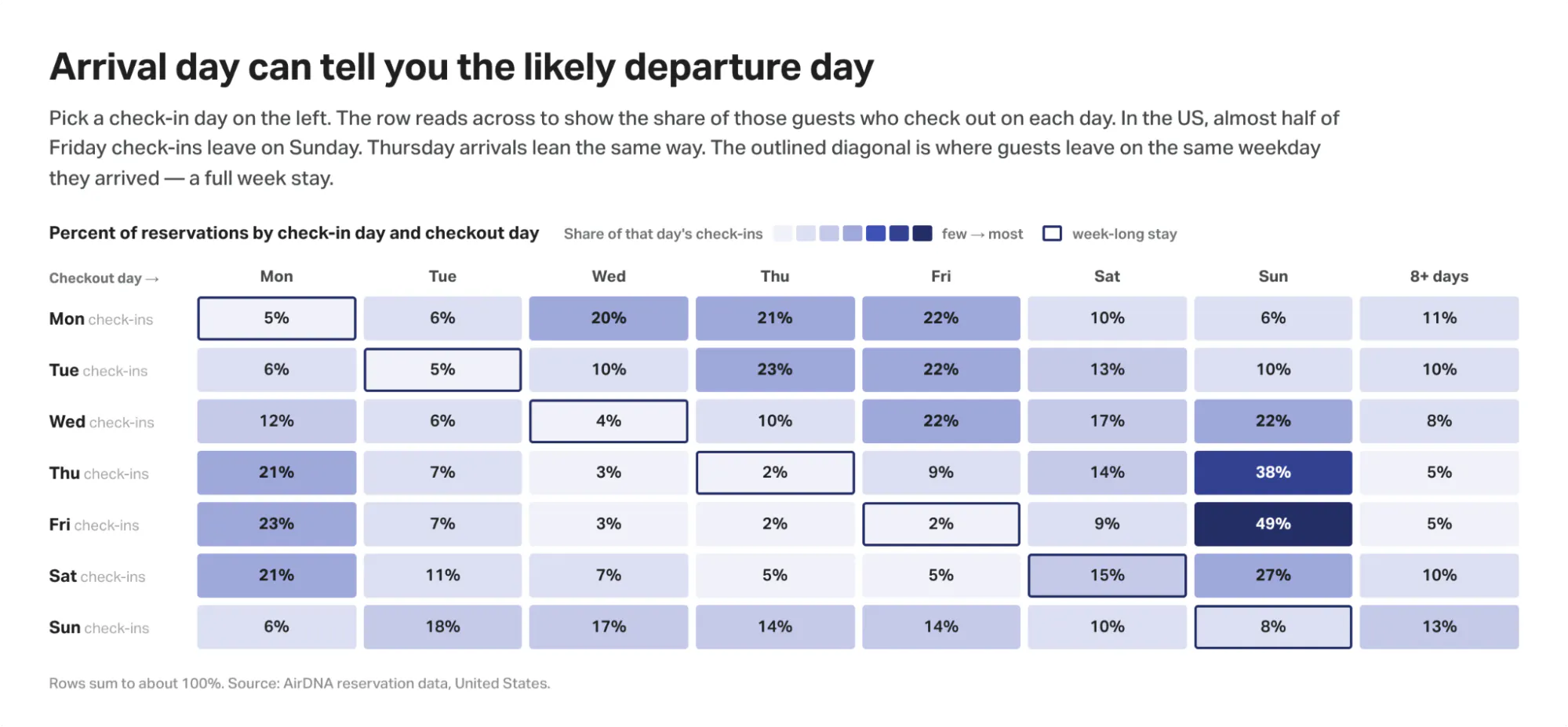
In the U.S., half of all Friday check-ins are two-night stays. Move one day later and the most common booking becomes a single night. Group the length of reservations in the U.S. by check-in date, and every day of the week tells a different story.
- Monday and Tuesday arrivals rarely reach the weekend. 68% of Monday check-ins and 55% of Tuesday check-ins are out by Friday.
- Wednesday is the hinge. About a third of Wednesday arrivals are out by Friday, but four-night stays with checkout on Sunday account for another 22% of stays.
- Thursday is the extended weekend. 38% of Thursday check-ins are three-night stays departing Sunday. Another 21% stay four nights and leave Monday, so roughly 60% of Thursday arrivals run through the weekend.
- Friday is the classic two-night weekend. Half of all Friday check-ins, 49%, are two nights, out on Sunday. Another 23% stay three nights and leave Monday.
- Saturday is the outlier. It’s the only day of the week where one-night stays are the most common length, at 27% of Saturday arrivals, with two-night stays close behind at 21%. It’s also where week-long trips begin: 15% of Saturday check-ins run seven nights. Those two facts describe two different guests, a Saturday-to-Saturday vacation renter booking months out and a last-minute single-night guest filling in calendar gaps.
Many operators run one minimum stay policy across all seven nights. The day-of-week trends above suggest your minimum might need to be different depending on the day. While the national picture is helpful context, check-in day and check-out day shift depending on the season, and they shift differently in every market. In this piece we’ll break down guest check-in and check-out trends for three different markets during peak season and slow season, and the minimum stay takeaways for each.

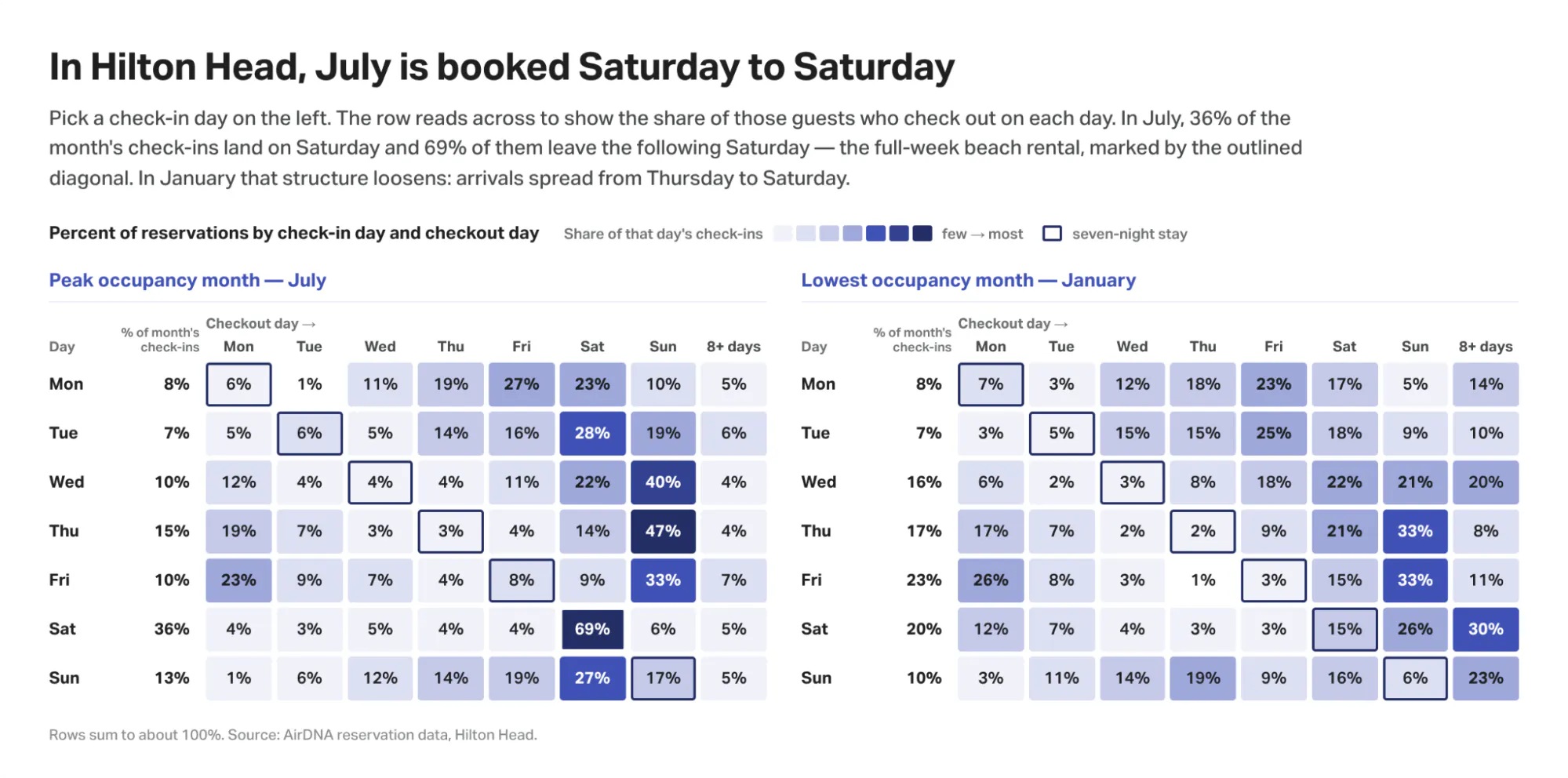
Hilton Head Runs Saturday to Saturday in July, Then Splits in Two by January
Hilton Head is a classic Southeastern beach market. July is its peak occupancy month; January is one of its slowest, with occupancy falling below 40%.
In July, Saturday is by far Hilton Head’s busiest check-in day. More than a third of all reservations in the month start on Saturday, and when guests check in on Saturday, 69% of them stay through the following Saturday. The prevalence of the Saturday-to-Saturday stay is buoyed by heavy demand for week-long stays, and it’s why many operators run a seven-night minimum through this stretch of the year: there’s enough market demand for full weeks that the minimum isn’t turning much away.
Contrast that with January. Where July’s Saturday check-ins are overwhelmingly week-long, January’s Saturday check-ins split between two very different stays: 26% are exactly one night, and another 30% run eight nights or longer. Saturday goes from the starting point of a week-long summer trip to either a short weekend getaway or the day a snowbird arrives for an extended winter stay.
Weekday check-ins have a different pattern. Monday and Tuesday are the least common check-in days in both months: in January and July, only 15% of reservations start on Monday or Tuesday. But when guests do check in early in the week, how long they stay depends entirely on the season. In January, more than half of Tuesday check-ins are out by Friday, compared to roughly a third in July. Wednesday and Thursday check-ins follow a similar seasonal split: about 60% of stays that start on either day extend till Saturday or Sunday in July. In January, only 43% of Wednesday check-ins and 54% of Thursday check-ins will extend till Saturday or Sunday.
The minimum-stay takeaway for Hilton Head. In summer, a seven-night minimum on Saturday check-ins is worth considering, as it will capture demand that’s already booking that way, especially far out in the booking window, since you can always lower it if the week doesn’t fill. For weekday arrivals in the back half of the week, a 3-4 night minimum makes sense in peak season, since Wednesday and Thursday guests are already stretching into the weekend, and a low minimum there just buys you extra turnover costs when the market would have booked a long stay. In January, both of those rules need to relax: a seven-night Saturday minimum doesn’t fit a month where only 15% of Saturday arrivals book exactly a week, and a 3-4 night weekday minimum is too restrictive when most guests aren’t trying to reach the weekend at all. January’s real opportunity is different: with snowbirds driving so much of the market’s long-stay demand, length-of-stay discounts that reward extended winter bookings are worth more here than a tighter minimum.

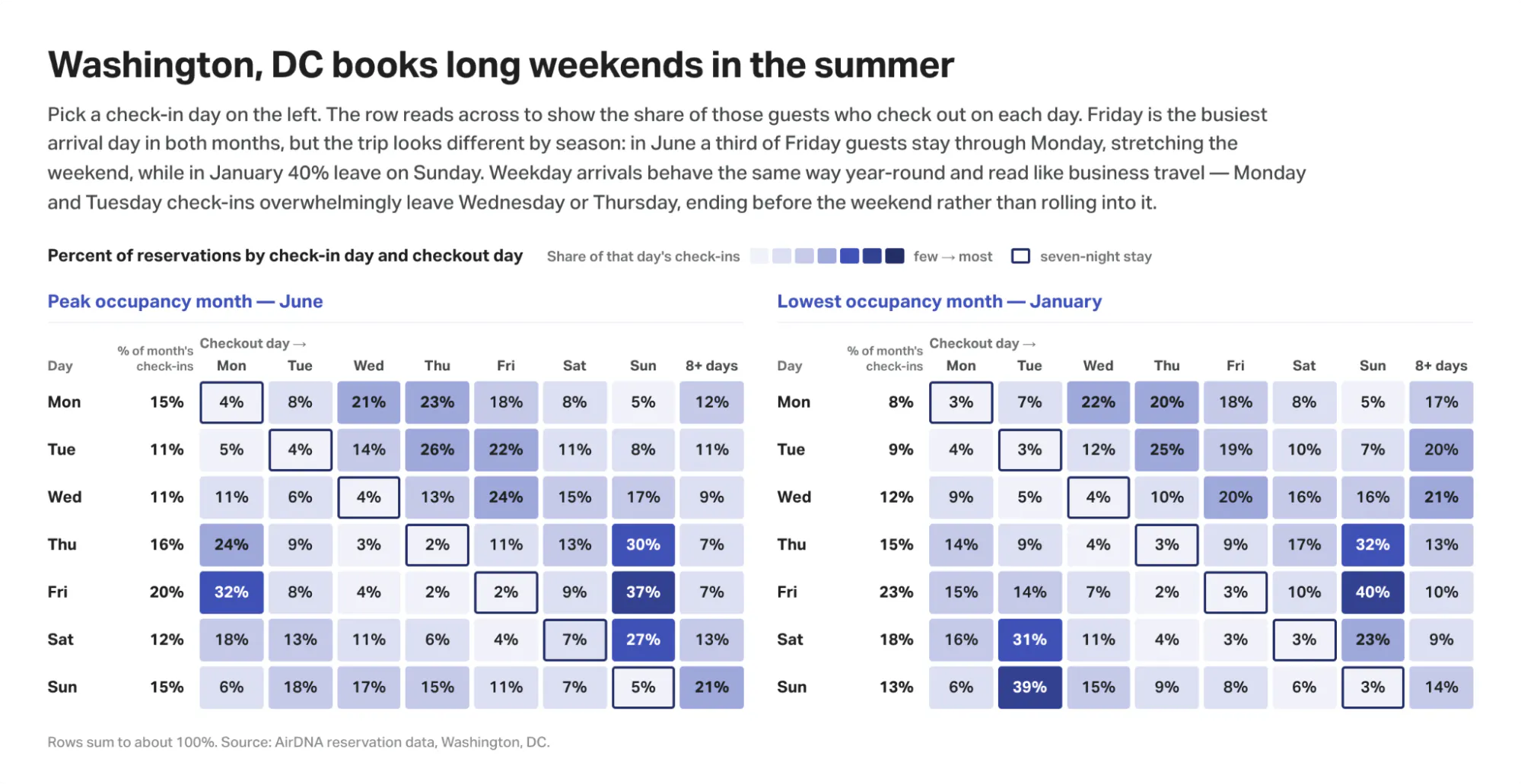
Washington DC Splits Cleanly Between Weekday Business and Weekend Leisure
Washington, DC runs on two overlapping guest types: leisure travelers who show up on the weekend, and business travelers, conference attendees, and visitors on Capitol Hill business, who arrive on weekdays.
In DC, June is the peak occupancy month, and it’s when leisure travel reaches one of its highest points of the year. Friday is the most popular check-in day, accounting for about 20% of the month’s reservations, and the majority of them are 2-3 night stays: 37% check out Sunday, another 32% check out Monday. Thursday is the second most common check-in day, and it behaves the same way, with 55% of Thursday check-ins departing Sunday or Monday. Put together, DC’s summer weekends are extended weekend stays: guests arriving Thursday or Friday and staying through Sunday or Monday.
While the back half of the week hosts extended weekend stays, the front half hosts short business trips. Sunday and Monday check-ins skew heavily that way: 67% of June’s Sunday check-ins are out by Friday, and 71% of Monday check-ins do the same.
In January, DC’s lowest-occupancy month, Friday is still the most common check-in day, but the guests booking it want less. 40% of January’s Friday check-ins leave on Sunday, and only 15% extend into Monday, a much smaller extended-weekend share than June’s. The weekday pattern holds up better: in January, almost half of Sunday check-ins are out by Tuesday, and roughly two-thirds of Monday check-ins are still out by Friday, close to June’s weekday behavior even as the weekend leisure pattern fades.
The minimum-stay takeaway for DC. Don’t build your early-week minimums around weekend logic; most Sunday and Monday guests were never trying to reach the weekend, in June or January. A 3-4 night early-week minimum will just turn away business you’d otherwise book. Thursday is the day worth raising in peak season: with more than half of June’s Thursday check-ins running through the weekend, a 3-4 night minimum captures demand that’s already there, and you can hold it further out in the booking window and relax it if the date doesn’t fill. However, the same Thursday minimum would be too restrictive in January, when occupancy sits closer to 50% and the extended-weekend guest is much rarer.

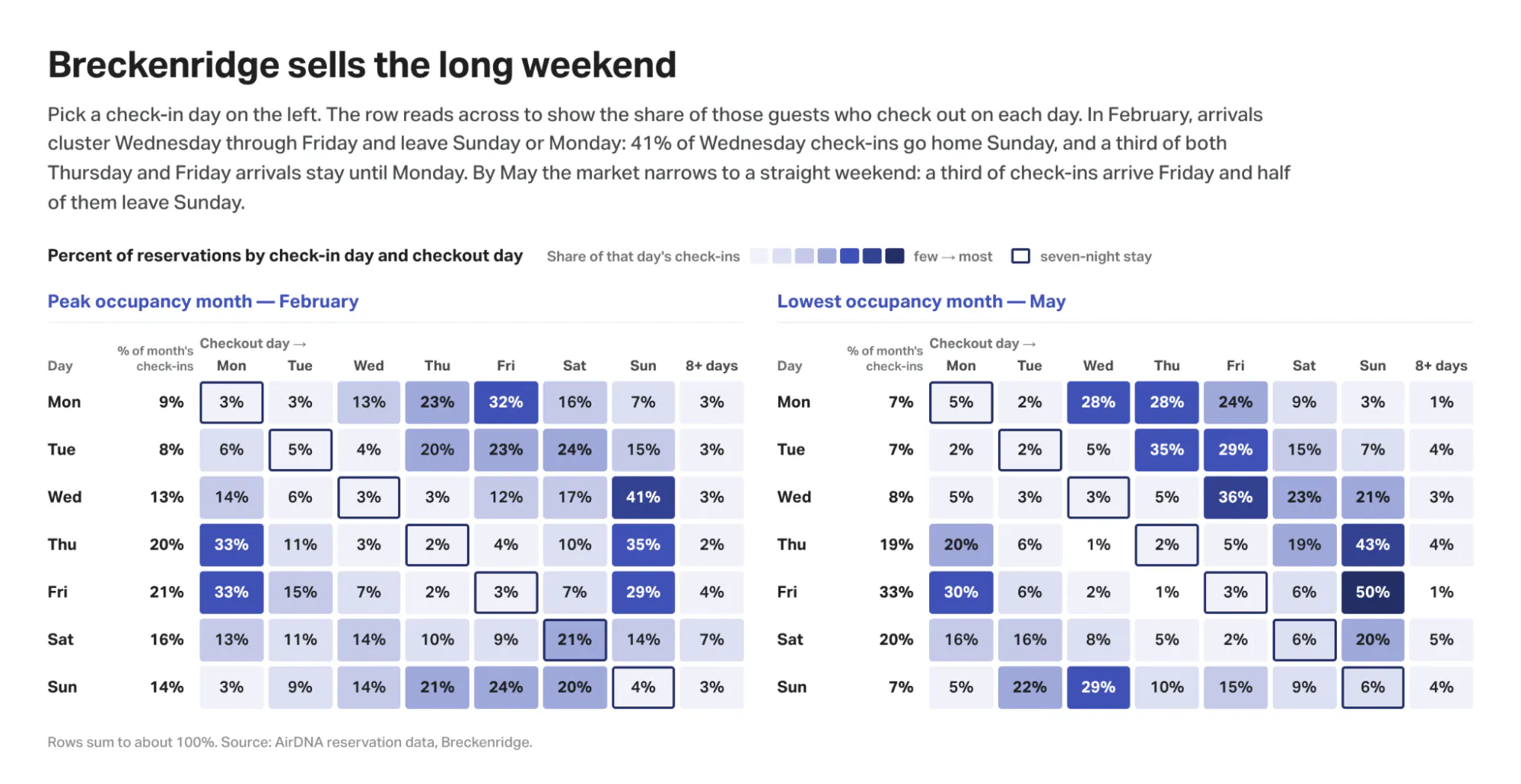
Breckenridge Sells a Four-Night Ski Weekend in February and a Two-Night One in May
Breckenridge is a Colorado ski market where occupancy peaks in February, deep in ski season, and bottoms out in May, the stretch known locally as mud season, after the lifts close and before summer trail traffic arrives.
In February, Thursday and Friday are the two most popular arrival days and account for about 40% of the month’s check-ins. When guests check in on either day, they tend to stay through the weekend: roughly two-thirds of both Thursday and Friday check-ins depart on Sunday or Monday. Ski season turns Thursday and Friday arrivals into extended, multi-day trips almost by default.
May keeps the same shape but shrinks it. Thursday and Friday check-ins are still common, but the extended stay mostly disappears: 43% of Thursday check-ins and half of Friday check-ins leave on Sunday, with less spillover into Monday than in February. The drop is sharpest on Thursday, where the share staying through to Monday falls from 33% in February to 20% in May.
Early-week check-ins are quiet in both months. Monday and Tuesday are consistently the slowest arrival days, whether it’s peak ski season or mud season. But when guests do check in early in the week, February guests stay meaningfully longer than May guests: only about half of February’s Tuesday check-ins are out by Friday, compared to 70% of May’s.
The minimum-stay takeaway for Breckenridge. In peak ski season, a higher minimum in the back half of the week, especially Thursday and Friday, matches real guest behavior: two-thirds of those arrivals are already running through the weekend, so a 3-4 night minimum isn’t turning much away. In mud season, that same minimum is too restrictive. Half of Friday’s May check-ins are gone by Sunday, so a rule built for February’s extended weekend will price you out of May’s plain two-night getaway. Weekday minimums should stay lower than weekend minimums in both seasons. 71% of February’s Monday check-ins and just under half of Tuesday check-ins are out by Friday, and that share climbs even higher in May, so a longer minimum early in the week could turn away demand.
Four Rules for Setting Day-of-Week Minimums
Hilton Head, Washington DC, and Breckenridge are three very different markets, but they told the same underlying story: check-in day predicts checkout day, and booking patterns change from market to market and season to season. As you’re thinking about how to set minimum stay rules for your calendar and market, here’s what to keep in mind:
- Match minimums to your market and season. Set your minimum at the length your market is already booking, in the season you’re pricing. Above that and you’ll lose bookings. Below it and you buy turnovers you didn’t need.
- Adjust minimums by day of arrival. Demand looks different depending on which night a guest arrives, and one rule across all seven nights will hurt your bottom line.
- Note that property size changes how guests book. Not every property size can support the same minimum stay policy even on the same day, in the same season. A seven-night minimum may be realistic for a larger property in a coastal market well before it makes sense for a studio down the street. See our companion piece on length of stay by market, season, and property size for the full breakdown.
- A high minimum is cheap to hold far out, and expensive to hold too long. It’s reasonable to hold a 2-3 night minimum on a Saturday early in your booking window, since a longer, more profitable stay could still come in. But if that date isn’t booked as check-in approaches, holding the line can cost you the short-stay guest you were trying to upgrade past. One-night Saturday stays are common enough in every market we looked at here that relaxing your minimum to one night as the date nears lets you capture that demand instead of sitting empty.
Let Adapt Set Your Day-of-Week Minimums for You
The right minimum stay policy for any given date is rarely fixed. It changes with the season, the day of the week a guest checks in, how far out that date sits in your booking window, the size of your property, and whether a holiday or event is in town.
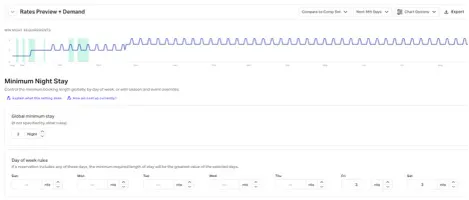
Adapt gives you the controls to build and automate your calendar rules so you don’t have to adjust every date manually. You can set minimum stay policies and check-in and check-out restrictions for each day of the week, create seasonal and event overrides for specific months and holidays, and override an individual date on its own.
But you may not want to build the rules yourself, or even know where to start. Adapt is an AI-native pricing tool, which means AI sits at the core of how pricing and calendar decisions get made rather than being layered onto a rules-based system. It starts from a pricing strategy you choose: Smart Yield to optimize your RevPAR, Volume Builder to price at market and work discounts hard to keep occupancy high, Steady Earner to fill early at a slightly lower rate for predictable income, or Premium Hold if you’d rather have an empty night than a cheap one. From there it sets your calendar rules, including which days of the week to raise or relax your minimum, adjusting them through the year based on lead time, season, holidays, events, and how your calendar and market are filling up.
Adapt calibrates all of it to your listing’s history, your local market, and attributes like property type and bedroom count. A one-bedroom urban condo and a five-bedroom beach house on the same strategy get different day-of-week rules, seasonal swings, and minimum stay rules.
In Hilton Head, Adapt will hold a longer Saturday minimum through the summer’s week-long-stay season and relax it once winter’s shorter, more varied Saturday demand takes over. In Washington DC, it will raise Thursday and Friday minimums for June’s extended weekend crowd while keeping early-week minimums lower since Sunday and Monday guests were never trying to reach the weekend in the first place. And in Breckenridge, it extends weekend minimums through ski season and pulls them back once mud season arrives, so a rule built for February doesn’t cost you bookings in May.
Build the rules yourself in Adapt, or pick a strategy and let Adapt build them. Either way, your minimum stay rules can match how guests are actually booking, by day of week and by season, all year long.
FAQs
Should my Airbnb minimum stay be different on different days of the week?
Yes, in most markets. Check-in day predicts checkout day, so a single rule across all seven nights will be too tight on some days and too loose on others. In the U.S., 49% of Friday check-ins are two-night stays, while Saturday is the only day where a one-night stay is the most common outcome, at 27%. A two-night Friday minimum and a one-night Saturday minimum describe the same market.
What day of the week has the longest Airbnb stays?
Saturday, but only in the markets and seasons built around full weeks. Nationally, 15% of Saturday check-ins run seven nights, the highest week-long share of any arrival day. In Hilton Head in July that rises sharply: 36% of the month’s check-ins land on Saturday and 69% of them leave the following Saturday. In the same market in January, only 15% of Saturday arrivals book exactly a week.
Why do I get one-night bookings on Saturday?
Because Saturday carries two completely different guests. It’s where week-long vacation rentals start, and it’s also where last-minute single-night stays land, filling gaps left between longer bookings. Nationally those one-night stays are 27% of Saturday arrivals, the single most common Saturday outcome, which is why a high Saturday minimum held all the way to the arrival date often ends in an empty night rather than a longer booking.
Should I raise my minimum stay in peak season?
Raise it on the arrival days your market is already booking long, not across the board. In Breckenridge in February, roughly two-thirds of Thursday and Friday check-ins run through to Sunday or Monday, so a 3-4 night minimum on those days turns very little away. Early-week minimums should stay low even in peak season: 71% of February’s Monday check-ins are out by Friday.
How far in advance should I hold a high minimum stay?
Hold it early in the booking window and relax it as the date approaches. A 2-3 night Saturday minimum is cheap to hold months out, because a longer and more profitable reservation could still arrive. Once check-in is close, that same rule blocks the short-stay guest who would have taken the night. One-night Saturday stays are common enough in every market in this analysis that relaxing to one night near arrival is usually worth more than holding out.
ARTICLE SUMMARY
The day a guest checks in predicts how long they’ll stay, and it predicts it differently in every market and every season. Using AirDNA reservation data, this piece maps check-in day against checkout day across the U.S. and in three very different markets, Hilton Head, Washington DC and Breckenridge, in both their peak and their slowest month. In the U.S., 49% of Friday check-ins are two-night stays, while Saturday is the only day where a one-night stay is the single most common outcome. The takeaway for every market is the same: one minimum stay across all seven nights leaves money on the table.
Linda Rollins
Senior Research Analyst
Linda Rollins is a Senior Research Analyst at AirDNA and a self-managing short-term rental host, which means she understands the market as both an analyst and an operator. She writes research and blogs for AirDNA and for Adapt, its revenue management tool, making her work a go-to resource for investors trying to find and size up the right opportunities, and for operators looking to understand changing market dynamics and find concrete ways to improve occupancy, rates, and guest experience. Her data is regularly cited in major news outlets, and she has a knack for bringing both the numbers and the story behind them. In her free time, Linda enjoys spending time with her family, traveling, and looking for good eats.