Calculate Revenue
 Research Markets
 Find For Sale Properties
 Compare My Listing
 STR Revenue Calculator
 Custom Comp Sets
 Submarket Insights
 Custom Search Filters
 Rate Recommendations
 Performance Benchmarking
 Competitor Comparison
 Owner Contact Details
 Property-level performance data
 Tourism Insights
 Real Estate Investment Analytics
 About Us
 Sales
 Support
 Press
Europe Market Review: Occupancy Surges with Demand Undeterred
Published: June 23, 2022
Last updated: May 5, 2026

Scott Sage
European Short-Term Rental Demand Growth Continues Despite Broader Economic Uncertainty
The recovery is fully on: Europe tallied up 31.5 million short-term rental nights stayed in the month of May, an increase of 11.4% over May 2019 (56.5% vs. May 2021). The strength of pent-up demand in 2022 has allowed the continent to maintain five consecutive months of growth over 2019. New bookings in May for future stays were up 40.8% year-over-year: topping 58.3 million nights.
The European supply of available short-term rentals in May was 4.8% below May 2019 (+9.3% vs. 2021), which was the highest rate of monthly supply relative to pre-pandemic levels yet. Though, the recent announcement by the European Central Bank (ECB) of interest rate increases should slow purchasing, a slowing economy could push second home owners to list their homes for let as a means to generate income from otherwise vacant assets.
May marks the eighth consecutive month of peak occupancy levels, coming in at 53.6%. Relative to the closest high in May 2019, this represents a percent change of 3.4% and a percent difference of 1.8%. These inflated occupancy levels are the result of demand exceeding 2019 levels, while in contrast, supply has been stunted to reach beyond pre-pandemic volume.

The abundance of short-term rental demand has allowed revenue levels to surpass 2019 figures for eight consecutive months. In May 2022, revenue rose 39.0% above 2019 and 55.5% above May of last year.
Despite the strength of demand, revenue, and rising inflation, average daily rates (ADR) in May were actually 0.7% below May of last year (though still 25.0% higher than May 2019). This can be attributed to changes in the demand mix from 2021. Relative to 2019, larger units continue to exhibit the strongest increases in demand. However, when comparing year-over-year demand, we can see that guest behaviour is beginning to favour smaller unit types this year, with the largest increases for private and shared rooms, followed by 1-bedroom properties, then 2-bedroom properties. These properties - also more likely to be located in urban areas - are typically priced lower and bring the ADR down.
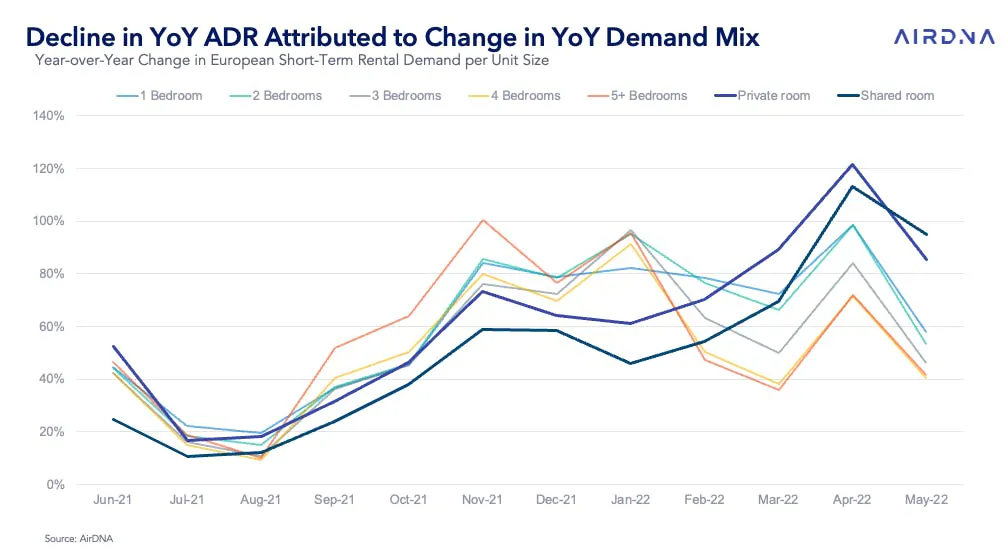
Similar to average daily rates, the Euro has also been in decline, having dropped to $1.04 from over $1.22 a year ago, as markets are weighing the implications of the ECB’s announcement. As the value of the Euro is pushed lower, it has a tendency to boost the European economy by making it more attractive to foreign buyers.
A pickup in international travel to Europe is widely anticipated across the travel industry. Though flights may come with a higher price tag as the airline industry experiences an influx in demand and passes heightened fuel costs on to consumers. U.S. travellers, specifically, may become more inclined to travel abroad to Europe in the coming months, as the United States announced in June that air travellers no longer need to take COVID-19 tests for entry. The rise in airfare and bottlenecked airports during peak periods may however make international travel more difficult.
At a glance: May Short-Term Rental Performance Summary for Europe
- Demand up 11.4%, five consecutive months positive vs. 2019
- Available listings down -4.8% vs. 2019, though highest they’ve been since pre-pandemic
- Revenue up 39.0%, eighth consecutive month positive vs. 2019
- Occupancy: 53.4%, highest ever for the month of May, eighth consecutive month of new highs
- ADRs down -0.7% vs. 2021 (+25.0% vs. 2019), which can be attributed to changing demand mix
Top-Twenty Countries: May STR Performance
Short-term rental (STR) demand for the top-20 European countries was positive in May when compared to the same period last year, though performance relative to 2019 remains diverse. Hungary saw the strongest increase year-over-year with 143.4% more nights stayed, though this lagged behind May of 2019 (-31.1%). Of the top-20 countries, six fell behind the gains that the broader European continent made over May 2021 (56.5%). The Netherlands saw just 15.7% more demand in May 2021, which represented the weakest gain in the period, followed by Switzerland (29.6%), Finland (32.7%), and the United Kingdom (35.4%).
When compared to the pre-pandemic levels of May 2019, a total of 11 countries saw positive demand levels, of which five outperformed broader Europe as a whole. In this comparison context, France saw the greatest gains (43.5%), followed by Germany (33.1%) and Greece (32.1%). Sustaining a period of declined demand relative to 2019, the Czech Republic (-41.1%), Hungary (-31.1%), and Ireland (-29.3%) were the weakest-performing countries in the month.

In May 2022, 11 of the top-20 European countries grew their supply of available listings relative to May 2019. The strongest growth in the period was seen in Germany (21.4%), followed by Austria (19.0%) and France (18.6%). In line with depressed demand, supply growth compared to May 2019 was most impaired in the Czech Republic (-33.5%), Ireland (-30.6%), and Hungary (-26.8%).
Each of the top-20 European countries grew their supply of available short-term rentals in May over last year, aside from the Netherlands. The largest developments in supply relative to May 2021 were seen in Norway, Poland, and Sweden, which increased by 26.1%, 21.1%, and 20.7%, respectively.

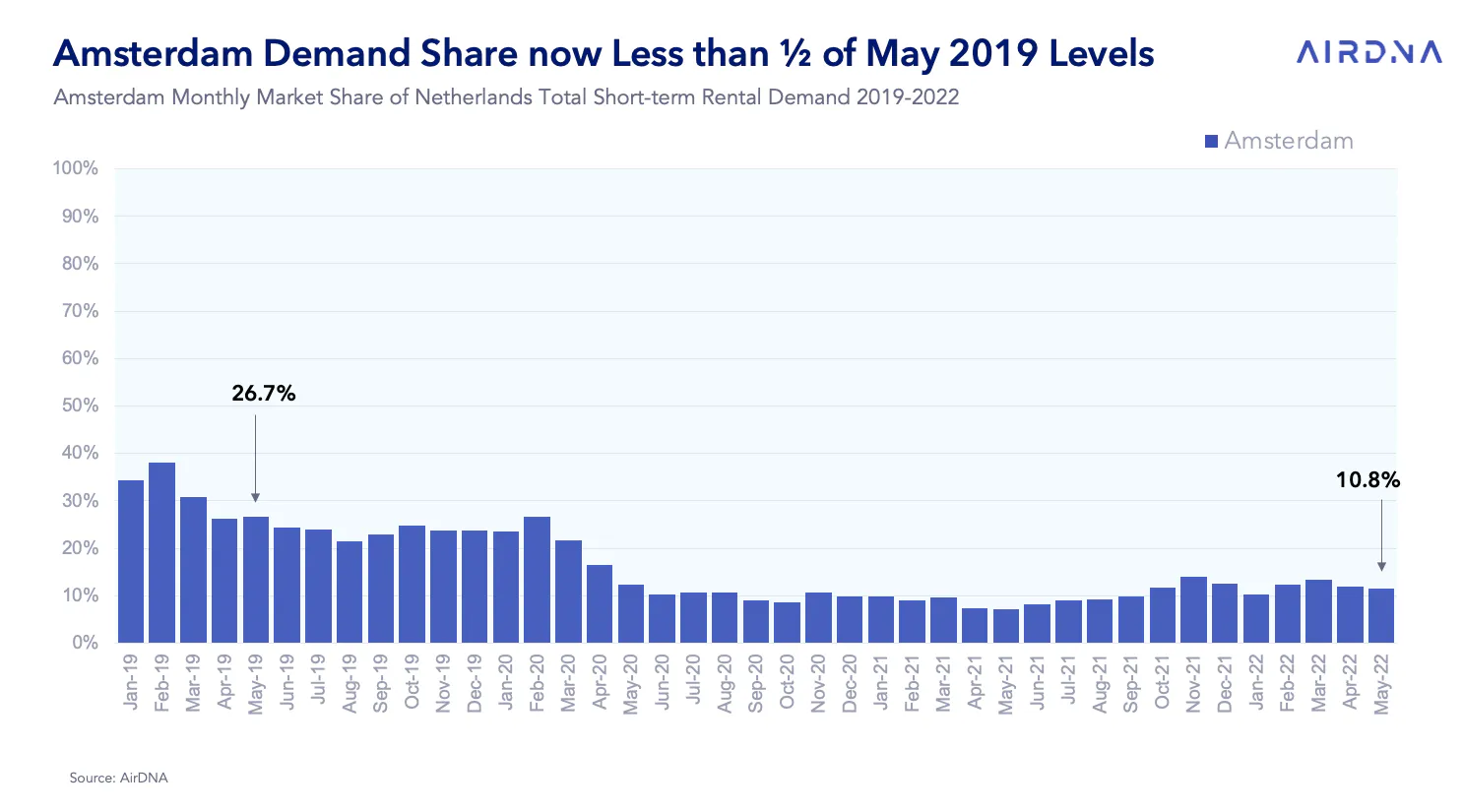
Implementation of stringent short-term rental regulations in Amsterdam has led to a 61.9% drop in supply within the city. In May of 2019, Amsterdam constituted 24.6% of all short-term rental supply and 26.7% of demand in the Netherlands. By May of 2022, however, the supply and demand market share of the country’s most-visited city had been reduced to 10.8% and 11.5%, respectively. Moreover, short-term rental demand and supply in the remainder of the Netherlands had increased by 3.9% and 3.0%, respectively, during the same period.
Occupancy increases in most countries
Fifteen of the top-20 European countries realised double-digit percentage change increases in occupancy levels this May over last year. Despite an increase in supply over May 2021, the influx in demand for Hungarian short-term rentals allowed the country to see 40.6% greater occupancy year-over-year, marking the greatest positive year-over-year change in occupancy of the top-20 countries. Portugal closely followed, with 40.5% higher occupancy than in May 2021. Contrastingly, the United Kingdom was the only country to realise lower occupancy levels over last May, posting a percentage change of 1.8% below May 2021, as guests began to return to mainland Europe for their holidays.
Portugal saw the largest increase in occupancy (13.9%) in the comparison period of May 2022 vs. May 2019. In total, eight countries saw gains in occupancy relative to May 2019. Aside from Portugal, other countries that realised strong increases in the period included France (8.8%), Italy (8.7%), and Spain (8.4%). The countries that saw the greatest declines in occupancy were Sweden, Norway, and Denmark, coming in at -14.9%, -12.5%, and -9.7%, respectively.
Average daily rates continued to rise from last year in five of the top-20 European countries. The greatest change in ADR was seen in Denmark (10.3%), followed by Poland (8.6%) and the Czech Republic (3.0%). Rates are coming off their highs in a double-digit fashion in Austria (-23.1%) and Finland (-18.3%).

Despite an exceptional rise in ADR relative to 2019, four of the top-20 European countries failed to reach May 2019 revenue levels this past May. As well as the lowest demand levels in the comparison period, the Czech Republic (-24.0%) saw the lowest revenue in the month of May, followed by Ireland (-8.4%), Hungary (-7.5%), and the Netherlands (-1.6%). France, Greece, and Germany each increased their revenues by over 70% relative to the same month in 2019, each seeing 73.5%, 73.0%, and 70.3%, respectively, over the comparison period.
Each of the top-20 European countries had recovered revenue over May 2021. Five of the countries saw triple-digit increases: Hungary (120.3%), the Czech Republic (119.1%), Portugal (108.1%), Greece (105.7%), and Denmark (101.6%). The slowest growth over last year was seen in Finland (8.4%), Switzerland (17.9%), and the Netherlands (18.5%).
European Outlook Strong for the Summer
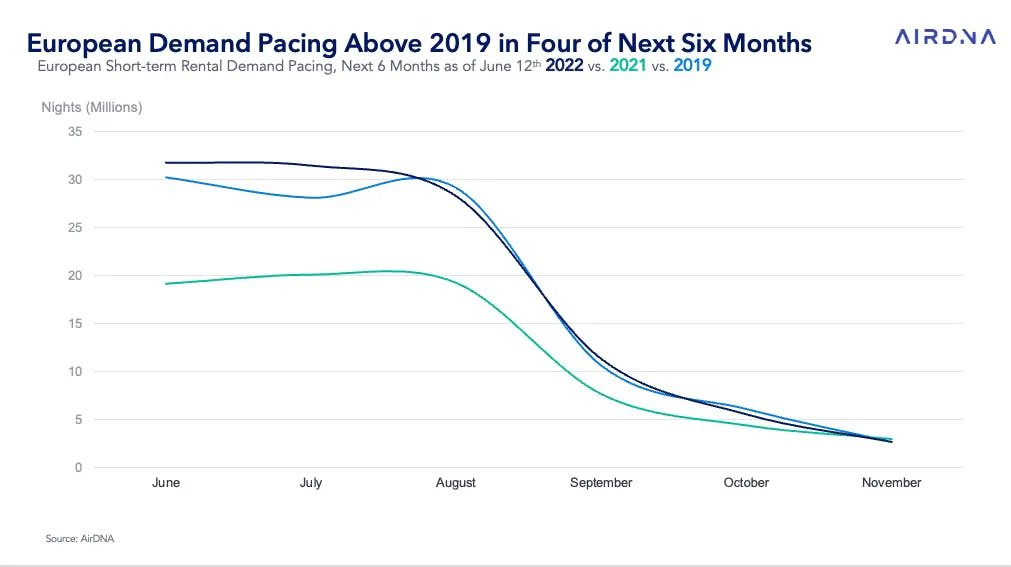
As of June 12th, summer (June-September) demand on the books in Europe was 5.0% higher than at the same point in 2019 and 55.5% higher than in 2021. Breaking this down, bookings are higher than in 2019 for June (5.2%) and July (12.1%). The month of August is trending 2.8% below 2019, though positive momentum returns in September (7.0%). Over the next six months, demand for European short-term rentals was trending 4.1% higher than in 2019 and 51.1% greater than in 2021.
In line with a recovery in demand pacing, lead times are starting to normalise as well. While still 12.5% shorter than in 2019, entire home reservations for stays in May 2022 on Airbnb were on average booked 51.2 nights prior to check-in, which was a 79.0% longer lead time than in the same period last year.
This pickup in demand pacing and willingness of guests to book reservations further out is allowing hosts to charge higher rates than last year over the summer months. Relative to rates in 2021, ADR was pacing toward a rise of 1.3% across the European continent as of June 12th.
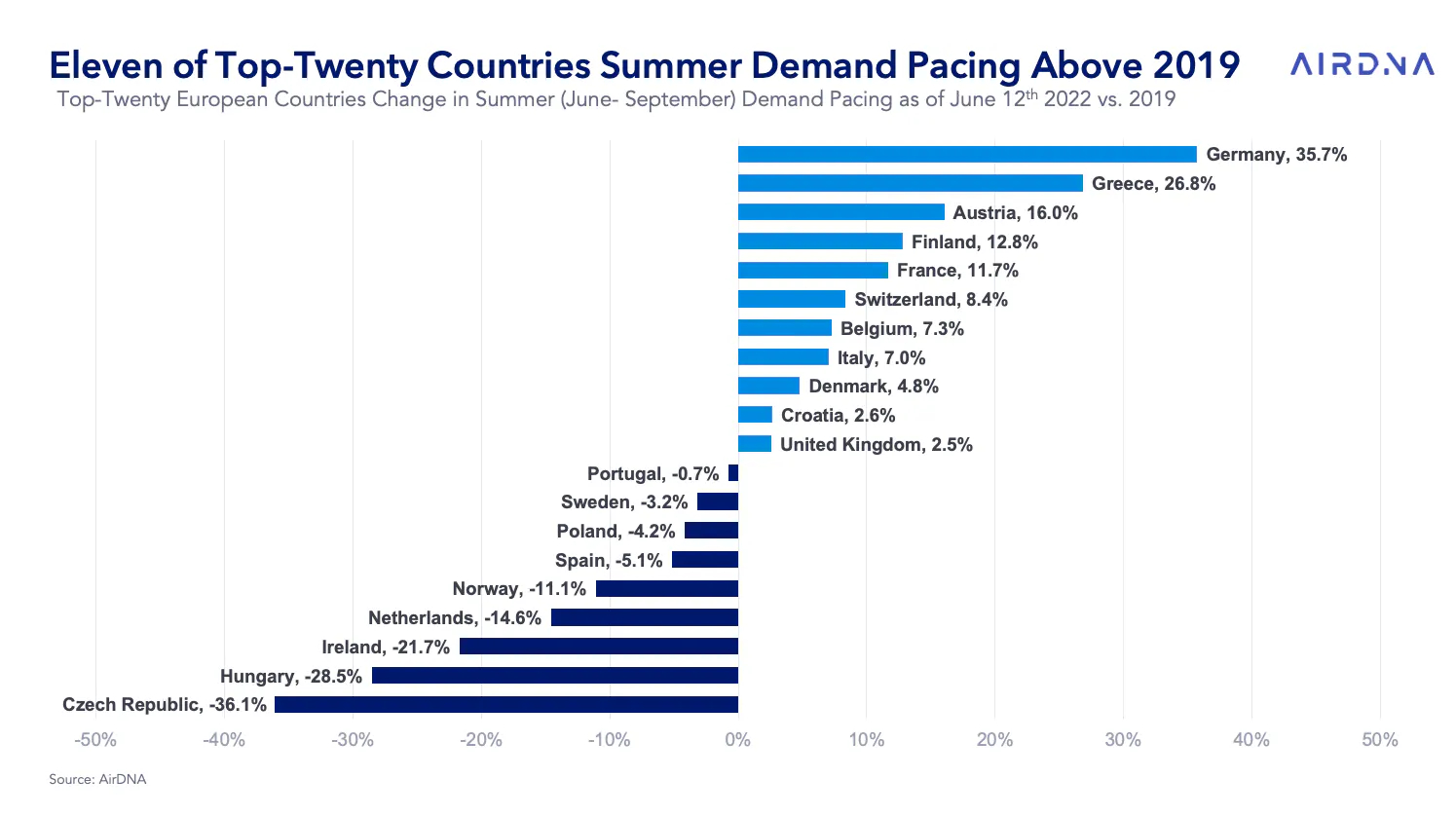
Summer month demand pacing for the top-20 European countries indicates that disparities remain on the road to recovery as 11 countries are pacing above this time in 2019. The strongest gains over the pre-pandemic period were seen in Germany (35.7%), Greece (26.8%), and Austria (16.0%), while the greatest laggards continued to be the Czech Republic (-36.1%), Hungary (-28.5%), and Ireland (-21.7%).
Relative to 2021, ADR is pacing toward increases during the summer months in seven of the top-20 countries. Denmark leads with 14.5% over last year, followed by Poland (11.3%) and Germany (8.4%). Though, decreases from the highs of last year appear to be more prevalent across the top-20 countries, with rates in seven of them pacing 5% or more below the same time in 2021. Finland (-24.0%) is seeing a substantial decrease in summer ADR pacing from last year, though is still trending 21.0% higher than the summer of 2019. Austria (-8.9%), Belgium (-8.4%), and Sweden (-8.1%) are each seeing declines of more than 8.0% relative to the same period in 2021.

Increased demand and average daily rates indicate that Europe is on the cusp of recovering from the lows of the pandemic. Though, the outlook of the European short-term rental industry is now being overshadowed by new hardships. The effects of increasing inflation, oscillating exchange rates, and changes in the ECB monetary policy will likely be reflected in different ways throughout European short-term rental markets. Europe-based consumers may become more fiscally conservative in relation to travel habits and find greater difficulty in obtaining financing to invest in second homes. Economies with higher exposure, debt, and risk of solvency will likely bear the brunt of these impacts if domestic spending slows. However, opportunity lies in an increased volume of foreign travellers; provided their respective economic states do not digress and air travel does not become less economically or logistically feasible.

See how bookings are going in your area
Use AirDNA's leading future data tools to be the first to know the trends in your area
U.S. Market Review: Supply Grows to Meet Demand
See the trends in the U.S.

How Destination Marketers Use Data to Get Smart About Tourism
Hear from key DMOs how AirDNA data helps them to understand their markets
Be the first to know about the latest industry trends
Sign up for our newsletter
ARTICLE SUMMARY
Inflation and airport delays aren’t showing signs of dampening the pent-up demand for travel in Europe this summer. Demand for European short-term rentals in May was 11.4% higher than the same month in 2019, the fifth consecutive month of higher demand than 2019, with 31.5 million nights stayed during the month.
Scott Sage
Senior Vice President, Marketing & Customer Experience
Scott is an Airbnb Superhost and industry pro, having founded Home Base BnBs—a short term rental management company that scaled to 200+ units. Scott combines his experience and passion for hosting to empower AirDNA customers' success. When he's not thinking about STRs, he is hiking, playing basketball, or playing pickleball.