


Dubai Turns to Medium-Term Rentals as War Cuts Short-Term Demand
Published: September 30, 2026

Bram Gallagher

Key takeaways
- Dubai’s short-term rental supply tripled between February 2022 and February 2026, from 10,700 average monthly available listings to more than 32,000, while annual revenue rose roughly fivefold from $215M to more than $1B.
- Cancelled nights reached 350,366 in March 2026, about 2.4 times the pre-shock baseline of 145,491 a month, and the number of listings able to book a short stay fell 38.8% year over year in April.
- Hosts pivoted fast. In April, listings booking a short stay fell 38.8% year over year while listings booking a medium-term stay rose 38.0%.
- Medium-term rentals reached 45.5% of Dubai rental revenue in April, the highest share since the pandemic and up from 17.4% in April 2025.
- The pivot mitigated the damage rather than erasing it. Total April revenue still fell 51.8% year over year, because short-term rentals are the larger base and rates fell in both segments.
- Forward pacing for September through January has revenue down 22% in aggregate, but only 7% for medium-term stays against 28% for short-term.
The buildout: supply tripled and revenue rose fivefold in four years
Since the COVID-19 outbreak, Dubai has undergone an intense buildout of its hospitality sector. According to the Dubai Department of Economy and Tourism, the city has added 16,300 hotel rooms since the end of 2021, an increase of around 11.8% of its stock.
Short-term rental growth followed an even steeper trajectory. Across the twelve months ending February 2022 through February 2026, average monthly available listings tripled, reaching more than 32,000 from a base of 10,700. Annual revenue increased about fivefold over the same period, from $215M in February 2022 to more than $1B by February 2026.

The shock: cancellations hit 2.4 times normal and bookable listings fell 38.8%
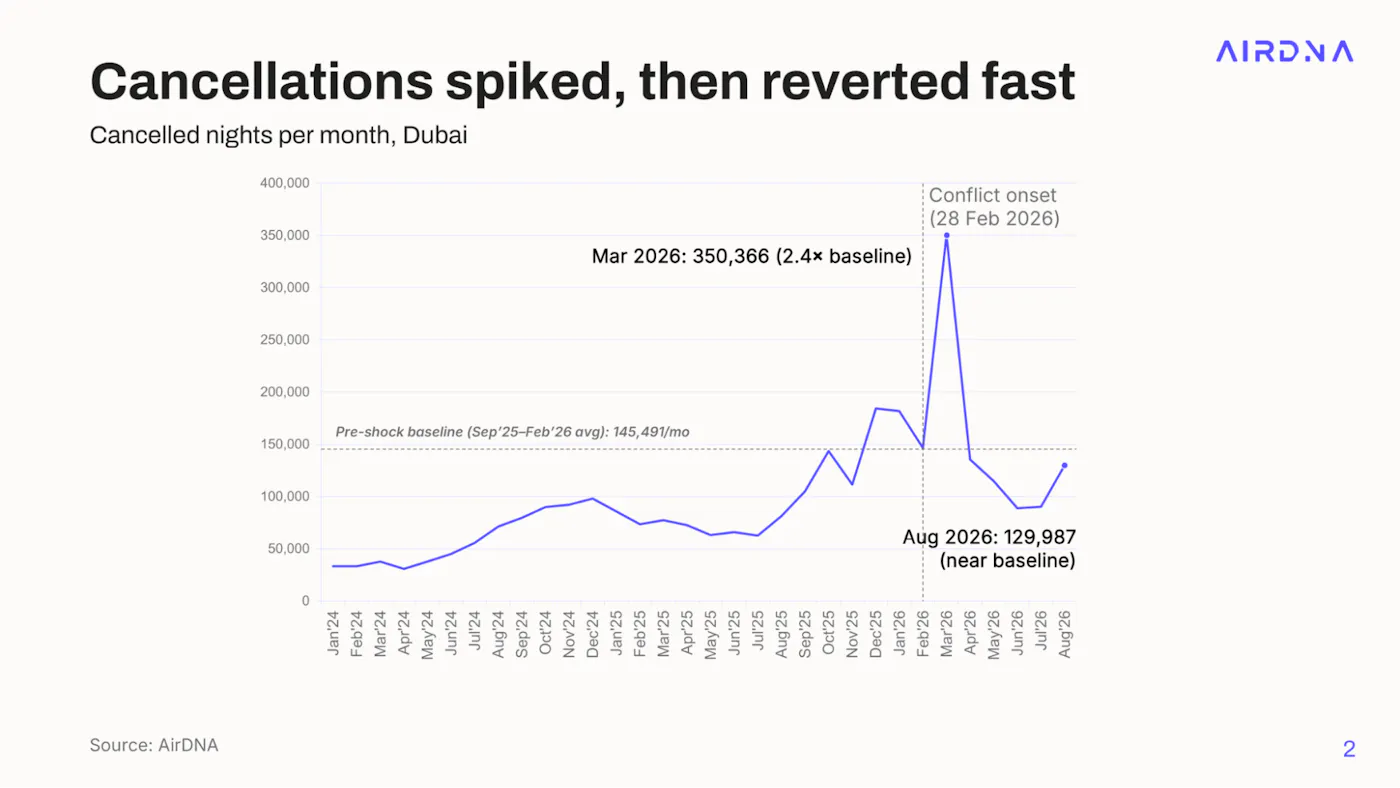
It seemed like nothing could stop the Dubai hospitality sector until the US war on Iran began on 28 February 2026. Reports of nearby explosions and conflict within the near vicinity suddenly made Dubai a less appealing destination, and cancellations immediately spiked, reaching 350,366 cancelled nights in March, about 2.4 times the pre-shock baseline of 145,491 nights a month.
Although cancellations reverted to more typical behavior just as quickly, the damage to the Dubai hospitality market continued. The number of listings that were able to book a short-term stay fell 38.8% in April on a year-over-year basis.
The pivot: short-stay listings fell 38.8% while medium-term listings rose 38.0%
One strategy available to mitigate losses in the immediate aftermath was to switch the listing offering from short-term lets aimed at international tourists to medium-term rentals, meaning stays of 28 days or longer, aimed at locals and residents.
Examining all the distinct available listings that rented either short-term or medium-term illustrates the effect well. In March, both counts of available listings declined from the previous year. In April, the month after, the number of available listings that booked a short stay dropped 38.8% year over year, just as the number that had booked a medium-term stay increased 38.0% year over year.
Since then, short-stay listings have recovered somewhat, to only about 20% below last year for May through August, and medium-term listings have flattened. Keep in mind that July is decidedly the low season in Dubai in a normal year, and flat medium-term listings correspond with the usual seasonal high in this type of accommodation.

Why the medium-term option was already there: MTR was 15% to 35% of 2025 revenue
Medium-term rentals in Dubai have been a significant component of the rental landscape throughout the past five years, making up between 15% and 35% of monthly revenues in 2025.
In fact, switching rental modalities in the UAE may be a regular feature of the market. The share of revenue attributable to medium-term rentals surges in the off-season, May through September, when the blistering Dubai summer keeps tourists away. For the rest of the year travelers enjoy cooler weather, with November through January usually hosting the highest demand levels of the year. December in Dubai also carries the highest ADR, as New Year’s celebrants flock to the fireworks set against the backdrop of the city’s skyline.
At least in this way, operators were spared a disaster occurring during the height of the season, since March generally performs as a shoulder-season month.

Medium-term rentals reached 45.5% of revenue, a post-pandemic high
After the spike in cancellations, hosts quickly got to work repositioning their listings. The share of revenue attributable to medium-term rentals reached its highest level since the pandemic in April, at 45.5%.
This was also a highly unseasonal increase in share, up about 160% from April 2025, when the share of revenue attributable to medium-term rentals reached only 17.4%. That share has remained elevated on a year-over-year basis since.
Why the pivot mitigates rather than erases: rates fell in both segments
One reason medium-term rentals can only mitigate rather than eliminate revenue losses is that ADRs for both types of listing dropped significantly after the conflict began and remain depressed.
Short-term rates fell 26.1% in April while medium-term rates fell 13.0%. Medium-term rates then deepened their losses to 23.4% by May, while short-term rates recovered slightly, posting a 17.6% decline. ADR has recovered more quickly in the medium-term segment as the off-season arrived, with August rates down only 1.2% year over year compared with 3.9% in the short-term segment.
The second reason is simple scale. Short-term rentals make up such a large portion of total revenue that a partial offset elsewhere cannot close the gap. While short-term rentals faced a steep 68.2% loss in revenue in April, the worst-performing month of the conflict, medium-term revenue increased 25.8%, bringing total revenue losses to 51.8% rather than something worse.
Since then, revenues have returned to levels closer to last year, trailing August 2025 by 23.1%.
What remains to be seen is how bookings take shape in the months ahead, as the off-season gives way to the autumn and winter months and thus more difficult comparisons.

Autumn pacing: revenue down 22% through January, with medium-term holding up far better
Dubai has a short median lead time for its reservations, so forward visibility is limited, but pacing data for a few months out is still informative.
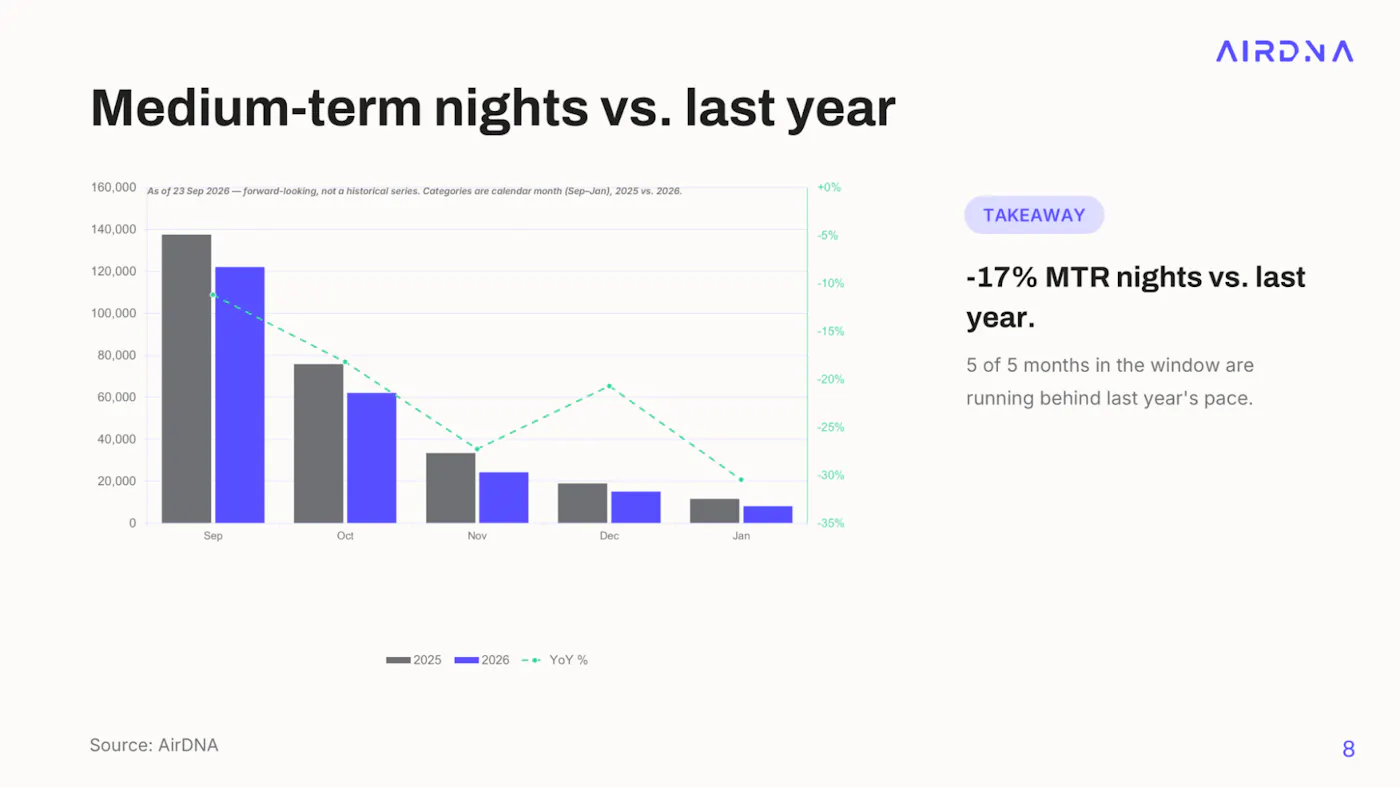
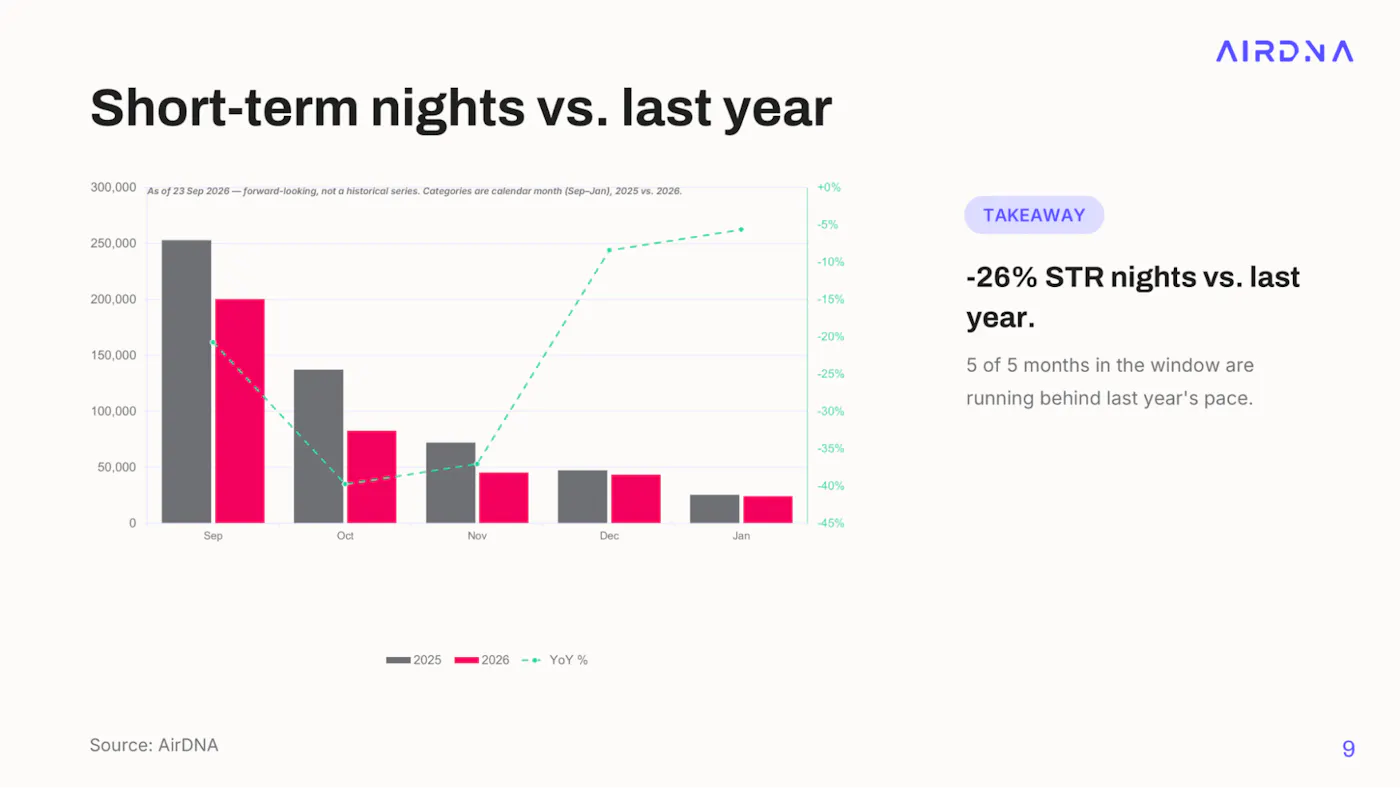
Demand is pacing down: 16.8% in September, and 33% and 36% in October and November. The medium-term segment is holding up better, with nights down only 11.2% in September, 18% in October and 27% in November.
Later pacing, although still early, shows more short-term optimism for New Year celebrations. Short-term nights are down 8% and 6% in December and January, considerably better than earlier months, against medium-term pacing of 21% and 30% for the same two months.
Revenue pacing shows durable differences between the two segments. Paced short-term revenue for the next five months, September through January, is down 28%, but because medium-term stays are taking a much smaller hit of 7%, overall revenue pacing through January is down only 22%. Until hostilities ease, medium-term stays will make up a larger part of Dubai’s rental market revenue.
What this means if you operate in Dubai
- Medium-term rentals are a real hedge in this market, not a theoretical one. The segment was already 15% to 35% of monthly revenue before the shock, which is why the pivot was available at all. Operators in markets without an established medium-term base would not have had the same option.
- Rate, not occupancy, is the binding constraint. Both segments took double-digit ADR hits. Filling nights at depressed rates recovers volume, not revenue.
- Watch pacing rather than last month’s occupancy. October and November are pacing roughly a third behind last year, and that is visible now.
- Plan for the seasonal comparison to get harder. Dubai’s strongest demand runs November through January, with December carrying the highest ADR of the year. The year-over-year comparisons from November onward are against a normal peak.
Check your Market Score
Every market gets a 1-100 score based on rental demand, revenue growth, and investability. See where yours lands.
Check my Market ScoreFAQs
How is the rental market in Dubai performing in 2026?
Short-term rental revenue fell sharply after the conflict began in late February 2026, bottoming at a 68.2% year-over-year decline in April. By August, total revenue was trailing the same month in 2025 by 23.1%. Forward pacing for September through January has aggregate revenue 22% below last year, with short-term stays down 28% and medium-term stays down only 7%.
What is a medium-term rental?
A medium-term rental is a stay of 28 nights or longer. In Dubai it typically serves residents, relocating professionals and long-stay visitors rather than tourists, and it made up between 15% and 35% of monthly market revenue in 2025.
Why did Dubai hosts switch to medium-term rentals?
International tourist demand collapsed while local and resident demand held up better. In April 2026, listings booking a short stay fell 38.8% year over year while listings booking a medium-term stay rose 38.0%, and the medium-term share of revenue reached 45.5%.
Did the pivot to medium-term rentals recover the lost revenue?
No. It reduced the loss rather than reversing it. Short-term rentals are the far larger revenue base, and average daily rates fell in both segments, so total April revenue was still down 51.8% year over year even with medium-term revenue up 25.8%.
When is peak season for short-term rentals in Dubai?
November through January carries the highest demand of the year, and December carries the highest ADR, driven by New Year’s travel. May through September is the off-season, when heat suppresses tourist demand and the medium-term share of revenue rises.
ARTICLE SUMMARY
When the 2026 US-Iran conflict reached the Gulf, Dubai’s short-term rental market lost more than two thirds of its April revenue year over year. Hosts responded within weeks by re-listing for stays of 28 nights or longer, pushing medium-term rentals to 45.5% of market revenue, the highest share since the pandemic. Using AirDNA data through August 2026 plus forward pacing to January 2027, Bram Gallagher shows what the pivot recovered, what it could not, and why rates rather than occupancy are the constraint.
Bram Gallagher
AirDNA Director of Economics and Forecasting
Bram Gallagher is an Economist at AirDNA, specializing in uncovering insights that drive smarter short-term rental decisions. He put his Ph.D. in Economics from the University of Georgia to work researching and forecasting hotel data with CBRE prior to joining AirDNA, as well as teaching economics at a number of universities. In his spare time, Bram enjoys making wooden furniture with hand tools.
Related





Get started with AirDNA today.
Powerful, easy-to-use tools that help hosts and investors succeed in the short-term rental market.
Try for free