

 Calculate Revenue
 Research Markets
 Find For Sale Properties
 Compare My Listing
 STR Revenue Calculator
 Custom Comp Sets
 Submarket Insights
 Custom Search Filters
 Rate Recommendations
 Performance Benchmarking
 Competitor Comparison
 Owner Contact Details
 Property-level performance data
 Tourism Insights
 Real Estate Investment Analytics
 About Us
 Sales
Sales Support
 Press
PressSTR Real Estate Valuation Analysis in 3 Easy Steps
Published: February 9, 2025
Last updated: February 27, 2025

Jamie Lane
Key Takeaways
- Real estate valuation requires analyzing multiple performance metrics beyond market price.
- The short-term rental market has shown remarkable growth since 2018, reaching $60.9 billion in annual revenue.
- Specialized tools that track metrics like daily rates, seasonality, and market-specific demand patterns are better for short-term rentals than traditional valuation tools.
Every property investment starts with a critical question: What is that property you’re about to invest your life savings on really worth?
While comparing listing prices might seem enough, determining a property's true value requires analyzing everything from market conditions to income potential. While traditional real estate valuation analysis tools work well for standard investments, today's diverse market—especially the booming short-term rental sector—demands more sophisticated analysis.
In this guide, we'll walk through the fundamentals of property valuation and explore the tools most investors rely on. Then we'll look at why short-term rentals are different, and how specialized tools like AirDNA help investors understand their unique market dynamics.
What Is Real Estate Valuation?
Real estate valuation is the process of determining a property’s fair market value and investment potential. It factors in physical characteristics, location, market conditions, income potential, and comparable sales data. For investors, valuation is essential—not only to understand what a property is worth today but also to assess its ability to generate returns over time.
Valuation revolves around market value, the estimated price a property would command in an open market. However, market value alone doesn’t tell the whole story. To fully evaluate a property’s profitability, investors rely on key metrics:
- Cap Rate (Capitalization Rate): Measures potential risk and return.
Formula: Cap Rate (%) = (NOI ÷ Purchase Price) × 100 - Net Operating Income (NOI): Revenue remaining after operating expenses.
Formula: NOI = Gross Operating Revenue – Operating Expenses - Yield: Shows the annual return as a percentage of the purchase price.
Formula: Yield = (NOI ÷ Purchase Price) × 100 - Cash-on-Cash Return: Evaluates income relative to the initial cash investment.
Formula: Cash-on-Cash Return (%) = (Cash Flow After Expenses and Mortgage ÷ Initial Cash Investment) × 100
Together, these metrics provide a detailed view of a property’s financial health and investment potential.
Real estate property valuation methods
Investors typically use three main methods to determine a property’s value, each suited to different property types and goals:
- Market comparison: Compares a property to recently sold similar properties in the same area. This is common for residential real estate but depends on available sales data.
- Income capitalization: Focuses on the income a property generates, using metrics like net operating income (NOI) and cap rate. Ideal for rental properties, especially cash-flow-driven assets like short-term rentals.
- Cost approach: Calculates value based on the cost to rebuild, including land value and construction expenses, minus depreciation. Often used for unique properties or new builds.
Using a combination of these methods provides a well-rounded valuation, tailored to the property’s location, type, and potential use.

Top Real Estate Valuation Software
For investors, real estate valuation tools simplify the process of analyzing properties. Here are three widely used options:
- RealData: Known for its robust financial modeling, RealData helps investors evaluate property performance with detailed cash flow analysis and projections.
- Valuate: A cloud-based tool tailored for commercial real estate, Valuate excels in scenario modeling and investment feasibility analysis.
- DealCheck: A user-friendly platform ideal for residential investors, DealCheck offers quick calculations for cash flow, cap rates, and ROI.
For a deeper dive into these tools and how they stack up, check out our full guide to real estate investment software.
While these tools work well for traditional real estate investments, they’re not always suited for every property type. Short-term rentals, with their unique revenue dynamics, often require specialized tools for accurate analysis—something we’ll explore next.
Calculate potential earnings
Understand the investment potential of any address in the world.
Why Short-Term Rentals Need Specialized Real Estate Valuation Analysis Tools
The rise of short-term rentals has transformed real estate investing. What began as a novel way to earn extra income has evolved into a powerful market force that's reshaping how investors think about property returns.
In 2023, the industry reached impressive heights: $67.3 billion in revenue from 217.1 million booked nights across 2.2 million active listings. To put this growth in perspective, 2018 saw just 137 million nights booked and $32.5 billion in revenue—meaning the market has nearly doubled its revenue in just five years.

Short-term rentals offer a large host of benefits to investors that set them apart from traditional properties:
- Higher nightly income potential compared to long-term leases
- Flexibility to adjust pricing based on demand, seasons, and local events
- Growing demand fueled by changing travel patterns and remote work trends
- Opportunity to capture premium rates in high-demand markets
As a result, short-term rentals require a different approach to valuation than traditional real estate. For accurate property valuation in the short-term rental market, investors must monitor performance metrics closely.
Tools that track ADR, occupancy rates, and RevPAR help investors not only assess a property's current market value but also project its future earning potential. Investors can better evaluate whether a property's asking price aligns with its revenue-generating capability by analyzing these metrics together.
Let's examine the key metrics that drive valuation in this industry:
- Occupancy Rate: This metric measures the percentage of available nights that a property is booked. Strong occupancy rates indicate demand, but even moderate rates can drive profitability when paired with dynamic pricing strategies.
- ADR (Average Daily Rate): ADR calculates the average income earned per booked night. Investors can use ADR to adjust rates for high-demand periods and ensure consistent profitability.
- RevPAR (Revenue Per Available Room): This metric combines ADR and occupancy rates to show the property’s overall revenue efficiency, providing a more complete view of its performance. RevPAR is essential for comparing properties or markets with differing demand profiles.
- Seasonality: Seasonal fluctuations play a major role in short-term rental revenue, with peak travel seasons and holidays driving income. AirDNA’s Seasonality Score provides investors with data on how a market’s revenue potential varies throughout the year to anticipate shifts in demand.

Our data shows the short-term rental market isn’t showing any signs of slowing down. ADR has shown particularly strong growth in the U.S., rising from $242 in 2019 to $300 in 2023—a clear indication that travelers are willing to pay premium rates for short-term rentals. According to our 2025 outlook report, occupancy rates will continue to improve until reaching pre-pandemic averages by the end of 2026. RevPAR continues to be on the up, landing at $170 in 2024. Continued growth suggests that well-managed properties can maintain healthy returns even as the market expands.
Airbnb Property Valuation Made Easy with AirDNA
AirDNA’s Airbnb Calculator, known as Rentalizer, is a powerful tool designed to simplify how you analyze properties for the short-term rental market. The calculator provides actionable insights that help you make data-driven investment decisions, whether you already own it or are considering purchasing it.
Rentalizer works by compiling a list of nearby properties and creating an index based on relevance. Properties that are most similar to the one you’ve inputted have the greatest weight in the calculation. In addition to using a comp set as a reference point, the Airbnb Calculator takes into account market-wide trends like seasonality, rental demand, and revenue growth. The result is an accurate assumption of how much a property could earn were it listed full-time as a vacation rental.
Step 1: Enter property details
There are several pathways that can take you to the revenue projection for an address shown in Step 2.
Option 1: Rentalizer calculator
The first option is to use our Rentalizer calculator. All you need to get started is an address along with details like the number of bedrooms, bathrooms, and guest capacity. Note that you’ll need to sign up for a free account in order to see the calculator results.
How much can I make on Airbnb?
Option 2: Search bar in your AirDNA account
If you already have an AirDNA account and you’re logged in, use the search bar at the top of the page to put in your desired address. Search options include Rentalizer, short-term rental markets, and for-sale properties. Rentalizer is the first option among your search choices.
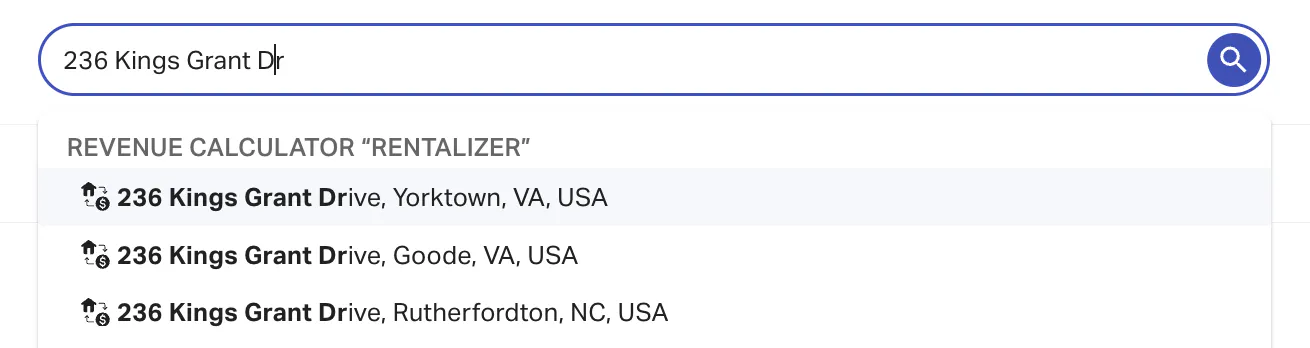
Option 3: For-sale properties
Let’s say you know what market you’re interested in, but you don’t have a specific property in mind. This is where AirDNA’s for sale properties feature saves the day. We keep track of for-sale listings in every market and automatically apply Rentalizer estimates to those properties. All you have to do is toggle to the For Sale properties in the Market Overview dashboard of the desired area, and you’ll see an up-to-date list of homes that are available on the market right now. Click into any listing that catches your eye, and you’ll be taken into the property page outlined in step 2.

Step 2: Review the financial calculator
Whether you’re analyzing your own property or browsing for-sale listings, the tool generates a comprehensive report. It includes projected monthly and annual revenue, average daily rate, occupancy rates, operating expenses, and cap rate. For for-sale listings, you’ll also see the property’s asking price, making it easy to assess the potential return on investment.
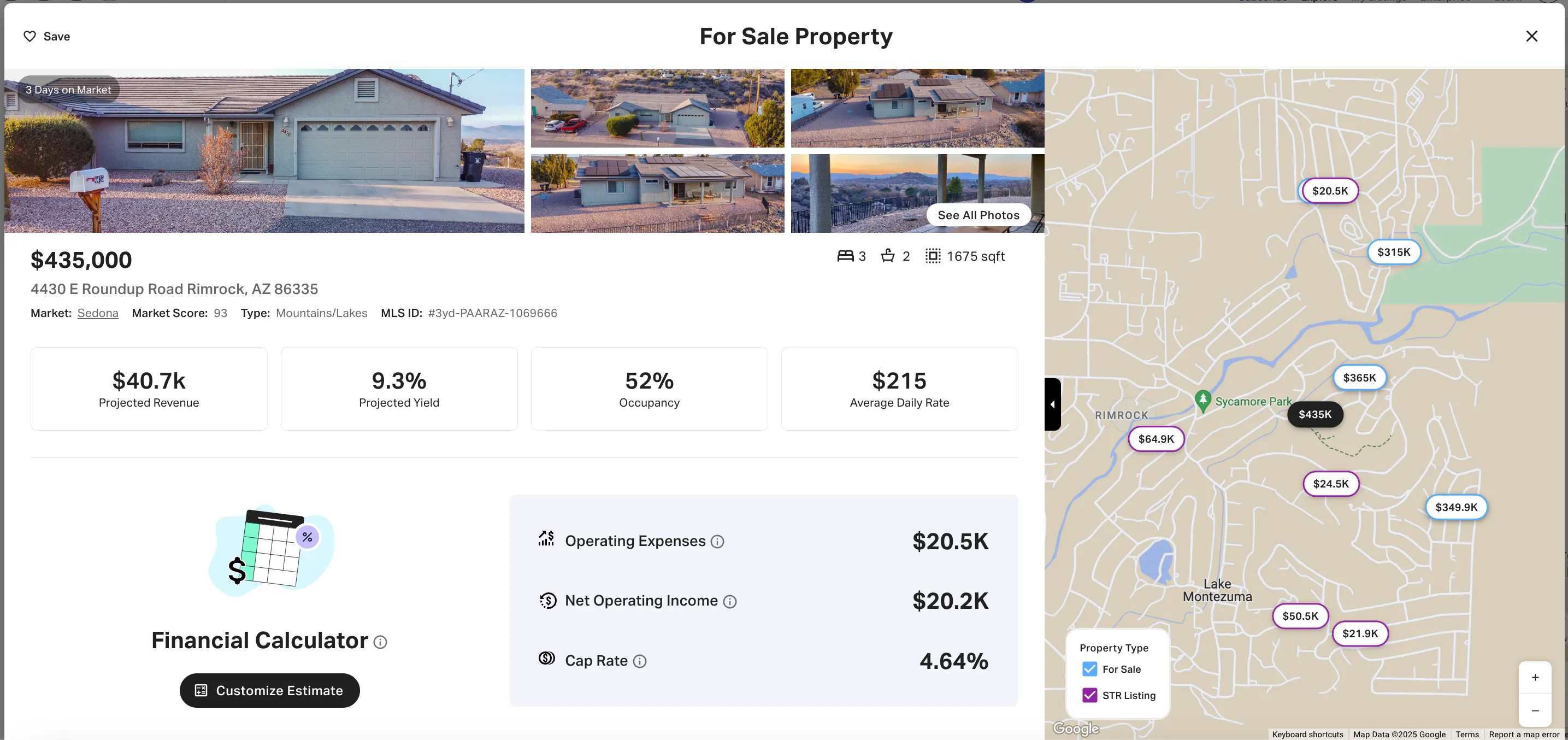
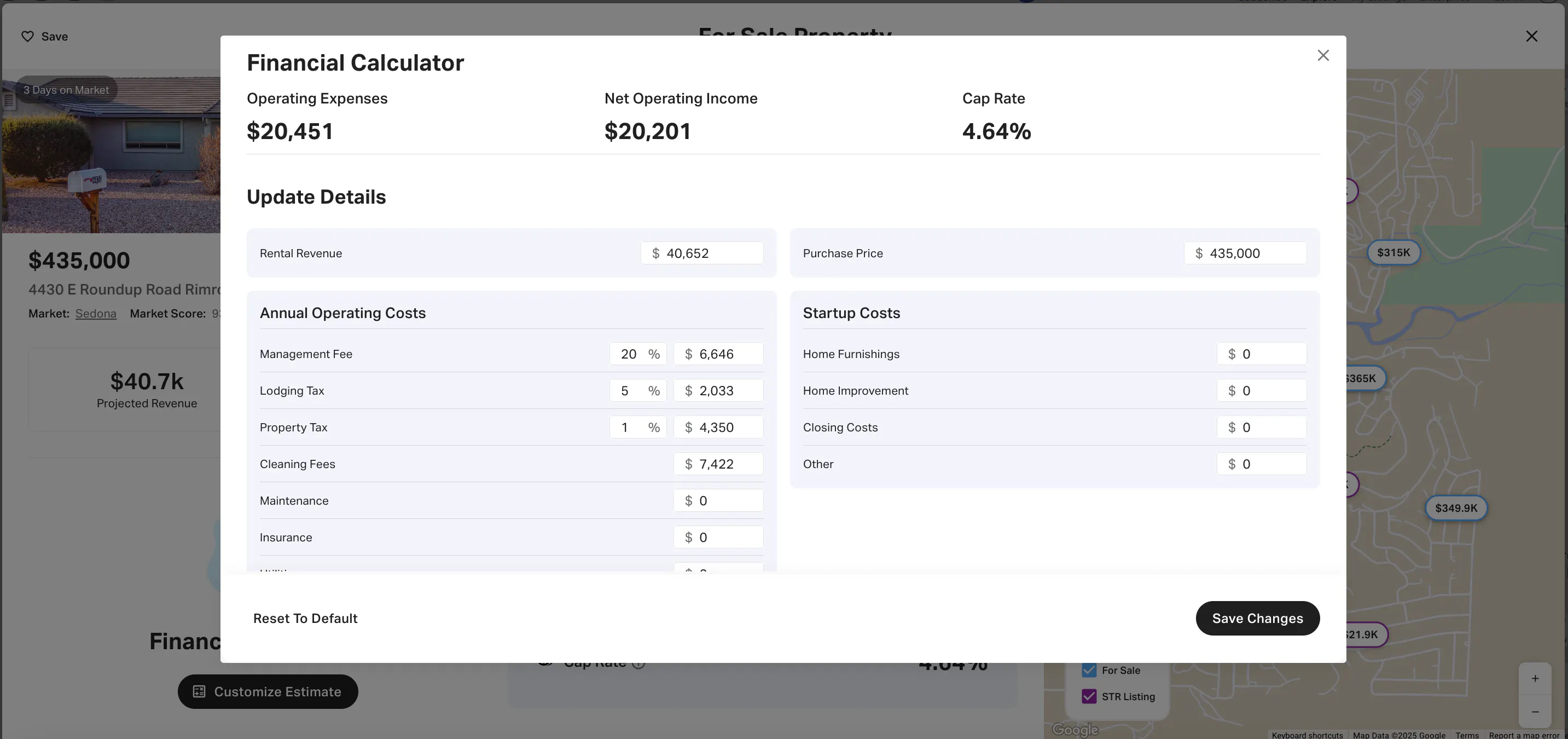
The financial calculator provides an estimate of your net operating income (NOI) and cap rate, assuming a 20% property management fee, 5% lodging tax, and 1% property tax. You can customize your estimate by inputting startup cost information as well as other operational expenses, like insurance.
Step 3: Compare and plan
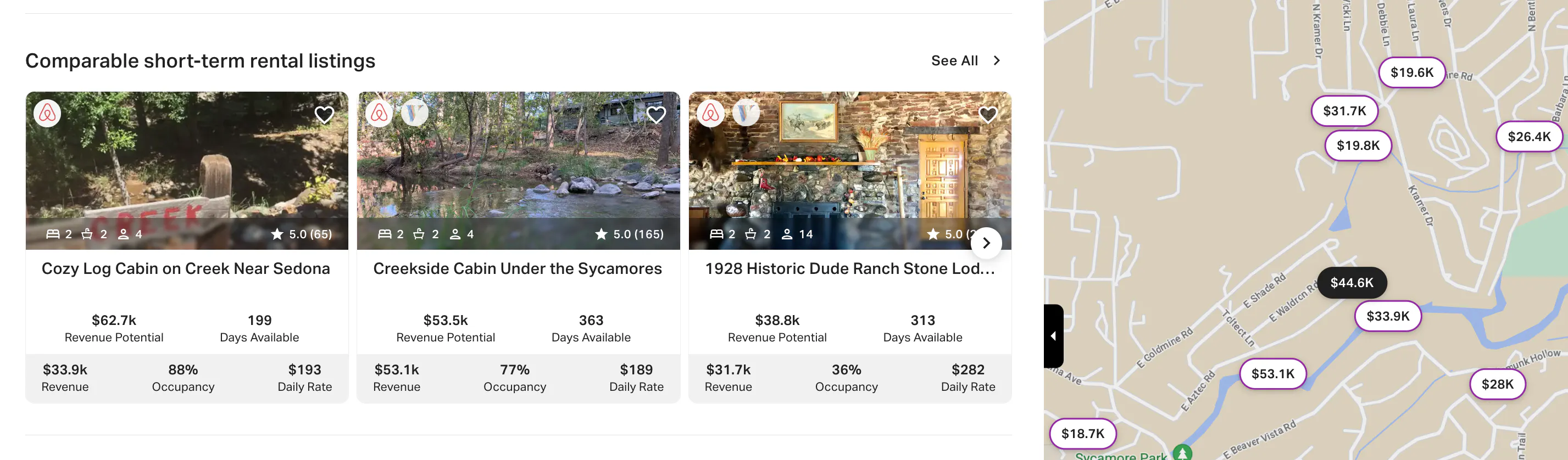
Every Rentalizer results page includes comparable short-term rental listings for the property, as well as similar properties for sale if you’re looking at a for-sale listing. The map on the right of the results page shows other vacation rentals in the area in purple, and other for-sale properties in blue.
Compare financial metrics like revenue and cap rate during your real estate valuation to determine which property offers the best investment potential.
Whether you’re starting with an address in mind, browsing properties for sale, or exploring a specific market, the Airbnb Revenue Calculator makes it easy to evaluate and compare investment opportunities with confidence.
Calculate potential earnings
Understand the investment potential of any address in the world

How AirDNA stacks up against other real estate valuation analysis tools
While traditional real estate valuation tools focus on long-term metrics like annual cash flow and cap rates, AirDNA's tools are built specifically to value properties based on short-term rental performance. Here’s how:
- Dynamic revenue analysis: AirDNA factors in seasonal rate changes, high-demand periods, and realistic ADRs based on market-specific data to project accurate revenue potential.
- Market-specific metrics: With insights like Seasonality Scores, booking patterns, and event-driven demand, AirDNA captures the nuances of short-term rental performance that generic tools miss.
- Competitive analysis: AirDNA provides real-time pricing, occupancy trends, and market saturation data to help investors position properties effectively and assess growth opportunities.
AirDNA delivers valuations based on real-world short-term rental performance by leveraging these specialized metrics. As a result, investors can make informed decisions and maximize returns with confidence.
Choosing the Right Investment Path
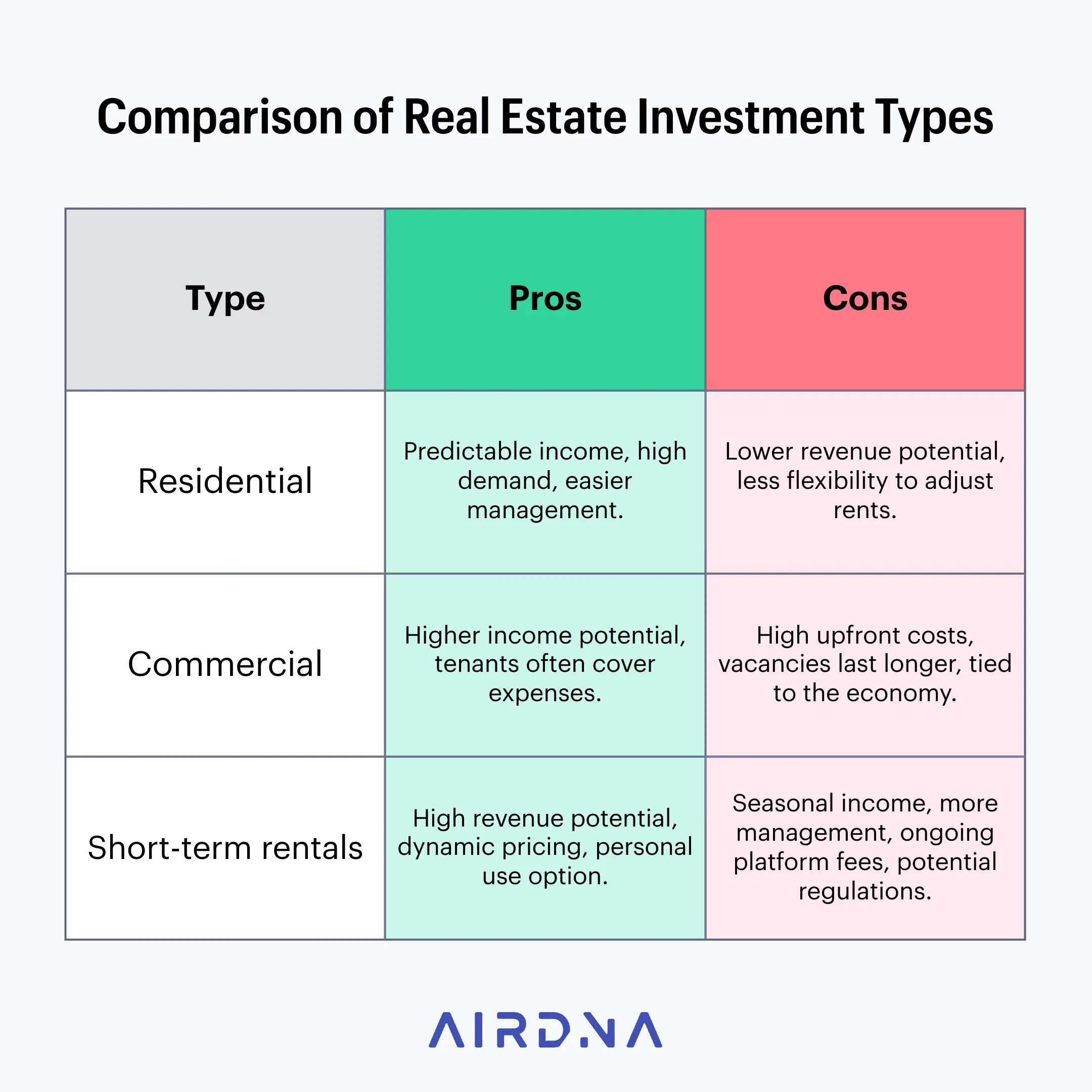
Real estate investment offers multiple paths to building wealth, each with its own valuation methods and return profiles.
Traditional residential rentals provide steady monthly income and relatively predictable property valuations, making them attractive for long-term investors focused on stable cash flow. Commercial properties often command higher rents and longer leases, but require larger capital investments and can be more vulnerable to economic shifts.
Short-term rentals represent a unique middle ground, combining the accessibility of residential properties with the potential for higher returns through dynamic pricing. While a traditional rental might generate $2,000 in monthly rent, the same property as a short-term rental could earn $300 per night, potentially doubling the monthly revenue—though with more variable occupancy rates.
That said, every investor's decision is different. Here’s a side-by-side comparison to help you decide what’s best for you.
When to use real estate valuation tools
Valuation tools are invaluable at every stage of the investment process, especially in the early phases when you’re deciding where and how to invest. Here’s how they can help:
1. Understand how much revenue a property could generate
Tools like AirDNA’s Airbnb Revenue Calculator estimate annual revenue, average daily rates (ADR), occupancy rates, and cap rate. For example, a valuation tool could reveal whether a lakefront property’s seasonal income outweighs a city apartment’s steady demand.
2. Compare different types of investments side by side
If you’re torn between a short-term rental or a long-term residential property, valuation tools can provide a clear picture of expected cash flow, operational costs, and return on investment, helping you choose the option that best aligns with your goals.
3. Spot market opportunities and potential gaps
Use tools to identify promising markets where demand outpaces supply or where adding amenities could give you an edge. For instance, in a high-demand vacation area, offering rare features like a private pool or EV charger might significantly boost revenue.
4. Account for local conditions and risks
Valuation tools help you factor in critical risks like seasonality, regulatory constraints, and competition. This ensures your investment strategy is rooted in an accurate understanding of market-specific challenges and opportunities.
By using real estate valuation analysis tools from the outset, you can confidently evaluate properties, compare options, and navigate market nuances to choose the investment path that best aligns with your financial goals.
ARTICLE SUMMARY
What separates successful property investors from those who struggle? The right valuation tools and knowing how to use them. This guide breaks down essential property valuation methods and analysis tools for both traditional investments and short-term rentals, helping you make data-driven decisions with confidence.
Jamie Lane
AirDNA Chief Economist
He is responsible for data analysis, thought leadership, and leveraging advanced analytical techniques to provide new insights into short-term rental market trends. Native to Atlanta and an Airbnb host himself, Jamie enjoys cycling, mountain biking, backpacking, running, and playing in a dart league in his free time.
