

 Calculate Revenue
 Research Markets
 Find For Sale Properties
 Compare My Listing
 STR Revenue Calculator
 Custom Comp Sets
 Submarket Insights
 Custom Search Filters
 Rate Recommendations
 Performance Benchmarking
 Competitor Comparison
 Owner Contact Details
 Property-level performance data
 Tourism Insights
 Real Estate Investment Analytics
 About Us
 Sales
Sales Support
 Press
PressWhy Private Rooms are the Focus of Airbnb’s Summer Release | AirDNA
Published: May 16, 2023
Last updated: February 26, 2025

Dillon DuBois
Airbnb announced its summer product update on May 2 with dozens of feature upgrades and usability improvements, like total price display and enhanced maps. But the most talked-about update is the introduction of Airbnb Rooms, a collection of tools that make it easier for guests to find private room listings and for hosts to provide comfortable experiences.
This move to reignite guest interest in renting private rooms—part of Airbnb’s original business model—raises some obvious questions. Why is Airbnb highlighting this segment here and now? And what does this strategy say about the company’s expectations for the future of the short-term rental (STR) space?
The history of Airbnb private room listings
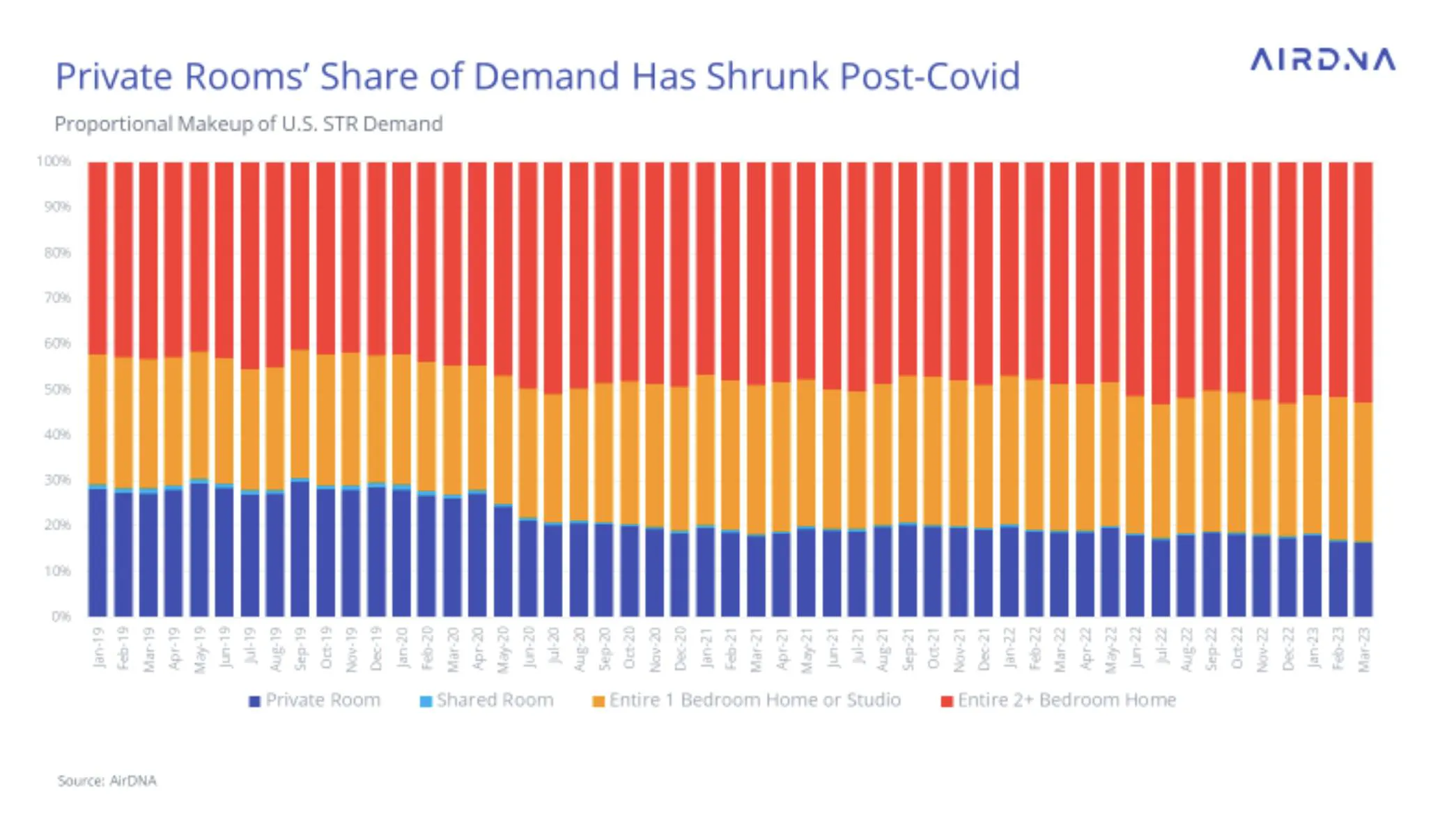
Private room listings made up more than 25% of total STR nights stayed in in 2019. Then 2020 hit. Unsurprisingly, private and shared rooms fared especially badly as health concerns rose. Private rooms made up less than a fifth of total demand by the end of 2020 and have gradually declined since, reaching an all-time low of 16.2% in March 2023.
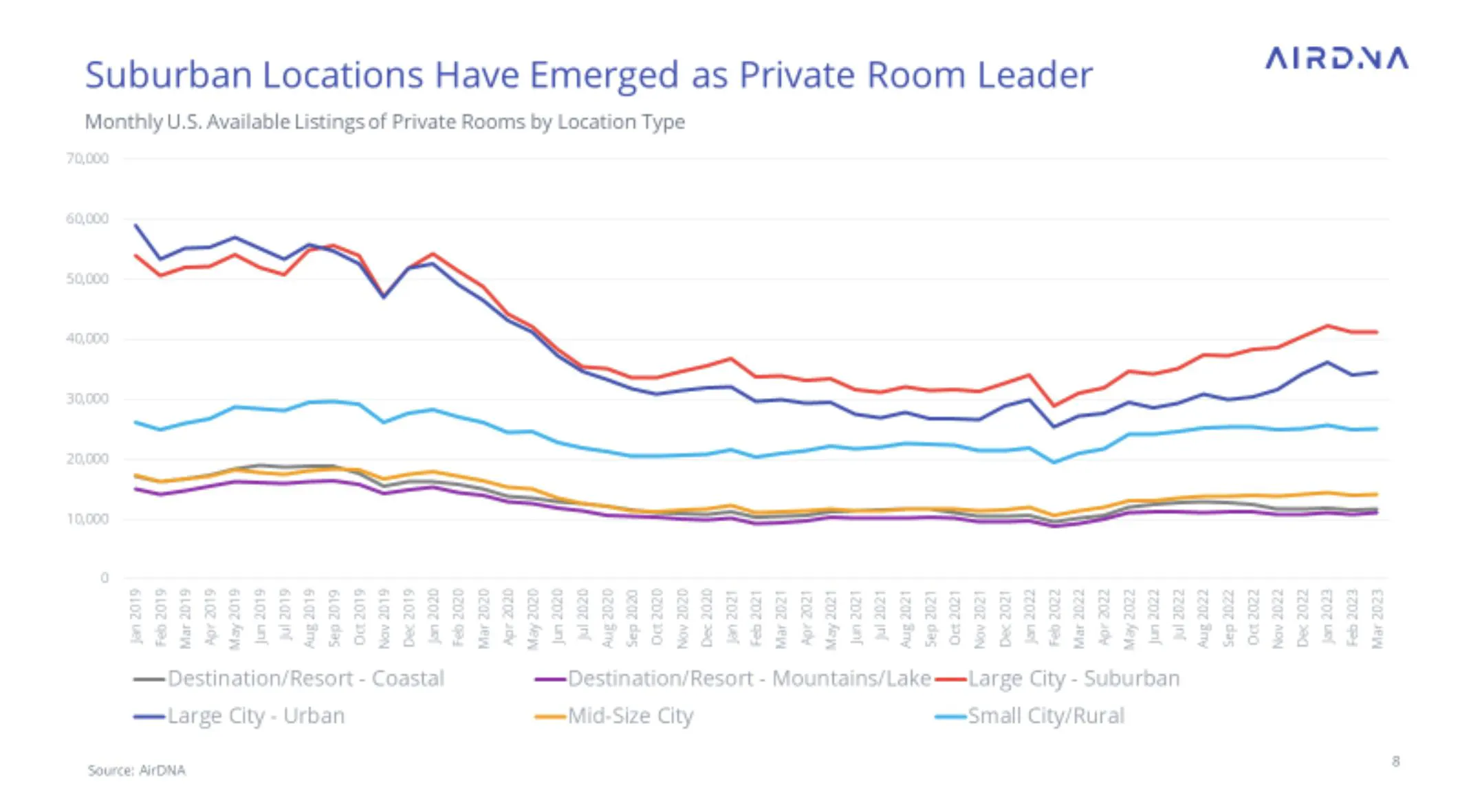
The number of private rooms available also declined significantly as the COVID-19 pandemic unfolded—and it hasn’t recovered. While the rest of the STR industry has seen rebounding growth since February 2022, there are still between 40,000 and 50,000 fewer private rooms versus 2019’s highmark.
Where private rooms are listed has also shifted in recent years. Urban locations once held the top position for private room listings, but increasing regulations in some urban areas, coupled with interest in less densely populated areas post-COVID, have made Suburban locations the biggest location type for private rooms. Small City/Rural markets have also closed the gap on Urban’s popularity significantly since 2019.
How today’s economy is impacting travel
Given lackluster growth statistics, why is Airbnb focusing on this type of listing rather than larger homes that have seen phenomenal growth in the past few years?
While we can’t know exactly why Airbnb makes its business decisions, a good guess is that Airbnb is motivated to push Rooms now because of the changing economic conditions most forecasters are expecting.
Oxford Economics’ baseline scenario (what will likely happen if nothing major changes) forecasts a recession starting in the third quarter of this year. At AirDNA, we use Oxford’s data intensively when forming opinions about our outlook and agree with their forecasts. Slowing employment and pullback in investment is the most likely outcome of the aggressive rate hike regime the Fed has undertaken in the last year. While we’re unsure whether this most recent hike will be the last one, the speculation that it might be (even though inflation remains well above the Fed target of 2%) is a direct result of faltering economic expectations, anxieties about bank failures, and the slowing pace of new investment.
This economic environment obviously has an impact on people’s everyday lives, including how they travel, invest, and afford homes … all things Airbnb is acutely interested in.
Why is Airbnb leaning into private rooms? (Hint: the economy!)
So what do consumers look for in troubled economic times? We don’t expect that travel will fall, even while the rest of the economy experiences a downturn. In fact, Oxford thinks accommodation spending in the U.S. will increase by more than 12% in 2023. A December 2022 survey by Destination Analysts showed that more than half of respondents said that travel remains a high priority. But about half also said that high prices kept them from traveling. These conflicting responses mean that travelers are likely looking for a good deal.
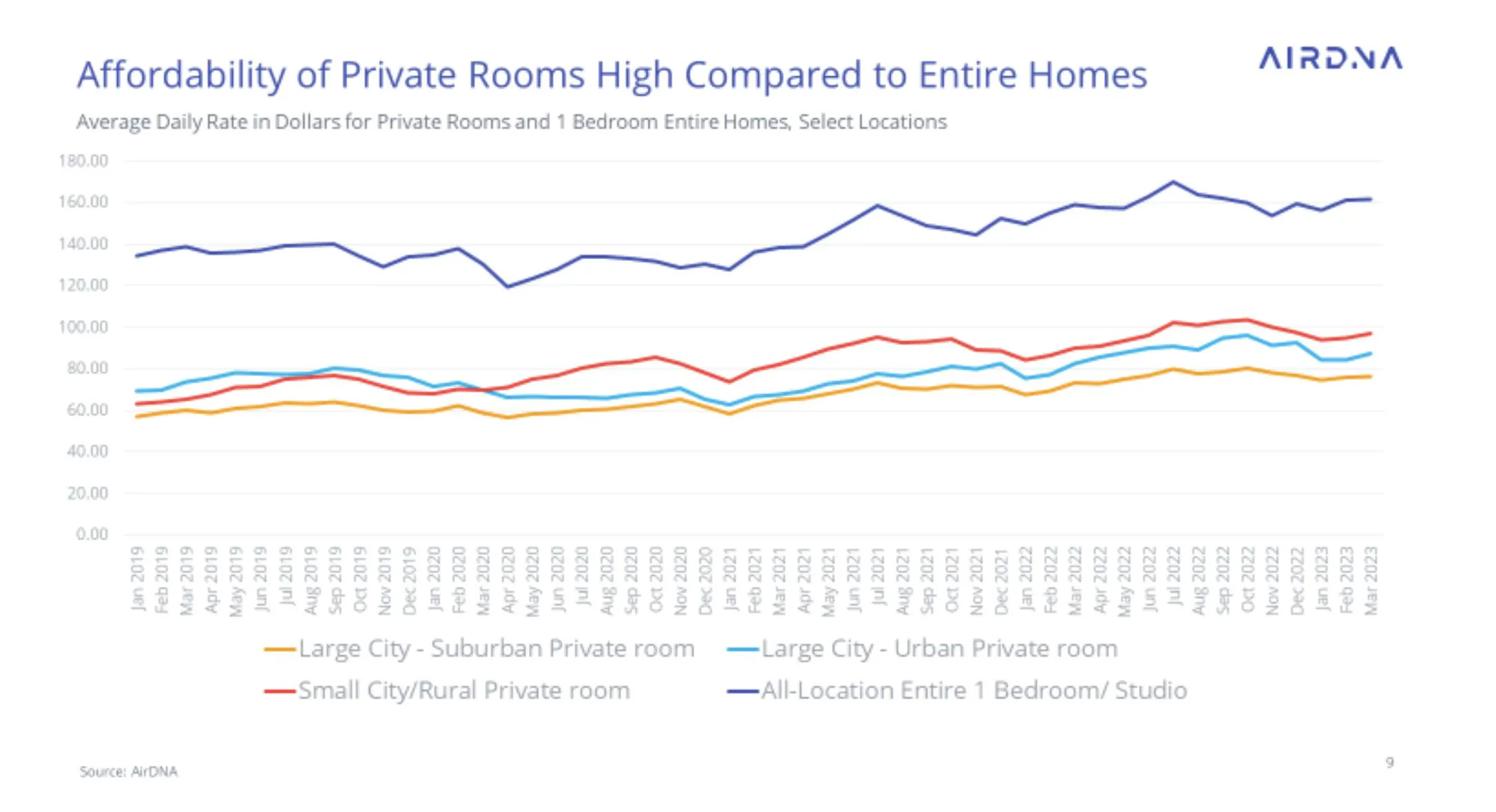
Private room listings excel when dealing with consumers who are prioritizing travel but very concerned about affordability. Average rates for private rooms have remained consistently at 55%-60% of single-bedroom entire home listings. For the three locations with the most private room listings (Small City/Rural, Large City-Suburban, and Urban), rates are between $60-$80 lower per night than the average single-bedroom entire home.
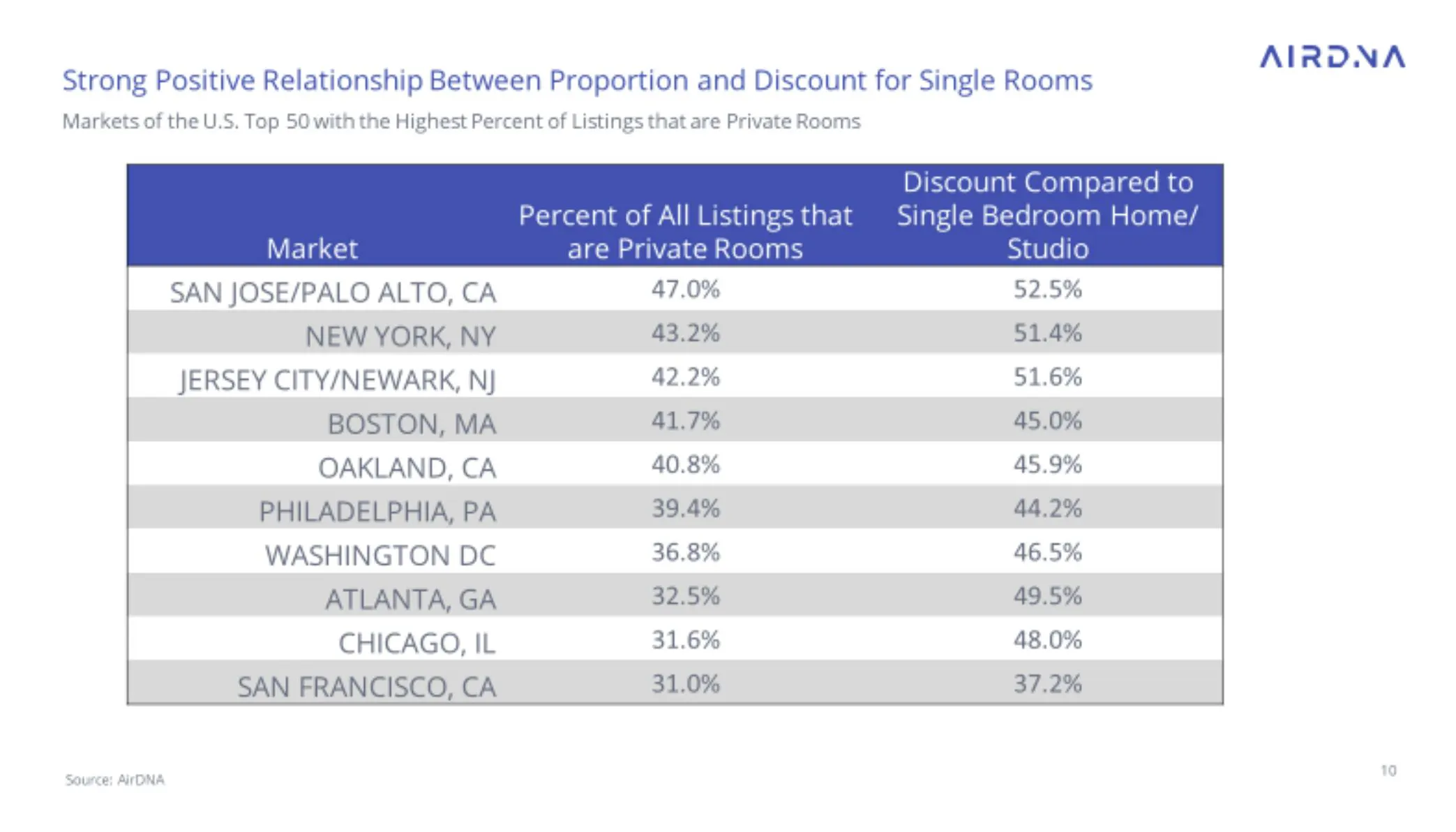
And the more private room listings in a location, the better the savings for travelers. When looking at the top 50 STR markets in the U.S., there is a strong association between the percentage of private room listings and the difference in price between single rooms and one-bedroom entire homes. For instance, San Jose/Palo Alto has the highest proportion of private room listings, nearly 50% of the market’s total listings. Private rooms in this area rent for an average of 52.5% less than single-bedroom entire homes or studios. In areas with a large percentage of private room Airbnbs, travelers can expect decent savings if they’re willing to forego a whole-home rental.
Meanwhile, markets with a low percentage of private room listings see smaller discounts between private rooms and single-room entire homes/studios. Popular vacation destinations like Big Bear, Gatlinburg/Pigeon Forge, and Panama City all have less than four percent of listings as private rooms. Private room prices in these markets are only 15%-24% lower than single-bedroom homes.
Since Airbnb makes its money when people book stays, it’s no wonder the company is looking to tap into this under-supplied, traveler-enticing area. For travelers concerned about high prices, the ability to book a room for well under $100 a night is an attractive proposition. The new features Airbnb introduced to make people feel more comfortable staying in private rooms likely have two benefits: attract budget-conscious travelers, and provide a good experience to encourage travelers to use Airbnb again in the future.
Positive experiences lead to repeat guests, and appealing to affordability is an important way to secure demand growth for the future.
Airbnb has also been vocal over the past year about attracting new hosts (it was a major focus of their 2022 Winter Release). Stressing private room stays feeds into this goal by making it easier for anyone to become an Airbnb host. This not only aligns with Airbnb’s goals but is also appealing in this economy to people who may be looking for extra income.
Monetary tightening by the Fed has had a strong effect on mortgage rates, and the total mortgage payment for a typical new home has increased considerably. (This has had a corresponding negative effect on our yield calculations, which have had a strong relationship with new supply in the past.) If home sales continue contracting, then a potential source of new STR listings is people letting rooms in homes they already own or rent. We may also see house hacking increase in popularity, particularly with Airbnb making it easier for new homeowners to rent private rooms in order to afford their mortgage.
A creative business approach during a unique economic time
The past two years have seen a veritable Airbnboom, with supply and demand both quickly growing coming out of the pandemic. Things are a bit different now, with the economy impacting both real estate investing and consumer spending. At the same time, the potential recession at the end of this year looks to be different from recent economic dips. People are still willing to spend on travel … but they might be looking for a better deal.
Airbnb is shoring up for this unique economic environment by tapping into a historic approach to STRs. One that—if done correctly on Airbnb’s part—appeals to both thrifty travelers and a new group of hosts. Now all that remains to be seen is if hosts and travelers are willing to re-embrace Airbnb Rooms.
Rentalizer™
ARTICLE SUMMARY
Airbnb's latest business move to reignite guest interest in renting private rooms raises some obvious questions. Why is Airbnb highlighting this segment here and now? And what does this strategy say about the company’s expectations for the future of the vacation rental space?
Dillon DuBois
AirDNA Senior Product Manager
Dillon DuBois is a seasoned expert in the short-term rental space, having worn many hats at AirDNA since joining in 2019. From driving B2B marketing initiatives to shaping product strategy, Dillon’s deep understanding of both the company and the industry makes him a key player in delivering innovative solutions. Now a Senior Product Manager, he leverages his experience to bridge the gap between data and user needs. He manages his own short-term rental in Medellín, Colombia, and enjoys all things outdoor adventure, travel, cooking, & surfing.
