

 Calculate Revenue
 Research Markets
 Find For Sale Properties
 Compare My Listing
 STR Revenue Calculator
 Custom Comp Sets
 Submarket Insights
 Custom Search Filters
 Rate Recommendations
 Performance Benchmarking
 Competitor Comparison
 Owner Contact Details
 Property-level performance data
 Tourism Insights
 Real Estate Investment Analytics
 About Us
 Sales
Sales Support
 Press
PressEuropean Market Review January 2022
Published: February 24, 2022
Last updated: May 5, 2026

Jamie Lane
After a downturn in December 2021, European short-term rental demand marked the highest positive percentage change in a single month in January 2022 since the start of the pandemic. With over 18.2 million nights sold, demand in January finished 12.5% above January 2019 figures (+87.7% vs. January 2021 and -4.5% vs. January 2020).
Rates and Revenues Continue to Rise, But Is it Sustainable?
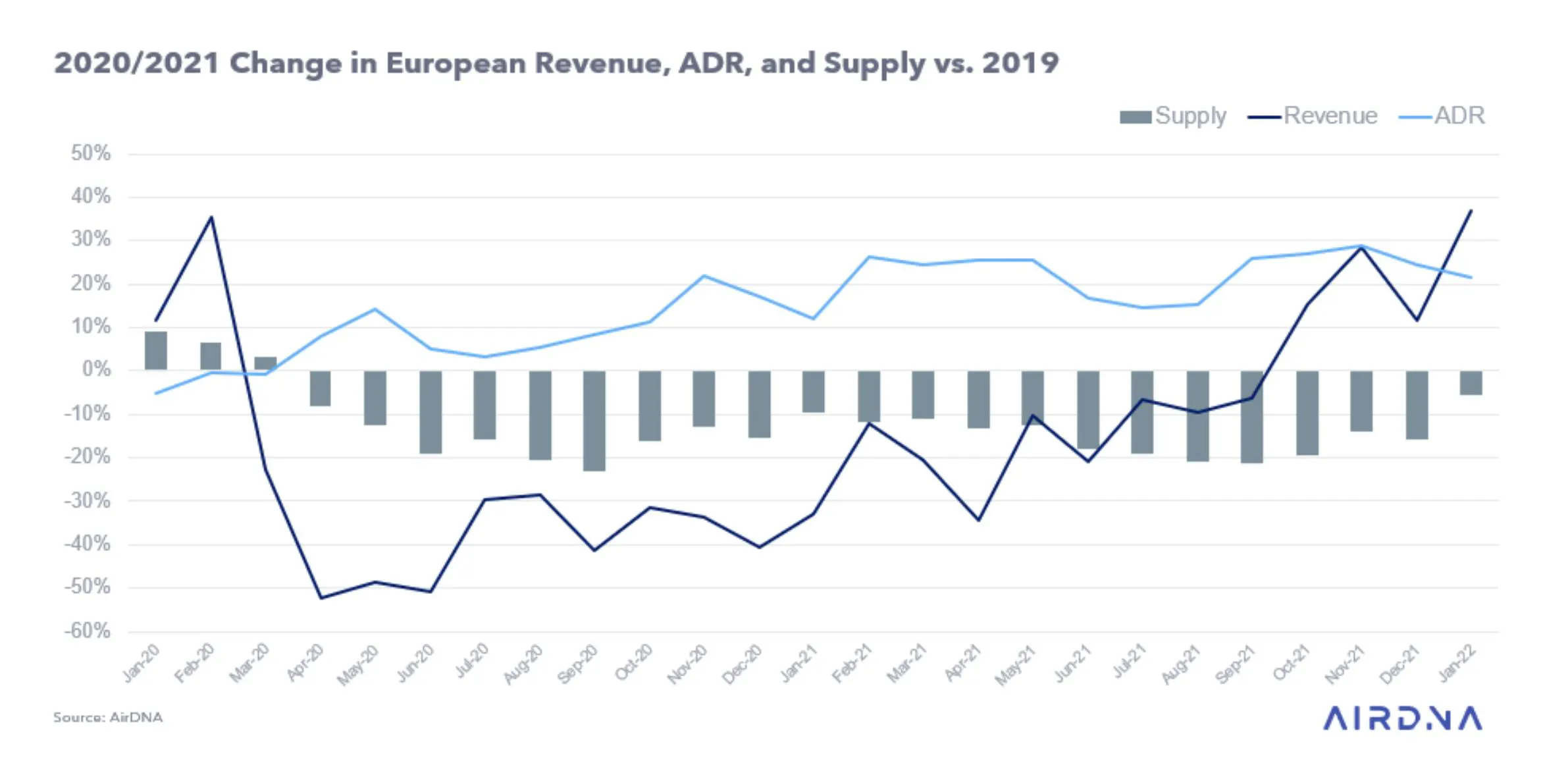
Revenue in the month of January was 36.9% greater than in January 2019 (+104.2% over January 2021 and +22.8% over January 2020), lofted by a tailwind of rising demand and guests paying 21.7% higher average daily rates (ADR) vs. January 2019. Revenue has seen double-digit growth in the last four months since turning positive in October 2021. Similar but to a greater extent, ADRs have seen double-digit growth relative to 2019 for the last 16 months.
Higher ADRs and revenue have been primarily driven by the mix of units and locations that guests have been booking, consisting of more whole homes and non-urban destinations than prior to the pandemic. Another factor driving increased ADRs and revenue is price appreciation resulting from high-demand markets and peak periods. ADR and revenue growth may moderate as:
- Demand returns to urban markets where units are typically smaller with lower rates
- Rates are driven down by increased competition and supply entering the market
Historically, January, February, and March experience the lowest levels of supply and demand of short-term rentals in Europe. Compared with August, the peak demand month, the month of January has seen on average -65.3% less demand and -20.5% less supply of available listings on the market since 2018. In the month of January 2022, there were -5.3% fewer available listings on the market relative to January 2019.
Despite remaining lower than 2019 supply levels, January 2022 was closest to normal monthly supply levels since March of 2020. Increased demand on a contracted supply of available listings pushed occupancy to a record high of 42.3% for the month of January, breaking the previous record of 41.1% in January 2019.
Russia, Austria, and Croatia Led Demand Growth, while Czech Republic Continues to Lag
The strength of demand across most of Europe intensified in the first month of 2022, following a downturn in December 2021 where only France and Russia saw positive demand levels compared to 2019. January 2022 saw 14 of the top 20 short-term rental European countries record positive demand vs. January 2019, with 10 of the 20 seeing double-digit positive demand. Russia (+45.1%), Croatia (+43.7%), Austria (+43.4%), Greece (+36.6%), and France (+30.5%) each garnered demand figures greater than 30% above January 2019.

The Czech Republic has maintained the bottom of the list in terms of monthly change in demand vs. 2019 since September 2021. Continuing the trend in January 2022, the country saw -47.3% less demand than in January 2019. Enforced closures and other pandemic restrictions have deterred bookings within the capital city Prague which, like many other large European cities, is heavily reliant on foreign tourists. January demand outside of large cities in the Czech Republic was up 25.6% over January 2019, while demand in large cities (which includes Prague and Brno) was down 67.9%.

January Travelers Skip the City for Non-Urban Destinations
As has been a theme over the last 22 months, demand continues to take a greater interest outside of the largest cities in Europe.
The pandemic delivered a forceful blow to demand and, consequently, supply in large cities, which have historically held the most available listings. Supply in these urban areas has been slow to recover after enduring an extended period of diminished demand. Coincidentally, the supply in many non-urban locations has grown in response to an influx of demand. Though strong, the growth of supply in non-urban locations has not fully offset the decrease in listings in urban locations, as the mix of supply and demand tends to vary between the two location types.
Russia excluded, each of the top 20 European countries saw negative demand for their largest cities in January 2022 relative to January 2019, averaging 42.7% lower. Of the large cities, Amsterdam, NL (-78%) had the weakest demand relative to 2019, followed closely by Dublin, IE (-72%), Munich, DE (-69%), Prague, CZ (-69%), and Frankfurt, DE (-68%). Contrastingly, demand outside of the largest cities for the top 20 countries was 45.4% higher on average in January.

Destination/resort areas are pacing considerably higher than in recent months, with coastal areas pacing up 57% for spring vs. around 30% over the past few months. Mountain/lake destinations are pacing even higher, up 62% for spring compared to 2019, significantly higher than the 30% to 40% growth in recent months.
Spring Demand Pacing Strong Across Most European Countries, Ukraine Invasion Brings New Uncertainty
For the months of March and April, nights booked as of February 14th, 2022, are pacing up 4.3% on average across the top 20 European countries. Denmark is leading the charge, up 108% nights booked over 2019 for the two spring months. Germany (40.8%), Russia (35.5%), the United Kingdom (28.4%), and Switzerland (21.9%) are seeing solid pacing gains for these months, with each 20% higher than in 2019.
The Russian invasion of Ukraine brings additional uncertainty to Europe’s recovery. While Ukraine (0.6%) and Russia (2.9%) make up only a small share of European short-term rental demand, a prolonged conflict will disrupt global travel and could cause guests to either avoid travel to certain regions or even Europe in general.
Barring a prolonged or escalating conflict, new travel restrictions related to COVID-19, or some other catastrophic event, 2022 looks to be a year of recovery for Europe. Pent-up demand, the reopening of international borders, and renewed confidence among American travellers point to a favourable outlook for the European short-term rental industry in the coming months. As we enter the month of March, we expect to see a surge in summer bookings as travellers finalise their sunny season getaways.

Jamie Lane
AirDNA Chief Economist
He is responsible for data analysis, thought leadership, and leveraging advanced analytical techniques to provide new insights into short-term rental market trends. Native to Atlanta and an Airbnb host himself, Jamie enjoys cycling, mountain biking, backpacking, running, and playing in a dart league in his free time.
