

 Calculate Revenue
 Research Markets
 Find For Sale Properties
 Compare My Listing
 STR Revenue Calculator
 Custom Comp Sets
 Submarket Insights
 Custom Search Filters
 Rate Recommendations
 Performance Benchmarking
 Competitor Comparison
 Owner Contact Details
 Property-level performance data
 Tourism Insights
 Real Estate Investment Analytics
 About Us
 Sales
Sales Support
 Press
PressAirbnb Cancellation Policies: The Best Choice for Hosts
Published: August 20, 2024
Last updated: September 25, 2026

Bram Gallagher
Key Takeaways:
- Your Airbnb cancellation policy can significantly impact booking rates and revenue—choosing the right one for your market is crucial.
- Different markets and property types need different cancellation policies. What works for a beach vacation rental might not suit an urban business-travel apartment.
- Implementing strategies like clear communication, flexible options, and early booking incentives can help minimize cancellations and protect your income.
Airbnb cancellation policies are more than just fine print—they're a tool that can significantly impact your hosting success.
The right Airbnb cancellation policy can attract more bookings by offering guests the flexibility they desire, while also protecting your income from last-minute cancellations. In unpredictable seasons, the right cancellation policy can be the difference between a calendar full of secure bookings and one plagued by costly vacancies. By striking the perfect balance between guest appeal and host protection, your cancellation policy becomes a key driver of both your occupancy rates and your bottom line.
This guide will help you understand the different types of cancellation policies, how to select the best one for your property and show you how to handle cancellations like a pro.
How is your STR performing?
Is your vacation rental better than your competition? Connect your Airbnb listing to see its Booking Performance Score.
Types of Airbnb Cancellation Policies
Airbnb offers several cancellation policies, ranging from flexible to strict. Each policy has its own set of rules regarding refunds and timing. Let's break them down:
Flexible
The Flexible cancellation policy is the most guest-friendly option:
- Full refund for cancellations made at least 24 hours before check-in.
- If a guest cancels less than 24 hours before check-in, you receive payment for each night the guest stays, plus one additional night.
Many listings that start out with a more flexible cancellation policy transition to a more strict one within their first year. This could be because they’ve received enough reviews to feel established or because they have realized they are losing revenue from cancellations. Either way, a flexible cancellation policy does not appear to be a common long-term strategy for higher ADR listings in urban markets.
A flexible cancellation policy does not appear to be a common long-term strategy for higher ADR listings.
Moderate
The Moderate cancellation policy offers a balance between guest flexibility and host protection:
- Full refund for cancellations made at least 5 days before check-in.
- For cancellations made between 5 days and 24 hours before check-in, the first night is non-refundable, but the remaining nights are refunded.
- Cancellations within 24 hours of check-in result in a 50% refund of the nightly rates for any unused nights.
This policy offers a middle ground, giving you more security while still accommodating guests who may need to change their plans.
Firm
The Firm cancellation policy provides stronger protection for hosts:
- Full refund for cancellations made at least 30 days before check-in.
- 50% refund for cancellations made at least 7 days before check-in.
- No refund for cancellations made less than 7 days before check-in.
Strict
The Strict cancellation policy offers the highest level of protection:
- Full refund only if canceled within 48 hours of booking and at least 14 days before check-in.
- 50% refund if canceled at least 7 days before check-in.
- No refund for cancellations made less than 7 days before check-in.
This policy is ideal for hosts who prioritize guaranteed revenue, particularly for properties with high demand or seasonal bookings.
Long-Term Cancellation Policies
For stays of 28 nights or more, Airbnb enforces long-term cancellation policies:
- Full refund if the guest cancels within 48 hours of booking and at least 28 days before check-in.
- After this period, the guest is responsible for paying the first month of the stay and providing 30 days' notice for cancellation.
This policy is designed to protect your income on extended stays, which often require more planning and preparation.
Super Strict (by invitation only)
Airbnb offers two Super Strict policies (30 days and 60 days) to a select group of hosts:
- These policies are even more rigid than the standard Strict policy
- Hosts must be invited by Airbnb to use these policies
Remember, the right policy for your property depends on various factors including your market, property type, and personal preferences. Now let’s explore how to choose the best cancellation policy for your unique situation.
What’s the Most Common Airbnb Cancellation Policy?
Interestingly, our data shows that the Strict cancellation policy is the most common choice among Airbnb listings in the United States, with 26% of hosts choosing this option to protect their bookings.
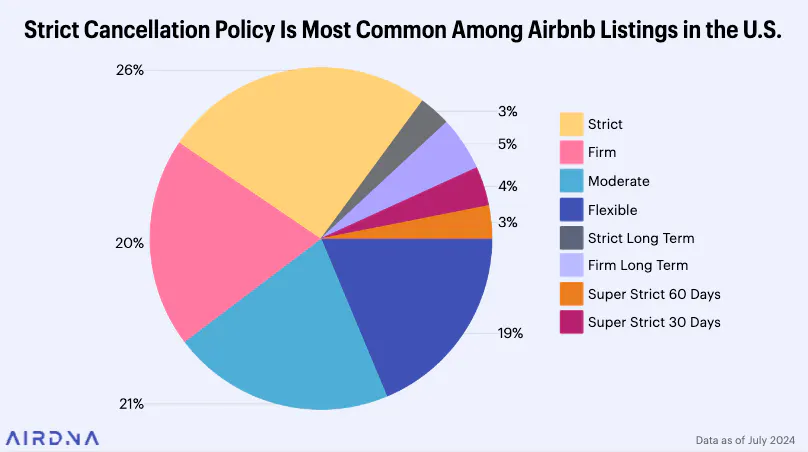
This preference for stricter policies suggests that many hosts prioritize financial security over the potential for increased bookings that more lenient policies might offer. However, it's important to note that the right policy for your property depends on various factors, including your specific market conditions and target guest demographic.

How to Choose the Best Airbnb Cancellation Policy
Evaluate the Market
The best Airbnb cancellation policy isn’t one-size-fits-all. It’s important not to base this decision on your gut. Instead, we recommend making an informed decision based on your market and overall industry trends.
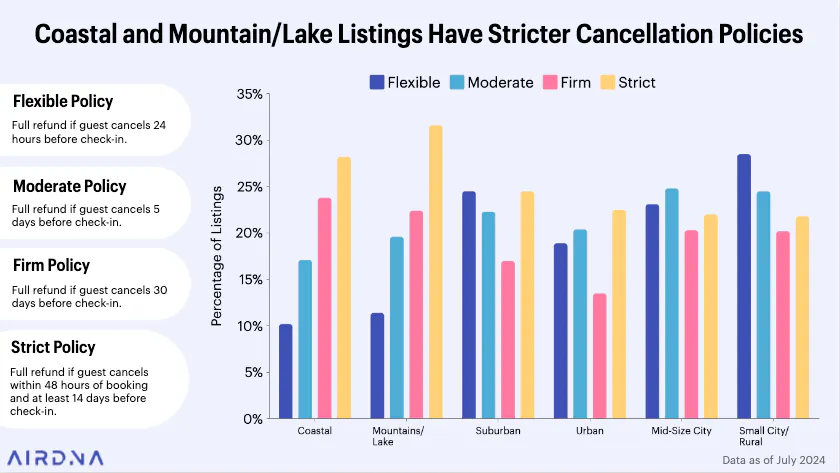
Our data shows that cancellation policies vary significantly by location type. Coastal and mountain/lake destinations tend to favor stricter policies, while urban and suburban areas show a more balanced distribution. Small city/rural locations have the highest proportion of flexible policies. These trends likely reflect the unique characteristics of each market, such as seasonality and typical guest profiles.
The great news is AirDNA makes it easy to access this vital information specific to your market. Here's how to find cancellation policy insights in your market:
- Log into your AirDNA account.
- Navigate to your desired market's overview page.
- Scroll down to find the "Market Performance Details" section.
- Look for the "Cancellation Policies" subsection. Here, you'll see a breakdown of policies used in your market.
- You'll notice AirDNA's unique merged categories: flexible, moderate, strict, super strict, and other. These categories combine policies from both Airbnb and Vrbo for easier comparison.
- The "other" category includes any custom policies that don't fit the standard options.
- Compare the percentages for each policy type in your market. Are strict policies more common, or do hosts tend to offer more flexibility?
By using these insights, you can align your cancellation policy with market norms or potentially differentiate your listing to attract more bookings. Remember, the right choice balances your financial protection with guest appeal in your specific market.
Research Airbnb Markets
Gain insights into the revenue and occupancy trends in your market.

Assess Guest Preferences
Understanding your target guests' preferences is crucial for crafting an effective cancellation policy. Start by analyzing your booking patterns: Are you seeing more last-minute reservations or advance planners? This can give you insight into your guests' needs and booking behaviors.
Consider your typical guest profile. Families planning annual vacations might appreciate the security of stricter policies, while spontaneous travelers or business guests may prefer more flexibility. Think about your property's location and amenities - are you attracting long-term stays or quick weekend getaways?
Also, examine how your cancellation policy might affect your competitiveness. A more flexible policy could attract more bookings, but it also increases the risk of last-minute cancellations. A more strict policy could deter potential guests from booking you over a comparable property with a more flexible policy. You really need to understand your guests and your competitors to weigh your options effectively.
Evaluate Potential Risks as a Host
Assessing the risks associated with different policies is a critical step in protecting your vacation rental business.
Consider these factors:
- Seasonality: Dive into your market's seasonal trends. During high season, when demand outstrips supply, a stricter policy might be warranted as rebooking is easier. However, during shoulder seasons, a more flexible policy could give you an edge. Consider implementing dynamic policies that adjust with the seasons to maximize your protection and appeal.
- Property type: The uniqueness of your property should influence your policy. Luxury or one-of-a-kind properties often have longer booking windows and attract guests willing to commit. In contrast, more standardized accommodations might benefit from flexibility to stand out in a crowded market. Use AirDNA comps to see how similar properties in your area approach this balance.
- Financial buffer: Assess your financial resilience. If each booking is crucial to covering your costs, a stricter policy might be necessary. However, if you have a strong financial buffer, you might afford to be more flexible, potentially attracting more bookings overall. Create a risk matrix to visualize your potential exposure under various policies. Consider your overall business strategy - are you aiming for volume or premium pricing?
Remember, this isn't a set-it-and-forget-it decision. Regularly review and adjust your cancellation policy as you gather more data and experience in your market.
Remember, this isn't a set-it-and-forget-it decision. Regularly review and adjust your cancellation policy as you gather more data and experience in your market.
A Tale of Two STR Types in Florida
Where Stay Type Shapes Policy: Jacksonville
AirDNA data shows Jacksonville's short-term rental market includes 9,826 active listings. At first glance, the city seems to favor customized policies, with "strict" cancellations following closely behind at 21% of all listings. A popular choice among Airbnb hosts is a 3-night minimum stay, accounting for 41.7% of listings.
But zoom in on the private room rentals, and the landscape shifts dramatically.
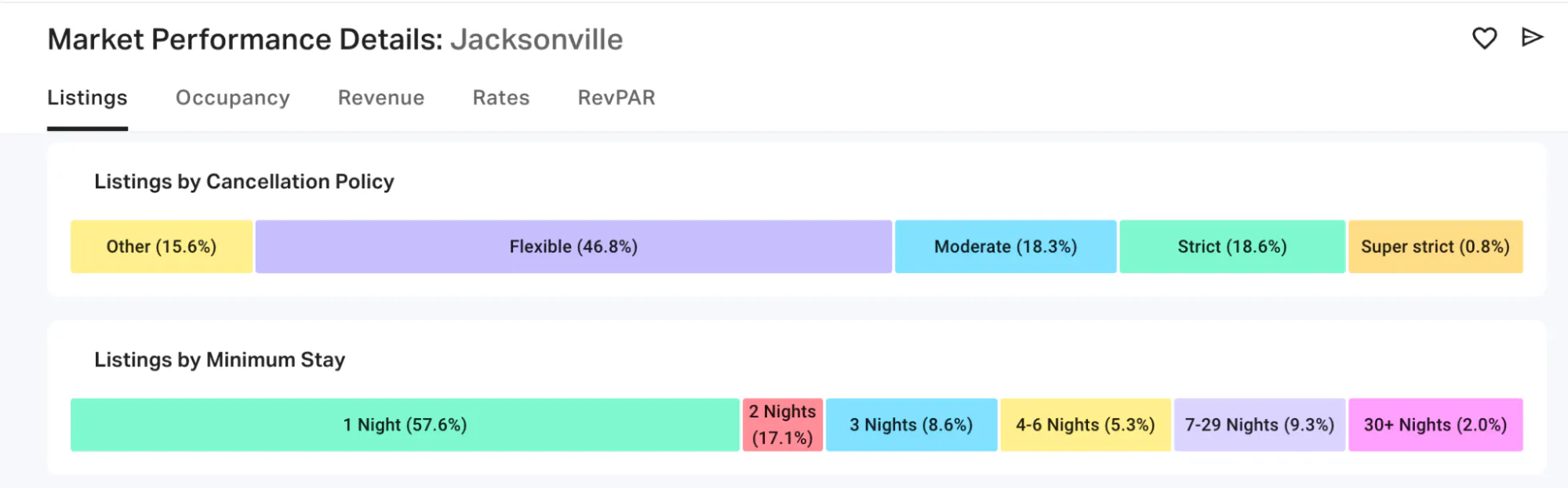
Here, flexibility reigns supreme, with a whopping 46.8% of listings offering flexible cancellation policies - a stark contrast to the city-wide average of just 15.1%. This flexibility extends to stay duration too, with 57.6% of private room rentals welcoming single-night bookings, compared to only 23.6% of all Jacksonville listings.
Why the difference? Guests are likely to stay for shorter periods of time in private room rentals, so hosts have less to lose if a guest cancels at the last minute. A last-minute cancellation for a 1-2 night stay in a private room is less consequential financially than it would for a host renting their entire home. By aligning your policy with these trends, you could make your listing more appealing without significantly increasing your risk.
Where Location Shapes Policy: St. Augustine Beach
Unlike the private room rental market in Jacksonville, St. Augustine Beach, Florida hosts lean towards stricter rules. Here, 21% of listings have strict cancellation policies (compared to 17.4% in Jacksonville), and 13.7% even opt for super strict policies (versus 8.3% city-wide).
This trend towards strictness extends to minimum stays too. A notable 61% of St. Augustine Beach listings require at least a 3-night stay, significantly higher than the 46.1% seen across Jacksonville.
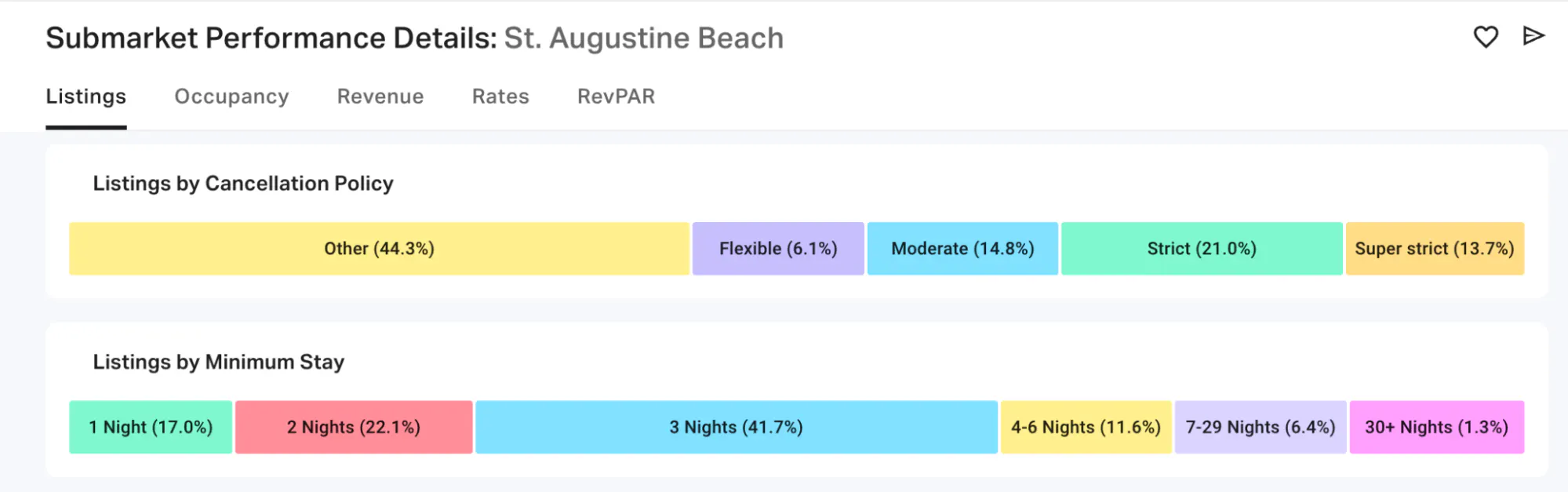
What's driving this trend? It's the allure of the beach. St. Augustine Beach commands an average nightly rate of $282.50, a full ten dollars higher than the Jacksonville average. For hosts here, a last-minute cancellation could mean losing out on premium, high-demand bookings.
The data tells us that in high-demand areas like St. Augustine Beach, stricter policies can help protect your revenue without necessarily deterring bookings. Guests are often willing to commit to stricter terms for that perfect beachfront getaway, especially when planning longer stays.
Market-Informed Pricing Decisions
AirDNA uses data-driven pricing recommendations to propose the best daily rates
How to Minimize and Handle Cancellations

While cancellations are a part of the short-term rental business, there are ways to reduce their frequency and impact:
- Clear communication: Provide detailed, accurate listing information to set proper expectations.
- Prompt responses: Address guest inquiries quickly to build trust and reduce uncertainty.
- Flexible options: Consider offering partial refunds or credit for future stays instead of full cancellations.
- Encourage early bookings: Offer slight discounts for bookings made well in advance.
- Implement minimum stays: Setting a minimum stay requirement can reduce cancellations by attracting more committed guests. However, be sure to balance this with your market demands. This strategy tends to work best during peak season or with guests who typically prefer longer visits.
- Maintain your property: Ensure your rental is always in top condition to avoid cancellations due to maintenance issues.
- Learn from cancellations: Analyze reasons for cancellations and adjust your strategies accordingly.
What about Host Cancellation?
Host cancellations, while sometimes necessary, can have serious consequences. Booking platforms may impose penalties like fees or reduced listing visibility. Guests can often leave reviews about the cancellation experience, potentially damaging your reputation. Frequent cancellations can jeopardize special host statuses and you might need to compensate guests or find them alternative accommodations. Given these risks, host cancellations should be a last resort, used only when absolutely unavoidable.
To minimize the impact of necessary host cancellations:
- Communicate early and honestly with guests about the situation.
- Offer to help find alternative accommodations.
- Consider providing a discount for a future stay if the guest is willing.
- Only cancel as an absolute last resort.
Changes and Extenuating Circumstances

Sometimes, events beyond anyone's control can affect travel plans. Most booking platforms have policies for extenuating circumstances and major disruptive events, but it's important to understand how these might apply to your listings:
Public Health Emergencies
During widespread health crises, like the COVID-19 pandemic, platforms may invoke special cancellation policies. These often allow more flexible cancellations for affected areas.
Government Travel Restrictions
Official travel bans or border closures usually qualify for special consideration under most platforms' extenuating circumstances policies.
Military Actions and Other Hostilities
War, civil unrest, or other dangerous conditions in a host or guest's area may warrant special cancellation provisions.
Large-Scale Outages of Essential Utilities
Extended power outages, water supply issues, or internet blackouts might qualify for special cancellation terms, especially if they significantly impact the stay.
Natural Disasters
Earthquakes, hurricanes, severe storms, and other natural disasters often fall under extenuating circumstances policies.
In all these cases, it's crucial to:
- Stay informed about platform-specific policies for extenuating circumstances.
- Communicate clearly and promptly with guests about any developing situations.
- Be prepared to be flexible and understanding, as these situations are stressful for all involved.
- Document everything carefully in case you need to appeal any platform decisions.
Remember, while these policies are in place to protect both hosts and guests, they can sometimes lead to financial losses. Consider this when setting your rates and managing your overall business strategy.

How to Change Your Airbnb Cancellation Policy
After carefully considering your market and your business goals, you may decide it's time to adjust your Airbnb cancellation policy. Changing your policy is a straightforward process, but it's important to note that any changes will only apply to future bookings, not existing reservations. Before making changes, ensure you're comfortable with how the new policy will affect your bookings and potential income.
Here's a step-by-step guide to updating your cancellation policy on Airbnb:
- From your hosting dashboard, navigate to the Listings tab in the top navigation menu.
- Select the listing that you want to adjust the cancellation policy for.
- Under the Listing Editor, make sure you are toggled to Your space (versus Arrival guide). Scroll down to Cancellation policy, which is towards the bottom as the second to last field.
- You will have the option to choose a standard cancellation policy for stays under 28 nights, as well as a long-term stay policy that applies to stays 28 nights or longer.
- Select the pencil icon by the standard cancellation policy. A new window will open showing the 4 standard options (flexible, moderate, firm, and strict). Select the cancellation policy of your choice and click ‘Save.’
- Choose whether you want to offer a non-refundable option with the toggle button. This option is in addition to your standard policy. Guests can choose to pay 10% less, but you keep your payout no matter when they cancel.
- If you want to adjust your long-term stay policy, select the pencil icon by the policy of that name and choose a new option. Don’t forget to click ‘Save!’
Ditch the guesswork
Plan your STR strategy based on real booking activity and trends—plus, see how things change year over year.
FAQ
What are the different types of Airbnb cancellation policies?
Airbnb offers several cancellation policies to hosts:
- Flexible: Full refund if cancelled at least 24 hours before check-in.
- Moderate: Full refund if cancelled at least 5 days before check-in.
- Firm: Full refund if cancelled at least 30 days before check-in.
- Strict: 50% refund if cancelled at least 7 days before check-in.
- Long Term: Applies to stays of 28 nights or more, with specific rules for long bookings.
- Non-refundable: Guests pay less upfront but receive no refund if they cancel.
What should I consider when choosing the best Airbnb cancellation policy?
When selecting a cancellation policy, consider your local market trends and competition. Think about your property type and typical guest profile - are you catering to business travelers or vacationing families? Factor in seasonal demand fluctuations and your financial buffer. Ultimately, aim to strike a balance between attracting bookings and protecting your income.
How can I minimize cancellations as a host?
To reduce cancellations, start by providing accurate, detailed listing information. Communicate promptly and clearly with guests to build trust. Keep your property well-maintained to avoid last-minute issues. Consider offering flexible options for changes instead of full cancellations. You might also encourage early bookings with slight discounts to secure more committed reservations.
Does a guest canceling their booking hurt your rating as a host?
Guest cancellations don't directly impact your host rating. However, they can indirectly affect your performance metrics. If cancellations lead to last-minute vacancies that you can't fill, it might lower your occupancy rate. This, in turn, could influence your overall hosting performance and visibility on the platform.
Does Airbnb penalize hosts for cancelling?
Yes, Airbnb takes host cancellations seriously. Penalties for frequent or last-minute cancellations can include fees charged to the host and lower search result rankings for your listing. You might lose your Superhost status if you have too many cancellations. In extreme cases, Airbnb may even suspend your account. Given these potential consequences, it's crucial to avoid host cancellations whenever possible to maintain a good standing on the platform.
ARTICLE SUMMARY
This guide offers expert guidance that will boost your bookings and revenue by selecting the best cancellation policy for your market and preventing cancellations.
Bram Gallagher
AirDNA Director of Economics and Forecasting
Bram Gallagher is an Economist at AirDNA, specializing in uncovering insights that drive smarter short-term rental decisions. He put his Ph.D. in Economics from the University of Georgia to work researching and forecasting hotel data with CBRE prior to joining AirDNA, as well as teaching economics at a number of universities. In his spare time, Bram enjoys making wooden furniture with hand tools.
