

 Calculate Revenue
 Research Markets
 Find For Sale Properties
 Compare My Listing
 STR Revenue Calculator
 Custom Comp Sets
 Submarket Insights
 Custom Search Filters
 Rate Recommendations
 Performance Benchmarking
 Competitor Comparison
 Owner Contact Details
 Property-level performance data
 Tourism Insights
 Real Estate Investment Analytics
 About Us
 Sales
Sales Support
 Press
PressEurope Market Review: Strongest July on Record Continues Blockbuster Summer for European Short-Term Rentals | AirDNA
Published: August 17, 2023
Last updated: May 5, 2026

Scott Sage
Summer travel is ON, and travelers are bringing the heat and bearing it! With a global average temperature of 16.95 degrees Celsius (62.51 degrees Fahrenheit), July was Earth’s hottest month on record. A heat dome hit southern European countries particularly hard, leading to record-breaking temperatures exceeding 45° C in Italy, Greece, and Spain. To protect tourists from extreme heat, Athens even shut down the Acropolis during afternoon hours for several days last month.
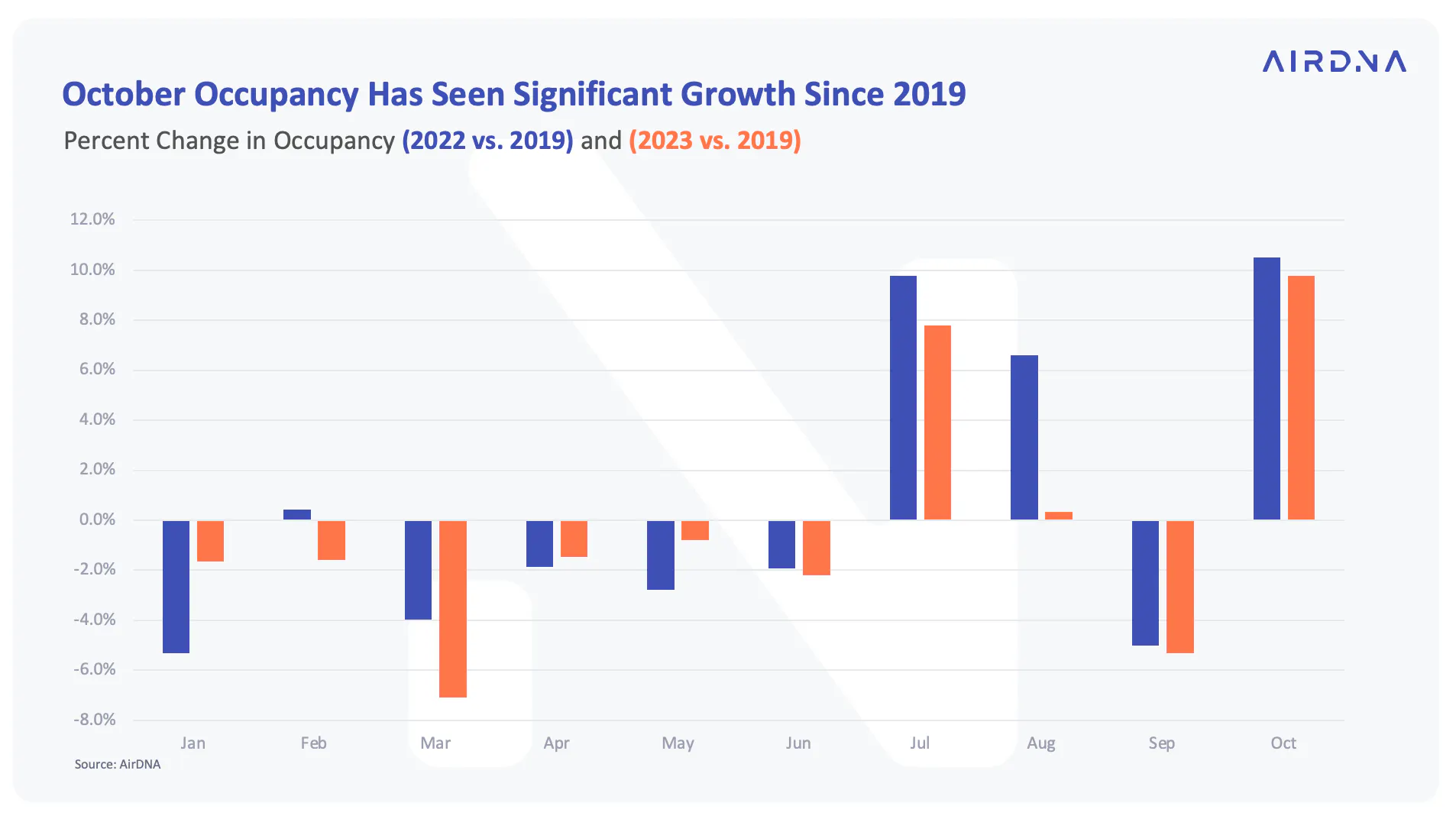
Despite heatwaves sweeping the continent, July saw incredible travel demand in Europe with short-term rentals (STRs) totalling 49.6 million nights stayed. Available listings hit 3.5 million, up 8.3% year over year (YOY) and 5% compared to 2019. Supply growth exceeding demand growth led to negative YOY occupancy growth in July (-1.8%), but occupancy for July was up an impressive 7.8% compared to 2019. Strong occupancy coupled with 13.9% YOY growth in average daily rates (ADRs) led to an 11.8% YOY increase in revenue per available rental (RevPAR).
At a Glance: July STR Performance in Europe
- Available listings were up 8.3% YOY and 5% from 2019
- Demand was up 4.6% YOY, 9.5% vs. 2019
- Average daily rates (ADRs) were up 13.9% YOY and 34.8% vs. 2019
- Revenue was up 19.2% YOY and 47.6% from 2019
- Occupancy was down 1.8% YOY and up 7.8% vs. 2019
- Revenue per available rental (RevPAR) grew 11.8% YOY and was up 45.3% from 2019
Growing Economic Confidence Fueling High Travel Demand
In Europe last month there were more nights stayed — and nights booked for future travel — than any other July on record. Travel demand has reached new heights this year, and much of that can be attributed to cooling inflation, record-low unemployment and wage growth increasing spending power, and the return of international travelers.
Inflation in Europe has been on the decline since the European Central Bank (ECB) started raising interest rates last July. As of June, the inflation rate for the Euro area was 5.5%, down from 6.1% in May and down a third from last June’s inflation rate of 8.6%. The ECB is expected to continue raising interest rates, and their current projections show inflation declining to about 3% by the last quarter of this year.
Unemployment in June was 6.4%, a historic low for the Euro area and current projections by the ECB show employment growth continuing through 2025. Along with employment growth, wage growth has also been strong. Wages and salaries per hour increased 4.6% in the euro area in the first quarter of 2023 compared to the same quarter of the previous year.
Falling inflation, a strong labor market, and robust wage growth are giving Europeans more disposable income and confidence in pursuing their travel plans. At the same time, pent-up travel demand from countries like the United States is also driving up demand for STR stays in Europe. With economic uncertainty on the decline and real disposable incomes projected to continue rising in Europe, demand for STR stays this year will likely continue its record-breaking trajectory.
Northern European Countries Lead YOY Demand Growth
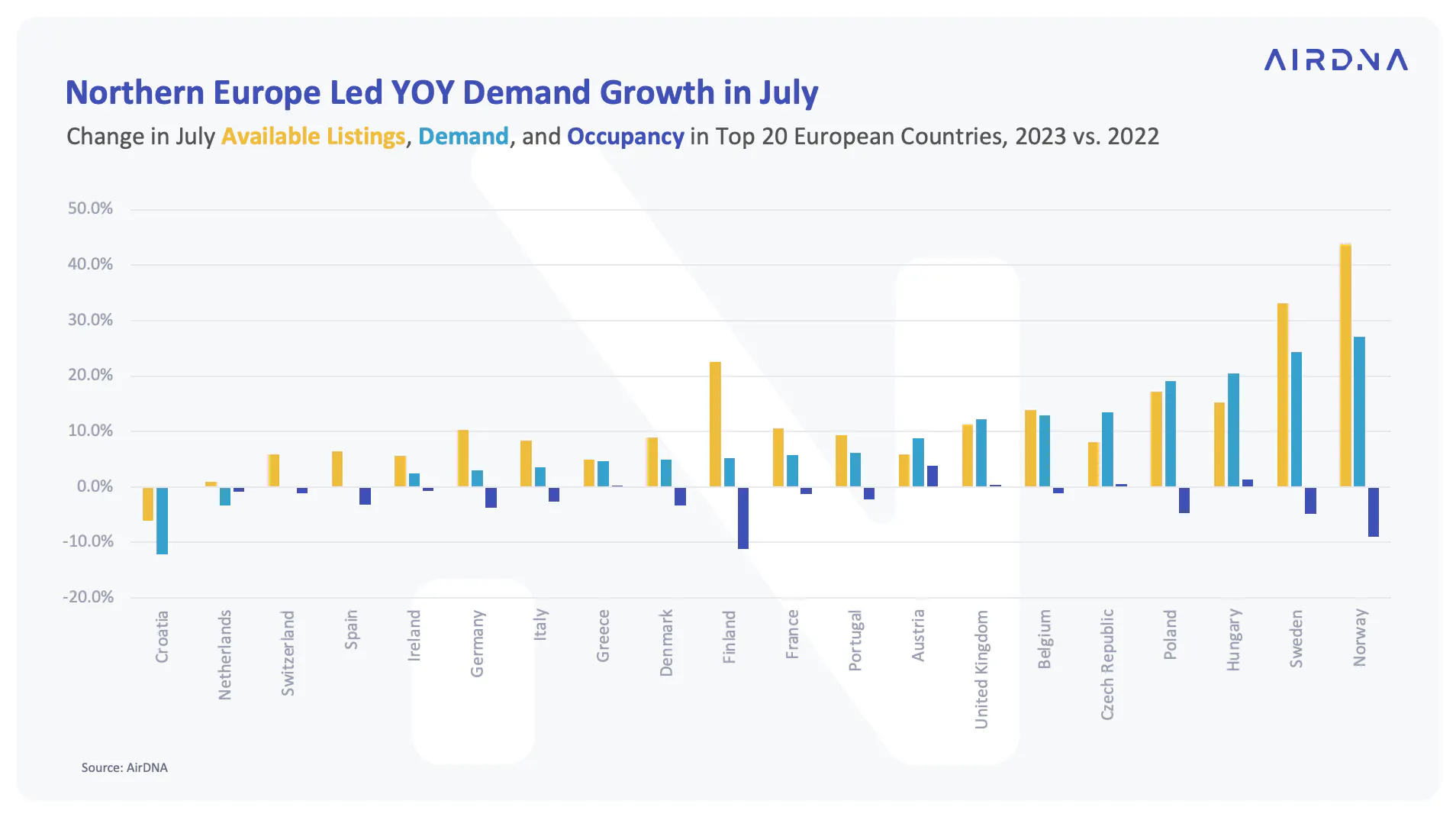
Lower ADRs and cooler temperatures are enticing travelers to head north. In July,) , Sweden (+24.3%), and Norway (+27%) led YOY demand growth. While demand growth was strong, supply growth continued to outpace demand growth and occupancies were down in Sweden (-4.9%) and Norway (-9%). Finland, which has also been seeing supply growth outpace demand growth, saw the biggest dip in occupancy in July with occupancy down 11.1%.
Leading occupancy growth last month were Austria, Hungary, and the Czech Republic where demand has been exceeding supply. In Austria, where occupancy was up an impressive 3.8 in July, demand was up 8.8% YOY while listings were only up 5.9%.
Cities Make a Comeback, but at Varying Paces
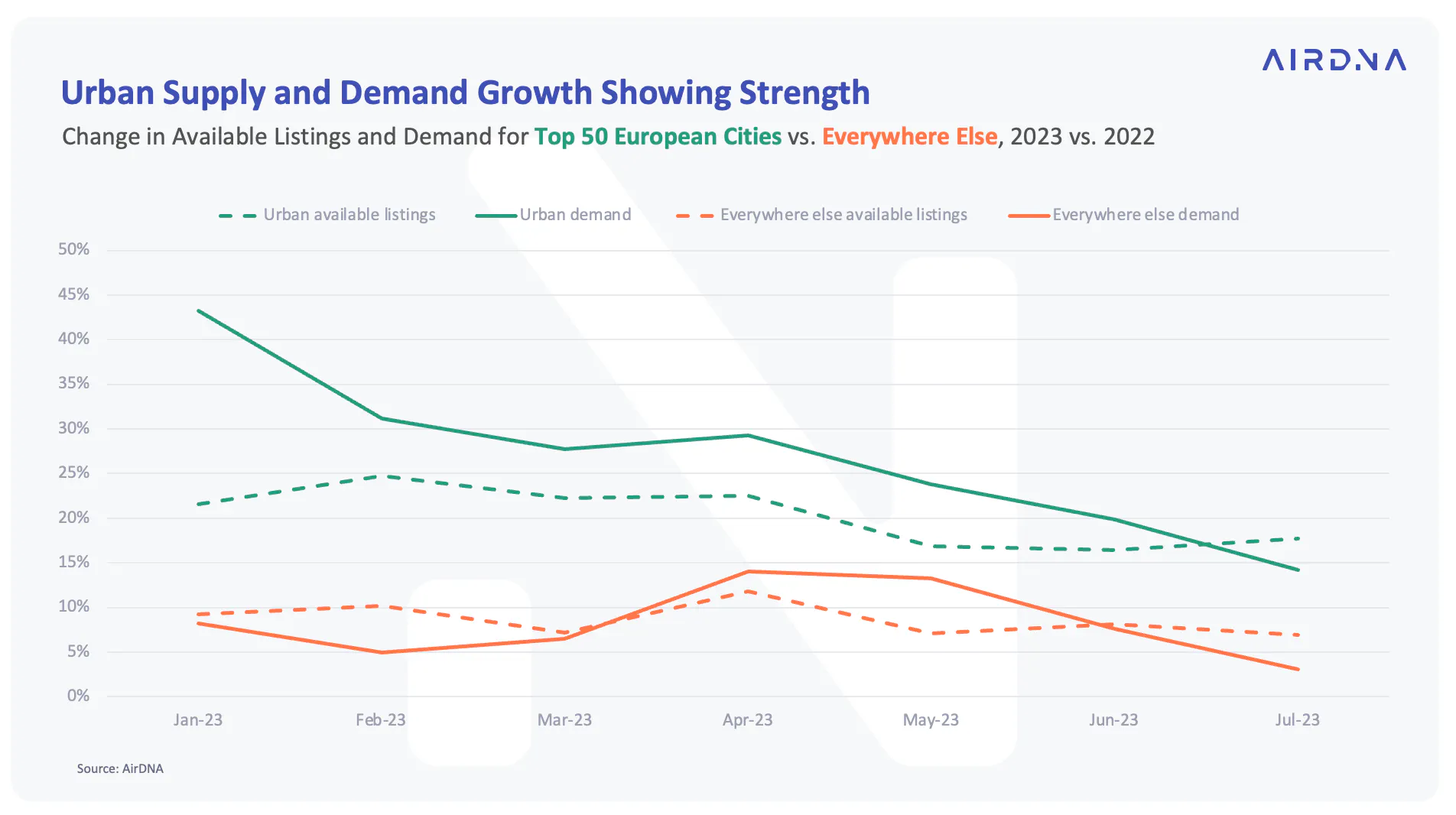
The return of international travel has brought demand back to the cities, and YOY growth in supply and demand has been stronger within the top 50 European cities than outside the cities. Available listings in July were up 18% YOY in the top 50 cities compared to 7% outside of the top 50 cities in more rural areas and smaller towns and cities. Demand in these top 50 cities was up 14% YOY compared to 3% outside of the top 50 cities.
Despite strong YOY growth, supply and demand have not returned to pre-pandemic levels in the top 50 European cities. As of July, demand in the top 50 European cities was still 14% below 2019 levels, and available listings were still 17% below 2019 levels. Meanwhile, outside of the top 50 European cities, demand was up 15%, and available listings were up 10%.
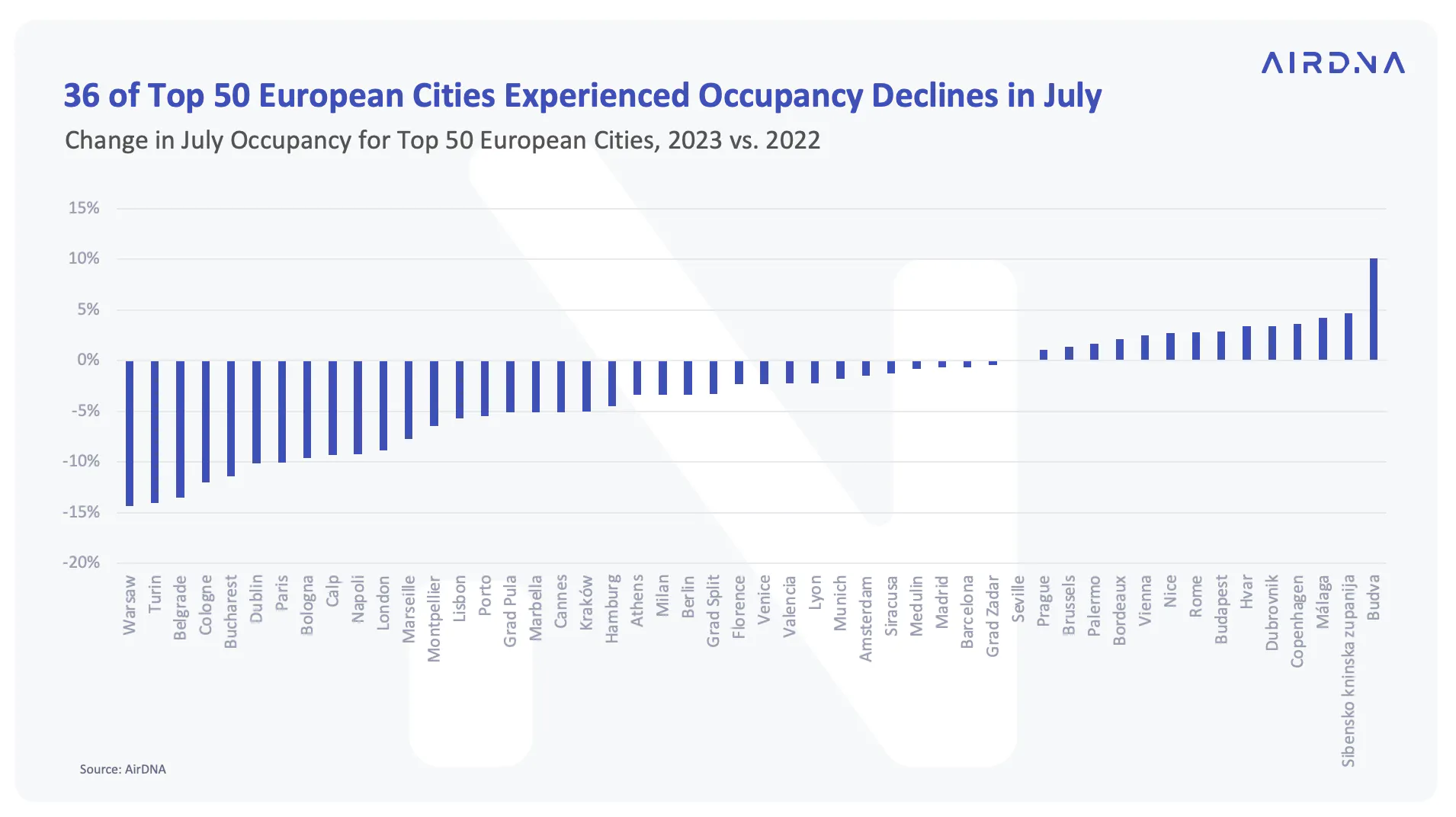
Of those top 50 European cities, 36 saw declines in YOY occupancy in July as supply was stronger than demand. Some cities, such as Turin, Italy, Porto, Portugal, and Hamburg, Germany, have seen occupancy declines due to weak YOY demand growth despite strong supply growth. Turin, Porto, and Hamburg saw 1%, 14%, and 7% YOY growth in demand while available listings grew 16%, 16%, and 12%. Other cities like London, Warsaw, Poland, and Napoli, Italy, have seen some of the strongest YOY demand growth among the top 50 European cities, but listing growth has simply been greater. London, Warsaw, and Napoli saw 27%, 29%, and 23% YOY growth in demand in July, but available listings in the three cities grew 39%, 41%, and 35%, respectively.
In 12 of the top 50 European cities, YOY occupancy growth has been driven by demand growth exceeding supply growth. Cities such as Vienna and Copenhagen have seen 35% and 28% YOY demand growth, but listing growth of 28% and 23% has fallen short, likely as the result of regulation. In Vienna, regulations in place since December 2018 prohibit homes from being rented out as short-term rentals on a regular basis in residential zones. Copenhagen has capped short-term property rentals at 70 nights per year since 2018.
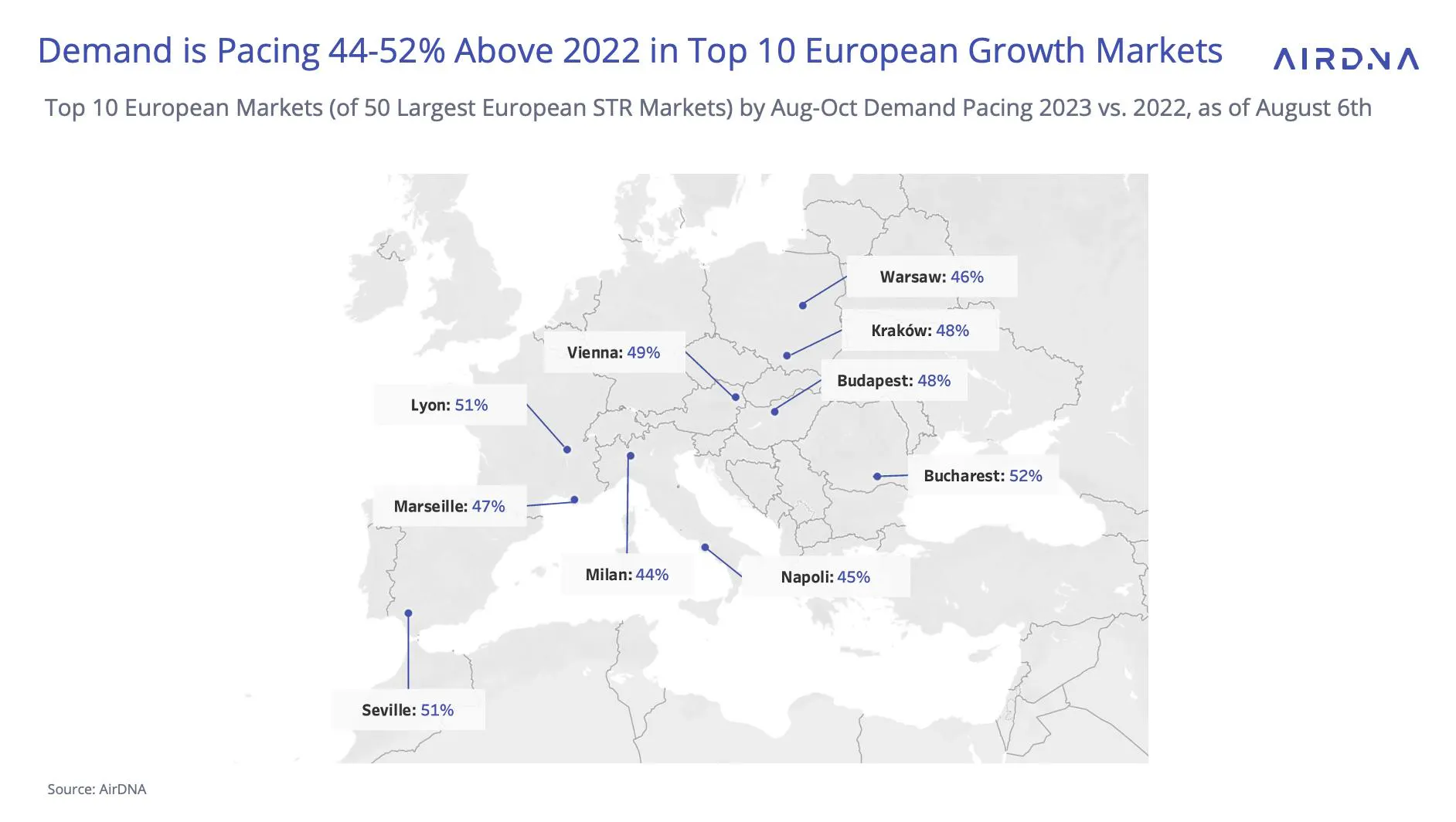
Looking ahead at demand until the end of the autumn, several Eastern European capitals are seeing strong YOY demand growth. Bucharest (+52%), Vienna (+49%), and Budapest (+48%) are seeing around 50% more nights on the books for August through October than at the same time last year. Several cities in France and Italy are also seeing strong YOY growth with demand pacing up significantly in French cities Lyon (+51%) and Marseille (+47%), and Italian cities Napoli (+45%) and Milan (+44%) compared to last year.
Northern Europe Remains Popular for the Fall
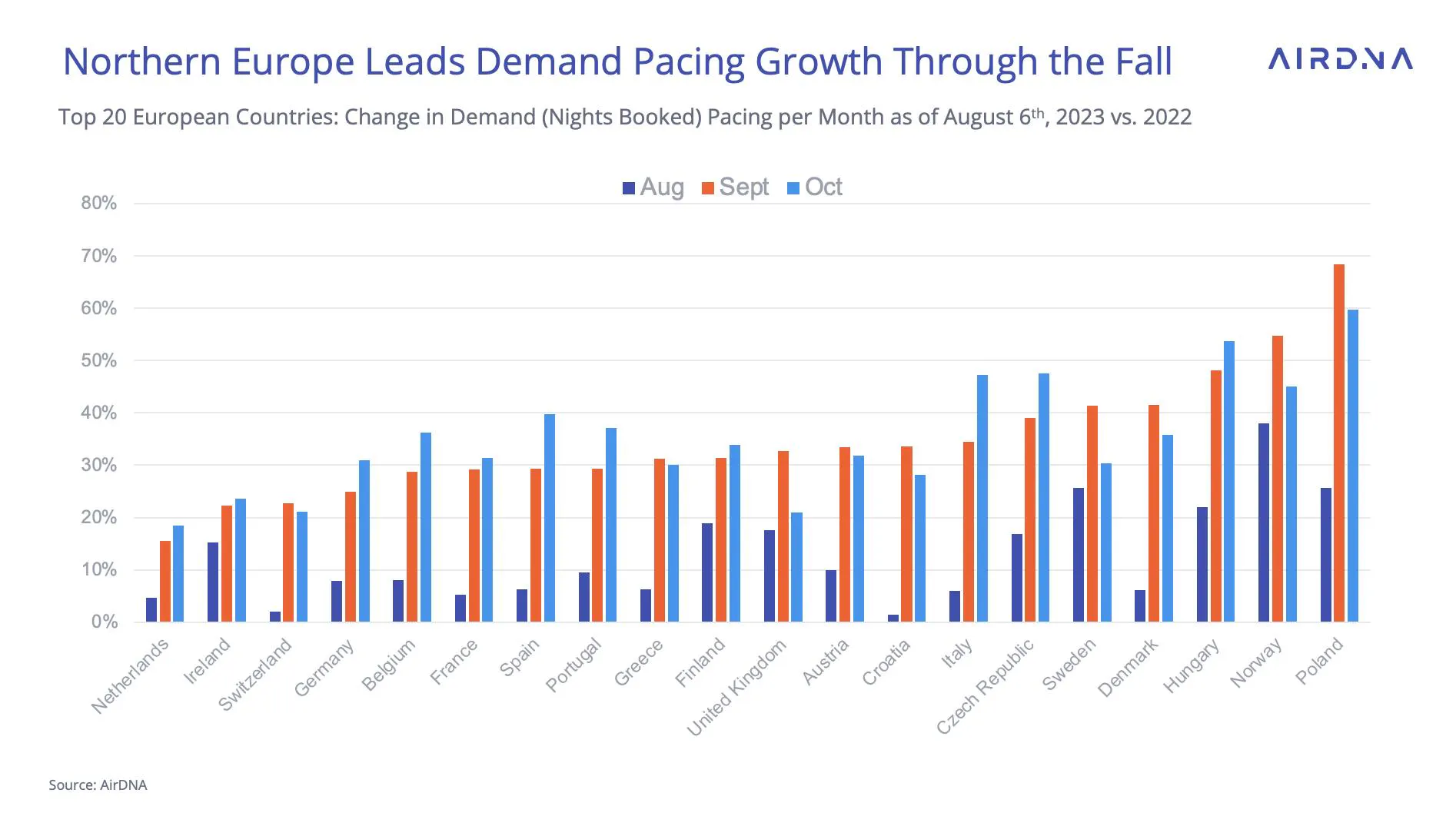
As of August 6th, demand for the rest of the year for Europe is pacing 17% above the same time last year. Off-season travel continues to be a key trend, as guests look to travel outside the traditional high season to avoid the crowds, high prices, and extreme heat. September and October demand are pacing 31% and 33% above last year and November and December demand are pacing 20% above last year.
Among the top 20 European countries, Norway (+42%), Poland (+36%), Hungary (+30%), and Sweden (+29%) are leading demand pacing for the remainder of the summer compared to last year. In Poland and Norway, demand on the books is up an impressive 68% and 55%, respectively, for September and 60% and 45% for October. Countries that are lagging in demand pacing this fall are Switzerland, the Netherlands, and Croatia which are only seeing 10% more nights on the books for August through October compared to last year.
It remains to be seen how the rest of the summer will play out with more heatwaves, strikes and travel disruption threatening some people’s holidays, but with a strong extended high season, the European STR market has nothing to worry about yet.
As part of our ongoing commitment to accuracy, we continuously implement data methodology improvements, leading to updates to some of the information in this report as of December 21, 2023. For further questions, please contact us.
ARTICLE SUMMARY
European short-term rentals saw their strongest July on record, with more than 49.6 million nights stayed. Northern countries saw high demand growth from travellers escaping searing heatwaves in the south.
Scott Sage
Senior Vice President, Marketing & Customer Experience
Scott is an Airbnb Superhost and industry pro, having founded Home Base BnBs—a short term rental management company that scaled to 200+ units. Scott combines his experience and passion for hosting to empower AirDNA customers' success. When he's not thinking about STRs, he is hiking, playing basketball, or playing pickleball.
