


U.S. Market Review: Record July Boosted by Last-Minute Bookings
Published: August 23, 2022
Last updated: May 5, 2026

Scott Sage

At a Glance: Key U.S. Short-Term Rental Performance Metrics for July 2022:
- Available listings reached 1.39 million, up 25.5% YOY (+10.5% vs. 2019)
- Demand was up 18.2% YOY (+20.6% vs. 2019)
- Occupancy was down 7.5% YOY to 69.1% (+12.1% vs. 2019)
- Average daily rates (ADRs) were up 3.7% YOY to $307 (+26.0% vs. 2019)
- Revenue was 22.6% higher YOY (+52.0% vs. 2019)
- Nights booked were up 19.1% YOY to 17.1 million
July 2022 was a record month for short-term rental demand. As is typical, July is the peak month for stays with school out and summer vacations in full swing. We estimate that over 23 million nights were stayed in a short-term rental in the U.S. during the month of July, which was 18.2% higher than last year and 20.6% higher than in 2019.
Last year, a lack of availability pushed occupancies to record levels and many guests were unable to find accommodation in popular locations. Since then, hosts and investors have brought hundreds of thousands of new listings online. Available listings topped 1.39 million last month, which was 25.5% higher than at the same time last year and 10.5% higher than in 2019.
In the eyes of the short-term rental guest, the economy doesn’t seem to be a concern as stays in short-term rentals increased across all location types and price tiers. There were strong gains in employment in July, with 528,000 new jobs added. Additionally, falling gas prices likely gave consumers continued confidence to keep spending on travel, even with inflation eating into their incomes and real spending power.
The outlook for the rest of the year remains a concern, though, with rising interest rates working to slow the housing market, which should drag down overall economic growth. It remains to be seen if the U.S. will be able to hold off pushing into recession, but the rally in stock over the previous months shows investors may have renewed confidence in the U.S. economy.
Last-Minute Bookings up 69% as Guests Travel at Record Levels in July
In July, new nights booked were up 19.1% compared to last year, which is a significant increase from the past few months as guests booked last-minute summer travel trips. For stays in the month of July, over 26% were booked in the same month, which was up significantly compared to prior years.

With overall demand up 18% year over year, we see considerable differences in how far in advance guests are booking their stays. For trips in July, the largest uptick in bookings were those made less than one week before the start of the stay—up 69% compared to last year. In contrast, bookings made more than 60 days in advance for stays in July were up only 4% compared to last year. That said, bookings made more than a month in advance still make up the majority (61%) of bookings this year, but that is also down from more than 68% last year.
Occupancies were down 7.5% year over year in July as the growth in the number of nights available (+25.5% year over year) continues to outpace the growth in demand. The decline in occupancy was less than in the previous few months but this is expected to worsen in upcoming months as kids go back to school and the summer travel season ends.

However, occupancies are still well exceeding pre-pandemic industry results. In July, occupancy was 12.1% higher than the same month in 2019. Zooming in on the top 50 U.S. short-term rental markets, 44 had higher occupancy levels in July 2022 than they did in July 2019.
Of those markets, Coachella Valley, California, has the largest gain in occupancy since 2019, with a 35.5% increase, while Denver has the largest decline in occupancy for the month, which was down 5.0%.
Slowing U.S. Housing Industry Fails to Impact New Short-Term Rental Additions
While the housing market continues to slow, it has yet to have an impact on the pace of growth of new short-term rental units. In July, there were 80,000 new listings added, matching June levels. There were 1.39 million listings available in the U.S., which was up 25.5% from the previous year. The percent change in listing growth continues to increase after growing by 25.1% in June and 24.1% in May. Overall listing counts are just 10.5% higher than in 2019 and still 15.8% lower than 2019 levels in urban areas.

All of the top 50 short-term rental markets have seen an increase in listings except those in the Bay Area of California: both San Francisco (-1.1%) and San Jose/Palo Alto (-6.5%) had a year-over-year drop in listings. Markets in Texas led the country for growth, with four of the six fastest growth markets coming from the Lone Star state. Houston led the top markets with a 57.1% year-over-year increase in listings, followed by Phoenix (+47.4%), San Antonio (+45.7%), Las Vegas (+45.4%), Austin (+40.1%), and Dallas (+39.8%).
The High End Gets Hit Hardest
While all price tiers have seen a relatively similar downward trend in occupancy, pricing power has been eroding most at the higher-end price tiers. For luxury properties (those with the highest 20% of ADRs in a market), ADRs in July 2022 were down 4.6% vs. last year, while prices were up significantly for both economy (+9.1%) and budget (+16.1%) properties. This has allowed lower-priced properties to continue to grow their average revenue per listing over the past year, while the luxury (-9.3%) and upscale (-4.2%) properties have seen a significant drop in their revenues.

The weakness in luxury properties was most pronounced in mountain/lake destinations where ADRs are on average down 11% year over year in July—pulling RevPAR down 16.2%. Luxury ADRs were positive in midsize cities (+1.1%) and small city/rural areas (+2.3%), but that wasn’t enough to offset falling occupancies, which were down by more than 5% for the month.
A contributing factor to the weakness in higher-end travel could stem from the return of international travel outside the U.S. Data through June from the National Travel and Tourism Office (NTTO) shows that travel spending by Americans outside of the U.S. is up by 113% compared to last year, just 11% below pre-pandemic levels, while travel spending by foreigners inside the U.S. has lagged behind and is still 40% below pre-pandemic levels. This deficit in travel spending, with more money flowing to destinations outside the U.S. than into the States, is likely being impacted by the strong dollar and disruptions in air travel.
Outlook for Demand Growth Slows as Fall Approaches
So what's next? Based on bookings made through July, the pace of demand growth is expected to slow but will maintain relatively strong when compared to last year. For the rest of 2022, nights booked are pacing 13.7% higher than at the same time in 2021. Pacing continues to be strongest in small city/rural areas where supply growth has been strong, and there is relatively little competition with hotels.

In July, ADRs were up by 3.7% YOY, which was the lowest increase in rates since the start of the pandemic. It appears ADRs will continue to push higher and are averaging up 6% for the rest of the year, with the highest ADR growth coming from midsize cities, where rates are up 12.5%. ADR growth is slowest in mountain and lake destinations, where ADRs are up just 2.8%—perhaps suffering from lower occupancy.
With occupancies continuing to push lower and ADR growth in the low single digits, average revenue per available listing will likely decrease further throughout the rest of the year. Thus, we expect a correction in revenues to continue over the next year or so, but still remain well above 2019 levels. We should still avoid any major declines or recession as consumers continue to prioritize travel and spending on services and experiences.
Watch our VP of Research, Jamie Lane, discuss the trends with our VP of Marketing, Mariah Kamei:
Meet Our New Rates Tool
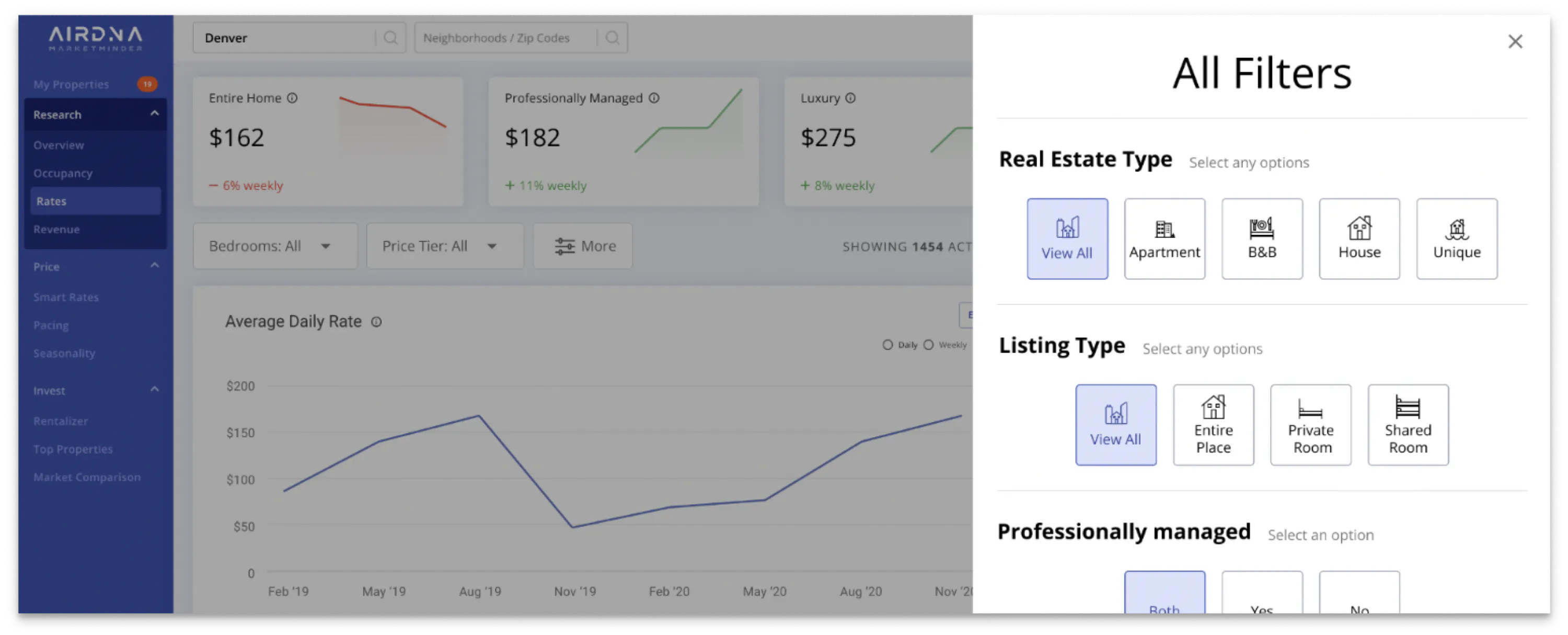
MarketMinder’s new-and-improved Rates tool is designed to help you drill deeper than ever before to truly understand your listing, market, and competition.
Market Insights
Understand your market to price smarter and boost occupancy with AirDNA's MarketMinder™

Is 2022 a Good Time to Invest in STRs?
We dig into the recent supply, demand, and occupancy data to help you determine if now is the right time to invest in your targeted short-term market.
ARTICLE SUMMARY
July 2022 was a record month for short-term rentals in the U.S., with over 23 million nights stayed, boosted by bookings coming in last minute.
Scott Sage
Senior Vice President, Marketing & Customer Experience
Scott is an Airbnb Superhost and industry pro, having founded Home Base BnBs—a short term rental management company that scaled to 200+ units. Scott combines his experience and passion for hosting to empower AirDNA customers' success. When he's not thinking about STRs, he is hiking, playing basketball, or playing pickleball.
Related



Get started with AirDNA today.
Powerful, easy-to-use tools that help hosts and investors succeed in the short-term rental market.
Try for free