

 Calculate Revenue
 Research Markets
 Find For Sale Properties
 Compare My Listing
 STR Revenue Calculator
 Custom Comp Sets
 Submarket Insights
 Custom Search Filters
 Rate Recommendations
 Performance Benchmarking
 Competitor Comparison
 Owner Contact Details
 Property-level performance data
 Tourism Insights
 Real Estate Investment Analytics
 About Us
 Sales
Sales Support
 Press
PressU.S. Market Review: STR Industry Begins Rebalancing as Supply Slows and Bookings Leap
Published: June 22, 2023
Last updated: May 5, 2026

Scott Sage
May has come and gone, and the 2023 summer travel season is here—along with plenty of reasons for those in the U.S. short-term rental (STR) industry to feel optimistic. Not the least of which is that, in the first half of 2023, the economy has outperformed economists’ and media outlets' expectations (a promising trend we discuss in our Mid-Year Outlook Report).
Inflation has been top of mind this year, and the latest Consumer Price Index (CPI) report showed that inflation declined significantly in May, dropping to 4.1% from 5% in April in terms of YOY changes in prices. Although still above the target inflation rate of 2.5%, the May rate was less than half of the 8.9% peak inflation rate seen in June 2022 and low enough to allow the Federal Reserve to wait until at least the end of July before once again taking action to slow the economy.
The May jobs report was also positive, with a promising 339,000 jobs added. Although unemployment has increased slightly since April, it continues to hover close to historic lows. This is a strong sign for both the economy and the STR industry, particularly when it comes to demand growth.
May’s unexpected economic performance significantly boosted demand for STRs: The number of nights stayed increased 5.3% YOY. Average daily rates (ADRs) were also on the rise, falling 0.7% YOY but up from -1.8% in April
At a Glance: Key U.S. STR Performance Metrics for May 2023
- RevPAR decreased 6.4% YOY to $161.95
- Available listings reached 1.554 million, up 15.3% YOY
- Total demand (nights) rose 5.3% YOY
- Occupancy was 5.7% lower YOY at 54.6% (-2.4% vs. 2019)
- Average daily rates (ADRs) fell 0.7% YOY to $296.64
- Nights booked increased 15.8% YOY
For the past two years, the months leading up to and including May have signaled how competitive an environment STR hosts will operate in. Many new listings become available in preparation for the summer travel season, and the number of available listings remains relatively steady until the following season.
If 2023 supply follows a similar pattern, listing growth will have slowed considerably in 2023. For example, the build-up to the 2022 summer travel season led to an average of approximately 300,000 additional monthly available listings. This year, that number is 240,000—about 20% lower.
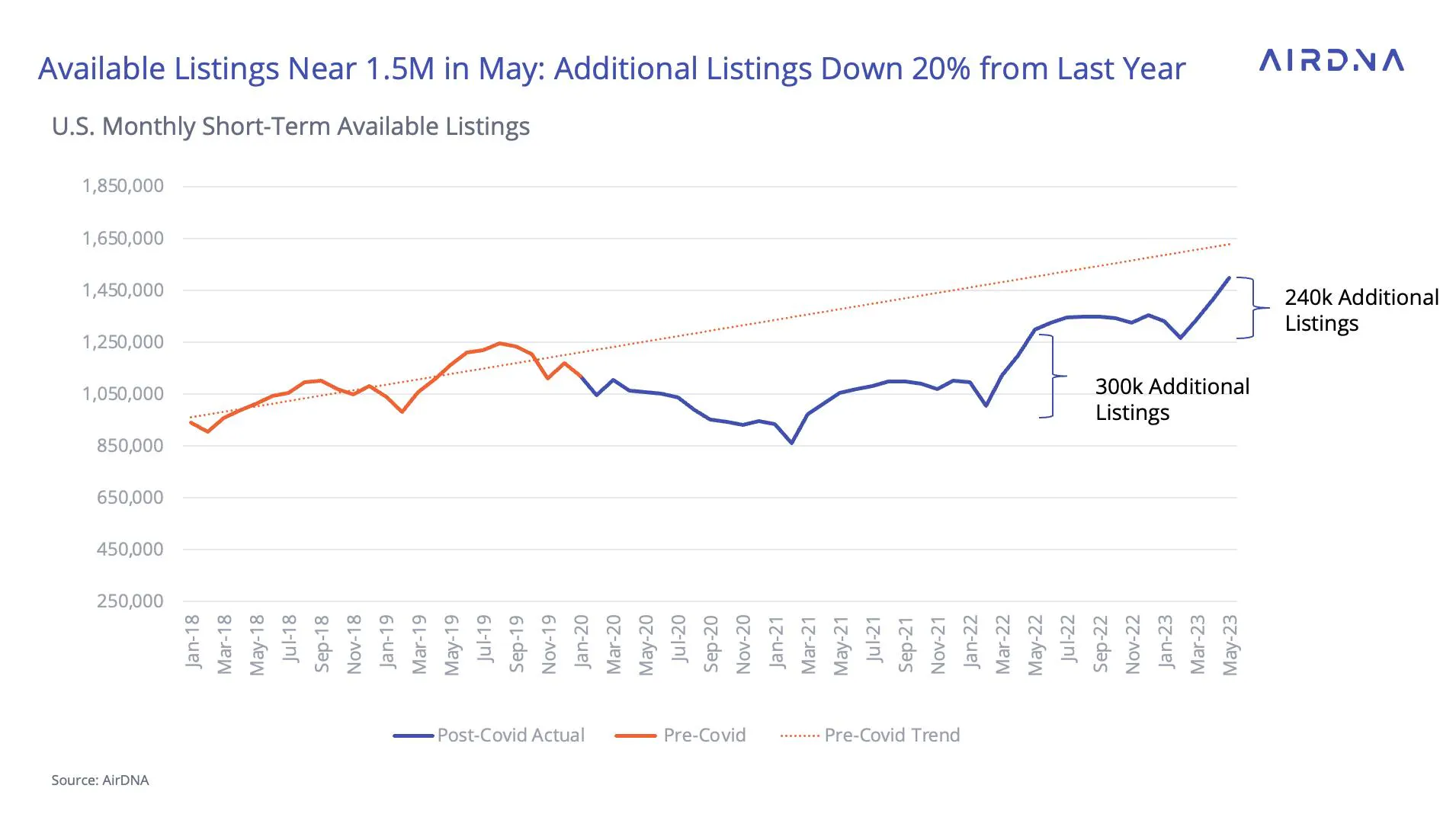
In May, the number of available listings grew by 15.3% YOY, the slowest supply growth in 18 months. Although it’s still an impressive growth rate, May just couldn’t compete with the breakneck pace supply has been growing at ever since 2021—when hosts and investors rushed to take advantage of the new STR performance boom.
In March of 2022, the Federal Reserve introduced a new series of interest rate hikes to temper inflation, and the higher interest rates have substantially slowed housing transactions. The lower supply growth rate suggests that the rate increases are also significantly impacting the STR market.
The number of new listings—which leads to an increase in total available listings—has also been lower YOY for the third month in a row. In 2023 so far, the proportion of new listings to total listings has followed 2021 fairly closely, with the exception of April and May, both of which have fallen short.
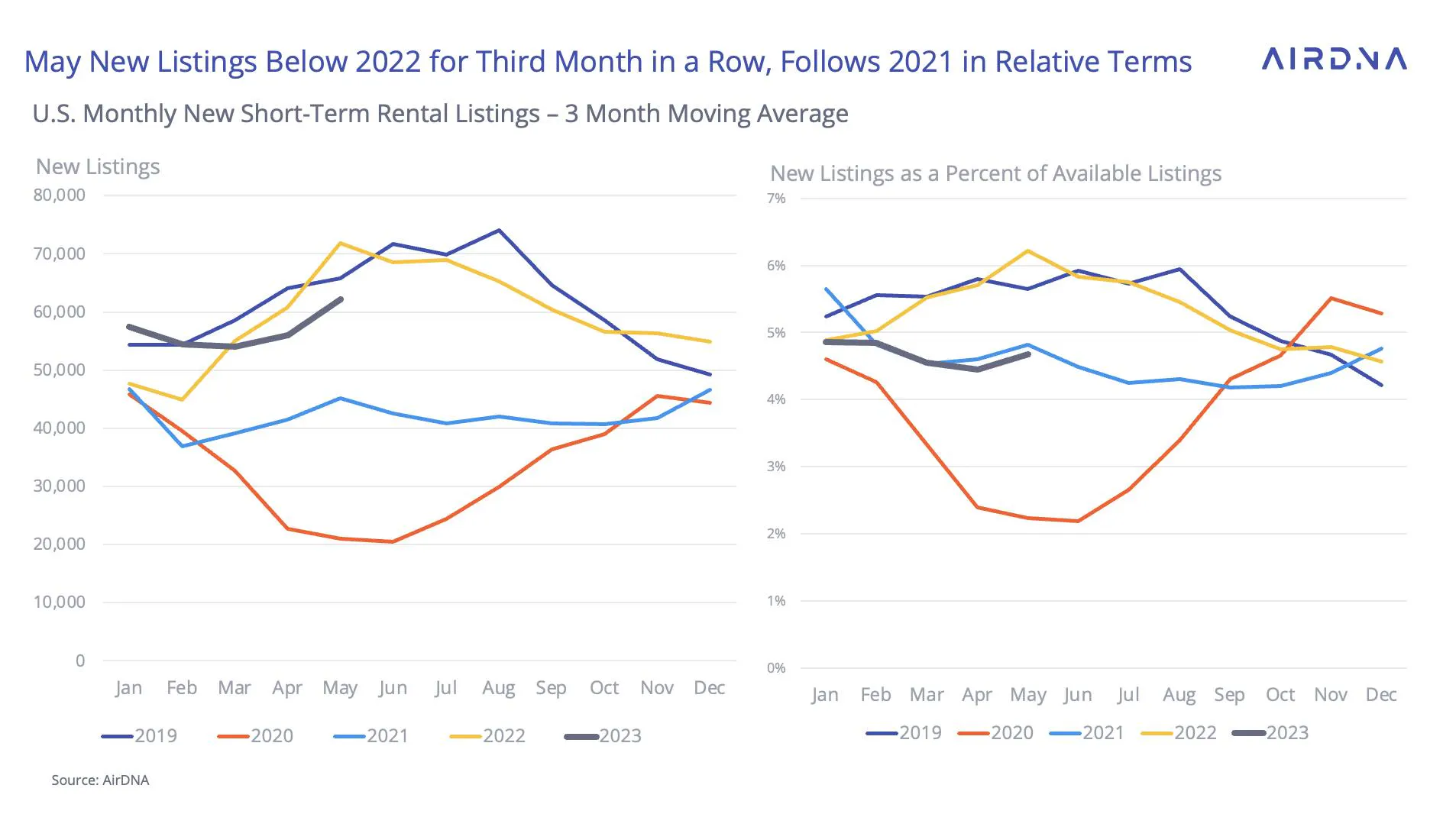
With the promise of slower growth, many hosts are likely breathing a sigh of relief. Occupancy rates are behind levels for 2019 and 2022, but the gap between 2022 and 2023 narrowed in May.
Occupancy Boost Gives Pricing Power to Hosts
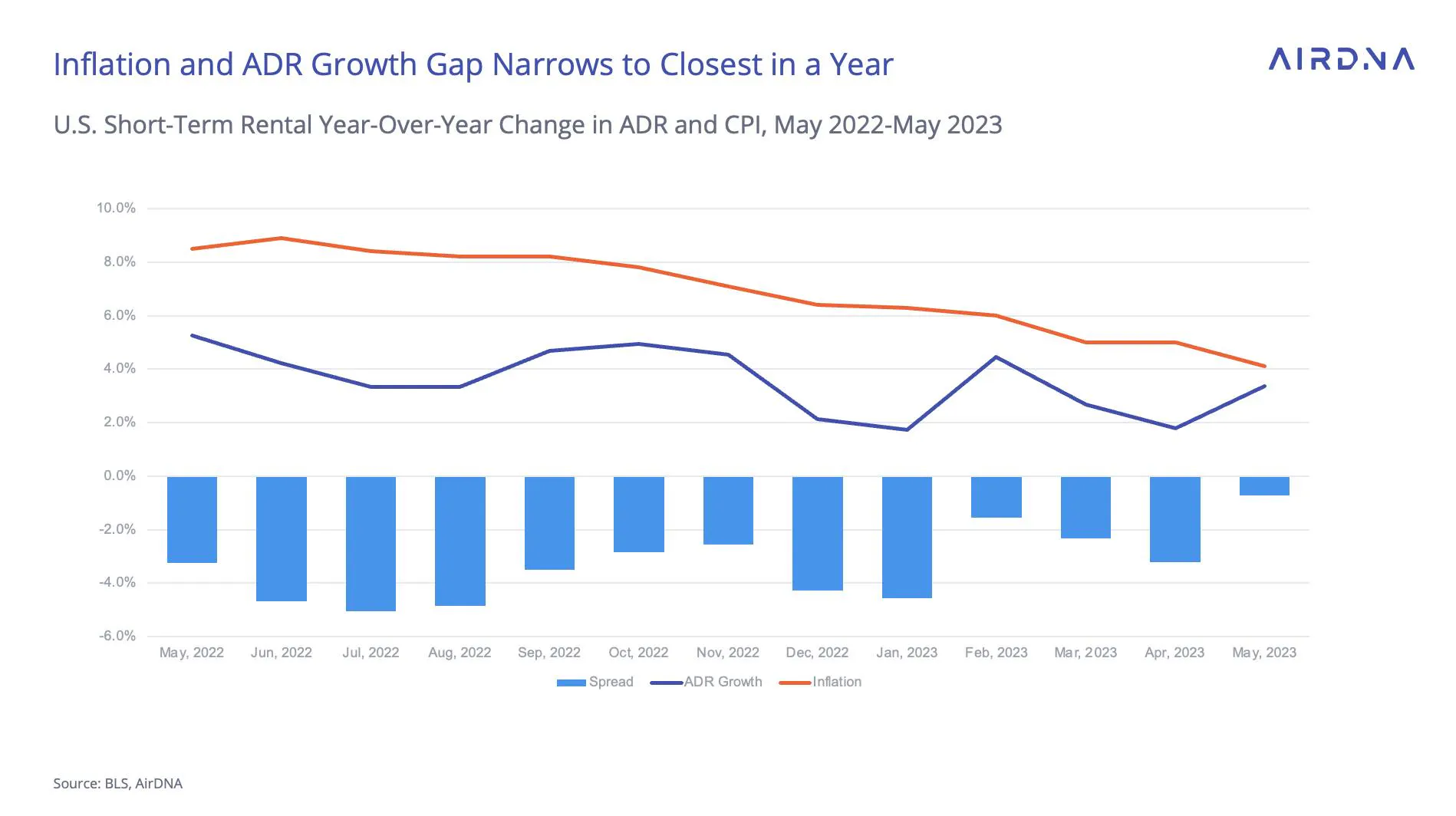
With improved occupancy comes renewed pricing power for STR hosts, and May’s ADR growth accelerated accordingly. Although ADRs for short-term rentals had high growth rates in 2021 and the beginning of 2022, growth rates have lagged behind inflation since May 2022. Simply put, this means that ADRs have been declining. In May, the gap between ADR and inflation very nearly closed, reaching its smallest level since last April.
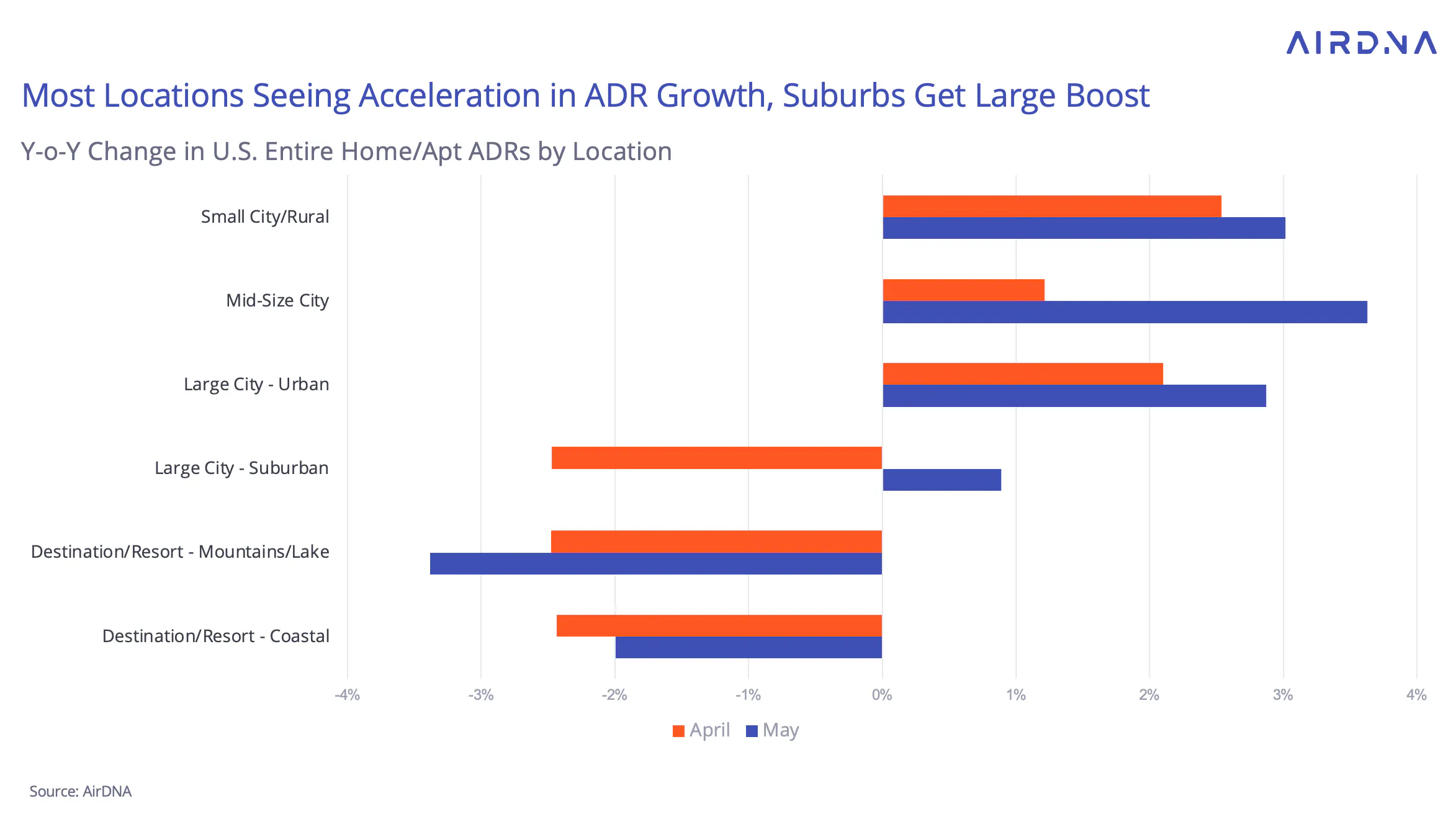
The acceleration in ADR growth was also widespread, with all locations except Mountain/Lake destinations experiencing higher ADR growth in May than they did in April. Even still, suburban locations experienced a dramatic boost in ADR, surging 0.9% in May compared to April’s modest -2.5% increase in rates. Mid-sized cities also saw sizable growth, from 1.2% YOY in April to 3.6% YOY in May.
ADR growth isn’t without its headwinds. The continued resurgence of international travel will likely restrain ADR growth in the coming season—and in some markets more than others.
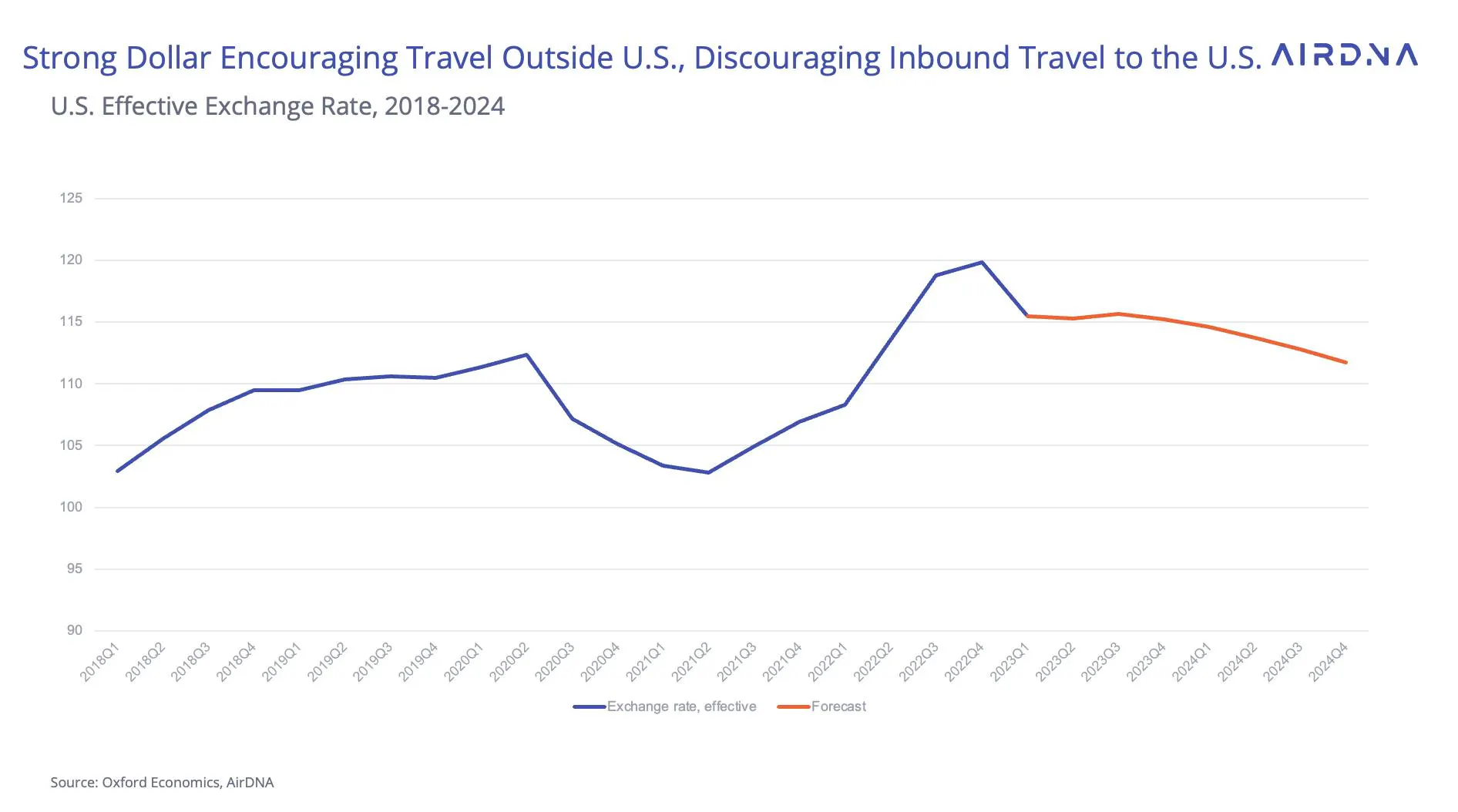
Post-pandemic inflation has been a global phenomenon, and the devaluation of money has been more severe in many other countries than it has been in the U.S.
This, coupled with international demand for seemingly secure U.S. assets in our uncertain economic environment, has caused the U.S. dollar to appreciate steeply since the beginning of 2021.
While this enhances the purchasing power of the U.S. consumer, it also makes U.S. goods and services—including lodging—relatively more expensive compared to international alternatives.
U.S. STR hosts (particularly those in the high-end resort market) are now competing not only with their neighbors but also with international destinations that American travelers are eager to visit. Meanwhile, international travelers anxious to finally revisit the U.S. will find prices enlarged by both high inflation and poor exchange rates. Thankfully, there is a silver lining: The inflation rate has been declining in 2023 and is expected to reduce further, although it will likely remain higher than it was in 2018 and 2019 through 2024.
Difficult international competition aside, all signs point to a promising upcoming season. In May, demand growth accelerated from 5.2% in April to 5.3% in May. Moreover, booking growth — typically a good indicator for how demand will grow in the near future — jumped to 7.5% from 15.8% in April.
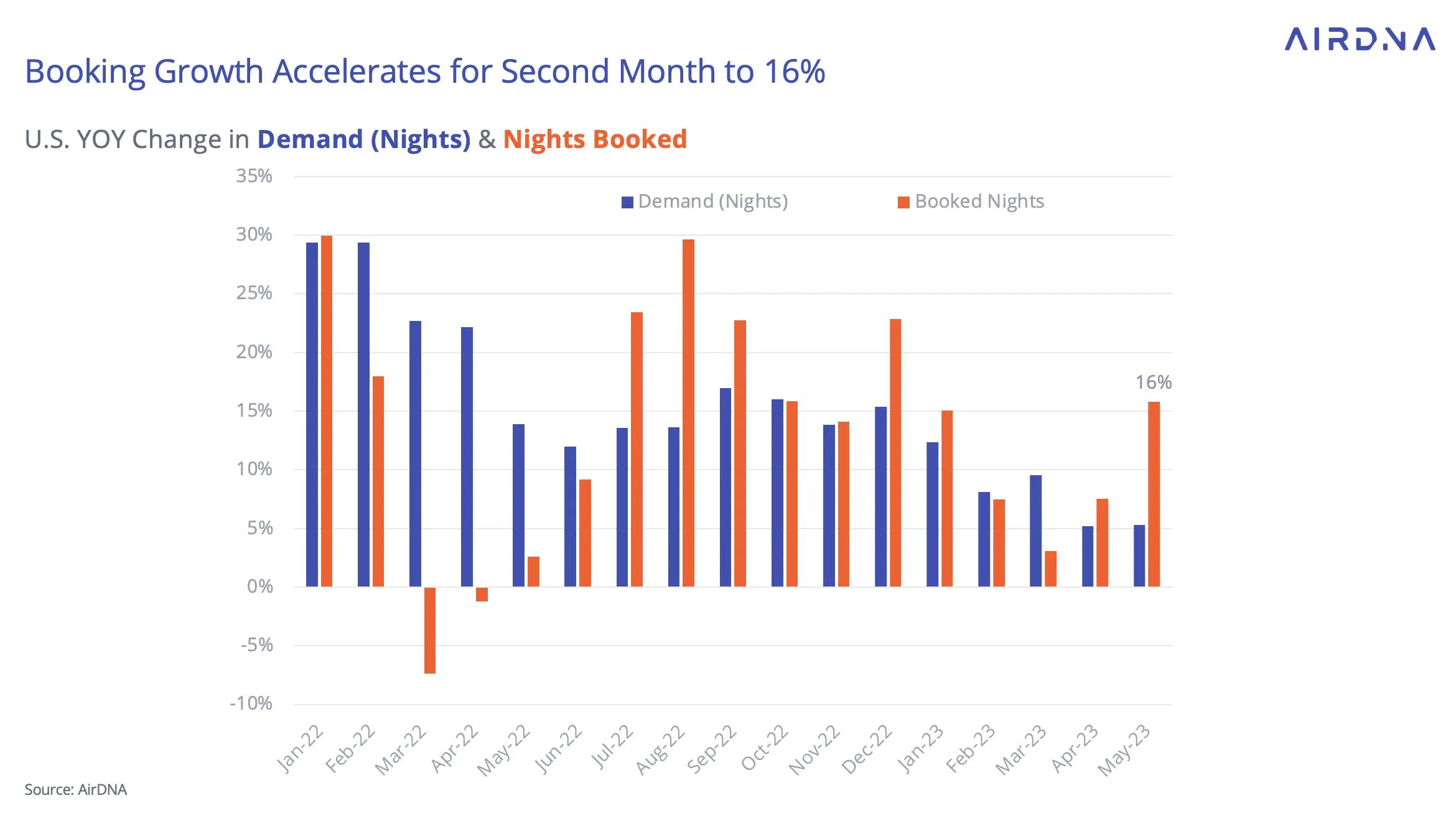
- Demand nights are the nights stayed during that month
- Nights booked are reservations made during that month for any future date
Strong Summer on the Way
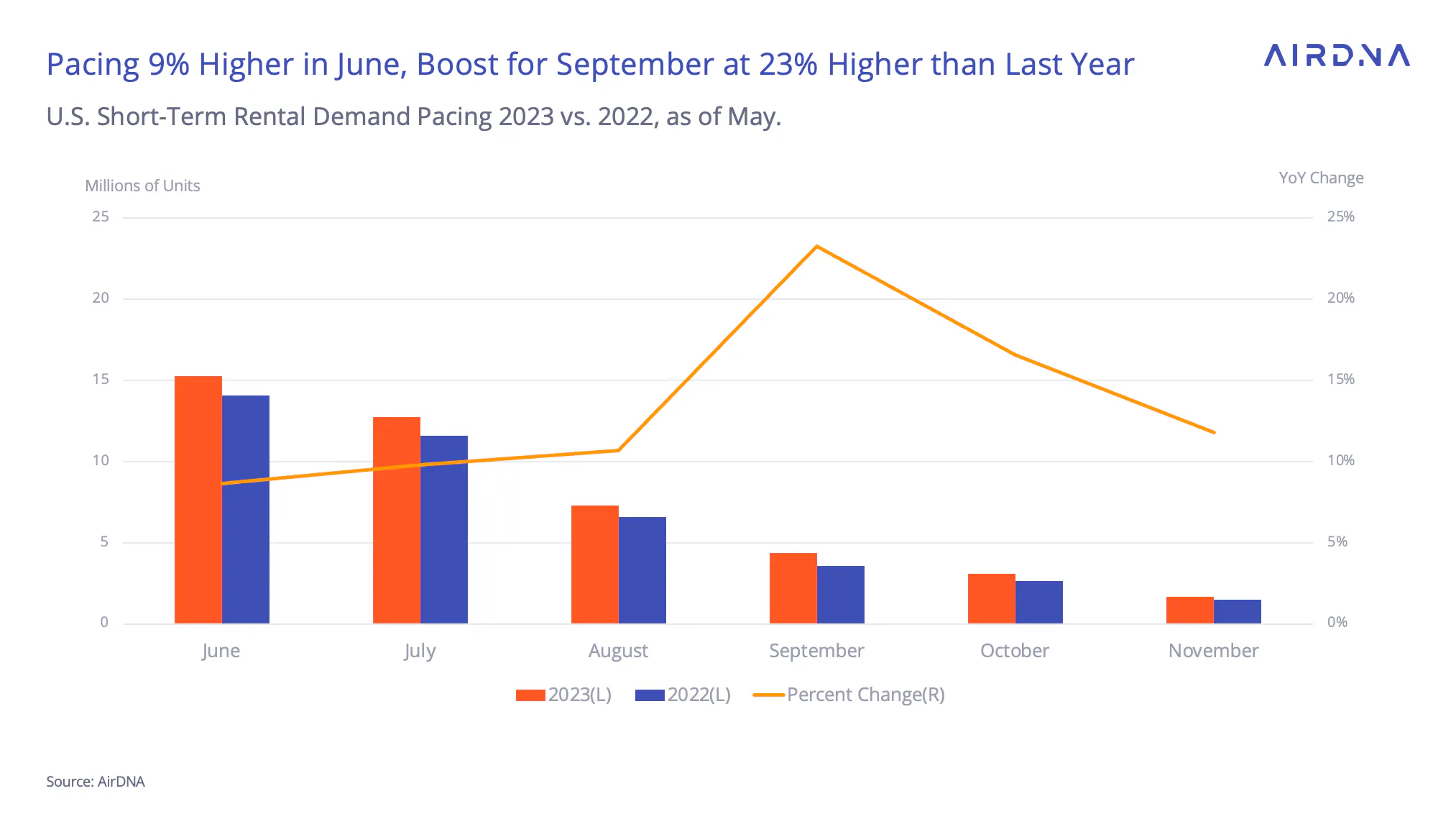
Forward booking pacing—the number of future nights booked today compared to the same time in the previous year—is considerably higher in 2023. June, for example, is pacing 9% higher. July and August are still pacing 10-11% higher YOY.
May’s large spike in new bookings compared to last year could mean that close-term booking behavior has changed since 2022. This means that true summer demand growth could be even higher than we expect it to be.
On the other hand, a less ambiguous signal is September pacing, which has consistently been 15-25% higher YOY. This may offer some proof of a trend that resort locations have felt anecdotally since the pandemic: The peak travel season is extending into what used to be shoulder seasons.
As part of our ongoing commitment to accuracy, we continuously implement data methodology improvements, leading to updates to some of the information in this report as of December 20, 2023. For further questions, please contact us.
ARTICLE SUMMARY
Demand increased, with July, August, and September pacing higher than the previous year, indicating a positive trend for the upcoming months.
Scott Sage
Senior Vice President, Marketing & Customer Experience
Scott is an Airbnb Superhost and industry pro, having founded Home Base BnBs—a short term rental management company that scaled to 200+ units. Scott combines his experience and passion for hosting to empower AirDNA customers' success. When he's not thinking about STRs, he is hiking, playing basketball, or playing pickleball.
