

 Calculate Revenue
 Research Markets
 Find For Sale Properties
 Compare My Listing
 STR Revenue Calculator
 Custom Comp Sets
 Submarket Insights
 Custom Search Filters
 Rate Recommendations
 Performance Benchmarking
 Competitor Comparison
 Owner Contact Details
 Property-level performance data
 Tourism Insights
 Real Estate Investment Analytics
 About Us
 Sales
Sales Support
 Press
PressThe War in Iran vs the Great American Road Trip: How Gas Prices Might Affect Summer Travel
Published: June 3, 2026

Bram Gallagher
Key Takeaways
- Rising gas prices are likely to affect long-haul urban travel more than regional drive-to destinations this summer.
- Markets with higher ADRs, particularly mountain and coastal destinations, are better insulated from fuel-cost increases.
- If oil prices continue climbing, travelers may increasingly shift toward shorter, closer vacations over cross-country trips.
The Strait of Hormuz, one of the world’s most important oil shipping routes, has been effectively closed for nearly two months. Before the February 28 closure, roughly a fifth of global oil shipments passed through the strait, so the market reaction was immediate.
West Texas Intermediate (WTI) crude oil prices surged from around $64 per barrel before the closure to nearly $100 shortly after. Since then, prices have swung sharply, dipping as low as $82 and climbing as high as $117, before recently settling back near the $100 mark as hopes for a quick resolution to the conflict have faded.
For American travelers, the impact has been felt most directly at the gas pump. The average price of regular gasoline climbed from roughly $2.80 per gallon on February 23 to around $4.30 by May 4, just as many households are beginning to plan summer vacations.
That raises an important question for the short-term rental industry: which markets are most exposed to higher fuel costs, and how might changing travel economics reshape summer demand patterns?
Which Markets Are Most Exposed to Higher Gas Prices?
To explore which short-term rental markets may be most vulnerable to rising fuel costs, we analyzed millions of guest reviews to estimate the average distance traveled by guests across continental U.S. markets throughout the full year 2025. We then compared the added cost of driving those distances against average short-term rental rates in each market.
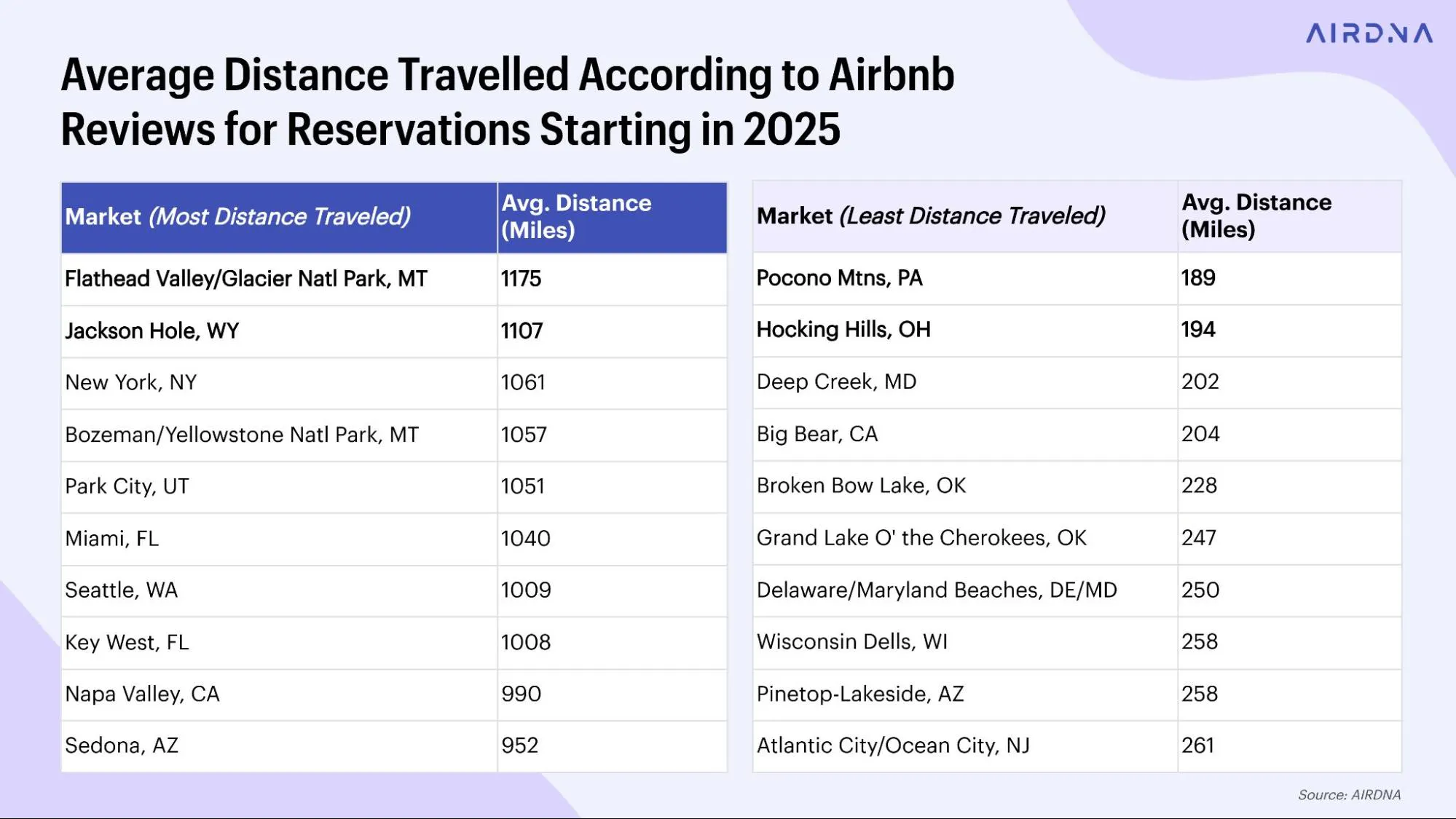
The markets with the longest average travel distances include a mix of major U.S. metros alongside remote mountain and coastal destinations that justify the extra travel with exceptional amenities, outdoor access, or unique natural scenery.
At the other end of the spectrum, the shortest-distance markets tend to be regional mountain and coastal destinations that primarily serve nearby travelers. Big Bear, for example, functions largely as a Southern California drive-to ski market, particularly for travelers coming from Los Angeles.
Many of these shorter-distance destinations also sit close to major population centers, including the Pocono Mountains near New York City, Broken Bow Lake near Dallas, and Pinetop-Lakeside within driving distance of Phoenix, Arizona. The Wisconsin Dells are situated between Chicago and St. Paul, and attracts travellers mostly from the surrounding region.
The next question is how much rising fuel prices actually influence travel decisions.
Using average vehicle fuel efficiency figures from the U.S. Department of Energy, roughly 25 miles per gallon, alongside the increase in gas prices before and after the conflict, we estimated the added driving cost associated with the average guest trip in each market. The difference ranges from roughly $141 in additional fuel costs for a typical round trip to Flathead Valley/ Glacier National Park to just $23 for a round trip to Pinetop-Lakeside.
But travelers don’t evaluate transportation costs in isolation. The nightly rate for a short-term rental stays the same regardless of how far a guest has traveled, meaning fuel costs become part of the broader equation travelers weigh when deciding where to vacation.
To measure that impact proportionally, we modeled a three-night stay using the average daily rates already booked across each market during the summer travel season, June through September, capturing both peak summer demand and some shoulder-season travel.
Among the markets with the longest average travel distances, large urban metros such as New York, Miami, and Seattle tend to have relatively lower ADRs. As a result, the increase in fuel costs represents a much larger share of the total trip cost, often reaching or exceeding 15%.
The dynamic looks very different in higher-priced mountain and coastal destinations like Flathead Valley/ Glacier National Park, Park City, Jackson Hole, Napa Valley, and Bozeman/Yellowstone National Park. These markets command significantly higher nightly rates, which helps absorb the increase in transportation costs. In many cases, the fuel-price impact stays closer to 5-10% of the total trip cost.
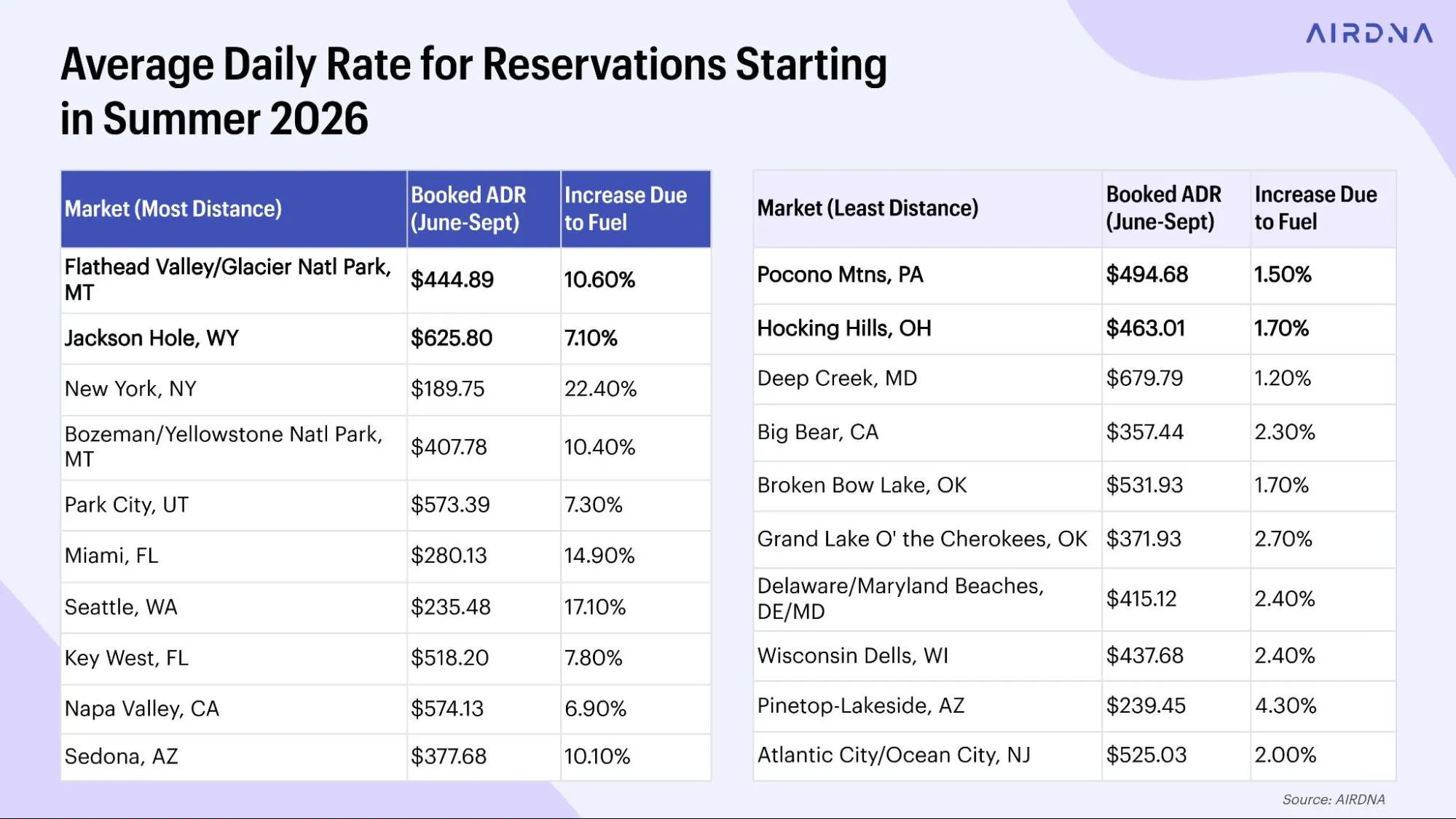
At the longest travel distances, the increase in fuel costs is more likely to discourage discretionary trips to large urban metros, where transportation makes up a larger share of the overall vacation budget. Higher-priced mountain and coastal destinations may feel less impact, since the additional fuel expense represents a smaller percentage of the total stay cost.
There could also be some downward pressure on pricing in these long-haul urban markets, or at minimum, more resistance to further rate increases during the summer season.
Trip length matters here as well. Longer stays naturally dilute transportation costs across more nights, while shorter trips amplify them. That means extended vacations and medium-term stays, particularly in markets like New York, are likely to be only marginally affected by higher gas prices.
Could Higher Gas Prices Push Travelers Toward Closer Destinations?
In the shortest-distance markets, higher fuel prices have only a minimal effect on overall trip costs, typically increasing them by just 1-4%. But the gap between short-distance and long-distance markets has widened considerably. As energy prices rise, nearby drive-to destinations become relatively cheaper compared to markets that require cross-country travel.
That creates potential upside for regional vacation markets as travelers substitute closer getaways for longer, more expensive trips.
For now, the impact on long-haul urban metros still appears fairly limited. Another factor helping offset some of the pressure is airfare, which hasn’t increased nearly as quickly as gas prices. According to the Bureau of Labor Statistics, domestic flight prices rose about 4% between the beginning of the year and March, which could help cushion demand for markets with very long average travel distances.
Of course, that assumes oil prices stabilize.
Following the Covid pandemic, supply chain disruptions pushed WTI oil prices to roughly $115 per barrel, while gas prices peaked near $4.80 per gallon, around 80 cents higher than current levels. If oil prices continue climbing, what currently looks like a relatively modest headwind for certain markets could start reshaping where and how Americans choose to travel this summer.
FAQs
How much have gas prices increased since the Strait of Hormuz closure?
Average U.S. gas prices rose from roughly $2.80 per gallon before the February 28 closure to around $4 by late April, following sharp increases in global oil prices.
Why are some vacation markets less affected by higher fuel prices?
Higher-priced mountain and coastal destinations tend to be more insulated because fuel costs make up a smaller percentage of the total trip cost compared to lower-ADR urban markets.
Could rising gas prices change summer travel behavior?
Potentially. As transportation costs rise, some travelers may opt for shorter regional drive-to vacations instead of longer cross-country trips, especially if fuel prices continue climbing.
ARTICLE SUMMARY
This analysis explores how rising gas prices could reshape summer travel demand across U.S. short-term rental markets, with long-haul urban destinations appearing more exposed than regional drive-to markets.
Bram Gallagher
AirDNA Director of Economics and Forecasting
Bram Gallagher is an Economist at AirDNA, specializing in uncovering insights that drive smarter short-term rental decisions. He put his Ph.D. in Economics from the University of Georgia to work researching and forecasting hotel data with CBRE prior to joining AirDNA, as well as teaching economics at a number of universities. In his spare time, Bram enjoys making wooden furniture with hand tools.
