

 Calculate Revenue
 Research Markets
 Find For Sale Properties
 Compare My Listing
 STR Revenue Calculator
 Custom Comp Sets
 Submarket Insights
 Custom Search Filters
 Rate Recommendations
 Performance Benchmarking
 Competitor Comparison
 Owner Contact Details
 Property-level performance data
 Tourism Insights
 Real Estate Investment Analytics
 About Us
 Sales
Sales Support
 Press
PressE.U. Review October 2024: Southern Markets Drive Shoulder Season Success
Published: November 21, 2024
Last updated: February 26, 2025

Linda Rollins
Key Takeaways:
- Europe's short-term rental market showed remarkable momentum in October, with demand surging 17.7% year-over-year and Southern destinations leading a wave of growth that lifted occupancy in 19 of the top 20 markets.
- Strong shoulder season occupancy gave hosts more pricing power, with Spain and Greece demonstrating how robust demand enabled steadier rates through the summer-to-fall transition compared to 2022's steeper declines.
- A clear shift toward luxury stays emerged this fall—as premium properties became more affordable in the shoulder season, travelers traded up, driving higher occupancy growth in upscale properties compared to budget options.
October knocked it out of the park this year. Demand nights reached 36.9 million, a 17.7% jump from last year and an impressive 31% increase from October 2019. February, March, and May are the only other months this year showing such strong growth compared to 2019.
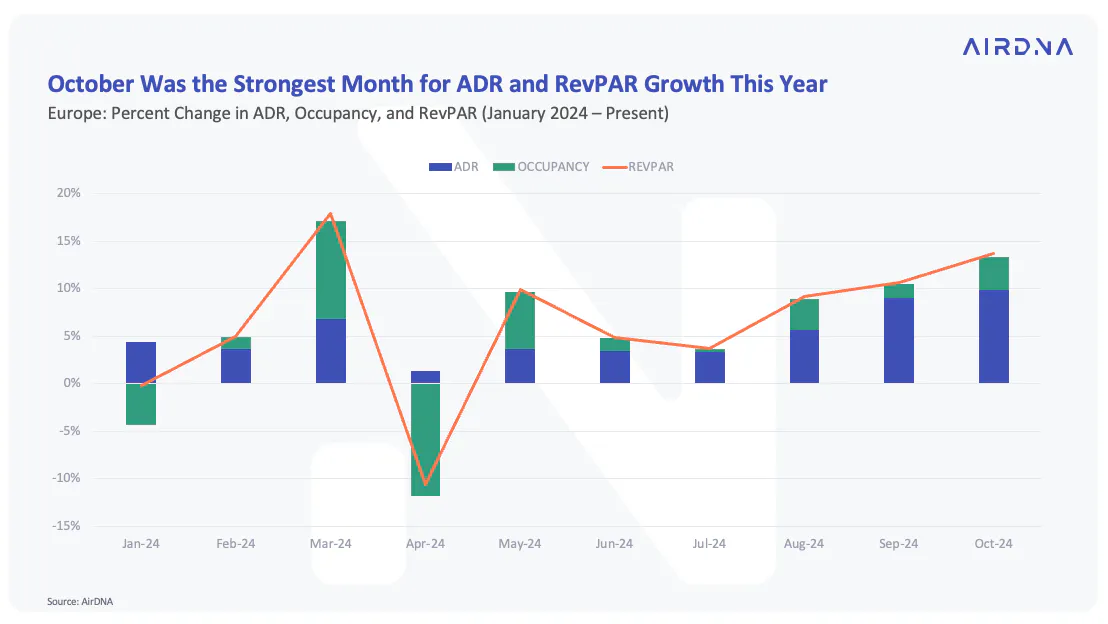
Supply growth took its seasonal step back this October. Available listings reached 3.6 million—up 12% from last October but marking the slowest listing growth since January. This moderated supply growth, combined with strong shoulder season demand, pushed occupancy up 3.5% year-over-year. The strength of October's occupancy drove strong ADR and RevPAR growth, topped only by March when Easter gave metrics an extra lift.
At a Glance: October 2024 STR Performance in Europe
- Available listings totaled 3.6 million, up 12% year-over-year (YOY)
- Demand reached 36.9 million, an increase of 17.7% YOY
- Average daily rates (ADR) averaged €158, up 9.8% YOY
- Average occupancy was 53%, up 3.5% YOY and up 13.2% compared to 2019
- Revenue per Available Rental (RevPAR) increased 13.7% YOY to €84
- Booked nights increased 17.7% YOY
Occupancy Up in 19 of the Top 20 European Countries
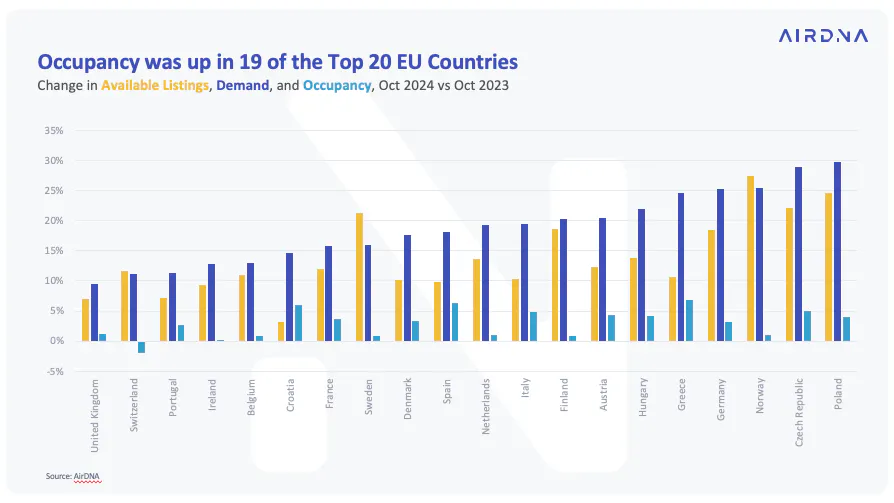
Southern Europe's charm proved irresistible this shoulder season. Among the top 20 European countries for STR demand, 19 saw occupancy growth last month. With travelers chasing the last rays of the Mediterranean sun, Greece, Spain, and Croatia each saw occupancy growth above 6%.
- Greece (+6.7%)
- Spain (+6.3%)
- Croatia (+6.0%)
Other top contenders for occupancy growth were Eastern European countries. October demand in all four countries below grew more than 20% YoY, paving the way for over 4% YoY occupancy growth.
- Czech Republic (+5.0%)
- Austria (+4.4%)
- Hungary (+4.2%)
- Poland (+4.1%)
Some markets faced headwinds despite healthy demand. Ireland and Belgium saw demand jump 13% year-over-year, yet occupancy barely moved, growing less than 1%. Meanwhile, Switzerland's occupancy declined as its 11.1% demand growth couldn't match the 13.2% rise in available listings.
- Belgium (+0.8%)
- Ireland (+0.1%)
- Switzerland (-1.9%)
October's Strong Occupancy Softens Late Summer Rate Drop
As peak season winds down after August, hosts typically adjust their rates downward. The size of these adjustments hinges on shoulder season occupancy—strong occupancy levels give hosts more room to maintain rates while softening demand often forces deeper discounts to stay competitive.
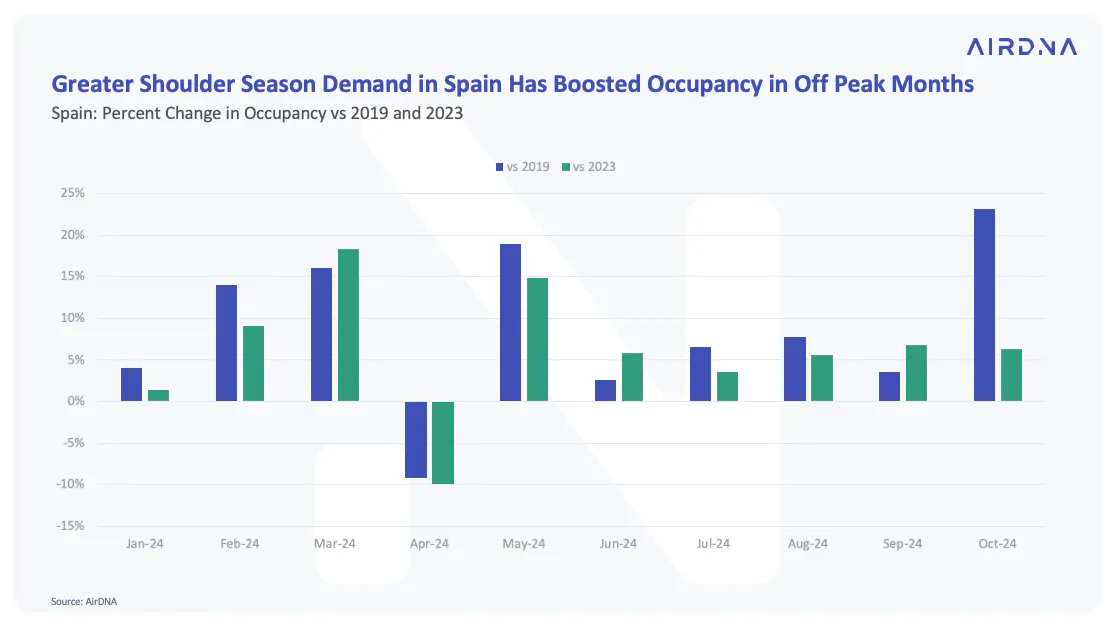
We looked at Spain for a great view of this pattern in action. The country has seen remarkable occupancy growth during shoulder season months this year, with February, March, May, and October all jumping more than 6% YoY and 14% above 2019 levels. October in particular was a standout month, with occupancy exceeding 2019 levels by 23% and 2023 levels by 6.3%.
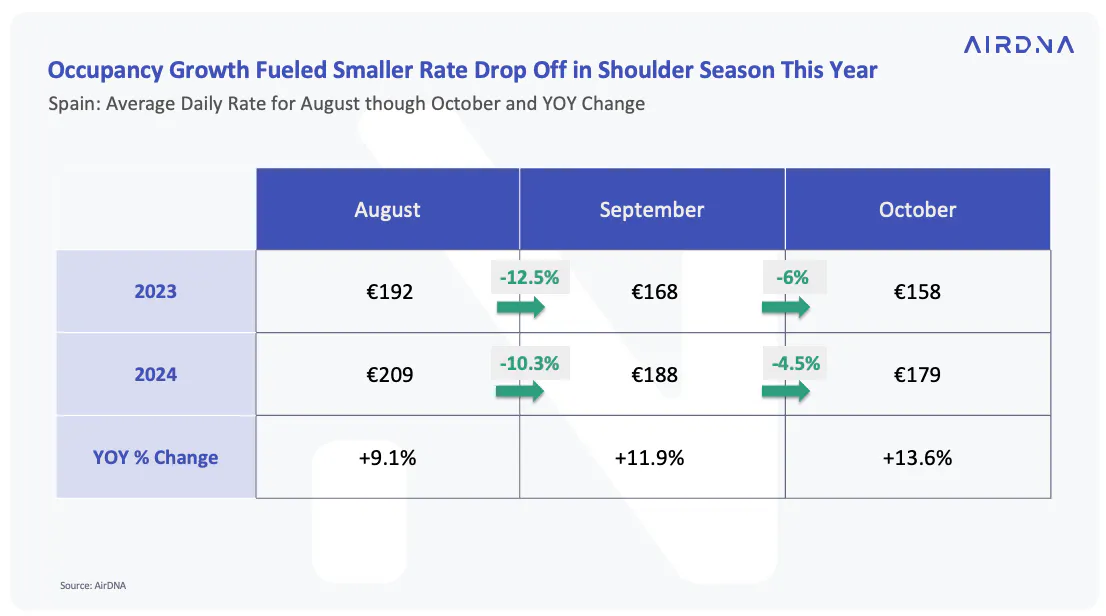
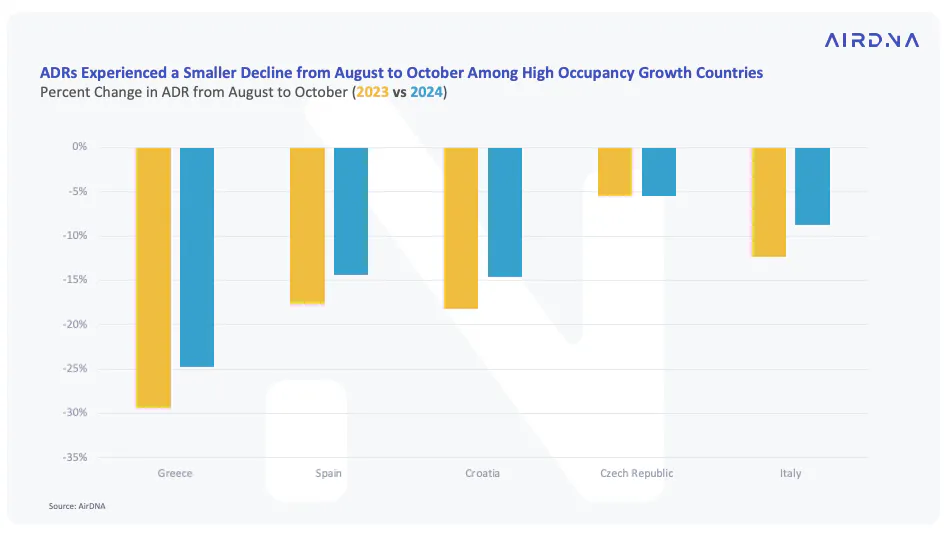
Thanks to higher occupancy, Spanish hosts didn't need to drop their rates as deeply this shoulder season. Last year, ADRs in September were 12.5% lower than August and ADRs declined another 6% from September to October. This year, ADRs in September were only 10.3% lower than August and ADRs only declined 4.5% from September to October.
The smaller decline in shoulder season rates drove Spain's strong ADR growth. Because hosts didn't have to cut prices as deeply as they did last year, the gap between this October and last widened—pushing ADRs 13.6% higher than October 2022.
Spain wasn't alone. Greece showed a similar pattern—rates declined 25% from August to October this year, compared to a steeper 29% drop in 2022. This trend played out across Europe's top 20 markets, where strong shoulder season occupancy helped hosts maintain steadier rates through the summer-to-fall transition. In fact, four of the top five countries for October occupancy growth saw notably smaller rate declines compared to last year's August-to-October drop.
High-End Properties See Greater Occupancy Growth in the Shoulder Season
There's another factor behind Europe's impressive rate growth in the last two months—travelers are treating themselves to more luxurious stays this fall.
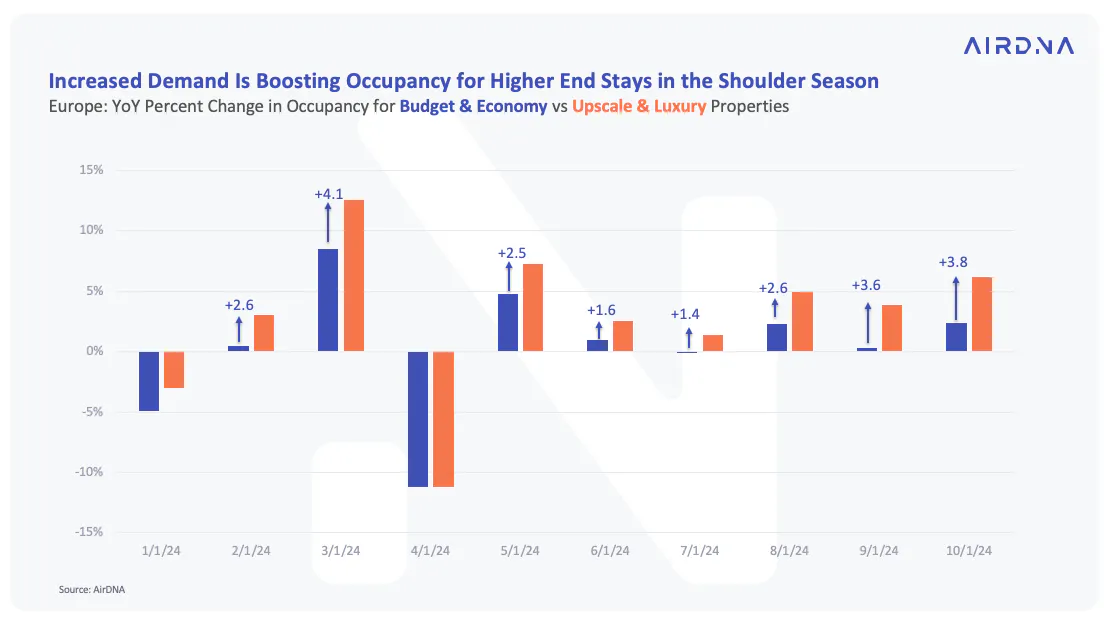
Looking at YoY occupancy growth by price tier, we see that higher-end stays (upscale and luxury tier stays) have had stronger occupancy growth than lower-end stays (budget and economy tier stays) throughout this year. However, in September and October, we see a greater gap between higher-end and lower-end occupancy growth.
While high-end stays saw only slightly stronger occupancy growth in peak summer—outpacing lower-end stays by 1.4 to 2.6 percentage points in July and August—the gap widened significantly this fall. In September and October, higher-end stays pulled ahead by 3.6 to 3.8 percentage points, showing a clear preference for premium properties in the shoulder season.
Here's why this matters: As luxury properties become more affordable in the shoulder season, travelers appear to be trading up. Rather than booking budget stays, they're taking advantage of lower off-peak rates to experience premium properties—driving up occupancy at high-end rentals while widening the gap between luxury and budget bookings. We saw this same pattern back in March, suggesting this isn't just a fall phenomenon—travelers consistently gravitate toward luxury when shoulder season prices make it more accessible.
Robust Demand Growth Among Top 50 European Cities in October
Large European cities may still be working their way back to pre-pandemic demand levels, but shoulder season is emerging as their sweet spot for recovery.
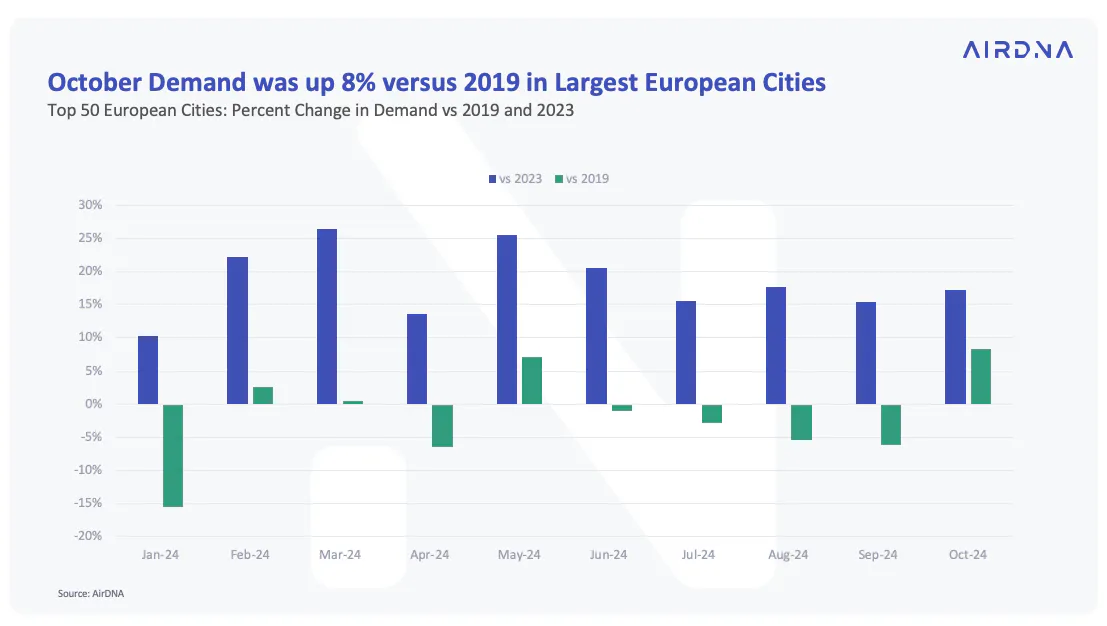
October demand among the top 50 cities was up 8% versus 2019. The only other month this year that has seen comparable demand growth is May, where demand was up 7% from 2019. Meanwhile, October demand was up 17.2% YOY, in line with growth rates we’ve seen in the second half of the year.
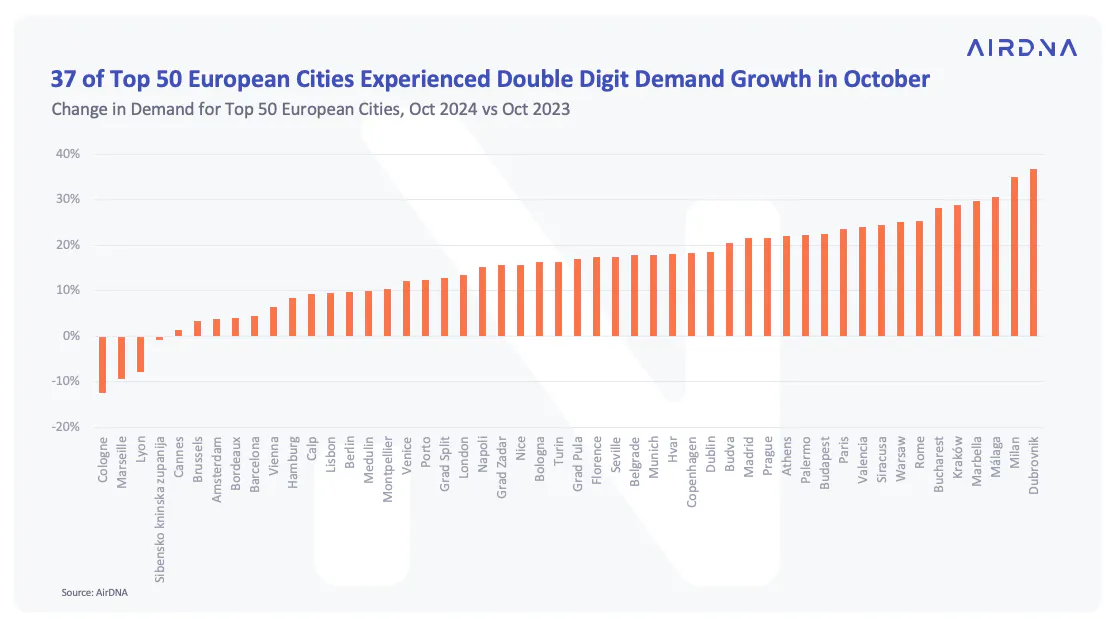
Among the top 50 European cities, 37 saw double-digit demand growth in October.
The top leaders saw demand up 25% or more YOY. Among them were several popular southern European beach destinations and three eastern European capitals.
- Siracusa (+25%)
- Warsaw (+25%)
- Rome (+25%)
- Bucharest (+28%)
- Kraków (+29%)
- Marbella (+30%)
- Málaga (+31%)
- Milan (+35%)
- Dubrovnik (+37%)
The October surge wasn't universal. Of Europe's top 50 cities, 13 either saw modest growth below 10% or experienced demand declines compared to last year.
In cities like Lyon or Bordeaux, caps on the number of days short-term rentals can take in guests and lagging travel demand have had a large impact on growth. Meanwhile, in Barcelona and Amsterdam, strict STR regulations have limited supply growth and suppressed demand growth.
Europe On Trend to Keep the Ball Rolling into 2025
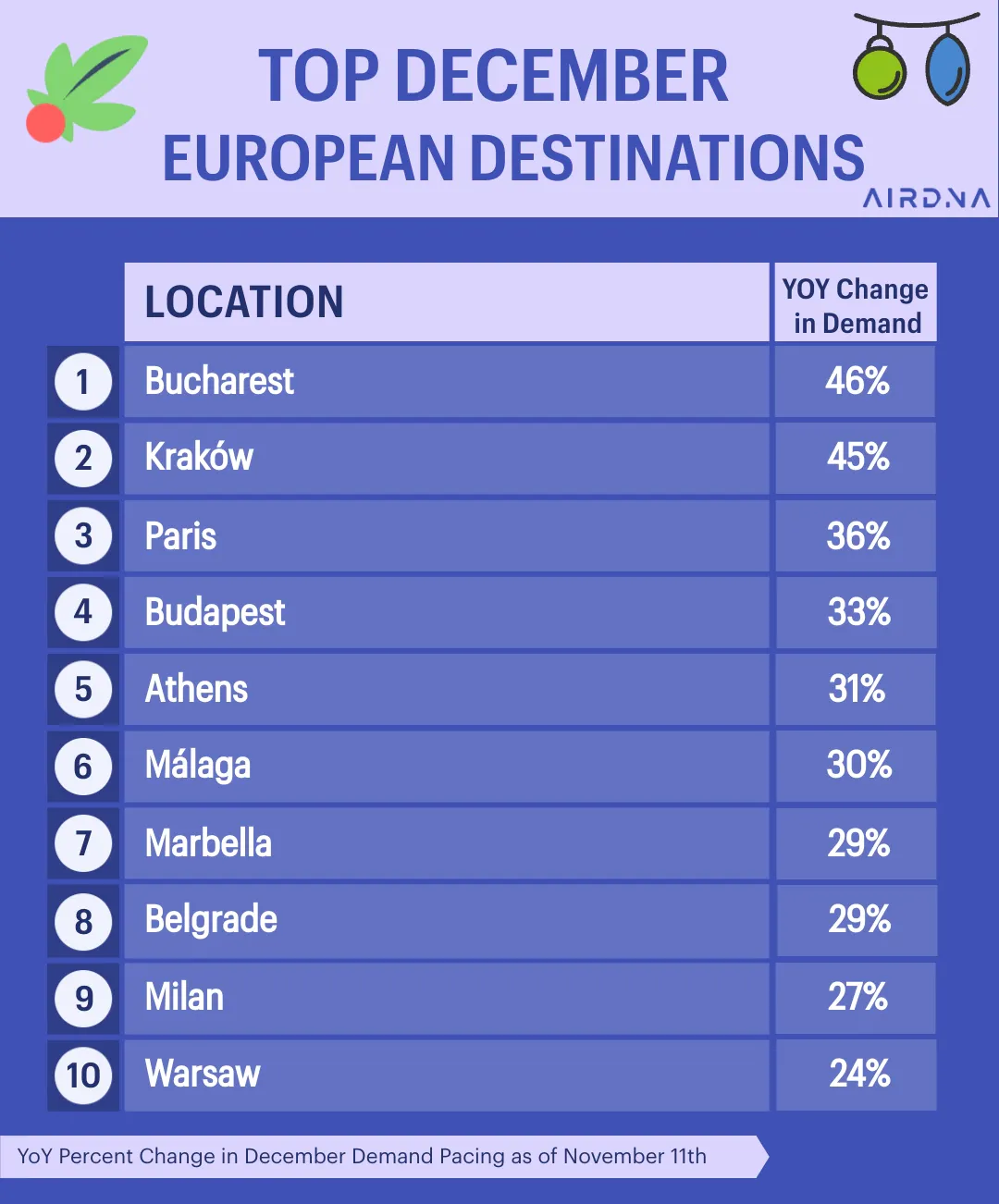
If you’re looking to spend your holidays in Europe, below are the top cities in Europe that are seeing the most YOY growth in demand pacing for December.
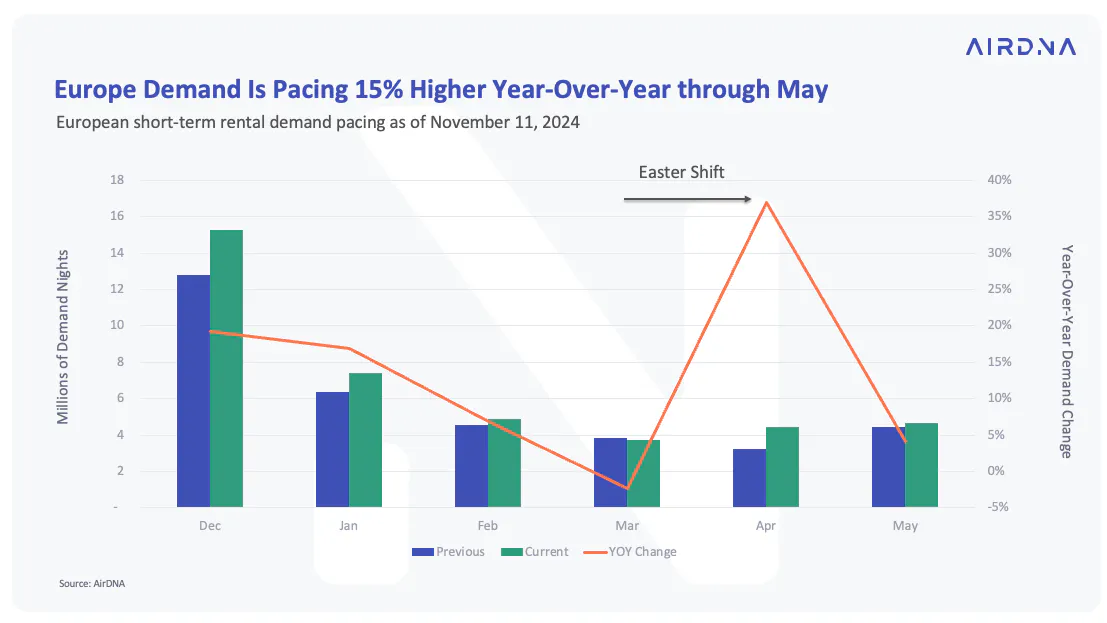
The momentum extends well beyond December. Current demand on the books is up 19% YOY for December, 17% YOY for January, and 7% YOY for February. March demand is currently down 2% while April demand is up 37% as Easter shifts back to April after landing in March last year.
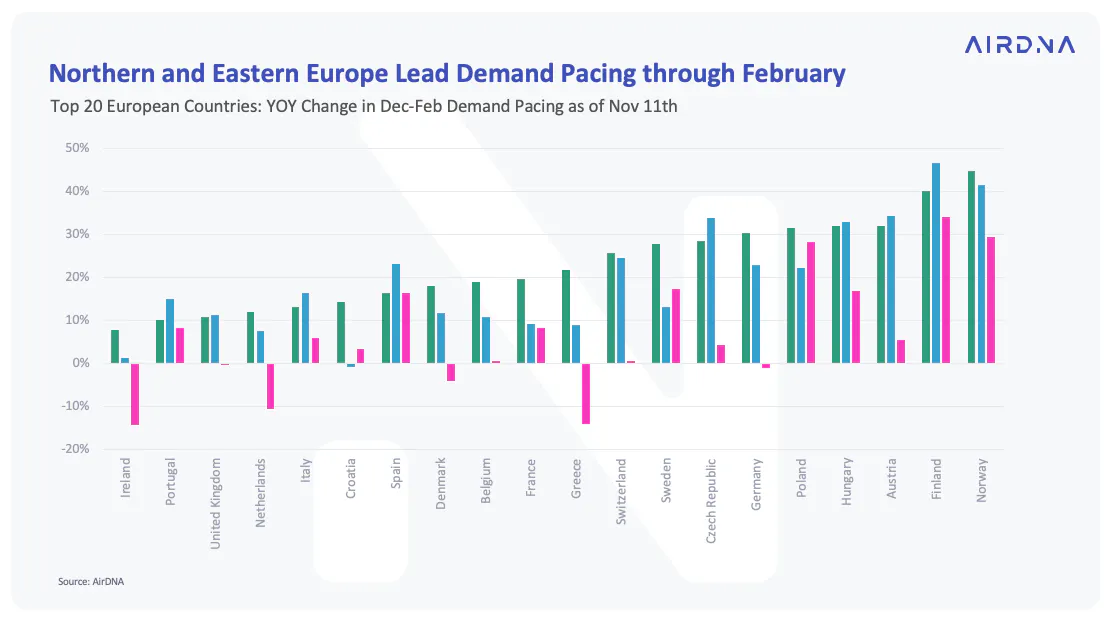
Among the top 20 European countries, northern and eastern European countries are leading demand growth into the new year. Demand pacing is up 40% YOY in Finland and Norway for December through February. Hungary, Poland, and the Czech Republic are all seeing 25% or more YOY growth in demand for the next three months. The countries experiencing slower demand growth are the United Kingdom, the Netherlands, Croatia, and Ireland.
ARTICLE SUMMARY
Higher occupancy levels gave European vacation rental hosts unexpected pricing power this October. With demand up 17.7% year-over-year, hosts maintained steadier rates through shoulder season compared to 2022—particularly in Southern markets where occupancy growth topped 6%.
Linda Rollins
Senior Research Analyst
Linda Rollins is a Senior Research Analyst at AirDNA and a self-managing short-term rental host, which means she understands the market as both an analyst and an operator. She writes research and blogs for AirDNA and for Adapt, its revenue management tool, making her work a go-to resource for investors trying to find and size up the right opportunities, and for operators looking to understand changing market dynamics and find concrete ways to improve occupancy, rates, and guest experience. Her data is regularly cited in major news outlets, and she has a knack for bringing both the numbers and the story behind them. In her free time, Linda enjoys spending time with her family, traveling, and looking for good eats.
