

 Calculate Revenue
 Research Markets
 Find For Sale Properties
 Compare My Listing
 STR Revenue Calculator
 Custom Comp Sets
 Submarket Insights
 Custom Search Filters
 Rate Recommendations
 Performance Benchmarking
 Competitor Comparison
 Owner Contact Details
 Property-level performance data
 Tourism Insights
 Real Estate Investment Analytics
 About Us
 Sales
Sales Support
 Press
PressOTA Earnings Analysis: What Airbnb, Vrbo, and Booking.com’s Q4 Earnings Reveal About the Future of STRs
Published: March 6, 2026
Last updated: May 16, 2026

Jamie Zhang
Key Takeaways
- Latin America and Asia Pacific are driving strong booking growth and first-time travelers, signaling continued geographic diversification of demand.
- Features like Reserve Now Pay Later, promotional tools, and loyalty-driven pricing aim to accelerate bookings while shifting pricing and cancellation dynamics for hosts.
- As platforms invest in AI-powered search and personalization, listings with complete data, strong reviews, and clear attributes will gain a competitive advantage.
Every quarter, the world’s largest online travel agencies (OTAs) offer a preview of where the short-term rental (STR) industry is heading next.
For hosts, property managers, distribution partners, and STR investors, these earnings calls are packed with signals: shifts in traveler demand, new platform features, pricing changes, and strategic bets on technology.
However, the raw information can be scattered across shareholder letters, earnings transcripts, and product announcements. This makes it difficult to connect the dots in an OTA earnings analysis and understand what actually matters for your business.
That’s why we’ve distilled the key takeaways from the Q4 2025 earnings releases from Airbnb, Expedia (Vrbo), and Booking.com into one practical briefing for STR practitioners.
Across these platforms, a few themes are already emerging:
- Demand continues to diversify globally, with strong growth in regions like Latin America and Asia Pacific.
- Product changes are increasingly focused on reducing booking friction, from flexible payment options to streamlined checkout experiences.
- AI is becoming foundational across search, personalization, and customer support, reshaping how listings surface and how travelers discover properties.
Each of these developments has practical implications, whether you're optimizing listings, managing revenue, building STR technology, or evaluating investment opportunities.
In this report, we break down what each OTA emphasized in their latest earnings cycle, highlight the operational changes that matter most for the STR ecosystem, and translate platform strategy from the OTA earnings analysis into actionable insights for hosts, operators, and industry stakeholders.
Airbnb
Supply-demand trend of platform
Q4 marked the strongest growth quarter of the year for nights, with year-over-year growth at 10% in booked nights, 16% in booking value, and 12% in revenue. All growth mentioned below is year-over-year growth for Q4 2025.
- North America: Nights grew at mid-single digit, mainly driven by strong domestic demand and trips with longer lead times. ADR increased 5%, mainly driven by growth in short-term stays and entire homes, particularly with large properties (4+ bedrooms).
- EMEA: Nights grew at high-single digit, reflecting broad improvement in both the core and expansion markets.
- Latin America: Nights grew at high-teens growth, marking a success of global expansion in Latin America. Brazil was highlighted with a 20% origin nights booked increase and first-time bookers increasing 17% while Mexico also delivered high-teens growth in origin nights booked.
- Asia Pacific: Nights grew at mid-teens. Japan continued strength in domestic travel and origin nights in India grew 50% year-over-year with first-time bookers up 60%.
Product strategy in Q4 focused on improving conversion by increasing flexibility and reducing booking friction. The features highlighted by Airbnb emphasized easier booking decisions and a smoother checkout experience.
On the supply side, quality remains central. To increase search prioritization, hosts are increasingly encouraged to earn Guest Favorite status, which accounts for approximately half of all bookings.
Demand trends also point to structural expansion. First-time users are accelerating in growth, indicating future demand diversification beyond traditional America/Europe corridors.

Hotel Expansion
Airbnb is actively incorporating hotels into its platform as an expansion strategy. Boutiques and independents are a large portion of the hotel inventory, which are also where Airbnb is starting off for now to strengthen the home base.
Top markets with a large inventory of independent hotels are the primary focus for their initial beta testing, which includes New York, Los Angeles, Madrid, and San Francisco.
As of Q4, hotels only took account of a single-digit percentage of total nights booked. By the end of 2026, Airbnb expects it to be a meaningfully larger percentage.
Reserve Now Pay Later
The Reserve Now Pay Later (“RNPL”) feature was tested in the U.S in the back half of 2025. It allows guests to reserve an eligible stay and pay $0 upfront and then pay in installments over time. The eligible stay needs to be a short stay (below 28 days) in a listing with flexible or moderate cancellation policies, reserved at least 14 days ahead of the check-in date.
Impact of Reserve Now Pay Later
Reserve Now, Pay Later (RNPL) already saw 70%+ adoption among eligible bookings in the U.S. The adoption percentage based on global GBV in Q4 2025. This feature contributed to the acceleration of bookings in Q4. Note that AirDNA shows just 37% of U.S. listings are eligible for RNPL based on their minimum-night stay and cancellation policies.
The feature has lengthened lead times. This makes it easier to book higher priced properties early and encourages guests to plan and book further ahead without having to pay for the entire cost of the stay upfront. What’s more, it also had a positive impact on increasing ADR as consumers who did not want to extend a huge purchase on their credit cards are more likely to choose a slightly nicer listing.
Future plan for Reserve Now Pay Later
The feature was made available globally in early 2026 to unlock booking potential worldwide. AirDNA shows 53% of global listings are eligible for RNPL based on min-stay and cancellation policies.
Updated cancellation policies
New cancellation policies were introduced in Oct 2025. This change removed the option for new listings to opt for a ‘strict’ policy and introduced a new ‘limited’ policy. The newly added limited policy enables free cancellation up to 14 days before check-in and limits strict policies on new listings. All reservations that are made more than a week ahead are having a 24-hour grace period for free cancellation after their reservation is confirmed.
Impact of updated cancellation policies
Airbnb called out that the more lenient policies helped reduce customer service contacts and increased bookings in Q4. However, the flexible structure raises cancellation risk for hosts, particularly for longer lead-time reservations.
Single service fee structure
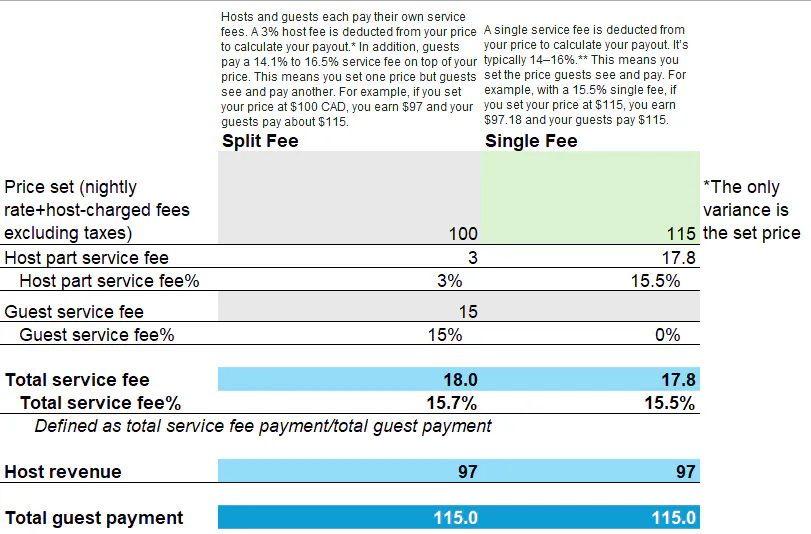
For PMS-connect hosts, the long-standing fee structure was a combination of 3% on hosts and a variable guest fee, making total fee ranging from 14.1% to 16.5% of the booking total. The migration in October moved API-connected hosts to the single service fee structure, simplifying the math and making total fee at 15.5%.
The single fee structure enables hosts to set the price as they intend to with price parity across channels for listings that are crosslisted. Usually the prices would be higher on Airbnb than other channels, as the earnings call stated.
Below is a comparison of the two fee structures of the same listing. Maintaining prior net revenue would require roughly a ~15% price increase in your set price, equivalent to ~18.34% change in the markup rate in the PMS system. However, many hosts resisted adjusting rates due to concerns that it will make their listing less competitive.
Impact of single service fee structure
In a highly price-elastic STR environment, hosts that kept rates lower rather than increasing ADR to offset the fee change maintained stronger demand and search visibility because of their lower relative price. The combination of lower prices and high price sensitivity led to a meaningful increase in bookings for listings that did not fully pass through the higher fee.
Future plan for single service fee structure
The single fee structure is also being piloted for individual hosts in select countries, simplifying the pricing process and making rate setting more straightforward.
AI-driven tools
Two major areas in AI tools were discussed. The first is AI search. AI search is still undergoing testing and represents a very small percent of traffic on Airbnb right now. Future development of this feature will be done through rapid iteration rather than a few big launches. Sponsored listings will serve as a result of developed AI and conversational search.
Customer service is another area where Airbnb actively adopts AI. In the past year, 30% of customer service? tickets in North America in English were handled by an AI agent. If successful next year, the AI customer service will be made available through voice and chat across multiple languages, representing more than 30% of tickets globally.
Expedia (Vrbo)
Supply-demand trend of platform
Q4 platform supply has grown 10% year-over-year. The Black Friday promotion became a meaningful driver-70% more properties participated than ever before. Specifically on Vrbo, the promotion suite expanded supply. Supply quality and promotional participation together drove demand.
Demand growth (+9% 2025 Q4 vs. 2024 Q4) was led by international markets, where room nights expanded faster than in the U.S., indicating continued demand diversification beyond the domestic base.
- United States: Room nights grew at high single digits, with revenue growing at 4%.
- EMEA: Room nights grew at low double digits.
- Rest of World: Room nights grew at low double digits.
Comparisons among segmentations show that the B2B (Business-to-Business) segment outpaced growth in B2C (Business-to-Consumer) (24% vs. 5%) in Q4, mainly contributed by rapid API. The B2B segment represents the distribution network through Expedia’s partners and sold to travelers indirectly, such as corporate travel platforms, loyalty programs and flight-inclusive bookings. The B2C segment represents the direct bookings made by individual travelers on Expedia’s own platforms, such as Expedia.com, vebo.com and Hotels.com.
On the one hand, the fast growth of B2B distributions brings incremental and less price-sensitive demand; the corporate travel guests could even help fill the midweek and shoulder periods. On the other hand, the indirect channels make it harder to maintain price parity and monitoring realized ADR will be increasingly important.
The acquisition of Tiqets (for experiences) also signals ambitions to bundle hotel and STRs with activities in new booking packages.
Vrbo has returned to growth. Specifically on Vrbo, the focus is mainly around quality supply and faster speed in checkout process.
Vrbo’s promotion suite
Promotion Suite is the smarter promotion or special deals feature Vrbo expanded in Aug 2025. Setting up promotions can help PMs secure bookings with designated lead time, length of stays, targeted trusted guests, and mobile booking prices.
Acting like another layer of discount, what differentiates “promotions” from weekly or monthly discounts is that promotions also boost the listing in search results, provide targeted access, and provide more flexibility especially in multi-season strategies.
Meanwhile, Expedia is doubling down on loyalty as a defensive moat, which can be translated into member-exclusive rates and inventory perks. Therefore, properties willing to offer differentiated rates for loyalty members will see improved placement and conversion.
VrboCare
VrboCare is a free feature that serves to reassure guests that Vrbo safeguards in the event of host-initiated cancellations, check-in issues, fraud, and significant property misrepresentation.
One of the top advertised benefits is that Vrbo agents can help rebook guests into comparable accommodations if they experience check-in issues or host-initiated cancellations.
Expedia believes the VrboCare program gives travelers more trust and reduces checkout frictions as they are confident about being backed up when plans change.
AI-driven personalization
Expedia is actively building native integrations with agentic browsers and gen AI search platforms, making sure their inventory surfaces in AI-generated travel recommendations. For hosts/PMs, this means changing logic for visibility from that for traditional search engines. Listings with rich, structured data, such as accurate amenity tags, strong verified reviews, precise location attributes, will be favored by AI recommendation layers. Vrbo suggests PMs audit listing completeness now, before AI-driven traffic becomes mainstream.
Booking.com
Supply-demand trend of platform
Booking.com's Alternative Accommodations (AA) grew listings 8% YoY, ending the year at 8.6 million properties. Room nights grew roughly 10% in 2025 Q4— in line with total platform room night growth — with the mix expanding to 36% of total room nights (up from 35% in 2024 Q4).
Specifically, it was mentioned that chain hotels only accounted for 10% of its listed supply. The majority, 90%, lies in independent hotels, alternative accommodations and smaller chains. Booking.com will continue in diverse supply investment and valuing the optionality.

On the demand side, North America and Asia stood out again with low double-digit growth in nights, and were highlighted as focused expansion regions in 2026. Booking.com will continue growing in the U.S. with the growth accelerating over a strong prior year comparison.
Although, the executives also mentioned the lower ADR and shorter length of stay that show discretion in guest behaviors in the U.S. while the booking window remained steady.
At guest level, the loyalty program Genius Levels 2 and 3 customers contributed higher room nights year-over-year, reflecting a growing tendency of guests to come directly to Booking.com for reservations.
Agentic AI
The agentic AI capabilities mainly focused on more engagement, faster search, better conversion and lower cancellation rates. Besides these, it’s also being used to reduce customer service costs, while still maintaining double digit growth.
Sources for short-term rental industry analysis
- Shareholder letter, Press Release, Earnings Transcript, 2025Q4. Airbnb. https://investors.airbnb.com/home/default.aspx
- Earnings Release, Earnings Presentation, Earnings Call Transcript, 2025Q4. Expedia. https://ir.expediagroup.com/investors/investors-overview/default.aspx
- Earnings Press Release, Quarterly Earnings Presentation, Earnings Transcript, Prepared Remarks, 2025Q4. Booking.com. https://ir.bookingholdings.com/overview/default.aspx
- Manage your promotions. Vrbo. https://help.vrbo.com/articles/Manage-promotions
ARTICLE SUMMARY
The latest earnings releases from Airbnb, Expedia (Vrbo), and Booking.com reveal where the short-term rental industry is heading next, from shifting global demand to platform-driven product changes. This briefing breaks down the most important signals for hosts, operators, and STR professionals, including the rise of AI-powered discovery, booking flexibility features, and evolving pricing dynamics across major OTAs.
Jamie Zhang
AirDNA Data Analyst
Jamie Zhang is a Data Analyst at AirDNA, leveraging her background in data science and analytics to uncover key trends in the short-term rental industry. Before joining AirDNA, she worked as a data analyst at Shanghai Disney, where she specialized in revenue forecasting and financial planning . She holds a Master’s degree in International Economics and International Relations from Johns Hopkins. Jamie enjoys cycling to explore different corners of the city.
