

 Calculate Revenue
 Research Markets
 Find For Sale Properties
 Compare My Listing
 STR Revenue Calculator
 Custom Comp Sets
 Submarket Insights
 Custom Search Filters
 Rate Recommendations
 Performance Benchmarking
 Competitor Comparison
 Owner Contact Details
 Property-level performance data
 Tourism Insights
 Real Estate Investment Analytics
 About Us
 Sales
Sales Support
 Press
PressWhy the 2026 PGA Championship Didn’t Deliver For Philadelphia STR Hosts
Published: May 13, 2026

Camilo Schmid Rivas
Key Takeaways
- Philadelphia saw far weaker PGA Championship demand growth than Charlotte and Louisville, despite strong booking activity leading into the event.
- Most PGA-week bookings were made months in advance, making early pricing strategy far more important than last-minute rate adjustments.
- Philadelphia hosts largely kept normal minimum-stay rules during tournament week, potentially leaving additional event revenue on the table.
When the PGA Championship rolls into town, hosts usually expect a perfect storm of premium pricing, packed calendars, and booking demand that throws normal market patterns out the window.
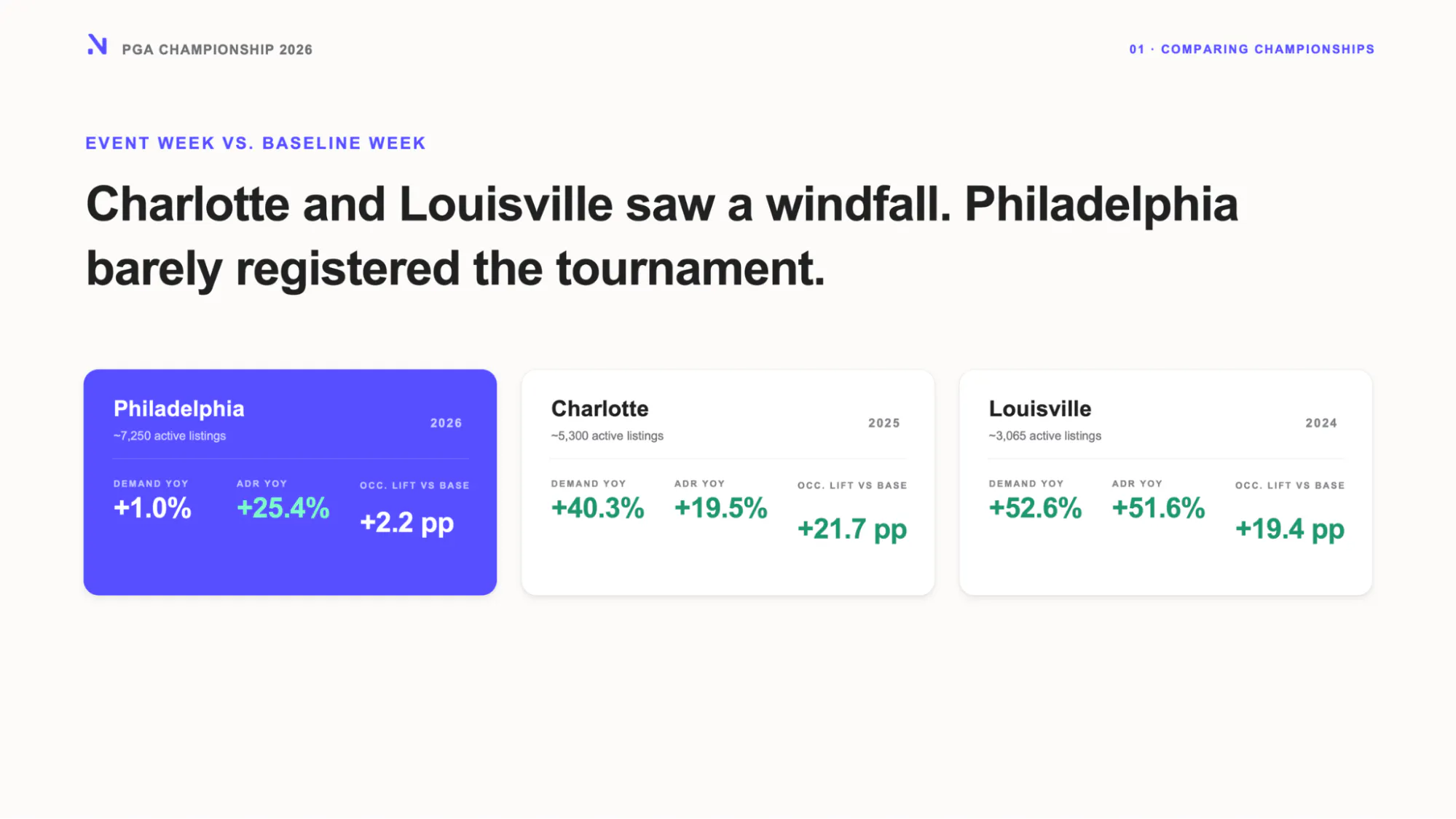
That’s exactly what happened in Charlotte in 2025 and Louisville in 2024. Both markets saw event-week demand jump by roughly 40% year over year, while occupancy climbed nearly 20 percentage points above baseline levels in the week before the tournament.
Philadelphia in 2026? Not quite. While the PGA Championship at Aronimink Golf Club gave ADR a modest lift, demand and occupancy barely moved compared to a typical May week. For an event known for driving major short-term rental surges, the market response was surprisingly muted.
So what happened? We dug into the data to understand why Philadelphia behaved differently, how booking patterns shifted beneath the surface, and what hosts in Frisco, Texas can learn before the 2027 PGA Championship arrives.
Comparing Philadelphia to Previous PGA Championships
The 2026 PGA Championship was supposed to be a major win for Philadelphia hosts, but the headline numbers tell a much softer story.
Charlotte hosts saw demand jump 40% year over year during the 2025 Championship, with occupancy climbing nearly 22 percentage points above baseline levels. Louisville saw an even stronger lift in 2024, with demand up 53% and occupancy up 19 points.
Philadelphia? Demand barely moved, rising just 1% year over year and sitting only 3.7 percentage points above baseline.
Why Philadelphia’s event impact was smaller
Market size is a big part of the explanation. Philadelphia has roughly 7,250 active short-term rental listings, compared to around 5,300 in Charlotte and just 3,065 in Louisville. When event-driven demand hits a market this large, the impact gets spread across far more inventory.
ADR was the one bright spot for Philly hosts, climbing 25% year over year during PGA week. But once you strip out the broader pricing growth Philadelphia was already seeing, with baseline-week ADR already up 21% YoY, the actual event-driven lift comes in at just 4.3 percentage points above baseline. Occupancy followed a similar pattern. The PGA Championship moved the needle in Philadelphia, but only slightly.
The booking curve tells a different story
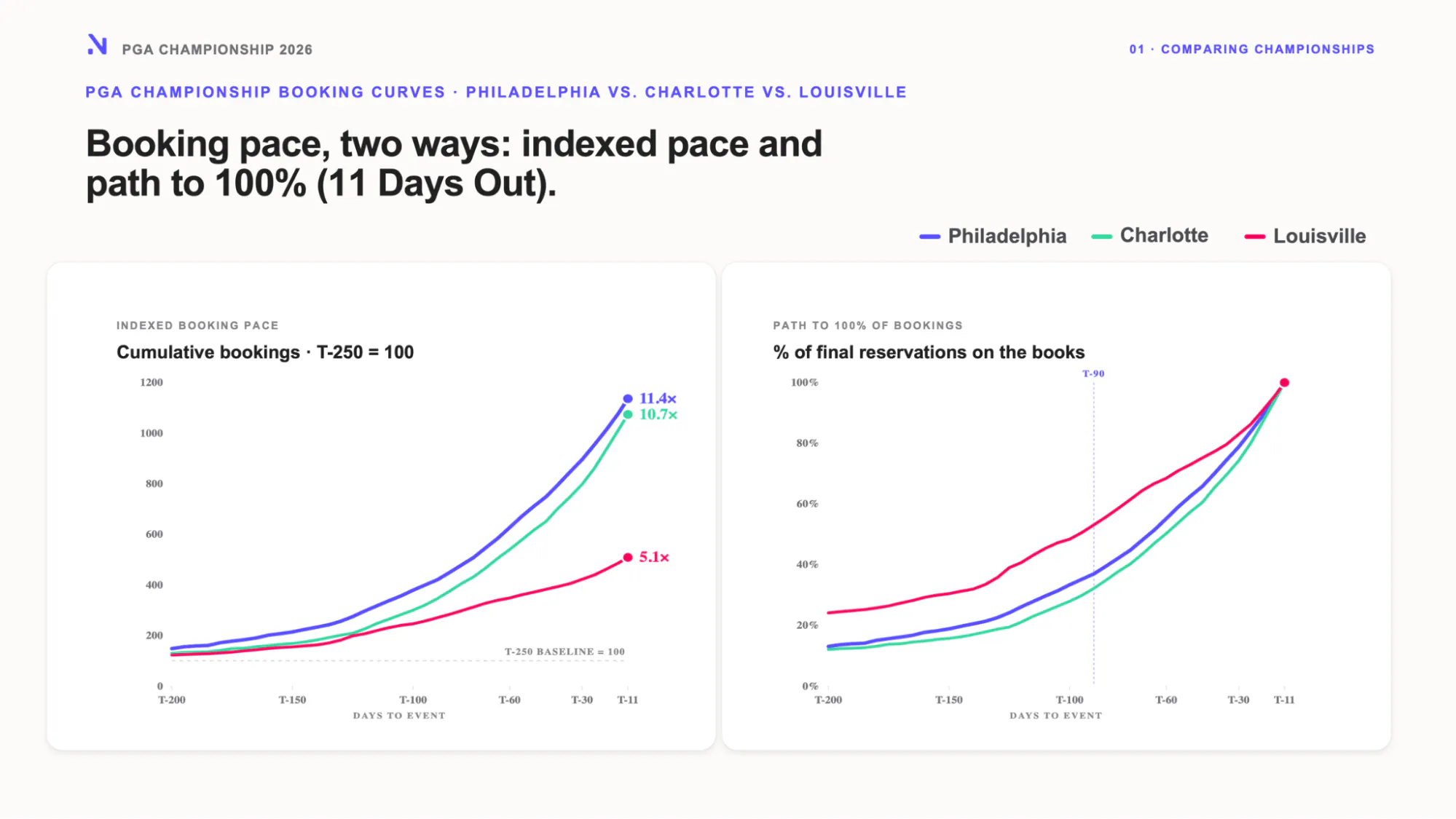
Underneath the softer headline metrics, the booking pace tells a much more interesting story. When we index each market’s booking curve to T-250, or 250 days before the tournament, Philadelphia actually accumulated reservations faster than either Charlotte or Louisville for much of the booking cycle.
By the time the tournament was 11 days away, Philadelphia’s booking volume had grown to more than eleven times its T-250 baseline, edging out Charlotte and sitting well ahead of Louisville. The acceleration during the final 60 days was especially sharp. For most of the run-up, Philadelphia hosts were dealing with the strongest booking pressure of the three PGA Championship markets, even if the final occupancy and demand metrics didn’t fully reflect it.
Smaller markets fill earlier
Looking at each market’s path toward 100% of final bookings reveals another important difference.
Louisville hosts had already locked in roughly 20% of their event-week reservations 250 days ahead of the tournament, around six to seven months out. Charlotte and Philadelphia were both sitting below 10% at the same point.
By T-90, Louisville had already reached 53% of its final bookings, while Philadelphia and Charlotte were still hovering around 37% and 32%. Louisville’s booking profile was much more front-loaded, meaning hosts needed to price for the event far earlier in the cycle.
Again, market size plays a major role here. In a smaller, supply-constrained metro like Louisville, guests who wait too long risk running out of inventory altogether, which pushes bookings earlier. In a larger market like Philadelphia, travelers have more flexibility and inventory to choose from, so a bigger share of bookings gets concentrated into the final eight weeks before the tournament.
For hosts, the takeaway is straightforward: in large metro markets, the demand is still there, it just arrives later. And that makes early pricing strategy especially important. By T-30, much of the booking ramp has already happened.
Try Our Vacation Rental Pricing Tool
Use AirDNA rate recommendations to optimize your pricing strategy.
The Demand Showed Up Earlier Than Usual
Even though the headline metrics barely moved, the timing of bookings shifted dramatically during PGA week, and that’s the signal hosts should really pay attention to.
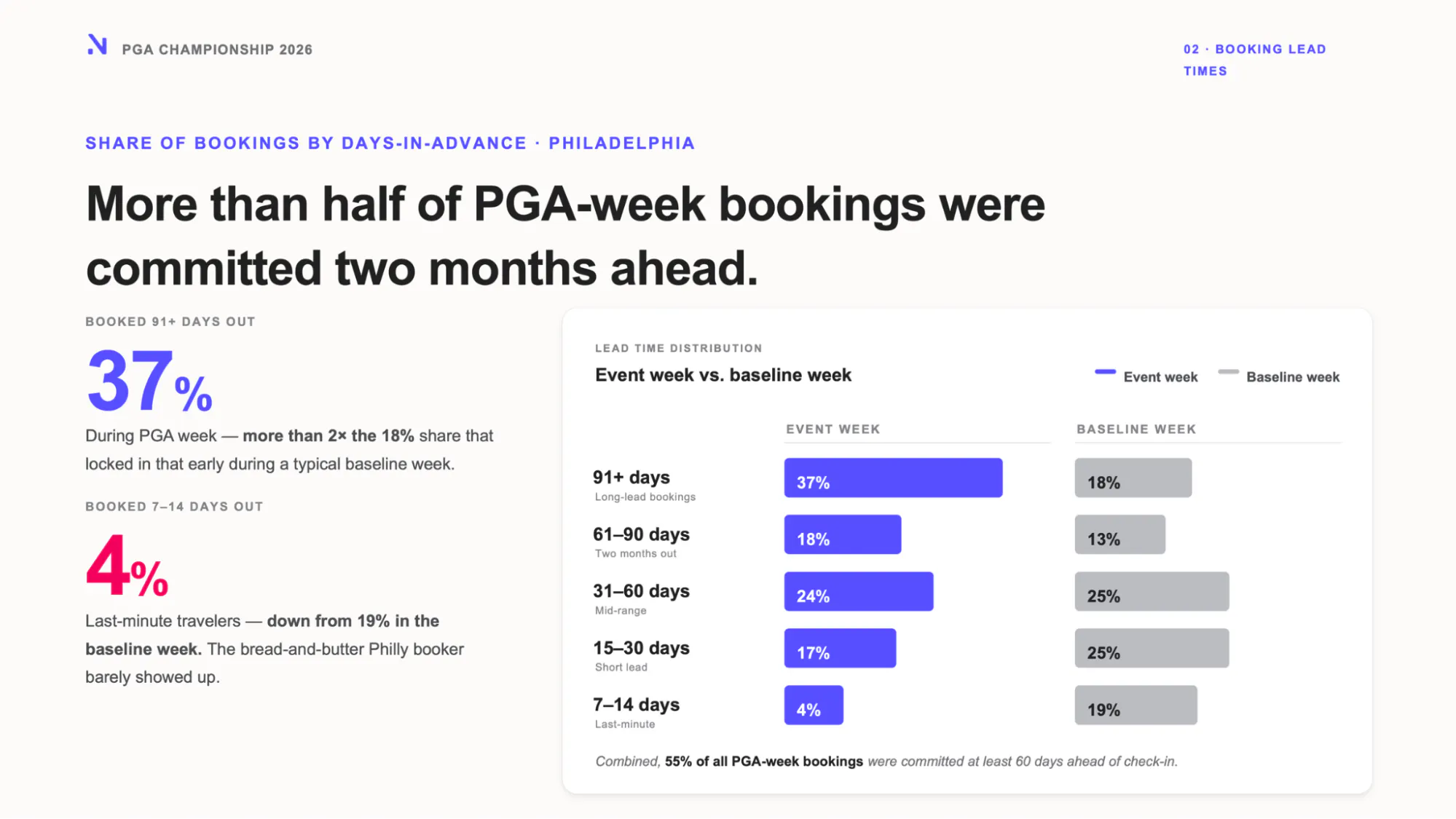
During tournament week, 37% of bookings were made 91+ days in advance, more than double the 18% share that locked in that early during a typical baseline week. The 61–90 day booking window also expanded, climbing from 13% to 18%. Altogether, more than half of all PGA-week bookings were committed at least two months before check-in.
The shorter end of the booking curve tells the same story in reverse. Just 4% of event-week bookings landed in the 7–14 day window, compared to 19% during a normal baseline week. Last-minute travelers, usually a major part of a typical Philadelphia booking cycle, barely showed up for the PGA. Most of the demand had already been locked in well before tournament weekend.
For hosts, this is where revenue management really matters. If rates weren’t adjusted for the event by February or March, much of the booking ramp was already missed. The hosts who captured the premium were the ones who recognized the early demand signal, priced accordingly, and held firm as the long-lead bookings rolled in.
Waiting for last-minute pricing power can work during a normal week. During a major event, the bookings are often already gone.
Increasing Minimum Stay Requirements For Major Events
The minimum-stay data reveals another opportunity Philadelphia hosts may have left on the table.
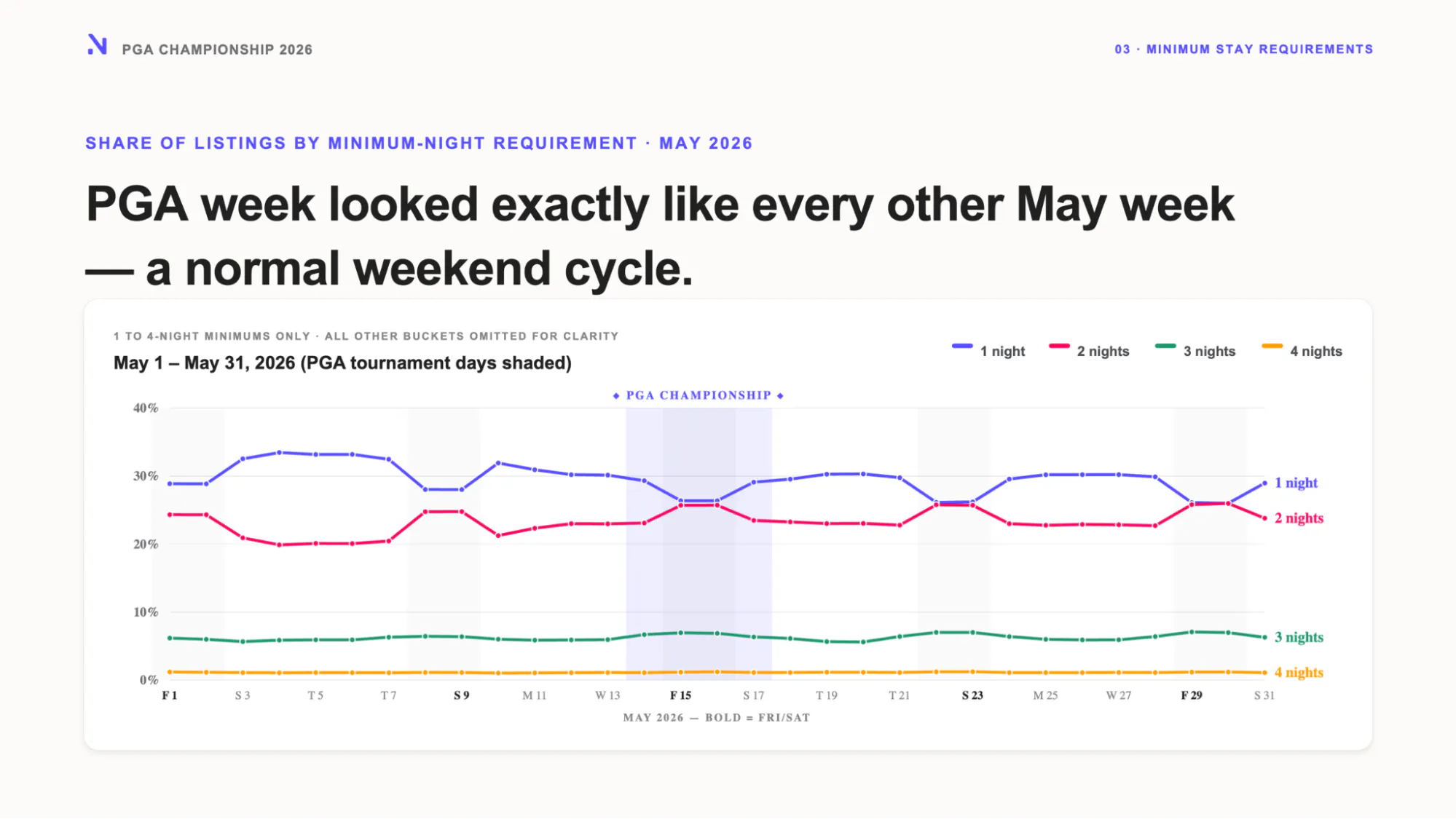
During PGA week, the share of listings requiring a two-night, three-night, or longer minimum stay looked almost identical to a normal non-event week. Hosts largely followed their standard weekly pattern, tightening minimum stays slightly on Fridays and Saturdays like any typical weekend, then loosening them again during the week, without making meaningful adjustments specifically for the tournament.
Charlotte and Louisville showed a different pattern. In Charlotte, the shift appeared on the second day of the 2025 Championship, when listings with a two-night minimum stay rose to 35% from a typical average of 31%. At the same time, listings offering one-night stays dropped from 39% to 33%.
Louisville hosts adjusted even more aggressively. On the first day of the 2024 PGA Championship, 38% of listings adopted a two-night minimum stay, up from 34% in the days leading into the event. Meanwhile, the share of listings allowing one-night stays fell from an average of 35% to just 28%.
That’s notable because the standard major events pricing playbook is usually the opposite of what Philadelphia hosts did. Hosts often raise minimum stays to three or four nights to secure longer bookings at premium event rates and reduce calendar fragmentation during periods of concentrated demand. Philadelphia hosts largely stayed flexible instead.
Whether that reflects a missed pricing signal or a deliberate strategy to keep calendars open, the result was a metro-wide inventory pattern that looked remarkably similar to a normal May week, even while the booking data suggested guest behavior was anything but typical.
So automatic, you won’t know what to do with yourself
It’s simple to automate repetitive tasks with Uplisting's short-term rental software. You’ll save hours every week and eliminate human error. Go ahead — take some time off.
How to prepare for the 2027 PGA Championships
The 2027 PGA Championship heads to PGA Frisco in Texas, giving local hosts a real opportunity to capture the kind of event premium that Philadelphia largely left on the table. The Philadelphia data points to a few clear strategies hosts should be thinking about well before tournament week arrives.
Price for the event by T-90
More than half of PGA-week bookings in Philadelphia were committed at least 60 days before the tournament, with the steepest booking acceleration happening during the final eight weeks. Hosts who weren’t priced for the event by February or March missed much of the demand ramp entirely.
Frisco is also a smaller market than Philadelphia, much closer to Charlotte and Louisville in overall scale. That likely means booking pressure will concentrate even earlier, making proactive pricing even more important. For hosts targeting the 2027 tournament, rates should ideally be adjusted by late winter 2026.
Tighten minimum stays during the tournament window
This was arguably the biggest missed opportunity in Philadelphia. Most hosts followed their normal weekly minimum-stay patterns throughout PGA week, leaving inventory open for short stays at rates that didn’t fully reflect tournament demand.
For major events like the PGA Championship, increasing minimum stays to three or four nights is often one of the simplest and most effective revenue management moves available. It helps lock in full-event reservations, reduce calendar fragmentation, and maximize premium pricing opportunities during concentrated demand windows.
For Frisco hosts, adjusting minimum stays across May 13–16, 2027 should be part of the event strategy early.
Use a pricing tool that reads the demand signal early
Major events reward hosts who react to demand signals before the market fully catches up.
This is exactly the type of scenario AirDNA Adapt was built for. Adapt uses AI-native pricing powered by AirDNA’s market data to detect emerging demand shifts and adjust rates automatically, helping hosts capture long-lead booking premiums without constantly monitoring booking curves manually.
In a market like Frisco heading into a major event, recognizing demand early can make the difference between capturing the booking surge and missing it entirely.
The PGA Championship is one of the few events where the demand is predictable, the lead times are long, and the playbook is relatively clear. The hosts who execute early are usually the ones still talking about the windfall long after tournament weekend ends.
FAQs
Did the 2026 PGA Championship increase short-term rental demand in Philadelphia?
Not significantly. While ADR increased during tournament week, overall demand rose just 1% year over year and occupancy increased only slightly above baseline levels compared to stronger event-driven surges seen in Charlotte and Louisville.
Why did Philadelphia see a smaller PGA Championship impact than other cities?
Philadelphia’s larger short-term rental market diluted the impact across more inventory. With over 7,000 active listings, guests also had more flexibility to wait before booking, unlike smaller, supply-constrained markets where reservations tend to lock in much earlier.
When should hosts start preparing pricing for a major event on AirDNA?
The data suggests hosts should adjust pricing at least 90 days before the event. In Philadelphia, more than half of PGA-week bookings were already committed two months before tournament weekend, meaning hosts who waited too long likely missed much of the premium demand.
ARTICLE SUMMARY
Philadelphia’s 2026 PGA Championship delivered weaker-than-expected STR demand growth compared to Charlotte and Louisville. This analysis explores what happened and what Frisco hosts can learn before the 2027 tournament.
Camilo Schmid Rivas
Senior Research Analyst
Camilo Schmid Rivas is a Senior Research Analyst at AirDNA who brings a uniquely well-rounded perspective to short-term rental analytics. With a background that spans investment, real estate, and business analysis—including roles at Stayery and Sollers Consulting—Camilo has worn many analyst hats, each sharpening his ability to turn complex data into clear, actionable insights. A graduate of École hôtelière de Lausanne, he now channels his multidisciplinary expertise into uncovering trends that drive smarter STR decisions. In his free time, he enjoys playing tennis or scuba diving in or around Barcelona.
