

 Calculate Revenue
 Research Markets
 Find For Sale Properties
 Compare My Listing
 STR Revenue Calculator
 Custom Comp Sets
 Submarket Insights
 Custom Search Filters
 Rate Recommendations
 Performance Benchmarking
 Competitor Comparison
 Owner Contact Details
 Property-level performance data
 Tourism Insights
 Real Estate Investment Analytics
 About Us
 Sales
Sales Support
 Press
Press8 Vacation Rental Management Tips From the Best Property Managers
Published: September 30, 2026
Last updated: October 6, 2026

Camilo Schmid Rivas
More than half of single-listing hosts in the U.S. hold a guest rating of 4.9 or better. Running one property well is hard work, but it’s manageable: one calendar, one cleaner, one place you know inside out.
Keeping that rating while you grow is a different problem. At 20 to 49 listings, about one host in five holds a 4.9. Past 100 listings, it’s one in sixteen. Above 500, it’s 0.6%.
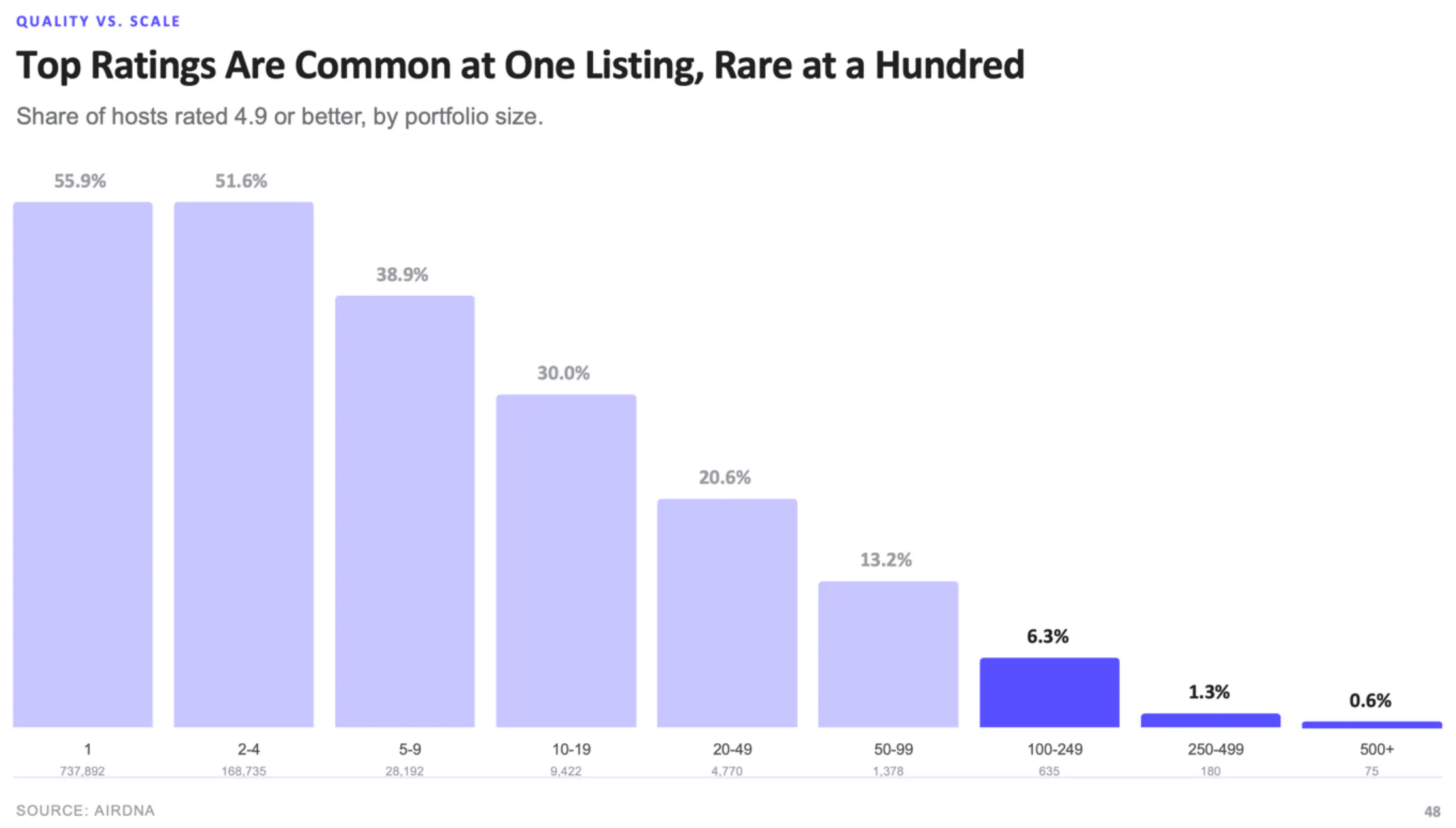
Our Best Property Managers ranking exists to find the operators who beat that curve. Nobody applies and nobody can pay their way on. We score every professional manager in our data on the same review-weighted rating and publish who comes out on top. This piece looks at what the top 25 do differently, and which of those vacation rental management habits a host of any size can adopt.
Key Takeaways
- The top 25 charge just 1% more than comparable homes but fill 13% more nights.
- 71% of their listings change rates substantially through the year, and just 6% accept one-night bookings.
- They reply to 49% of their reviews, three times the rate of hosts with five to nine units.
- Every one of the top 25 keeps all of its listings above a 90% response rate.
- 70% of their listings are rated 4.9 or above, against 22% at other large operators.
How We Compared the Top 25 With Other Hosts
- Who: the top 25 managers from our 2026 ranking, all of whom run more than a hundred U.S. listings.
- Compared with: every U.S. host with five or more listings, grouped by portfolio size (5 to 9, 10 to 19, 20 to 49, 50 to 99, and 100 or more). Owners of one to four units are left out, because their ratings run high for reasons that don’t carry over to a growing business.
- Like for like: performance is measured against comparable homes in the same market, with the same bedroom count, in the same price band, so a strong market is never mistaken for strong management.
- When: a settled trailing twelve months for listings active in summer 2026.
We only report areas where the top 25 show a clear difference.
8 Vacation Rental Management Tips From the Top 25
1. Win on occupancy, not on price
The median top 25 listing earns $55,400 a year, more than two and a half times the $21,700 a small host earns. Most of that gap is the homes themselves: bigger houses in pricier markets. Compared with similar homes in the same market and price band, the top 25 charge just 1% more but fill 13% more nights.
2. Price dynamically instead of discounting up front
71% of top 25 listings change their nightly rate substantially through the year, against 31% for hosts with five to nine units. They’re also less likely to lock in standing discounts. 43% offer a weekly discount and 32% a monthly one, against 59% and 61% for hosts with five to nine units. They adjust to demand rather than committing to a discount in advance, and their occupancy against comparable homes suggests it works better.
Stop Guessing Your Nightly Rate
Most hosts price on gut feel. Adapt prices every night on real demand, real competition, and what drives bookings.
3. Set a minimum stay and hold it
Just 6% of top 25 listings accept one-night bookings, against 32% for small hosts, and their typical minimum is three nights. A one-night stay costs as much to turn over as a five-night stay for a fraction of the revenue. Their calendars also fill earlier. Just 24% of their bookings arrive in the final week before a stay, against 32% for small hosts.
4. Invest in photos
The median top 25 listing carries 45 photos, against 26 for small hosts, and 84% have at least 30. Of every gap in the study, this is the cheapest to close.
5. Stay responsive on every listing, not just on average
Every one of the top 25 keeps all of its listings above a 90% response rate. Among other managers with more than a hundred listings, just 62% manage that. Responsiveness is usually the first thing to slip as a portfolio grows, and the best operators don’t let a single property fall behind.
6. Reply to your reviews
The top 25 respond to 49% of the reviews they receive, three times the rate of hosts with five to nine units (16%). It costs only time, and it’s one of the widest behavioral gaps in the study.
7. Get the basics of the stay right
Cleanliness is the rating where the top 25 lead by the most, at 4.91 against 4.70 for other large operators. Complaints are rarer across the board. Dirt appears in 0.45% of their reviews against 1.65%, and broken or poorly maintained items in 1.0% against 2.4%. Guests write about how a stay was run, and they notice when the basics slip.
8. Build depth before breadth
The median top 25 manager keeps 98% of its listings in a single market. None of them reached the top by spreading across many markets. They concentrated in one and offered a range of homes within it. For hosts thinking about growth, knowing one market well looks like the more reliable route.
Cancellation Terms, Instant Book, and a Third Channel Matter Less
Some practices that sound like professional management don’t separate the best from the rest.
- Cancellation policy. The top 25 are split between moderate and strict terms. The only clear signal is that they avoid flexible cancellation, used on 1% of their listings against 18% for small hosts.
- Instant Book. They use it on 63% of listings, less than the 91% across the rest of the published list.
- A third booking channel. 94% of their listings are on both Airbnb and Vrbo, but just 34% are also on Booking.com, against 55% for the rest of the published list.
- Calendar management. Year-round availability, blocked nights, and seasonal patterns look much the same across every group.
The Bottom Line: Consistency Across Every Listing Is the Edge
Guest experience usually deteriorates as a portfolio grows. At a typical operator with more than a hundred listings, two-thirds of homes carry neither of Airbnb’s quality badges. Among the top 25, it’s 1%. Seventy percent of their listings are rated 4.9 or above, against 22% at other large operators, and 84% of the managers beat their local market on occupancy.
None of the practices behind this requires capital, and none of them is unusual on its own. What sets the top 25 apart is applying them consistently across every listing, which is precisely what tends to break down as other operators grow.
Grow Your Portfolio With Better Data
Win pitches, price smarter, and report to owners with the data platform built for property managers.
FAQs
What do the best property managers do differently?
AirDNA compared the top 25 operators from its 2026 Best Property Managers ranking with every U.S. host running five or more listings. The top 25 win on occupancy rather than price, change rates through the year instead of relying on standing discounts, hold minimum stays, carry more listing photos, keep every listing above a 90% response rate, reply to 49% of their reviews and concentrate in a single market. None of these practices requires capital.
Do top property managers charge higher nightly rates?
Barely. Compared with similar homes in the same market and price band, the top 25 charge just 1% more but fill 13% more nights. 71% of their listings change their nightly rate substantially through the year, against 31% for hosts with five to nine units, and fewer of them lock in standing weekly or monthly discounts.
What minimum stay do the best property managers set?
Their typical minimum is three nights, and just 6% of their listings accept one-night bookings, against 32% for small hosts. A one-night stay costs as much to turn over as a five-night stay for a fraction of the revenue.
How many photos should a vacation rental listing have?
The median top 25 listing carries 45 photos, against 26 for small hosts, and 84% have at least 30. Of every gap in the study, it’s the cheapest to close.
How often should hosts respond to Airbnb reviews?
The top 25 respond to 49% of the reviews they receive, three times the rate of hosts with five to nine units (16%). Every one of them also keeps all of its listings above a 90% response rate, which just 62% of other managers with more than a hundred listings manage.
ARTICLE SUMMARY
AirDNA compared the top 25 operators from its 2026 Best Property Managers ranking with every U.S. host running five or more listings. The best managers win on occupancy rather than price, hold minimum stays, reply to half their reviews and keep every listing above a 90% response rate. These eight vacation rental management tips cost little to adopt and work at any portfolio size.
Camilo Schmid Rivas
Senior Research Analyst
Camilo Schmid Rivas is a Senior Research Analyst at AirDNA who brings a uniquely well-rounded perspective to short-term rental analytics. With a background that spans investment, real estate, and business analysis—including roles at Stayery and Sollers Consulting—Camilo has worn many analyst hats, each sharpening his ability to turn complex data into clear, actionable insights. A graduate of École hôtelière de Lausanne, he now channels his multidisciplinary expertise into uncovering trends that drive smarter STR decisions. In his free time, he enjoys playing tennis or scuba diving in or around Barcelona.
