

 Calculate Revenue
 Research Markets
 Find For Sale Properties
 Compare My Listing
 STR Revenue Calculator
 Custom Comp Sets
 Submarket Insights
 Custom Search Filters
 Rate Recommendations
 Performance Benchmarking
 Competitor Comparison
 Owner Contact Details
 Property-level performance data
 Tourism Insights
 Real Estate Investment Analytics
 About Us
 Sales
Sales Support
 Press
PressScaling a Rental Portfolio: Growth Strategies for Hosts
Published: March 29, 2024
Last updated: September 25, 2026

Bram Gallagher
Key Takeaways:
- Grow your STR portfolio through careful selection of diverse properties, guided by detailed market data.
- Boost earnings by using dynamic pricing and frequently evaluating your investments for performance.
- Overcome expansion hurdles with strategic management and insights from current market trends.
You've already climbed the first big hill: your initial real estate investment. You navigated through those early mornings and late nights, balancing spreadsheets, managing your first guests, and maybe even tackling a surprise maintenance issue or two. Now you’re looking over the horizon, thinking, "What's next?” The answer: it’s time to scale up.
If you're looking to grow your short-term rental (STR) business, it's not just about adding more properties to your portfolio. You want to create a legacy and a consistent source of passive income that can withstand market changes. You need a well-planned strategy that considers every step carefully to achieve this goal. That’s why we’ve outlined the strategies on how to scale your rental properties successfully and sustainably.
Why You Should Scale Your Short-Term Rental Business
Scaling is all about strategically increasing the scope of your investments to make them more profitable, spread risk, and capitalize on new opportunities. For real estate investors, this goes beyond adding more properties to their portfolio. They should also consider diversification across different real estate types, such as raw land, single-family homes, multifamily real estate, and commercial properties.
When applied to the niche of STRs, scaling becomes an avenue for tapping into the growing market of travelers and vacationers looking for unique lodging experiences. It's about leveraging the flexibility and high-yield potential of Airbnb properties to build a resilient, profitable investment strategy. Read AirDNA’s article, 10 Reasons Why You Should Scale Your Airbnb Investments, if you’re intrigued by the prospect of expanding your Airbnb operations.

How to Scale Rental Properties Effectively
1. Set the Right Foundation for your Rental Property Business
Establish a Goal
Sophisticated investors know that clear, measurable objectives are the bedrock of successful real estate investments. Your focus may range from maximizing rental income to purchasing properties that will appreciate in value over time to enhancing your portfolio's diversity. Regardless of your focus, setting precise goals guides your strategic decisions and investment choices.
Educate Yourself on Real Estate Investment Strategies
Advanced real estate investing extends beyond basic rental income to encompass a variety of strategies to meet diverse financial goals. Explore in-depth tactics, including the BRRRR method or leveraging commercial real estate for higher yields, to find the strategy that aligns with your investment objectives and market opportunities. An STR-friendly real estate agent can help bring you up to speed on the investment strategies most relevant to you and your goals.

Learn from Your First Vacation Rental Property
The first property purchase is pivotal. It offers you invaluable lessons in market analysis, property management, and guest satisfaction. It’s where you apply your budgeting skills in a real-world context and learn what makes a rental property successful. This experience provides a blueprint for expansion, teaching you to identify properties that not only align with your investment goals but also have the potential for high occupancy rates and favorable returns. Integrating these insights into your real estate investing strategy enables a smoother transition as you scale, ensuring each addition to your portfolio builds upon the success of the last.
Decide How You Will Manage Your Vacation Rentals
Determining your plan for managing multiple properties from the outset is important. Whether you opt for self-management to maximize control or leverage property managers for convenience and expertise, your decision will majorly influence your operational efficiency. This choice impacts everything from guest satisfaction to the scalability of your investments. Our property manager's guide to scaling can provide you with a clearer understanding of how to sustain growth. We’ve also put together a list of the top property management companies in the U.S. to make it easier for you to put your STR in good hands.
2. Research and Prepare for Profitability
Research Potential Markets and Explore Your Earning Potential
Leveraging advanced data analytics and market research tools is crucial for real estate investors to identify high-potential investment properties. Platforms like AirDNA offer comprehensive market insights, enabling you to pinpoint locations with the highest seasonal RevPAR and assess the earning potential of diverse property types.
Look Up the Relevant Local, State, and Federal Laws and Regulations
Navigating the regulatory landscape is more crucial than ever, with laws affecting everything from rental property operations to tax obligations. A deep understanding of these regulations and each local real estate market ensures your investments remain compliant and profitable.
Prepare a Budget
A comprehensive budget is the cornerstone of successful real estate investments, ensuring financial readiness for both expected and unexpected expenses. A comprehensive budget encompasses monthly operating costs, potential rental income, and potential unexpected expenses. A well-prepared budget means you're financially equipped to make a smart investment and maintain your property long-term.
Explore Financing Options
Financing the next property might involve moving beyond traditional mortgages to options tailored for the growth of investment properties. Explore a range of financing options tailored to real estate investors, from portfolio loans to creative financing strategies, to fuel the growth of your investment properties.
Host Financial suggests using Debt-Service Coverage Ratio (DSCR) loans, which are specifically tailored for income-generating properties such as vacation rentals. Unlike traditional loans, DSCR loans evaluate the property's capacity to generate cash flow rather than relying solely on the borrower's personal income. This makes them an excellent option for investors looking to expand their real estate investment portfolio. DSCR loans give you the leverage necessary to purchase multiple properties simultaneously, thereby accelerating growth while minimizing risk.
Learn about financing your vacation rental to understand the options at your disposal.

3. Scale Strategically
Use Your STR Revenue History to Secure Loans for Additional Properties
A solid track record of rental income demonstrates your success as a real estate investor to lenders, making it easier to secure financing for new properties. Present a well-documented history of your STR revenue and unlock better loan terms for acquiring additional properties. Learning how to leverage this history effectively is crucial for expanding your portfolio strategically.
Leverage Equity to Secure Loans for Additional Properties
Equity in existing properties can be a powerful tool for financing the expansion of your portfolio. You can access funds at competitive rates through home equity loans or lines of credit, using the value you've built in your current investments as collateral. This strategy provides the capital needed for new acquisitions and also utilizes the assets you already own to foster growth.
Use the BRRRR Method
The BRRRR method—Buy, Rehab, Rent, Refinance, Repeat—offers a systematic approach to scaling your real estate investments. You can reinvest equity into new projects by rehabilitating underperforming properties and refinancing based on the improved value. This method not only maximizes the efficiency of your capital but also accelerates the growth of your property portfolio. The BRRRR method is a favored strategy among savvy investors.

4. Expand Your Real Estate Portfolio
Diversify Property Types
Diversification is key to mitigating risk and ensuring steady growth in real estate investment. Expanding your portfolio to include various types of properties—like single-family homes, multifamily properties, and commercial real estate—across different markets can protect you against fluctuations in any single sector.
The same principle applies to short-term rentals. “Investing in different types of properties and in various locations can help mitigate risk and tap into different tourist demographics and seasons,” says Daniel Ramirez from Host Financial, “This approach requires thorough market research to identify emerging destinations with high growth potential. Diversification not only spreads out your investment risk but also maximizes revenue potential by appealing to a broader range of guests."
Be sure to listen to this episode of AirDNA’s podcast on diversifying your real estate investments.
Consider Seasonal Markets
Diversification isn't just about varying your property types—it's also about strategic timing and geographic location. Targeting markets with differing peak seasons ensures that your income streams don't dry up at the same time.
For example, incorporating properties from areas with high RevPAR during the spring, such as Coachella Valley, CA, can balance out off-peak seasons in other parts of your portfolio. Similarly, investing in winter hotspots like Park City, UT, complements investments in summer destinations like Lake of Ozarks, MO. The chart below illustrates the various markets that hit their peak revenue per available room (RevPAR) at different times of the year, offering you a roadmap for strategic investment and revenue balancing throughout the seasons.
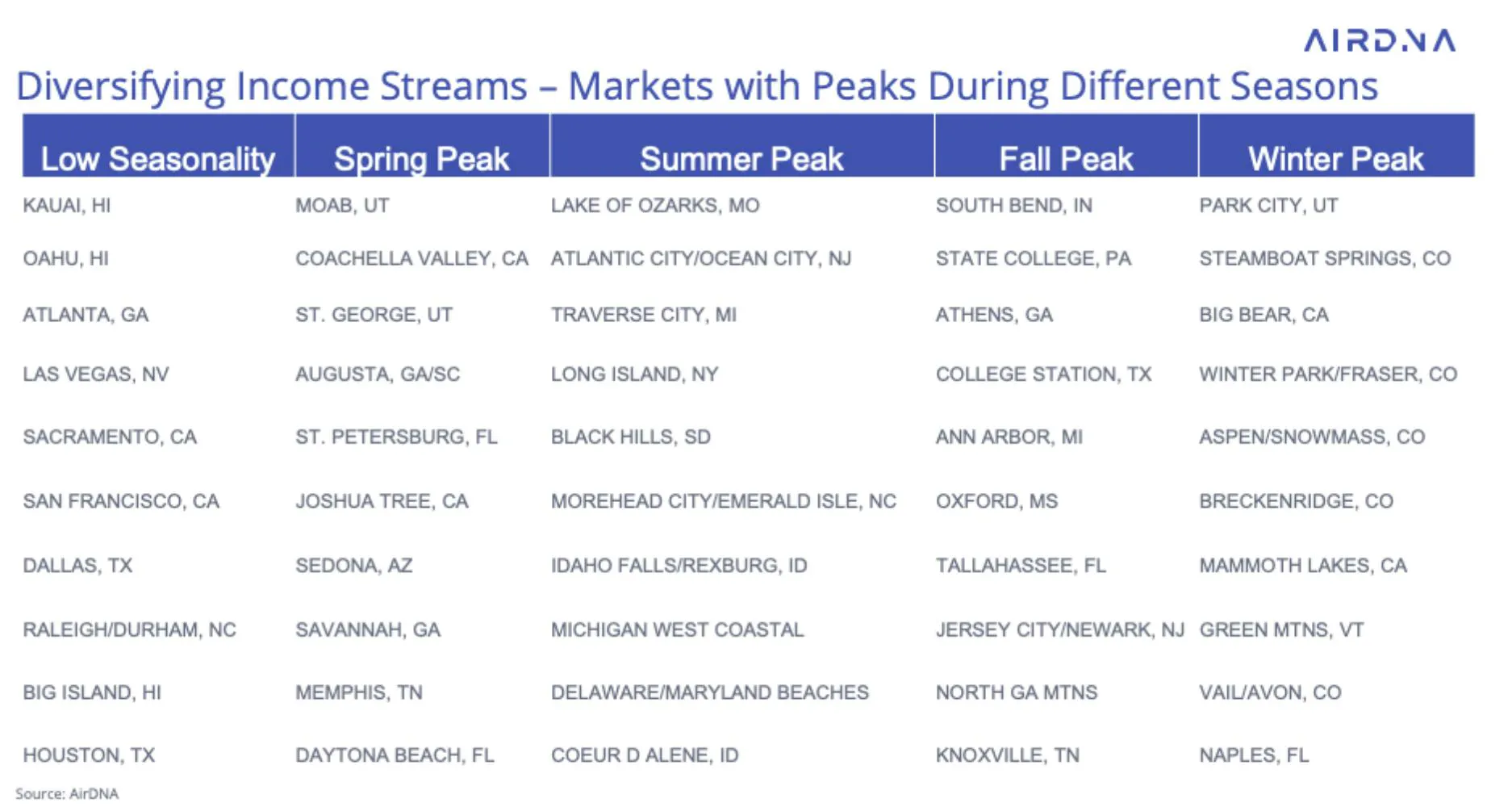
You can create a rental portfolio that maximizes occupancy and income year-round and mitigates the risk of low-season downturns by carefully selecting properties across diverse markets. This approach stabilizes your monthly cash flow and underpins a robust growth strategy that taps into each location's unique demand cycles.
5. Evaluate and Optimize Along the Way
Assess Your Real Estate Investments Regularly
Regularly evaluate your properties to maintain a profitable real estate portfolio. This involves analyzing rental income, occupancy rates, and maintenance costs to gauge whether your investments align with current market trends and your long-term financial goals. Consider integrating tools and data to gain a deeper understanding of each property’s performance and the overall health of your portfolio.
Sell Low-Performing STRs with a 1031 Exchange
If certain properties aren't yielding the expected returns, it might be time to consider a 1031 exchange. This tax-deferral strategy allows you to sell underperforming STRs and reinvest the proceeds into more promising real estate investments without immediate capital gains taxes. It's a strategic move that can help optimize your portfolio's performance and realign it with your investment criteria.
Seek Expert Guidance as Needed
Navigating the complexities of real estate investment often requires professional insight. This is especially true when you’re ready to optimize your portfolio or utilize tax strategies like a 1031 exchange. Don't hesitate to consult real estate professionals, financial advisors, or tax experts who can provide tailored advice and help you make informed decisions. Engaging with experts can be instrumental in maximizing your portfolio’s potential and staying ahead in the ever-changing real estate market.
6. Prepare for Challenges
More Properties, Unhappier Guests
Scaling your vacation rental business can be a double-edged sword, especially when trying to keep your guests happy. AirDNA data reveals that as the number of properties under a host increases, it becomes challenging to provide personalized attention that typically results in higher review scores.
For instance, hosts with a single listing can achieve an average review score of around 4.89. This high number is a testament to the focus they can give to each guest's experience. However, when operations expand to 100 or more listings, review scores dip to an average of 4.66.
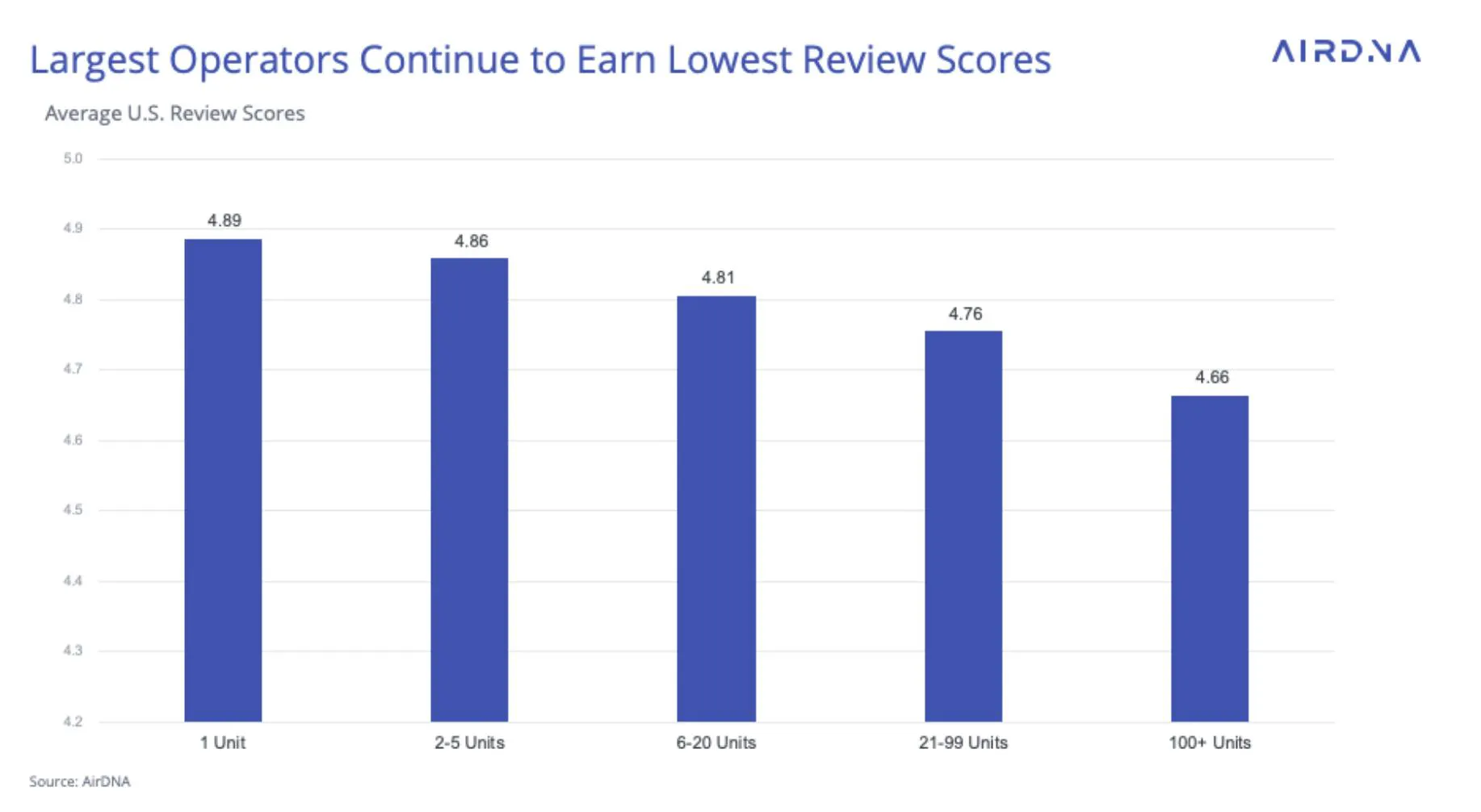
However, it's worth noting that not all declines in specific review scores should be cause for concern. For example, a dip in the 'value' score might reflect a conservative pricing approach rather than a drop in actual service quality.
In a larger operation, you can refine your revenue management using dynamic pricing strategies and specialized tools that can offset the impact of lower scores in certain areas. In essence, scaling gives you the means to invest in resources that can further professionalize and profit-optimize your business. This can lead to an increase in overall profitability, even if every single score isn't perfect.
Cleanliness and Communication Take Hits
When you scale your rental business, the attention to detail that delighted your initial guests can be challenging to replicate across a larger operation. AirDNA data analysis highlights that hosts with a single listing might find it easier to maintain spotless environments and provide immediate responses to guests. These aspects tend to see a dip in satisfaction as the number of properties increases. It's a common growing pain in scaling – as you broaden your reach, overseeing the same level of cleanliness and communication becomes more complex.
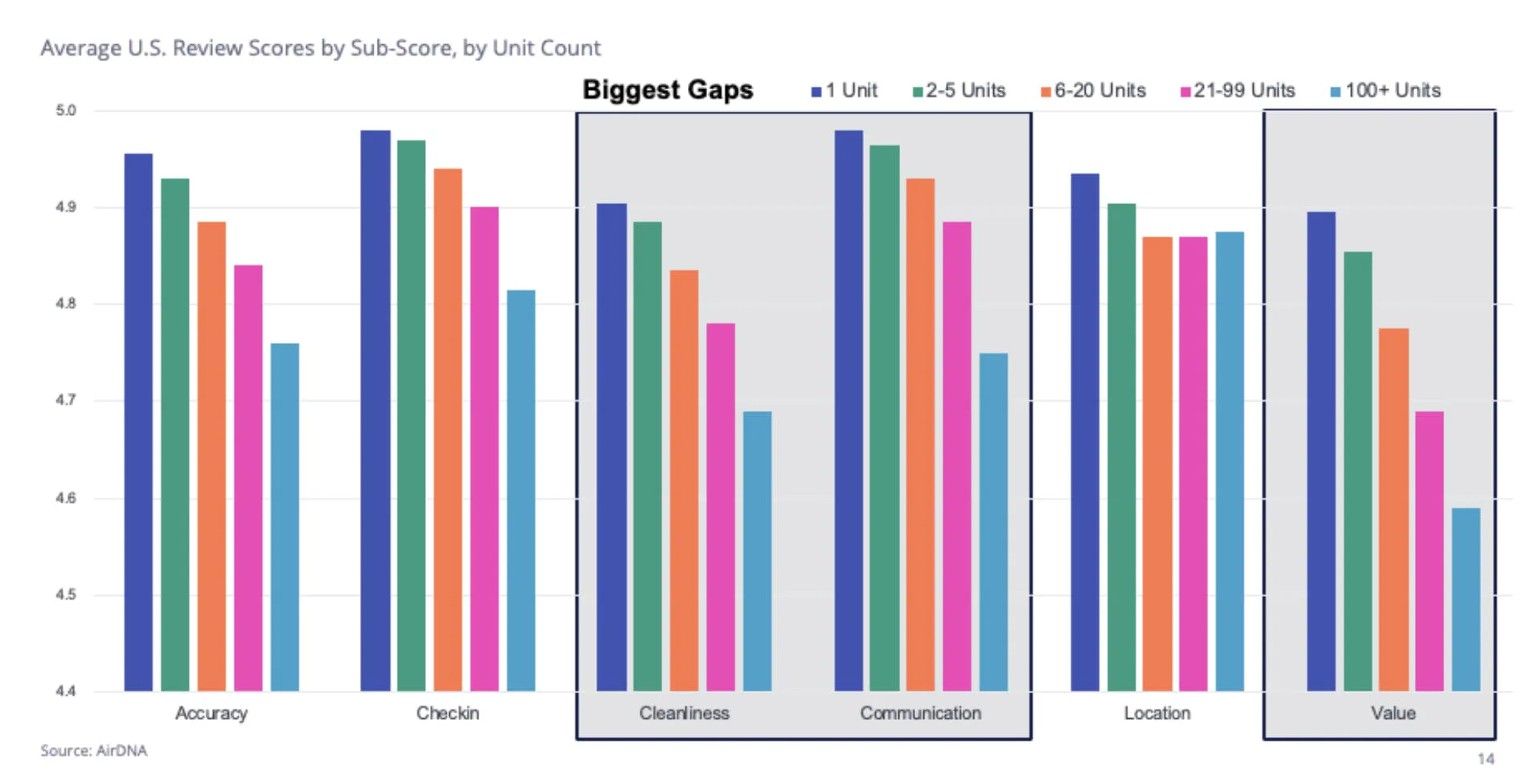
It’s crucial to establish systems that allow for personalization at scale—whether that’s through automated yet customized guest communications or by implementing a guest feedback loop that helps you to continuously improve their experience. Maintaining this personal touch translates into repeat business and excellent reviews, which are the lifeblood of a thriving rental property business.
Complex Operations Require Better Management
With each new property added to your portfolio, the demand on your operational capabilities multiplies. This is where strategic delegation and potential adoption of property management software become essential. Consider using property management services or technologies that can help streamline booking processes, maintenance schedules, and guest communications. Effective management is key to handling the increased workload without sacrificing service quality or operational efficiency.
Optimize for Dynamic Pricing Challenges
Dynamic pricing can be a complex but rewarding strategy for maximizing your rental income. It involves adjusting your prices in response to market demand, competition, seasonal trends, and even local events. Tools like the AirDNA app can help you navigate these challenges by providing market data and pricing recommendations tailored to your properties. You can ensure your pricing strategy adapts to market changes and maximizes revenue potential by employing these resources.
The Benefits of Scaling Real Estate Investments
Scaling short-term rentals (STRs) brings a wealth of opportunities for real estate investors, from generating strong passive income streams to strengthening your financial portfolio. The flexibility of STRs means you can adjust to market demands quickly, optimizing occupancy and maximizing returns.
Furthermore, STRs often yield higher rental income than traditional long-term rentals, especially when you pair a strategically located STR with savvy revenue management practices. This scalable approach allows you to grow your investment footprint by catering to a diverse and expanding traveler base seeking unique accommodation experiences.
For a deep dive into markets offering the highest potential for STR investment growth, AirDNA’s research is an invaluable resource for strategic investment decisions.
ARTICLE SUMMARY
Learn how to grow your STR portfolio effectively by using data for smarter investments. Earn more money with strategic management and better pricing.
Bram Gallagher
AirDNA Director of Economics and Forecasting
Bram Gallagher is an Economist at AirDNA, specializing in uncovering insights that drive smarter short-term rental decisions. He put his Ph.D. in Economics from the University of Georgia to work researching and forecasting hotel data with CBRE prior to joining AirDNA, as well as teaching economics at a number of universities. In his spare time, Bram enjoys making wooden furniture with hand tools.
