

 Calculate Revenue
 Research Markets
 Find For Sale Properties
 Compare My Listing
 STR Revenue Calculator
 Custom Comp Sets
 Submarket Insights
 Custom Search Filters
 Rate Recommendations
 Performance Benchmarking
 Competitor Comparison
 Owner Contact Details
 Property-level performance data
 Tourism Insights
 Real Estate Investment Analytics
 About Us
 Sales
Sales Support
 Press
PressBest Military Towns for Airbnb Investment
Published: January 27, 2026

Jamie Lane
Key Takeaways
- The best military towns for Airbnb investments are where steady demand and attainable home prices are in balance.
- Military-driven travel creates year-round booking consistency, but returns vary widely based on entry price and local regulations.
- AirDNA helps investors evaluate military-adjacent markets using data from short-term rentals already operating in that area.
Investing in an Airbnb near a military base looks a little different than the traditional vacation rental investment. Demand near military bases is driven by function, not seasonality. Weather-agnostic, consistent demand can be appealing for Airbnb investors. However, home prices, local rental rules, and the type of housing near a base all shape whether military-driven demand translates into stellar performance or thin margins.
To find the best military towns for Airbnb investment, we analyzed AirDNA data across markets near major U.S. military installations, focusing on how current for-sale properties perform relative to their revenue potential. The markets that stand out are the ones where demand, pricing, and yield are clearly aligned.
Why Proximity to a Military Town Is a Powerful STR Investment Driver
Structure and predictability are the cornerstones of demand for STRs (short-term rentals) around military bases. Bases operate on fixed schedules, rotations, and timelines, which create recurring housing needs that don’t depend on weather, tourism cycles, or discretionary travel.
Demand shows up year-round
Training programs, PCS (Permanent Change of Station) moves, graduations, temporary assignments, and visiting family members all generate steady demand throughout the calendar. Unlike leisure markets that rely on a handful of peak months, military-driven demand tends to be spread more evenly across the year, which supports more consistent annual occupancy.
Stays are purposeful and repeatable
Most people who book an Airbnb near a military base aren’t visiting once and moving on. Contractors, military families, and service members often return to the same base multiple times or stay for extended periods. That repeat behavior means STR hosts secure more consistent bookings, can more easily pivot to direct bookings, and rely less on constant guest acquisition.
Short-term rentals fill a real housing gap
Hotels and long-term leases don’t always meet the needs of military travelers. STRs offer flexibility, space, and amenities that work better for families, longer stays, and short-notice travel. In markets with limited on-base lodging or constrained rental inventory, that gap meaningfully supports demand.
Pricing is less sensitive to tourism swings
Because travel is tied to operational needs rather than vacations, military-adjacent STRs tend to be sheltered from broader travel slowdowns. Sure, performance still depends on pricing and local competition, but demand in these markets is usually more resilient than in purely leisure-driven destinations.

Our Methodology for Ranking Housing Markets Near Military Bases
To build our list of the best military towns for Airbnb investment, we examined the average revenue potential of homes currently for sale near military bases and compared that against purchase prices to calculate yield.
In simple terms: We assessed how much income a property might generate relative to what it costs to buy.
Using AirDNA data, we analyzed markets across the U.S. and ranked them by yield to highlight where military-driven demand and pricing appear more closely aligned. The resulting list showcases housing markets near military bases that offer a more practical starting point for Airbnb investors.
Best Places to Invest in Airbnbs Near Military Bases
The markets below surfaced based on yield, highlighting places where military-driven demand appears to translate into stronger income relative to purchase price. While some familiar military towns make the list, many of the higher-yielding opportunities are in markets where housing costs are more moderate.
That said, property-level variation matters. Homes close to base entrances, medical centers, or training facilities can command different pricing and performance profiles than properties farther out, and differences in size, layout, and amenities can affect yield, too.
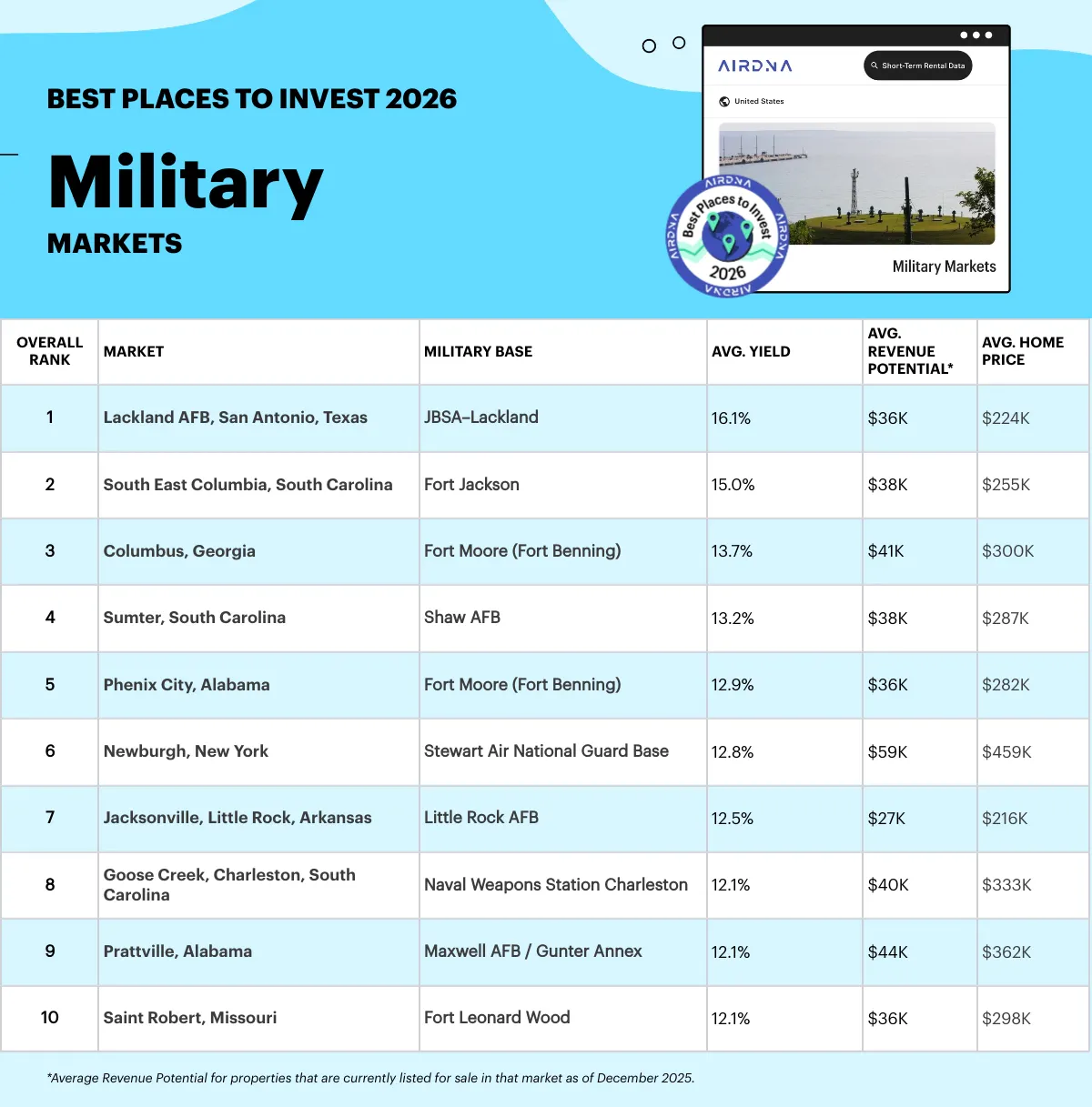
Remember, the data below reflects properties currently for sale, which change over time, so take care to check the yield of an individual property before investing.
1. San Antonio, Texas - JBSA–Lackland


Lackland Air Force Base (AFB) sits in the southwest corner of one of Texas’s most resilient visitor economies: San Antonio.
Investing in an Airbnb near JBSA-Lackland means you’re attracting guests who frequently book specifically for base-related travel, then extend their stays to explore downtown, the River Walk, the Alamo, and family attractions like SeaWorld and Six Flags. That mix helps keep calendars full and supports repeat visitation tied to JBSA-Lackland activity.
The market’s affordability stands out for a major destination city. With an average home price of less than $230K and average revenue potential of $36K, San Antonio delivers a whopping 16.1% average yield. That’s some seriously strong income relative to the acquisition cost and a lower break-even threshold than many higher-priced metros.
Regulations:
San Antonio requires operators to apply for and maintain a Short-Term Rental permit, and STRs are generally allowed in residential and multifamily zoning districts (and most commercial districts), with some zoning exceptions. STR hosts are also responsible for paying the Hotel Occupancy Tax (HOT), including reporting and payment requirements when not remitted by a platform. Overall, this is a manageable, rules-based environment for investors.
2. South East Columbia, South Carolina - Fort Jackson


Columbia, South Carolina, combines year-round, diversified demand with a still-accessible entry price, making it one of the stronger military-adjacent STR markets in the Southeast. Proximity to Fort Jackson, the U.S. Army’s main production center for Basic Combat Training, creates a steady baseline of short-term housing in the South East Columbia submarket.
The military-driven demand of Columbia is layered on top of a broader visitor economy. Government activity, the University of South Carolina, healthcare, sports, and outdoor recreation all contribute to consistent bookings throughout the year, so hosts aren’t relying on a narrow peak season.
The data supports the story. Homes for sale near Fort Jackson average around $255K and have an average revenue potential of just over $38K, resulting in an impressive 15% average yield.
Regulations: Columbia requires both a Short-Term Rental Permit and a Business License prior to allowing occupancy. Investors should also monitor local reporting on potential rule updates (e.g., minimum night requirements).
3. Columbus, Georgia - Fort Benning
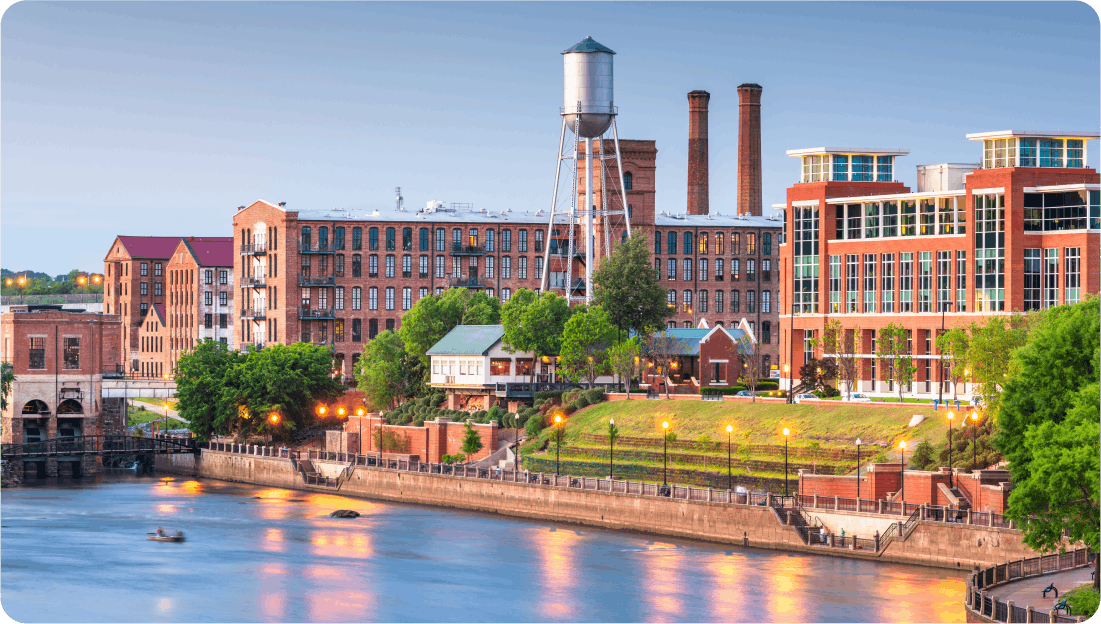

Situated right on the Alabama border, Columbus, Georgia, is an investor-friendly market: affordable enough to enter without stretching, yet established enough to support consistent guest demand. It’s a market anchored by proximity to Fort Benning, which supports more than 120,000 active-duty military, family members, reserve component soldiers, and employees.
Demand extends beyond the base itself. The Chattahoochee River corridor, home to RiverWalk and the longest urban whitewater course in the world, drives outdoor-focused travel. Uptown Columbus adds dining, entertainment, and events that encourage longer stays and repeat visits. Together, military activity and diversified local attractions help keep occupancy steady throughout the year.
Homes for sale near Fort Benning average about $300K. With average revenue potential of $41,171, Columbus offers an enticing 13.7% average yield. That balance keeps capital risk in check while offering returns that can compete with pricier, more crowded vacation markets.
Regulations:
Columbus’ regulatory environment looks workable and relatively clear. The city states that every house/unit used as a short-term rental must obtain a separate permit and pay a permit fee. Overall, this reads as a “rules-and-permits” market rather than a ban-heavy or highly restrictive one, which is generally favorable for investors.
4. Sumter, South Carolina - Shaw Air Force Base


Located closer to Shaw Air Force Base than neighboring Columbia, Sumter captures repeat short-term housing demand tied to the AFB without the pricing pressure of a larger metro. Of course, Sumter also benefits from its proximity to Columbia, allowing guests to combine base-related travel with dining, entertainment, and events in the state capital to further extend stays.
Beyond demand tied to Shaw Air Force Base, leisure demand adds a second layer. Parks, trails, and outdoor recreation within driving distance support weekend stays, while family-friendly attractions like Swan Lake Iris Gardens broaden the guest mix.
AFB-driven demand supports consistent bookings throughout the year, so investors here don’t need to rely on a handful of peak weekends. With an average home price under $290K and revenue potential near $38K, Sumter delivers a 13.2% average yield, an ideal profile for anyone investing in an Airbnb near Shaw Air Force Base.
Regulations:
Sumter appears to have minimal local STR regulation, with multiple sources stating there is no specific short-term rental ordinance and that operators may need a local business license. However, the City of Sumter has no information about STR requirements on its website, so you’ll want to contact the city before investing.
5. Phenix City, Alabama - Fort Benning


Phenix City, Alabama, delivers strong cash-flow potential at an attainable buy-in, supported by twin-city demand from Columbus, Georgia and proximity to Fort Benning just across the state line. Located on the Alabama side of the Chattahoochee River, Phenix City benefits from overflow demand tied to Fort Benning training cycles, graduations, and visiting families, while also capturing leisure and event travel that spans both cities. That cross-border dynamic allows guests to stay where value is strongest while remaining close to base activity and Columbus attractions.
Beyond proximity to Fort Benning, STR demand for Phenix City is driven by riverfront recreation, events at the Phenix City Riverwalk and Amphitheatre, and motorsports at East Alabama Motor Speedway. Those drivers help keep calendars active throughout the year.
Average home prices in Phenix City sit around $282K. Average revenue potential of $36,401 means Airbnbs near Fort Benning achieve a 12.9% average yield.
Regulations: Phenix City allows short-term rentals but operates under a structured, compliance-driven framework. Property owners must obtain a Short-Term Rental License and a Certificate of Occupancy before listing or operating, with licensing required for each individual STR property.
The ordinance also mandates:
- Commercial vacation-rental insurance
- A 24/7 local emergency contact
- Advance neighbor notification within a 500-foot radius
How to Find the Best Markets to Invest In
Investing with demand drivers in mind opens up far more options than chasing a single destination or property type. Instead of asking where people vacation, the better question is why they travel, and which markets consistently benefit from that behavior.
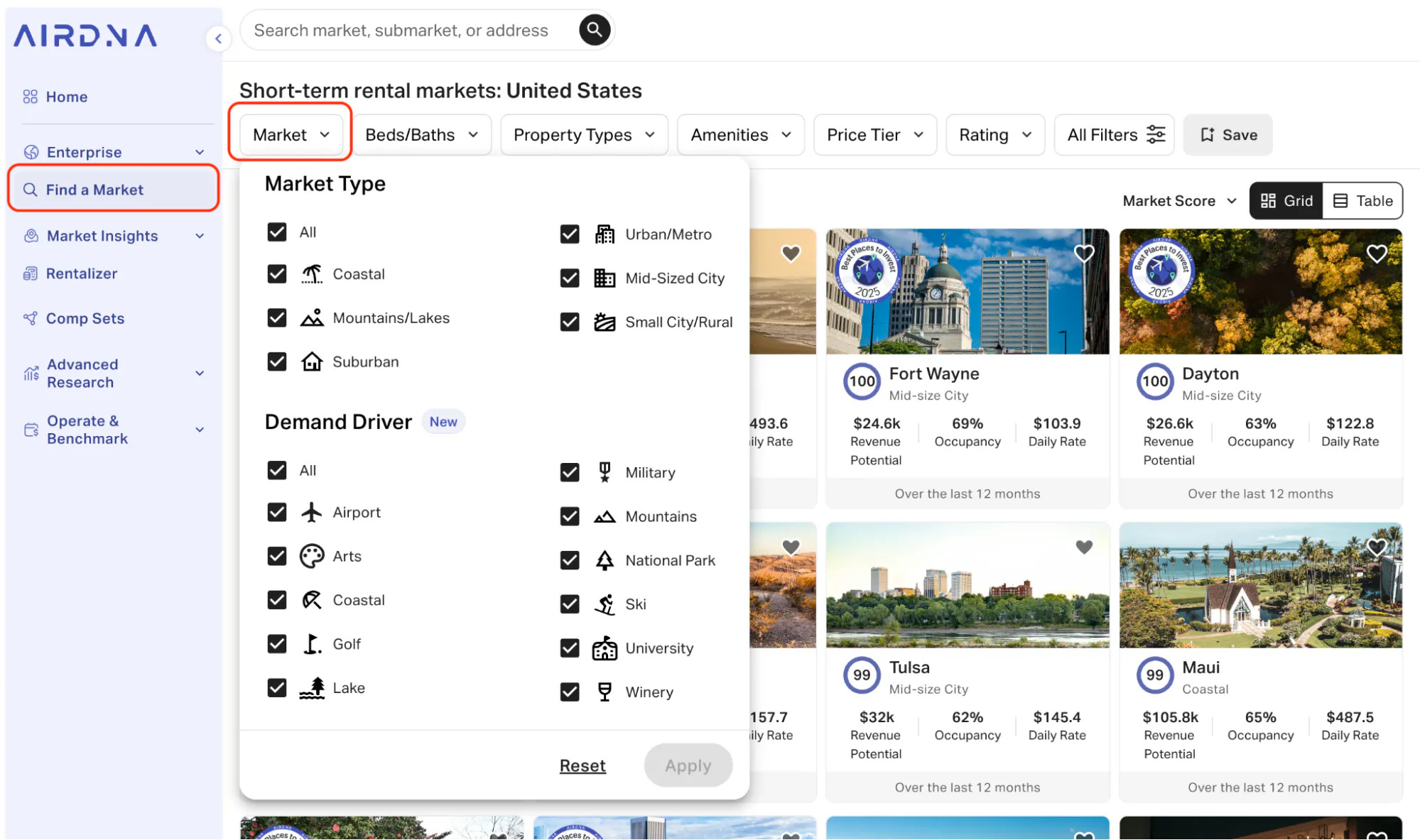
With AirDNA, you can explore housing markets tied to specific demand drivers, like proximity to military bases, universities, or airports, then compare how those markets perform. This approach helps narrow your search to places where short-term rental demand is consistent and predictable.
Use demand driver market filters
Different demand drivers create very different booking patterns. By using AirDNA’s demand driver filters, you can surface markets where short-term rental demand is closely tied to a nearby institution or activity, instead of relying on broad geographic searches alone.
This makes it easier to:
- Focus on markets where demand plays a meaningful, ongoing role
- Compare markets with similar demand profiles but different pricing or supply dynamics
From the Find a Market tab in AirDNA, click the Market filter to choose which demand drivers you want to search for.
Filter by budget and yield
Once you’ve identified markets that align with the type of demand you’re targeting, the next step is evaluating for-sale properties within those markets.
To narrow down your options, use these filters:
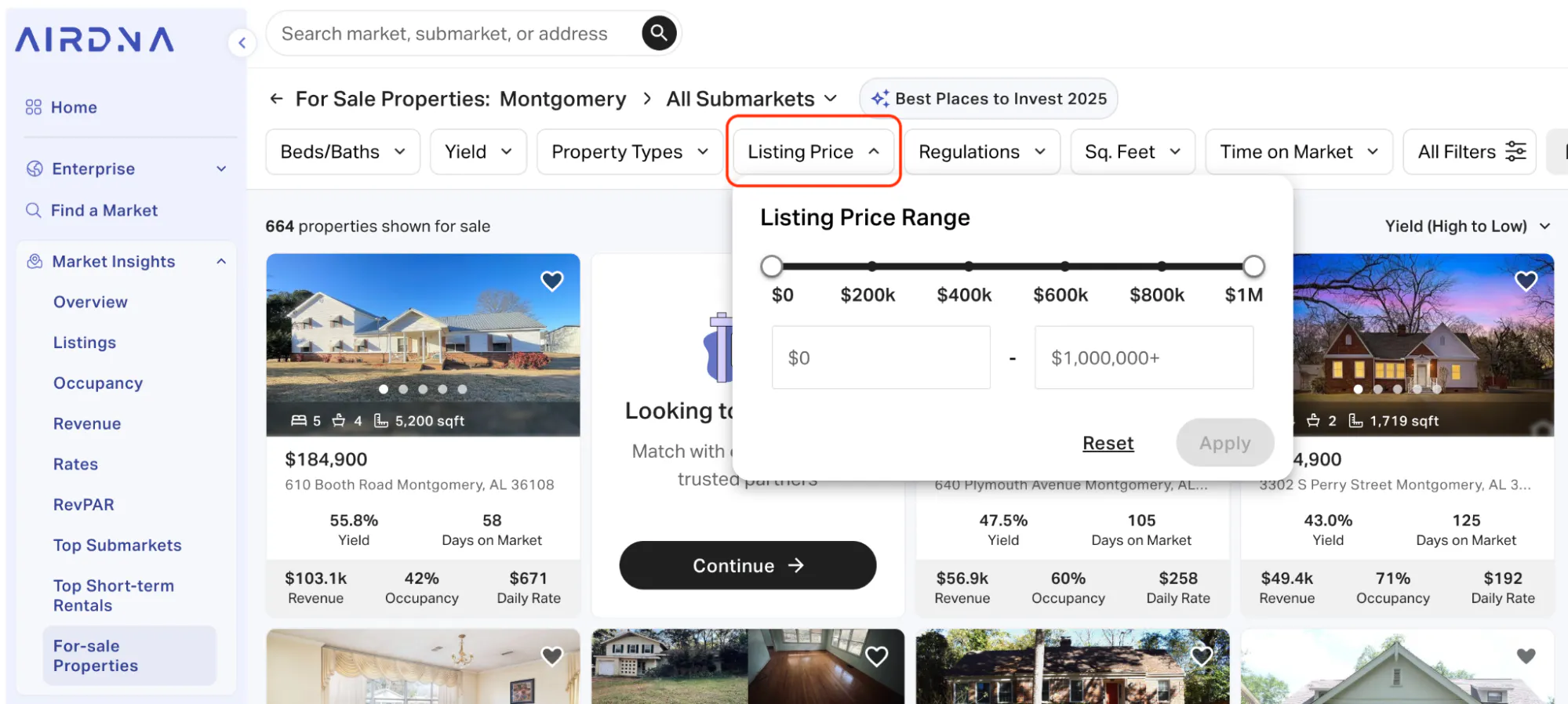
Price range filter
Use the listing price filter to only view for-sale properties within your budget. You can set upper and/or lower limits. Find this filter in the For-sale properties tab.
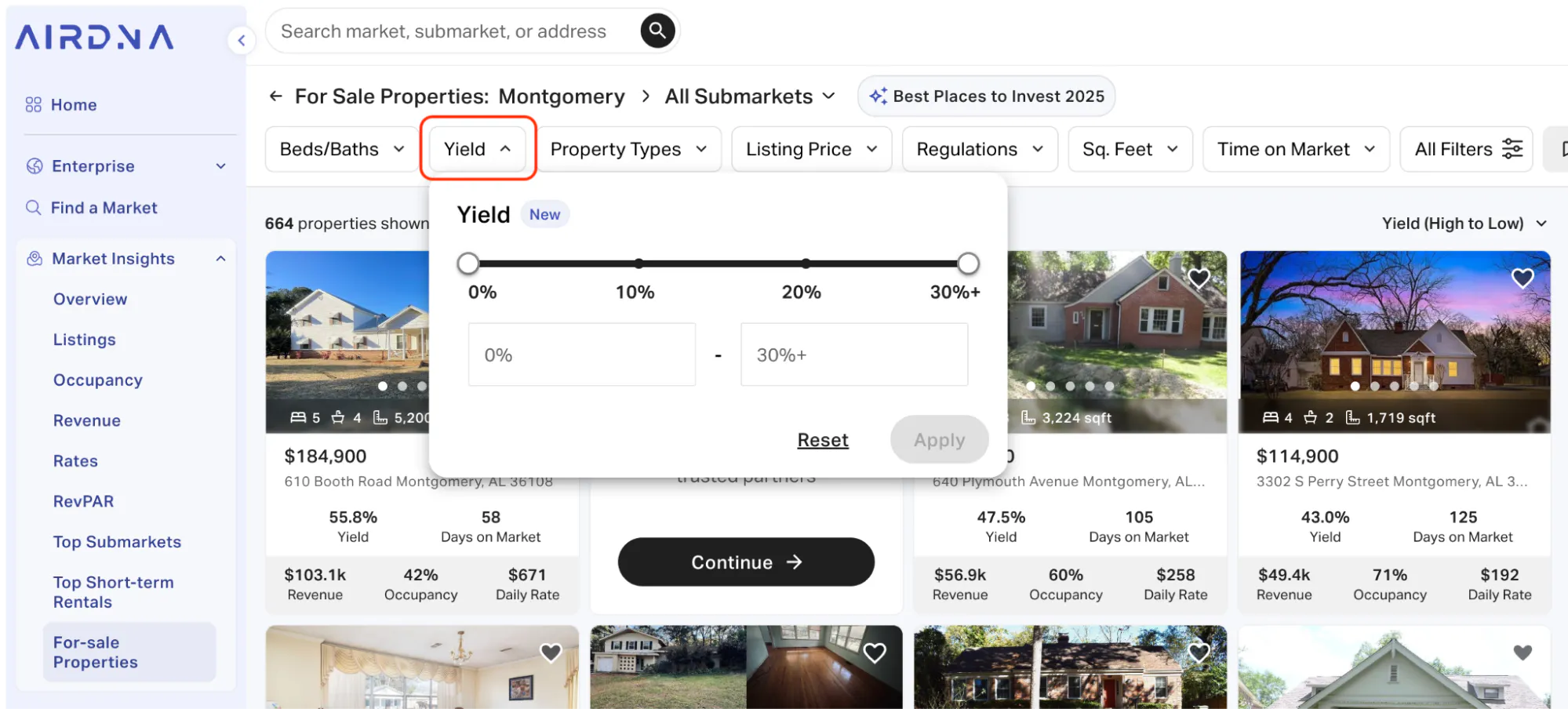
Yield filter
Use the yield filter to highlight properties that meet your desired yield. Setting a lower limit will filter out any properties that likely won’t provide the yield you’re seeking. Find this filter in the For-sale properties tab.
Find markets that match your strategy
Looking for an up-and-coming mountain town? Or a high-performing coastal city? Filter by market type, score, and listing count to discover the markets that meet your goals.
FAQs
Are Airbnbs near military bases profitable?
Airbnbs near military bases can be profitable, especially in markets where home prices remain affordable relative to demand. Military-driven travel creates repeatable booking patterns that support steady occupancy throughout the year. At the end of the day, though, profitability depends on acquisition cost, local regulations, and how well the property meets demand.
Who typically stays in Airbnbs near military bases?
Guests staying in Airbnbs near military bases often visit for specific, practical reasons rather than leisure travel. Common guest segments include:
- Family members attending graduations
- Service members on temporary assignments
- Contractors
- Medical staff
- Visiting friends or relatives
These stays tend to favor functional, comfortable homes over luxury or resort-style properties.
Do military-adjacent Airbnbs rely on seasonality?
Less so than traditional vacation rentals. While demand can spike around graduations or large training events, military-related travel tends to occur year-round. That means hosts generally don’t have to rely on narrow peak seasons and enjoy more consistent booking activity across the calendar.
What should investors look for when buying real estate in a military town?
Properties closer to base entrances, medical centers, or training facilities often perform differently and better than those farther out. Investors should also pay close attention to local short-term rental regulations, parking requirements, occupancy limits, and neighborhood rules, which vary significantly by city.
Start with yield, go deeper later
Use AirDNA to assess market performance and compare Airbnb yield across for-sale listings before diving into full ROI.
ARTICLE SUMMARY
Short-term rentals near military bases follow a different demand pattern than traditional vacation markets. This analysis breaks down the best places to invest in Airbnbs near U.S. military installations, comparing yield, home prices, and revenue potential to highlight where military-driven demand delivers strong returns.
Jamie Lane
AirDNA Chief Economist
He is responsible for data analysis, thought leadership, and leveraging advanced analytical techniques to provide new insights into short-term rental market trends. Native to Atlanta and an Airbnb host himself, Jamie enjoys cycling, mountain biking, backpacking, running, and playing in a dart league in his free time.
