


How Does Vrbo Work? A Quick Guide for Rental Owners
Published: May 31, 2024
Last updated: November 13, 2026

Bram Gallagher

Key Takeaways:
- Vrbo is a leading platform for vacation rental owners to showcase their properties and maximize rental revenue.
- Listing on Vrbo offers increased visibility to millions of travelers worldwide, potentially leading to more bookings.
- By following best practices such as prompt communication, competitive pricing, and maintaining cleanliness, Vrbo hosts can enhance guest experiences and earn more rental income.
Vrbo is a leading player in the vacation rental industry, number 2 in a dominating duo with Airbnb. Short for “Vacation Rentals by Owner,” Vrbo is an online travel agency (OTA) that streamlines the process of listing, booking, and managing rental properties. It offers hosts an array of robust website and mobile app features along the way.
Whether you’re just getting started with short-term rentals or you’re a vacation rental veteran, this guide will give you a birds-eye-view of Vrbos position in the industry and how to best leverage it as a short-term rental (STR) host. Let’s dive in.
What is Vrbo?
Believe it or not, Vrbo was actually the internet’s first major vacation rental platform. Their idea back in 1995 was to make it easier for travelers to find vacation homes by connecting them directly with rental property owners.
In 2015, Vrbo was acquired by Expedia Group. Today, Vrbo is one of the top online marketplaces for vacation rental properties. The Vrbo app boasts over 1.3M global active listings located in some of the world’s most sought-after destinations.
Vrbo’s user-friendly interface and powerful features make it easy for property owners to showcase their listings to a global audience of travelers—especially travelers looking to rent homes capable of hosting large groups.
Vrbo owners who consistently deliver great guest experiences have a chance to become Premier Hosts, giving them greater platform visibility and leading to more online bookings.

How Does Vrbo Work?
If you’re wondering how does Vrbo work, here’s a quick overview:
- List your property: Create a listing for your vacation rental property by describing its location, size, amenities, and availability. If you really attract guests, upload high-quality photos and videos to the listing.
- Manage bookings: Once your property is listed on Vrbo, users can request bookings directly through the platform. You can accept or decline booking requests, communicate with guests, and securely accept payment all within Vrbo’s platform.
- Respond to guests: Prompt responses to guest inquiries are crucial to success on Vrbo. Their messaging tool lets you communicate with guests before, during, and after their stay.
Along with these basic offerings, Vrbo can help with managing multiple properties, tracking rental performance, and getting help from Vrbo's customer service team.
Vrbo also offers optional property management and professional photography services to help you optimize your listings and attract more guests.
Why Rent Out Your Property on Vrbo?
One of the greatest benefits of listing your STR on Vrbo is increased visibility. Millions of travelers around the world check Vrbo when searching for a vacation rental home. Listing on Vrbo—especially in addition to other short-term rental platforms—gives you exposure to more potential guests and, as a result, more bookings.
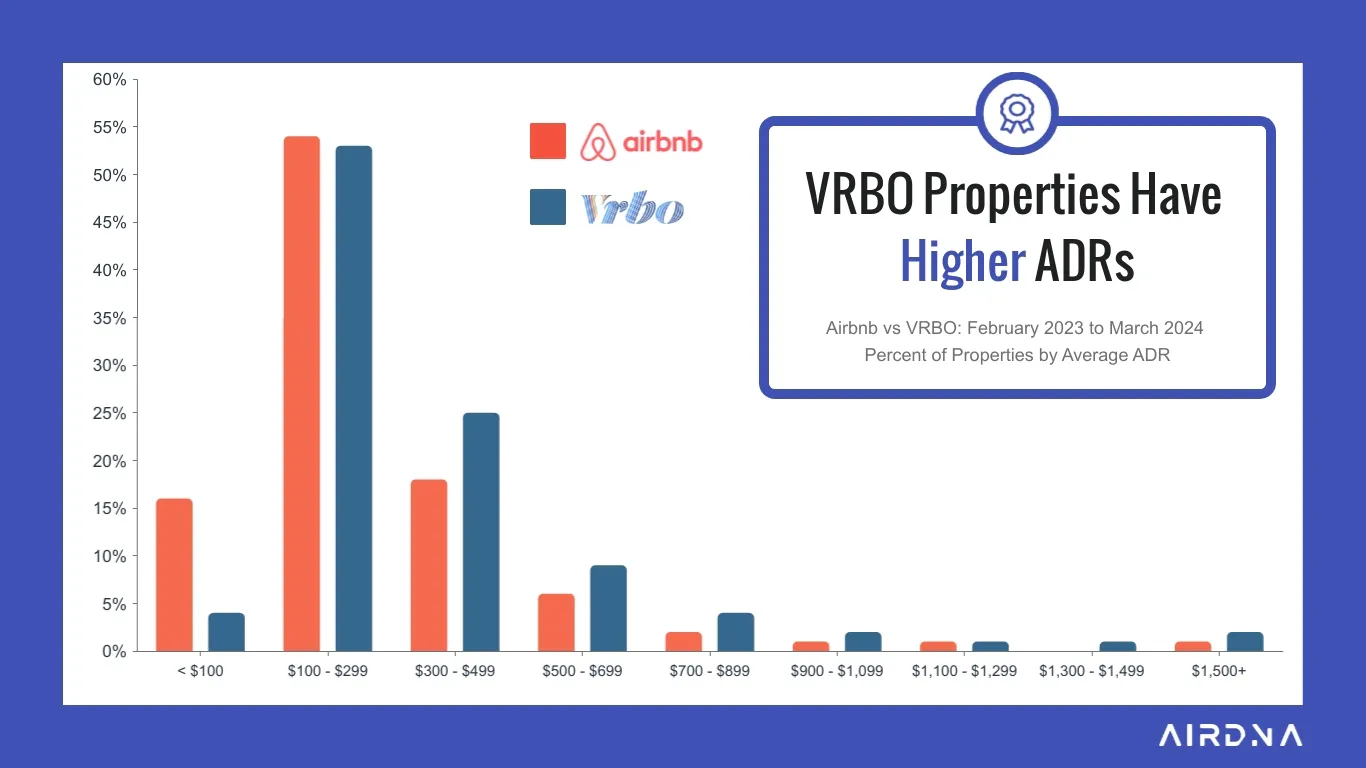
Listing on Vrbo also expands your potential for more rental income. Compared to Airbnb, Vrbo has more higher-priced properties—only 4% of Vrbo listings in the US are priced under $100 a night, compared to 16% of US Airbnb listings. Vrbo’s presence in expensive coastal and mountain destination markets, plus its absence of shared rooms, contribute to higher average daily rates (ADR).
How Much Does it Cost to Offer Your Vacation Rentals on Vrbo?
Unfortunately, it’s not free to list your property—there are fees for vrbo owners. The cost of listing your property on Vrbo depends on factors like your subscription plan, commission rates, and whether or not you utilize any of the platform’s additional services.
Vrbo offers two subscription options for property owners:
- Annual subscription: Hosts pay an annual fee of $699 to list on the platform, with no limit to the number of bookings. Annual subscriptions also allow hosts to list on international sites, access reservation management tools, and upload up to 50 high-definition photos. The annual fee option is a good fit for property owners with large portfolios, high booking volume, and/or highly priced listings.
- Pay-per-booking: Hosts pay a commission rate of 8% of the booking total, with potential for an additional fee if you use a property management software (PMS) for off-site bookings. This option may be more appropriate for single listings and properties with low booking volume.
How Do You List Your Vacation Rental Properties on Vrbo?
Follow this step-by-step guide to list your STR on Vrbo:
- Create a Vrbo account: Provide basic information about yourself and your property before diving into the listing process.
- Provide property information: Give Vrbo information about your property type, number of bedrooms and bathrooms, amenities, location, and any unique features or attractions nearby. Make sure to highlight your property’s key selling points.
- Write a description: Showcase what makes your vacation rental home special by painting a vivid picture of what guests can expect during their stay. Highlight any special features, such as a private pool, panoramic views, or proximity to popular spots.
- Upload high-quality photos: Photos play a big role in whether or not guests book a stay. Take high-quality photos that represent your property and its surroundings, including interior shots of each room, exterior views, and outdoor amenities such as a patio or deck.
- Set rental rates and availability: With your listing visible, it’s now time to set nightly rates, availability, and minimum stay requirements. Tools like AirDNA can help you optimize your rates throughout the year to maximize revenue.
- Optimize your listing for search: Include relevant words and phrases in your property title, description, and amenities list. These terms will help your listing appear higher in Vrbo search results. Examples could be, "beachfront condo," "pet-friendly accommodation," or "ski-in/ski-out chalet." Consider testing out different listing titles, tracking each option’s performance over a trial period.
You should plan to revisit your listings from time to time and track how they’re doing in terms of occupancy rates and average daily rates (ADR). Great properties sometimes get overlooked because of poor or inaccurate descriptions, uncompetitive pricing, or calendar errors. Don’t let it happen to you.
Try Our Vacation Rental Pricing Tool
Use Smart Rates™ to optimize your pricing strategy.
Start for freeVrbo vs Airbnb for Hosts
Vrbo and Airbnb are the two most popular vacation rental platforms around, but there’s a clear winner in terms of number of listings and overall popularity as a booking platform.
In most US markets, Airbnb listings take the lead. In 72% of markets, the majority of properties are listed on Airbnb only. In 26% of US markets, cross listed properties make up the majority. It’s only in 2% of US markets that VRBO only properties have the majority. The 7 markets with a majority of vacation rentals listed exclusively on Vrbo are:
- Cape St. Blas/St George Island, Florida (45%)
- Key West, Florida (42%)
- Naples, Florida (40%)
- Hilton Head, South Carolina (39%)
- Atlantic City/Ocean City, Maryland (39%)
- Jersey Shore, New Jersey (38%)
- Delaware/Maryland Beaches (38%)
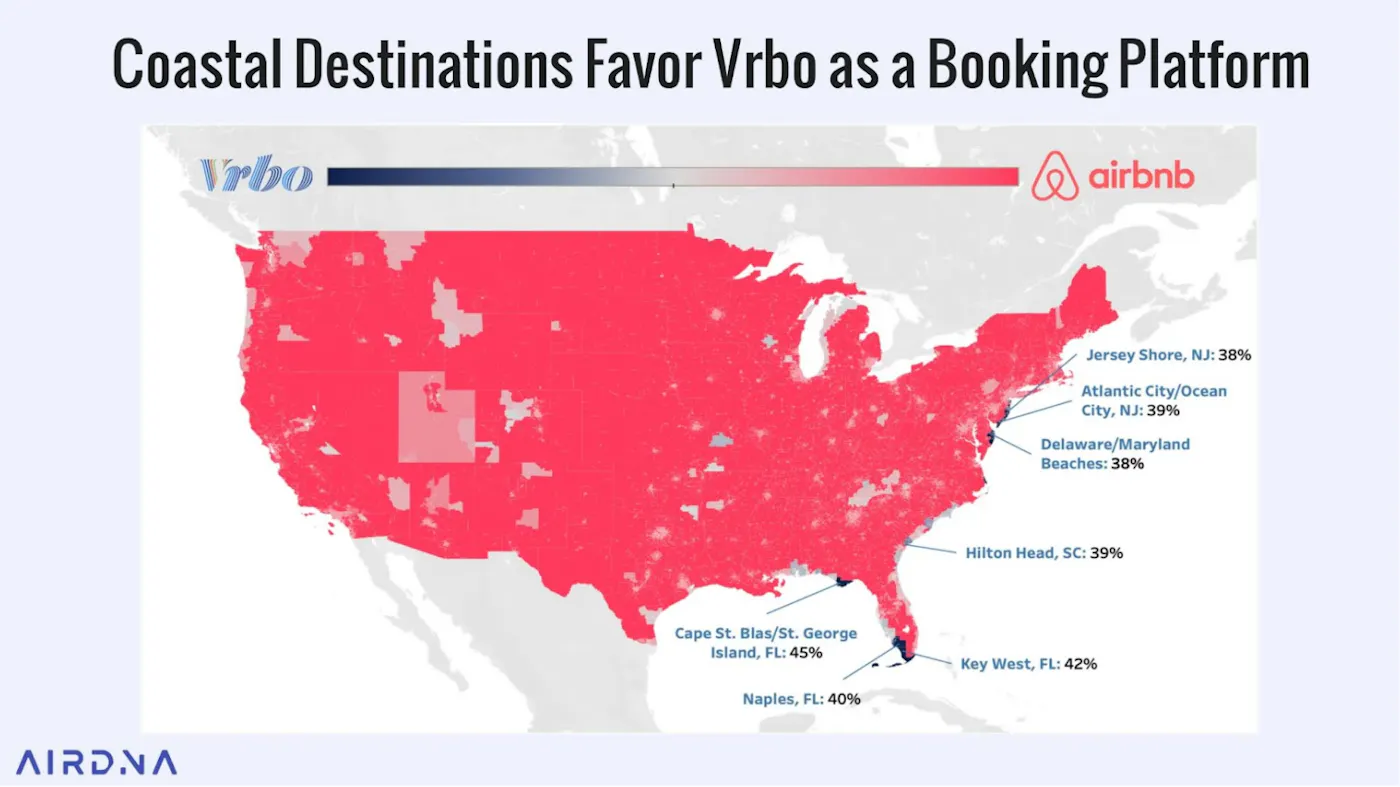
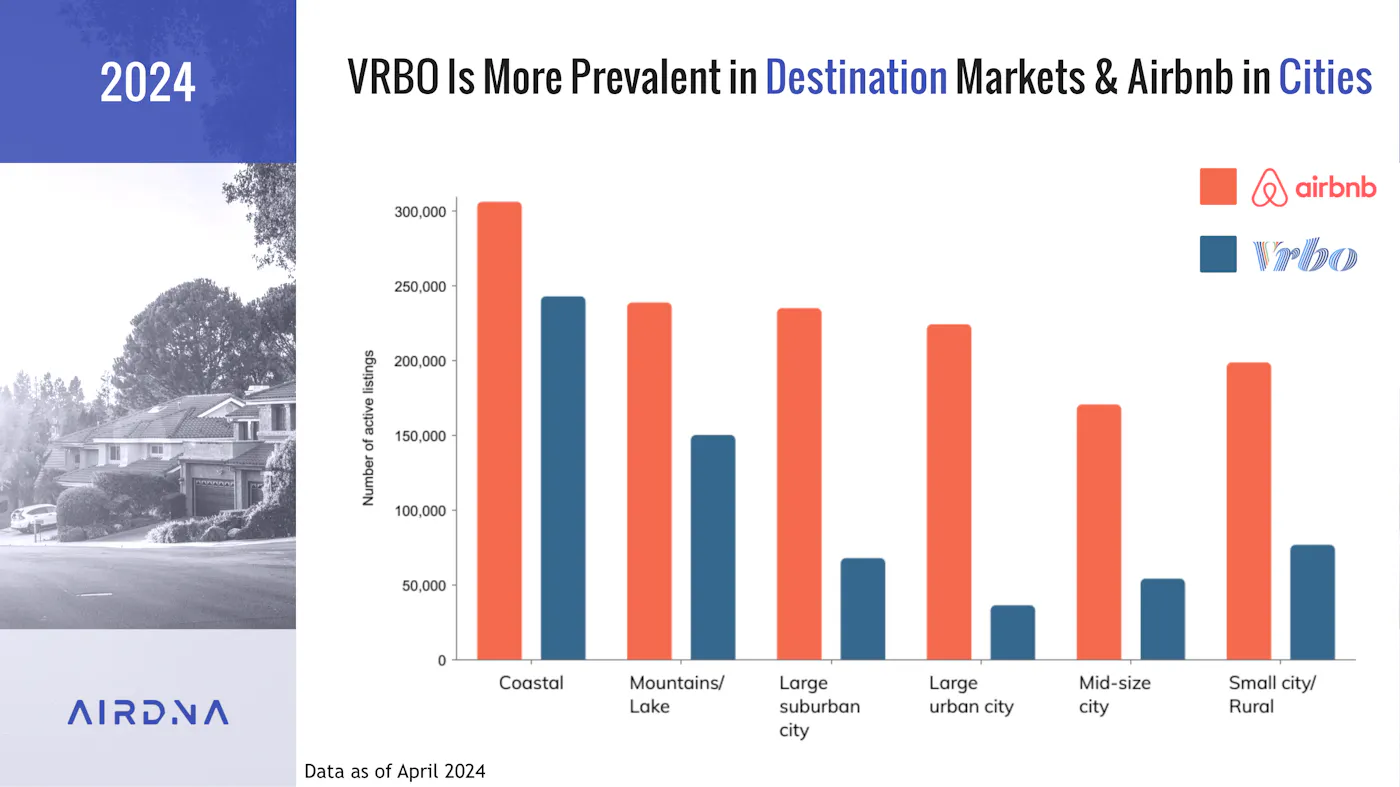
It’s unsurprising that the U.S. markets with majority Vrbo listings are on the coast. Vrbo properties are concentrated in Coastal and Mountain/Lake destinations, while Airbnb properties are more common in cities.
Vrbo properties are also usually larger and command higher average daily rates (ADR) as a result. While about half of Airbnb and Vrbo properties list for $100-299, ADRs of $300+ are more common on Vrbo.
These higher prices result from:
- More presence in expensive coastal and mountain destination markets
- Lack of shared rooms
- Higher bedroom counts
Vrbo also differs from Airbnb on pricing and property insurance. Vrbo’s annual subscription model lets hosts pay a one-time fee for all their listings. However, if hosts choose the per stay commission fee (8%), those fees are typically higher than they are on Airbnb (3-5%).
Host liability insurance is automatically provided to Airbnb hosts, whereas Vrbo charges for the same level of property damage protection. Some Vrbo owners pass these costs onto renters in the form of damage deposits.
Check out our comprehensive guide on Airbnb vs Vrbo for more detailed insights.
Tips for Vrbo Owners
It’s easy to get started on Vrbo, but getting the most out of it is a whole other ball game. Here are a few best practices you should follow.
- Be professional: Be there for your guests when they need you, and always act with respect and courtesy. Promptly respond to their questions and concerns to build trust, leading to better reviews.
- Offer competitive pricing and flexible booking options: Learn what other short-term rentals in your area charge, and set your pricing to be competitive. Offering discounted rates for longer stays or last-minute bookings can help fill vacant dates on your calendar.
- Cleanliness and maintenance: Each guest should arrive to a clean and well-maintained property. This makes for a better guest experience, positive reviews, and repeat bookings. Establish a cleaning checklist and set a schedule so your property stays in optimal condition. Consider cleaning fees to cover the extra lengths you go through to keep your property in tip top shape.
At the end of the day, listing on Vrbo is the way to go if you operate a short-term rental. Hosts who list on both Vrbo and Airbnb have higher occupancy rates, regardless of price tier or bedroom count.
If your rental is in a Mountain/Lake or Coastal destination and/or has a higher bedroom count, Vrbo is particularly beneficial since it caters to larger groups and entire-home rentals. Listing on Vrbo can have a huge impact on the profitability of your vacation rental business, so don’t wait to become active on this platform!
Boost Your Rental Revenue
AirDNA’s vacation rental pricing tool uses data-driven recommendations to propose the best daily rates.
Start for freeARTICLE SUMMARY
Vrbo offers property owners an opportunity to showcase their rentals to a global audience, simplifying the process of listing, booking, and managing properties while maximizing revenue potential.
Bram Gallagher
AirDNA Director of Economics and Forecasting
Bram Gallagher is an Economist at AirDNA, specializing in uncovering insights that drive smarter short-term rental decisions. He put his Ph.D. in Economics from the University of Georgia to work researching and forecasting hotel data with CBRE prior to joining AirDNA, as well as teaching economics at a number of universities. In his spare time, Bram enjoys making wooden furniture with hand tools.



Get started with AirDNA today.
Powerful, easy-to-use tools that help hosts and investors succeed in the short-term rental market.
Try for free