

 Calculate Revenue
 Research Markets
 Find For Sale Properties
 Compare My Listing
 STR Revenue Calculator
 Custom Comp Sets
 Submarket Insights
 Custom Search Filters
 Rate Recommendations
 Performance Benchmarking
 Competitor Comparison
 Owner Contact Details
 Property-level performance data
 Tourism Insights
 Real Estate Investment Analytics
 About Us
 Sales
Sales Support
 Press
PressShoulder Season in Europe: Ten Hot Cities Now Beat the Summer
Published: October 15, 2026

Camilo Schmid Rivas
Key Takeaways
- Across Europe, average daily demand nights in the 2026 shoulder season so far (April, May and September) were −30.2% compared to summer (June-August 2026), and ADR was −13.1%.
- In ten large city markets with average daily highs above 30°C in June-August, led by Seville, Turin and Rome, average daily demand nights in the 2026 shoulder season (April, May and September) were +22.4% compared to summer (June-August), and ADR was +8.8%.
- In these ten cities, shoulder occupancy (April, May and September) was +7.1 pts higher than summer occupancy (June-August) in 2019 and +13.6 pts higher in 2026.
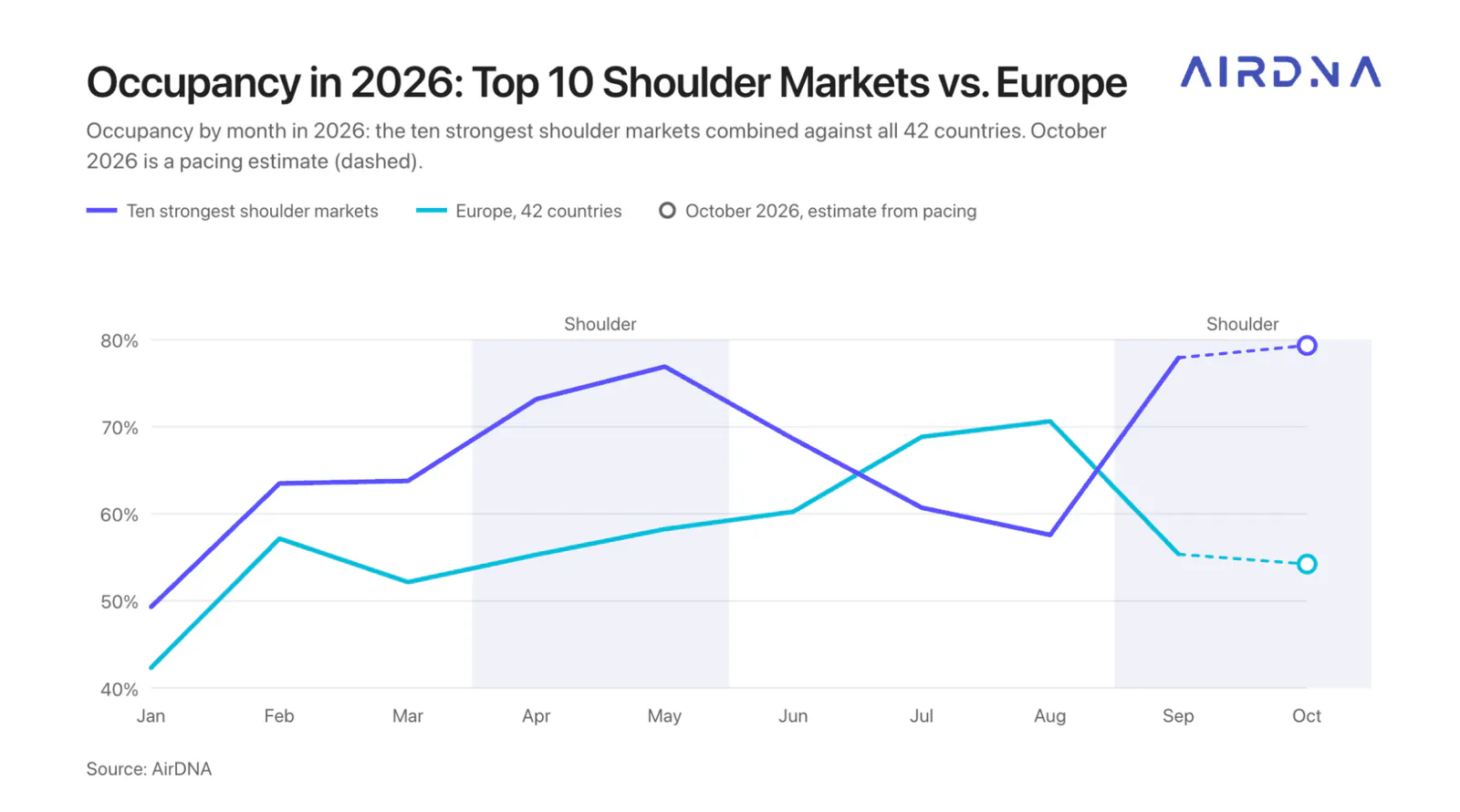
Across Europe’s short-term rental market as a whole, demand nights historically peak in July and August, and hosts cut ADR in the months either side to hold occupancy. In ten of Europe’s largest city markets, occupancy in 2026 instead reached its highest levels in May and September, and July and August ranked among its three weakest months of the year.
Europe Still Belongs to the Summer
Europe-wide, the 2026 shoulder months so far (April, May and September) recorded −30.2% average daily demand nights and −13.1% ADR compared to summer (June-August), and occupancy averaged 56.3% compared to 66.9%. That gap on average daily demand nights has narrowed only slightly since 2019, when it stood at −34.3%.
The median of Europe’s largest markets sits at −16.9% average daily demand nights and −8.0% ADR in the shoulder months compared to summer. Only 19 of the largest markets drew more average daily demand nights in the shoulder months than in summer, and just 11 of those also recorded a higher ADR, which suggests summer still sets both demand nights and ADR in most large European markets.

Ten Hot Cities, Led by Seville, Beat the Summer
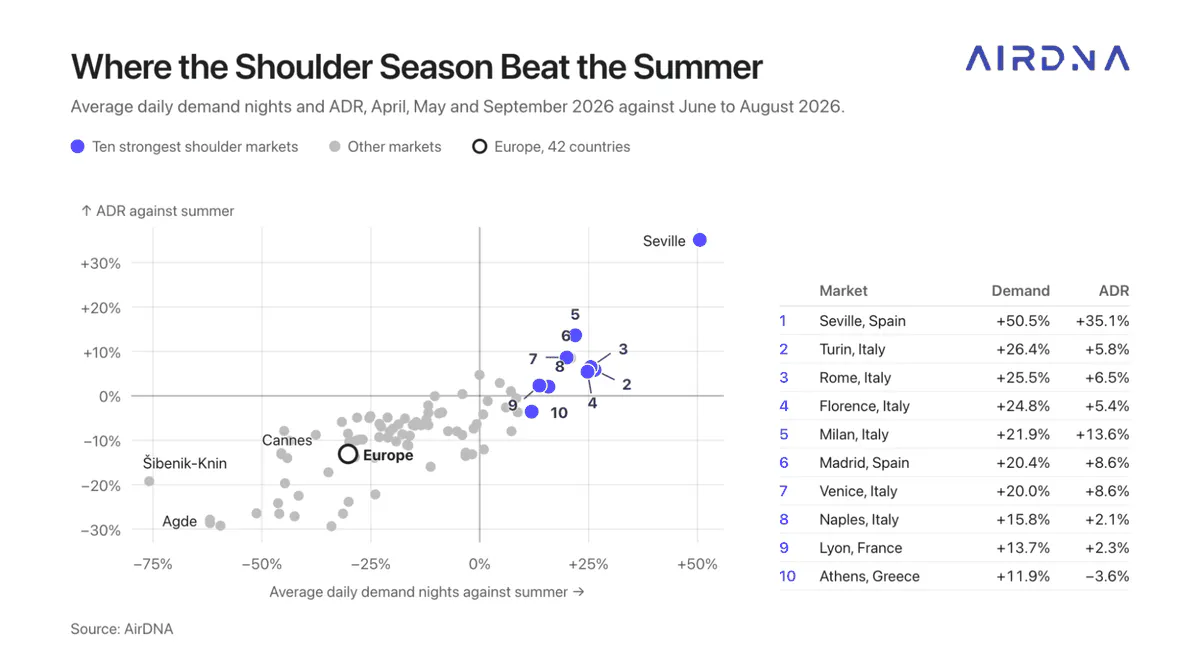
Combined, the ten cities recorded +22.4% average daily demand nights and +8.8% ADR in the 2026 shoulder months (April, May and September) compared to summer, and nine of the ten earned a higher ADR in the shoulder months than in summer; Athens, at −3.6%, was the exception.
Year over year, the ten cities’ shoulder ADR rose +9.2% to €160.28, compared to +7.7% for Europe, and their shoulder occupancy reached 76.0% (+0.9 pts), while Europe’s declined −1.2 pts to 56.3%. Demand nights in the ten cities held flat in those months (+0.2%), compared to −3.1% across Europe.
Seville stood furthest ahead, with +50.5% average daily demand nights and +35.1% ADR in its shoulder months compared to its summer. Several of Europe’s best-known cities ranked just below the ten: Paris (+8.7%), Amsterdam (+8.4%), Barcelona (+7.3%) and Lisbon (+6.0%) also drew more average daily demand nights in the shoulder months than in summer, but at a lower ADR, which suggests July and August remain their pricing peak.
The winners combine hot summers with city-break demand
All ten are cities rather than beach destinations, drawing visitors for sightseeing, culture and business, which are often easier outside summer, and Italy, with several large culture-led cities, supplies six of them.
Average daily highs in summer 2026 (June-August) exceeded 30°C in all ten, compared to a median of 23.8°C for the other 78 large markets analyzed, while Seville averaged nearly 36°C. Heat of that kind makes July and August uncomfortable for a city break, and visitors increasingly come in April, May and September instead.
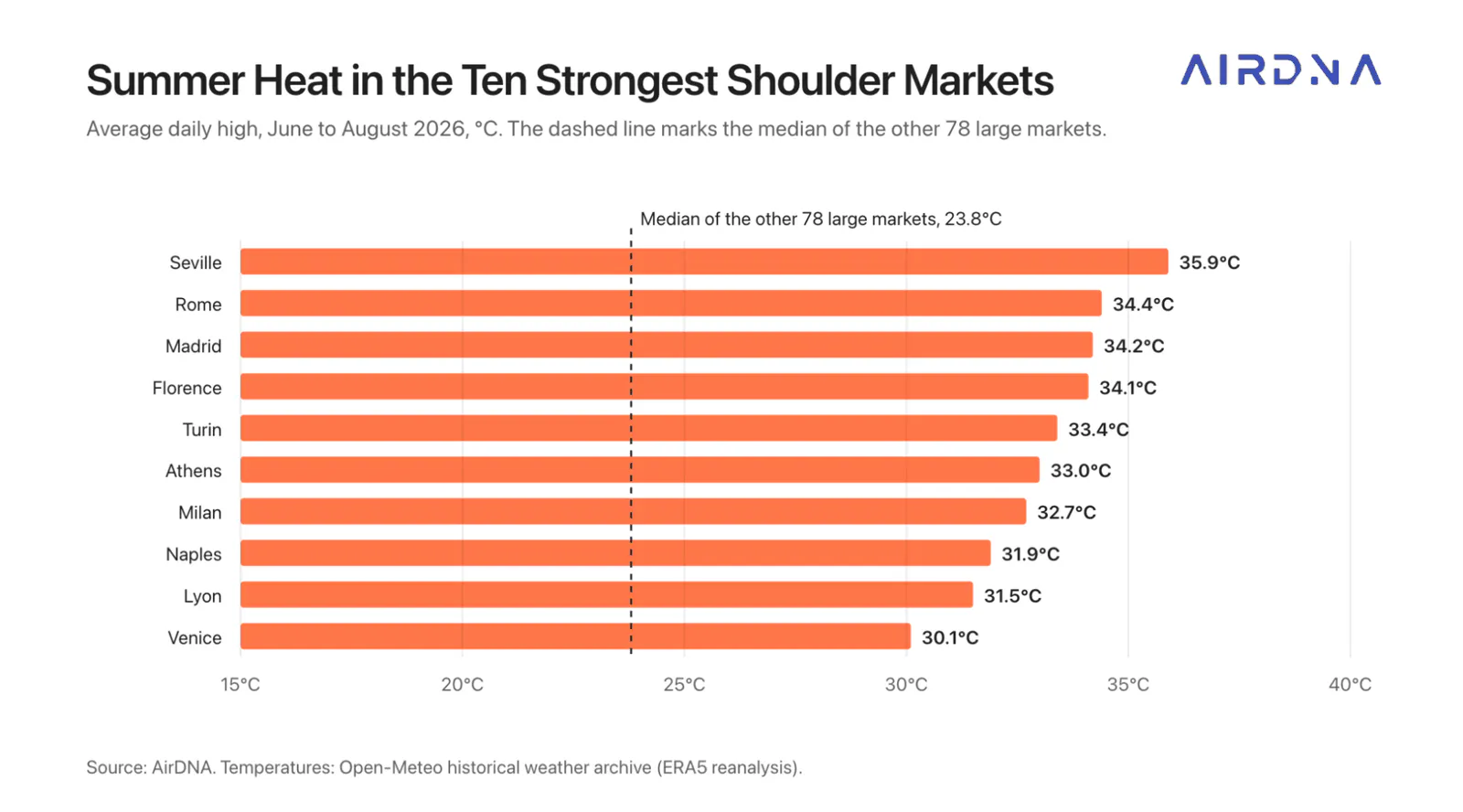
Heat alone does not explain the pattern, because several markets at the bottom of the ranking were just as hot. Šibenik-Knin and Split in Croatia, Budva in Montenegro, Corfu in Greece, Agde in France and Vlorë in Albania all averaged daily highs above 30°C, yet recorded between −46.3% and −75.9% average daily demand nights in the shoulder months compared to summer. Beach destinations draw their visitors because of the heat, while city-break markets lose visitors to it, so the winners combine a hot summer with sightseeing, cultural and business demand that does not depend on the weather.
The Ten Cities’ Shoulder Season Lead Nearly Doubled Since 2019
Measured by occupancy, which accounts for changes in how many listings are open, the shoulder season was already the ten cities’ strongest season in 2019, when their shoulder occupancy (April, May and September) was +7.1 pts compared to summer occupancy (June-August) and nine of the ten recorded higher occupancy in the shoulder months than in summer. What has changed since is the size of that gap.
Between 2019 and 2026, shoulder occupancy in the ten cities rose while summer occupancy declined, so the gap between the two nearly doubled to +13.6 pts. On average daily demand nights, the ten cities’ shoulder months went from +2.7% compared to summer in 2019 to +22.4% in 2026. Across all 88 large markets, the number whose shoulder months beat their summer on average daily demand nights rose from 5 to 19. In 2025, the last complete year, the full shoulder season including October held 40.2% of the ten cities’ annual demand nights, compared to 25.5% for summer.
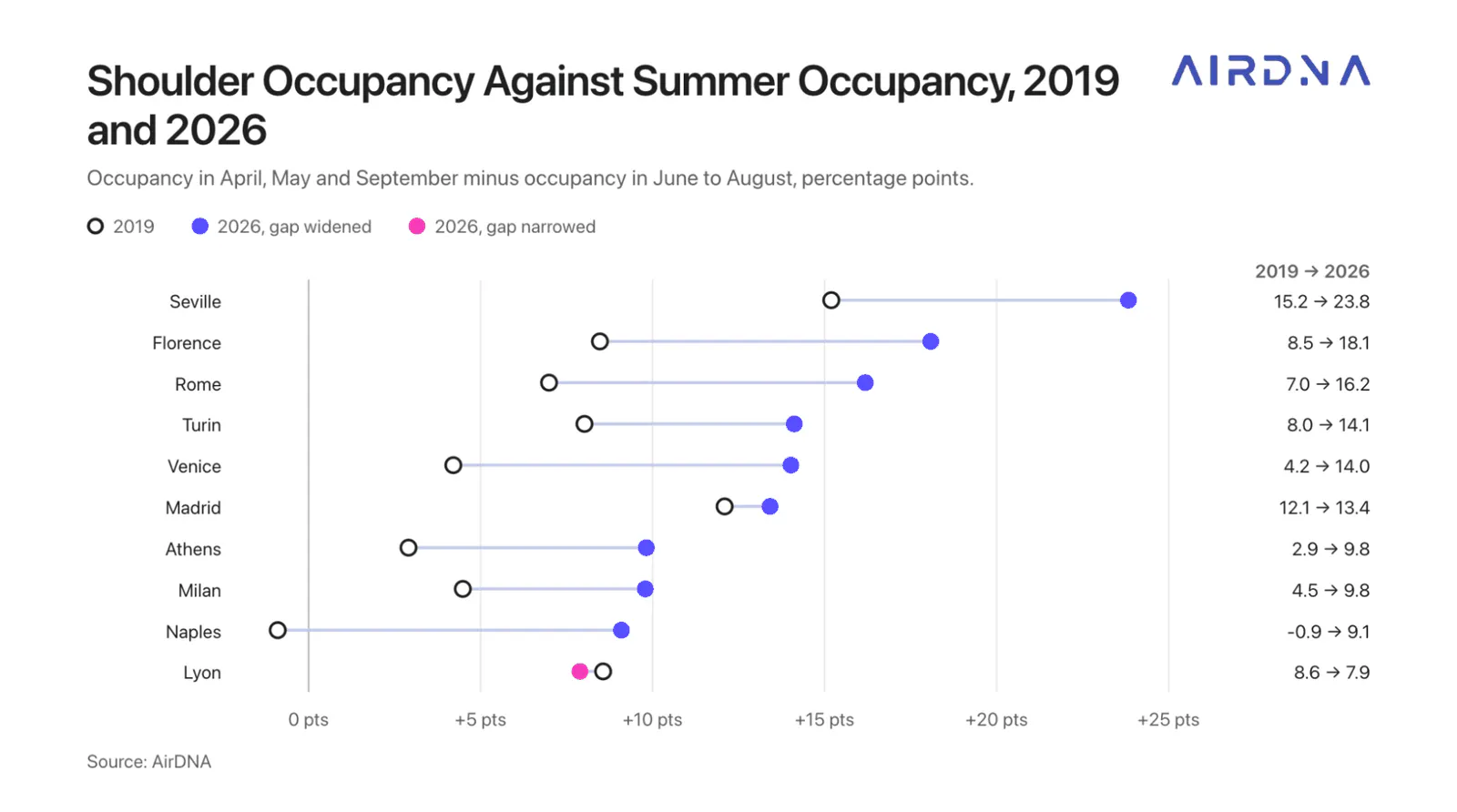
The change was sharpest in Italy, where the gap between shoulder and summer occupancy widened from +4.2 to +14.0 pts in Venice, from +8.5 to +18.1 pts in Florence and from +7.0 to +16.2 pts in Rome between 2019 and 2026, and Naples moved from −0.9 to +9.1 pts. Seville’s gap, already the widest of the ten in 2019, grew from +15.2 to +23.8 pts. The gap widened in nine of the ten cities; only Lyon’s narrowed slightly.
Europe-wide shoulder occupancy was −10.7 pts compared to summer occupancy in 2026, little changed from −11.2 pts in 2019, and occupancy across the continent still peaked in August, so the deepening shoulder season appears concentrated in hot-summer cities rather than spread across the continent.
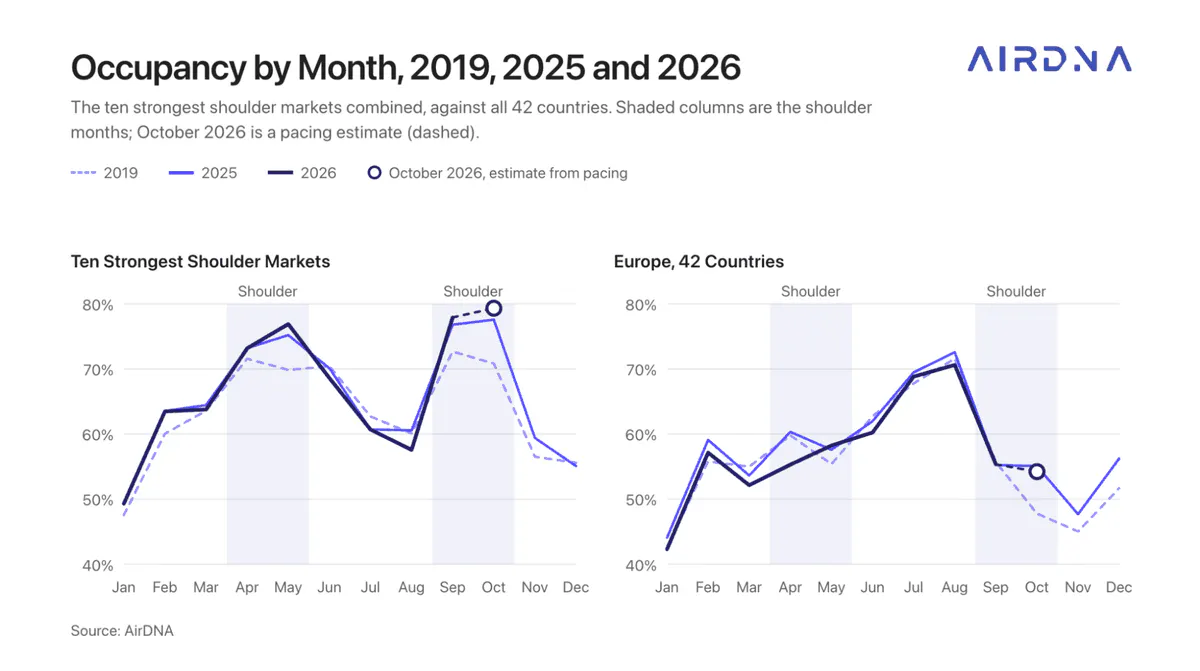
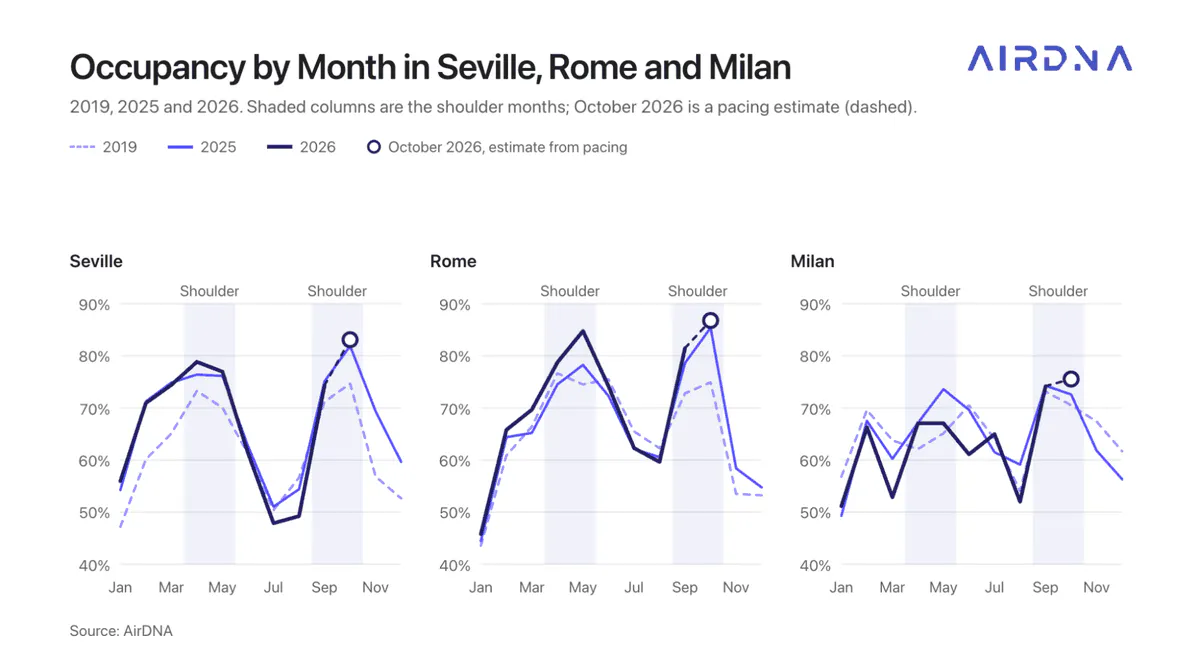
In Seville, the strongest of the ten markets, April occupancy rose from 73.3% in 2019 to 78.8% in 2026 while July’s declined from 50.4% to 47.9%. In Rome, the largest market by listings, May rose from 74.5% to 84.8% and August declined from 62.3% to 59.6%, and in Milan, the second largest market, September held near 74% while August declined from 54.1% to 52.0%.

Summer Hotspots Like Mallorca and Amalfi Are Stretching Into Spring
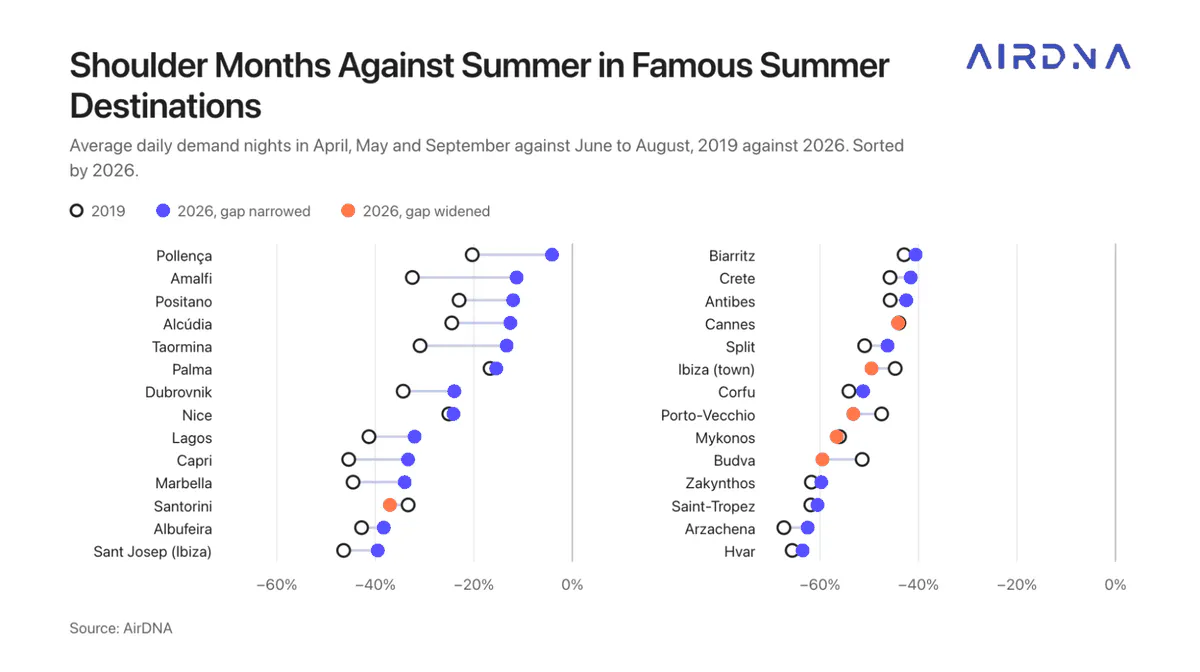
At the other end of the scale, the median of 28 well-known European summer destinations, from Cannes and Saint-Tropez to Mykonos and Mallorca and many below our 5,000-listing threshold, recorded −40.0% average daily demand nights in the 2026 shoulder months (April, May and September) compared to summer (June-August), and every one recorded a lower ADR. Cannes recorded −44.2% average daily demand nights and −14.0% ADR.
These destinations’ shoulder season is growing nonetheless, with the median gap on average daily demand nights narrowing from −44.6% in 2019 to −40.0% in 2026. The gains came in April and May, which improved compared to summer in 26 of the 28 major summer markets, led by Pollença, Amalfi, Taormina and Dubrovnik. September moved the other way in 18 of the 28 markets: in Cannes, Mykonos, Santorini and Budva its decline outweighed the April and May gain, and Porto-Vecchio and Ibiza town weakened in both, so these six trailed their summer by more in 2026 than in 2019, Budva most (from −51.4% to −59.5%). For these destinations, the season appears to be lengthening into April and May rather than into September.
Hot-City Hosts Should Stop Pricing Spring and Fall as Off-Peak
Hosts in the ten hot-summer cities who discount April, May, September and October as off-peak months give up ADR that demand in those months supports, since their 2026 shoulder occupancy was +13.6 pts compared to summer and their shoulder ADR +8.8%. With July and August occupancy near 60% in these cities, flexible minimum stays, air conditioning and pricing aimed at the travelers who still come matter most in the hottest months.
Europe’s beach destinations still peak in summer on average daily demand nights, but their season is lengthening into April and May rather than September, so pricing and minimum stays that pull demand into April and May appear to offer their hosts the most room to grow.
A hot-summer European city whose shoulder occupancy exceeds its summer occupancy offers investors a steadier year than its July and August occupancy suggests, and if summers keep getting hotter, the shoulder season is likely to matter more for these cities.
FAQs
What is shoulder season?
Shoulder season is the period between a destination’s peak and off-peak seasons. In this AirDNA analysis of Europe’s short-term rentals, the shoulder months are April, May and September, compared with a June to August summer.
When is shoulder season in Europe?
For most of Europe, shoulder season falls in April and May and again in September and October. In 2026 so far, Europe-wide average daily demand nights in April, May and September were 30.2% below summer, and ADR was 13.1% lower.
Which European cities are busiest in shoulder season?
Seville, Turin, Rome, Florence, Milan, Madrid, Venice, Naples, Lyon and Athens drew more average daily demand nights in April, May and September 2026 than in summer. Combined, they recorded +22.4% demand nights and +8.8% ADR, led by Seville at +50.5% and +35.1%.
Why is shoulder season beating summer in some European cities?
All ten cities averaged daily highs above 30°C in summer 2026, against a 23.8°C median for other large markets, and all draw visitors for sightseeing, culture and business. Heat makes July and August uncomfortable for a city break, so visitors shift to spring and early fall.
Should short-term rental hosts in Europe discount shoulder season?
Not in the ten hot-summer cities, where 2026 shoulder occupancy was 13.6 pts above summer and shoulder ADR was 8.8% higher. In beach destinations summer still leads, so pricing and minimum stays that pull demand into April and May offer the most room to grow.
About the Data
Markets: We filtered for markets with at least 5,000 available listings on average between April and September 2026.
Demand: The shoulder months and the summer differ in length, so we compare average daily demand nights: the nights stayed in a market’s listings divided by the number of days in the period.
Over time: Comparisons with 2019 and 2025 use the same three shoulder months, April, May and September, in every year.
Rates: ADR in each market’s own currency; Europe-wide figures in euros, converted at each month’s exchange rate.
Climate: Average daily highs for June to August 2026 from the Open-Meteo historical weather archive.
ARTICLE SUMMARY
AirDNA compared the 2026 shoulder season in Europe (April, May and September) with summer across 88 large short-term rental markets. Europe as a whole still peaks in July and August, but ten hot-summer cities led by Seville, Turin and Rome now draw more demand at higher rates in spring and early fall, and their lead over summer has nearly doubled since 2019.
Camilo Schmid Rivas
Senior Research Analyst
Camilo Schmid Rivas is a Senior Research Analyst at AirDNA who brings a uniquely well-rounded perspective to short-term rental analytics. With a background that spans investment, real estate, and business analysis—including roles at Stayery and Sollers Consulting—Camilo has worn many analyst hats, each sharpening his ability to turn complex data into clear, actionable insights. A graduate of École hôtelière de Lausanne, he now channels his multidisciplinary expertise into uncovering trends that drive smarter STR decisions. In his free time, he enjoys playing tennis or scuba diving in or around Barcelona.
