Calculate Revenue
 Research Markets
 Find For Sale Properties
 Compare My Listing
 STR Revenue Calculator
 Custom Comp Sets
 Submarket Insights
 Custom Search Filters
 Rate Recommendations
 Performance Benchmarking
 Competitor Comparison
 Owner Contact Details
 Property-level performance data
 Tourism Insights
 Real Estate Investment Analytics
 About Us
 Sales
 Support
 Press
European Market Review December 2021
Published: January 26, 2022
Last updated: May 5, 2026

Jamie Lane
Q4 2021 Strongest for European STRs Since Start of Pandemic
Despite demand hesitancy in December, Q4 2021 emerged as Europe’s best quarter for short-term rental (STR) demand and revenue since the beginning of the pandemic.
Demand for European short-term rentals gained much-needed momentum in Q4 2021, reaching positive levels in November for the first time since the start of the pandemic (+0.3%). However, the emergence of the Omicron variant pulled demand back to negative territory in December amidst rising COVID-19 cases. December 2021 demand, measured by the number of listing nights stayed over the previous month, ended up 9.7% lower than in December 2019 (although it was up 103.5% over December 2020). Overall, Q4 2021 demand was down just 6.6% vs. Q4 2019 and 66.3% higher than Q4 2020.
A combination of recovering demand and rising rates resulted in revenue growth for the third consecutive month in December. Average daily rates (ADRs) rose in December by 24.7% over 2019 and 6.4% vs. December 2020. At the same time, STR revenue rose 12.6% in December 2021 vs. December 2019, 88.9% over December 2020. Quarter-over-quarter average revenue growth was stronger than monthly comparisons, with Q4 2021 coming up 18.2% over Q4 2019. For 2021 as a whole, revenue totals for Europe were 8.3% below 2019 and 35.5% above 2020.
Recovering demand also pushed occupancy to 47.1%, a record for the month of December, breaking the previous record of 46.2% in 2018. This was driven in part by demand outpacing the supply of available listings. As of December 2021, the number of available listings was 15.3% lower than in December 2019 and only 0.2% higher than in December 2020.
Only France and Russia Maintain Demand Growth in December
European demand reached its highest growth over 2019 in November 2021, with Croatia, France, Germany, Greece, Russia, and Switzerland each in positive territory. In December, however, only France and Russia saw positive demand levels (+13.3% and +3.3%, respectively) while demand in the remaining major European countries fell below that of December 2019. Hungary and the Czech Republic, traditionally popular city break destinations, saw the lowest demand levels of all the major European countries in December 2021, down 44.5% and 57.2%, respectively, vs. December 2019.
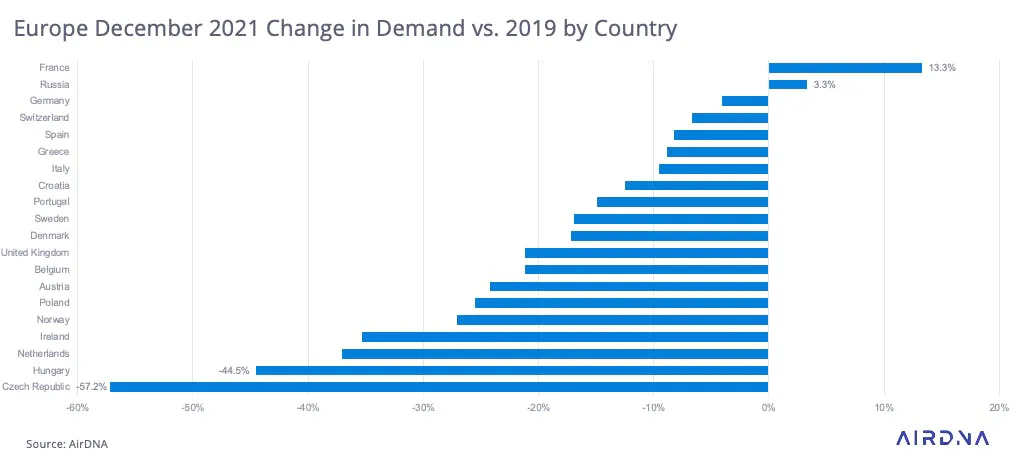
Every major European country saw positive demand gains in the month of December compared with December 2020. The countries with the strongest gains were Greece (+53.5%), Italy (+51.9%), Croatia (+49.9%), Spain (+48.7%), and France (+45.8%).
Comparing 2021 with Years Past
With December data on the books, we can now compare 2021 to years past to gain insight on emerging trends within the European short-term rental market.
While total demand for the continent remains 24.2% below 2019 levels, 2021 demand was up 18.4% over the lows of 2020. European supply continued to lag, with the number of average monthly available listings falling 4.8% in 2021 vs. 2020 (-15.7% vs. 2019).
As demand surged for low supply, hosts were able to charge higher rates. In 2021, Average Daily Rates (ADRs) grew 22.0% over 2019 and 13.8% vs. 2020. The higher ADRs paired with increased demand pushed revenue up to 8.3% below 2019 levels (35.5% above 2020).
Demand continued to favour areas outside of Europe’s 25 largest cities, as guests chose getaways in less populous destinations. Demand outside of the 25 largest cities in 2021 grew 16.1% over 2019 and 21.5% vs. 2020. Meanwhile, total demand for Europe’s 25 largest cities in 2021 was down 57.9% from 2019 (-1.8% vs. 2020).
Remarkably, supply has not recovered at the same rate as demand across Europe. Relative to 2019, 2021 average monthly available listings in the top 25 cities in Europe fell 36.1%, while they were 22.0% lower than in 2020. Declines in average monthly available listings throughout the rest of Europe were less steep, having been only 15.7% lower in 2021 compared with 2019 (-4.8% vs. 2020).
Prior to the pandemic, larger cities with smaller units held the majority of the supply, and these markets continued to lose listings in 2021. Demand has shifted to smaller, typically rural or coastal, markets with larger and more unique types of units. In these smaller markets, supply has grown to meet demand. This indicates that the mix of supply in 2021 was distinct from that of 2019, albeit smaller in volume. In 2021, guests stayed in different locations and unit types for different time frames, rates, and reasons than in 2019.
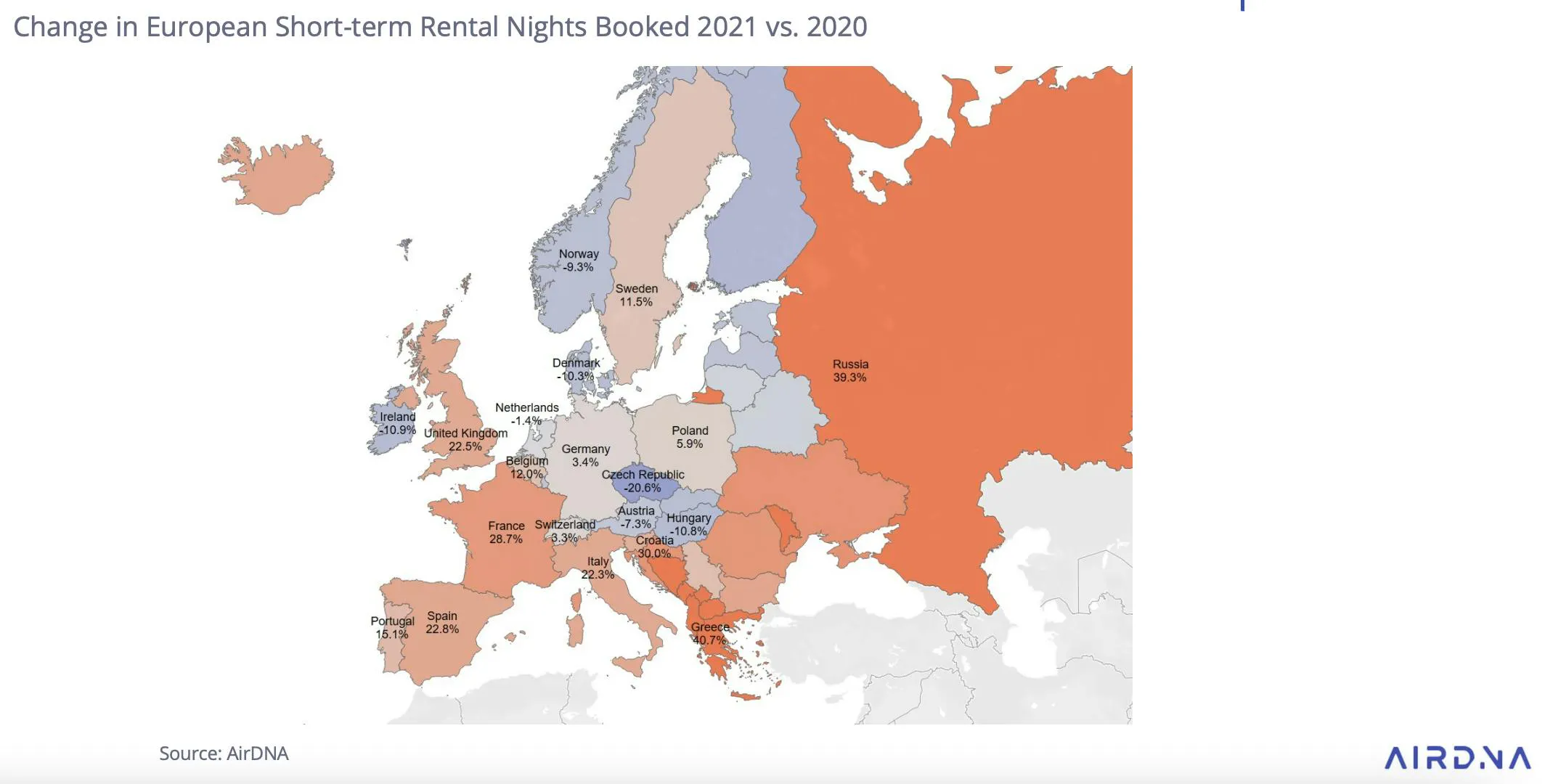
Russia was the only major European country to see positive demand for all of 2021 vs. 2019, with growth of 10.1%. 13 of the 20 countries realized positive demand levels in 2021 compared with 2020, with double-digit growth for 10 of the 13. Russia, countries with Mediterranean coastline, and the United Kingdom have led the demand recovery, while Central Europe underperformed the other major markets. The Czech Republic continues to have the most difficulty reclaiming demand. Levels there are 20.6% lower than in 2020 and 60.8% lower than in 2019.
Demand in France Remains Strongest Outside of Major Cities
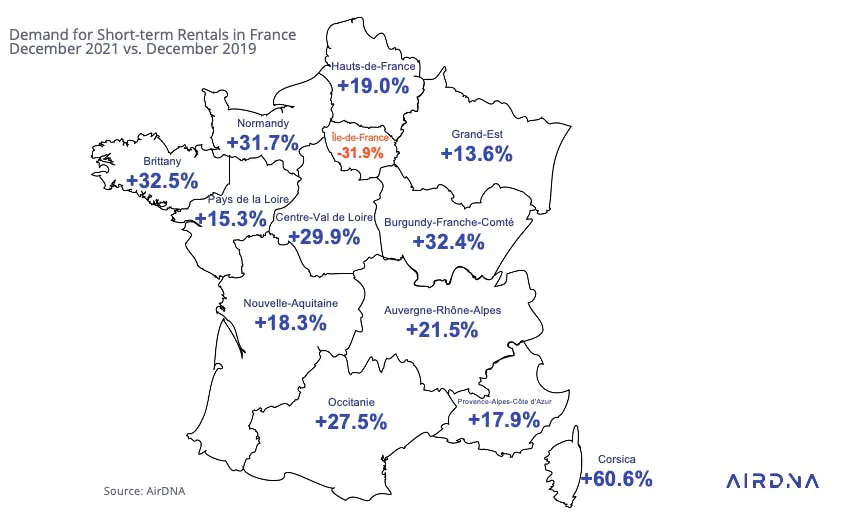
After a volatile year for short-term rental demand in France, the country ended 2021 on a positive note in December, up 13.3% vs. December 2019. Total demand in 2021 was 5.8% below 2019 levels and 28.7% above 2020. Rising demand in France allowed occupancy to hit 48.5% for the month of December, the highest occupancy in December since 2018 (46.1%).
Demand in France is still strongest for stays outside of major cities. In December, demand surpassed 2019 levels in every major French region except for Île-de-France, which includes Paris. Demand growth in December was strongest in Corsica, Brittany, and Burgundy-Franche-Comté.
Rising demand outside of major cities contrasts with falling demand in other large cities within France, including Strasbourg (-33.8%), Lyon (-32.5%), Bordeaux (-29.4%), and Nice (-28.9%). While demand for each of these major cities is lower than in December 2019, demand for their corresponding regions is higher.
ADRs in France continue to rise, as they have in Europe as a whole. In December, ADRs reached levels normally only seen in the peak summer months of July and August, up a substantial 24.3% vs. December 2019 (+9.4% vs. 2020). ADRs in Q4 2021 were 24.7% higher than in Q4 2019 (+13.3% vs. 2020).
Heightened demand outside of major cities, where homes are larger and ADRs are typically higher, continues to push rates higher during off-peak seasons. In August 2021, when demand generally favours locations outside of cities, ADRs were only 11.2% higher than in 2019. This indicates that current ADR growth is driven less by rate inflation and more by a different mix of homes, lofts, and villas being rented than in 2019.
Scarce Demand for Cities Continues to Impede Recovery
Demand continues to recover, but disproportionately across location types. Guests are favouring stays outside of major cities not only in France but across Europe—as well as in the United States. For the top 25 cities in Europe, December 2021 demand was still 43.8% below December 2019 levels. The rest of Europe (which includes resort/holiday destinations and small and mid-sized cities) was only down 0.2% relative to December 2019.
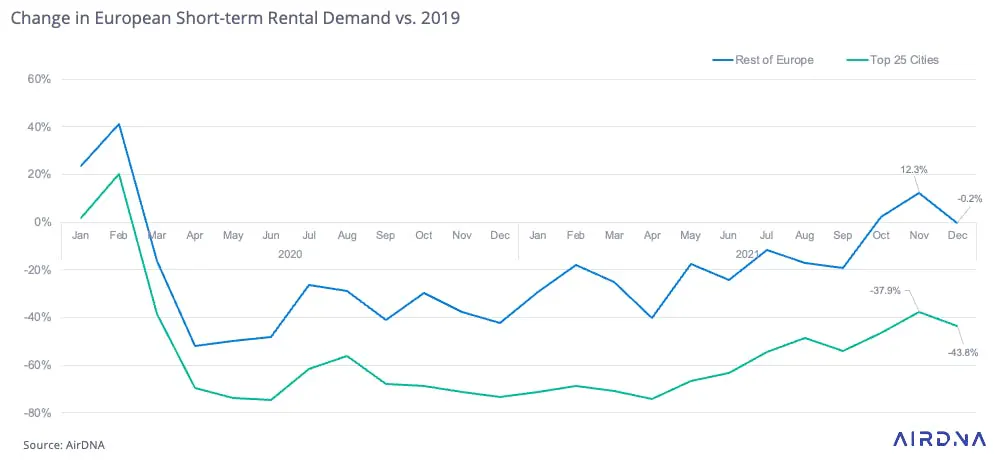
After a two-month streak of positive demand in October (+2.2%) and November (+12.3%), the areas outside of major cities returned to barely negative territory in December, at 0.2% below December 2019. Understandably, demand fell in December from its November high for the top 25 cities and the rest of Europe due to rising COVID-19 cases and the threat of Omicron across the continent in the last three months of 2021.
When taking a closer look at the 25 largest European cities, Cannes, FR (+2.0%) was the only city that recorded positive demand in December relative to 2019. The other top three performing cities were Saint Petersburg, RU (-13.6%), Marseille, FR (-17.4%), and Venice, IT (-17.6%).
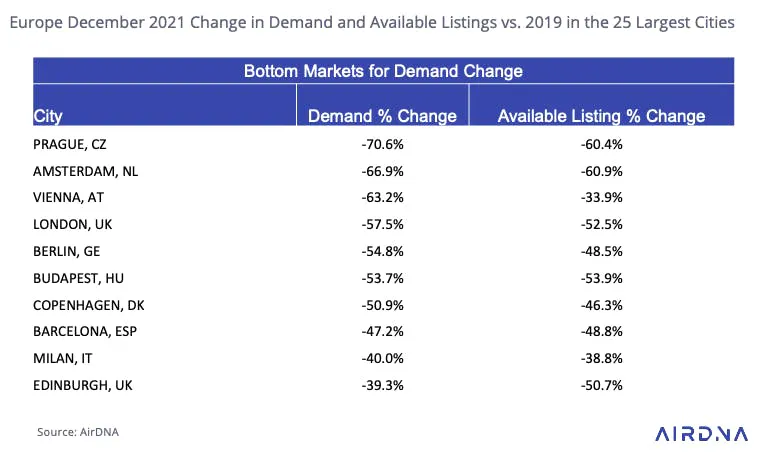
As of December, three of the 25 largest cities had yet to exceed 50% of their pre-pandemic demand levels since March 2020: London, UK; Amsterdam, NL; and Prague, CZ. The extended period of low demand in major cities has resulted in many hosts removing their listings from the short-term rental market or temporarily converting their space to other uses. The supply of available listings still remains less than half of what it was in December 2019 in five markets: Amsterdam, NL (-60.9%), Prague, CZ (-60.4%), Budapest, HU (-53.9%), London, UK (-52.6%), and Edinburgh, UK (-50.7%).
Summer Outlook Looks Solid—So Far
2022 is shaping up to be a year of recovery for most European countries. New bookings actively slowed down with the emergence of the Omicron variant, with 17% fewer nights booked in December 2021 after just 8% fewer bookings in November. However, for all of 2021, there were 40% more bookings than in the previous year, which puts the continent on a solid footing as the industry moves ahead to 2022. While not all neighbourhoods are great investment opportunities, there are many locations within London that provide solid occupancy metrics and travel demand.
Looking ahead to Q1 2022, demand on the books is just about even (+0.3%) with the start of 2019, and a full 88% above the beginning of 2021. As we look out further to the summer, pacing for June to September 2022 is down just 10% relative to 2019 levels.
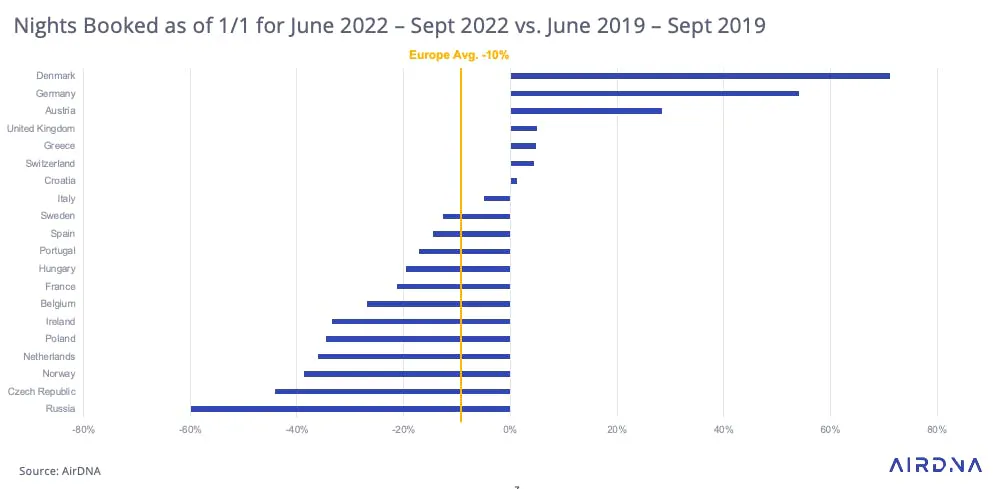
Denmark leads the major European countries in summer demand pacing, with 71.2% more nights booked in 2022 than in January 2019, followed closely by Germany (54.1%) and Austria (28.4%). The United Kingdom, Greece, and Croatia are also seeing marginal pacing gains for the summer (June-September) over the same months in 2019.
Booking lead times, the number of days on average from a guest making their booking to their check-in, in June-September 2021 averaged 48 days, which was an average of three weeks shorter (29% fewer days) than in 2019. Given current uncertainty around Omicron and consistently shorter booking lead times for most travelers, we expect that actual demand could exceed the present figures. However, as we have learned over the past two years, conditions for travel can change anytime and have a huge impact on actual performance.
ARTICLE SUMMARY
Despite demand hesitancy in December, Q4 2021 emerged as Europe’s best quarter for short-term rental (STR) demand and revenue since the beginning of the pandemic.
Jamie Lane
AirDNA Chief Economist
He is responsible for data analysis, thought leadership, and leveraging advanced analytical techniques to provide new insights into short-term rental market trends. Native to Atlanta and an Airbnb host himself, Jamie enjoys cycling, mountain biking, backpacking, running, and playing in a dart league in his free time.