

 Calculate Revenue
 Research Markets
 Find For Sale Properties
 Compare My Listing
 STR Revenue Calculator
 Custom Comp Sets
 Submarket Insights
 Custom Search Filters
 Rate Recommendations
 Performance Benchmarking
 Competitor Comparison
 Owner Contact Details
 Property-level performance data
 Tourism Insights
 Real Estate Investment Analytics
 About Us
 Sales
Sales Support
 Press
PressEuropean Review April 2025: Easter Surges While Summer Momentum Builds
Published: May 15, 2025
Last updated: May 21, 2025

Jamie Zhang
Key Takeaways
- European short-term rental (STR) demand rose 27.4% year-over-year, driven by the Easter holiday shift into April.
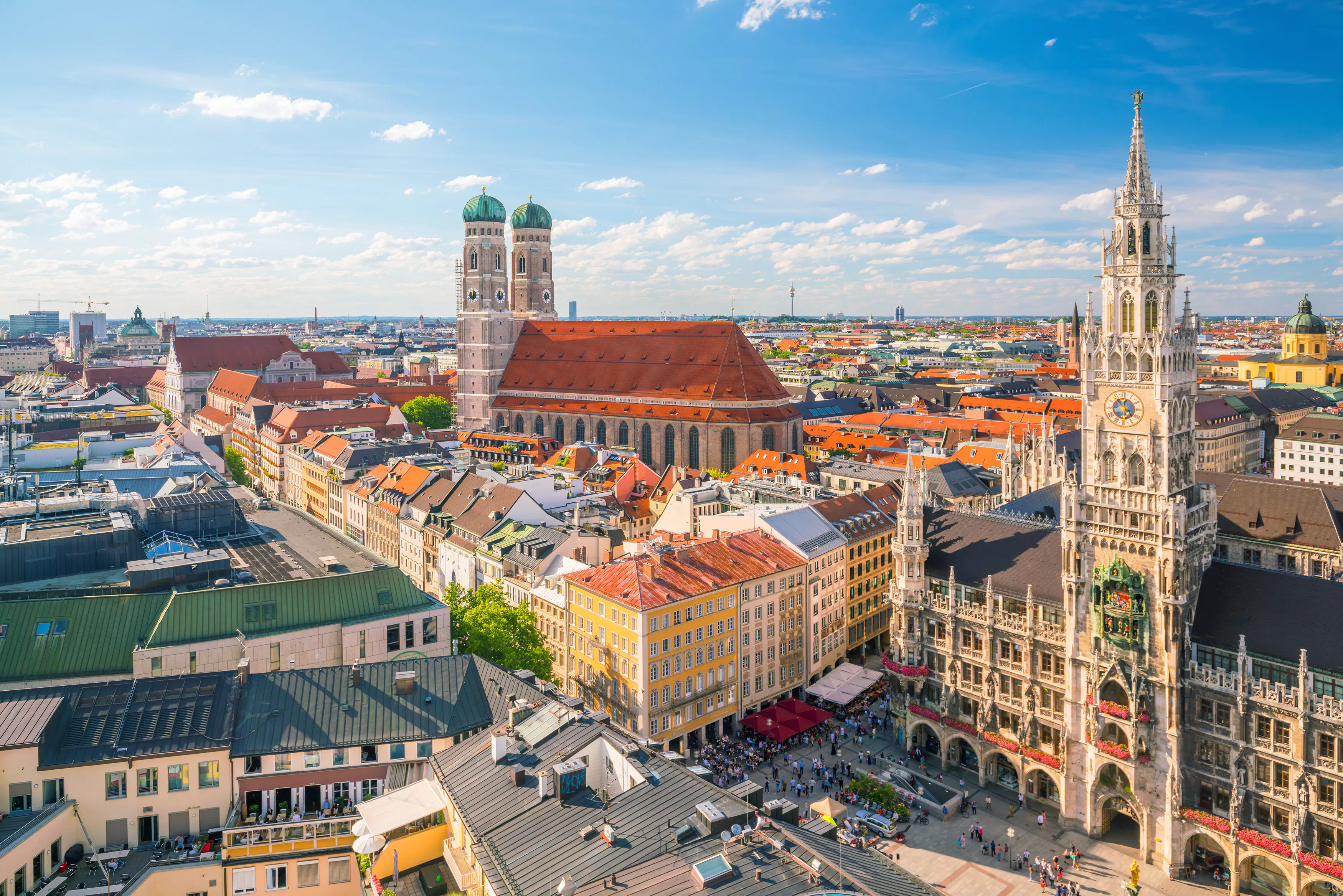
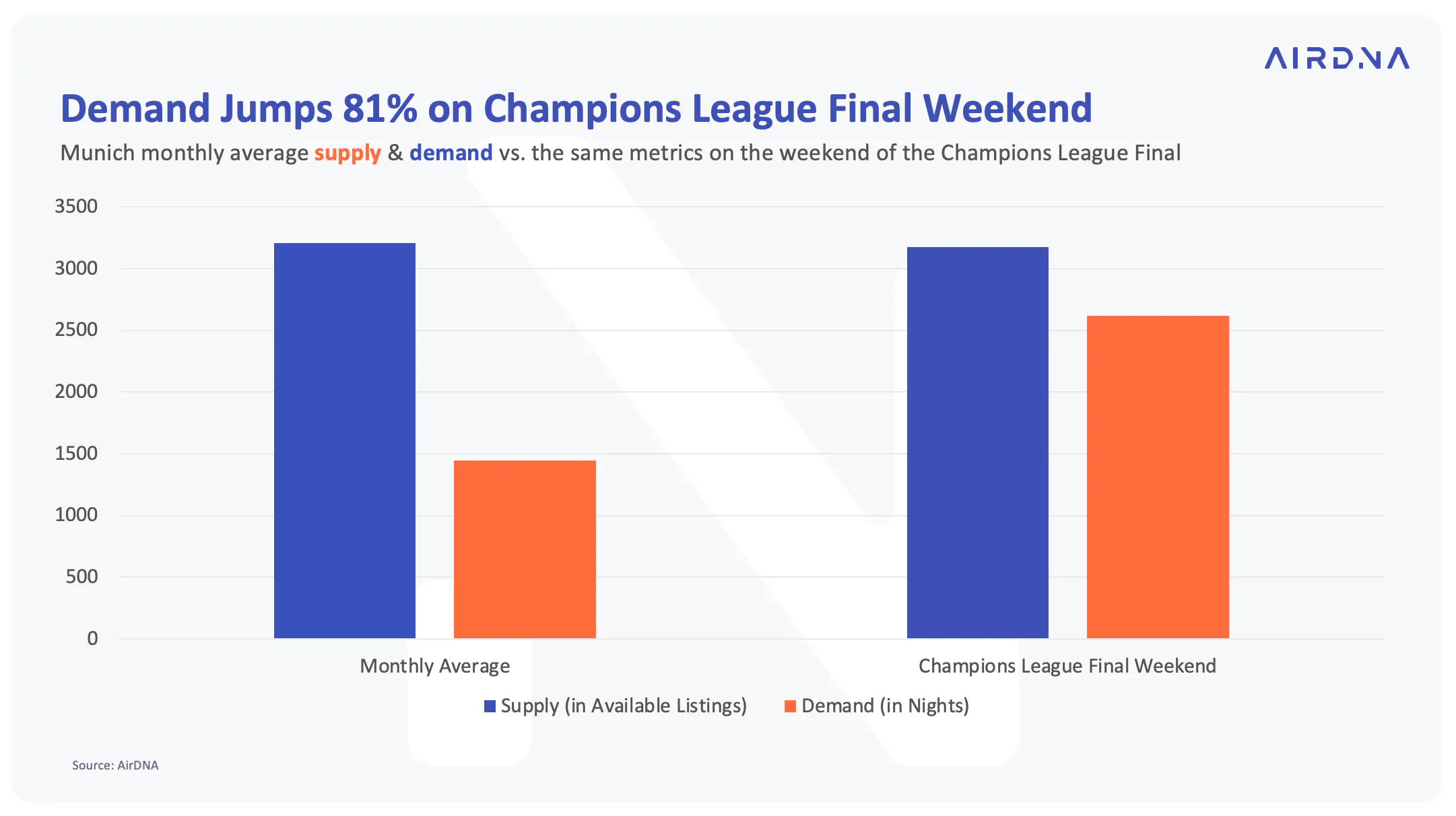
- Munich demand soared 81% for the Champions League Final weekend, significantly boosting local revenues.
- France maintained a steady share of international visitors despite political and economic headwinds.
- Forward bookings for summer signal strong travel interest across most of Europe’s top markets.
After a promising start to 2025, Europe’s STR market delivered another month of solid growth in April. The later timing of Easter played a significant role, pushing holiday travel into the month and lifting performance across the continent. Demand surged, occupancy improved sharply, and revenue metrics followed suit. Forward-looking data suggests this momentum may carry into the summer travel season.
At a Glance: April 2025 STR Performance in Europe
- Available listings totaled 3.6 million, reflecting a 7.1% increase year-over-year (YoY)
- Demand nights reached 36.6 million, a sharp increase of 27.4% YoY
- Average daily rates (ADR) averaged €150, an increase of 4.2% from 2024
- Average occupancy rate was 59%, 18% higher than that in 2024
- Revenue per Available Rental Night (RevPAR) increased 23% year-over-year to €88
The State of the European Economy
Despite broader uncertainty, the European economy continued on a path of steady growth in April. The European Central Bank (ECB) slightly revised its GDP forecast downward, from 1.0% to 0.9%, reflecting concerns over shifting global trade policies and potential pressure on exports and investment across the Eurozone. However, this outlook still marks an improvement from earlier projections following U.S. tariff announcements, which had pulled forecasts as low as 0.5%.
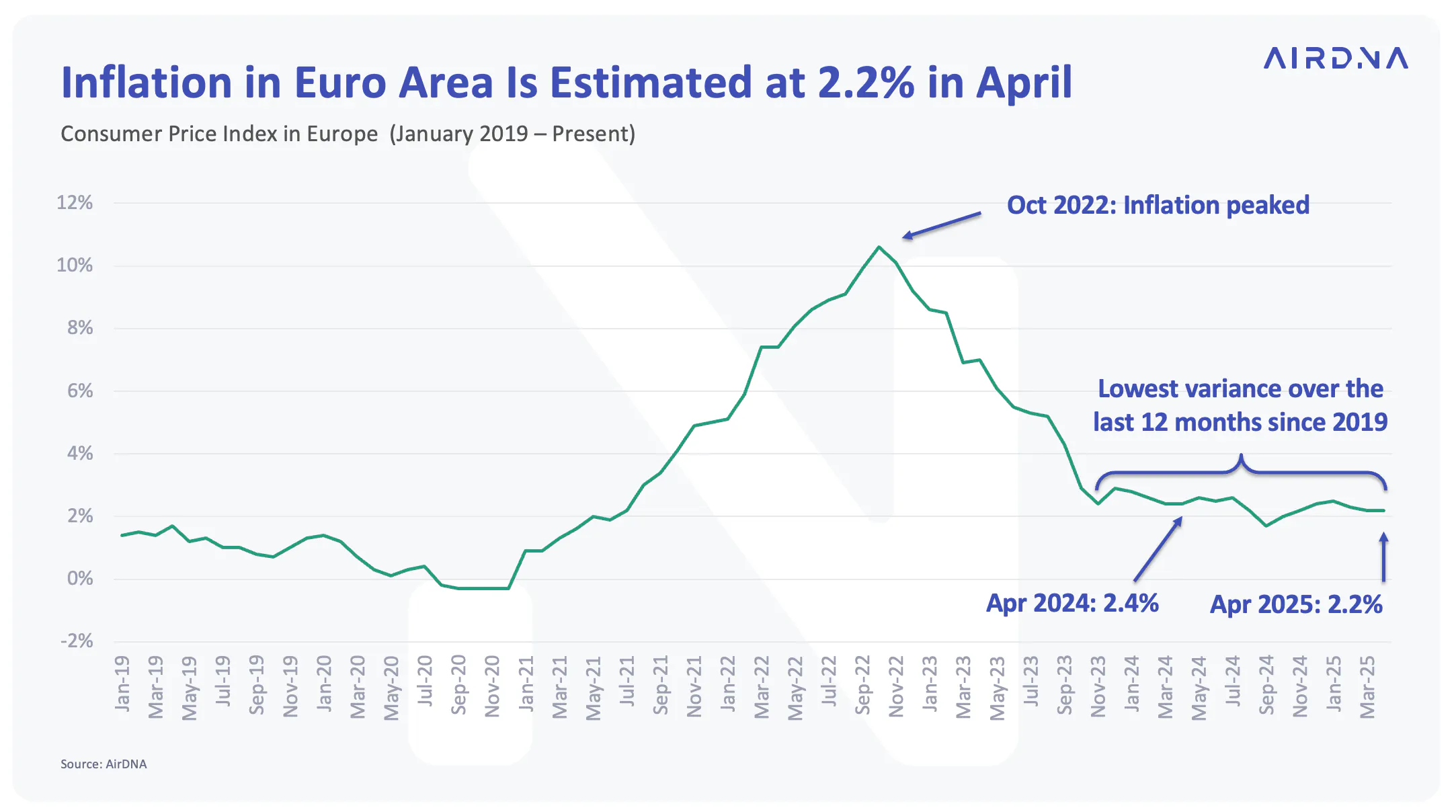
Inflation dropped to 2.2% year-over-year, down from 2.4% in April 2024, bringing it closer to the ECB’s 2% target. The inflation trend has also become more stable, with the lowest trailing 12-month variance recorded since 2019 — well below the October 2022 peak of 10.6%.
In response, the ECB lowered interest rates by 25 basis points, bringing the deposit facility rate to 2.25% and its lowest since December 2022. These lower rates may present new opportunities for STR investors, particularly those looking to finance new listings.
Employment also improved. Unemployment in Europe fell to 6.2% (from 6.4% last year), and in the EU overall to 5.8% (from 6.0%). Combined with easing inflation and reduced borrowing costs, these conditions could support rising consumer confidence—and potentially stronger discretionary spending on travel in the coming months.
Even as international travel patterns shift—Accor CEO Sébastien Bazin noted a 25% drop in European bookings to the U.S.—domestic demand remains resilient. Stable economic fundamentals suggest a strong summer ahead, especially within intra-European tourism.
Calculate potential earnings
Understand the investment potential of any address in the world.
Booked Nights Continue Steady Growth
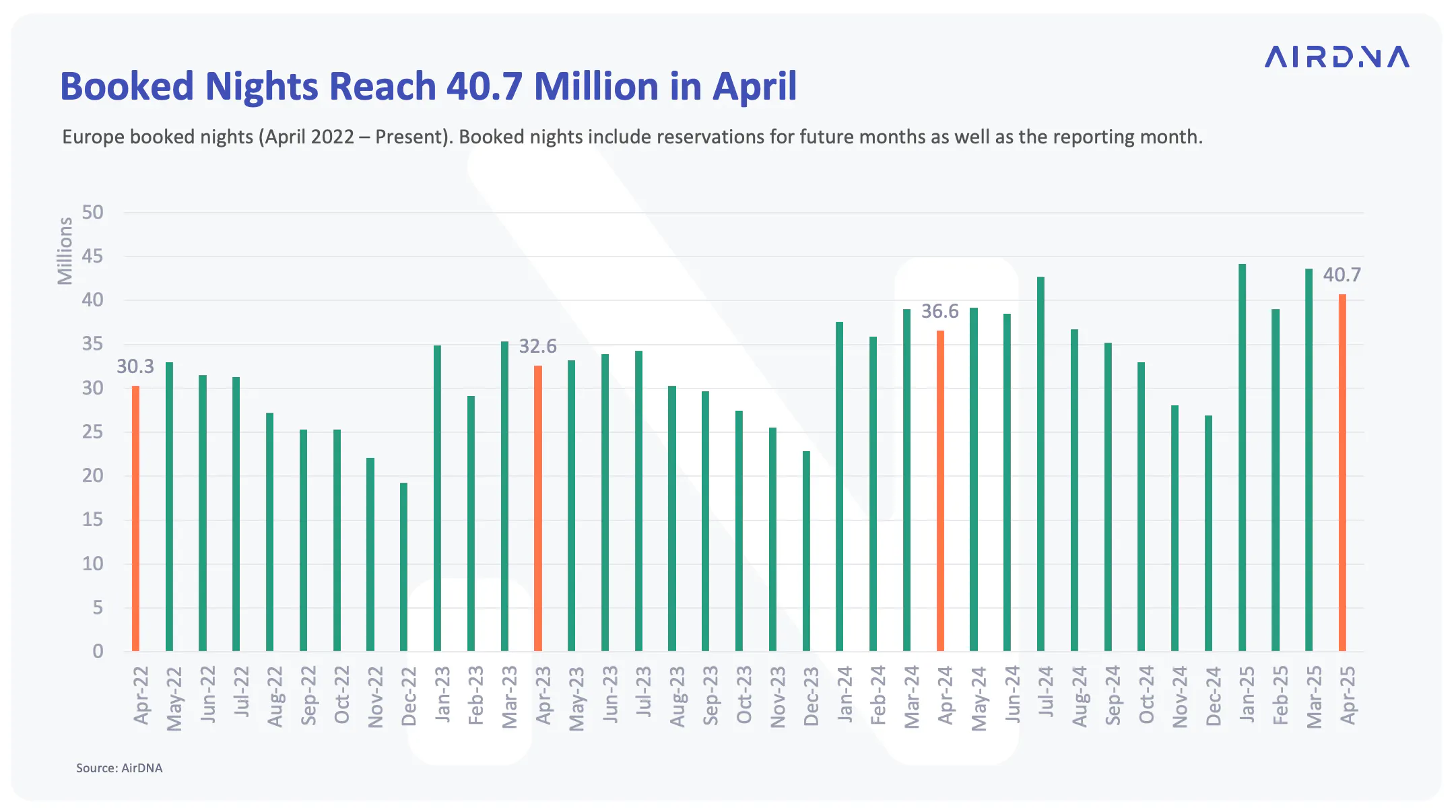
Booked nights—reservations made in April for stays in April or beyond—remained a reliable signal of continued travel interest across Europe. In total, 40.7 million nights were booked, representing an 11.2% year-over-year increase.
Among the top 20 markets, the following countries stood out with particularly strong growth in booked nights:
- Belgium (+24% YoY)
- Norway (+23% YoY)
- Czech Republic (+22% YoY)
- Poland (+21% YoY)
- Denmark (+19% YoY)
While all countries saw positive year-over-year gains, we see the lowest growth among the following countries:
- Finland (+7% YoY)
- Austria (+7% YoY)
- United Kingdom (+9% YoY)
- Hungary (+11%)
- Italy (+12% YoY)
Demand Surges—And with It, Occupancy and Revenue Too
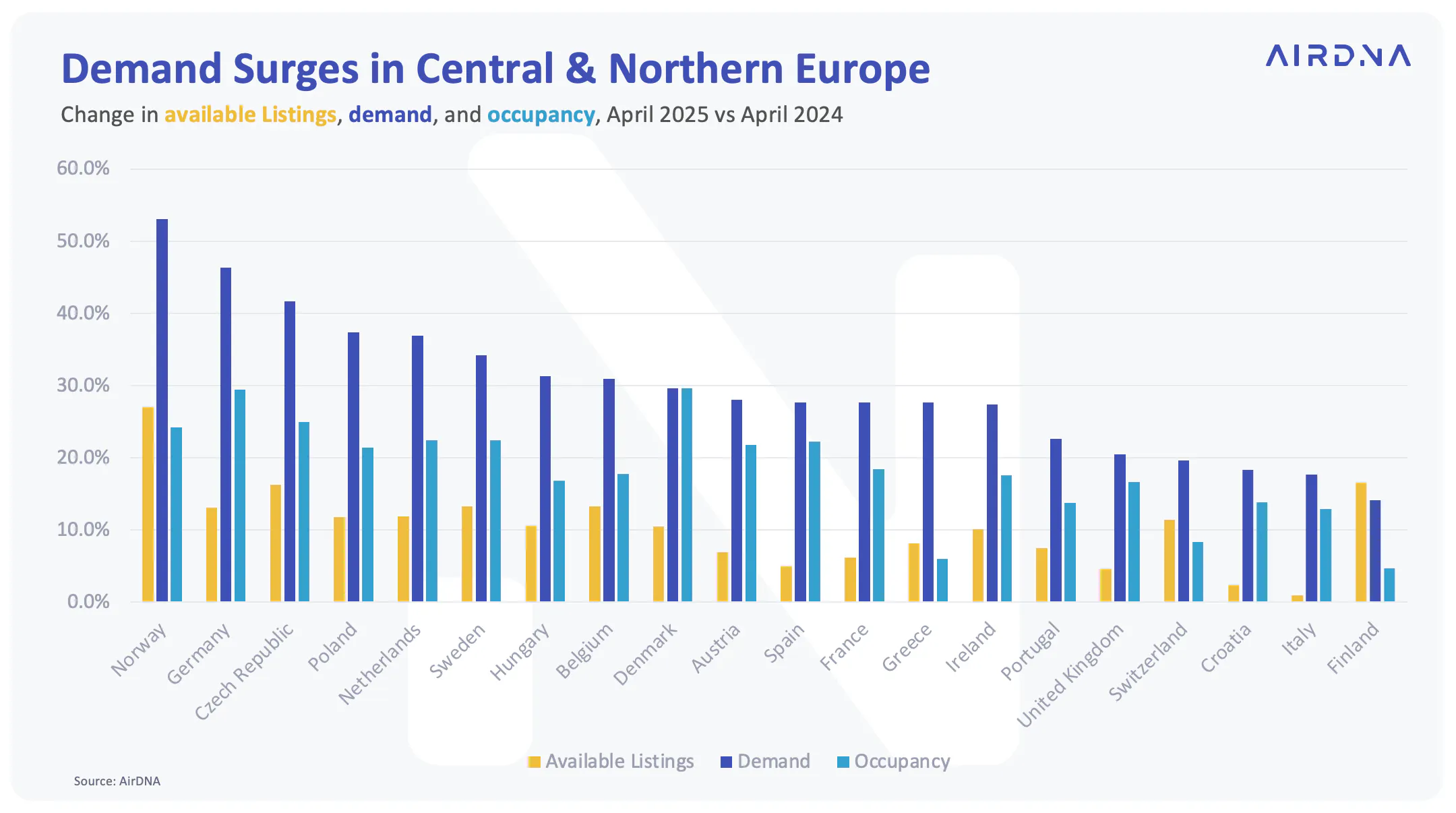
April’s later Easter holiday had a clear and consistent impact on demand across Europe. All of the top 20 countries posted year-over-year demand growth above 14%, with nine countries exceeding 20%. That boost translated into meaningful increases in both occupancy and revenue.
Standout performers by year-over-year demand growth included:
- Norway (+53.1% YoY)
- Germany (+46.3% YoY)
- Czech Republic (+41.7% YoY)
- Poland (+37.4% YoY)
- Netherlands (+36.9%)
- Sweden (+34.2%)
Even on the lower end, countries still saw solid gains:
- United Kingdom (20.5% YoY)
- Switzerland (+19.7% YoY)
- Croatia (+18.3% YoY)
- Italy (+17.6% YoY)
- Finland (+14.2% YoY)
Overall, demand outpaced supply growth in most markets—driving occupancy higher and pushing revenue upward. Finland was a notable exception. There, supply grew by 16.5%, outpacing demand growth of 14.2%. As a result, occupancy rose just 4.7%, and revenue gains were more muted.
Still, the broad-based strength across Europe shows a sharp rebound from the previous month and reinforces the momentum heading into summer.
Revenue Gains Widespread, but Growth Patterns Vary
April brought strong revenue growth across all of Europe’s top 20 STR markets. While higher occupancy was a common driver, the extent to which this translated into revenue gains varied by country (often influenced by changes in ADR and listing supply).
Top performers included:
- Germany and Denmark, which each saw 30% occupancy growth and impressive revenue gains of +55% and +49%, respectively.
- Norway, despite more modest occupancy growth, led in revenue with a 68.5% increase—driven by a 10.1% rise in ADR and a 27.1% expansion in available listings.
Other notable markets:
- Netherlands: +45% revenue, +24% occupancy
- Czech Republic: +44% revenue, +25% occupancy

Some countries saw strong revenue growth even without large occupancy increases.
- Finland posted +40% revenue growth on just +4.7% occupancy, supported by a surge in available listings (+16.5%).
- Greece and Switzerland also converted small occupancy gains into solid revenue increases, suggesting ADR played a larger role in those markets.
These results show that while demand growth lifted most markets, local pricing power and supply dynamics played a critical role in determining revenue outcomes.
Champions League Final Drives Booking Surge in Munich
The German city of Munich sees a significant rise in demand as it prepares to host the UEFA Champions League Final, scheduled for May 31.
Bookings for the event weekend were 81% higher than the city’s May average — and 145% higher than the previous weekend — highlighting the draw of major international sporting events for STR operators.
Despite this spike in demand, supply remained relatively unchanged throughout the month, suggesting limited host expansion in response to the event.
The impact on revenue was even more pronounced:
- Revenue during the Final weekend was 96% higher than Munich’s May average.
- Compared to the weekend before the match, revenue rose 153%, driven by both higher occupancy and elevated nightly rates.
This data underscores the value of large-scale local events to local STR markets, plus the importance of pacing data in anticipating demand spikes.
France’s Fastest-Growing STR Markets Show Widespread Momentum
France’s short-term rental market saw notable expansion in both supply and demand in April, with growth spread across large cities, mid-size towns, and rural regions.
While Paris continues to dominate in volume, smaller destinations are seeing meaningful gains, pointing to increased decentralization and domestic travel strength.
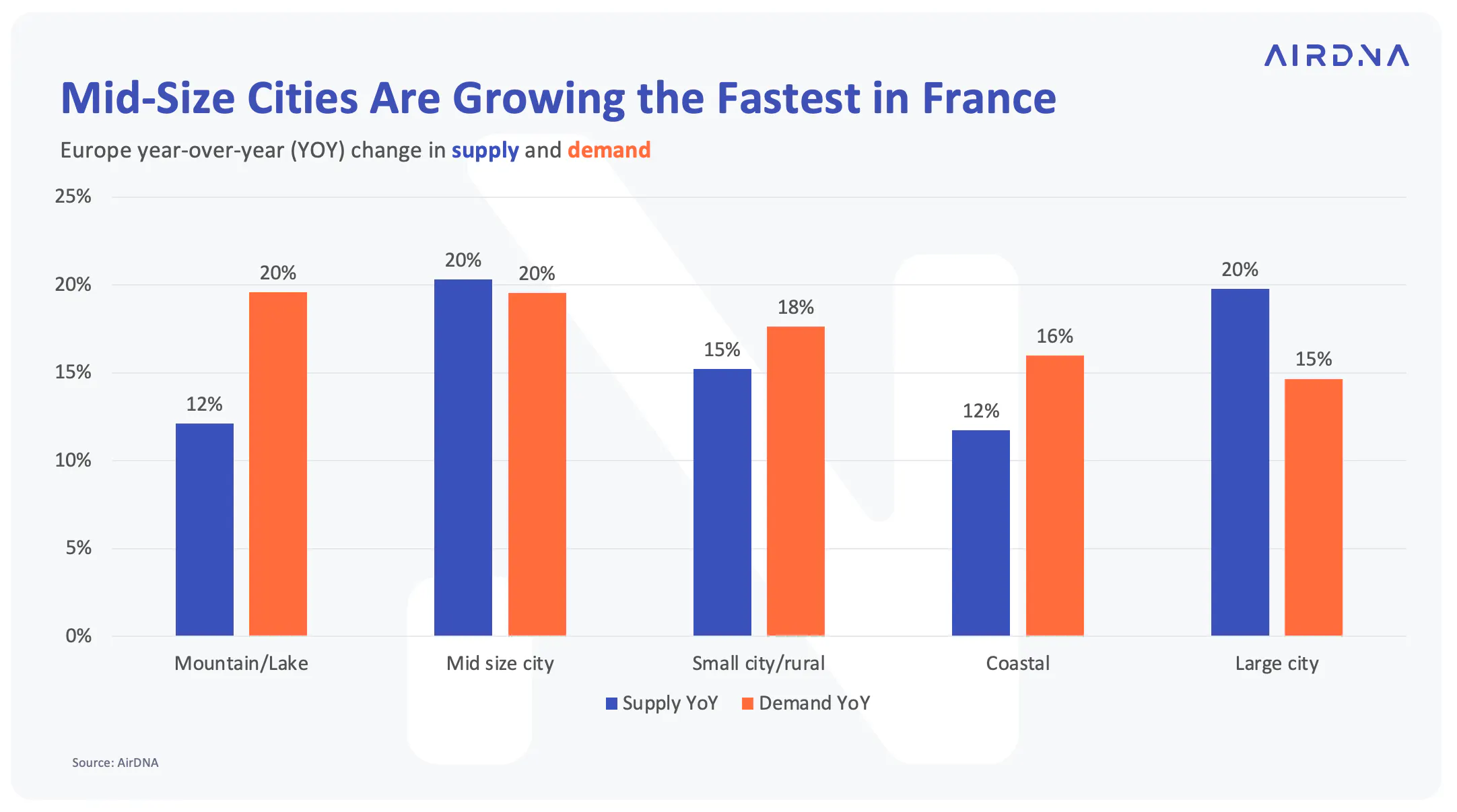
When taking a look at France's highest-growing markets by location:
- Mid-size cities led in both demand and supply growth (+20% YoY each).
- Large cities showed equivalent supply growth (+20%) but slightly slower demand growth (+15%).
- Mountain/lake destinations matched mid-size cities in demand (+20%) but trailed in supply growth (+12%).
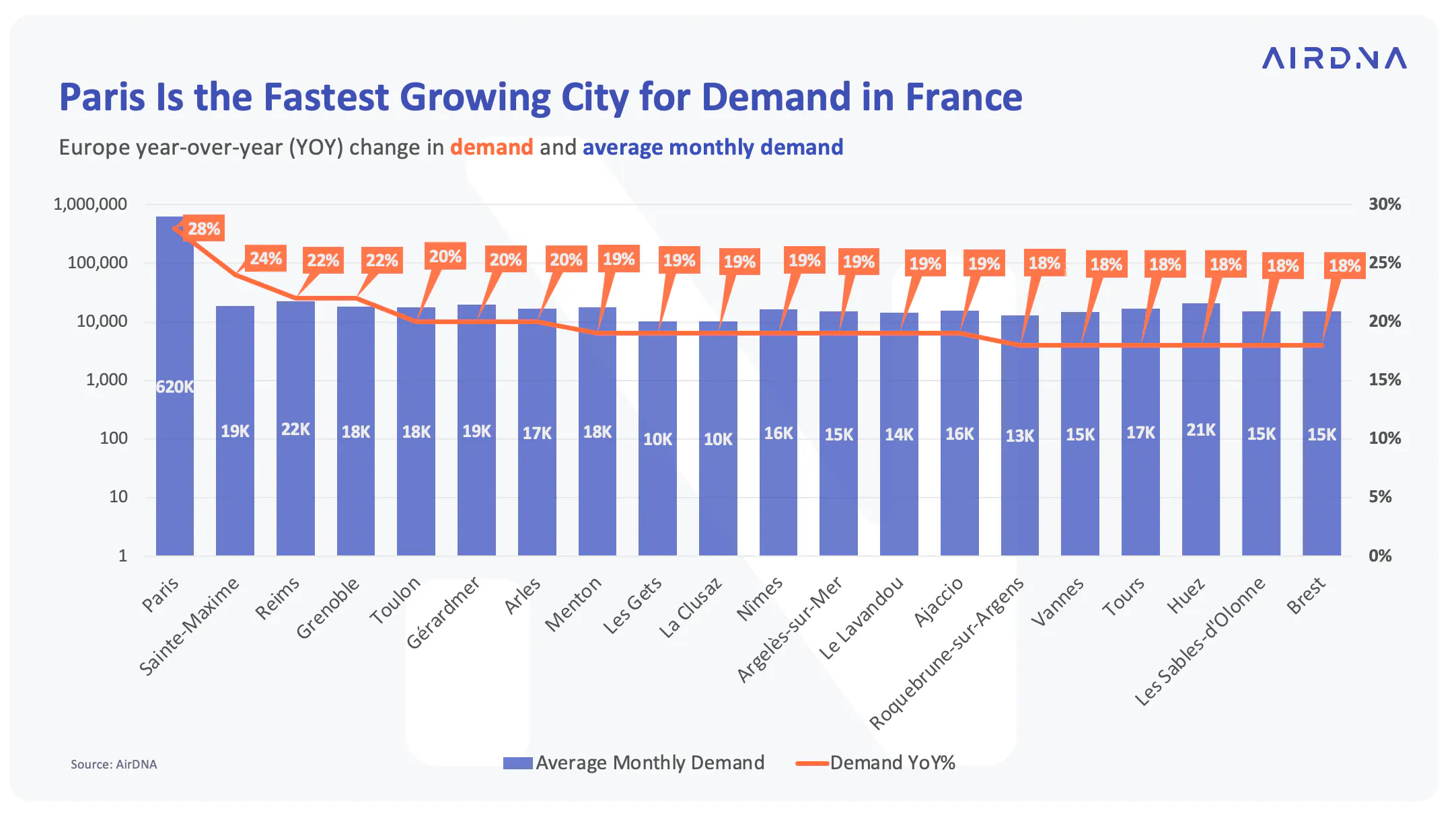
Digging deeper into France’s short-term rental performance, Paris remains the clear leader, both in scale and growth. The capital recorded over 620,000 demand nights in April—up 28% year-over-year—reinforcing its role as the country’s primary STR hub. But growth wasn’t limited to major metros. Several smaller and lesser-known cities also saw impressive demand increases, suggesting a continued shift toward more domestic, decentralized travel patterns across France.
Let’s take a closer look at demand in some standout cities:
- Gérardmer (+20%YoY)
- La Clusaz & Les Gets (+19% YoY)
- Roquebrune-sur-Argens (+19% YoY)
- Vannes, Tours, Brest (+18% YoY)
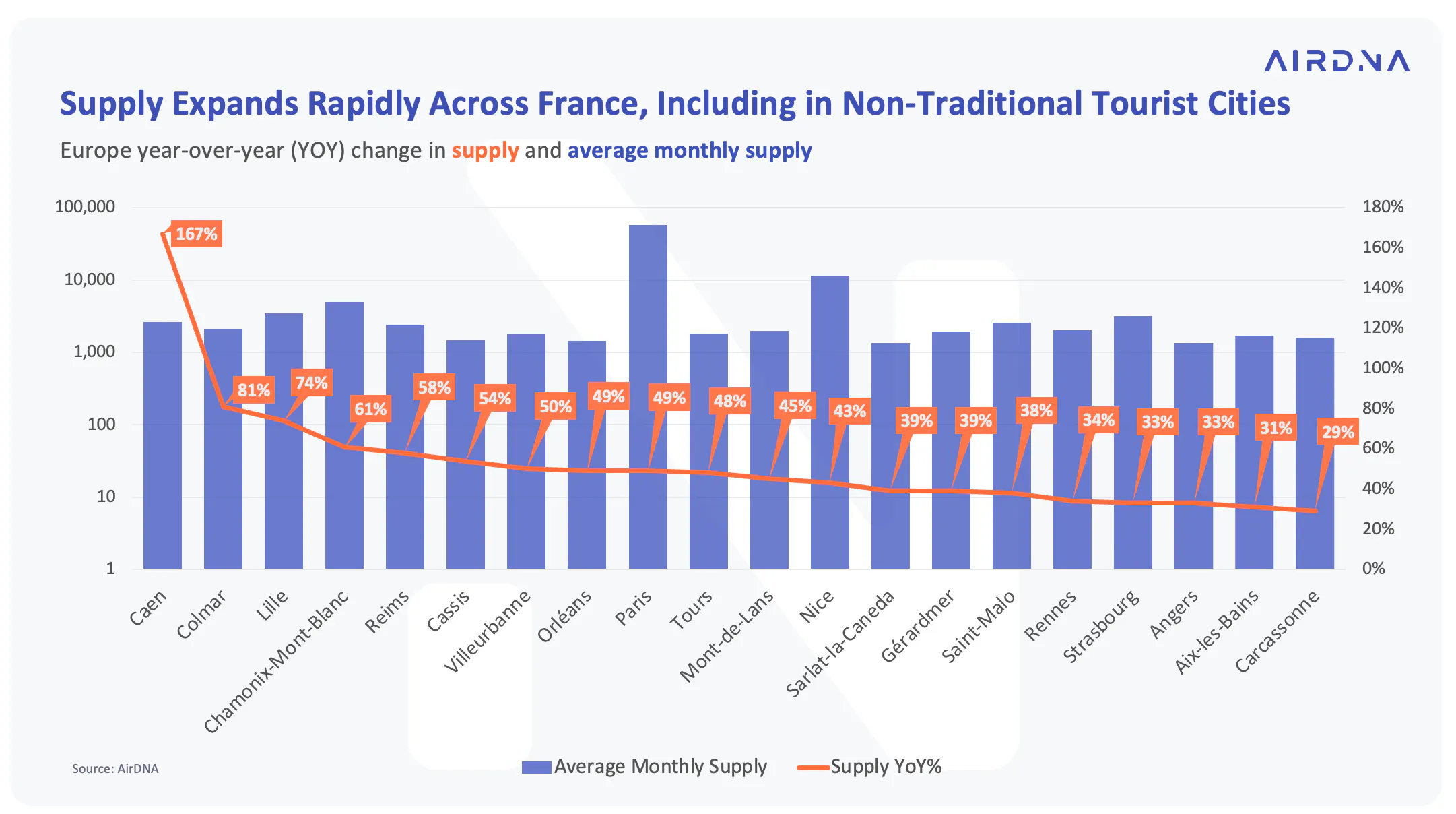
Turning to supply, growth has been strong across the board. Many of France’s fastest-growing cities posted year-over-year listing increases between 30% and 60%.
While this expansion reflects rising host adoption nationwide, Paris continues to play a central role, with a notable +49% YoY increase in available listings, highlighting its enduring weight in the national STR landscape.
But interestingly, some of the most impressive growth is occurring in non-traditional tourist cities, including:
- Caen (+167% YoY)
- Cassis (+54% YoY)
- Villeurbanne (+50% YoY)
- Mont-de-Lans (+48% YoY)
- Sarlat-la-Canéda (+43% YoY)
Get reliable data for smarter investment decisions
AirDNA allows you to handpick the active short-term rentals that align with your investment criteria and shows you exactly how a similar property performs in the real world.
Tour de France Fuels Luxury Demand in Southern Cities
The 2024 Tour de France brought a wave of visitors to southern France—especially during its final week, when the race concluded in Nice for the first time. The event ran from June 29 to July 21, drawing both cycling fans and high-spending travellers to the Côte d’Azur.
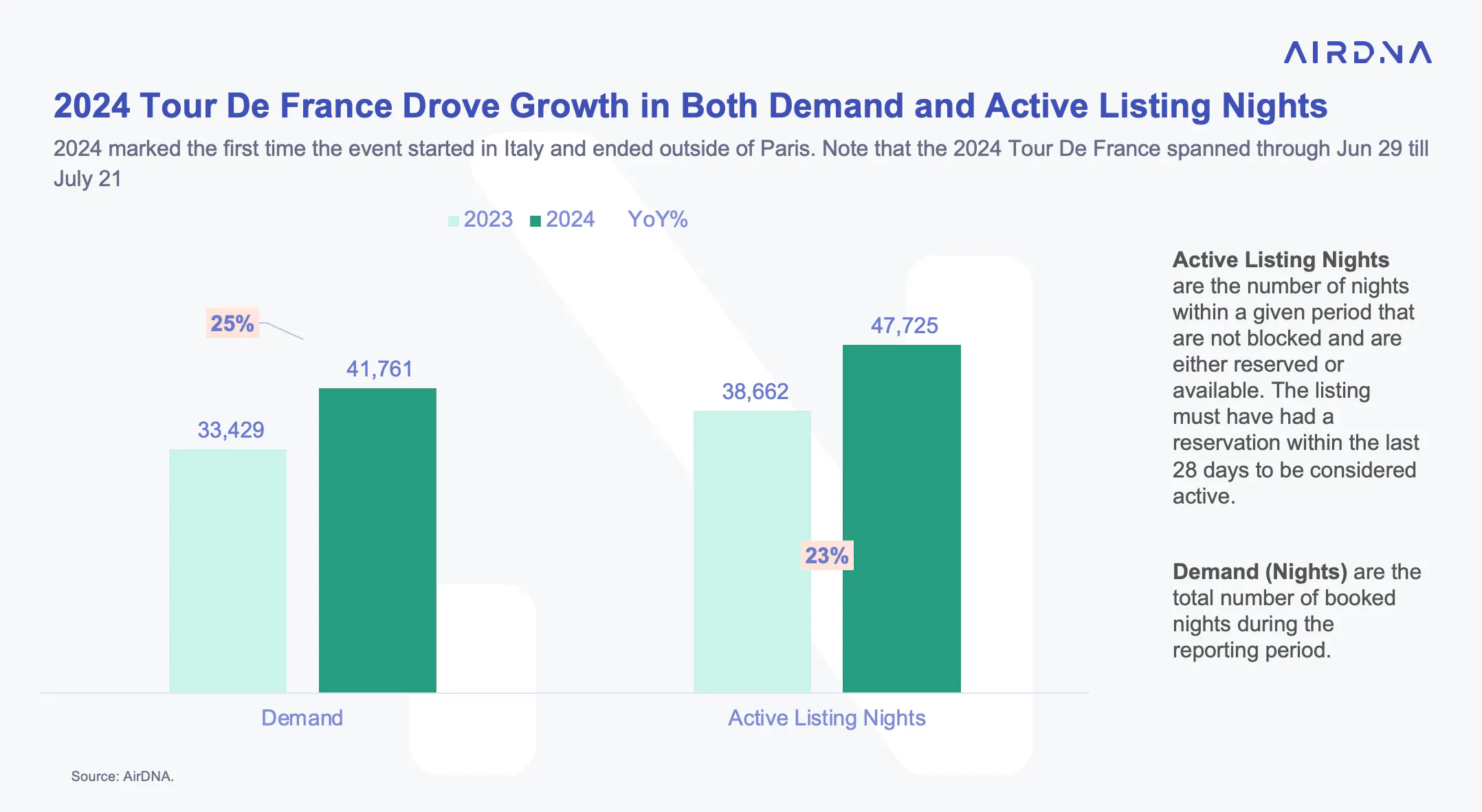
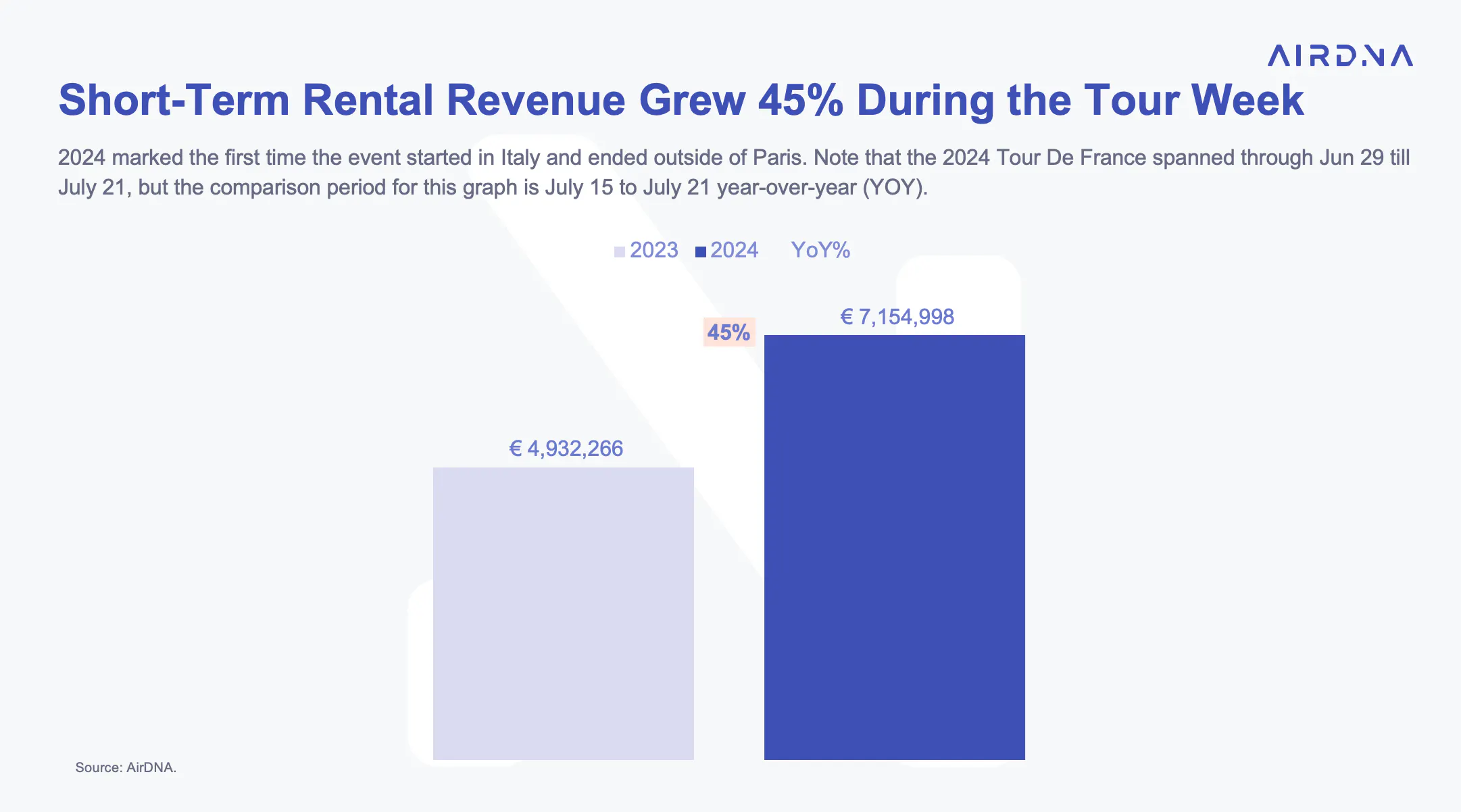
During the final week of the Tour, Nice saw a +45% increase in revenue, with demand nights increasing by +25% and ADR increasing by +16%.
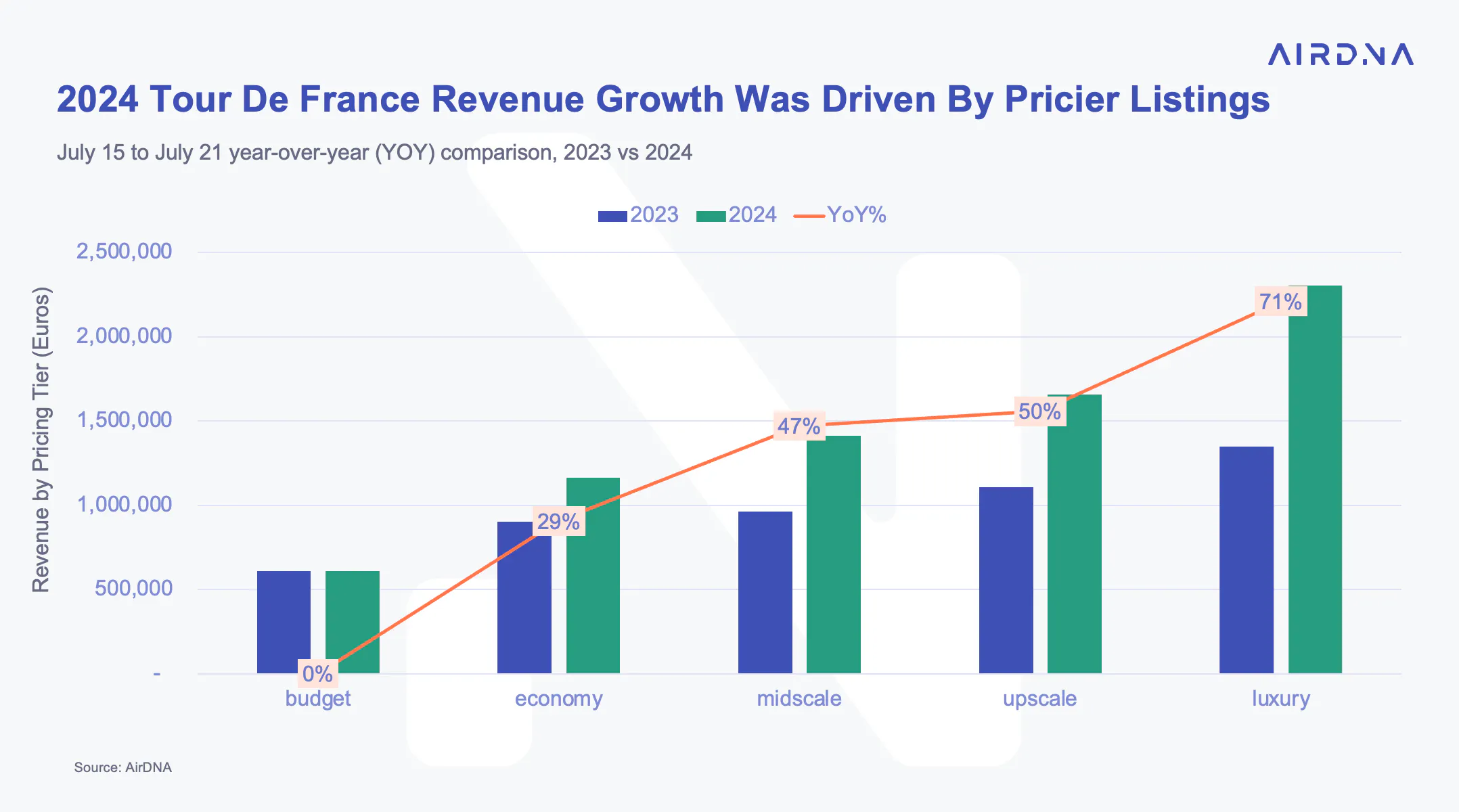
Luxury travel stood out as a clear beneficiary of the Tour’s arrival in Nice. Revenue for luxury-tier properties surged by 71%, while upscale listings saw a 50% increase. In contrast, budget-tier performance held steady year-over-year, with little to no change.
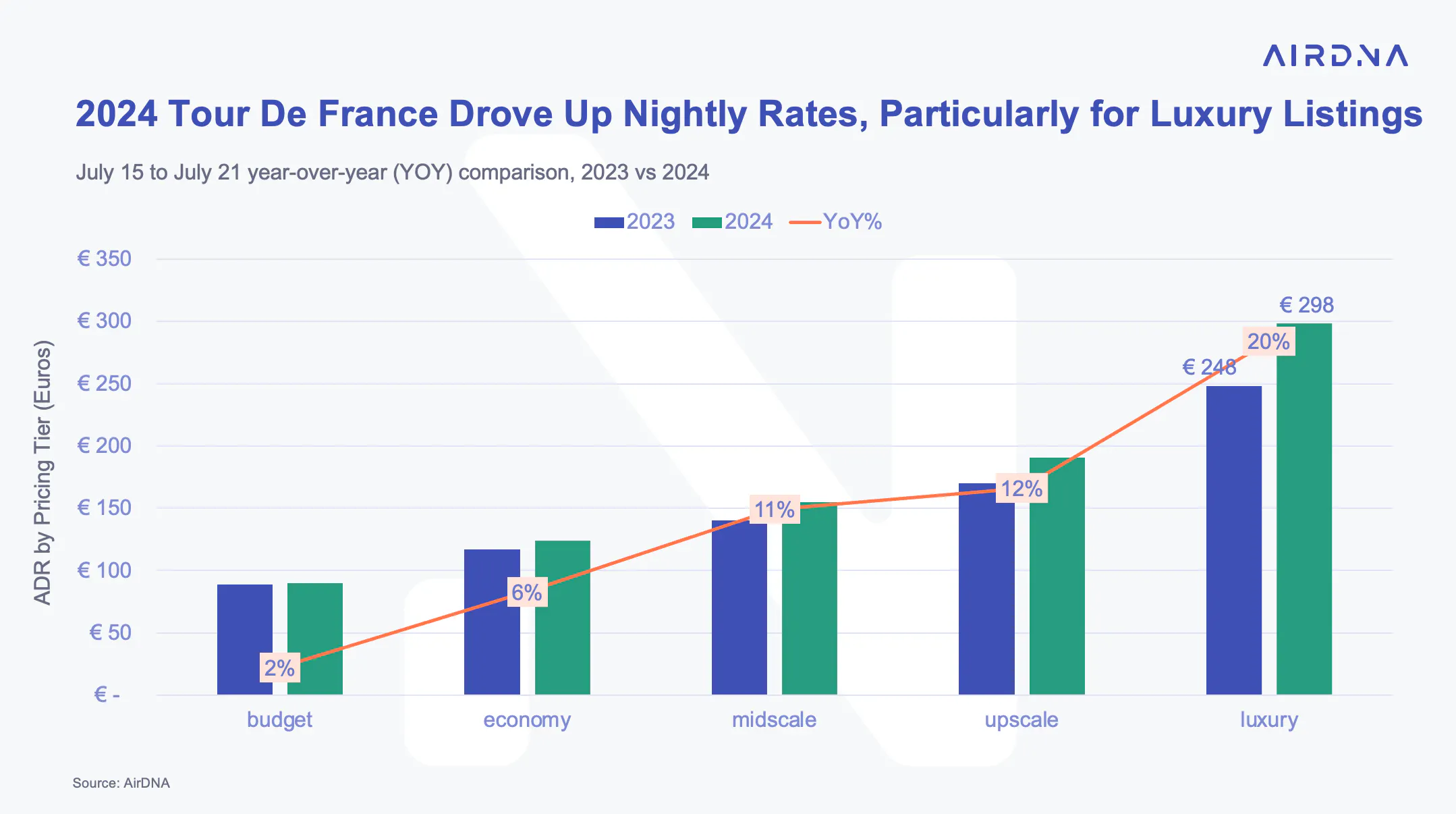
This tiered pattern extended to both occupancy and pricing: High-end segments recorded the strongest occupancy gains, while occupancy for budget properties dipped slightly. ADR followed suit, rising by 20% for luxury rentals but only 2% for budget accommodations.
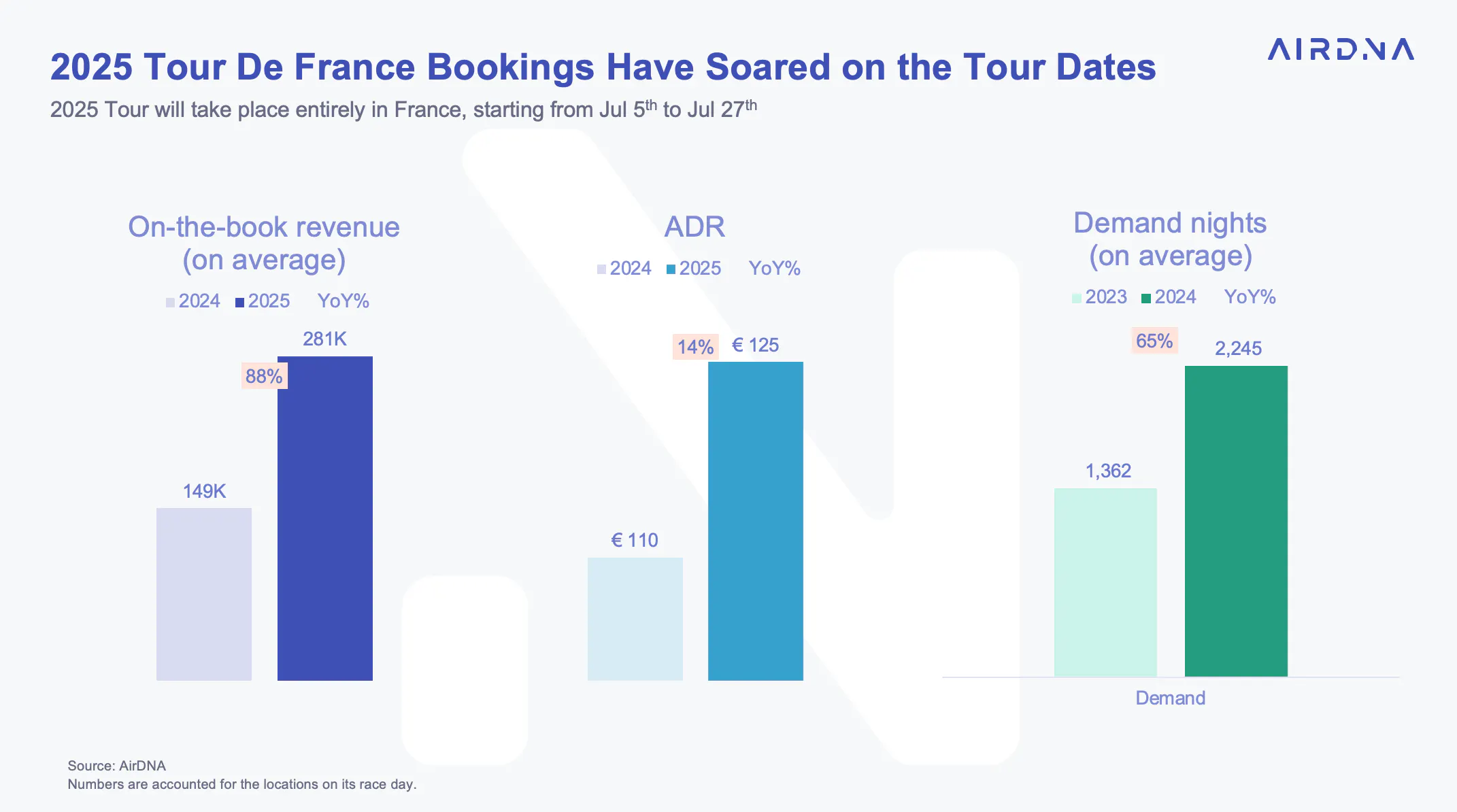
Looking ahead to 2025, the Tour will return to an all-France route, starting in Lille and finishing in Paris. Early booking data already shows +88% revenue growth for cities along the route (excluding Paris) compared to the same dates in 2024. This is driven by a 65% increase in demand nights and a 14% increase in ADR, suggesting another strong performance, particularly in cities hosting major race stages.
Summer Pacing Shows Strong Momentum Across Europe
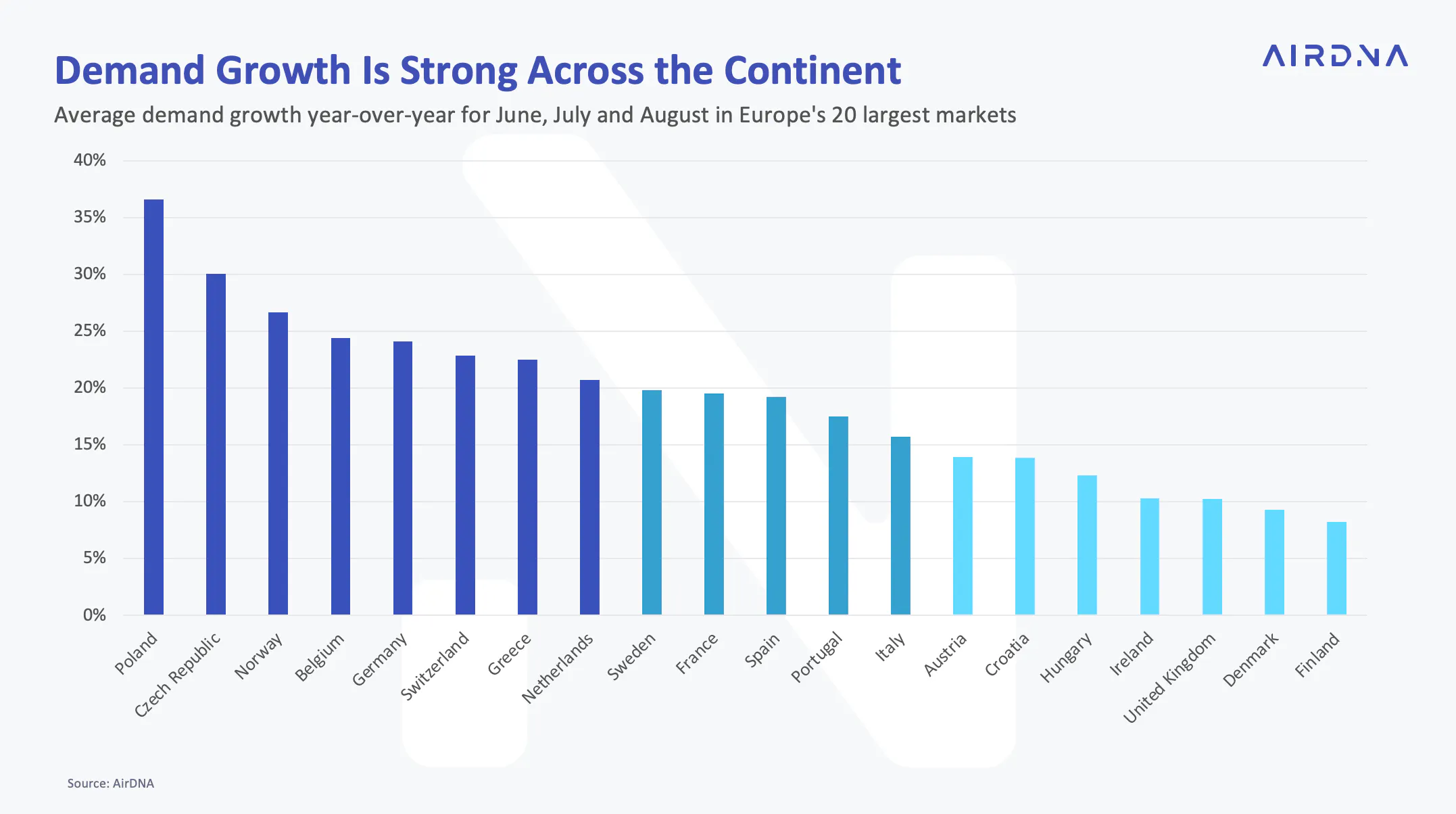
Looking ahead to the summer months—June, July, and August—forward bookings point to a strong season across much of Europe. Eighteen of the continent’s top 20 markets are showing year-over-year demand growth of 10% or more, with several seeing significantly higher gains.
The strongest performers include:
- Poland (+37% YoY)
- Czech Republic (+30% YoY)
- Norway (+27% YoY)
- Belgium and Germany (both +24% YoY)
By contrast, a few northern European countries are lagging slightly:
- Finland (+8% YoY)
- Denmark (+9% YoY)
- United Kingdom and Ireland (+10% YoY)
- Hungary (+12% YoY)
Despite ongoing economic and political uncertainty, early indicators point to a robust summer ahead. Rising booking volumes, strong domestic travel, and easing inflation all suggest that travel demand will remain resilient across most of the continent.
France’s STR Market Poised for a Strong Summer
France is expected to see significant short-term rental growth during the summer of 2025, with forward-looking data pointing to strong performance across both location types and price tiers.
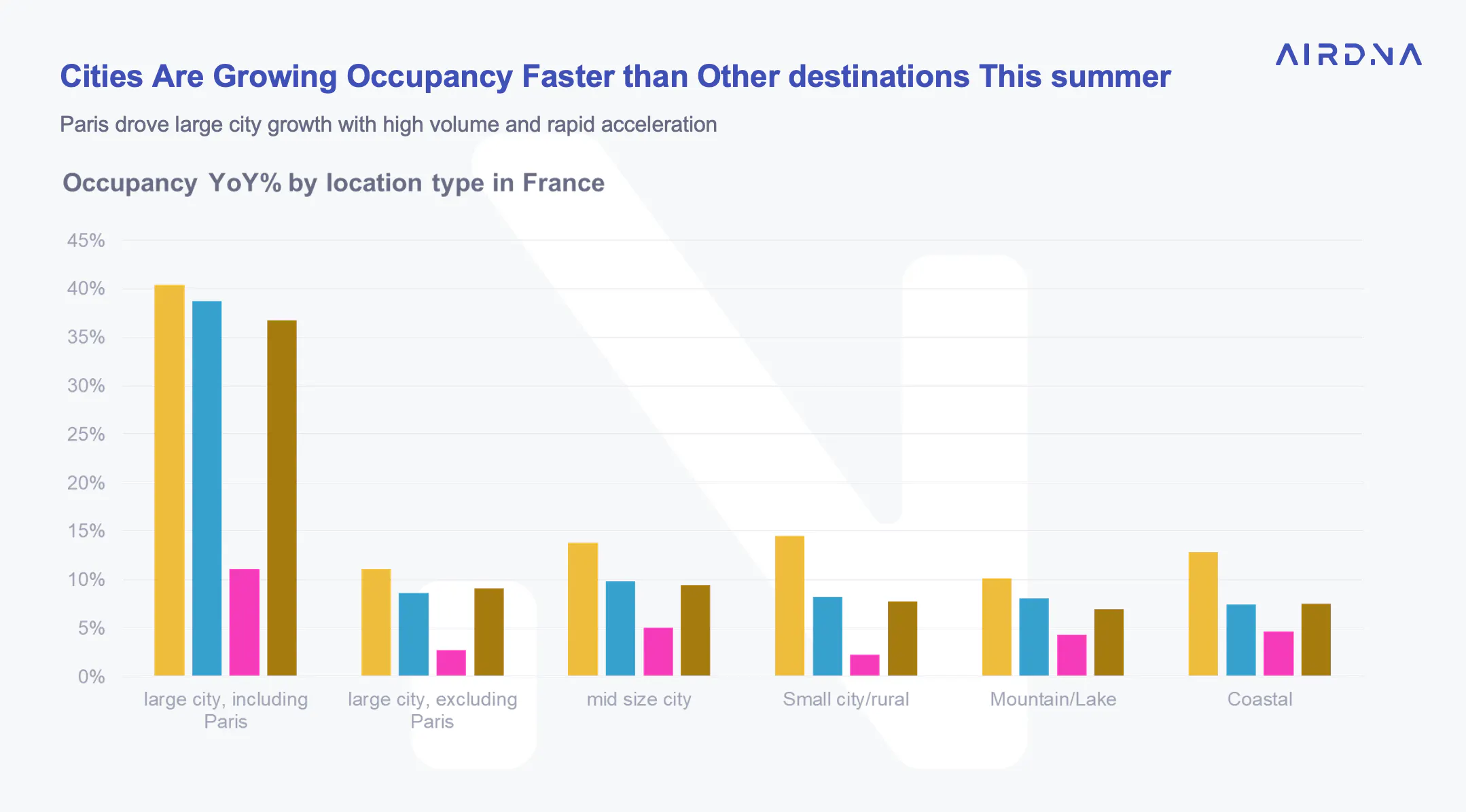
By location, large cities are leading the way. Occupancy is projected to grow by 37% from June to August, with June seeing the highest year-over-year increase at 40%.
It’s important to acknowledge that Paris is driving much of this growth. When the capital is excluded from the large city group, occupancy growth levels out, matching those of other location types and highlighting Paris’s outsized influence on national trends.
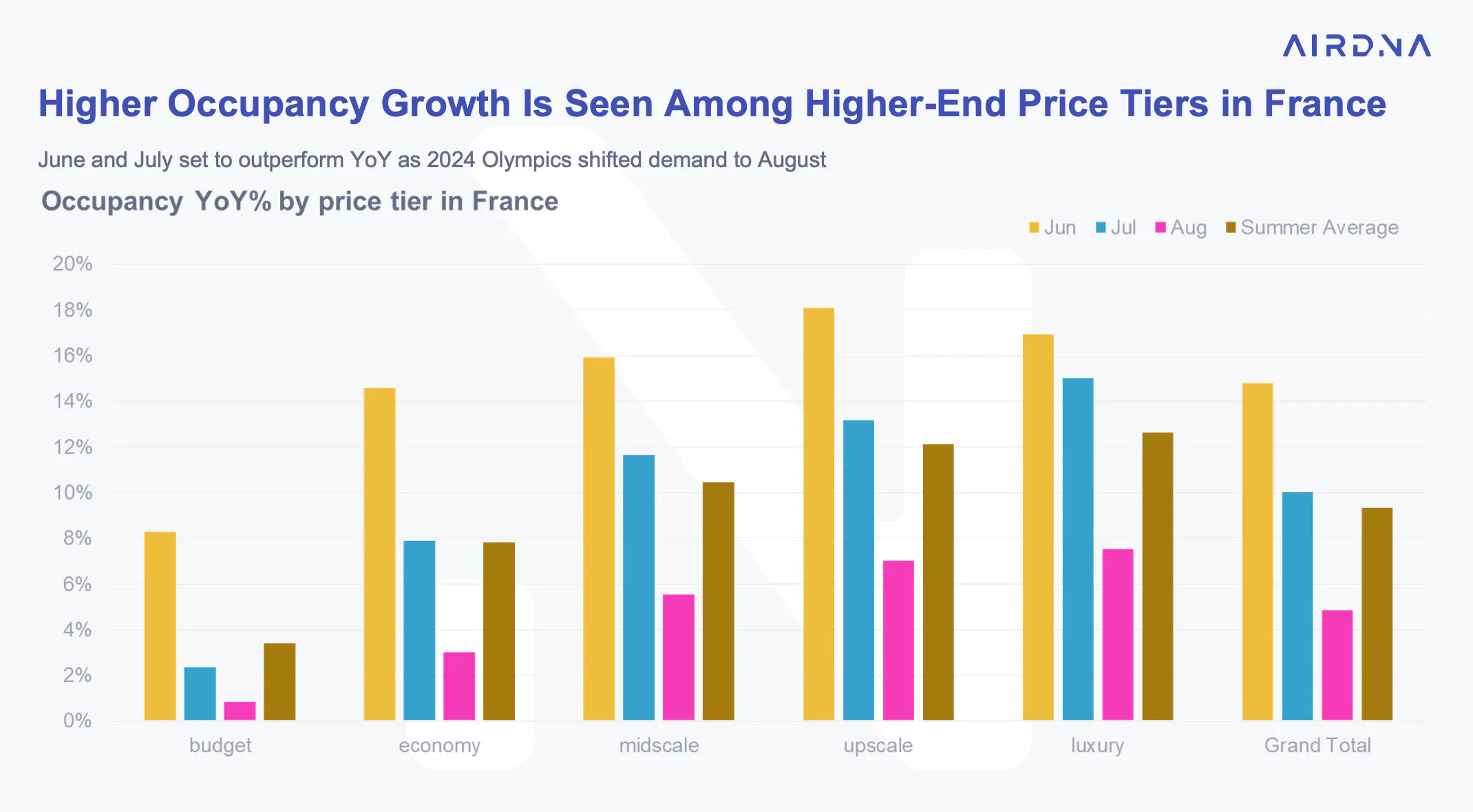
By price tier, higher-end properties are pacing ahead. The luxury tier has already recorded a 13% year-over-year occupancy increase for the summer months, followed closely by upscale listings. Budget-tier rentals, meanwhile, are seeing more modest gains, with occupancy up just 3% on average. This trend may reflect stronger early booking activity among affluent travelers and slower planning among more budget-conscious segments, especially in a year still marked by broader economic uncertainty.
Altogether, the data points to a strong season ahead for France, especially in its urban centers and high-end rental categories.
ARTICLE SUMMARY
April 2025 saw a 27.4% rise in STR demand across Europe, driven by the Easter shift. Revenue and occupancy climbed, with early data showing strong summer momentum.
Jamie Zhang
AirDNA Data Analyst
Jamie Zhang is a Data Analyst at AirDNA, leveraging her background in data science and analytics to uncover key trends in the short-term rental industry. Before joining AirDNA, she worked as a data analyst at Shanghai Disney, where she specialized in revenue forecasting and financial planning . She holds a Master’s degree in International Economics and International Relations from Johns Hopkins. Jamie enjoys cycling to explore different corners of the city.
