

 Calculate Revenue
 Research Markets
 Find For Sale Properties
 Compare My Listing
 STR Revenue Calculator
 Custom Comp Sets
 Submarket Insights
 Custom Search Filters
 Rate Recommendations
 Performance Benchmarking
 Competitor Comparison
 Owner Contact Details
 Property-level performance data
 Tourism Insights
 Real Estate Investment Analytics
 About Us
 Sales
Sales Support
 Press
PressEuropean Review November 2025: Stable RRI Signals Pricing Resilience
Published: December 22, 2025
Last updated: August 31, 2026

Camilo Schmid Rivas
Key Takeaways
- Demand decreased by 3.7% in November, marking the fourth consecutive month of flat or declining demand and resulting in occupancy losses in 14 of Europe's top 20 nations.
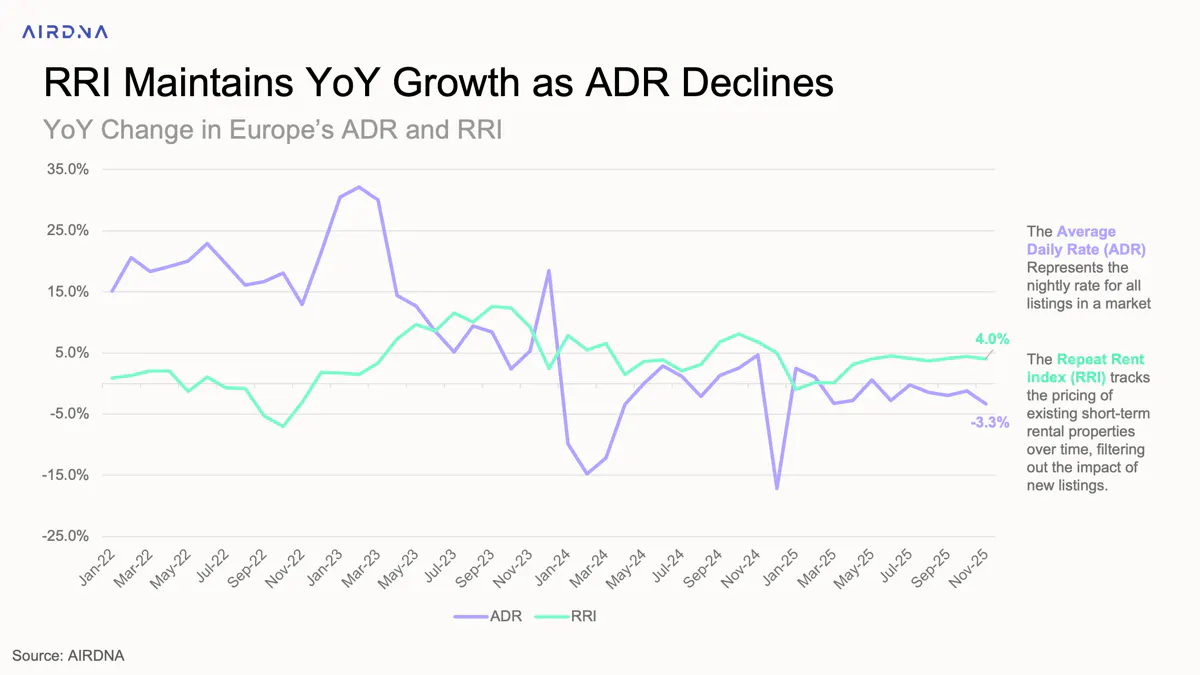
- The RRI (Repeat Rent Index) remained positive for ten consecutive months at 4.0% YoY, while ADR declined for a sixth straight month at -3.3%, indicating stable pricing power for existing hosts.
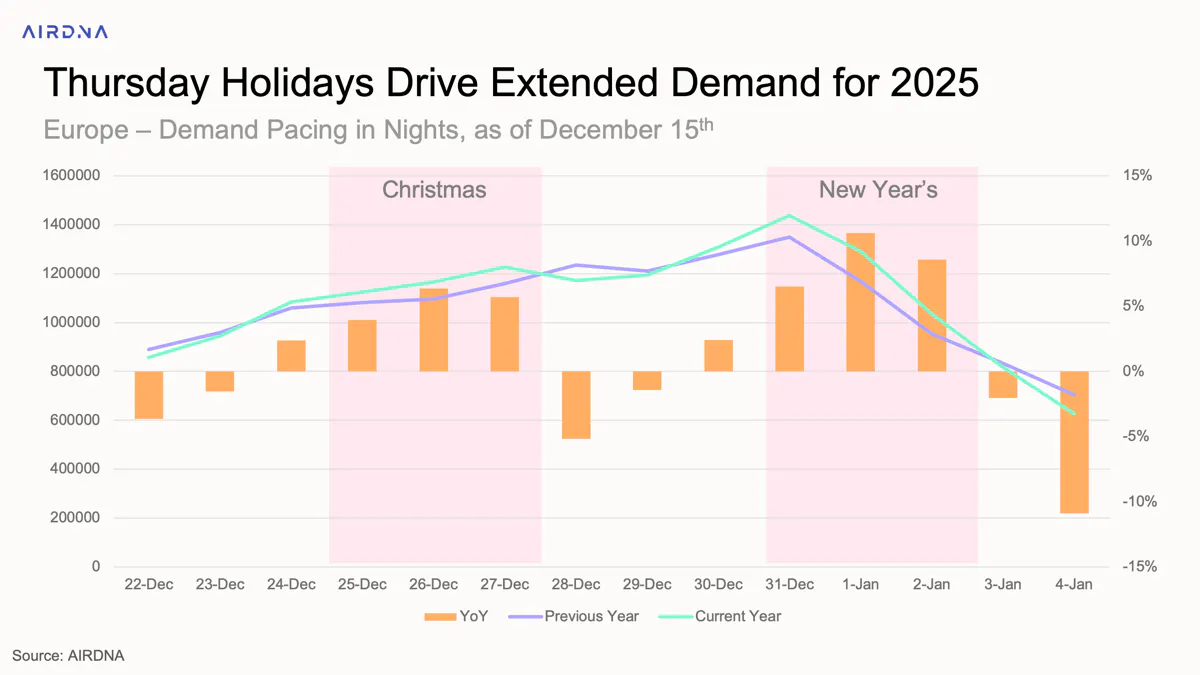
- The calendar shift putting Christmas and New Year’s on a Thursday has led to demand increases, with 5.3% higher demand for Christmas and 8.6% for New Year’s.
The European short-term rental market continued to stabilize in November, with available listing growth holding at around 2.5% for a second consecutive month. This marks a clear shift away from the double-digit growth rates seen throughout 2024. Demand, however, declined sharply, falling 3.7% year-over-year (YoY), even as nights booked showed a slight recovery following four months of declines.
With demand falling and supply continuing to grow at a steady pace, occupancy across Europe declined by 2.4%, with 14 of Europe’s top 20 countries recording year-over-year occupancy losses. Average daily rates (ADR) also continued to decline, falling 3.3%, which contributed to a 5.6% drop in RevPAR.
Despite this softness, the Repeat Rent Index (RRI), which tracks pricing for existing operators and removes the impact of new listings, posted its tenth consecutive month of positive growth. This suggests that pricing power among established operators remains intact, while newer listings are entering the market at lower price points.
Looking ahead to the holiday period, demand pacing reflects the impact of the calendar shift, with both Christmas and New Year’s falling on a Thursday. This alignment appears to be driving stronger year-over-year demand, as travelers are more inclined to book extended weekend trips. At the country level, Germany stands out among Europe’s largest markets for holiday demand growth, while Spain noticeably trails behind in year-over-year performance.
At a Glance: November 2025 STR Performance in Europe
- Available listings reached 3.45 million, an increase of 2.5% YoY
- Demand Nights declined by 3.7% YoY to 26.4 million
- Average daily rates (ADR) decreased by 3.3% YoY to €110
- Average occupancy rate reached 47.5%, down 2.4% YoY
- Revenue per Available Rental Night (RevPAR) decreased by 5.6% YoY to €52.40

The State of the European Economy
Despite some policy uncertainty caused by announced tariffs from the United States, the European economy has remained stable over the past year. Unemployment has held steady at around 6.4% across the Euro Area, while inflation has remained well below the European Central Bank’s 2% target. Oxford Economics expects inflation to remain manageable, with the European Central Bank projected to keep interest rates steady and the Main Refinancing Operations Rate holding at 2.15%.
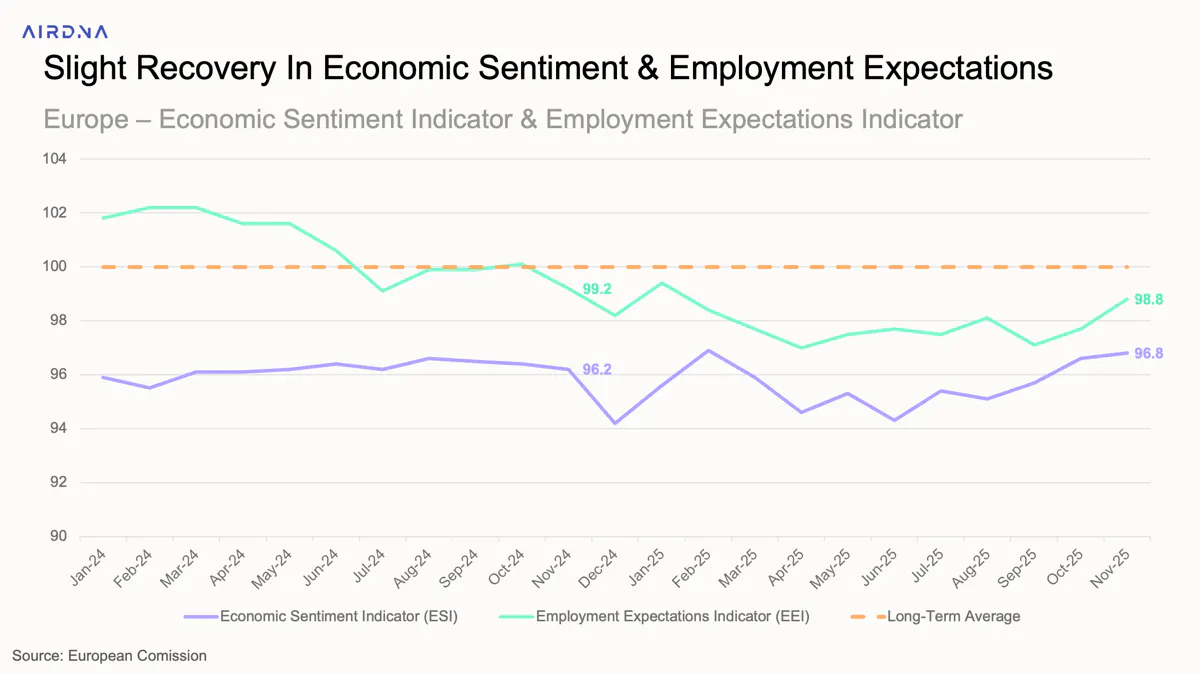
Consumer sentiment, however, remains somewhat pessimistic. The Economic Sentiment Indicator, which tracks overall economic activity and GDP growth across five key sectors, along with the Employment Expectations Indicator, which reflects business managers’ outlook for future employment, have both remained below Europe’s long-term average. That said, November data shows a modest improvement, with a slight rise in both economic optimism and employment expectations.
With interest rates stable, inflation subdued, and unemployment steady, economic and employment sentiment may continue to improve in the months ahead.
How Is Your STR performing?
Your vacation rental may be amazing, but is it better than your competition? Connect your Airbnb listing to AirDNA to see its Booking Performance Score.
New Listings Recover Slightly in November, Still Trailing 2024
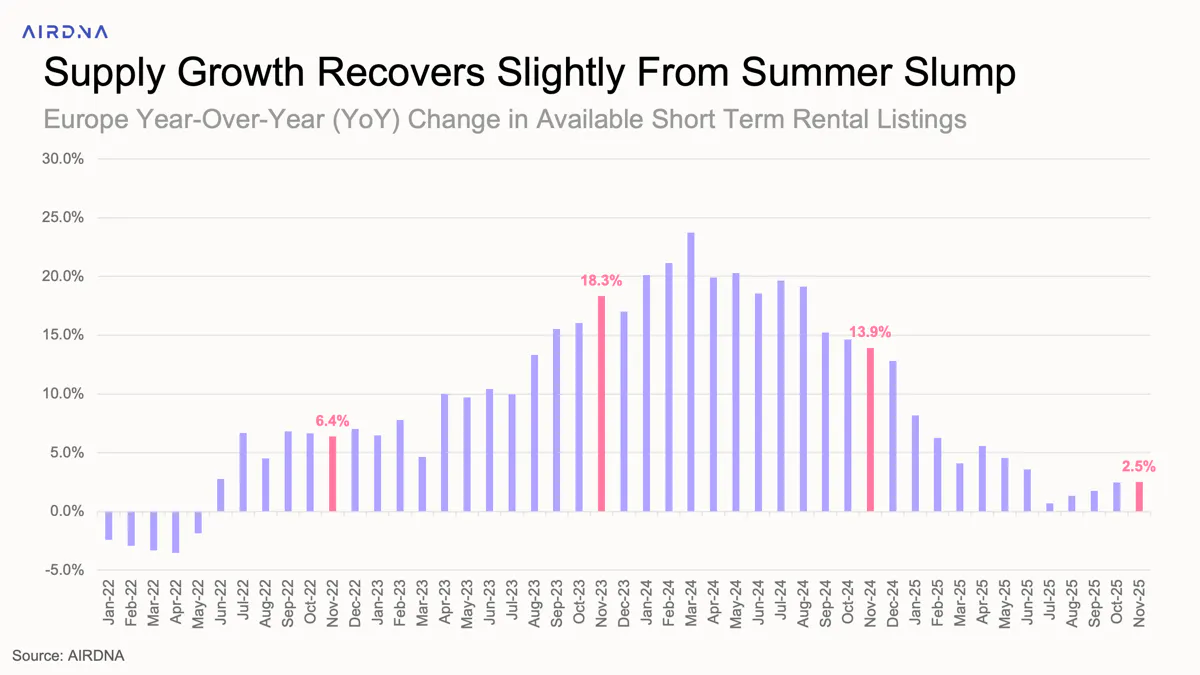
Available listings, which include the total number of properties listed and open for bookings, increased by 2.5% year-over-year in November to reach 3.5 million. This represents a modest rebound from the summer slowdown, when available listings in July and August grew by just 0.7% and 1.3%, respectively.
Despite this slight recovery, the overall trend points to significantly slower growth, well below the 18.3% average seen in 2024 and also below growth rates observed in prior years. While growth is decelerating, this shift may help restore pricing power for operators who are no longer facing overwhelming new supply.
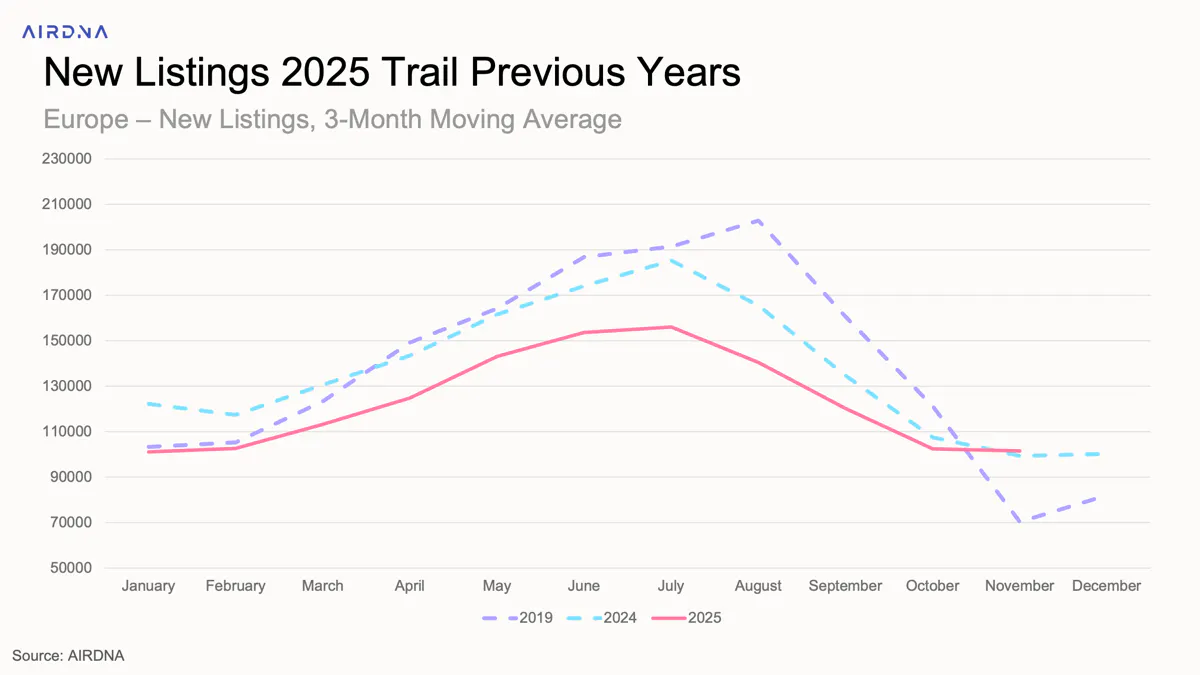
Analysis of new listings, which track properties entering the market for the first time, shows a continued slowdown throughout 2025. Every month except November has lagged behind 2024 and remained well below pre-pandemic levels.
On a year-to-date basis, new listings are down an average of 11%, with January trailing 2024 by 17%. November showed early signs of recovery, with new listings up 2% year-over-year and 44% higher than in 2019. Despite this improvement, the broader slowdown in new listings remains a key factor behind the stagnant growth in available inventory.
Spain continues to lead in supply decline month-over-month
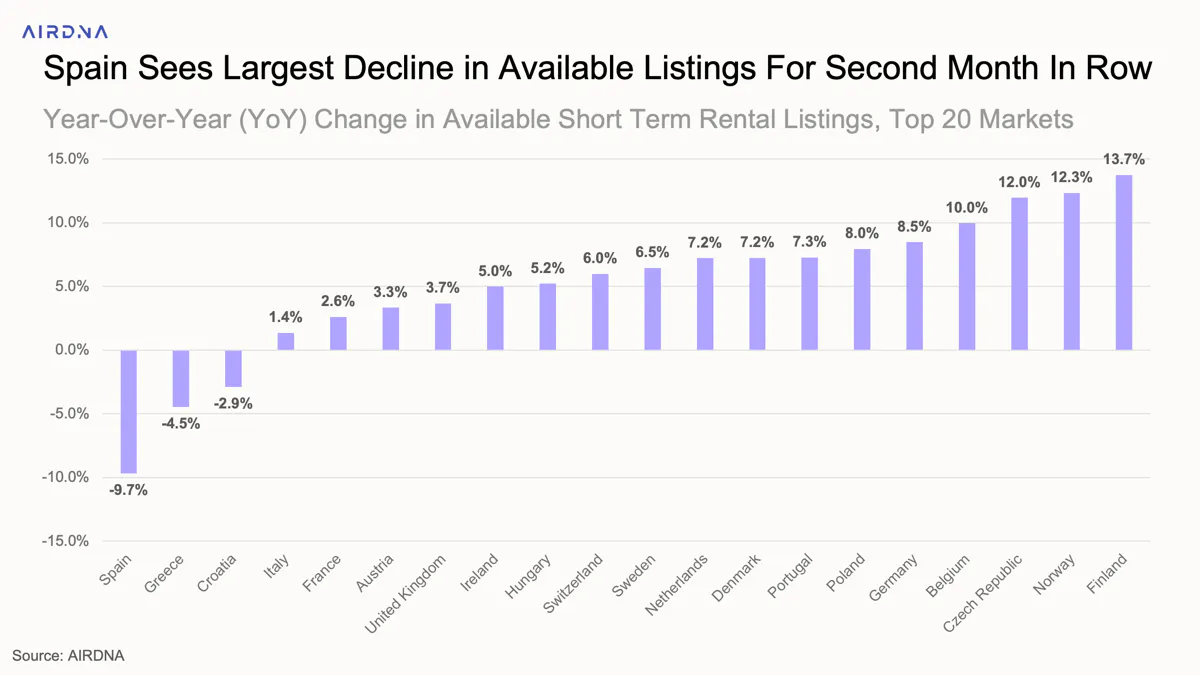
Looking at year-over-year changes in available listings across Europe’s top 20 countries in the graph below, Spain posted the largest decline for the second consecutive month, with available listings down 9.7%, compared to an 8.2% decline in October. This continues to reflect the Spanish government’s efforts to remove unlicensed short-term rental properties.
Greece and Croatia also recorded declines for a second month, driven by a combination of stricter regulations and weakening market sentiment. In contrast, Nordic countries continued to show strong growth, while central European markets such as Belgium and Germany ranked among the top performers.
Demand Growth Underperforms in the Second Half of the Year
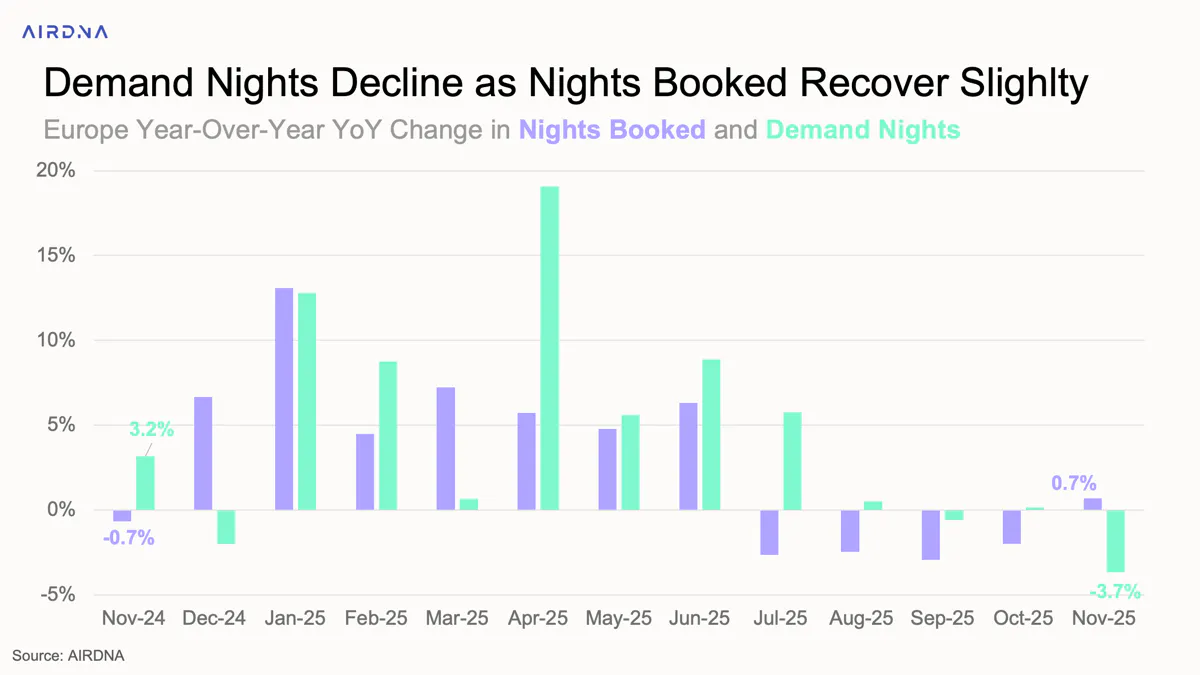
As supply in available listings increased slightly for a second consecutive month, demand nights and reservations for the reporting month declined by 3.7%, extending the downward trend from a flat October. This marks the largest year-over-year decline in demand since March 2021, when demand nights fell by 5%. By contrast, nights booked, which capture reservations made during the reporting month for stays in the current or future months, showed a modest recovery. After several months of decline, nights booked rose 0.7% year-over-year in November.
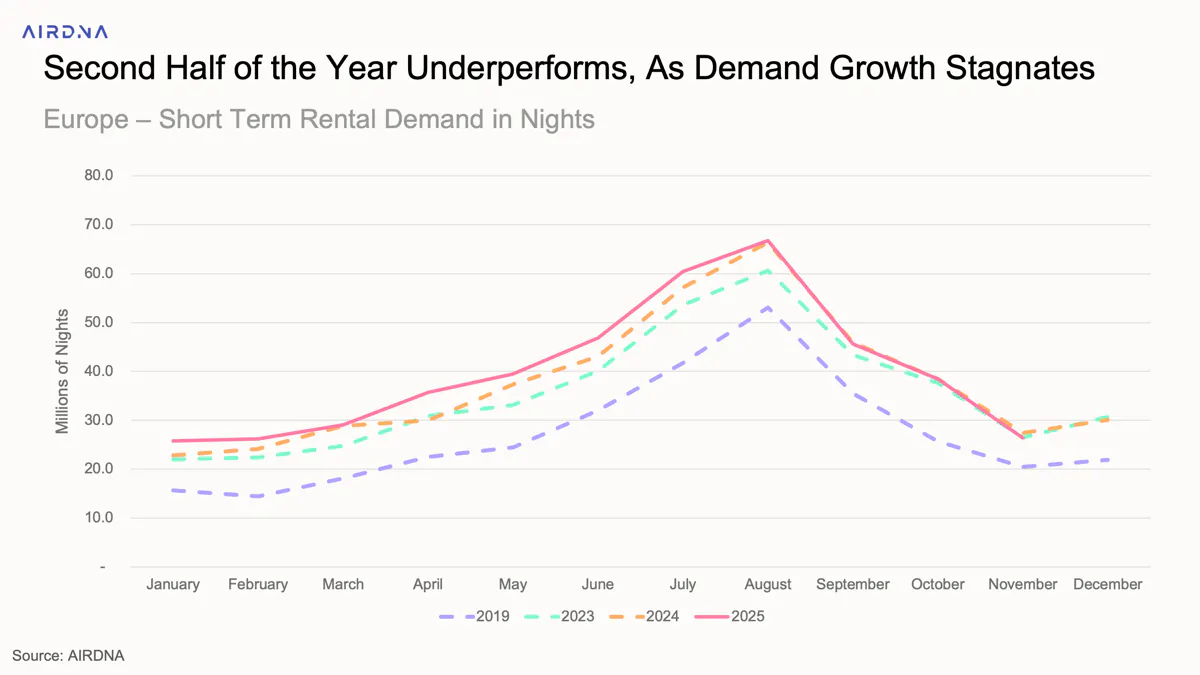
Total monthly demand nights further illustrate the underperformance seen in the second half of the year. Demand grew by an average of 9.3% during the first two quarters, before slowing sharply to an average growth rate of just 0.4% from July onward. A similar pattern was observed last year, with demand growth moderating in the second half. In 2024, demand increased by 7.5% in the first half of the year, compared to 4.2% in the second half.
Occupancy Declines as Demand Weakens Across Europe
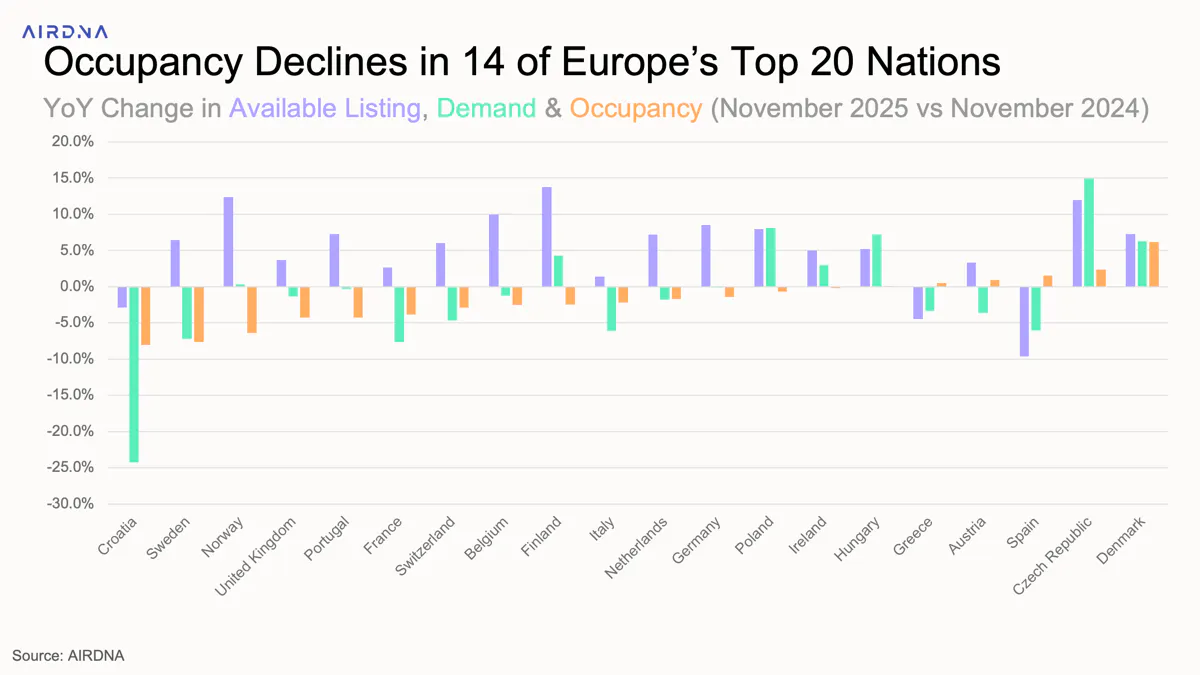
Declining demand and steady supply growth led to occupancy declines across Europe in November. With supply increasing by 2.5% and demand falling, occupancy dropped by 2.4% year-over-year. Fourteen of Europe’s top 20 countries recorded year-over-year declines in occupancy rates.
A small number of countries did post occupancy gains. The largest increases were seen in:
- Denmark (+6.2%)
- The Czech Republic (+2.3%)
- Spain (+1.5%).

However, these gains were more than offset by sharper declines elsewhere, with the steepest drops occurring in:
- Croatia (-8.1%)
- Sweden (-7.6%)
- Norway (-6.4%).
Among countries with improving occupancy, Spain stands out following recent regulatory crackdowns that led to the removal of tens of thousands of unlicensed short-term rental properties. The crackdown caused occupancy to increase despite a decline in demand, with available listings falling 9.7% year-over-year and demand nights decreasing by 6% due to reduced capacity.
By contrast, Croatia experienced one of the sharpest occupancy declines, driven by a much steeper drop in demand relative to supply. While available listings declined by 2.9%, demand nights fell by 24.3%, resulting in significant occupancy pressure.
Further analysis shows that although available listings fell modestly, active listing nights declined by 17.7%, contributing to the sharp reduction in demand. November revenue declined by 29%, highlighting a loss of pricing power in a low-demand environment. Revenue declines were already evident in September and October, down 13% and 15%, respectively, even as ADR rose 1%, suggesting that operators were slow to adjust pricing in response to weakening demand.
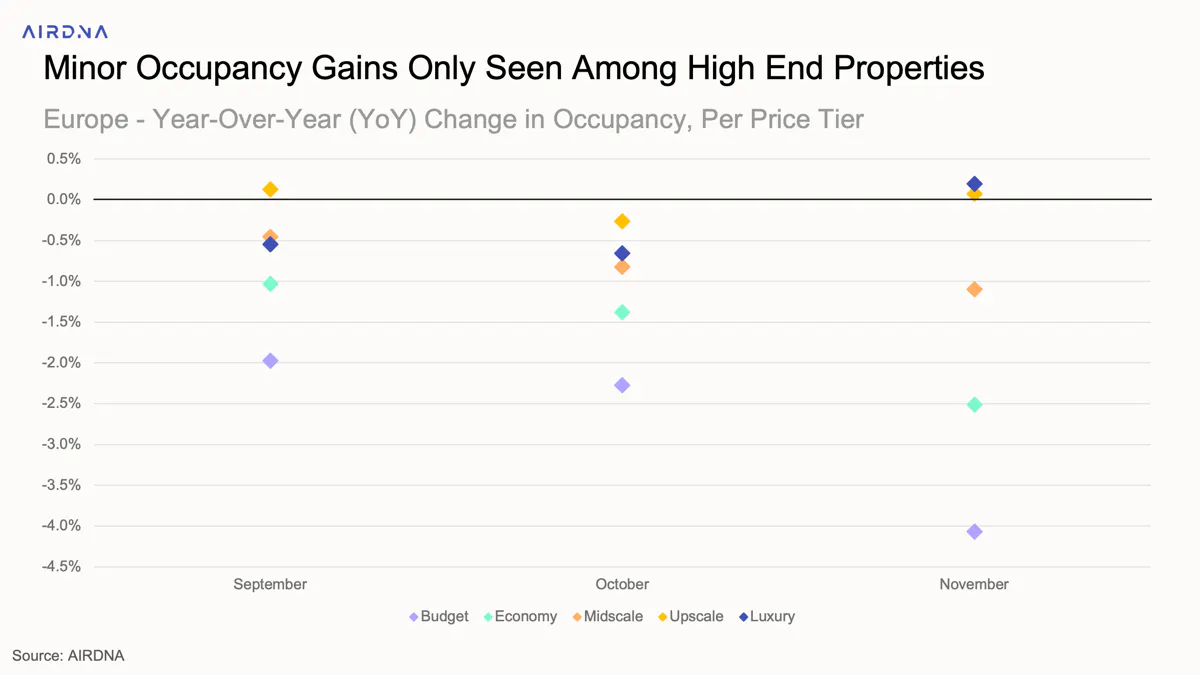
Higher-priced inventory continued to outperform in terms of occupancy. Upscale and Luxury listings were the only pricing tiers to record positive growth in November, rising 0.1% and 0.2%, respectively. Lower-priced segments saw larger declines, with Budget inventory experiencing the steepest drop at -4.1%. This pattern points to a continued shift in demand toward higher-end properties as the year draws to a close.
Get Reliable Data For Smarter Investment Decisions
AirDNA allows you to handpick the active short-term rentals that align with your investment criteria and shows you exactly how a similar property performs in the real world.
RRI Remains Stable as ADR Drives RevPAR Trends
Average daily rates (ADR) in Europe stood at €110 in November, down from €120 in October and representing a year-over-year decline of 3.3%. This brings the year-to-date change in ADR to -1.2% compared to last year.
In contrast, the Repeat Rent Index (RRI), which tracks price changes among existing operators and excludes the impact of new listings, recorded its tenth consecutive month of growth. Year-to-date RRI gains averaged 2.9%, while November posted a 4.0% year-over-year increase, slightly down from 4.5% in October.
The widening gap between ADR and RRI may partly reflect the impact of regulatory crackdowns on short-term rentals across Europe. As higher-priced properties exit the market, RRI may be elevated by filtering out mix shifts caused by the removal of these listings. Despite headline ADR declines, the continued strength of RRI suggests that pricing power among existing operators remains stable.
As occupancy rates decline and supply continues to grow at around 2%, newer market entrants may be more inclined to lower ADRs in an effort to boost occupancy and RevPAR. This dynamic helps explain the ongoing contrast between softer headline ADR performance and stronger pricing trends among established listings.
Pricing performance varies widely across European markets
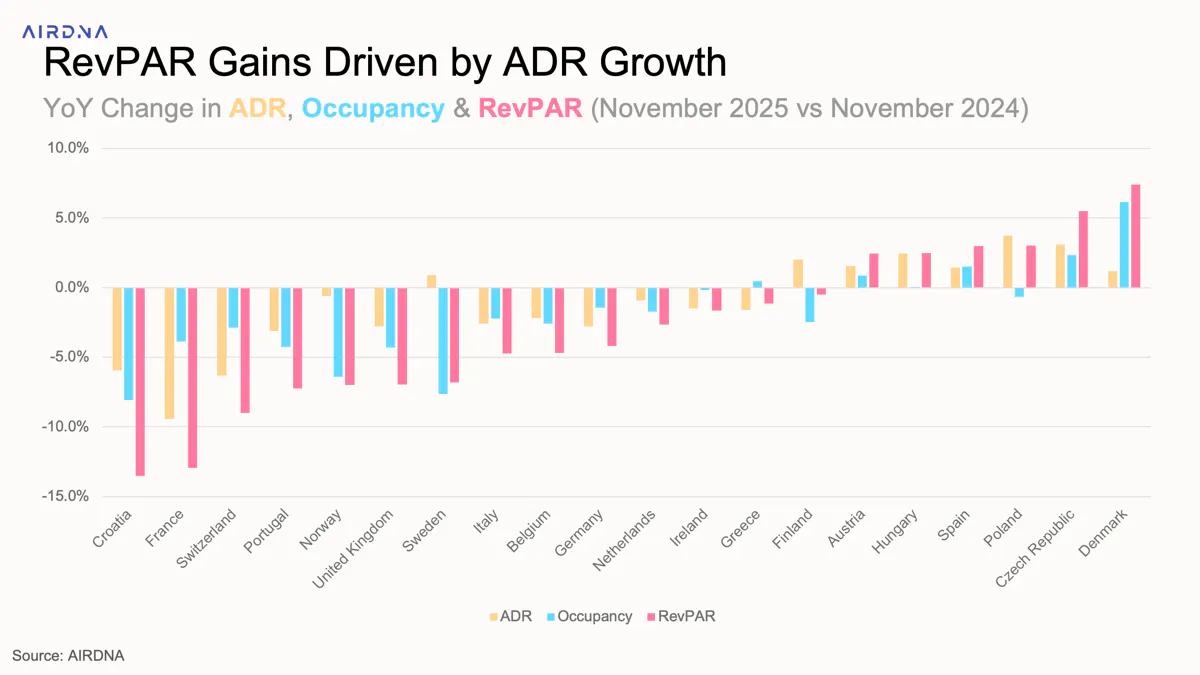
Examining ADR performance across Europe’s top 20 countries reveals a small number of markets with positive year-over-year growth:
- Poland (+3.7%)
- The Czech Republic (+3.1%)
- Hungary (+2.4%)
The steepest ADR declines were recorded in:
- France (-9.4%)
- Switzerland (-6.3%)
- Croatia (-6.0%)
Outside of these markets, Spain stood out with ADR growth of 1.4%, alongside a 1.5% increase in occupancy and a 3.0% rise in RevPAR. This performance coincided with a sharp contraction in supply, primarily among lower-priced properties, which helped lift average rates.
Existing Spanish operators also continued to demonstrate pricing power, with the Repeat Rent Index rising 5.4% year-over-year. Other countries with strong RRI growth included Poland (+8.7%) and Austria (+8.3%), indicating that established operators in these markets were able to raise rates despite broader demand softness.
Despite these positive outliers, RevPAR declined in 14 countries, largely due to weaker occupancy. As occupancy pressures persist, ADRs may face additional downward pressure as operators adjust pricing to stimulate demand.
Thursday Holidays Lift Christmas and New Year’s Travel
Looking at Christmas and New Year’s pacing, the impact of the calendar shift is clearly visible in stronger demand for both holidays. With Christmas and New Year’s moving from a Wednesday in 2024 to a Thursday in 2025, travellers appear more likely to extend their stays into long weekends, reducing the need to take additional days off. Year-over-year, demand nights between December 25th and 27th are up an average of 5.3%, while demand between December 31st and January 2nd has increased by 8.6%.
Data showing sustained demand following the Thursday holidays suggests operators may benefit from adjusting strategies to capture the value of these extended stays. Implementing minimum stays of three to four nights for check-ins on December 25 and January 1 can help prevent fragmented bookings. Treating the “bridge Fridays” of December 26 and January 2 as holiday dates, rather than reverting to standard weekend pricing, may also better reflect demand patterns. In addition, limiting or restricting check-ins on those Fridays could encourage bookings that span the full Thursday-to-Sunday period, reducing turnover and supporting higher occupancy.
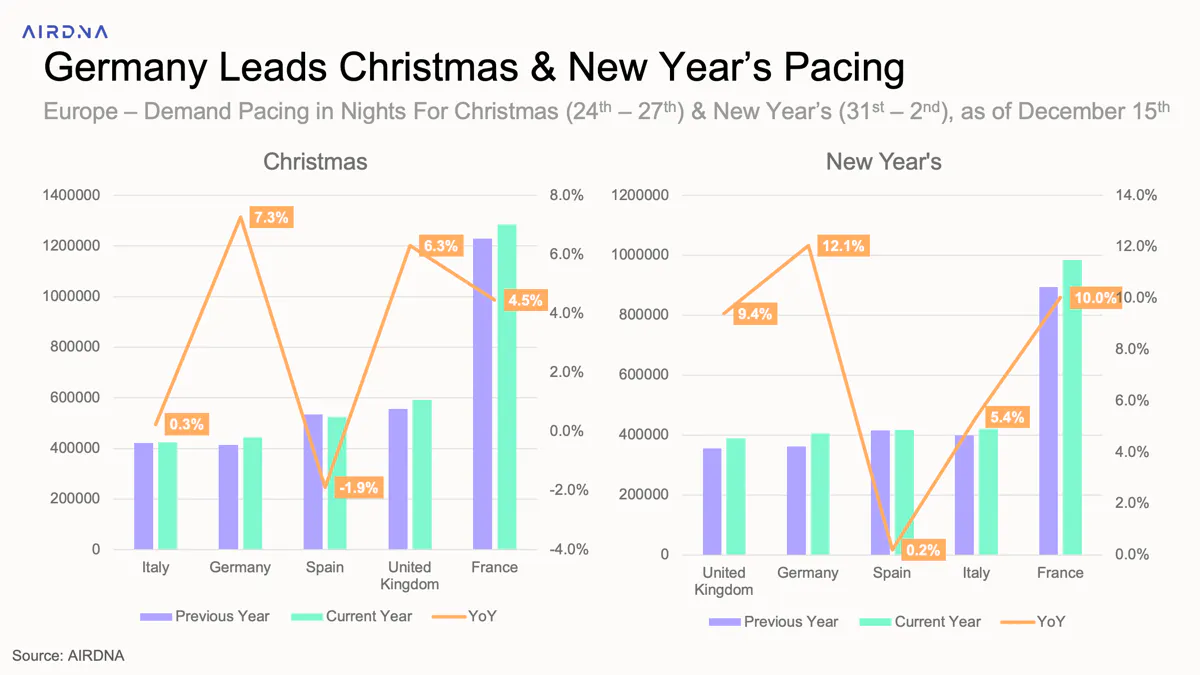
Examining demand pacing across Europe’s top five countries for both Christmas (December 24th to 27th) and New Year’s (December 31st to January 2nd) further highlights the effect of the calendar shift. On average, demand is pacing 3.5% higher for Christmas and 7.8% higher for New Year’s.
Germany stands out, with year-over-year demand growth of 7.3% for Christmas and 12.1% for New Year’s. By comparison, Spain and Italy, which are typically stronger summer destinations, trail behind during the winter holiday period.
Research Airbnb Markets
Gain insights into the revenue and occupancy trends in your market.
ARTICLE SUMMARY
November 2025 saw Europe’s short-term rental market continue to stabilize, with modest supply growth and softer demand weighing on occupancy and revenue. Despite falling ADR, the Repeat Rent Index remained positive, signalling stable pricing power among existing operators. Calendar effects support stronger holiday demand heading into the end of the year.
Camilo Schmid Rivas
Senior Research Analyst
Camilo Schmid Rivas is a Senior Research Analyst at AirDNA who brings a uniquely well-rounded perspective to short-term rental analytics. With a background that spans investment, real estate, and business analysis—including roles at Stayery and Sollers Consulting—Camilo has worn many analyst hats, each sharpening his ability to turn complex data into clear, actionable insights. A graduate of École hôtelière de Lausanne, he now channels his multidisciplinary expertise into uncovering trends that drive smarter STR decisions. In his free time, he enjoys playing tennis or scuba diving in or around Barcelona.
