


Top 10 Largest Airbnb Markets in the U.S.
Published: June 23, 2025
Last updated: November 13, 2026

Camilo Schmid Rivas
Key Takeaways
- The top 10 Airbnb markets in the U.S. account for 25% of all short-term rental revenue nationally.
- Orlando leads across all major metrics for size—revenue, demand, and listings.
- High revenue doesn’t always mean high volume. Markets like Maui and Santa Rosa/Rosemary Beach earn big with fewer listings.
From beach towns to mountain escapes to sun-soaked cities, short-term rentals (STR) are fueling local economies across the U.S. Some destinations are pulling in far more than others, though. Where exactly is Airbnb making the biggest splash?
To find out, we analyzed the largest Airbnb markets in the U.S. based on one key metric: total revenue generated between April 2024 and April 2025. Revenue reflects both traveler demand and a market’s ability to meet it—offering a clearer picture of real economic impact than listings or occupancy alone.
In this article, we break down the top Airbnb cities in the U.S. by revenue, explore what’s driving demand in each market, and share insights for anyone thinking about where to invest next. Spoiler: Florida’s a standout, but it's far from the only hotspot.
Smart investments happen here.
AirDNA’s powerful yet easy-to-use tools make hosting and investing a breeze. This means having every insight you need, all in one place, always up-to-date.
Start Exploring For FreeFactors Defining Large Airbnb Markets
What makes an Airbnb market “large”? It depends on how you define success. Some might point to the number of active listings, others to demand or popularity on travel sites. For investors and operators focused on performance, though, revenue is the ultimate metric.
We ranked cities by the total short-term rental revenue they generated between April 2024 and April 2025 to determine the largest Airbnb markets in the U.S.
Why revenue? Real earnings cut through the noise. A market with lots of listings but low occupancy isn’t necessarily profitable. Likewise, a market with strong demand but not enough supply can’t fully capitalize on its potential. Revenue captures both demand and the ability to meet it, making it the clearest indicator of Airbnb market size.
In this analysis, we also looked at Airbnb listings by city and vacation rental demand to provide a fuller picture. Some cities ranked consistently across all three metrics, while others showed major differences—like Charleston and Maui, which had strong earnings despite lower demand and listing counts.
By focusing on economic output, our rankings for largest Airbnb markets in the U.S. highlights where short-term rentals are having the greatest financial impact. Understanding the drivers of market size helps you think beyond just bookings—and start thinking about returns.
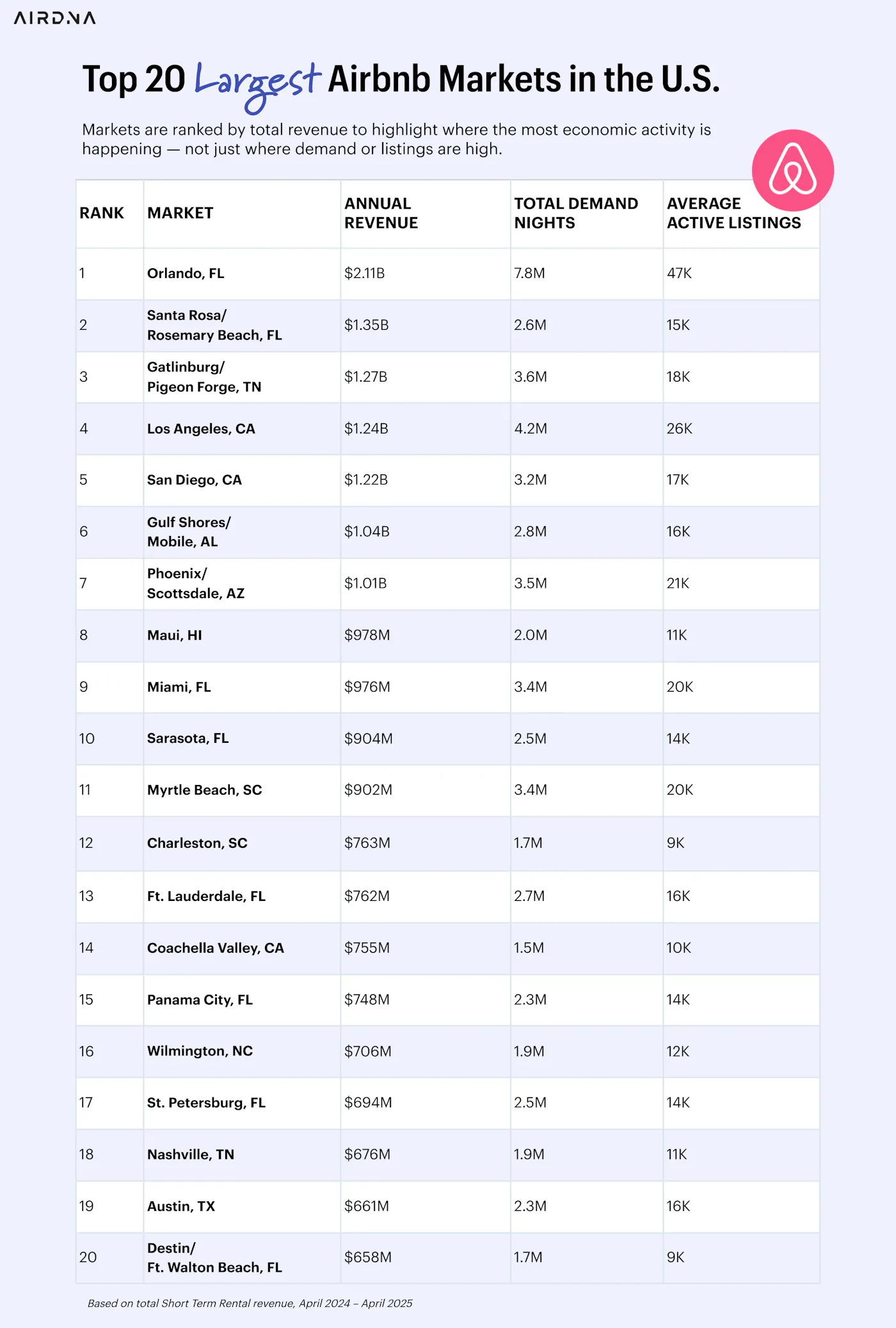
Top Airbnb Cities in the U.S. Based on Size
The rankings, which we get into below, provide some big-picture takeaways worth considering.
Airbnb Market Size Trends in the U.S.
The largest short-term rental markets in the U.S. are disproportionately influential. The top 10 largest Airbnb markets in the U.S. alone account for 25% of all STR revenue nationally, with Orlando representing a full 4% of the total. Expand to the top 20, and that share jumps to 40%, revealing just how concentrated short-term rental earnings are in a handful of powerhouse destinations.
This dynamic becomes even clearer when you zoom out. The vast majority of STR markets across the U.S.—about 70%—generate less than $500 million in annual revenue. The average Airbnb market size in the U.S. is smaller than our top earners, making the few markets pulling in $1 billion or more true outliers in terms of both demand and performance.
Geographically, Florida and California dominate. Four of the top 10 markets are in Florida (Orlando, Santa Rosa/Rosemary Beach, Miami, and Sarasota), while two are in California (Los Angeles and San Diego). These states benefit from strong tourism infrastructure, favorable climates, and well-known destinations that attract both domestic and international travelers year-round.
Other high-ranking markets reflect diverse guest preferences:
- Mountain getaways like Gatlinburg/Pigeon Forge cater to family vacations and nature lovers.
- Desert metros like Phoenix/Scottsdale thrive on seasonal events and second-home travel.
- Remote-luxury markets like Maui combine scarcity with pricing power.
- And under-the-radar beach towns like Gulf Shores and Sarasota show that smaller, affordable destinations can punch above their weight when demand and supply align.
In short, there’s no single formula for STR success. The top performers all share a powerful blend of consistent demand, the ability to absorb it, and the regulatory headroom to keep growing. Now, let’s dive into the largest Airbnb markets in the U.S. rankings.
1. Orlando, Florida
Orlando ranks as the largest Airbnb market in the U.S., thanks to its year-round tourism and global appeal. From theme parks to conferences, this city keeps short-term rentals booked solid.
Orlando Market Size
Orlando has the most Airbnb listings by city in the entirety of the U.S. with nearly 47,000 active listings. The market generated over $2.1 billion in revenue and recorded 7.8 million booked nights over the past year, making it the undisputed STR giant. It ranks number one for size, no matter which of the three metrics you use as a ranking factor.
What’s driving demand in Orlando?
Orlando’s steady stream of vacationers, business travelers, and event-goers fuels high occupancy. Proximity to Walt Disney World and Universal Studios, plus a surge in vacation rental developments, supports both scale and consistency.
Orlando Investment Insights
Orlando offers strong returns but requires thoughtful strategy. Competition is fierce, and performance varies by location, amenities, and home size. Investors should watch for zoning restrictions in Orange County but will find more flexibility in surrounding areas like Osceola.
2. Santa Rosa/Rosemary Beach, Florida
Despite being a relatively small coastal area, Santa Rosa and Rosemary Beach ranks as the second-largest Airbnb market in the U.S. by revenue—a testament to the Gulf Coast’s high-end vacation appeal and premium nightly rates.
Santa Rosa/Rosemary Beach Market Size
With just over 15,000 active listings, this market brought in $1.35 billion in short-term rental revenue over the past year, with 2.6 million booked nights. It ranks 10th in demand and 11th in listing count, showing impressive revenue performance relative to its size.
What’s driving demand in Santa Rosa/Rosemary Beach?
This stretch of Florida’s 30A is known for its upscale beach towns, family-friendly vibe, and seasonal luxury tourism. High daily rates, extended summer bookings, and repeat vacationers contribute to strong revenue despite fewer listings.
Santa Rosa/Rosemary Beach Investment Insights
High revenue and moderate listing volume suggest healthy profitability, but also tight competition for top-tier properties. Investors should be aware of Walton County’s short-term rental rules, which require registration, local contacts, and parking minimums. Homes near the beach with modern finishes and strong design aesthetics tend to outperform.
3. Gatlinburg/Pigeon Forge, Tennessee
Tucked into the Great Smoky Mountains, Gatlinburg and Pigeon Forge are a standout in the short-term rental world—ranking third in the U.S. for revenue, demand, and among the top six for active listings. This mountain destination punches well above its population size thanks to year-round tourism and big-family vacation appeal.
Gatlinburg/Pigeon Forge market size
With an average of 18,500 active listings, the region pulled in $1.27 billion in revenue from 3.6 million booked nights last year. Its balanced strength across all key metrics reflects a mature, high-performing STR market.
What’s driving demand in Gatlinburg/Pigeon Forge?
Easy access to Great Smoky Mountains National Park, plus major draws like Dollywood, seasonal festivals, and cabin-style accommodations, keep bookings strong. The area’s wide appeal to families, couples, and multigenerational groups boosts both occupancy and length of stay.
Investment insights for Gatlinburg/Pigeon Forge
This market offers solid revenue potential with relatively accessible price points. Large cabins and amenity-rich properties (think hot tubs and game rooms) perform especially well. Regulations vary by city—Sevier County requires STR permits and inspections—but remain favorable overall. For investors seeking a high-demand, drive-to destination with strong fundamentals, Gatlinburg/Pigeon Forge is hard to beat among Airbnb investment opportunities.
4. Los Angeles, California
Los Angeles ranks second in the U.S. for both demand and active Airbnb listings, and fourth overall in revenue. As a global hub for entertainment, business, and tourism, LA offers diverse rental opportunities—from beachfront bungalows in Venice to high-rise apartments in Downtown.
Los Angeles market size
With over 25,900 active listings, LA saw 4.2 million nights booked and earned $1.24 billion in STR revenue over the past year. Its vast size and traveler diversity make it one of the most dynamic and competitive short-term rental markets in the country.
What’s driving demand in Los Angeles?
LA’s year-round sunshine, international airport, and world-famous attractions (Hollywood, beaches, theme parks) attract a steady flow of tourists. At the same time, a strong business travel sector and events like film festivals and tech conferences keep demand high across different guest segments.
Los Angeles investment insights
Los Angeles offers scale and variety, but strict short-term rental regulations are a critical consideration. The city limits STRs to primary residences and enforces registration and compliance rules. Investors need to focus on permitted properties or look to adjacent areas like Glendale or Long Beach for more flexibility. In neighborhoods where STRs are allowed, high ADRs (average daily rates) and consistent demand make LA an attractive—but highly regulated—market.
5. San Diego, California
San Diego ranks as the fifth-largest Airbnb market in the U.S. by revenue, bringing in over $1.2 billion last year. Known for its sunny beaches, laid-back vibe, and strong tourism economy, it’s a consistent performer in the short-term rental space.
San Diego market size
San Diego has about 17,500 active listings and logged 3.2 million booked nights and $1.22 billion in STR revenue over the past 12 months. It ranks seventh nationally for both demand and listing count, showing strong balance across key performance metrics.
What’s driving demand in San Diego?
Tourism is a major driver here, thanks to attractions like Balboa Park, the San Diego Zoo, and year-round surf-friendly beaches. Its proximity to Mexico, military bases, and universities also brings in a steady stream of short-term guests beyond just vacationers.
San Diego investment insights
San Diego remains a solid bet for investors, but local STR regulations are complex. The city limits whole-home rentals to specific license types, with caps on the number of permits issued in certain areas. That said, high ADRs and a broad guest base help offset these hurdles. Homes near the coast or downtown tend to see the strongest returns, especially those offering parking and outdoor space.
6. Gulf Shores/Mobile, Alabama
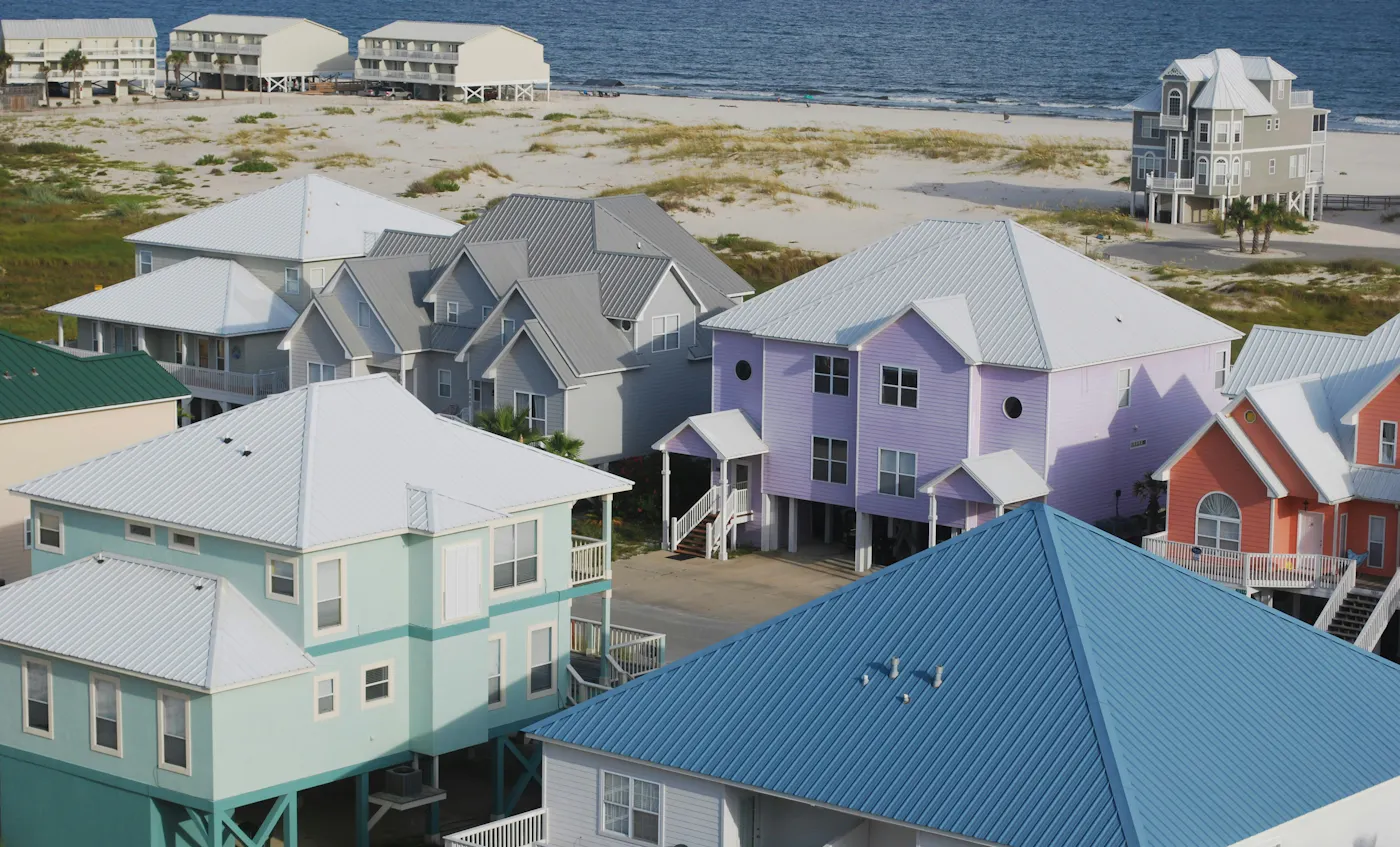
Gulf Shores and Mobile may not make every STR investor’s radar, but they should. This coastal Alabama market ranks sixth in the U.S. for short-term rental revenue, earning over $1 billion in the past year. Its steady growth reflects rising demand for Gulf Coast vacations that offer value, charm, and easy access.
Gulf Shores/Mobile market size
With about 15,600 active listings, the area generated 2.8 million booked nights and over $1.04 billion in revenue over the past 12 months. It currently ranks eighth for demand and tenth for active listings. These are impressive stats for a region with historically lower national visibility.
What’s driving demand in Gulf Shores/Mobile?
Gulf Shores is known for its family-friendly beaches, fishing charters, and seasonal festivals. Mobile adds urban appeal, with cruise terminals, a historic downtown, and one of the oldest Mardi Gras celebrations in the U.S. The blend of beach and city makes it attractive to a wide range of travelers, especially road trippers from the Southeast.
Gulf Shores/Mobile investment insights
This market continues to offer relatively affordable entry points with strong returns, making it stand out as an Airbnb investment opportunity. Regulations are generally favorable, though both cities require business licenses and occupancy tax compliance. Properties with beach access or water views tend to perform best. With a growing national profile and rising demand, Gulf Shores/Mobile presents a compelling opportunity for investors seeking coastal cash flow without coastal price tags.
7. Phoenix/Scottsdale, Arizona
Phoenix and Scottsdale form one of the most active short-term rental markets in the U.S., ranking seventh in revenue but landing in the top four for both demand and active listings. With year-round sunshine, a booming events calendar, and easy accessibility, this desert metro continues to attract both visitors and investors.
Phoenix/Scottsdale market size
The region saw 3.5 million nights booked and earned just over $1 billion in revenue across 21,200 active listings in the past year. These high rankings across multiple metrics highlight both strong traveler interest and an expansive inventory.
What’s driving demand in Phoenix/Scottsdale?
Major golf tournaments, spring training, world-class spas, and desert scenery draw vacationers and business travelers alike. Scottsdale’s luxury appeal and Phoenix’s convention circuit create year-round demand, with winter and early spring as peak seasons.
Phoenix/Scottsdale investment insights
The market is large, liquid, and increasingly regulated. Scottsdale allows short-term rentals with registration and safety compliance, while parts of Phoenix have tightened zoning restrictions. Investors should review city-specific ordinances and favor well-located homes with pools or upscale amenities. Despite added regulation, high occupancy and solid ADRs make this a prime target for STR investment in the Southwest.
8. Maui, Hawaii
Maui ranks eighth in the U.S. for short-term rental revenue, earning nearly $1 billion over the past year—despite much lower rankings in both demand (16th) and listing count (21st). This rare combination signals one of the highest-performing markets on a per-listing basis, driven by strong ADRs and premium vacation experiences.
Maui market size
With just 11,175 active listings, Maui brought in 2 million booked nights and $978 million in STR revenue. That puts its average revenue per listing well above most other top-earning markets, revealing exceptional efficiency compared to larger markets like Phoenix or Gatlinburg, which rely on volume over nightly rate.
What’s driving demand in Maui?
Maui’s appeal is simple and powerful: natural beauty, luxury resorts, and a deep-rooted tourism economy. Travelers pay a premium for beachfront views, tropical climates, and access to destinations like Haleakalā National Park and the Road to Hana. Despite a smaller guest volume compared to continental destinations, each stay tends to be longer and more lucrative.
Maui investment insights
The combination of high revenue and limited supply is a double-edged sword. Current operators benefit from strong pricing power, but short-term rental regulations in Maui are among the strictest in the country. New vacation rental permits are limited or banned in many zones, especially post-wildfire recovery efforts. Investors considering Maui must navigate zoning laws carefully and factor in rising community pushback. Compared to markets like Orlando or Phoenix, where scale is key, Maui is a case study in quality over quantity—rewarding, but not easily entered.
9. Miami, Florida
Miami ranks ninth in short-term rental revenue nationwide, but it's a top-tier player in both demand and supply—ranking fifth for demand and fourth for active listings. A year-round hotspot for domestic and international travelers, Miami’s STR market thrives on volume, versatility, and vibrancy.
Miami market size
Miami generated 3.4 million booked nights and $976 million in STR revenue from nearly 20,500 active listings over the past year. Its size and performance reflect a well-established and highly competitive market with plenty of demand to go around.
What’s driving demand in Miami?
Beaches, nightlife, major events (like Art Basel and the Miami Grand Prix), and its role as a gateway to Latin America keep Miami’s tourism engine humming. The city also draws remote workers and business travelers, adding further diversity to the guest pool.
Miami investment insights
Miami offers strong demand and consistent booking activity, but saturation and regulation are growing concerns. The city requires STR licenses and enforces zoning that restricts rentals in certain residential areas. Investors should look for properties in designated STR zones like Downtown, Brickell, or Miami Beach, where both occupancy and nightly rates can be high. Compared to Maui’s exclusivity or Orlando’s scale, Miami’s advantage lies in urban energy and global appeal—ideal for investors who can navigate its dense, fast-moving landscape.
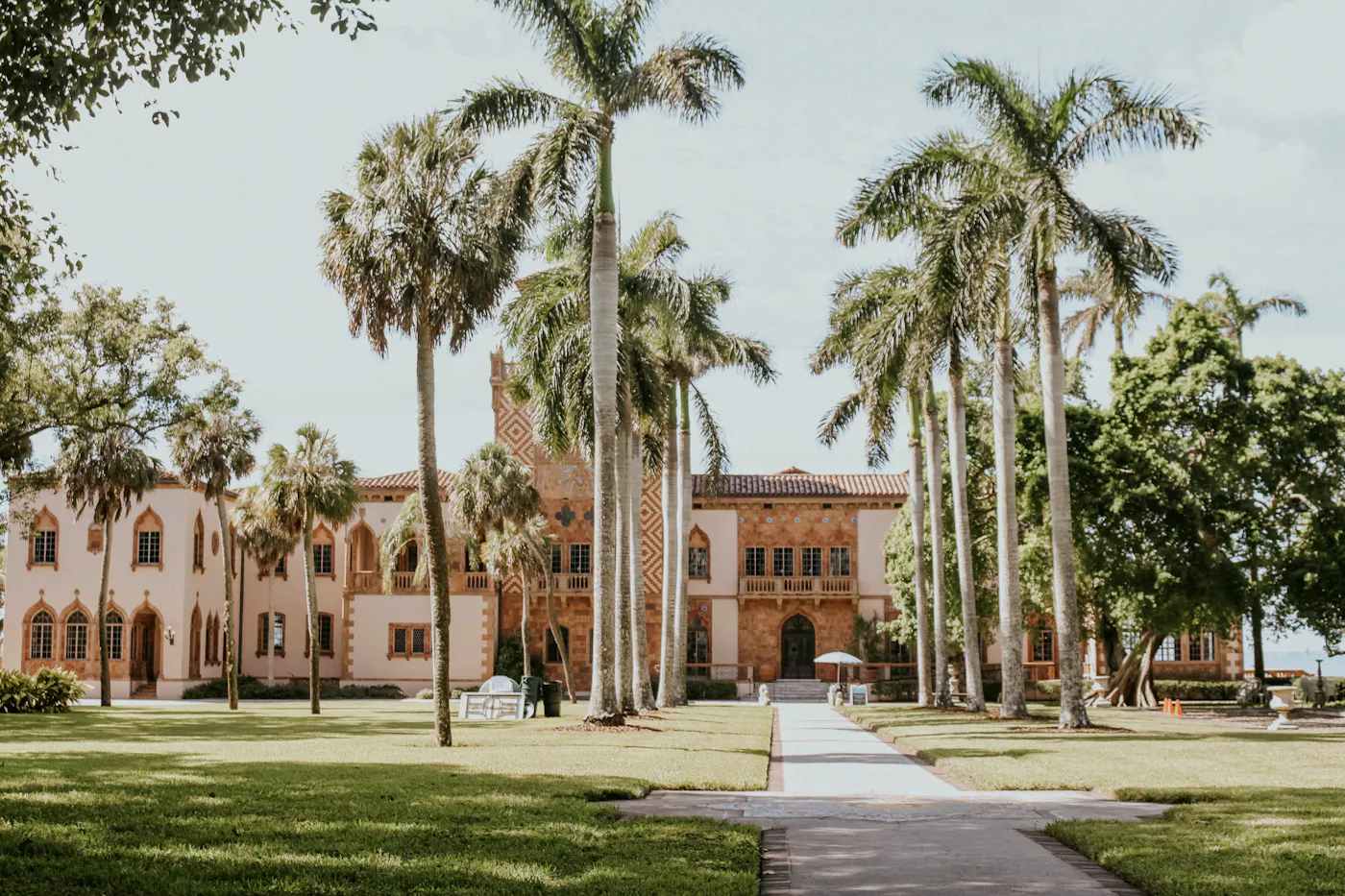
10. Sarasota, Florida
Sarasota ranks tenth in the U.S. for short-term rental revenue, bringing in over $900 million in the past year. While it sits just outside the top 10 for both demand and active listings, Sarasota consistently delivers strong returns for hosts—blending coastal charm with a relaxed, upscale feel.
Sarasota market size
With approximately 14,400 active listings, Sarasota saw 2.5 million booked nights and $904 million in STR revenue over the past 12 months. Its mid-range scale, combined with strong performance, places it among the most efficient and dependable STR markets on Florida’s Gulf Coast.
What’s driving demand in Sarasota?
White-sand beaches, cultural events, golf courses, and a steady stream of snowbirds and retirees drive Sarasota’s demand profile. Unlike more party-centric destinations, Sarasota appeals to older travelers, families, and long-stay vacationers, especially during winter months.
Sarasota investment insights
Sarasota offers solid income potential with less saturation than nearby markets like Miami or Gulf Shores. However, the city has adopted more structured STR regulations in recent years. Short-term rentals under 30 days may be restricted to certain zones and require business licenses. Investors should do due diligence on neighborhood-level rules. Still, with a mature guest base, year-round demand, and a manageable competitive landscape, Sarasota presents a stable and attractive option for both new and seasoned STR investors.
Frequently Asked Questions
Where is Airbnb most popular in the U.S.?
Guest demand is one of the clearest indicators of popularity because it reflects how often travelers are actually booking stays, not just browsing or listing properties. By that measure, Orlando, FL is the most popular Airbnb market in the U.S., with over 7.8 million booked nights in the past year. Other high-demand, top Airbnb cities in the U.S. include Los Angeles, Phoenix/Scottsdale, and Miami, each attracting millions of guests annually for everything from family vacations to business travel.
What is the biggest market for Airbnb?
Orlando is also the largest Airbnb market by total revenue, bringing in more than $2.1 billion over the past year. It ranks number one across three key metrics for size—revenue, demand, and active listings—making it a dominant force in the U.S. short-term rental landscape.
Where is the most demand for Airbnb?
Measured by total nights booked, Orlando leads the nation, followed by Los Angeles, Phoenix/Scottsdale, and Miami. These markets benefit from strong tourism, large populations, and year-round events that keep bookings steady.
What are the most profitable cities in the U.S. for Airbnb?
Profitability isn’t just about how much revenue a property generates—it’s about yield, or how much return you get relative to your investment. While large markets like Orlando and Miami generate the most income overall, high-yield markets may offer better profit margins thanks to lower home prices and strong occupancy. Visit AirDNA’sBest Places to Invest in Vacation Rentals report to find the best opportunities in U.S. short-term rental markets based on projected returns.
ARTICLE SUMMARY
AirDNA ranks the top 10 largest Airbnb markets in the U.S. based on total revenue, with additional insights based on demand and number of listings. We explore what’s driving demand in each city and offer insights for investors and hosts looking to understand where short-term rentals are making the biggest financial impact.
Camilo Schmid Rivas
Senior Research Analyst
Camilo Schmid Rivas is a Senior Research Analyst at AirDNA who brings a uniquely well-rounded perspective to short-term rental analytics. With a background that spans investment, real estate, and business analysis—including roles at Stayery and Sollers Consulting—Camilo has worn many analyst hats, each sharpening his ability to turn complex data into clear, actionable insights. A graduate of École hôtelière de Lausanne, he now channels his multidisciplinary expertise into uncovering trends that drive smarter STR decisions. In his free time, he enjoys playing tennis or scuba diving in or around Barcelona.


Get started with AirDNA today.
Powerful, easy-to-use tools that help hosts and investors succeed in the short-term rental market.
Try for free