


Leaf Peeping 2026: The Fastest-Growing Region Is Raising Prices the Least
Published: September 29, 2026
Last updated: November 13, 2026

Bram Gallagher

It’s officially fall, and that means apple picking, spooky costumes, pumpkin spice and, most enduringly, the annual changing of the foliage. Every year, leaf peepers flock to picturesque mountain destinations to enjoy the changing colors, and many of them stay in short-term rentals. To get a fuller picture of how 2026 is shaping up, AirDNA examined 19 markets across five regions in the East and Midwest. All five regions are increasing both rates and demand this year, but they are developing very differently from last year.
Key Takeaways
- Nights booked for September 22 to November 23 stays are pacing 9.8% ahead of last year across 19 leaf-peeping markets in five regions.
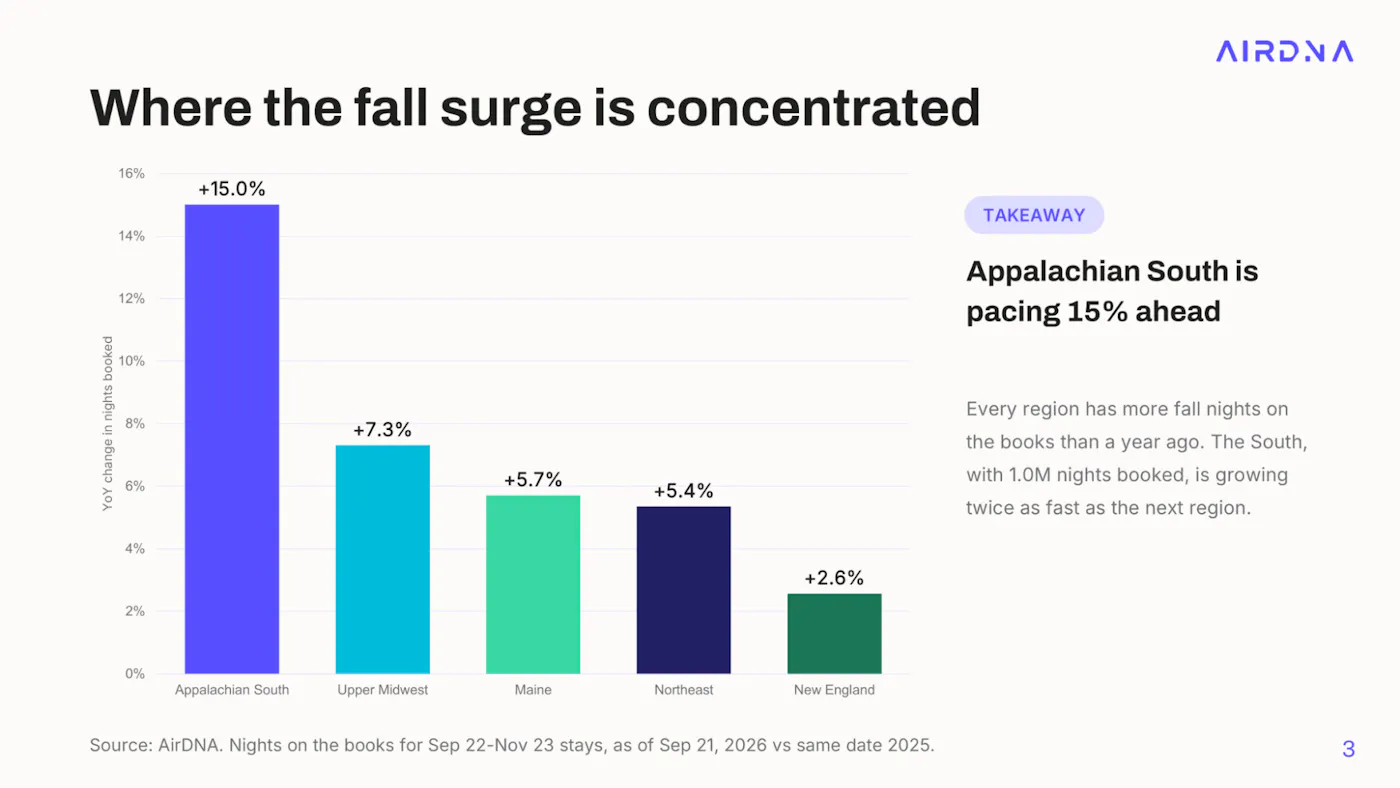
- The Appalachian South leads demand growth at +15.0%, roughly six times New England’s +2.6%.
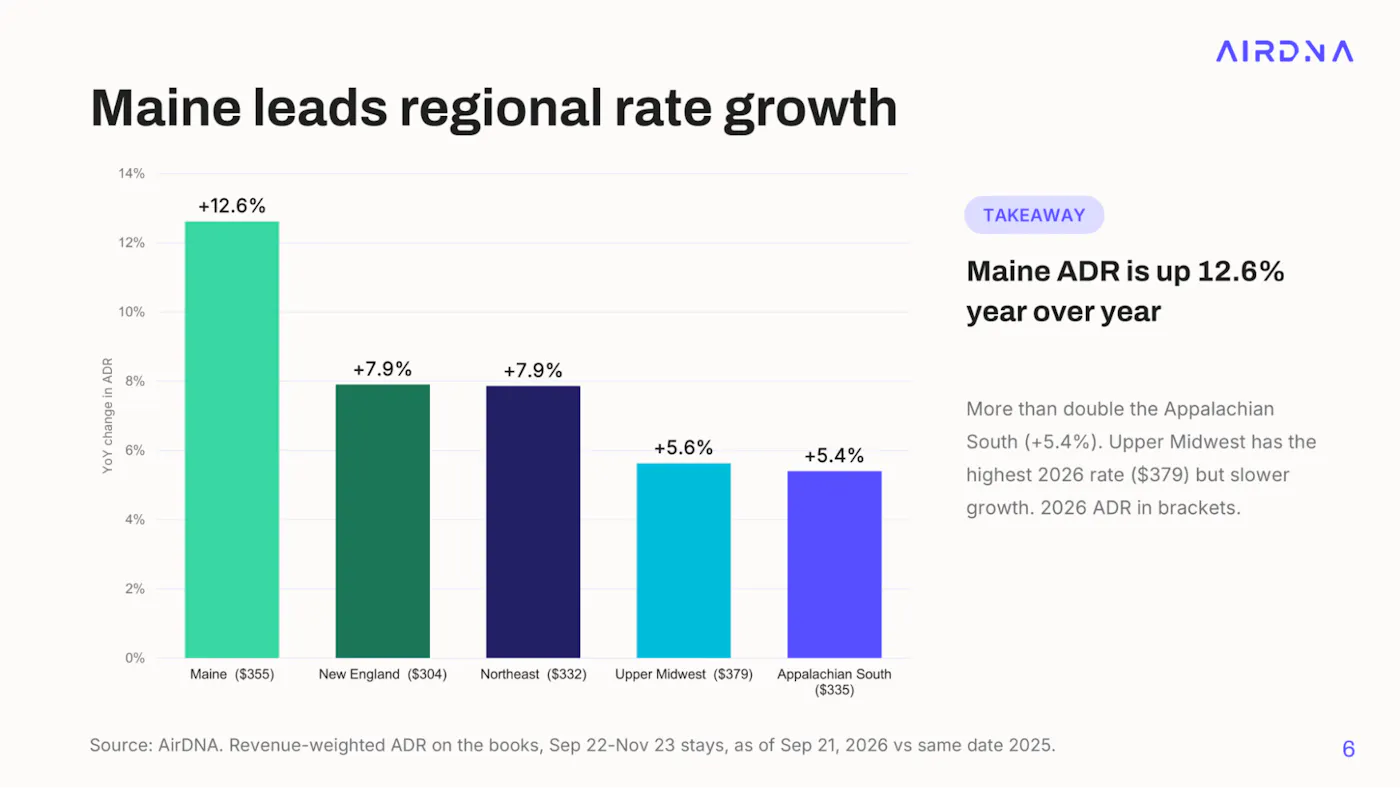
- Rate growth runs the other way: Maine is up 12.6%, New England and the Northeast 7.9%, and the Appalachian South just 5.4%.
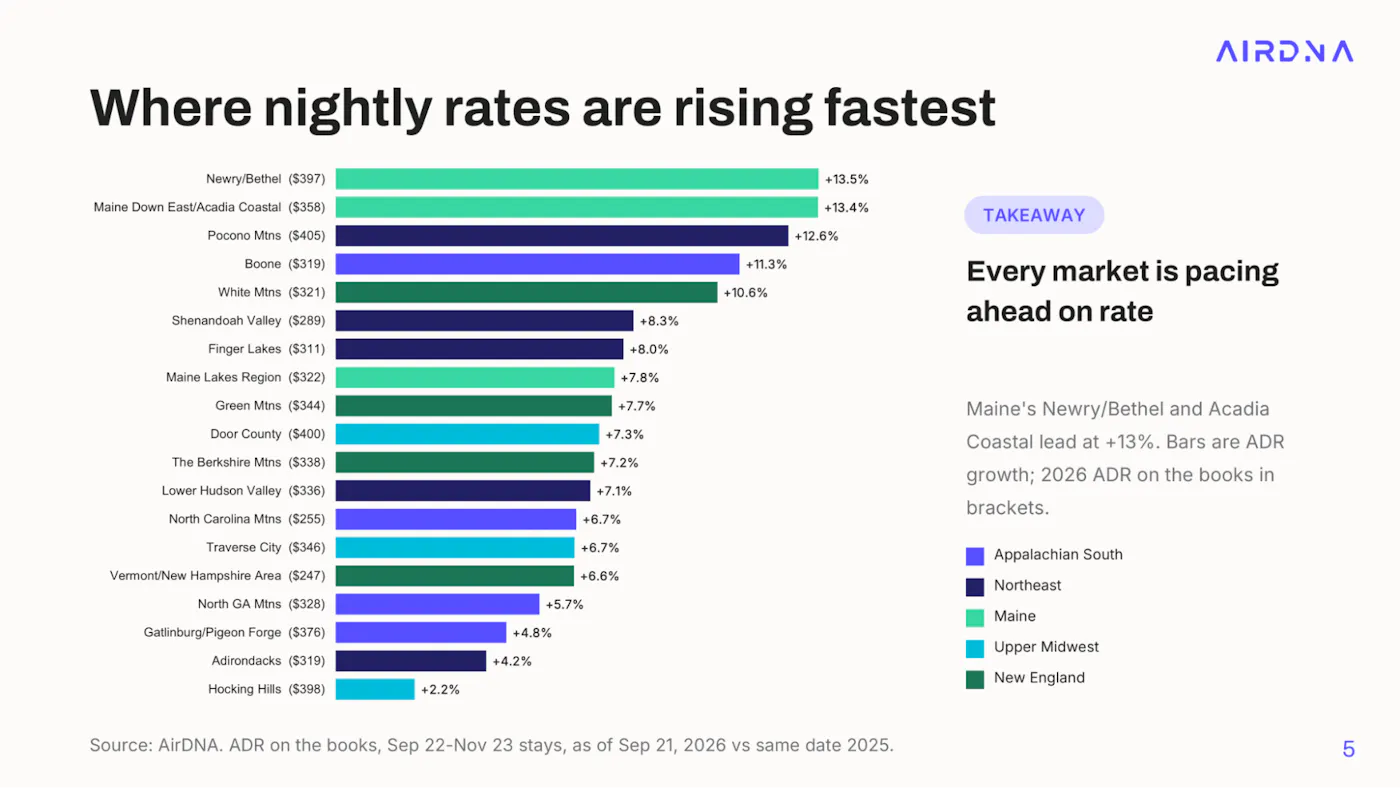
- At market level, Newry/Bethel, Maine, has the fastest rate growth (+13.5%, $397 ADR), while Hocking Hills, Ohio, has the slowest (+2.2%, $398).
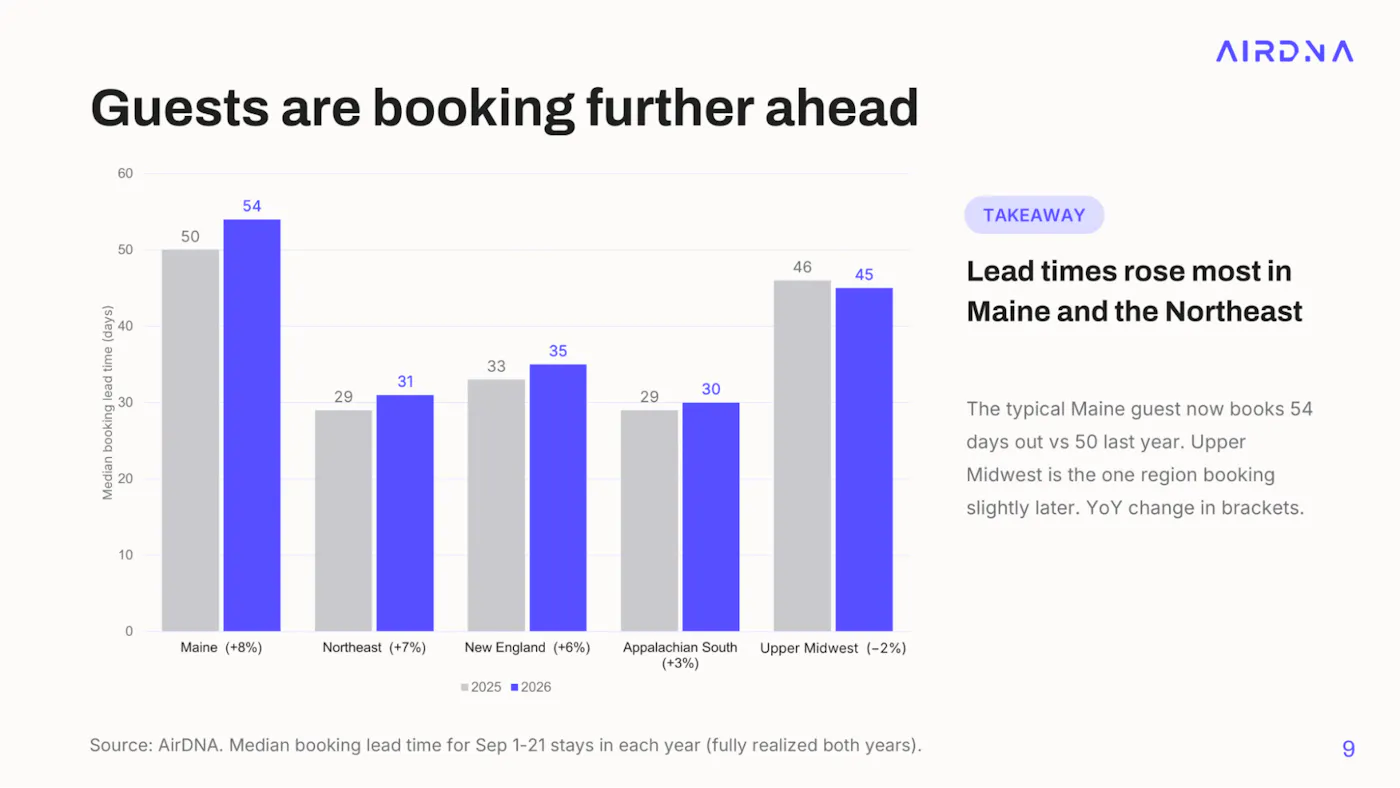
- Guests are booking earlier, with median lead times up 7% to 8% in Maine and the Northeast.
Fall Demand Is Pacing 9.8% Ahead, and the Appalachian South Leads
Looking at demand for stays from September 22 to November 23, roughly the two months of leaf-peeping season excluding Thanksgiving, the number of nights booked so far is 9.8% higher than at the same point last year across all five regions, a sign of strong interest and significant growth. However, the Appalachian South is pacing at roughly six times the rate of New England, with nights booked up 15.0% against 2.6%.
The North Is Full at Peak, So New Demand Spills South
In 2025, most of these regions saw demand peak in the second week of October, and New England’s occupancy on Saturday, October 11 was 93.6%. That is essentially a full market, but the Appalachian South’s occupancy was higher still, at 96.8%. So where does the extra demand come from, and where will it go?
The main explanation may be the growing popularity of the pastime, and perhaps more interest in the shoulder season in general. Peeping season at more northerly latitudes ends abruptly after the second week of October, and many listings, particularly in Maine, shut for the winter shortly after. For the aspiring leaf peeper, the North is full, leaving the Appalachian South and, to a lesser extent, the Upper Midwest as the only outlets for new demand in the weeks after the peak.
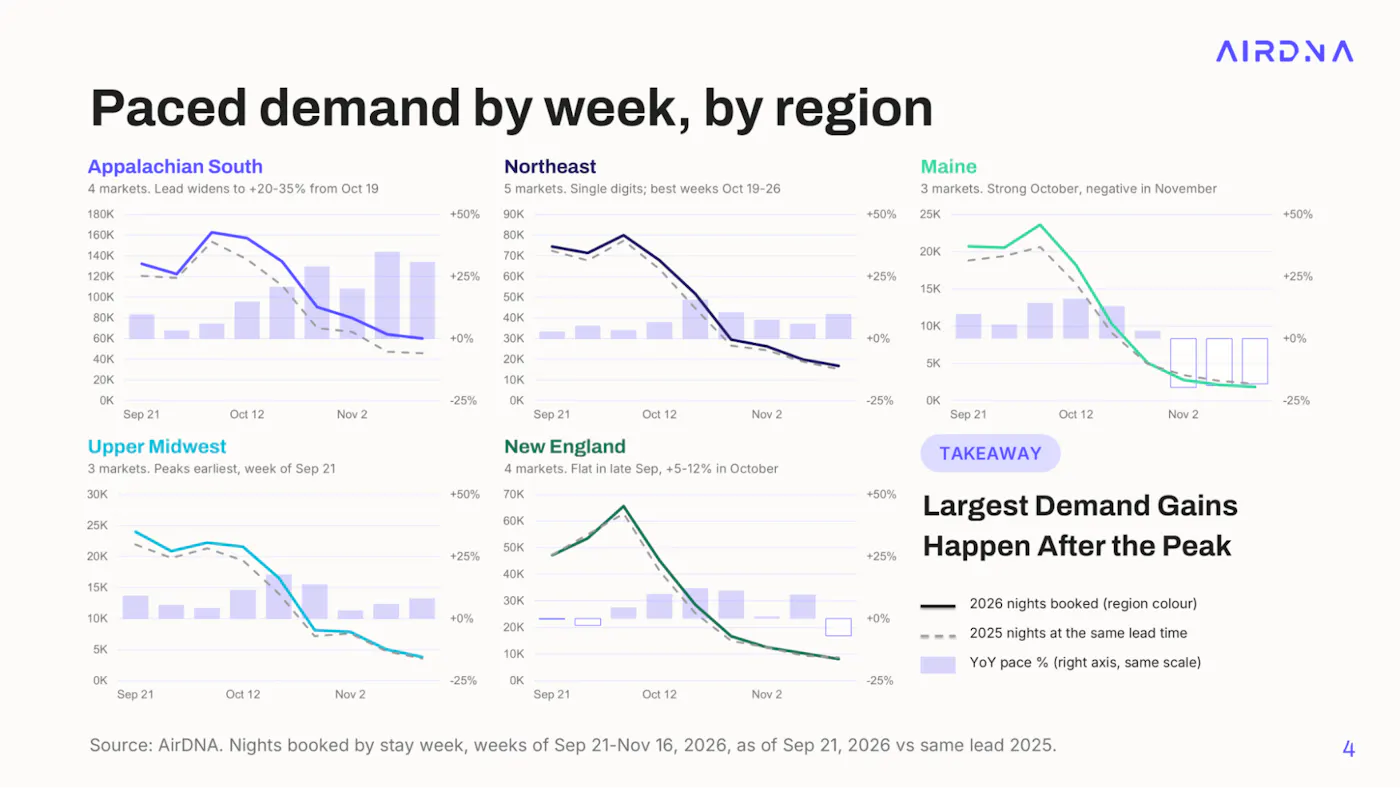
The sharp peaks in New England, the Northeast and Maine differ from the more gradual roll-off in the Appalachian South and Upper Midwest, which lets demand spread out through October and early November.
That doesn’t mean northern destinations are less desirable for leaf peepers. These regions include some of the most famous spots for cozy fall vibes. The weather simply can’t be reasoned with.
Rates Tell the Opposite Story: Maine and New England Raise Prices Most
Pacing data on rates for the upcoming season illustrates this well, because the order essentially reverses from the demand story. Maine (+12.6%) leads, followed by New England and the Northeast (both +7.9%), as operators look to capitalize on growing demand concentrated on a few weekends that are already at capacity. The Appalachian South, where demand growth is handily outpacing its northern counterparts, is growing rates at the slowest pace of any region, at +5.4%.

Market by Market, Rate Growth Tracks Capacity, Not Price Level
Looking at individual markets within these regions doesn’t reveal a rate convergence or affordability story, because there is no clear relationship between the level of rates and rate growth. Newry/Bethel (+13.5%) has the fastest rate growth and is also pacing for one of the highest average daily rates, at $397. Hocking Hills, on the other hand, has the slowest rate growth of any market examined, at +2.2%, and lands at essentially the same price ($398). The regional pattern and the limited-capacity explanation fit better, although there are exceptions.
Boone, North Carolina, for example, sits in our Appalachian South region but has high ADR growth (+11.3%). Some of this may reflect shifting supply, as Boone is still recovering from 2024’s Hurricane Helene.
Guests Are Booking Leaf-Peeping Stays Earlier
One final wrinkle in this pacing analysis is a subtle change in guest behavior this year. Average lead times have increased significantly across most of these regions, the exception being the Upper Midwest. While actual lead times for leaf peepers won’t be known until after the season, Maine and the Northeast both had 7% to 8% longer median lead times in 2026 than in 2025, and New England’s median lead time rose 6%. Guests in these areas are locking in reservations for scarce weekends earlier. The Appalachian South’s lead time rose 3%, and it has the shortest lead time of any region.
What Operators Should Do This Fall
Whether it’s travel deferred from a busy and expensive World Cup summer, more interest in shoulder seasons as the weather warms, or simply more people catching on to the fall foliage fireworks, leaf peeping is on the rise. The takeaway for operators is straightforward. Where weather limits your season, make hay while the sun shines by raising your rates. In warmer locales, feel free to extend your offerings well into November, but keep in mind that your competitors can operate then too. Keep close tabs on prices across your comparable set, since potential guests will have more choices.
Build your comp set
Pick the properties that match yours and benchmark against real competitors, not city averages.
Build my comp setFAQs
What is leaf peeping?
Leaf peeping is traveling to see fall foliage change color. In the eastern and midwestern U.S., the season runs from roughly late September to mid-November, and many leaf peepers stay in short-term rentals near mountain and lake destinations.
When is leaf peeping season in New England?
Short-term rental demand in New England peaks in the second week of October. In 2025, New England occupancy reached 93.6% on Saturday, October 11. Northern markets drop off sharply after mid-October, and many Maine listings close for the winter soon after.
Where is leaf-peeping rental demand growing fastest in 2026?
The Appalachian South. Nights booked for September 22 to November 23 stays are pacing 15.0% ahead of last year there, compared with 7.3% in the Upper Midwest, 5.7% in Maine, 5.4% in the Northeast and 2.6% in New England.
Which leaf-peeping markets are raising rates the most?
Maine leads regional rate growth at +12.6%. At market level, Newry/Bethel (+13.5%), Maine Down East/Acadia Coastal (+13.4%) and the Pocono Mountains (+12.6%) are growing average daily rates fastest. Hocking Hills is slowest at +2.2%.
Are fall guests booking earlier this year?
Yes, in most regions. For stays in the first three weeks of September, median booking lead times rose 8% in Maine, 7% in the Northeast, 6% in New England and 3% in the Appalachian South. The Upper Midwest is the exception, with lead times down 2%.
ARTICLE SUMMARY
Leaf-peeping season is driving more short-term rental demand in 2026, with nights booked for late September to late November pacing 9.8% ahead of last year across 19 markets in the East and Midwest. Bram Gallagher breaks down why the Appalachian South is capturing the most new demand while raising rates the least, why Maine and New England are pushing prices hardest, and how guests are booking earlier.
Bram Gallagher
AirDNA Director of Economics and Forecasting
Bram Gallagher is an Economist at AirDNA, specializing in uncovering insights that drive smarter short-term rental decisions. He put his Ph.D. in Economics from the University of Georgia to work researching and forecasting hotel data with CBRE prior to joining AirDNA, as well as teaching economics at a number of universities. In his spare time, Bram enjoys making wooden furniture with hand tools.
Related



Get started with AirDNA today.
Powerful, easy-to-use tools that help hosts and investors succeed in the short-term rental market.
Try for free