Céline Dion’s Paris Residency Lifts Local Rental Demand 37%
Published: September 11, 2026
Last updated: October 22, 2026

Camilo Schmid Rivas
Key Takeaways
- Demand around Paris La Défense Arena is up 37% year over year on the 16 show nights, and nightly rates are up 25%.
- The lift is hyper-local. Beyond roughly two kilometers from the arena, demand is essentially flat at -0.3%.
- Paris as a whole is up just 2% in demand, and the city’s 12% rate growth this autumn shows up on non-show nights too.
- Bookings did not build gradually. The week tickets went on sale produced 2,250 booked nights against 123 in the same week a year earlier.
- Around 43% of the arena-area calendar was still open as of August 31, and the October dates have the most room left.
Céline Dion plays 16 nights at Paris La Défense Arena between September 12 and October 17, 2026. Looking at short-term rental bookings already on the books, the residency is doing something dramatic to the neighborhood around the arena, with limited impact on the city of Paris.
We analyzed the residency’s impact by comparing forward bookings as of August 31, 2026 with bookings at the same stage in last year’s cycle.
The Effect Stops Two Kilometers From the Arena
On the 16 show nights, demand in the three communes that make up the La Défense district, Nanterre, Puteaux, and Courbevoie, is up 37% year over year. Guests are paying 25% more a night than they paid on the equivalent nights last year.
| Show nights, year over year | Demand | Nightly rate |
|---|---|---|
| La Défense core, within 1.7 km | +37% | +25% |
| Next ring out, 1.8 to 2.7 km | +6% | +17% |
| Paris | +2% | +12% |
Measured as rings from the arena rather than by commune, the 2 to 5 km band is -0.3%, essentially flat. The whole effect is observable within a fifteen-minute walk.
The impact on Paris is muted. The city is raising rates around 12% this autumn, and that increase shows up just as strongly on non-show nights. The weeks surrounding the residency are pacing more strongly than the residency week itself. Paris is having a strong autumn in line with the wider European market, and the residency is not what is driving it.
Show Nights Are Up 37%, and One Night Either Side It Collapses
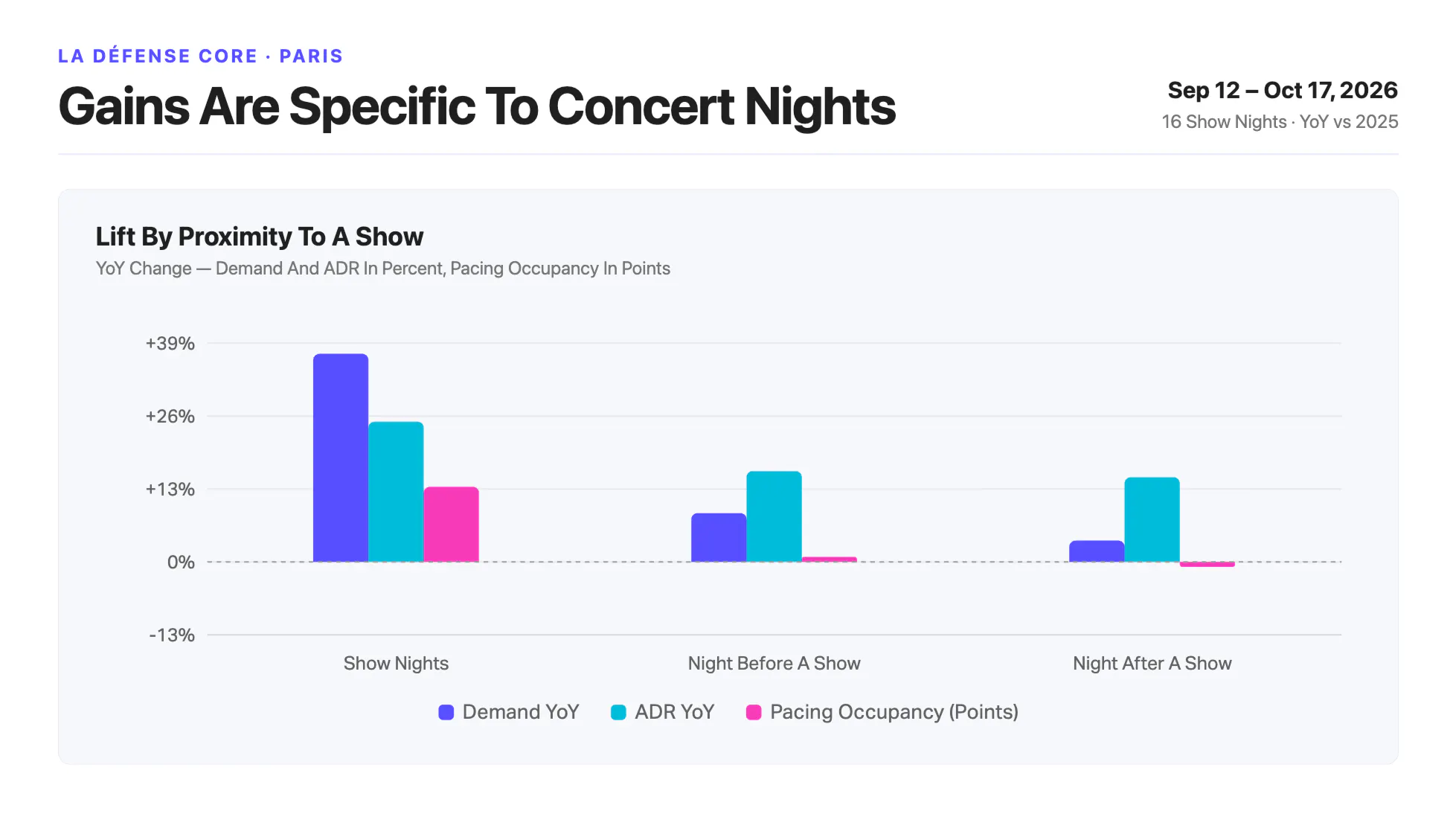
Every show falls on a Wednesday, Friday, or Saturday. Around the arena, those 16 nights are up 37% in demand, and guests have agreed to pay 25% more than they paid on the equivalent nights last year.
Move one night either side, and it collapses.
| Around the arena, year over year | Nights | Demand | Nightly rate |
|---|---|---|---|
| Show nights | 16 | +37.1% | +25.0% |
| The night before a show | 11 | +8.7% | +16.2% |
| The night after a show | 11 | +3.8% | +15.1% |
That decay is the cleanest evidence that what we are looking at is the residency and not something else. Only a single-evening event produces a fall from +37% to +9% to +4% across three consecutive nights. We found the same single-day signature around college football home games in the United States.
The asymmetry matters too. The night before a show is up more than twice as much as the night after. Guests arrive the evening before and leave the morning after.
You Can See the Tickets Go on Sale in the Booking Data
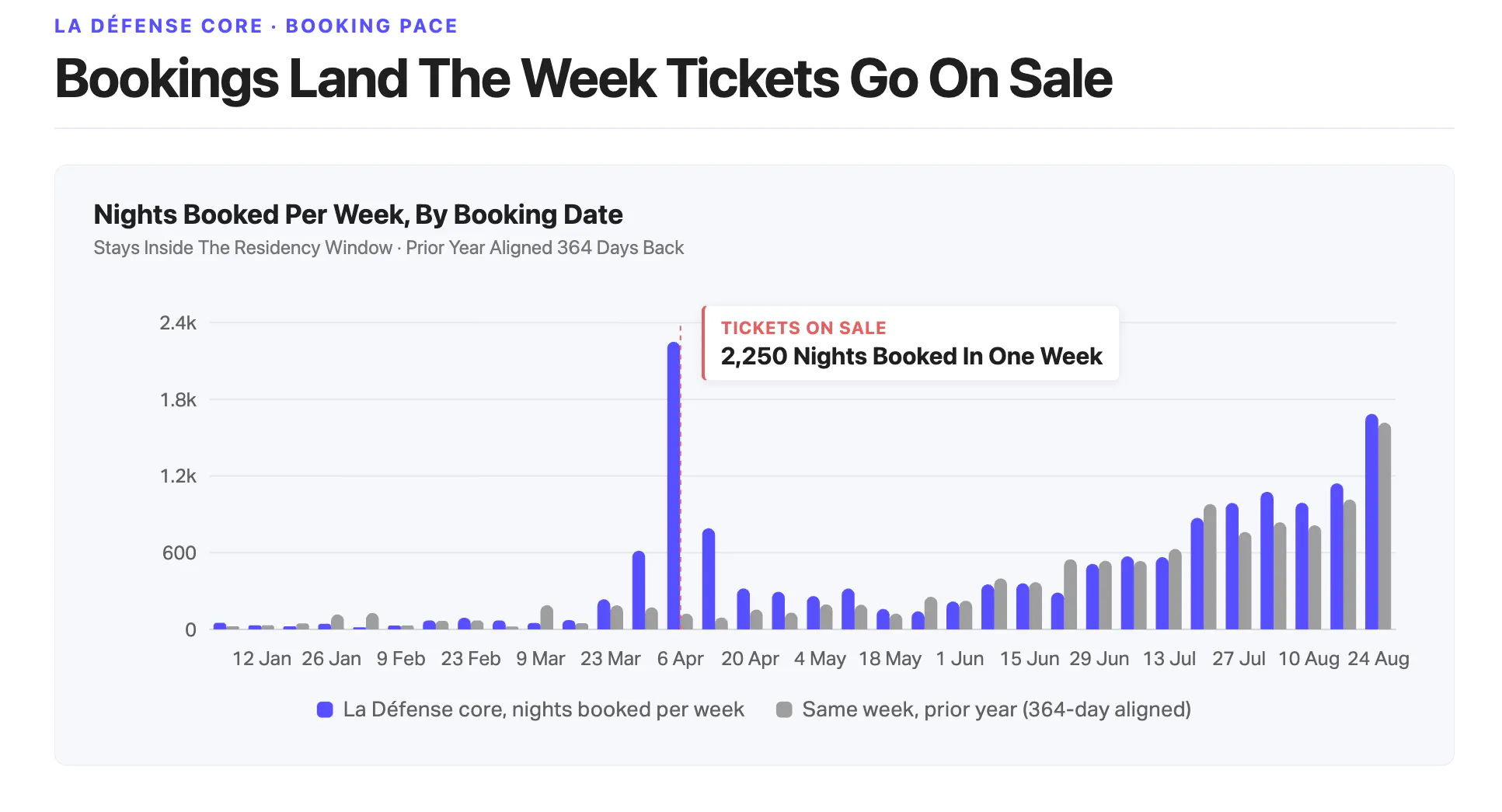
Bookings for these dates did not accumulate gradually. They arrived in a two-week window. During the week starting April 6, hosts near the arena recorded 2,250 nights of bookings for residency dates. In the same week a year earlier, they booked 123 nights.
The effect faded quickly. In the weeks after the on-sale, bookings paced close to the same weeks in 2025.
Around 43% of the Arena Calendar Is Still Open
Everything above is bookings already made, twelve days before the first show and seven weeks before the last. A lot of the calendar is still empty.
At the same point in last year’s booking cycle, the Paris calendar held around two-thirds of the nights that were eventually booked for those dates. The other third came in later, much of it in the final few weeks. Booking windows have been getting shorter rather than longer, so there is no reason to expect this year to fill any earlier.
The later shows have the most room left. The October dates sit five to seven weeks out, against a couple of weeks for the opening weekend, so they are the least complete and the most likely to move.
It Is Already Happening Again for May 2027
Ten additional shows have been scheduled at the same arena between May 8 and May 29, 2027, with tickets going on sale on June 3 and 4, 2026. That gives us a second run of the same event on different dates and a different on-sale period.
During the week those tickets went live in June 2026, hosts around the arena recorded 876 booked nights for May 2027 dates, against 6 in the same week a year earlier. That single week accounts for half of the bookings on the books for the 2027 residency. Paris also recorded an increase that week, around five times the previous year, but around the arena bookings were 146 times higher.
The wider picture has not changed. City-wide bookings for the 2027 dates are still down against last year, while the arena’s neighborhood is several times up. The same venue, the same weekday pattern, and the same two-kilometer radius.
It is too early to draw conclusions. Those dates are eight to nine months away, and only around 15% of the arena’s calendar is booked, against 57% for September. Most hosts have not opened their 2027 calendars yet, which explains the negative city-wide figure. The trend appears positive, but the final impact remains uncertain.
What This Means for Hosts Near the Arena
With around 43% of the September and October calendar still open, and October the least complete, the remaining nights are the ones where pricing decisions still change the outcome. The pattern in the data is narrow and sharp. Show nights carry a 25% rate premium, the night before carries 16%, and two kilometers out there is no premium at all.
A city-wide Paris average misses all three. That gap between the market average and the block-level reality is what dynamic pricing exists to close, and it is what AirDNA Adapt prices against every night.
Frequently Asked Questions
How much has the Céline Dion Paris residency increased short-term rental demand?
Demand around Paris La Défense Arena is up 37.1% year over year on the 16 show nights, based on bookings on the books as of August 31, 2026. Nightly rates on those nights are up 25.0%.
How far does the residency effect reach from the arena?
Around two kilometers. Within 1.7 km of the arena, demand is up 37% and rates are up 25%. In the 1.8 to 2.7 km ring, demand is up just 6%. Measured as rings, the 2 to 5 km band is -0.3%, essentially flat.
Is the whole Paris short-term rental market benefiting from the residency?
No. Paris demand is up 2% on show nights and rates are up 12%, but that 12% rate growth shows up just as strongly on non-show nights. The weeks around the residency are pacing more strongly than the residency week itself, which points to a strong autumn for Paris rather than a residency effect.
When did hosts near Paris La Défense Arena get their bookings?
Almost entirely in the week tickets went on sale. During the week starting April 6, 2026, hosts near the arena recorded 2,250 nights of bookings for residency dates, against 123 nights in the same week a year earlier. Bookings in the following weeks paced close to 2025.
Is there still availability for the Céline Dion residency dates?
Yes. As of August 31, 2026, around 57% of the arena-area calendar was booked for the September dates, leaving roughly 43% open. The October shows sit five to seven weeks out and are the least complete, so they are the most likely to move.
ARTICLE SUMMARY
Céline Dion plays 16 nights at Paris La Défense Arena between September 12 and October 17, 2026. AirDNA booking data as of August 31 shows short-term rental demand around the arena up 37% year over year on show nights, with guests paying 25% more a night. The effect is unusually contained. It disappears roughly two kilometers out, and Paris as a whole is up just 2%.
Camilo Schmid Rivas
Senior Research Analyst
Camilo Schmid Rivas is a Senior Research Analyst at AirDNA who brings a uniquely well-rounded perspective to short-term rental analytics. With a background that spans investment, real estate, and business analysis—including roles at Stayery and Sollers Consulting—Camilo has worn many analyst hats, each sharpening his ability to turn complex data into clear, actionable insights. A graduate of École hôtelière de Lausanne, he now channels his multidisciplinary expertise into uncovering trends that drive smarter STR decisions. In his free time, he enjoys playing tennis or scuba diving in or around Barcelona.