The Spanish Grand Prix Is Filling Madrid Rentals at Premium Rates
Published: September 10, 2026
Last updated: October 22, 2026

Camilo Schmid Rivas
Race-Weekend Demand Is Pacing Well Ahead of Last Year
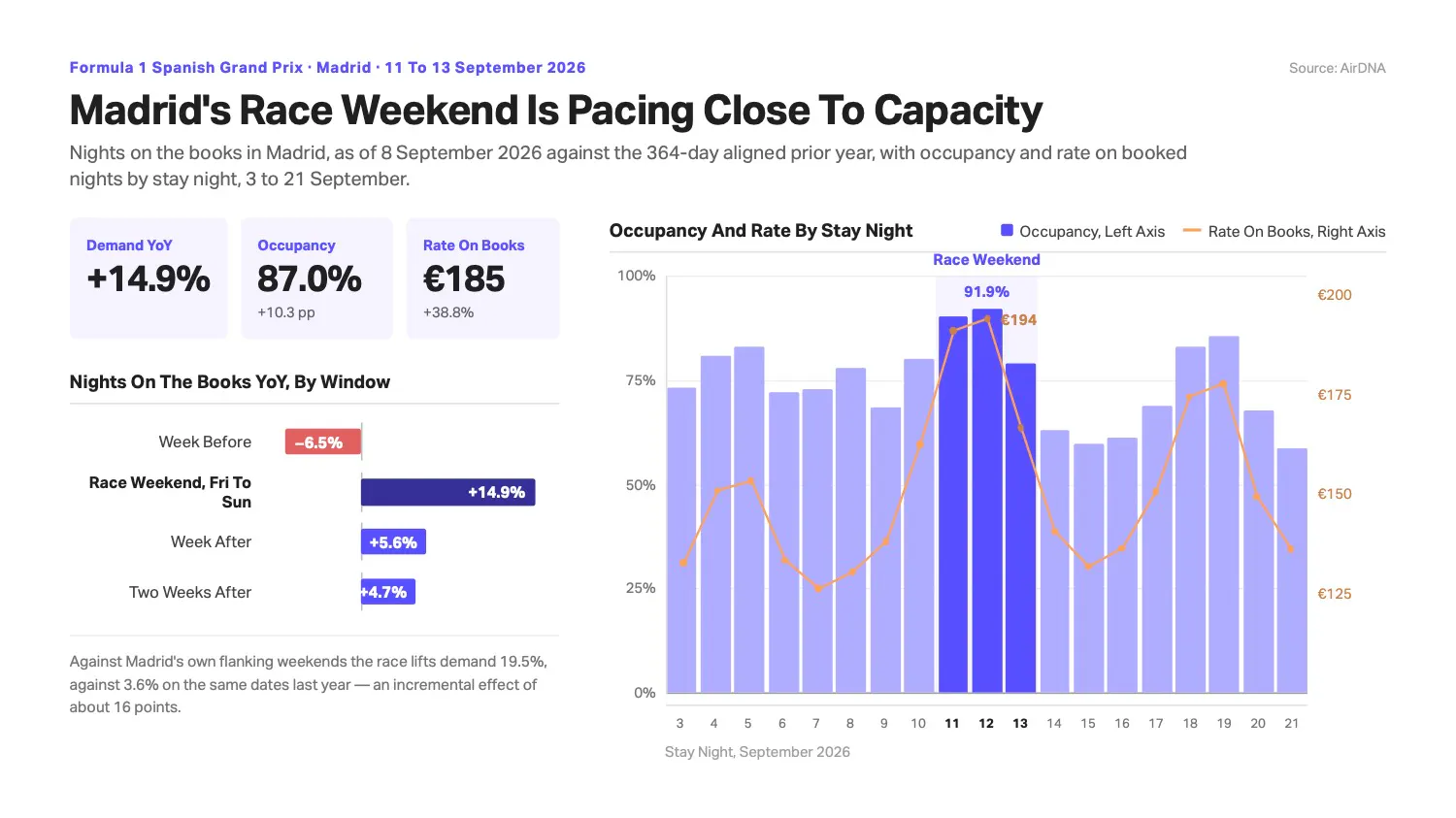
Madrid hosts the Spanish Grand Prix on September 11 to 13, the first running at the new IFEMA street circuit, and the race is already visible in forward bookings. Demand for the race weekend is pacing 14.9% ahead of the same weekend last year.
Occupancy is up 10.3 percentage points, to 87%, and the rate on booked nights has risen 38.8%, to around €185. The surrounding weeks are quieter: the week before is pacing behind (-6.5%), the week after ahead (+5.6%), and two weeks after ahead (+4.7%).
Measured against Madrid’s own flanking weekends, the race lifts demand 19.5% this year, compared with 3.6% on the same dates last year. The incremental effect is close to 16 percentage points of demand.
The Peak Is a Weekend, Not a Week
The peak is concentrated and close to capacity. Friday sits at 90.2% occupancy with around €191 on the books, and Saturday at 91.9% and €194. The flanking weekend runs at roughly 83% to 85% and €175.
Thursday the 10th lifts to 80%, adding a shoulder night, but Monday does not hold. The pattern reads as a weekend trip rather than an extended stay.
Madrid’s Modest Uplift Is About Headroom, Not Weak Demand
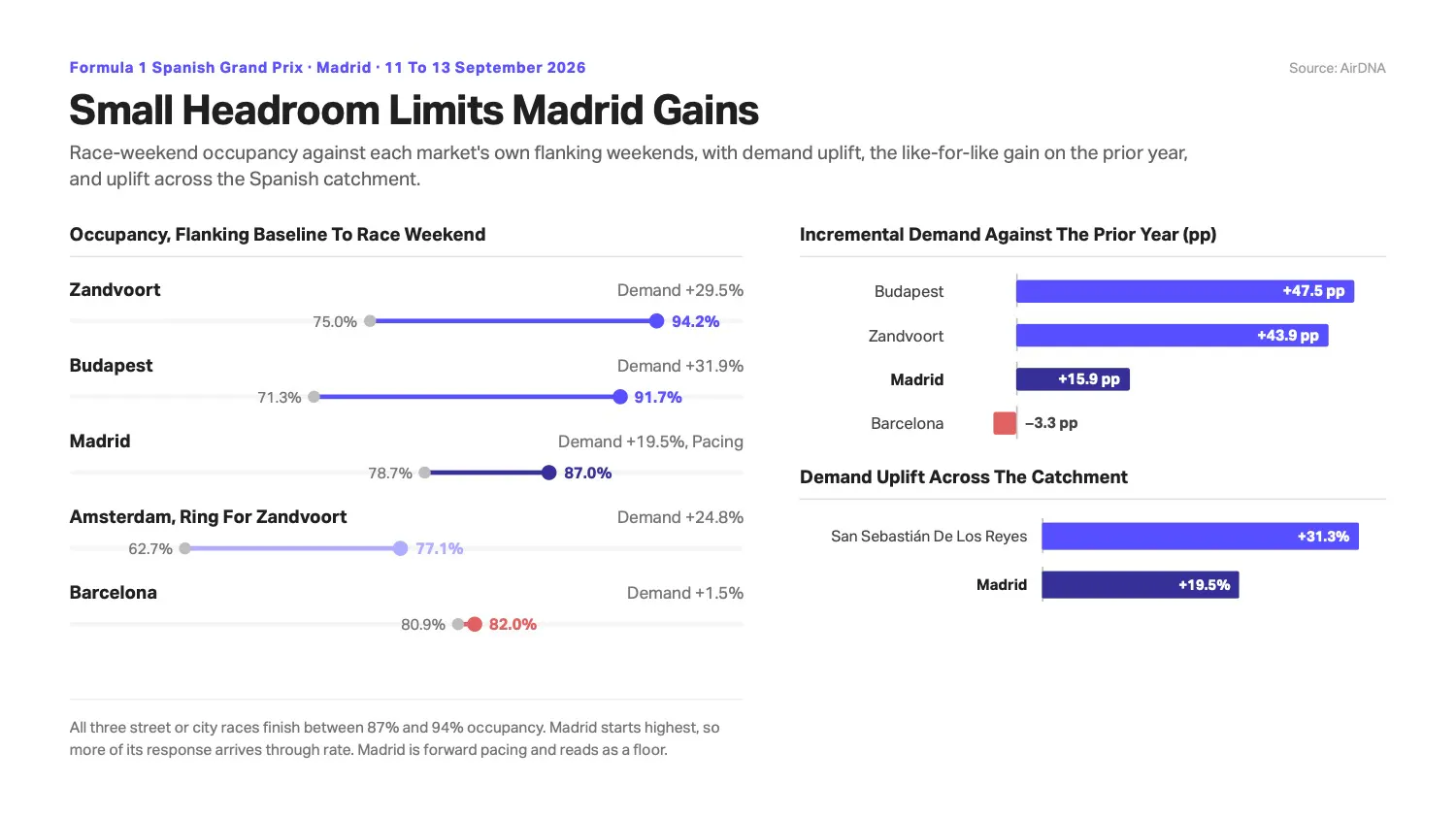
Set against comparable races, Madrid’s uplift looks modest. The reason is headroom, not weak demand. Budapest lifts demand 31.9% on its race weekend and Zandvoort 29.5%, but both start from lower baselines: 71.3% and 75.0% occupancy, against Madrid’s 78.7%.
All three finish in the same place, at 87% to 94%. Madrid therefore has less room to express demand as occupancy, so more of its response has to arrive through rate. On a like-for-like basis against the prior year, Budapest gains 47.5 percentage points and Zandvoort 43.9, against Madrid’s 16 on pacing. Madrid’s figure is a floor that should rise as the remaining nights book.
Proximity to the City Is What Makes a Race Register
Barcelona is the more instructive comparison, because its race is effectively invisible. The Barcelona-Catalunya Grand Prix lifts city demand just 1.5% against flanking weekends. Once last year is controlled for, the effect turns slightly negative, with rates down 0.6%.
The circuit sits around 30 km outside the city, at Montmeló, and Barcelona is large enough, and already full enough at 80.9% baseline occupancy, to absorb the race without registering it. Madrid shows up precisely because its circuit is closer to the city.
The same logic runs through the catchment. San Sebastián de los Reyes, the municipality next to IFEMA, is pacing 31.3% ahead with occupancy up 12.7 percentage points, outpacing Madrid city itself. The Dutch race shows the same pattern. Amsterdam is pacing 24.8% ahead of its own baseline on Zandvoort’s weekend.
FAQs
How much is the Spanish Grand Prix lifting short-term rental demand in Madrid?
Demand for the race weekend (September 11 to 13, 2026) is pacing 14.9% ahead of the same weekend last year, with occupancy up 10.3 percentage points to 87% and the rate on booked nights up 38.8%, to around €185. Measured against Madrid’s flanking weekends, the race adds close to 16 percentage points of demand.
Where is the new Madrid Grand Prix circuit?
The 2026 Spanish Grand Prix runs at a new street circuit at IFEMA, Madrid’s exhibition complex on the northeast side of the city. Its closeness to central Madrid is a big reason the race shows up so clearly in rental data, unlike the Barcelona-Catalunya circuit, which sits around 30 km outside Barcelona at Montmeló.
Which nights see the biggest demand for the Spanish Grand Prix?
The peak is concentrated on the race weekend. Friday runs at 90.2% occupancy and Saturday at 91.9%, against roughly 83% to 85% on a normal weekend, with booked rates near €191 to €194 versus about €175. Thursday adds a shoulder night at 80%, but Monday does not hold, so the trip reads as a weekend rather than an extended stay.
Why is Madrid’s Grand Prix uplift smaller than Budapest’s or Zandvoort’s?
Headroom, not weak demand. Madrid starts from a higher baseline occupancy (78.7%) than Budapest (71.3%) or Zandvoort (75.0%), so it has less room to add occupancy and more of its race-weekend response shows up in rate. All three markets finish the weekend at 87% to 94%.
Which areas around Madrid benefit most from the Grand Prix?
The municipalities closest to the IFEMA circuit. San Sebastián de los Reyes, next to IFEMA, is pacing 31.3% ahead of its baseline with occupancy up 12.7 percentage points, outpacing Madrid city itself. The Dutch race shows the same catchment effect, with Amsterdam pacing 24.8% ahead on Zandvoort’s weekend.
ARTICLE SUMMARY
The 2026 Spanish Grand Prix debuts on Madrid’s new IFEMA street circuit on September 11 to 13, and forward bookings already show it. AirDNA data has race-weekend demand pacing 14.9% ahead of last year, with occupancy at 87% and booked rates up 38.8%. The lift is smaller than at Budapest or Zandvoort, but only because Madrid starts closer to full, so more of the response arrives through rate. The contrast with Barcelona, whose out-of-town circuit barely registers, shows that a race moves the rental market most when its circuit sits inside the city.
Camilo Schmid Rivas
Senior Research Analyst
Camilo Schmid Rivas is a Senior Research Analyst at AirDNA who brings a uniquely well-rounded perspective to short-term rental analytics. With a background that spans investment, real estate, and business analysis—including roles at Stayery and Sollers Consulting—Camilo has worn many analyst hats, each sharpening his ability to turn complex data into clear, actionable insights. A graduate of École hôtelière de Lausanne, he now channels his multidisciplinary expertise into uncovering trends that drive smarter STR decisions. In his free time, he enjoys playing tennis or scuba diving in or around Barcelona.