How the 2026 Solar Eclipse Will Impact Short-Term Rentals in Spain and Iceland
Published: August 11, 2026

Camilo Schmid Rivas
Key Takeaways
- The 2026 total solar eclipse will create a rare, highly localized demand event for hosts within the path of totality.
- Spain is positioned for stronger occupancy gains, while Iceland is likely to see the biggest ADR growth.
- Dynamic pricing helps hosts respond to eclipse demand before the booking window closes.
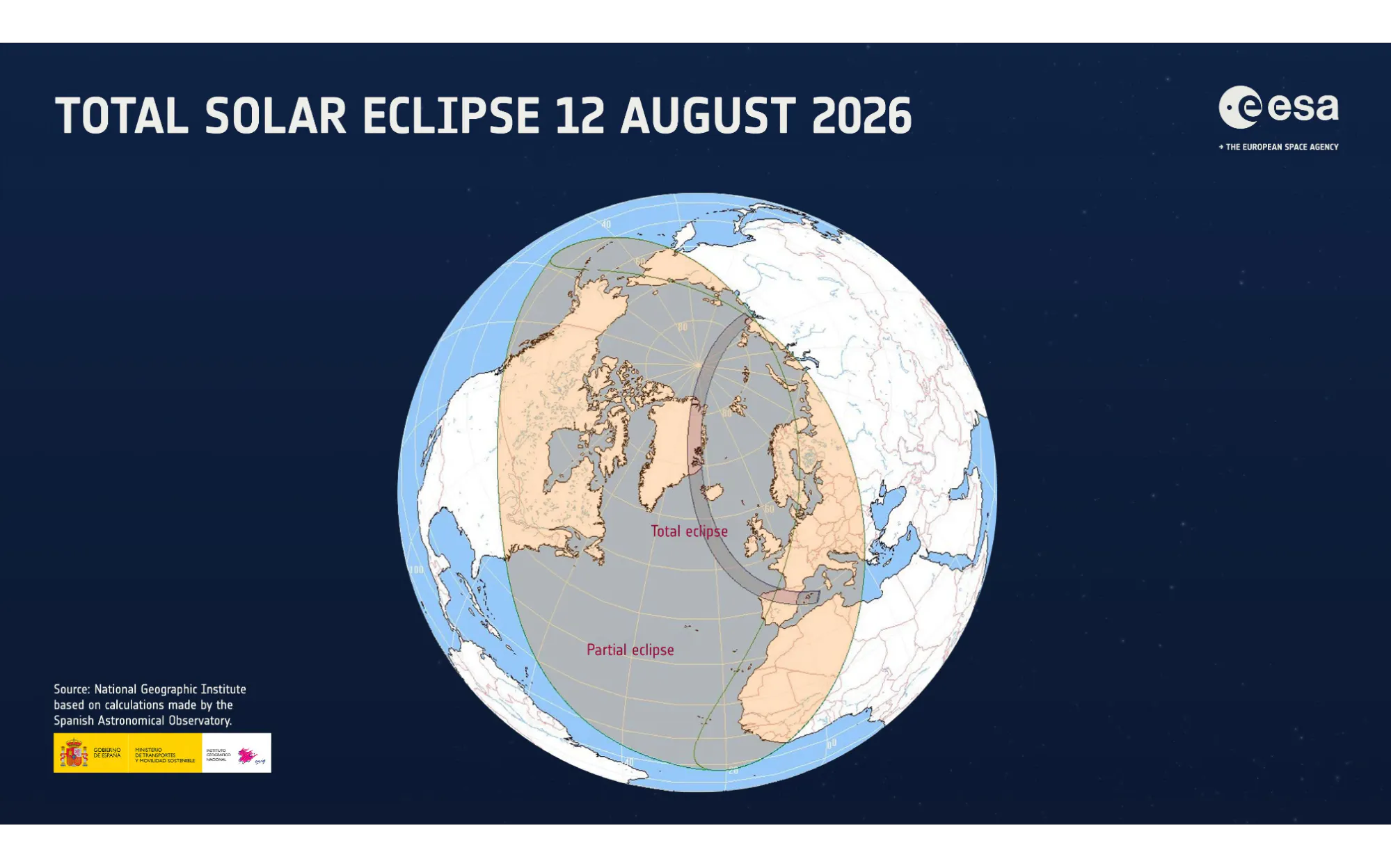
On August 12, 2026, a total solar eclipse will cross the North Atlantic before passing over Iceland and Spain. It will be the first total eclipse visible from mainland Europe since 1999, and for hosts inside the path of totality, it could become one of the biggest demand events of the year.
Unlike most travel trends, eclipse demand is remarkably concentrated. Travelers don't spread evenly across a country. They flock to the narrow corridor where the eclipse can be seen in full, creating a sharp but short-lived spike in bookings.
In this report, we compare short-term rental performance inside the path of totality with comparable markets just outside it to understand how much value the eclipse is likely to create, and where hosts stand to benefit the most.
What the 2024 Eclipse Can Teach Us
Fortunately, we don't have to guess how travelers respond to an eclipse. The North American eclipse of April 2024 provides a clear blueprint.
The impact on short-term rentals was substantial, but highly localized. Markets inside the path of totality reached occupancy of 88%, while ADR increased 18.4% year over year. Markets outside the path saw only modest gains. The lesson was clear: eclipse demand doesn't lift an entire country. It concentrates almost entirely in the places where travelers can experience totality.
The 2026 eclipse presents a similar opportunity across two very different markets. In Spain, the path crosses a broad swathe of the north and east, including Zaragoza, Valencia, Bilbao, and Palma de Mallorca, while Madrid and Barcelona sit just outside it. In Iceland, the path crosses the country's west and south, giving much of its tourism infrastructure a front-row seat to the event. Throughout this report, we compare markets inside and outside the path to isolate the eclipse's true impact, rather than simply looking at national trends.
Where the Eclipse Meets Short-Term Rental Supply
To understand the eclipse's potential impact, we first looked at how much short-term rental supply falls within the path of totality across the two countries expected to attract the most visitors: Iceland and Spain.
The difference is striking. In Iceland, around 6,000 of the country's 9,000 available listings, or 63.8%, sit inside the path. Because the eclipse crosses Iceland's busiest western and southern regions, it covers the majority of the country's active short-term rental inventory. In a small market with limited supply, a concentrated surge in demand has the potential to influence national performance.
Spain's pricing response is much less pronounced. Of its 365,400 available listings, 77,627 (21.2%) fall within the path of totality. While that share is much smaller than Iceland's, the absolute volume is enormous. Spain's in-path supply alone is more than eight times the size of Iceland's entire short-term rental market. The opportunity is therefore very different: Iceland faces a market-wide event, while Spain sees demand concentrated across a significant portion of a much larger market.
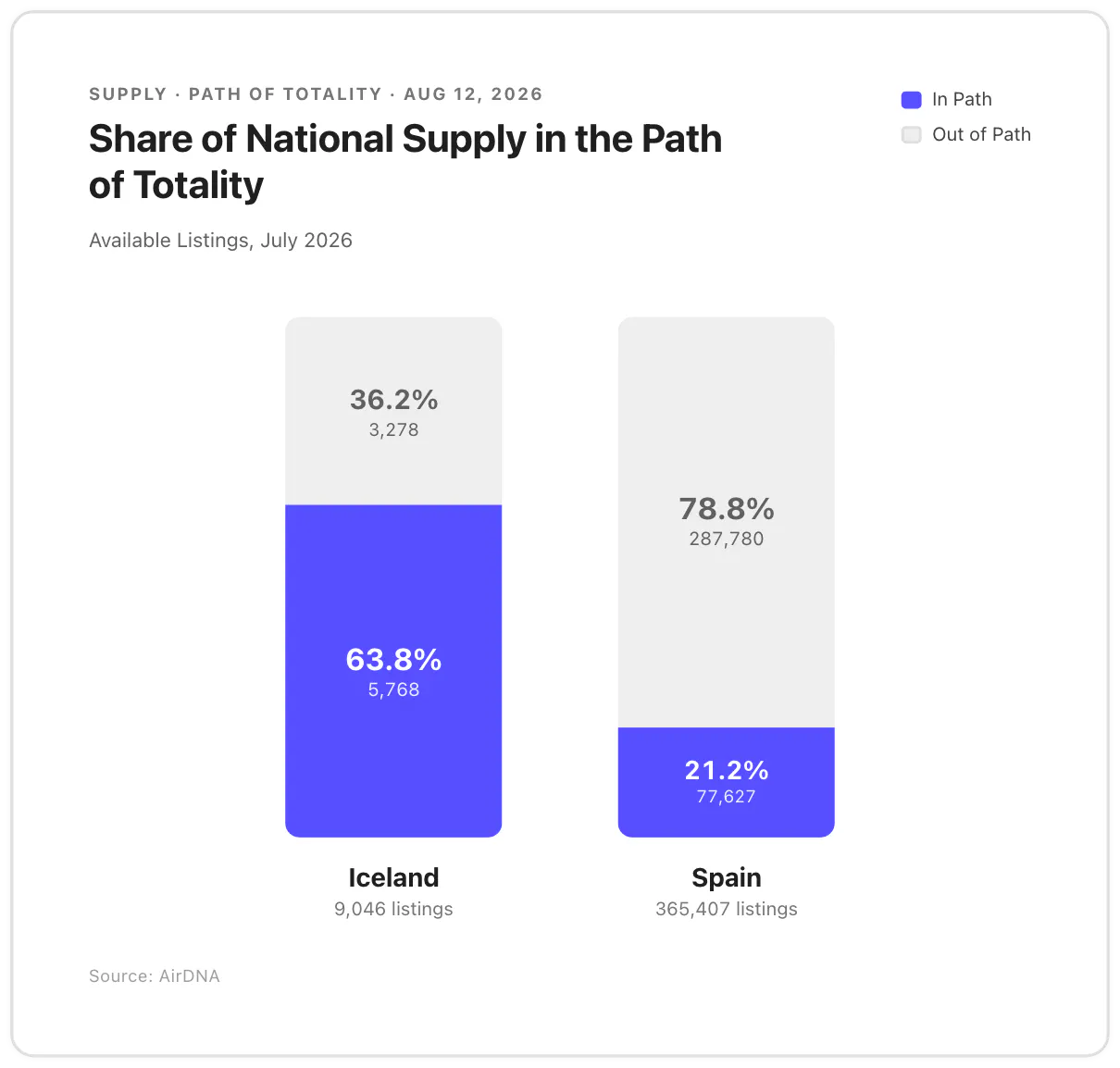
These figures represent available listings as of July 2026 and provide a snapshot rather than a fixed total. Supply is likely to grow as the eclipse approaches, particularly within the path of totality, as more hosts make properties available for the event. As a result, the final eclipse-week inventory could be higher than the figures shown here.
Eclipse Demand Is Already Taking Shape
Demand pacing for the eclipse window already shows a clear divide between markets inside the path of totality and those outside it.
As of August 10th in Spain, demand within the path is pacing 1.6% behind last year for the night of August 11-12, while demand across the rest of the country is down 9.1%. The contrast suggests the relative outperformance is being driven by the eclipse rather than a broader improvement in Spanish travel demand, even as both cohorts are trailing a stellar 2025 performance.
The strongest gains are concentrated in inland markets close to the centerline of totality rather than Spain's traditional coastal destinations. As of August 10th Zaragoza leads with demand pacing 55.3% ahead of last year, followed by Logroño (51.9%), Valladolid (43.7%), and Burgos (39.7%). The markets vary considerably in size, from regional cities to Zaragoza, Spain's fifth-largest city, suggesting location matters far more than market size.
The pattern is even stronger in Iceland. Demand within the path is pacing 39.5% ahead of last year, compared with 13.2% across the rest of the country for the night of August 11-12. In other words, demand inside the path is growing almost three times faster than elsewhere. Kópavogur is pacing 26.9% ahead of last year, while Reykjavík is up 34.2%.
This reflects the different market dynamics discussed earlier. Because most of Iceland's short-term rental inventory sits inside the path of totality, a concentrated influx of visitors has a much larger effect on national performance than it does in Spain's much larger market.
| City | Demand YoY | Country |
|---|---|---|
| Zaragoza | 55.3% | Spain |
| Logroño | 51.9% | Spain |
| Valladolid | 43.7% | Spain |
| Burgos | 39.7% | Spain |
| Reykjavík | 34.2% | Iceland |
| Kópavogur | 26.9% | Iceland |
Same Eclipse, Two Different Trip Types
The eclipse doesn't just increase demand. It also changes how long people stay, and it does so very differently in Spain and Iceland.
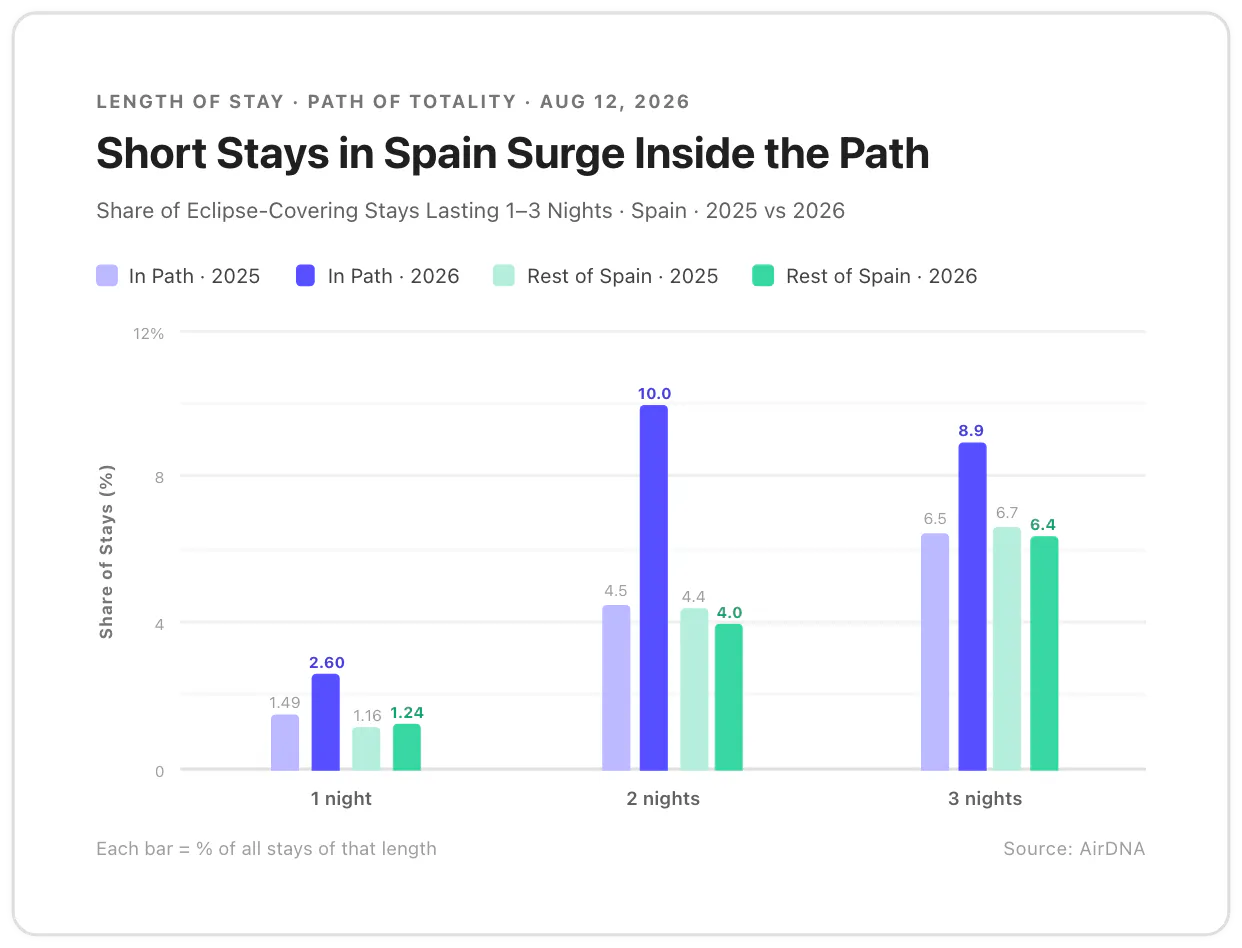
In Spain, the eclipse drives a clear shift toward short trips. The share of two-night bookings within the path of totality doubled year over year, from 4.5% to 10.0%, while falling slightly outside the path. Three-night stays also increased, and the average length of stay within the path fell from 12 to 9.5 nights. Longer stays became less common, pointing to a wave of deliberate one-to-three-night eclipse trips rather than traditional summer holidays.
Iceland tells the opposite story. The share of one- and two-night stays fell within the path, while bookings shifted toward trips of four to six nights, with three-night stays also increasing. The pattern was unique to markets inside the path of totality and suggests travelers are using the eclipse as the centerpiece of a longer trip rather than making a brief visit.
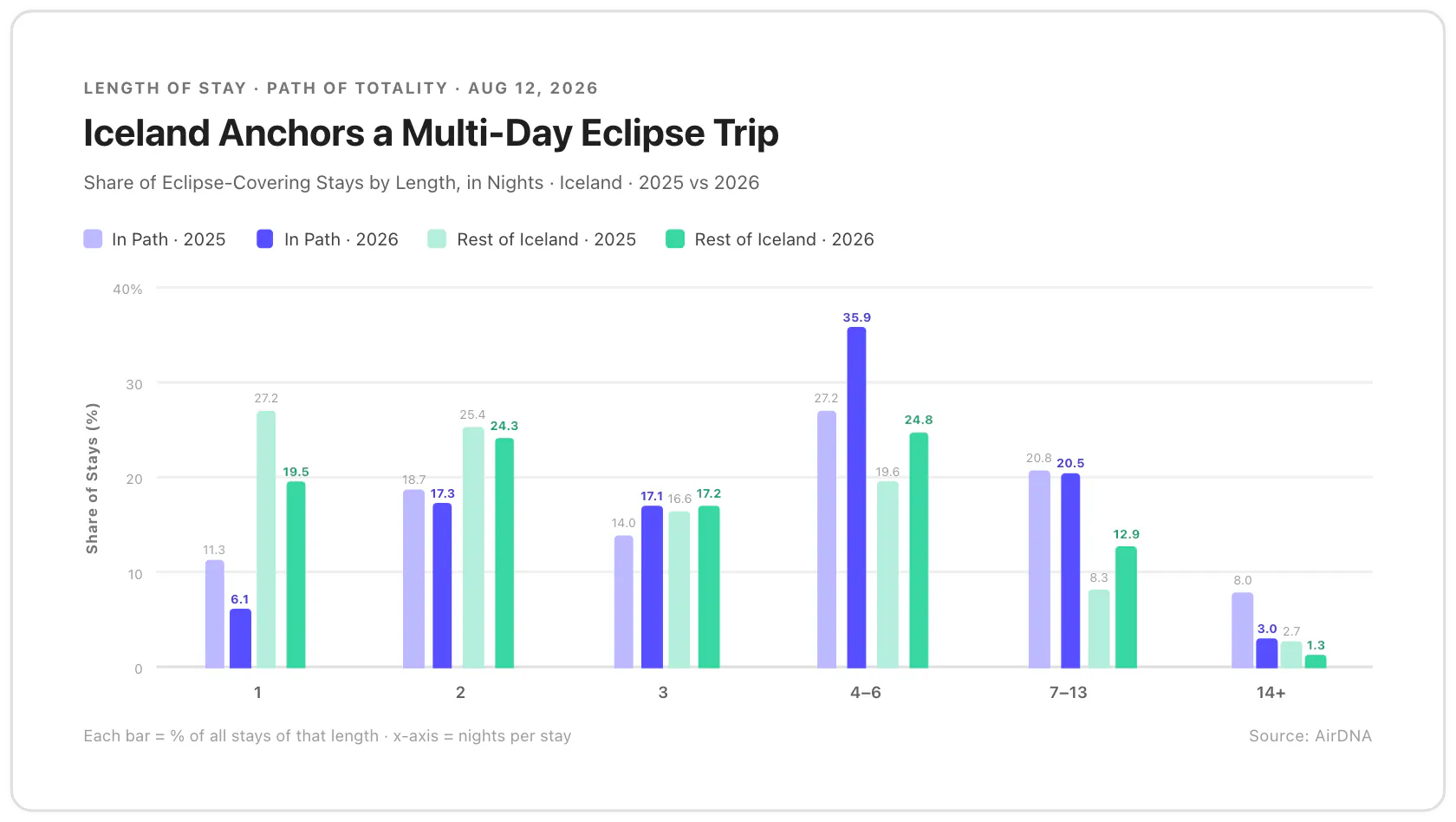
The difference comes down to accessibility. Although both countries attract overwhelmingly international visitors, Spain is a short-haul destination for much of Europe, making a two- or three-night eclipse trip relatively easy. Iceland, by contrast, is a long-haul destination where travelers are more likely to build a multi-day vacation around the event. The same eclipse produces two very different booking patterns simply because one destination is much easier to reach than the other.
For hosts, the takeaway is straightforward. In Spain, the opportunity lies in pricing and positioning for high-turnover short stays. In Iceland, it's about capturing longer bookings. Minimum-night rules and pricing calendars around August 11 and 12 should reflect those different booking patterns rather than treating the two markets the same.
Occupancy Peaks on Eclipse Day
Occupancy is the clearest measure of how eclipse demand translates into bookings. Looking at daily occupancy across the week of August 9-15, the pattern is unmistakable. In both countries, occupancy rises sharply inside the path of totality before quickly returning to normal once the eclipse has passed.
In Spain, the effect is dramatic. Three days before the eclipse, occupancy within the path already exceeded the rest of the country by 5.8 percentage points. The gap widens each day, peaking at 15.4 points on August 12, when in-path occupancy reaches 91.7%, compared with 76.3% outside the path. The advantage fades almost as quickly, shrinking to 2.5 points by August 15. Occupancy outside the path remains broadly unchanged throughout the week, confirming that the spike is driven by the eclipse rather than broader seasonal demand. The rapid return to normal also mirrors the shorter booking patterns seen earlier.
Iceland tells a different story because the markets begin from very different occupancy levels. The Reykjavík region, which sits inside the path, typically runs below Iceland's rural summer destinations, creating a structural occupancy gap before the eclipse even begins. Looking only at the gap between in-path and out-of-path markets therefore understates the event's impact.
Instead, the year-over-year comparison provides the clearer picture. Occupancy within the path is rising by around 1.1 percentage points on eclipse day, with the rest of the nation seeing a -7.6 percentage point decline.
The difference is capacity. In Spain, inland cities still have room to absorb a surge in bookings. Iceland, by contrast, is already close to full during the peak summer season, with many out-of-path markets running between 76% and 82% occupancy. That leaves less room for occupancy to grow, meaning additional eclipse demand is more likely to translate into higher rates than higher occupancy. In both countries, however, the effect is tightly concentrated around eclipse day before fading within a matter of days.
Why Iceland Sees Bigger Rate Gains
The ADR data completes the picture. While the eclipse fills more properties in Spain, it pushes rates much higher in Iceland.
In Iceland, ADR growth accelerates sharply as the eclipse approaches. After running around 7 to 10 percentage points ahead of the rest of the country during the preceding days, in-path ADR growth jumps to 45.2% year over year on August 11 and 53.7% on August 12, compared with roughly 18% to 24% elsewhere. Within a few days, the premium has largely disappeared as demand returns to normal with a similar YoY change of 21.5% for the markets in the path compared to 20.2% for the rest of the nation.
Spain shows little evidence of a similar rate response. ADR within the path remains modestly ahead of the rest of the country throughout the week, but that premium is actually smaller on the eclipse dates than on the surrounding days. Rather than driving prices higher, the additional demand is absorbed through higher occupancy.
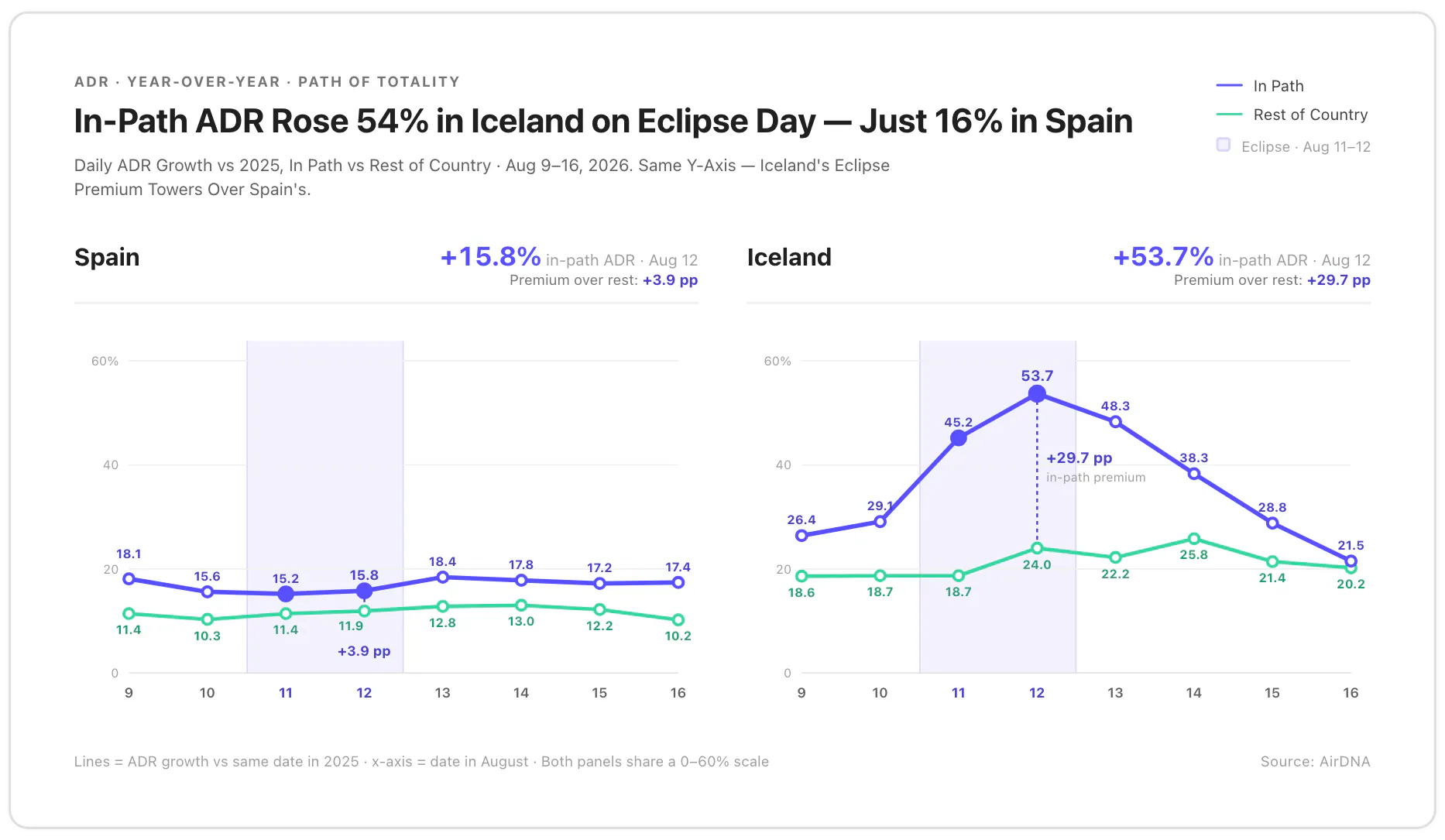
The explanation is straightforward. Spain's inland markets still have room to accommodate more visitors, allowing occupancy to increase without putting significant pressure on prices. Iceland enters the eclipse period much closer to peak summer occupancy, leaving rates as the primary mechanism for balancing additional demand. Longer international trips also make Iceland's visitors less price-sensitive than travellers taking shorter eclipse breaks in Spain.
Taken together, the occupancy, ADR, and length-of-stay data point to the same conclusion. Accessibility shapes the type of trip visitors book, while available capacity determines whether demand appears in occupancy or price. The result is fuller calendars in Spain and higher nightly rates in Iceland.
Adjusting Minimum Stay Policies
Minimum-night requirements represent a primary lever for hosts, dictating which guest segments can access their calendars. By shifting from a one-night to a two-night minimum, hosts effectively filter for longer stays, swapping sheer booking volume for increased revenue per guest and reduced operational friction. During a hyper-specific demand event like the 2026 eclipse, this strategy becomes particularly potent. Since the influx of travelers is predictable and fixed to a single date, implementing a two-night minimum helps secure the surrounding shoulder nights that might otherwise remain vacant. Consequently, analyzing minimum-stay trends serves as a proxy for host awareness; it reveals who is proactively optimizing their strategy for the event rather than merely reacting as bookings materialize.
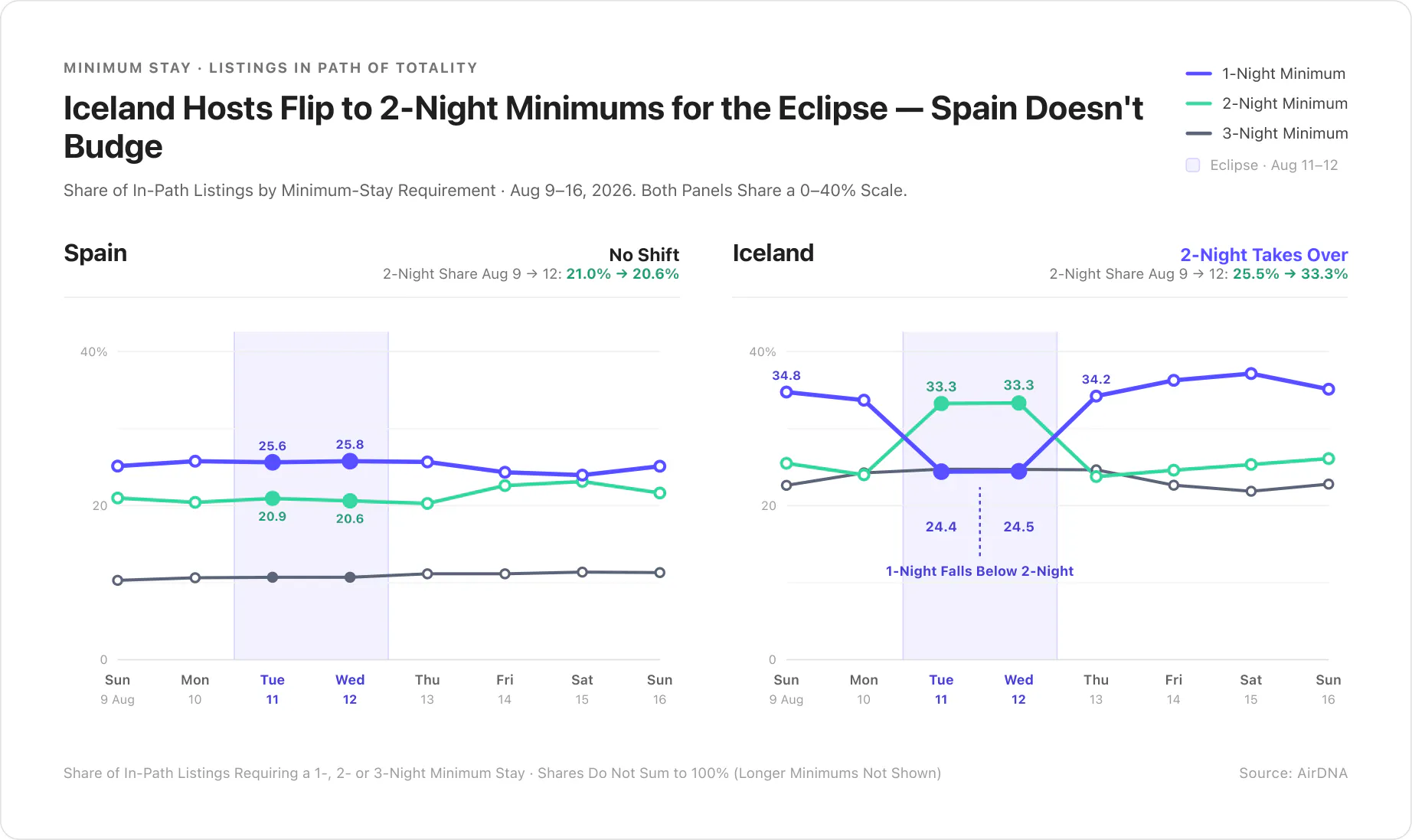
Within Spain's path of totality, minimum-stay requirements remained remarkably static. Listings requiring a one-night minimum accounted for 25.1% of inventory on Sunday, August 9, and moved only slightly to 25.8% by eclipse day. Similarly, the share of two-night minimums shifted from 21.0% to 20.6% over the same period, representing no real strategic adjustment for the year's highest demand nights. The only noticeable shift occurred following the main event; on Friday, August 14, and Saturday, August 15, two-night requirements rose to 22.6% and 23.1% while one-night stays dipped to 24.3% and 24.0%. This mirrors standard weekend booking behaviors rather than a specific reaction to the eclipse. Historical data from August 2025 supports this, as two-night shares peaked at 23.7% and 23.8% on the corresponding Friday and Saturday. Spanish hosts largely adhered to their routine peak-season settings, even as in-path occupancy climbed to 91.7% on August 12.
Iceland tells the opposite story. For the nights of August 11 and 12, around ten percentage points of inventory inside the path of totality transitioned from a one-night to a two-night minimum. Specifically, the one-night share dropped from 34.8% to 24.4%, while the two-night share climbed from 25.5% to 33.3%, a broadly offsetting shift that saw two-night requirements become the dominant setting for the only time during the eclipse window. This change was brief, with the one-night share bouncing back to 34.2% by Thursday. The timing clearly indicates a strategic move; because August 11 and 12, which were a Tuesday and Wednesday, fell midweek, this appears to be a deliberate response to the eclipse, not a weekend influence. Icelandic hosts effectively shifted their weekend-style restrictions to coincide with the event, causing in-path minimums to actually dip below previous-year levels during the actual weekend that followed. This strategy functioned in tandem with pricing: in-path ADR reached a peak of €352 on eclipse day, a 53.7% year-over-year increase, while demand surged 39.6% and four-to-six-night bookings grew by 79%.
Turning Eclipse Demand Into Revenue
The eclipse shows how quickly demand can reshape a market, but not always in the same way. In Spain, the opportunity comes from capturing a surge in short-stay bookings. In Iceland, it comes from recognising when limited supply allows rates to rise.
That's where dynamic pricing makes the difference. Rather than relying on historical patterns, AirDNA Adapt uses forward-looking demand signals to recommend pricing and stay rules that reflect how guests are booking. For events like the eclipse, that means helping hosts capture higher rates where demand is constrained and maximise occupancy where there is still room to grow.
The same approach applies to concerts, festivals, and major sporting events, but a total solar eclipse offers only one opportunity to get pricing right. With another total eclipse crossing Spain in 2027, hosts who use this year's event to refine their pricing strategy will be in the strongest position to capture the next one.
FAQs
How will the 2026 solar eclipse affect short-term rental demand?
Demand is expected to be concentrated within the path of totality, with hosts in those markets likely to see higher occupancy, stronger booking activity, and, in some destinations, higher nightly rates.
Why are the short term rental impacts of the eclipse different in Spain and Iceland?
The report shows demand is likely to play out differently because of each market's starting point. Spain has more available inventory, allowing occupancy to grow, while Iceland is already close to peak summer occupancy, making higher rates the more likely outcome.
How can Airbnb hosts prepare for the eclipse?
Reviewing pricing, minimum-night requirements, and availability well in advance can help hosts make the most of eclipse demand. Dynamic pricing tools such as AirDNA Adapt can also help identify changing demand patterns and adjust pricing accordingly.
ARTICLE SUMMARY
The 2026 total solar eclipse is expected to create a sharp surge in short-term rental demand within the path of totality. This report examines how booking patterns differ between Spain and Iceland, revealing where hosts are likely to see higher occupancy, stronger ADR growth, and the greatest revenue opportunities.
Camilo Schmid Rivas
Senior Research Analyst
Camilo Schmid Rivas is a Senior Research Analyst at AirDNA who brings a uniquely well-rounded perspective to short-term rental analytics. With a background that spans investment, real estate, and business analysis—including roles at Stayery and Sollers Consulting—Camilo has worn many analyst hats, each sharpening his ability to turn complex data into clear, actionable insights. A graduate of École hôtelière de Lausanne, he now channels his multidisciplinary expertise into uncovering trends that drive smarter STR decisions. In his free time, he enjoys playing tennis or scuba diving in or around Barcelona.