


Who Is Affected by Airbnb’s New House Rules? What Our Data Shows
Published: November 6, 2026

Linda Rollins
Does your listing ask guests to sign a rental agreement? Charge $500 if someone smokes? Strip the beds and run the dishwasher before they leave? Starting with bookings made on November 20, 2026, a lot of that has to go. Airbnb’s new house rules ban host fines and heavy checkout chores and limit rental agreements and ID requests. We looked at what hosts were actually writing on their listings before the change to see who it really affects.
Who Will Be Impacted the Most?
Mostly large vacation rental managers. They’re the hosts most likely to require a rental agreement or collect guest ID, which in most cases Airbnb’s new policy won’t allow. According to AirDNA data, about 3 in 10 homes run by property managers with more than 100 listings require a rental agreement and about 4 in 10 ask for ID, compared with under 5% of homes from single-listing hosts, so most small hosts have much less to change. Across all US Airbnb entire homes, about 13% require a separate rental agreement, about 14% ask for ID or guest information, about 18% list a fine, and about 6% ask for a checkout chore Airbnb is banning.
All figures are AirDNA data for Airbnb entire-home listings, with house rules and listing descriptions as of each listing’s latest scrape between September 21 and October 19, 2026, unless noted. These figures only cover what’s written on the listing. Anything hosts send off the platform, such as agreements or rules shared by message or email after booking, isn’t included, so every share is a minimum.
What Is Changing in Airbnb’s House Rules on November 20, 2026?
Airbnb announced on October 21, 2026 that house rules must be “reasonable” and listed in one place on the listing page, and that hosts can no longer add requirements by message or with signs in the home. The changes apply to reservations booked on or after November 20, 2026. Bookings made before then keep the rules that were in place when they were booked.
According to Airbnb, the new policy:
- Ends heavy checkout chores. Hosts generally can’t require guests to strip beds, start laundry, wash or put away dishes, or take trash off the property, but they can still ask guests to put used dishes in the sink.
- Bans host-imposed fines. Hosts can’t set their own penalties (damage is covered by Airbnb’s AirCover protection for hosts instead), and any fee for an advertised feature has to be in the price shown at booking.
- Limits separate contracts. A rental agreement is generally allowed only when local law or a community association requires it, for optional amenities, for stays of 28 nights or more and for Luxe listings.
- Limits what hosts can ask for. Hosts generally can’t collect copies of ID, contact or financial details, background checks or outside sign-ups to get in. That includes Wi-Fi login pages, like those from StayFi, that ask guests for an email address or other personal information, unless the listing is a hotel or resort.
- Sets check-in and checkout limits. Check-in can’t start later than 4 PM, and checkout can’t be earlier than 10 AM.
- Separates rules from requests. Seven standard house rules (maximum overnight guests, quiet hours, events, pets, smoking, commercial photography and locking up at checkout) are mandatory, and everything else is a request guests are encouraged to follow.
Airbnb says the goal is clearer expectations and fewer surprises for guests. Not every host agrees. Petitions and the #ItsNotAboutTheDishes campaign argue that the changes also take away tools hosts use for safety and screening.
Most hosts already use the standard rules. In the US, about 89% of entire homes list no smoking and about 83% list no parties or events. The bigger change is in the custom rules hosts write underneath them.
To see how many hosts were already asking for the things Airbnb is now limiting (rental agreements, ID, fines and checkout chores), we checked each listing’s “additional rules” section and listing description. We looked at listings before Airbnb’s new standard rules started appearing.
Which Airbnb Hosts Require Rental Agreements or Ask for ID?
Who asks guests for a signed agreement or an ID depends on three things: where the home is, how many homes the host runs, and whether it’s also listed on Vrbo. According to AirDNA data, about 13% of US Airbnb entire homes require a rental agreement and roughly 14% ask for ID, but those shares climb far higher among large managers, in traditional vacation markets and on homes listed on Vrbo as well.
More than 1 in 8 US homes requires a rental agreement; Spain and Italy lead on ID requests
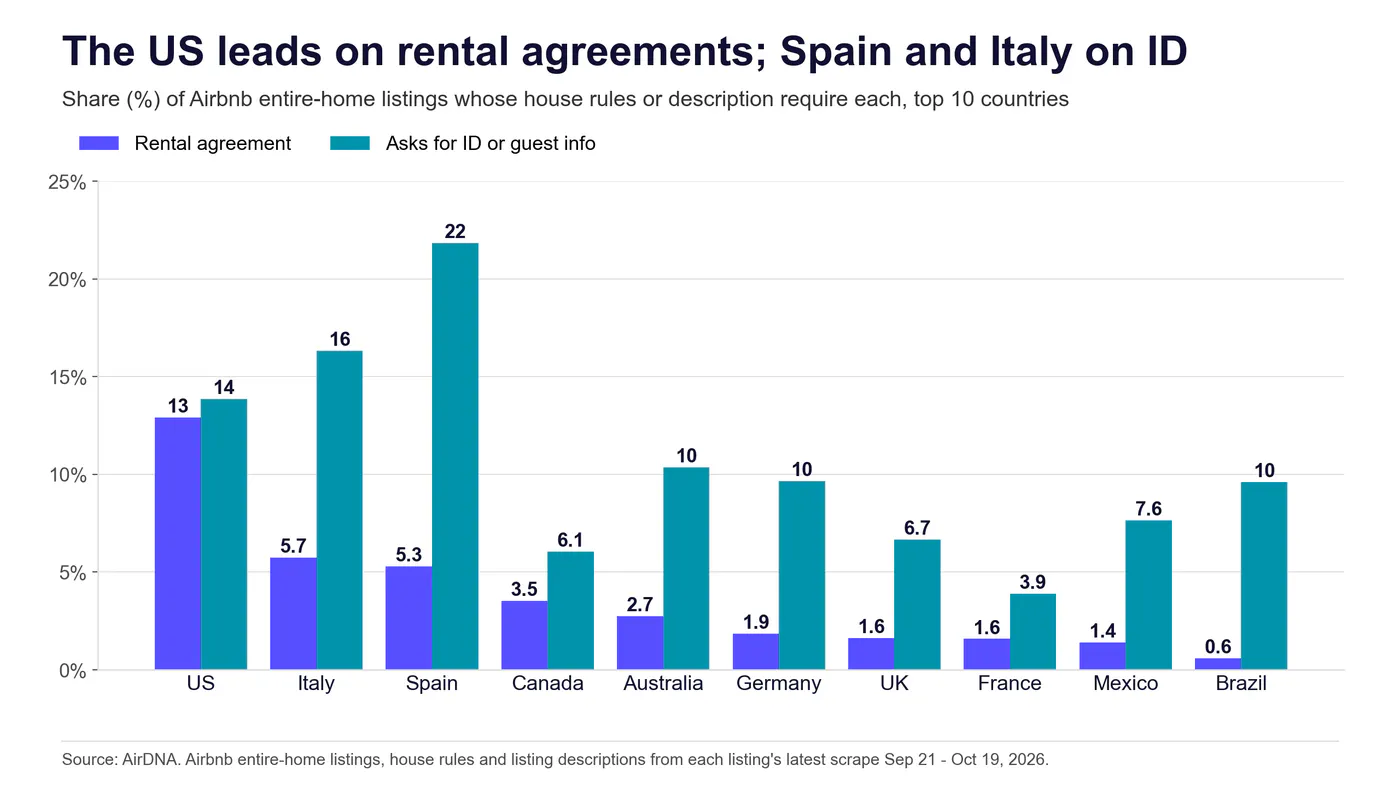
In the US, about 13% of entire homes require a rental agreement. Outside the US, separate rental agreements are rare. Italy has the highest share of the other countries, at nearly 6%, and some of those are agreements Italian rules require, which the new policy still allows. In France and Germany it’s under 2%.
ID requests follow the law instead. More than 1 in 5 homes in Spain and about 1 in 6 in Italy ask for ID or guest information, the highest of the 10 countries, compared with about 14% in the US. The reason is that both countries require hosts to register every guest’s identity documents with the police.
The real share of listings that require ID in Spain and Italy is probably higher. In both countries, many hosts check ID in person at check-in and never mention it on the listing. Nearly 4 in 5 Spanish listings don’t mention the registration anywhere, because most hosts handle it by message, a check-in link or at the door. Many Spanish and Italian listings hint at it without mentioning ID: they charge a late check-in fee, ask for your arrival time, have guests check in at an office or say the host hands over the keys in person.
Agreements and ID checks vary widely by market
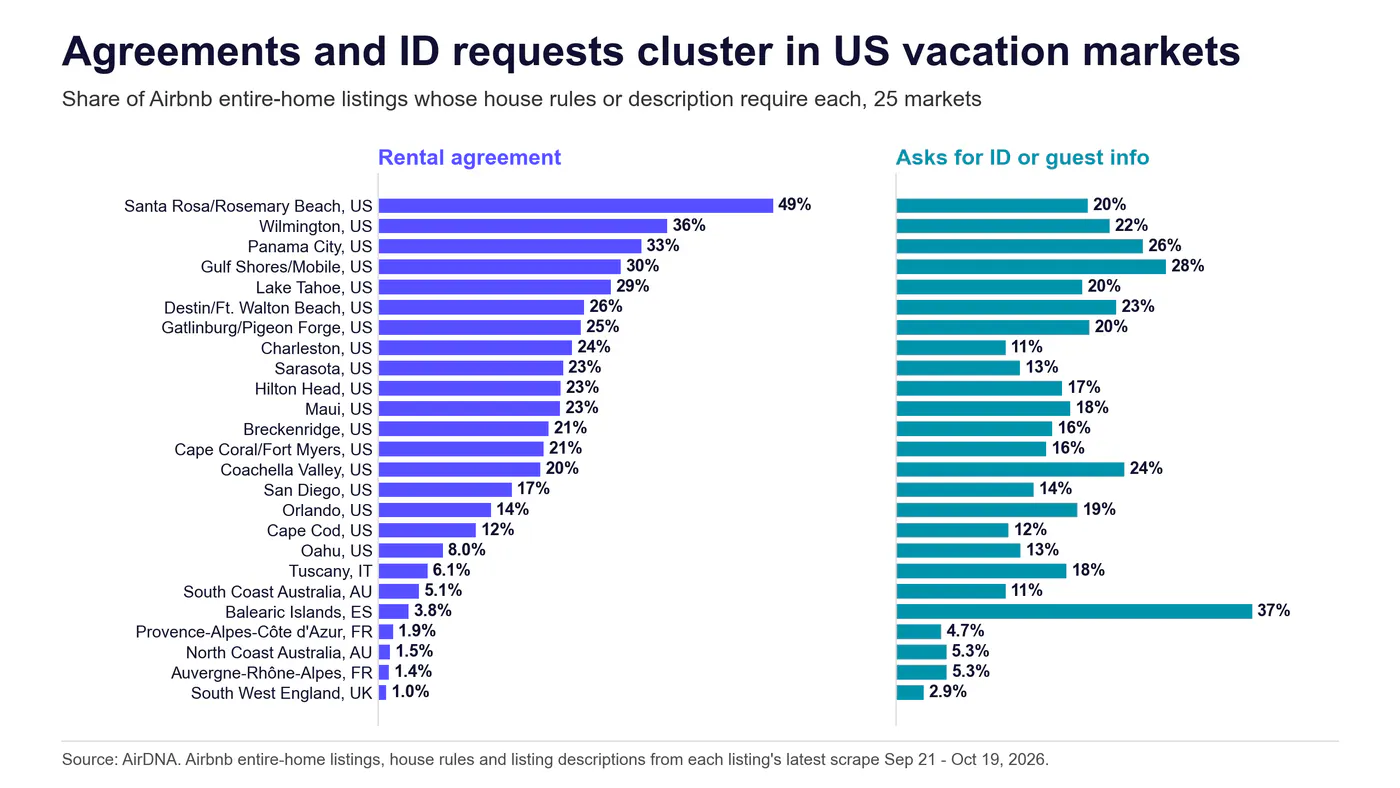
The share of listings that require rental agreements or ID also varies widely by market. In the US, agreements cluster in drive-to beach and mountain markets. Nearly half of entire homes in Santa Rosa/Rosemary Beach require one, more than a third in Wilmington and about a third in Panama City.
ID requests are more spread out. In Spain, more than a third of homes in the Balearic Islands require ID. In US beach markets, it’s more than a quarter in Gulf Shores and about a quarter in Panama City. In the French markets and South West England, it’s about 3% to 5%.
The bigger the host, the more paperwork
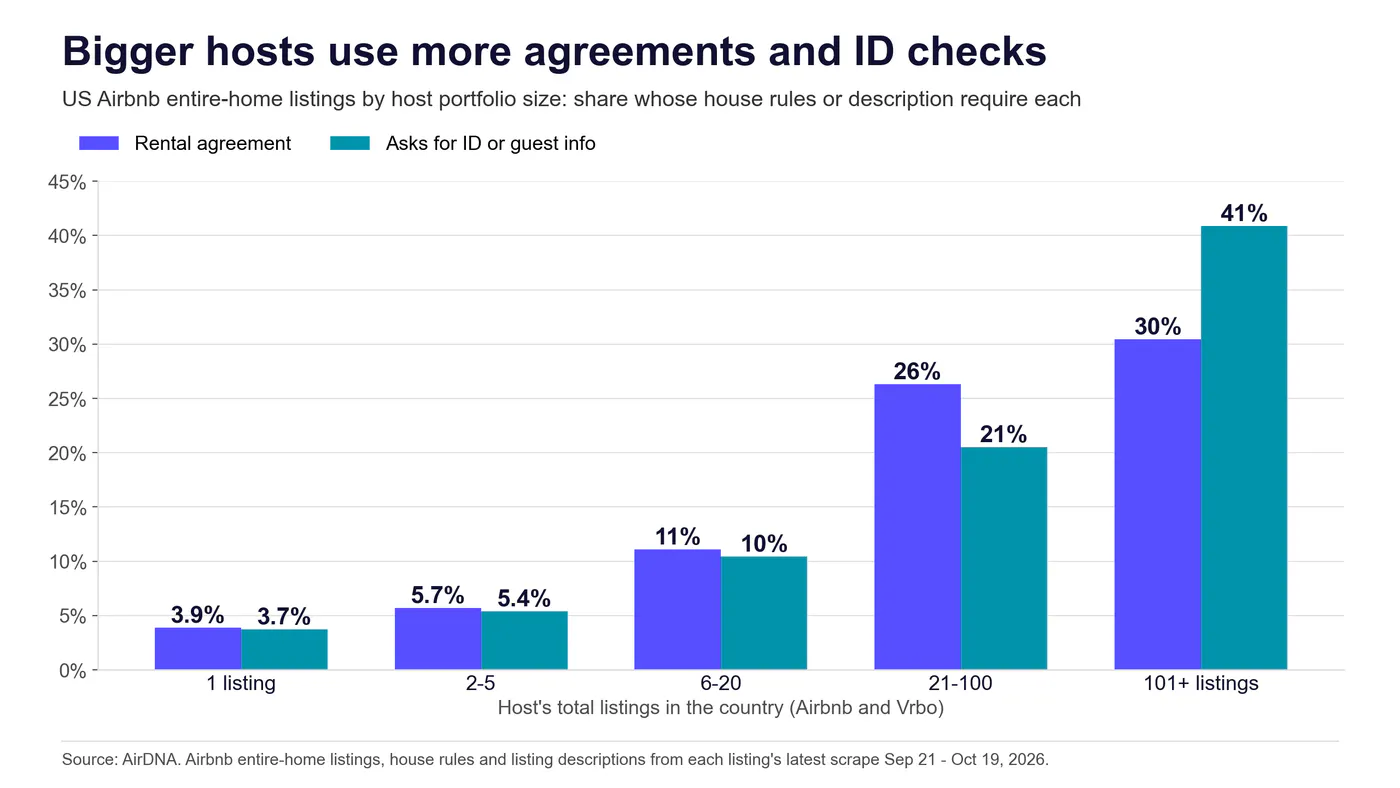
Rental agreements and ID requests climb steadily with portfolio size. About 4% of US hosts with a single listing require a rental agreement, compared with about 3 in 10 homes run by hosts with more than 100 listings. ID requests rise even faster, from under 4% of single-listing hosts to about 4 in 10 homes run by the largest hosts.
The reasoning is straightforward. Large managers run standardized operations, with one rental agreement and one online check-in form applied across hundreds of homes where they rarely meet guests face to face. A single-listing host is more likely to rely on a conversation with the guest than on paperwork.
The same holds in Spain and Italy, where about half of homes run by hosts with more than 100 listings ask for ID (55% and 48%), compared with about 8% of single-listing hosts in both countries.
Many large managers also roll the two into one step: the same online check-in form asks guests to upload ID and sign the rental agreement. That means some listings that only mention an ID check or a check-in link are likely collecting a signed agreement too, which is one more reason the agreement share in this post is a minimum.
Homes also on Vrbo are five times more likely to require an agreement
US homes also listed on Vrbo are about five times more likely to require a rental agreement than homes listed only on Airbnb (about 20% vs. under 4%) and about three times more likely to ask for ID (about 20% vs. 6%). That isn’t just because big managers are the ones who cross-list. The gap holds among smaller hosts as well: single-listing hosts who are also on Vrbo require an agreement about three times as often as single-listing hosts on Airbnb only (about 7% vs. 2%), and the same is true for hosts with 21 to 100 listings (about 32% vs. 10%). That points to agreements and ID checks being habits that come from the traditional vacation-rental world, not just a sign of a big operator. Vrbo lets hosts attach their own rental agreement that guests accept when they book, so managers who list on both sites are used to working with one and often carry the same terms over to their Airbnb listings. Hosts weighing Airbnb vs. Vrbo will find the two sites now handle this very differently.

What this means for hosts. If your listing requires a rental agreement for every stay, check whether it falls under one of Airbnb’s exceptions. If it doesn’t, the terms you care about (occupancy, pets, parties) need to move into your listing’s house rules before November 20. ID is less clear-cut. The new policy generally stops hosts from asking for copies of ID or making guests sign up on an outside site to get in, but requirements set by law are still allowed, and hosts can still check ID in person at check-in if the listing says so. If the law requires you to collect ID before arrival, say so clearly on the listing rather than asking for it later. And if your smart lock needs its own app, guests have to be able to ask for another way in.

How Common Are Host Fines and Checkout Chores?
Fines depend on where a home is and who runs it, but checkout chores don’t follow either rule. According to AirDNA data, about 1 in 6 US Airbnb entire homes (roughly 18%) lists a fine, compared with under 4% in Europe, and fines rise with host size up to about 100 listings. The chore ban has dominated the headlines, yet it affects only about 1 in 16 US listings, a share that barely changes from small hosts to large ones.
Fines are a North American habit; Australia leads on chores
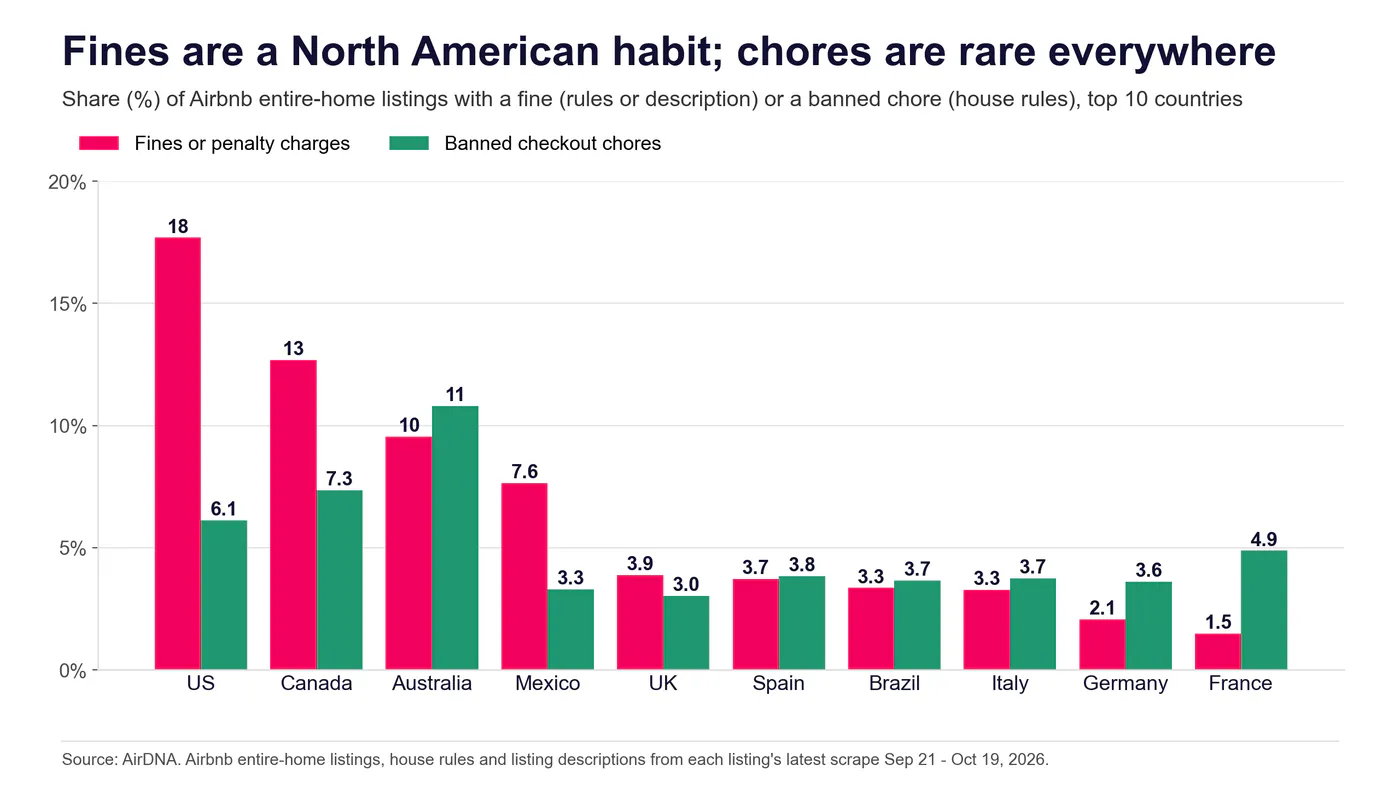
Fines are mostly a North American habit. The US leads at about 18%. Canada is next at about 13%, Mexico and Australia are at about 8% to 10%, and France is under 2%. The most common fines are charges for smoking, unauthorized guests or parties, late checkout, and leaving the home in a state that needs extra cleaning.
Chores are a different story. Australia has the highest share of homes asking for a banned chore, at about 11%, mostly washing dishes. Everywhere else, between about 3% and 7% of homes ask.
Washing or putting away dishes is by far the most common banned chore, at about 5% of US homes. About 1.3% ask guests to strip beds or start laundry, and about 0.6% ask them to take trash off the property. We count asking guests to put the bins out at the curb for collection as taking trash off the property, so that share is on the generous side. The reason chores are rare is that most checkout lists stick to lighter tasks: dishes in the sink or dishwasher, towels in a pile, trash in the outdoor bin.
Fines rise with host size up to 100 listings; chores don’t
Fines rise with host size up to about 100 listings. About 1 in 10 single-listing US hosts lists a fine, rising to nearly a third of homes run by hosts with 21 to 100 listings, before dipping to about a quarter for the largest hosts. Chores stay between about 5% and 7% at every portfolio size, because a checkout list is something every host writes, whatever the size of the business.
Fines cluster in a few US markets; chores are rarest where big managers dominate
Fines are most common in Santa Rosa/Rosemary Beach and Charleston, where more than a quarter of entire homes list one. In the French markets and South West England, it’s under 2%.
Chores are rarest in the markets most dominated by big managers. In Santa Rosa/Rosemary Beach and Hilton Head, where about two-thirds or more of homes are run by hosts with more than 20 listings, under 5% of homes ask, likely because those managers send in their own cleaning crews. Wilmington (about 17%) and the South Coast of Australia (16%) lead instead.

What this means for hosts. A posted fine was mostly a deterrent. Under the new rules, the deterrent has to come from clear house rules (no smoking, no parties, a guest limit) and good guest screening. Real damage is covered by Airbnb’s AirCover protection for hosts instead of a fee you set, which is worth backing with short-term rental insurance. For chores, rewrite your checkout list now: “wash and put away the dishes” becomes “put used dishes in the sink,” and “strip the beds” becomes “leave used towels in the tub.” If the extra work was saving you money on cleaning, that cost now belongs in your cleaning fee or nightly rate.
Will Airbnb’s New Rules Make Cleaning Turnovers Tighter?
Under the new policy, check-in can’t start later than 4 PM and checkout can’t be earlier than 10 AM. Most US hosts already fit inside those limits. Only about 2% of US Airbnb entire homes start check-in after 4 PM, and fewer than 1% set checkout before 10 AM.
The reason is that US vacation-rental managers already built their turnovers around that window. More than half of US homes start check-in at 4 PM and about 4 in 10 check out at 10 AM, which leaves cleaners about six hours between guests.
The hosts who have to change are mostly in Europe. About 18% of French entire homes start check-in after 4 PM, though most of those start at 5 PM, just an hour past the limit. The share rises to about 1 in 4 in Auvergne-Rhône-Alpes. Spain is next, at about 10%.

What this means for hosts. If your check-in starts after 4 PM or checkout is before 10 AM, move them before November 20. Hosts who used a later check-in to give cleaners more time now have to fit the whole turnover, including the work guests used to do, into six hours. Our guide to managing an Airbnb remotely covers scheduling cleaners.
What Should Hosts Do Before November 20?
- Read your house rules and description as a guest would. Remove fines, banned chores and requests for ID copies, contact details or outside sign-ups, unless a law or community association requires them. If your Wi-Fi uses a login page that asks for an email address, switch it to a plain password.
- Move anything important out of messages and signs. Requirements that only appear in a welcome book or a pre-arrival message won’t count under the new policy.
- Check your rental agreement against the exceptions. Local law, community-association rules, optional amenities, stays of 28 nights or more and Luxe listings can still use one.
- Check your check-in and checkout times. Move check-in to 4 PM or earlier and checkout to 10 AM or later, and make sure your cleaning schedule still fits.
- Sort what’s left into rules and requests. Anything outside the seven standard rules becomes a request. If a safety instruction, like hot tub rules or a steep trail, needs to be firm, ask Airbnb about an exception.
- Price for the work guests no longer do. If guests used to strip beds or wash dishes, your cleaning costs will rise. Look at what similar listings charge before you adjust your cleaning fee or rate.
Methodology
Listings. We looked at Airbnb entire-home listings that AirDNA tracked between September 1 and late October 2026, in the 10 countries with the most Airbnb entire homes and in 25 vacation-rental markets in the US, Europe and Australia. Private rooms, shared rooms and hotel rooms weren’t included.
Host size. A host’s size is the number of listings they had on Airbnb and Vrbo in that country, counting every listing type. Property managers count as one host across all their accounts where AirDNA can identify them.
Also on Vrbo. A listing counts as also on Vrbo if AirDNA matches it to a Vrbo listing for the same home.
What we counted. We searched each listing for four requirements:
- Rental agreements: any mention of a rental agreement, lease or contract for the stay, a liability waiver the guest must sign, or an e-signature tool or guest portal that includes an agreement-signing step.
- Fines: a fine or penalty charge. Replacement fees for lost keys don’t count.
- ID or personal information: any request for ID, including showing a photo ID at check-in, legally required guest registration, an online check-in or registration form, a background check or verification service, contact details or the names of all guests.
- Banned chores: stripping beds or starting laundry, washing or putting away dishes, and taking trash off the property. Putting bins out at the curb counts as taking trash off the property, but loading the dishwasher doesn’t count as washing dishes.
For agreements, fines and ID, we read the whole listing (the “additional rules” section, the description and other listing sections), because many managers put those terms in the description. For chores, we read the house rules only, since descriptions often mention cleaning the host does or advertise “no chores.”
Shares. Each share is the number of listings with the requirement divided by all listings with a rules scrape, including listings with no custom rules at all.
What we can’t see. Our data only covers what’s written on the listing. Anything hosts share after booking (by message, email, a booking link or a separate contract) or post inside the home isn’t included. Neither are ID checks done in person at check-in when the listing doesn’t mention them, which is common in Spain and Italy, where the law requires hosts to register guests. That means every share in this post is a minimum.
Source: AirDNA. Airbnb entire-home listings seen since September 1, 2026; house rules and listing descriptions from each listing’s latest scrape between September 21 and October 19, 2026.
FAQs
When do Airbnb’s new house rules take effect?
The new house rules apply to reservations booked on or after November 20, 2026. Bookings made before then keep the rules that were in place when they were booked.
Can Airbnb hosts still charge fines for breaking house rules?
No. Under the new policy, hosts can’t set their own penalties. Damage is covered by Airbnb’s AirCover protection for hosts instead, and any fee for an advertised feature has to be in the price shown at booking. According to AirDNA data, about 18% of US Airbnb entire homes listed a fine before the change.
Can Airbnb hosts still require a rental agreement?
Only in specific cases: when local law or a community association requires it, for optional amenities, for stays of 28 nights or more and for Luxe listings. About 13% of US Airbnb entire homes required a rental agreement before the change, rising to about 3 in 10 homes run by property managers with more than 100 listings.
Can Airbnb hosts still ask guests for ID?
Hosts generally can’t collect copies of ID, contact or financial details, or make guests sign up on an outside site to get in. Requirements set by law are still allowed, and hosts can still check ID in person at check-in if the listing says so. About 14% of US Airbnb entire homes asked for ID or guest information before the change.
What happens to house rules that aren’t one of Airbnb’s seven standard rules?
They become requests. The seven standard house rules (maximum overnight guests, quiet hours, events, pets, smoking, commercial photography and locking up at checkout) are mandatory, and everything else is a request guests are encouraged to follow.
ARTICLE SUMMARY
Airbnb’s new house rules, which apply to bookings made on or after November 20, 2026, ban host fines and heavy checkout chores and limit rental agreements and ID requests. AirDNA data on Airbnb entire-home listings shows about 13% of US homes require a rental agreement and 14% ask for ID, rising to about 3 in 10 and 4 in 10 among property managers with more than 100 listings.
Linda Rollins
Senior Research Analyst
Linda Rollins is a Senior Research Analyst at AirDNA and a self-managing short-term rental host, which means she understands the market as both an analyst and an operator. She writes research and blogs for AirDNA and for Adapt, its revenue management tool, making her work a go-to resource for investors trying to find and size up the right opportunities, and for operators looking to understand changing market dynamics and find concrete ways to improve occupancy, rates, and guest experience. Her data is regularly cited in major news outlets, and she has a knack for bringing both the numbers and the story behind them. In her free time, Linda enjoys spending time with her family, traveling, and looking for good eats.
Related




Get started with AirDNA today.
Powerful, easy-to-use tools that help hosts and investors succeed in the short-term rental market.
Try for free