


How to Calculate Your Airbnb Tax Deductions and Save Big
Published: September 30, 2025
Last updated: November 13, 2026

Bram Gallagher

Key Takeaways
- Airbnb tax deductions include everything from cleaning fees and utilities to depreciation on your property.
- Calculating your Airbnb tax deductions starts with estimating income, subtracting expenses, and layering in bonus depreciation, personal tax deductions (SALT), and QBI (business income deductions).
- The Big Beautiful Bill supercharges tax savings for hosts by restoring 100% bonus depreciation and raising the SALT deduction cap to $40,000 for qualifying taxpayers.
Every year, short-term rental hosts miss out on thousands in potential savings simply because they don’t know which Airbnb tax deductions they qualify for or how to calculate them. If you’ve ever found yourself wondering what counts as an Airbnb write-off or how to properly track expenses, you’re not alone.
In 2025, the stakes are even higher. With the Big Beautiful Bill tax savings now in play, hosts have more access than ever to powerful Airbnb tax benefits. These benefits range from 100% bonus depreciation to an expanded State and Local Tax (SALT) cap and enhanced Qualified Business Income (QBI) deductions.
However, to make the most of these new benefits, you’ll need a clear understanding of what impacts your Airbnb taxable income and how to approach accounting for Airbnb as a business.
This guide breaks it all down, so you can stop guessing and start calculating with confidence.
Smart investments happen here.
AirDNA’s powerful yet easy-to-use tools make hosting and investing a breeze. This means having every insight you need, all in one place, always up-to-date.
Start Exploring For FreeAirbnb Tax Deductions in the Era of the Big Beautiful Bill
Hosting in 2025 comes with a serious tax advantage. The Big Beautiful Bill, a sweeping update to the tax code, has reenergized the way short-term rental owners can access short-term rental tax deductions, making this one of the most deduction-friendly years in recent memory.
Under the bill, key tax benefits for hosts have expanded. You can now deduct 100% of qualified improvements in the year they’re made, thanks to the return of full bonus depreciation. The SALT deduction cap has quadrupled to $40,000 for many taxpayers, offering meaningful relief in high-tax states. Meanwhile, the QBI deduction—which lets qualified hosts deduct a portion of their net income—has been extended and enhanced.
In short: the Big Beautiful Bill makes it easier to reduce your Airbnb taxable income, but only if you understand how the pieces fit together to make the most of your Airbnb tax deductions.

Types of Airbnb Tax Deductions Available
Short-term rental hosts are eligible for a wide range of tax deductions, many of which go beyond the basics. Whether you're operating one listing or building a portfolio, these are the core categories that can help reduce your Airbnb taxable income.
Operating expenses
These are your everyday costs for keeping the property guest-ready and running smoothly. If you’re spending money to clean, stock, or maintain your rental, chances are it’s deductible. Operating expenses can include:
- Cleaning fees (whether you pay a service or do it yourself)
- Guest amenities like toiletries, coffee, or snacks
- Supplies and linens
- Routine maintenance and minor repairs
Property-related costs
These are the larger, ongoing expenses tied directly to property ownership. If your rental is generating income, you may be able to deduct:
- Mortgage interest
- Property taxes
- Homeowners association (HOA) fees
- Utilities—including internet, water, gas, and electricity
- Property insurance
Depreciation
Depreciation allows you to deduct the cost of your property and its improvements over time. Tith the Big Beautiful Bill, there’s a major upgrade.
- Standard depreciation spreads the value of your property (excluding land) over 39 years.
- Bonus depreciation, now restored to 100% under BBB, lets you deduct the full value of eligible improvements in the year they’re placed in service.
Many hosts choose to conduct a cost segregation study to unlock the full value of bonus depreciation. This process breaks your property into parts—like cabinets, flooring, and lighting—that can be depreciated on a faster timeline. That means bigger deductions, faster.
Think of it like a piggy bank that your parents told you you can’t have until you're 18. A cost-segregation study allows you to smash the piggy bank earlier and get your money quicker!
There’s one important thing to keep in mind: Land value is not depreciable. Only the building and improvements count.

Travel, marketing, and professional fees
If you’re actively managing your STR, your business-related expenses may also qualify. These often-overlooked deductions include:
- Mileage or travel expenses to and from your property
- Advertising or marketing costs
- Booking platform fees (which vary between Airbnb, Vrbo, and Booking.com)
- Legal and accounting for Airbnb services
SALT deduction increase
One of the biggest tax wins under the Big Beautiful Bill is the expanded State and Local Tax (SALT) cap. Previously limited to $10,000, the cap now goes up to $40,000 for eligible income brackets. That means significantly more room to deduct:
- State income taxes
- Property taxes
This is a key opportunity for hosts operating in high-tax states.
QBI deduction
If your Airbnb activity qualifies as a business, you may be eligible for the Qualified Business Income (QBI) deduction, which is worth up to 20–23% off your net rental income. To qualify, you generally need to “materially participate” in the business. That includes setting prices, managing bookings, or coordinating cleanings, so most active hosts check the box.
How to Calculate Airbnb Tax Deductions Step by Step
Once you’ve gathered your financial inputs, it’s time to run the numbers. These eight steps walk you through calculating your total deductions, estimating your Airbnb taxable income, and understanding the impact on your federal tax bill.
Step 1: Determine gross Airbnb income
If you already host: Use your 1099-K form or platform earnings report to find your annual gross rental income.
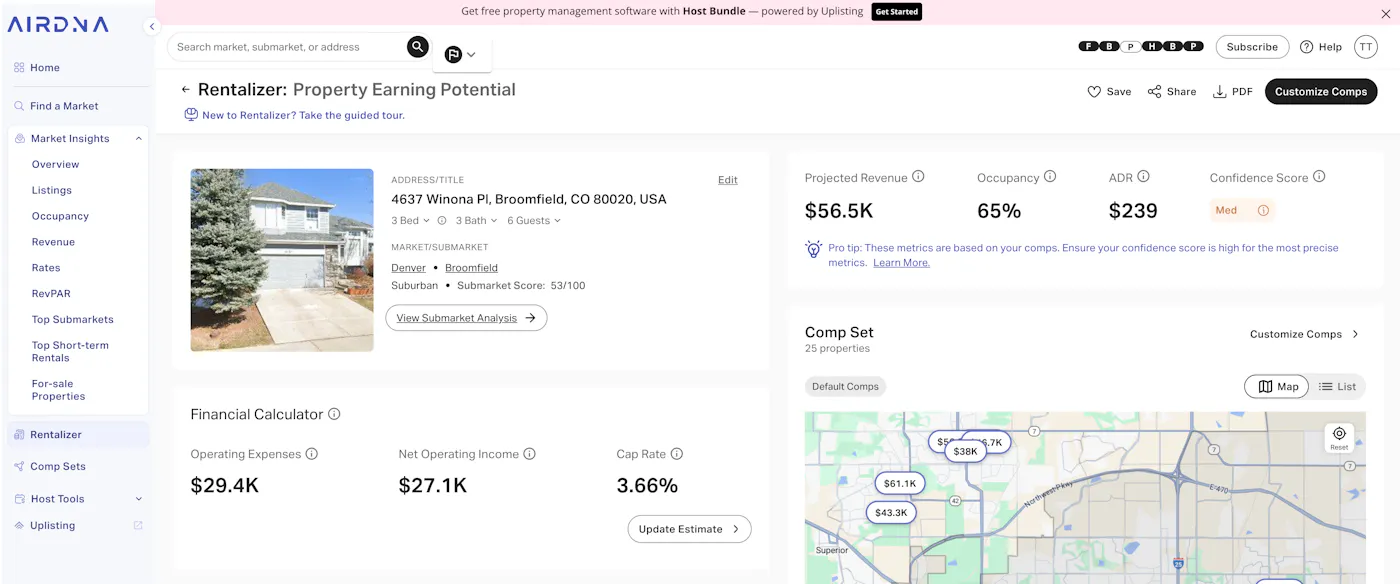
If you’re still in the planning phase: Use AirDNA’s Revenue Calculator to project income based on market demand, occupancy rates, and comparable listings. It’s a reliable way to estimate your future cash flow.
All you have to do is plug the address of a potential investment property in, and you’ll get a report with projected income, occupancy, average daily rate (ADR), and more. The accuracy of these projections depends on how many similar properties are operating in your area (also known as the comp set). The Confidence Score communicates the level of accuracy, and you can customize the properties informing the performance projections to improve that score.
Step 2: Subtract deductible operating expenses
Make a list of all host costs associated with running your rental. These are the numbers you’ll subtract from income to determine your Airbnb taxable income.
Include:
- Utilities (gas, electric, water, Wi-Fi)
- Insurance premiums
- Cleaning and maintenance
- Marketing and advertising costs
- Property management or co-hosting fees
- Any recent renovations or upgrades that qualify as improvements (like new appliances, furnishings, or landscaping)
Step 3: Apply property-related deductions
Now add in the costs tied to property ownership. These are often some of your biggest deductions.
You may be able to deduct:
- Mortgage interest
- Property taxes
- Property insurance premiums
Step 4: Add depreciation
Here’s where things can get technical, but also where the biggest tax benefits tend to show up. Depreciation lets you deduct the cost of your property and improvements over time, and thanks to the Big Beautiful Bill, hosts in 2025 have more flexibility than ever.
There are two main approaches: standard depreciation and bonus depreciation.
Standard depreciation spreads the value of your building (not the land) over 39 years. You deduct a portion each year—great for long-term planning, but slow. Your depreciable basis determines how much you can write off over time.
Use this formula:
Depreciable basis = purchase price + cost of improvements – land value
- The land portion of a property can’t be depreciated.
- You can usually find land value through your county assessor’s website, tax records, or appraisal documents.
Bonus depreciation, reinstated at 100% under BBB, lets you deduct the entire cost of qualifying assets in the first year. This applies to things like furniture, appliances, carpeting, and even certain landscaping or renovation costs—as long as they have a useful life of 20 years or less.
Here's where it gets interesting: you can dramatically expand what qualifies for bonus depreciation by using a strategy called cost segregation.
Bonus depreciation vs. cost segregation
Bonus depreciation is the rule: a tax benefit that lets you immediately write off short-lived assets.
Cost segregation is the tool: a study that reclassifies parts of your building (like cabinets, flooring, or lighting) into shorter asset lifespans. That makes them eligible for bonus depreciation too, even though they’re technically part of the structure.
Without cost segregation, you're limited to depreciating obvious, standalone items like a new sofa or hot tub. With it, you might unlock six figures' worth of bonus-eligible value that would otherwise be stuck in slow 39-year depreciation.
Here’s the bottom line: Bonus depreciation is powerful on its own. However, when paired with cost segregation, it can become one of the biggest tax-saving strategies in a host’s toolkit.
Step 5: Factor in SALT deduction
Under the Big Beautiful Bill, the cap on State and Local Tax (SALT) deductions was raised from $10,000 to $40,000 for eligible income brackets. This is a major benefit for hosts in high-tax areas.
You can include:
- State income taxes
- Property taxes
If your total SALT payments are under $40,000, you can likely deduct the full amount.
Step 6: Apply QBI deduction (if eligible)
If your Airbnb qualifies as a business, the Qualified Business Income (QBI) deduction lets you subtract 20–23% of your net rental income.
- To qualify, you must "materially participate" in the rental—meaning you’re actively managing bookings, guest communication, or maintenance.
- If your rental shows a net loss after depreciation, you may not be able to claim this deduction in that year—but it’s something to track annually.
Note that your filing status and other income don’t just affect your tax bracket—they also help determine your eligibility for deductions like QBI and how much of your SALT taxes you can deduct.
For example:
- Married couples filing jointly may qualify for higher deduction limits.
- Your W-2 or other income streams can impact how much of your Airbnb losses can offset your total taxable income.
Step 7: Calculate taxable income
Now it’s time to bring it all together.
Airbnb taxable income = gross income – all deductions
This includes operating expenses, property costs, depreciation, and eligible SALT or QBI deductions. If you’ve used bonus depreciation, it’s possible to show a tax loss—even while your property is cash-flow positive.
Step 8: Estimate federal tax savings
Finally, apply your federal tax rate to your total deductions to estimate your tax savings.
Your federal income tax bracket plays a big role in determining how much your deductions will actually save you. The higher your tax rate, the more valuable your deductions become. Tax rates depend on your total taxable income and filing status.
For example, if you deducted $80,000 and you're in the 24% tax bracket, that’s roughly $19,200 in tax savings.
Calculate potential earnings
Understand the investment potential of any address in the world.
See Your STR Revenue PotentialUsing Tax Calculators and Tools
You don’t have to be a tax pro or spend hours building formulas in Excel to estimate your Airbnb deductions. A handful of well-built tools can help you run the numbers with much less guesswork.
Here are the best options depending on how hands-on (or high-level) you want to get.
Depreciation Calculator
SMF Cost Segregation Advisor's Real Estate Depreciation Cost Savings Calculator is a fast, simple way to estimate depreciation using a cost segregation approach. Check out their support page for additional context around the calculator.
It’s especially useful if you've already bought a property and want to understand how much bonus depreciation you might unlock from recent improvements.
You’ll need to input:
- Purchase date
- Purchase price
- Your land allocation (usually available from your county assessor or closing docs)
This tool gives you a ballpark figure that helps inform tax planning or decide whether a formal cost segregation study is worth the investment.
Ryan Bakke’s STR Deals Spreadsheet
If you want a more detailed and tailored estimate, Ryan Bakke’s STR Deals Spreadsheet goes far beyond depreciation. Originally designed for investors evaluating deals, it’s also a favorite among seasoned operators looking to model total tax savings.
What makes this spreadsheet stand out is its ability to factor in:
- Your federal tax bracket
- W-2 income, which impacts your overall tax strategy
- Filing status, which affects eligibility for deductions like QBI
- Your projected Airbnb expenses
- Key Big Beautiful Bill provisions, including SALT and bonus depreciation rules
It also includes investment metrics like cap rate, DSCR, and cash-on-cash return—handy for those evaluating new purchases. Even if you’re not buying, you can input current valuation and past purchase details to model your property’s tax position.
To access the spreadsheet, join Ryan’s free tax community and find it under the Classroom tab.
General Airbnb tax calculators
Platforms like Everlance or FreshBooks offer Airbnb tax calculators designed for gig workers and freelancers. These tools are great for high-level estimates and quarterly planning, but they may not account for Big Beautiful Bill provisions like bonus depreciation or the expanded SALT cap.
In other words, they’re helpful, but not fully optimized for short-term rental hosts in 2025.
Example Scenarios of Airbnb Tax Deductions
Tax deductions sound great on paper, but what do they actually look like in practice? How much can a typical host really save? And how do those big-ticket terms like bonus depreciation and SALT caps translate into real dollars?
In the examples below, we break down two fictional scenarios to show how Airbnb tax deductions can meaningfully lower your taxable income—whether you’re already hosting or still in the investment phase.
Please note: The examples below are for illustrative purposes only. Actual tax outcomes will vary based on your personal finances, filing status, and property details. Review your own calculations with a qualified tax professional.
Scenario 1: Current host in Salt Lake City

Let’s say you’ve been running a short-term rental in Salt Lake City, Utah for a few years. In 2025, your Airbnb brought in about $53,300 in revenue. Hosting costs (including cleaning, insurance, maintenance, and platform fees) totaled around $40,000 for the year.
You also made a few upgrades:
- A new hot tub ($4,000)
- Updated cabinets ($6,000)
- Fresh living room furniture ($8,000)
To figure out depreciation, you look up your county assessor’s records. Your total property value is $466,200, but the land portion ($87,900) can’t be depreciated. That leaves you with a depreciable basis of $373,300 for the building, plus the $18,000 in improvements, for a total of $391,300.
Using the Recostseg Depreciation Calculator, you estimate about $78,008 in bonus depreciation, thanks to the Big Beautiful Bill.
As for taxes, you pay:
- $7,400 in property taxes
- $7,962.50 in Utah state income tax (based on a $175K household income)
Combined, that’s $15,362.50—well within the new $40K SALT cap.
Since you're in the 24% federal tax bracket, here’s how it shakes out:
Total deductions:
- $78,008 (bonus depreciation)
- $32,600 (operating expenses)
- $15,362 (SALT deduction)
= $118,008 in total deductions
Estimated federal tax savings:
$118,008 × 24% = ~$30,232
So what about QBI?
This host’s rental likely qualifies as a business, since they materially participate. But here’s the catch:
- Net income before depreciation = $13,300
- Apply depreciation = –$64,708 in taxable income
Since the QBI deduction only applies to positive business income, the host can’t claim it this year. However, in a future year (if they opt for straight-line depreciation or take fewer deductions) they might qualify. In that case . . .
$13,300 × 20% = $2,660 potential QBI deduction.
Find a prospective Airbnb for sale
Discover your next profitable short-term rental with real market revenue projections.
Start Your Property SearchScenario 2: New investor evaluating a property in Atlanta
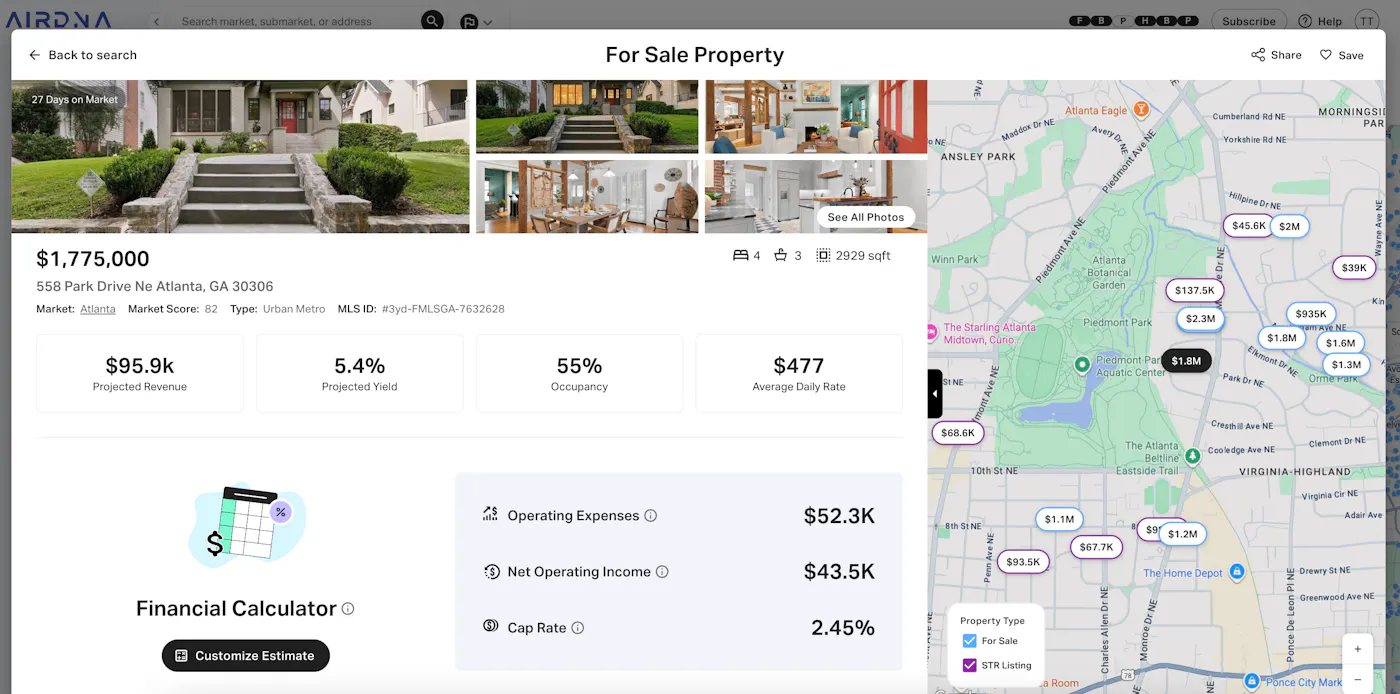
Let’s say you’re a new investor evaluating a short-term rental opportunity in Atlanta, Georgia. You find a property listed at $1,775,000 and use AirDNA’s For Sale property view and Financial Calculator to run the numbers.
The projected revenue is $95,900 per year, based on full-time availability, a 55% occupancy rate, and a $477 average daily rate.
You plan to spend an additional $85,000 on improvements by adding a new deck and furnishing the home. Based on the county assessor’s data, you learn that $870,800 of the purchase price is allocated to land (about 49%), which can’t be depreciated. That leaves a depreciable basis of $1,025,200 for the building and improvements combined.
Using the Recostseg depreciation calculator, you estimate $405,218 in first-year bonus depreciation, made possible by the Big Beautiful Bill and a cost segregation strategy.
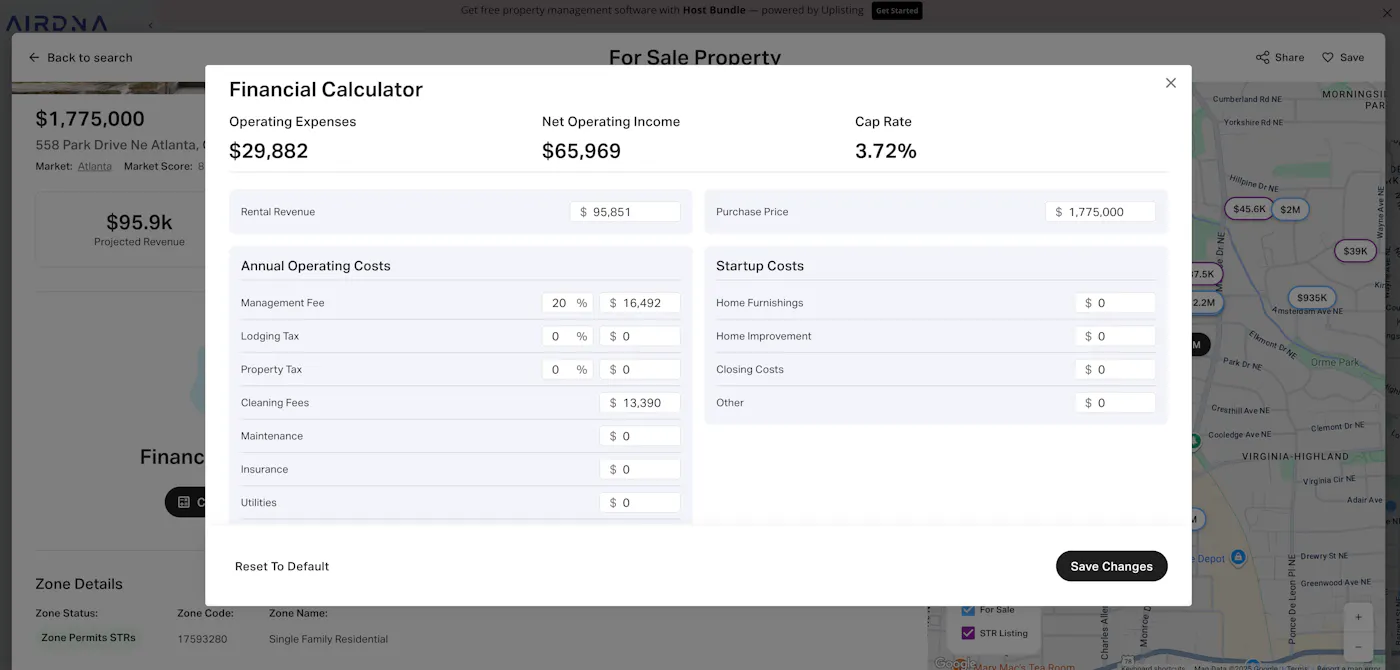
Annual operating expenses, pulled from AirDNA’s Financial Calculator, are projected at $29,882. That includes cleaning fees, which is based on what equivalent properties in your area are collecting in cleaning fees over the course of a year, and a 20% property management fee applied to your gross income. This is a rough estimation and likely a conservative one. It’s always wise to fill in as many fields of the calculator as possible to improve the financial projections.
Note that the Lodging Tax and Property Tax fields will always have a default percentage of 5% and 1%, respectively. You can and should customize those numbers based on your area and operating systems to improve the accuracy of the resulting net operating income (NOI) projection. In this case, we’re leaving those fields blank in favor of calculating those costs separately.
After consulting local regulations, you determine that your state and local taxes break down like this:
- Property tax (city + county): $21,100
- Georgia state income tax: $17,831.85 (based on $343,581 in income—$300K W-2 plus STR income before depreciation)
Together, that adds up to $38,931 in eligible SALT deductions.
And thanks to the BBB's expanded SALT cap, you're well under the $40,000 limit—as long as your modified adjusted gross income (MAGI) stays under $500,000.
If you creep into the $500K–$600K range, the deduction begins phasing out by 30 cents on the dollar. Once you hit $600K+, the cap reverts to the old $10,000 limit. In this example, the investor likely qualifies for the full SALT benefit—but high-income filers will need to watch this closely.
Now, let’s look at the potential tax savings. As a single filer in the 35% federal tax bracket, here’s the breakdown:
- $29,882 in operating expenses
- $38,931 in SALT deductions
- $405,218 in bonus depreciation
= $474,031 in total deductions
Applying the 35% rate, that could result in ~$165,910 in reduced federal tax liability in the first year alone.
Not bad for a first-time STR investment. This scenario shows how strategic planning, especially around depreciation and the SALT cap, can create serious savings before your property even gets its first booking.

Practical Tips for Maximizing Airbnb Tax Deductions
Even with the best tax laws in your favor, your deductions are only as strong as the records behind them. To make the most of the opportunities we’ve covered, especially under the Big Beautiful Bill, here are a few habits that can help you maximize savings and stay audit-ready.
Keep clean records (and keep them early).
Receipts, invoices, mileage logs, depreciation reports . . . whatever supports your deductions should live in one central place. This includes any costs related to property improvements, travel to and from your rental, and recurring expenses like utilities or supplies. The IRS won’t just take your word for it, so documentation is key.
Re-run your numbers regularly.
Don’t wait until tax season to see where you stand. Market conditions, expenses, and occupancy rates change, and your projected deductions will too. Running quarterly calculations can help you spot opportunities to reinvest in the property, shift strategies, or even defer certain upgrades to align with your tax planning goals.
Bring in a CPA who understands short-term rentals.
STR tax strategy isn’t one-size-fits-all. A CPA who specializes in real estate or vacation rentals can help you structure your finances to meet eligibility thresholds for deductions like QBI, maximize depreciation, and avoid common missteps that generic tax software won’t catch.
FAQs
Are utilities tax-deductible for Airbnb hosts?
Yes, utilities are generally considered an ordinary and necessary operating expense for short-term rentals. This includes electricity, water, gas, trash, and internet service. If you rent out only part of your home, you may need to prorate the expense based on square footage or days used.
Can you write off Airbnb expenses?
Absolutely. Common Airbnb write-offs include cleaning fees, maintenance costs, supplies, insurance, property taxes, utilities, and platform service fees. You can also deduct larger items like mortgage interest and depreciation on the building itself, especially under the Big Beautiful Bill.
What can I write off on my taxes for Airbnb?
Eligible Airbnb tax deductions typically fall into five categories: operating expenses (like cleaning and utilities), property-related costs (such as mortgage interest and insurance), depreciation, travel and marketing expenses, and professional services like accounting. Be sure to keep detailed records, especially for any improvements that qualify for bonus depreciation.
Are Airbnb fees tax-deductible?
Yes, fees charged by Airbnb or other booking platforms are deductible as a business expense. That includes service fees, host fees, and any other percentage the platform takes from each booking.
Are furnishings for an Airbnb tax-deductible?
They can be. Items like beds, sofas, dining sets, and decor qualify as capital improvements and may be deductible through depreciation. With the Big Beautiful Bill, many furnishings now qualify for 100% bonus depreciation, meaning you can deduct the full cost in the year you place them in service, assuming they meet IRS criteria.
ARTICLE SUMMARY
Want to lower your Airbnb tax bill in 2025? Learn how to calculate Airbnb tax deductions to take full advantage of new savings under the Big Beautiful Bill.
Bram Gallagher
AirDNA Director of Economics and Forecasting
Bram Gallagher is an Economist at AirDNA, specializing in uncovering insights that drive smarter short-term rental decisions. He put his Ph.D. in Economics from the University of Georgia to work researching and forecasting hotel data with CBRE prior to joining AirDNA, as well as teaching economics at a number of universities. In his spare time, Bram enjoys making wooden furniture with hand tools.


Get started with AirDNA today.
Powerful, easy-to-use tools that help hosts and investors succeed in the short-term rental market.
Try for free